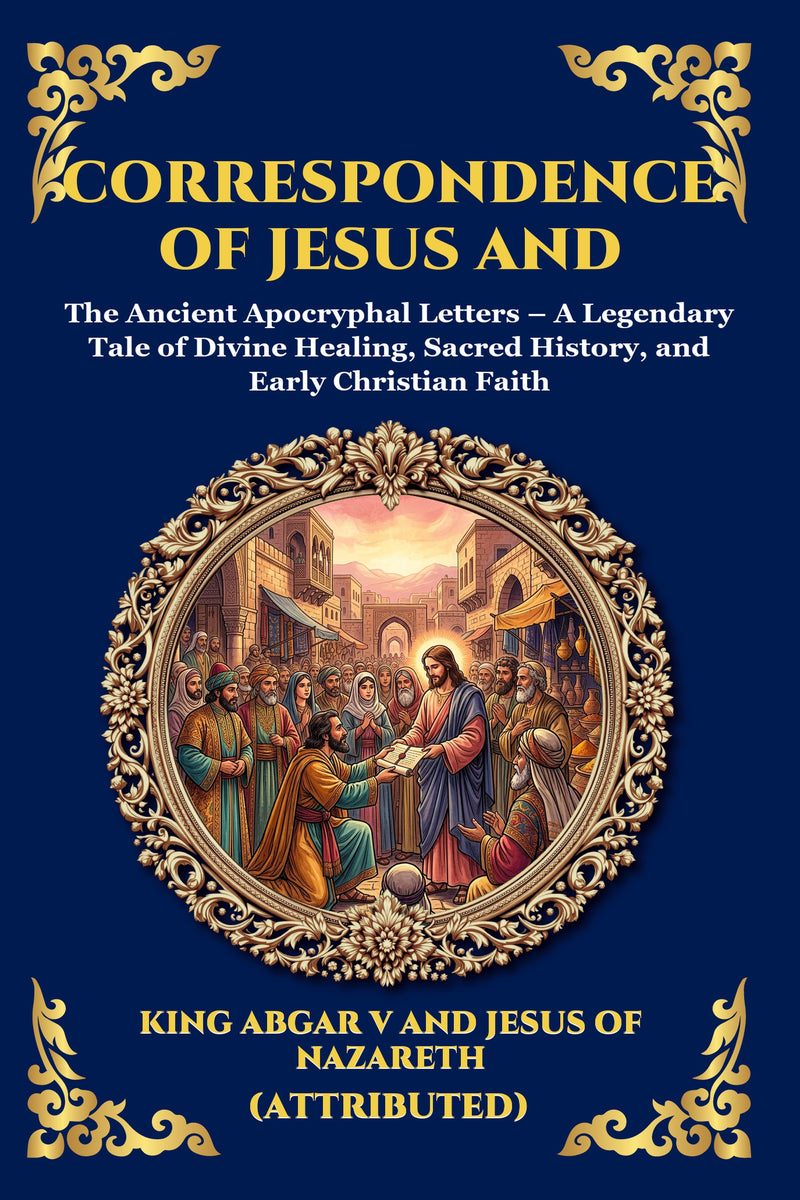
Correspondence of Jesus and Abgar — Large Print
A foreign king's plea and a promised disciple's healing: the Correspondence of Jesus and Abgar was once a revered text among early Christians. While this miraculous exchange was left out of the Bible, it shaped the faith and hope of those who heard its tale.
or free app
10,000+ hrs library
30-day guarantee
From Eusebius of Caesarea's Ecclesiastical History (circa 325 AD), this complete modern English translation of the Correspondence of Jesus and Abgar is readable online with audiobook narration included for members.
Large Print Edition. The complete, unabridged text set in a larger, easy-on-the-eyes typeface for comfortable reading.
Have you ever wondered why the earliest Christians believed Jesus wrote a letter to a foreign king?
The Correspondence of Jesus and Abgar is one of the most fascinating and deeply revered apocryphal texts of early Christianity. According to ancient tradition, King Abgar V of Edessa, suffering from a terrible illness, heard of the miraculous healings performed by Jesus in Judea. In a desperate bid for salvation, he sent a letter begging Jesus to come to his city, heal his affliction, and take refuge from those who sought to harm him.
The miraculous reply—attributed directly to Jesus—declines the invitation but promises to send a disciple to heal the king and grant life to his people after his ascension. For centuries, this brief but powerful exchange was celebrated as a genuine historical artifact. It was inscribed on city walls for protection, worn as an amulet, and fundamentally shaped the development of early Christian faith and art in the Eastern Roman Empire.
This edition brings these legendary letters to life, exploring their historical context, their profound theological implications, and their enduring legacy. Whether it is a genuine artifact of the first century or a magnificent expression of early Christian devotion, this correspondence offers a captivating window into the faith of the ancient world.
What You Will Discover Inside:
- The Legendary Letters — Read the complete text of King Abgar’s plea and the purported reply from Jesus of Nazareth.
- The Story of Divine Healing — Explore the ancient narrative of faith, illness, and the miraculous cure brought by the disciple Thaddeus.
- A Window into Early Christian Faith — Understand how this text shaped the beliefs and practices of the early church in Edessa and beyond.
- Sacred History and Apocrypha — Dive into the fascinating intersection of historical fact, myth, and early Christian literature.
Whether you are a student of theology, a lover of ancient history, or a seeker of spiritual inspiration, The Correspondence of Jesus and Abgar offers a profound journey into one of the greatest legends of the Christian faith.
Step into a story of unwavering belief and discover the legendary letters that captivated the ancient world. Begin your journey today.
| Formats | eBook (EPUB + PDF) · Audiobook · Paperback · Hardcover · Large Print |
| Language | English |
| Trim size (print) | 6 × 9 in |
| Binding | Paperback — perfect-bound · Hardcover — casewrap |
| Large Print edition | Same text in a larger, easy-read type — a larger font, not a larger trim |
| Print pricing | Every physical book at our true cost — at-cost, no profit (members) |
| Library | 873 restored titles, always growing |
| Source tradition | Syriac manuscript tradition |
| Translation basis | Public-domain scholarly translation, rendered in clear modern English |
| Length | 2,937 words · ~12 min reading |
| Reading level | Grade 14 · rich, literary prose (this modern-English edition) |
| Edition | Modern English translation · 2026 |
Member reviews for this edition are collected as readers finish it — be the first. Across the library: 12,000+ books shipped, every plan covered by a 365-day print guarantee.
About this edition
The complete, unabridged text in clear modern English — faithful to the original, never simplified. Every paragraph is checked against the source, so nothing is cut, summarised, or paraphrased away. It reads cleanly for today while keeping the original meaning intact.
The correspondence survives in Syriac manuscript traditions and is quoted in Eusebius's Ecclesiastical History. This edition renders the standard scholarly translation in clear modern English.
- Complete & unabridgedVerified paragraph by paragraph against the source — never a scan, never abridged.
- Modern English, faithfulReadable today, with the author’s meaning kept intact. Readable — not simplified.
- Every format, one membershipRead in your browser or the free app, or listen to the full audiobook.
Included free with your membership
Cancel anytime, one click · 30-day money-back guarantee
Edition last updated June 2026
What’s inside
Correspondence of Jesus and Abgar — Large Print — complete and unabridged: all 5 sections included with membership, plus the full audiobook.
Begin reading Correspondence of Jesus and Abgar — Large Print
In clear modern English — the complete text is included with membership.
A Kingdom at the Crossroads
To appreciate why a legend like this one could take root and flourish, you need to understand the place where it was planted. Edessa was not a backwater. Situated at the intersection of trade routes connecting the Mediterranean world to Persia, India, and beyond, it was a city of genuine cosmopolitan significance — a place where Greek and Syriac and Aramaic were all spoken, where merchants from a dozen cultures rubbed shoulders in the bazaars, where philosophical schools competed for students and religious communities of every description jostled for space and influence. The kingdom of Osroene, of which Edessa was the capital, occupied a peculiar geopolitical position: it was a buffer state, perpetually caught between the gravitational pulls of Rome to the west and Parthia to the east. Its rulers, a dynasty known as the Abgarids, navigated this precarious position with considerable skill for several centuries, playing the great powers against each other and maintaining a degree of autonomy that larger and less nimble states might have envied.
The historical Abgar V, who ruled Osroene in the first century of the common era, was a real person. Inscriptions, coins, and the accounts of ancient historians confirm his existence. He was known, somewhat puzzlingly, as 'Abgar the Black' — a epithet whose precise meaning has been debated, with suggestions ranging from a reference to his physical appearance to a moral judgment by later sources. What is clear is that he was a figure of some regional importance, a king who maintained relations with Rome and who was remembered by later Edessan tradition as a pivotal figure in the city's history. The tradition that he was the first Christian king — that he received the faith directly from Christ or from Christ's emissary — gave him a significance that transcended his actual political importance and made him a founding figure of almost mythological stature.
The question of when Christianity actually arrived in Edessa is genuinely difficult to answer with precision. The evidence is fragmentary, contested, and often shaped by the very legendary traditions we are trying to evaluate. What seems clear is that there was a Christian community in Edessa by the second century, and that it was a community of considerable theological vitality and diversity. Edessa produced some of the most important figures in early Syriac Christianity, including Tatian, who compiled the Diatessaron — a harmonized version of the four gospels that was the standard gospel text in Syriac-speaking churches for centuries — and Bardaisan, a philosopher-poet of extraordinary originality whose theological views were eventually deemed heretical but whose influence on Syriac Christian culture was immense. The city was a place where ideas were taken seriously, where the boundaries between orthodoxy and heterodoxy were still being negotiated, and where the question of Christianity's origins and legitimacy was a live and urgent one.
It is in this context that the legend of Abgar makes perfect sense as a cultural and theological artifact. A community that wanted to assert its antiquity, its apostolic legitimacy, and its special relationship with Christ would naturally produce — or preserve, or elaborate — a story that connected the city directly to Jesus himself. The letters do precisely this work. They establish Edessa as a place that Jesus knew about, cared about, and specifically blessed. They provide the community with a founding narrative that rivals anything the western churches could claim. Rome had Peter and Paul. Edessa had a letter from Christ. The theological capital represented by such a claim was enormous, and it is no surprise that the community guarded it jealously and elaborated it over time.
The elaboration is itself a fascinating process to trace. The bare bones of the story — a letter from Abgar, a reply from Jesus, a subsequent mission to Edessa by one of Jesus's disciples — were supplemented over the centuries with increasingly rich detail. The disciple sent to Edessa acquired a name: Thaddaeus, or in some versions Addai, a figure who became the legendary founder of the Edessan church and the subject of a substantial apocryphal text known as the Doctrine of Addai. The healing of Abgar, promised in Jesus's letter, was narrated in vivid detail. And eventually, the story acquired what may be its most famous embellishment: the idea that Jesus sent not only a letter but an image of himself — a miraculous self-portrait, produced either by pressing his face to a cloth or by some other supernatural means — that became one of the most venerated objects in the medieval Christian world.
This image, known as the Image of Edessa or the Mandylion, takes us into territory that is simultaneously historical, theological, and deeply strange. The tradition of the acheiropoieton — the image 'not made by human hands' — is one of the most persistent and powerful in Christian art and devotion. The Mandylion was claimed to have performed miracles, to have protected Edessa from military conquest, and eventually to have been transferred to Constantinople, where it joined the extraordinary collection of relics assembled in the imperial capital. Its subsequent history is tangled with the story of the Turin Shroud in ways that scholars continue to debate. Whether or not any physical object underlies these traditions, the theological idea they express — that Christ left a direct physical trace of his presence in the world — is one of enormous importance for understanding Christian attitudes toward images, relics, and the material dimensions of faith.
The political uses of the legend are equally striking and deserve careful attention. When Eusebius of Caesarea included the letters in his Ecclesiastical History, he was making a move with significant implications. Eusebius was writing in the early fourth century, in the aftermath of Constantine's conversion, at a moment when the relationship between Christianity and imperial power was being fundamentally renegotiated. His history was, among other things, an argument for Christianity's antiquity, its legitimacy, and its fitness to serve as the religion of the empire. The Abgar correspondence fit neatly into this argument: here was evidence of Christianity's early reach, of its capacity to attract the attention even of foreign kings, of its deep historical roots. That Eusebius claimed to have found the letters in an official archive — that he presented them as documents of state, not merely pious tradition — was a rhetorical move of considerable sophistication. It grounded the legend in the language of historical evidence at precisely the moment when such grounding was most useful.
Later rulers would find the legend equally useful for their own purposes. The story of Edessa as a divinely protected city — a city that could not fall because Christ himself had promised its safety — was invoked repeatedly in the face of military threats. When the Persian king Khosrow I besieged Edessa in the sixth century, the defenders reportedly carried the letter of Christ in procession around the walls. When the Arab conquest transformed the political landscape of the Near East in the seventh century, the legend continued to circulate and to serve as a resource for communities trying to maintain their identity under new rulers. The longevity and adaptability of the story are themselves evidence of its cultural power — this was not a legend that belonged to a single moment or a single purpose, but one that could be picked up and redeployed across radically different historical circumstances.
Reading the Letters Across Time
What does it mean to read an ancient text that may not be what it claims to be? This is a question that the Abgar correspondence forces us to confront directly, and it is a question with implications that reach far beyond this particular set of documents. We live in a culture that tends to treat authenticity as the primary criterion of value — if something is not what it says it is, we feel entitled to dismiss it. But this is a relatively modern attitude, and it is one that serves us poorly when we are trying to understand the ancient world. Ancient authors, compilers, and communities had different ideas about authenticity, authorship, and the relationship between a text and the authority it claimed. Pseudonymous writing — writing produced in the name of a revered figure — was a widespread and largely accepted practice in antiquity. It was not necessarily an attempt to deceive; it was often a way of continuing a tradition, of speaking in a voice that carried recognized authority, of making explicit what was felt to be implicit in a teacher's legacy.
Understanding this does not mean abandoning critical judgment. It means applying critical judgment more carefully and more historically. When we ask whether the letters are authentic, we need to be clear about what question we are actually asking. Are they first-century documents written by the historical Jesus and the historical Abgar? Almost certainly not. Do they preserve genuine historical memories of early contact between the Jesus movement and the kingdom of Osroene? Possibly, though the evidence is ambiguous. Were they produced in good faith by a community that believed in their essential truth? Almost certainly yes. And do they tell us important things about the theological convictions, the historical self-understanding, and the devotional practices of early Syriac Christianity? Absolutely and without question.
The text of Abgar's letter, as Eusebius preserves it, is a remarkable document in its own right. It is written in the voice of a man who has heard secondhand reports of miracles and has drawn from them a theological conclusion of considerable boldness: that Jesus must be either God or the Son of God, because no ordinary human being could do what he is reported to have done. This is not the language of the Nicene Creed, worked out in councils and committees over decades of debate. It is the language of raw inference, of someone reasoning from experience toward theology rather than from theology toward experience. Whether or not Abgar actually wrote these words, they capture something true about how many people in the ancient world came to faith — not through systematic instruction but through encounter with the inexplicable, and the attempt to make sense of it.
The reply attributed to Jesus is equally interesting from a theological standpoint. It is notable for what it does not say as much as for what it does. It does not make the kind of explicit divine claims that would later become standard in Christian theology. It speaks of faith and blessing and future promise. It is, in a sense, a pastoral letter — the kind of response a teacher might give to a sincere but distant inquirer. Scholars have noted that the theology of the letter is consistent with certain strands of early Syriac Christianity rather than with the developed Christology of the later councils, which is one of the reasons some have argued that even if the letter is not authentic in the strict sense, it may preserve early theological traditions of genuine historical value.
The manuscript tradition of the letters is itself a subject of considerable complexity and fascination. The text that Eusebius quotes in Greek is not identical to the Syriac version preserved in the Doctrine of Addai, and neither of these is identical to the numerous later versions that circulated across the medieval world. The letters were translated into Latin, Coptic, Armenian, Georgian, Arabic, and a host of other languages, and each translation introduced its own variations, expansions, and interpretive choices. Tracing these variations is a form of detective work that tells us a great deal about how different communities understood the story and what they needed it to say. A version that emphasizes Abgar's political authority is making a different argument than one that emphasizes his personal piety. A version that expands the description of Jesus's miracles is doing different theological work than one that focuses on the exchange of letters itself.
The physical history of the letters — the objects on which they were written, the places where they were kept, the rituals surrounding their display and veneration — is another dimension of the story that deserves serious attention. In the ancient and medieval world, texts were not merely information carriers; they were objects with their own power and presence. A letter from Christ was not simply a document to be read; it was a relic to be venerated, a talisman to be carried, a source of protection and blessing in its own right. The practice of inscribing the letter on city gates — attested for Edessa and imitated in other places — transformed the text into a kind of permanent prayer, a continuous invocation of divine protection written into the very fabric of the city's architecture. This is a profoundly different relationship with a text than the one we typically have with documents today, and understanding it requires a genuine effort of historical imagination.
The scholarly debate about the letters has been going on, in one form or another, since at least the Renaissance, when humanist scholars began applying the tools of philological criticism to ancient texts with unprecedented rigor. The great Erasmus expressed doubts about the authenticity of the correspondence. Later scholars refined and sharpened those doubts, pointing to linguistic anachronisms, historical implausibilities, and the suspicious convenience of a text that served so perfectly the theological and political interests of the communities that preserved it. The twentieth century brought new tools — archaeological evidence from Edessa itself, improved understanding of the Syriac literary tradition, more sophisticated methods of textual analysis — that have allowed scholars to place the letters more precisely within their historical context, even if many questions remain open.
Cancel anytime, one click · 30-day money-back guarantee
Founding annual rate available now — your price locks for life when you join.
Not ready? Get this free chapter by email — read it anytime.
✓ Sent — check your inbox for Correspondence of Jesus and Abgar — Large Print.
Questions about Correspondence of Jesus and Abgar — Large Print
Is the Correspondence of Jesus and Abgar authentic?
Modern scholarship considers the Correspondence of Jesus and Abgar to be pseudepigraphic, not authentic letters from Jesus or King Abgar V. However, it was widely accepted as genuine by early Christians and influenced Christian thought for centuries.
Why was this correspondence excluded from the biblical canon?
The Correspondence of Jesus and Abgar was excluded from the biblical canon as questions arose about its authenticity and apostolic origin. Church authorities ultimately determined it did not meet the criteria for canonical scripture despite its early popularity.
What does the Correspondence of Jesus and Abgar contain?
The Correspondence of Jesus and Abgar contains letters between King Abgar V of Edessa, who requests Jesus heal his illness, and Jesus's reply promising to send a disciple after his ascension to heal the king.
Is Correspondence of Jesus and Abgar free to read?
The opening of the text is free to read below. Members read and listen to the complete work — and the entire Lost & Forbidden Library — free.
What is Correspondence of Jesus and Abgar?
Have you ever wondered why the earliest Christians believed Jesus wrote a letter to a foreign king? The Correspondence of Jesus and Abgar is one of the most fascinating and deeply revered apocryphal texts of early Christianity.
How long is Correspondence of Jesus and Abgar?
5 chapters (~288 words) in this restored edition.
Shipping & returns
Billing & membership
More from the library


Explore Lost Gospels & Acts
- The Lost Books of the Bible · Various early Christian authors
- Gospel of the Lots of Mary
- Gospel of the Twelve · Anonymous early Christian writers
- Infancy Gospel of Thomas · Attributed to Thomas the Israelite
- Gospel of the Hebrews · Attributed to early Jewish-Chri...
- Acts of Thomas
- Gospel of the Savior · Anonymous (Early Christian Author)
- Acts of Saturninus
- Death of Pilate · Attributed to various early Chr...
- Doctrine of Addai · Attributed to Thaddeus of Edessa
- Gospel of the Nativity of Mary · Attributed to St. Matthew
- Toledot Yeshu
- Papyrus Berolinensis 22220
- Oxyrhynchus Papyrus 1224
- Correspondence of Jesus and Abgar · Attributed to Eusebius of Caesarea
- Papias: Expositions of the Sayings of the Lord · Attributed to Papias of Hierapolis
- Questions of John · Attributed to John the Apostle
- Narrative of Joseph of Arimathea · Attributed to Joseph of Arimathea
- Avenging of the Savior · Attributed to various early Chr...
- Report of Pilate to Caesar
- Letter of Pontius Pilate to Claudius
- Acts of Peter and Simon · Attributed to Leucius Charinus
- Acts of Andrew and Matthias in the City of the Cannibals · Attributed to early Christian a...
- Preaching of Peter · Attributed to the apostle Peter
- Egerton Gospel II
- Gospel of Barnabas
- Letter to the Laodiceans · Attributed to the Apostle Paul
- Diatessaron · Attributed to Tatian
- Descent of Christ into Hell (Harrowing of Hell) · Attributed to the Apostle Peter
- Acts of Pilate (Gospel of Nicodemus) · Attributed to various early Chr...
Correspondence of Jesus and Abgar — Large Print
The Correspondence of Jesus and Abgar
The Letters of King Abgar of Edessa and Jesus — The Ailing King's Plea for Healing and Offer of Refuge, and the Saviour's Reply: A Blessing on Those Who Believe Without Seeing, and the Promise of a Disciple to Come
Library of Alexandria Press
The Correspondence of Jesus and Abgar
© Copyright 2026 Library of Alexandria Press. All rights reserved.
Published by Library of Alexandria Press
Printed in the United States of America
It is not legal to copy, share, or send any part of this document in either digital or printed form without written permission from the publisher, except short quotes in a book review.
Table of Contents
Introduction
A Kingdom at the Crossroads
Reading the Letters Across Time
Chapter 1
Chapter 2
Introduction
There is something almost unbearably intimate about the idea of writing a letter to God. To set down words on papyrus or parchment, to fold the page, to send it across miles of desert and mountain road, trusting that it will arrive — and then, impossibly, to receive a reply. This is precisely what the legend of Abgar of Edessa asks us to imagine: a dying king, desperate enough to reach across the known world and beg a wandering healer for his life, and a healer gracious enough to write back. Whether you approach this story as a historian, a theologian, a lover of ancient literature, or simply someone drawn to the strange and luminous corners of early religious tradition, what you are about to encounter is one of the most fascinating, contested, and quietly influential documents in the entire history of Christianity.
The exchange of letters attributed to Jesus of Nazareth and Abgar V, ruler of the small but strategically significant kingdom of Osroene, with its capital at Edessa — modern-day Şanlıurfa in southeastern Turkey — has captivated readers for nearly two thousand years. It first surfaces in recognizable form in the writings of Eusebius of Caesarea, the fourth-century bishop and historian who claimed to have discovered the letters in the royal archives of Edessa and translated them from Syriac into Greek. From that moment forward, the correspondence took on a life of its own, spreading across continents, languages, and centuries, inspiring devotion, debate, forgery, pilgrimage, and no small amount of scholarly fury. Few texts of comparable brevity have generated such an extraordinary afterlife.
To read these letters today is to step into a world that feels at once deeply foreign and strangely familiar. The political anxieties, the hunger for healing, the longing for some authoritative word from beyond the ordinary — these are not exclusively ancient preoccupations. Abgar's letter, as tradition preserves it, is the letter of a man who has heard rumors of miracles and decided, with a kind of reckless hope, to act on them. He is not a mystic. He is a king, a practical man of power, and yet he writes with a vulnerability that cuts through the centuries. He has heard what Jesus has done. He believes, or wants to believe. And he asks, with the directness that only genuine desperation produces, whether Jesus might come to him and heal what physicians cannot.
The reply attributed to Jesus is brief, careful, and in its own way remarkable. It does not promise the impossible. It acknowledges the faith that prompted the letter. It declines the journey to Edessa — offering an explanation rooted in the logic of his mission — but extends a promise of future blessing. And it is this promise, this small, precise commitment to Abgar and his city, that would become the seed of an enormous tradition. Edessa would come to see itself as a specially protected city, shielded by the very words of Christ. The letter would be inscribed on city gates. Copies would be carried into battle. Pilgrims would travel hundreds of miles to see it. The story of how a piece of correspondence became a talisman, a theological argument, and a cornerstone of one of Christianity's oldest communities is, in itself, a story worth telling at length.
But we should be honest about what this book is, and what it requires of its readers. The letters are apocryphal. That word, which has accumulated so many layers of meaning over the centuries, deserves careful handling here. In its most technical sense, apocryphal simply means 'hidden' or 'set apart' — texts that exist outside the canonical scriptures recognized by the major Christian traditions. It does not automatically mean false, fabricated, or worthless. The apocryphal literature of early Christianity is vast, varied, and often astonishingly rich. It includes gospels, acts, epistles, and apocalypses that circulated widely in the ancient world, that were read and valued by communities of genuine believers, and that preserve traditions, theological ideas, and historical memories that the canonical texts do not. To dismiss apocryphal literature wholesale is to impoverish our understanding of early Christianity enormously.
At the same time, the historical questions surrounding the Abgar correspondence are real and cannot be wished away. The scholarly consensus, built over generations of careful philological, historical, and archaeological work, is that the letters as we have them cannot be authentic first-century documents. The arguments for this conclusion are substantial and will be examined in the pages that follow. But the inauthenticity of the letters as literal historical documents does not exhaust their interest, not by a long measure. A text can be legendary and still be important. It can be a later composition and still tell us true things — about the communities that created it, the needs it served, the theological convictions it expressed, and the historical memories it may, however imperfectly, preserve. The Abgar legend is important precisely because it was believed, because it shaped lives and cities and liturgies and wars, and because it opens a window onto the earliest centuries of Christian expansion into the Syriac-speaking world.
That world — the world of Edessa, of Osroene, of the communities that spoke and wrote and prayed in Syriac — is one that Western readers often know far too little about. The story of Christianity is frequently told as if it moved in a single direction: from Jerusalem westward, through Greece and Rome and eventually into Europe. But Christianity also moved east, and it moved east early. The Syriac-speaking communities of Mesopotamia and Persia developed their own rich theological traditions, their own liturgical practices, their own saints and martyrs and sacred texts. Edessa was one of the great centers of this eastern Christianity, and the legend of Abgar was central to Edessa's sense of its own sacred identity. To understand the letters is to begin to understand a whole branch of the Christian family tree that has been unjustly neglected in popular accounts of the faith's history.
This book is designed to be read by anyone with curiosity and patience — not just specialists. The letters themselves are short enough to be quoted in full, and they are. But around those brief texts, this volume builds the fullest possible context: the history of Edessa and the kingdom of Osroene, the figure of Abgar V and his historical reality, the transmission of the legend through Eusebius and beyond, the theological arguments the story was used to make, the physical objects — the famous Image of Edessa, the so-called Mandylion — that became entangled with the legend over time, and the long, contentious scholarly debate about what any of it means. Each of these threads is fascinating in its own right. Together, they form a picture of how sacred stories are made, how they travel, how they change, and why they matter.
Chapter 1
A copy of a letter written by King Abgar to Jesus, and sent to him by his courier Ananias, to Jerusalem, inviting him to Edessa.
Abgar, king of Edessa, to Jesus the good Saviour, who is at Jerusalem: greetings.
I have heard reports about you and the cures you perform, which require no medicines or herbs.
It is said that you make the blind see and the lame walk, that you cleanse lepers, cast out unclean spirits and demons, heal those who have suffered long illnesses, and raise the dead.
When I heard all this, I became convinced of one of two things: either that you are God himself, descended from heaven, who does these things, or that you are the Son of God.
For this reason I am writing to ask you earnestly to make the journey here and cure the disease from which I suffer.
I also hear that the Jews mock you and mean you harm.
My city is small, but pleasant, and large enough for us both.
Chapter 2
Abgar, you are blessed, because you have believed in me without having seen me.
For it is written concerning me that those who have seen me will not believe in me, so that those who have not seen me might believe and live.
As for the part of your letter where you ask me to come to you, I must tell you that I am to fulfill everything I was sent here to accomplish, and after that to be received back to the one who sent me.
But after my ascension I will send one of my disciples to you. He will heal your disease and bring life to you and to all who are with you.
End of the free sample
Keep reading, free
Members read and listen to the complete book — and the entire library. Cancel anytime, one click · 30-day money-back guarantee.