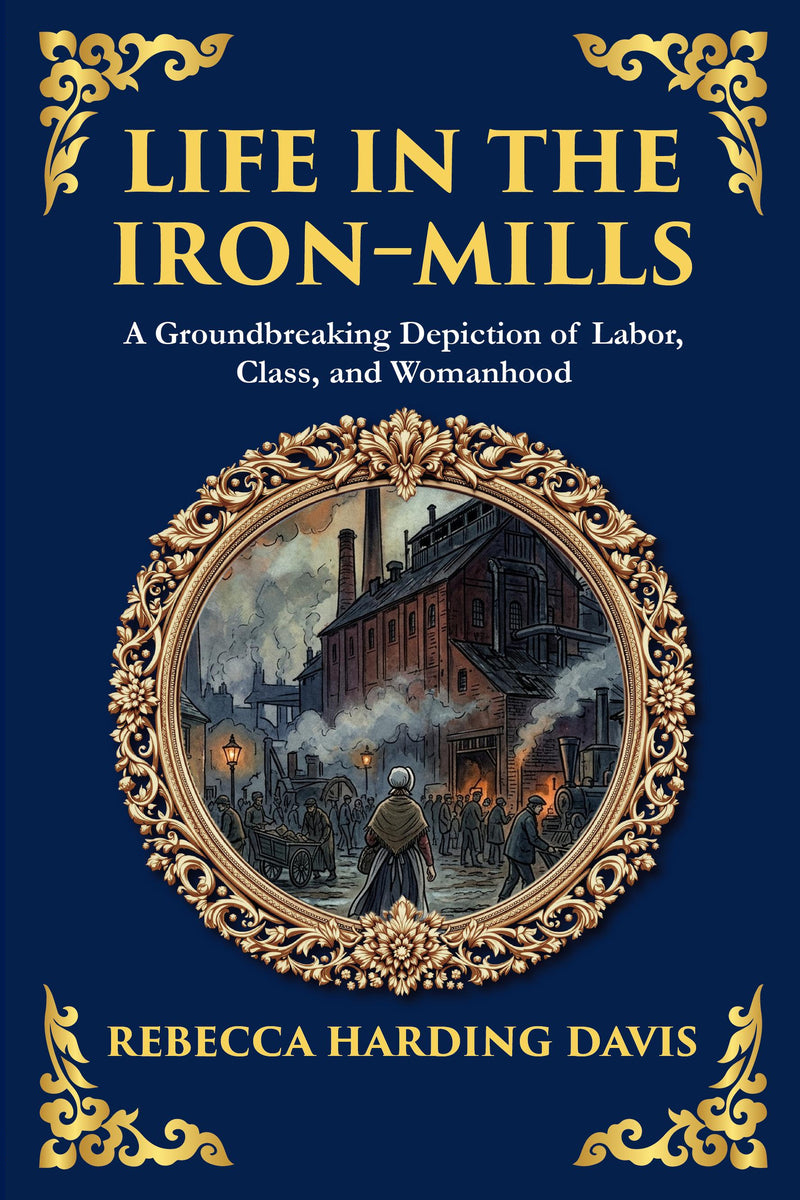
Life in the Iron-Mills; Or, The Korl Woman
Beneath the smoke-stained skies of a steel town, where soot clings to every surface and hope is in short supply, a silent rebellion brews in the soul of a forgotten worker.
or free app
10,000+ hrs library
30-day guarantee
The complete Life in the Iron-Mills appears in modern English through Library of Alexandria Press, available online with audiobook narration included for members.
Have you ever wondered why some voices are silenced even when they scream through their art? Life in the Iron-Mills is a seminal work of American literature that rips away the polished veneer of industrial progress to expose the crushing realities of the working class. First published in 1861, this novella by Rebecca Harding Davis marked a radical shift in American storytelling— giving voice to the invisible, illuminating the ugliness of systemic injustice, and challenging the literary elite to look directly into the soot-covered face of labor.
Set in a grim iron mill town, the story follows Hugh Wolfe, a factory worker with the soul of a sculptor, and his cousin Deborah, a sickly woman who sacrifices everything for him. Their lives are marred by endless labor and social indifference—until one night, an act of desperation sets them on a tragic course.
What you’ll discover in this modern edition
- in This Modern Edition of Davis’s Groundbreaking Work:
- A Stark Portrait of Industrial America – Explore the oppressive world of the iron mills and the class hierarchy that kept workers in chains.
| Formats | eBook (EPUB + PDF) · Audiobook · Paperback · Hardcover · Large Print |
| Language | English |
| Trim size (print) | 6 × 9 in |
| Binding | Paperback — perfect-bound · Hardcover — casewrap |
| Large Print edition | Same text in a larger, easy-read type — a larger font, not a larger trim |
| Print pricing | Every physical book at our true cost — at-cost, no profit (members) |
| Library | 873 restored titles, always growing |
| Length | 18,405 words · ~1 hr 14 min reading |
| Reading level | Grade 3 · an easy, flowing read (this modern-English edition) |
| Edition | Modern English translation · 2026 |
Member reviews for this edition are collected as readers finish it — be the first. Across the library: 12,000+ books shipped, every plan covered by a 365-day print guarantee.
About this edition
A faithful, unabridged modern-English edition by The Library of Alexandria — carefully rendered for today's reader and verified paragraph-by-paragraph against the public-domain source. Available as eBook, audiobook, paperback, hardcover, and large print.
- Complete & unabridgedVerified paragraph by paragraph against the source — never a scan, never abridged.
- Modern English, faithfulReadable today, with the author’s meaning kept intact. Readable — not simplified.
- Every format, one membershipRead in your browser or the free app, or listen to the full audiobook.
Included free with your membership
Cancel anytime, one click · 30-day money-back guarantee
Edition last updated July 2026
What’s inside
Life in the Iron-Mills; Or, The Korl Woman — complete and unabridged, included in full with membership, plus the full audiobook.
Begin reading Life in the Iron-Mills; Or, The Korl Woman
In clear modern English — the complete text is included with membership.
Introduction
When Life in the Iron-Mills first appeared in the pages of The Atlantic Monthly in April 1861, its readers had little idea that they were holding in their hands a document that would help reshape the course of American literature. The story carried no author’s name. It arrived anonymously, slipped into a magazine whose subscribers were accustomed to genteel essays, refined poetry, and the polished prose of New England’s literary establishment. What they encountered instead was something raw, unsettling, and entirely without precedent: a vision of industrial America rendered in language so vivid and so unflinching that it seemed to rise off the page like the smoke and soot it described. The unsigned tale would soon be revealed as the work of Rebecca Harding, a young woman writing from the industrial town of Wheeling, in what was then western Virginia, and her debut would announce the arrival of one of the most important and prophetic voices of the nineteenth century.
This modern translation has been prepared with a single purpose: to bring the full force of that original achievement to readers today. The text you are about to encounter has been carefully adapted for the contemporary reader, with attention paid to the dense, sometimes archaic constructions of mid-nineteenth-century prose, while preserving the essential power, rhythm, and moral seriousness of the author’s vision. Nothing of the story’s substance has been lost. What has changed is the ease with which you can now inhabit its world—a world of furnaces and fog, of human beings ground down by labor, and of a single, extraordinary statue that holds within it the whole tragic question of the book. The aim throughout has been to remove the barriers of time and idiom that can stand between a modern reader and a great work, so that the story’s enduring emotional and intellectual power can reach you as directly as it reached those first astonished subscribers more than a century and a half ago.
To understand why this slender work matters so much, it helps to understand the world from which it emerged and the silence it broke. By 1861, the United States stood on the brink of civil war, but it was also in the grip of a transformation just as profound and far less examined: the rise of industry. Across the country, factories and mills were rising along the rivers, drawing in waves of workers—immigrants, the rural poor, the desperate—to feed the insatiable machinery of production. Iron and coal were the lifeblood of this new economy, and towns like the one Rebecca Harding knew so intimately had become landscapes of fire and grime, places where the air itself seemed to be made of soot and where human labor was consumed as readily as fuel.
American literature, for the most part, had not yet looked at this world. The great writers of the period—the Transcendentalists in their New England villages, the Romantics drawn to nature and the inner life of the soul—wrote of ponds and forests, of conscience and self-reliance, of the dignity of the individual spirit. There was beauty and depth in this tradition, but there was also an enormous blind spot. The men and women who toiled in the mills, who lived in cellars and rooms thick with the smell of grease and smoke, who labored from dawn until late into the night for wages that barely kept them alive—these people had no place in the literature of the age. They were invisible, unrepresented, unspoken. Their suffering went unrecorded because no one of literary standing had thought to record it.
Rebecca Harding changed that. Growing up in Wheeling, she had watched the mills day after day. She had seen the workers trudge to their shifts and the furnaces light the night sky. She had breathed the same heavy air, observed the same grinding poverty, and felt, with a sensitivity that would define her entire career, the human cost of the industrial machine. When she sat down to write her story, she did not soften what she had seen. She did not romanticize it or wrap it in moral consolation. Instead, she demanded that her readers look—truly look—at lives they had spent years comfortably ignoring. The opening pages of the work are among the most arresting in all of nineteenth-century American writing precisely because they refuse to let the reader look away. The narrator addresses you directly, almost confrontationally, insisting that you come down into the smoke-choked streets and confront the reality of what lies there.
This was a radical act. It was radical in its subject matter, in its sympathy, and in its sheer aesthetic daring. The prose itself seems to take on the qualities of the world it describes—dense, heavy, charged with feeling, yet shot through with moments of startling beauty and tenderness. Harding understood something that would not become a commonplace in literature for decades: that the lives of the poor and the laboring were not merely subjects for charity or pity, but were worthy of the full seriousness of art. She insisted that within the body of a mill worker there could dwell a soul as deep, as yearning, and as tragic as any in the great tradition of literature. In doing so, she anticipated the entire movement that would later be called literary realism, and beyond that, the naturalism that writers like Émile Zola, Stephen Crane, and Theodore Dreiser would make famous toward the end of the century. She was decades ahead of her time, and the fact that she achieved this in a single, anonymous story published when she was barely thirty is one of the remarkable facts of American literary history.
The story made an immediate impression. Readers and critics recognized that something new had appeared. The great writers of the day took notice; the editors of The Atlantic were eager for more. Harding—who would soon marry and become Rebecca Harding Davis—went on to a long and productive career, writing novels, stories, and journalism, much of it concerned with the social questions of her age: the rights of workers, the condition of women, the corruptions of politics and commerce. She was, in her way, a pioneer of socially engaged fiction in America. Yet for much of the twentieth century, her name was largely forgotten, her work neglected, her contribution unacknowledged. It was only when this story was rediscovered and republished in the early 1970s, championed by the writer Tillie Olsen, that Rebecca Harding Davis was restored to her rightful place in the canon. Olsen recognized what generations of readers had missed: that here was a foundational text, a work that had opened doors no one else had thought to approach, written by a woman whose vision was both deeply moral and unflinchingly honest.
Part of what makes the rediscovery so significant is the question of authorship itself. That this searing portrait of industrial labor was written by a woman is a fact of enormous importance. In an age when women were expected to confine their literary efforts to domestic sentiment, to the comforts of hearth and home, Harding plunged her readers into the most masculine, most brutal, most public sphere of the new economy—the iron mill. She wrote of men’s bodies broken by labor, of the violence and despair of working life, of the systems of power and ownership that determined who lived and who suffered. And yet, woven through this masculine landscape, the story holds a profound concern with womanhood, with the female figures who move through its margins and, most hauntingly, with the great central image from which the work takes its subtitle: the korl woman, a statue carved by one of the laborers from the waste material of the mills. This figure—mysterious, powerful, and unforgettable—becomes the emotional and symbolic heart of the entire narrative, a vessel into which the author pours her deepest questions about hunger, longing, and the human spirit’s reach for something beyond the grinding limits of its circumstances.
It would be a disservice to you, the reader, to reveal the events of the narrative before you have had the chance to experience them for yourself. The power of this work lies in part in the way it unfolds—in the slow descent into its world, in the gradual revelation of its characters, in the accumulating weight of its central tragedy. So nothing here will spoil what awaits you. But it is worth saying something about the questions the story raises, the themes it explores, and the emotional terrain it asks you to traverse, so that you may read with the fullest possible understanding of what you are encountering.
At its core, this is a story about the relationship between the inner life of the human soul and the outer conditions that shape, constrain, and too often destroy it. The central figures are working people—men and women whose existence is defined by labor and want. And yet Harding insists, with a force that gathers throughout the narrative, that within these constrained and exhausted bodies there burn the same hungers that animate all human beings: the hunger for beauty, for meaning, for recognition, for some life larger than the one the mills allow. The tragedy of the story emerges from the collision between these deep, irreducible human longings and a social order that has no room for them, that treats human beings as instruments of production and asks nothing of their souls.
This is why the figure of the artist looms so large in the work. One of the central characters possesses a creative gift—an instinct toward beauty and expression that has somehow survived the deadening environment of the mill. The question the story poses, again and again, is what becomes of such a gift, such a soul, in a world that neither values nor nourishes it. What happens to the longing for a fuller life when every avenue toward that life is blocked by poverty, by class, by the indifference of those with the power to help? These are questions that the nineteenth century was only beginning to ask, and that remain searingly relevant in our own time. The story does not offer easy answers. It refuses consolation. Instead, it presents the reader with a moral challenge, one that the narrator makes explicit: having looked at this suffering, having understood it, what will you do? What is your responsibility to the lives that the engine of progress consumes?
The theme of class runs through every page. Harding draws, with unsparing clarity, the gulf that separates the mill owners and the comfortable visitors who occasionally pass through the world of labor from the workers who inhabit it. She is acutely aware of how the language of religion, philosophy, and morality can be used to soothe the consciences of the privileged without ever touching the structures that produce the misery they observe. There is a sequence in the story in which several well-to-do men discuss the condition of the workers, and the gap between their abstract reasoning and the desperate, concrete reality of the lives they are discussing is rendered with a quiet, devastating irony. Harding understood that talk—however well-meaning, however philosophically sophisticated—was no substitute for justice, and that the comfortable have an almost infinite capacity to explain away the suffering of those beneath them.
And yet the story is never reducible to a political tract. What gives it its enduring power is the depth of its human sympathy and the beauty of its language. Harding writes with a painter’s eye and a poet’s ear. Her descriptions of the mill at night—the rivers of molten metal, the figures of the workers moving through the smoke and flame, the strange and terrible beauty of the industrial scene—are unforgettable. She finds, in the very ugliness of the world she describes, moments of transcendent vision, as though insisting that beauty cannot be entirely extinguished even in the darkest of places. This is one of the great achievements of the work: its refusal to flatten its subject into mere misery, its insistence on the complexity and dignity and even the strange grandeur of the lives it depicts.
Cancel anytime, one click · 30-day money-back guarantee
Founding annual rate available now — your price locks for life when you join.
Not ready? Get this free chapter by email — read it anytime.
✓ Sent — check your inbox for Life in the Iron-Mills; Or, The Korl Woman.
Questions about Life in the Iron-Mills; Or, The Korl Woman
What is Life in the Iron-Mills about?
Beneath the smoke-stained skies of a steel town, where soot clings to every surface and hope is in short supply, a silent rebellion brews in the soul of a forgotten worker. Life in the Iron-Mills exposes the brutal reality of 19th-century American laborers—trapped in poverty, hunger, and invisibility. In this haunting and revolutionary novella, Rebecca Harding Davis confronts the hypocrisies of industrial capitalism and the moral blindness of a society that exploits the weak and silences the creative.
Who wrote Life in the Iron-Mills?
Life in the Iron-Mills was written by Rebecca Harding Davis. This edition presents the complete work in clear modern English, faithfully rendered from the public-domain original by Library of Alexandria Press.
Is Life in the Iron-Mills free to read?
The opening chapter is free to read on this page. Members read and listen to the complete work — and the entire library — free, and can order any physical book at our true print cost.
How long is Life in the Iron-Mills?
2 chapters (~18,405 words) — about 1 hr 14 min of reading in this modern-English edition.
Is this an abridged version of Life in the Iron-Mills?
No. This is the complete, unabridged Life in the Iron-Mills, carefully rendered into clear modern English and verified paragraph-by-paragraph against the public-domain source — nothing is cut or summarised.
What formats does Life in the Iron-Mills come in?
Life in the Iron-Mills is available as eBook, paperback, hardcover and large print. eBook and audiobook are included with membership; printed editions ship at our true print cost.
Shipping & returns
Billing & membership
More from the library


Explore Classic & Literary
- Dream Psychology: Psychoanalysis for Beginners · Sigmund Freud
- Great Expectations · Charles Dickens
- The Brothers Karamazov · Fyodor Dostoyevsky
- The Great Gatsby · F. Scott Fitzgerald
- Wild Flowers Worth Knowing · Neltje Blanchan
- Italian Hours · Henry James
- A Popular History of France from the Earliest Times, Volume 5 · François Guizot
- A history of English literature: A practical text-book · Edward Albert
- Italian Highways and Byways from a Motor Car · M. F. Mansfield
- The Heart-Cry of Jesus · Byron J. Rees
- Castes and Tribes of Southern India. Vol. 6 of 7 · Edgar Thurston
- Against the Grain · J.-K. Huysmans
- Dombey and Son · Charles Dickens
- How to Invest Money · George Garr Henry
- The Great Controversy Between Christ and Satan · Ellen Gould Harmon White
- One Hundred Proofs That the Earth Is Not a Globe · William Carpenter
- Southern Literature From 1579–1895 · Louise Manly
- The Renaissance: Studies in Art and Poetry · Walter Pater
- Mark Twain’s Speeches · Mark Twain
- Tacitus on Germany · Cornelius Tacitus
- The Rosary · Florence L. Barclay
- Peculiarities of American Cities · Willard W. Glazier
- Tennis for Girls · Florence A. Ballin
- The World’s Greatest Books — Volume 02 — Fiction
- Shirley · Charlotte Brontë
- Daisy Miller: A Study · Henry James
- Louis Lambert · Honoré de Balzac
- Historic Jamaica · Frank Cundall
- The Gambler · Fyodor Dostoyevsky
- The Mayor of Casterbridge · Thomas Hardy
Life in the Iron-Mills; Or, The Korl Woman
Life in the Iron-Mills; Or, The Korl Woman
A Groundbreaking Depiction of Labor, Class, and Womanhood
Rebecca Harding Davis
Contents
- Introduction
- Life in the Iron-Mills
Introduction
When Life in the Iron-Mills first appeared in the pages of The Atlantic Monthly in April 1861, its readers had little idea that they were holding in their hands a document that would help reshape the course of American literature. The story carried no author’s name. It arrived anonymously, slipped into a magazine whose subscribers were accustomed to genteel essays, refined poetry, and the polished prose of New England’s literary establishment. What they encountered instead was something raw, unsettling, and entirely without precedent: a vision of industrial America rendered in language so vivid and so unflinching that it seemed to rise off the page like the smoke and soot it described. The unsigned tale would soon be revealed as the work of Rebecca Harding, a young woman writing from the industrial town of Wheeling, in what was then western Virginia, and her debut would announce the arrival of one of the most important and prophetic voices of the nineteenth century.
This modern translation has been prepared with a single purpose: to bring the full force of that original achievement to readers today. The text you are about to encounter has been carefully adapted for the contemporary reader, with attention paid to the dense, sometimes archaic constructions of mid-nineteenth-century prose, while preserving the essential power, rhythm, and moral seriousness of the author’s vision. Nothing of the story’s substance has been lost. What has changed is the ease with which you can now inhabit its world—a world of furnaces and fog, of human beings ground down by labor, and of a single, extraordinary statue that holds within it the whole tragic question of the book. The aim throughout has been to remove the barriers of time and idiom that can stand between a modern reader and a great work, so that the story’s enduring emotional and intellectual power can reach you as directly as it reached those first astonished subscribers more than a century and a half ago.
To understand why this slender work matters so much, it helps to understand the world from which it emerged and the silence it broke. By 1861, the United States stood on the brink of civil war, but it was also in the grip of a transformation just as profound and far less examined: the rise of industry. Across the country, factories and mills were rising along the rivers, drawing in waves of workers—immigrants, the rural poor, the desperate—to feed the insatiable machinery of production. Iron and coal were the lifeblood of this new economy, and towns like the one Rebecca Harding knew so intimately had become landscapes of fire and grime, places where the air itself seemed to be made of soot and where human labor was consumed as readily as fuel.
American literature, for the most part, had not yet looked at this world. The great writers of the period—the Transcendentalists in their New England villages, the Romantics drawn to nature and the inner life of the soul—wrote of ponds and forests, of conscience and self-reliance, of the dignity of the individual spirit. There was beauty and depth in this tradition, but there was also an enormous blind spot. The men and women who toiled in the mills, who lived in cellars and rooms thick with the smell of grease and smoke, who labored from dawn until late into the night for wages that barely kept them alive—these people had no place in the literature of the age. They were invisible, unrepresented, unspoken. Their suffering went unrecorded because no one of literary standing had thought to record it.
Rebecca Harding changed that. Growing up in Wheeling, she had watched the mills day after day. She had seen the workers trudge to their shifts and the furnaces light the night sky. She had breathed the same heavy air, observed the same grinding poverty, and felt, with a sensitivity that would define her entire career, the human cost of the industrial machine. When she sat down to write her story, she did not soften what she had seen. She did not romanticize it or wrap it in moral consolation. Instead, she demanded that her readers look—truly look—at lives they had spent years comfortably ignoring. The opening pages of the work are among the most arresting in all of nineteenth-century American writing precisely because they refuse to let the reader look away. The narrator addresses you directly, almost confrontationally, insisting that you come down into the smoke-choked streets and confront the reality of what lies there.
This was a radical act. It was radical in its subject matter, in its sympathy, and in its sheer aesthetic daring. The prose itself seems to take on the qualities of the world it describes—dense, heavy, charged with feeling, yet shot through with moments of startling beauty and tenderness. Harding understood something that would not become a commonplace in literature for decades: that the lives of the poor and the laboring were not merely subjects for charity or pity, but were worthy of the full seriousness of art. She insisted that within the body of a mill worker there could dwell a soul as deep, as yearning, and as tragic as any in the great tradition of literature. In doing so, she anticipated the entire movement that would later be called literary realism, and beyond that, the naturalism that writers like Émile Zola, Stephen Crane, and Theodore Dreiser would make famous toward the end of the century. She was decades ahead of her time, and the fact that she achieved this in a single, anonymous story published when she was barely thirty is one of the remarkable facts of American literary history.
The story made an immediate impression. Readers and critics recognized that something new had appeared. The great writers of the day took notice; the editors of The Atlantic were eager for more. Harding—who would soon marry and become Rebecca Harding Davis—went on to a long and productive career, writing novels, stories, and journalism, much of it concerned with the social questions of her age: the rights of workers, the condition of women, the corruptions of politics and commerce. She was, in her way, a pioneer of socially engaged fiction in America. Yet for much of the twentieth century, her name was largely forgotten, her work neglected, her contribution unacknowledged. It was only when this story was rediscovered and republished in the early 1970s, championed by the writer Tillie Olsen, that Rebecca Harding Davis was restored to her rightful place in the canon. Olsen recognized what generations of readers had missed: that here was a foundational text, a work that had opened doors no one else had thought to approach, written by a woman whose vision was both deeply moral and unflinchingly honest.
Part of what makes the rediscovery so significant is the question of authorship itself. That this searing portrait of industrial labor was written by a woman is a fact of enormous importance. In an age when women were expected to confine their literary efforts to domestic sentiment, to the comforts of hearth and home, Harding plunged her readers into the most masculine, most brutal, most public sphere of the new economy—the iron mill. She wrote of men’s bodies broken by labor, of the violence and despair of working life, of the systems of power and ownership that determined who lived and who suffered. And yet, woven through this masculine landscape, the story holds a profound concern with womanhood, with the female figures who move through its margins and, most hauntingly, with the great central image from which the work takes its subtitle: the korl woman, a statue carved by one of the laborers from the waste material of the mills. This figure—mysterious, powerful, and unforgettable—becomes the emotional and symbolic heart of the entire narrative, a vessel into which the author pours her deepest questions about hunger, longing, and the human spirit’s reach for something beyond the grinding limits of its circumstances.
It would be a disservice to you, the reader, to reveal the events of the narrative before you have had the chance to experience them for yourself. The power of this work lies in part in the way it unfolds—in the slow descent into its world, in the gradual revelation of its characters, in the accumulating weight of its central tragedy. So nothing here will spoil what awaits you. But it is worth saying something about the questions the story raises, the themes it explores, and the emotional terrain it asks you to traverse, so that you may read with the fullest possible understanding of what you are encountering.
At its core, this is a story about the relationship between the inner life of the human soul and the outer conditions that shape, constrain, and too often destroy it. The central figures are working people—men and women whose existence is defined by labor and want. And yet Harding insists, with a force that gathers throughout the narrative, that within these constrained and exhausted bodies there burn the same hungers that animate all human beings: the hunger for beauty, for meaning, for recognition, for some life larger than the one the mills allow. The tragedy of the story emerges from the collision between these deep, irreducible human longings and a social order that has no room for them, that treats human beings as instruments of production and asks nothing of their souls.
This is why the figure of the artist looms so large in the work. One of the central characters possesses a creative gift—an instinct toward beauty and expression that has somehow survived the deadening environment of the mill. The question the story poses, again and again, is what becomes of such a gift, such a soul, in a world that neither values nor nourishes it. What happens to the longing for a fuller life when every avenue toward that life is blocked by poverty, by class, by the indifference of those with the power to help? These are questions that the nineteenth century was only beginning to ask, and that remain searingly relevant in our own time. The story does not offer easy answers. It refuses consolation. Instead, it presents the reader with a moral challenge, one that the narrator makes explicit: having looked at this suffering, having understood it, what will you do? What is your responsibility to the lives that the engine of progress consumes?
The theme of class runs through every page. Harding draws, with unsparing clarity, the gulf that separates the mill owners and the comfortable visitors who occasionally pass through the world of labor from the workers who inhabit it. She is acutely aware of how the language of religion, philosophy, and morality can be used to soothe the consciences of the privileged without ever touching the structures that produce the misery they observe. There is a sequence in the story in which several well-to-do men discuss the condition of the workers, and the gap between their abstract reasoning and the desperate, concrete reality of the lives they are discussing is rendered with a quiet, devastating irony. Harding understood that talk—however well-meaning, however philosophically sophisticated—was no substitute for justice, and that the comfortable have an almost infinite capacity to explain away the suffering of those beneath them.
And yet the story is never reducible to a political tract. What gives it its enduring power is the depth of its human sympathy and the beauty of its language. Harding writes with a painter’s eye and a poet’s ear. Her descriptions of the mill at night—the rivers of molten metal, the figures of the workers moving through the smoke and flame, the strange and terrible beauty of the industrial scene—are unforgettable. She finds, in the very ugliness of the world she describes, moments of transcendent vision, as though insisting that beauty cannot be entirely extinguished even in the darkest of places. This is one of the great achievements of the work: its refusal to flatten its subject into mere misery, its insistence on the complexity and dignity and even the strange grandeur of the lives it depicts.
A cloudy day: do you know what that means in a town full of ironworks? Before dawn, the sky felt like it was sinking—muddy, flat, and frozen. The air is thick and clammy, heavy with the breath of crowds. It suffocates me. I open the window and look out, but I can barely see the grocery store across the street through the rain. A group of drunk Irishmen are there, smoking Lynchburg tobacco in their pipes. I can smell it even through all the other foul odors floating in the air.
The defining feature of this town is smoke. It rolls gloomily in slow waves from the massive chimneys of the iron foundries, settling into black, slimy puddles on the muddy streets. There is smoke on the docks, smoke on the dingy boats, and smoke on the yellow river. It clings as a layer of greasy soot to the fronts of houses, to the two faded poplar trees, and to the faces of people passing by. Long lines of mules, dragging heavy loads of pig iron through the narrow streets, have a foul vapor clinging to their stinking sides. Inside, there is a small, broken angel figurine pointing upward from the mantel; but even its wings are clotted and black with smoke. Smoke is everywhere! A dirty canary chirps miserably in a cage beside me. Its dream of green fields and sunshine is an ancient dream—one that is almost worn out, I think.
From the back window, I can see a narrow brickyard sloping down to the river, littered with rain barrels and tubs. The river, a dull, brownish color (the beautiful river!), drags itself along sluggishly, exhausted by the heavy weight of boats and coal barges. Why wouldn’t it be? When I was a child, I used to imagine a look of tired, silent pleading on the face of the river, like a slave bearing its burden day after day. I have that same idle thought today as I look from the street window at the slow stream of people creeping past, morning and night, toward the great mills. Masses of men with dull, exhausted faces bent toward the ground, their expressions sharpened only by pain or cunning. Their skin, muscles, and flesh are stained with smoke and ash. They stoop all night over boiling vats of metal, then spend their days hiding in dens of drunkenness and vice. From infancy to death, they breathe air saturated with fog, grease, and soot—filth for both soul and body. What do you make of a life like that, amateur psychologist? You might say that being alive is a serious matter; to these men, it is a drunken joke—perhaps horrifying to angels, but completely ordinary to them. My idea about the river was just a fantasy; it isn’t actually like this life. Even if the river is stagnant and slimy here, it knows that fragrant sunlight, charming old gardens with soft green apple trees and crimson roses, open air, fields, and mountains wait for it further down. The future of the Welsh puddler passing by right now is not so pleasant. Once his grimy work is done, he will be tucked away in a hole in a muddy graveyard. After that, there will be no fresh air, no green fields, and no beautiful roses.
End of the free sample
Keep reading, free
Members read and listen to the complete book — and the entire library. Cancel anytime, one click · 30-day money-back guarantee.