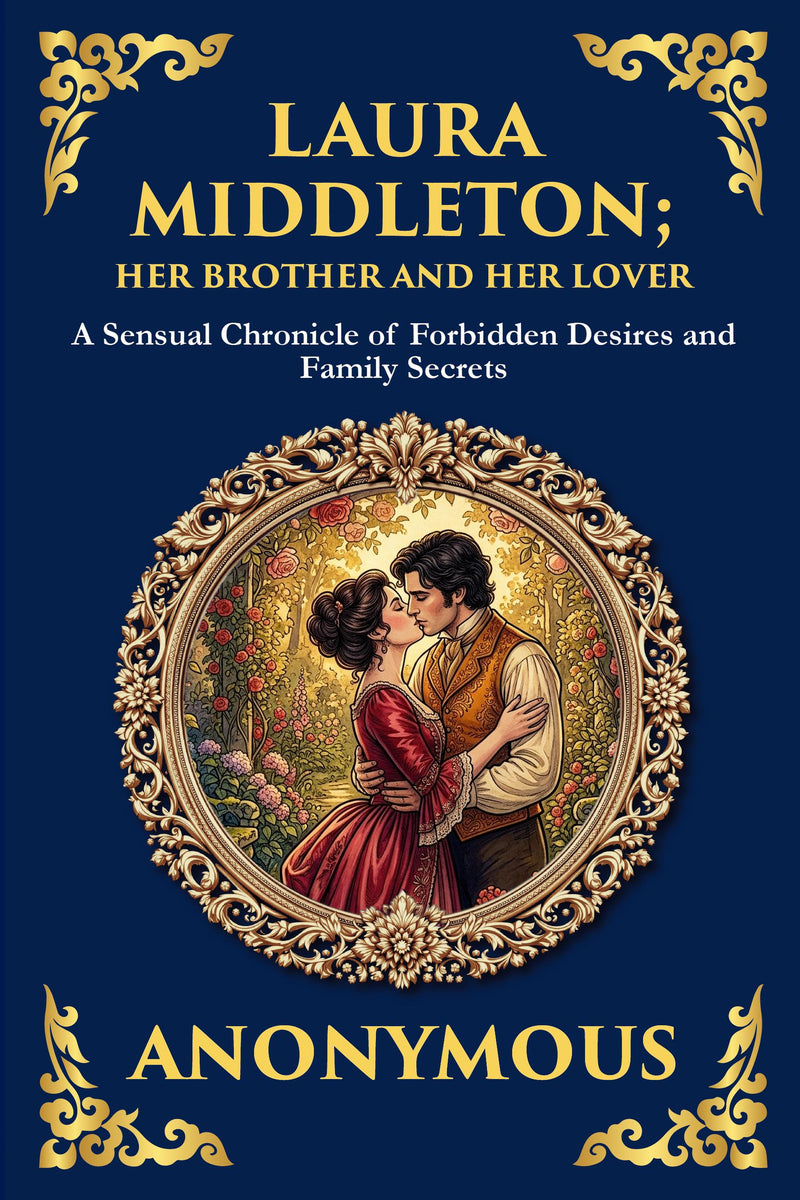
Laura Middleton: Her Brother and Her Lover
Laura Middleton; Her Brother and her Lover is one of the most daring and provocative works of 19th-century underground literature.
or free app
10,000+ hrs library
30-day guarantee
The complete Laura Middleton: Her Brother and Her Lover appears in modern English through Library of Alexandria Press, available online with audiobook narration included for members.
Have you ever wondered why forbidden desires hold such irresistible power? Laura Middleton; Her Brother and her Lover is a controversial and strikingly honest work of Victorian-era erotic literature, penned by an anonymous author whose daring pen challenged the norms of morality and propriety. Set against a backdrop of secrecy and repression, the novel traces the entangled lives of Laura Middleton, her brother, and her lover—three figures caught in a web of passion, secrecy, and transgression.
Through its frank portrayal of intimacy and desire, it stands as both a provocative story and a rare historical glimpse into the private expressions of love and lust in an era of strict social codes. This modern edition brings to life one of the most talked-about works of underground Victorian literature, preserving its intensity while offering contemporary readers a window into the hidden side of 19th-century sexuality.
What you’ll discover in this modern edition
- A Bold Exploration of Desire – A story that unflinchingly portrays the depth and danger of forbidden passions.
- Taboo and Temptation – Witness how secrecy and repression intensify the pull of human longing.
- A Glimpse into Victorian Erotica – Experience a rare literary artifact that pushed against the boundaries of its age.
- Love, Lust, and Conflict – Explore how desire, guilt, and intimacy intertwine in ways both shocking and deeply human.
- A Controversial Classic – A daring tale that has fascinated, scandalized, and intrigued readers for generations.
| Formats | eBook (EPUB + PDF) · Audiobook · Paperback · Hardcover · Large Print |
| Language | English |
| Trim size (print) | 6 × 9 in |
| Binding | Paperback — perfect-bound · Hardcover — casewrap |
| Large Print edition | Same text in a larger, easy-read type — a larger font, not a larger trim |
| Print pricing | Every physical book at our true cost — at-cost, no profit (members) |
| Library | 873 restored titles, always growing |
| Length | 29,955 words · ~2 hr 0 min reading |
| Reading level | Grade 3 · an easy, flowing read (this modern-English edition) |
| Edition | Modern English translation · 2026 |
Member reviews for this edition are collected as readers finish it — be the first. Across the library: 12,000+ books shipped, every plan covered by a 365-day print guarantee.
About this edition
A faithful, unabridged modern-English edition by The Library of Alexandria — carefully rendered for today's reader and verified paragraph-by-paragraph against the public-domain source. Available as eBook, audiobook, paperback, hardcover, and large print.
- Complete & unabridgedVerified paragraph by paragraph against the source — never a scan, never abridged.
- Modern English, faithfulReadable today, with the author’s meaning kept intact. Readable — not simplified.
- Every format, one membershipRead in your browser or the free app, or listen to the full audiobook.
Included free with your membership
Cancel anytime, one click · 30-day money-back guarantee
Edition last updated July 2026
What’s inside
Laura Middleton: Her Brother and Her Lover — complete and unabridged, included in full with membership, plus the full audiobook.
Begin reading Laura Middleton: Her Brother and Her Lover
In clear modern English — the complete text is included with membership.
Introduction
There is a particular kind of pleasure in opening a book that has survived against the odds — a book that passed quietly from hand to hand, often unsigned, frequently disguised, and almost always read in private. Laura Middleton: Her Brother and Her Lover belongs to that fascinating category of literature that flourished in the shadows of the nineteenth century: the privately printed, anonymously authored work of erotic fiction that circulated among readers who, for reasons of propriety, reputation, or law, could never publicly admit to owning it. To pick up such a volume today is to step across a threshold into a world that is at once intimately familiar and startlingly foreign — a world where desire spoke a coded language, where the body was both celebrated and censored, and where the very act of writing about pleasure was an act of quiet rebellion.
This modern translation and adaptation has been prepared with the contemporary reader in mind. The original text, like so many works of its era, was written in a prose style that can feel dense, ornamented, and occasionally impenetrable to those accustomed to the rhythms of modern storytelling. Sentences sprawled across half a page. Euphemism was layered upon euphemism. Cultural references, social customs, and turns of phrase that would have been instantly legible to a Victorian audience now require unpacking or, at the very least, a sympathetic rendering. The purpose of this edition is not to sanitize or to censor, but to make the experience of reading flow naturally for a present-day audience — to preserve the heat, the audacity, and the emotional texture of the original while clearing away the linguistic underbrush that might otherwise obscure it.
What you hold, then, is a bridge between two eras. On one side stands the anonymous author, writing in an age of crinolines and gaslight, of strict moral codes publicly proclaimed and privately transgressed. On the other side stands you, the modern reader, equipped with a frankness about human sexuality that the original audience could scarcely have imagined expressing aloud. The aim of this adaptation is to let these two worlds meet without friction — to allow the boldness of the story to register fully, unmuffled by archaic syntax, while still honoring the period flavor that gives the work its distinctive charm.
It is worth pausing, before you begin, to consider what it means that this book was published anonymously. Anonymity in erotic literature was rarely a matter of mere shyness. It was, more often, a practical necessity. The legal landscape of the nineteenth century was treacherous for anyone who dared to put explicit material into print. Obscenity laws were enforced with periodic ferocity, and the penalties — fines, imprisonment, public disgrace — were severe enough to ruin a career and a family name. Authors, printers, and booksellers alike operated under constant threat. The decision to withhold one’s name was therefore an act of self-preservation, but it was also, in a curious way, an act of liberation. Freed from the constraints of reputation, the anonymous author could write with a candor that signed work could not afford. The mask permitted a kind of honesty. There is something poignant in that paradox: that some of the most uninhibited writing of the age came precisely from those who could never claim credit for it.
This particular work, with its frank exploration of forbidden attractions and concealed family secrets, sits squarely within a tradition that prized transgression as a literary engine. The titillation of the era’s clandestine fiction depended heavily on the contrast between surface respectability and hidden appetite. Victorian society was, on its public face, a monument to restraint — a culture obsessed with propriety, decorum, and the careful management of appearances. Beneath that polished surface, however, ran a powerful undercurrent of curiosity and longing that found its outlet in exactly the kind of literature represented here. To understand the appeal of such books, one must understand the pressure that produced them. The more rigidly a society polices desire, the more intense becomes the fascination with its forbidden expressions. This is not a defense of the content so much as a context for it: these works are documents of their psychological moment, revealing as much about the anxieties and obsessions of their readers as about the imaginations of their authors.
A word of guidance is in order regarding how best to approach a text of this nature. The modern reader, accustomed to the explicit content readily available in contemporary media, may be tempted to dismiss nineteenth-century erotica as quaint, tame, or overly mannered. This would be a mistake — and it would also rob the experience of much of its richness. The pleasures of a book like this one are not solely, or even primarily, the pleasures of explicit description. They are the pleasures of suggestion, of anticipation, of the slow and deliberate building of tension. The Victorian erotic imagination delighted in delay, in the charged moment before contact, in the eloquence of a glance or the meaning of a touch withheld. To read this book well is to slow down, to attend to its rhythms, and to allow yourself to be drawn into a mode of desire that operates differently from the immediate gratifications of the present age.
There is, too, a frankly theatrical quality to the storytelling that rewards an attentive reader. The narrative voice often addresses the reader directly, drawing you into a confidence, inviting complicity. This was a common technique in the genre, designed to collapse the distance between the page and the person holding it — to make the reader not merely an observer but a participant in the scandalous disclosures unfolding. You may notice that the prose lingers over scenes that a modern writer might rush past, and races through transitions that a modern writer might dwell upon. These are not flaws but features of the period’s aesthetic. They tell us something about what the original audience valued, what they found arousing, what they considered worth describing in loving detail and what they were content to leave to the imagination.
This translation has worked to preserve those qualities even while modernizing the language. Where the original employed elaborate circumlocution to describe physical acts, this edition has sought a middle path — clear enough to be comprehensible, yet faithful to the suggestive, sometimes coy spirit of the source. Where cultural references would have meant little to a contemporary reader, they have been gently clarified or recast. The goal throughout has been transparency: to let you see the story as clearly as possible, as though through freshly cleaned glass, without the distortions and obscurities that the passage of time inevitably imposes.
It must also be acknowledged, plainly and without evasion, that this book deals with themes and relationships that many readers will find provocative, and that some will find genuinely uncomfortable. The title itself signals as much. The literature of transgression takes as its subject precisely those desires that society forbids, and it does so deliberately, in order to explore the frisson of the forbidden. Nineteenth-century erotic fiction frequently ventured into territory that violated the deepest taboos of its day — and ours. It is essential to read such material with a clear understanding that it is a work of fiction, a product of fantasy and imagination, written within a particular historical and literary tradition that used transgression as a means of generating intensity and shock. The taboos these stories transgress are taboos for sound reasons, and nothing in the act of reading should be mistaken for endorsement of the conduct depicted. The mature reader approaches such fiction as one approaches any dark or troubling work of imaginative literature: with intellectual distance, critical awareness, and an understanding of the difference between the realm of fantasy and the realm of action.
Indeed, part of what makes period erotica so revealing as a cultural artifact is the way it externalizes the forbidden. These books served, for their original readers, as a kind of pressure valve — a space in which the unspeakable could be spoken, the unthinkable thought, all within the safe confines of the printed page. Psychologists and cultural historians have long noted that the content of a society’s fantasies often inverts the content of its stated values. A culture that publicly idealized feminine purity, domestic harmony, and sexual restraint produced, in its hidden literature, a torrent of material devoted to exactly the opposite. This is not hypocrisy so much as the inevitable shadow cast by repression. To read this book, therefore, is to read a kind of confession — not of any individual author, but of an entire age, speaking through the anonymous mask about the things it could not say in the light of day.
For the reader who wishes to engage with this work on more than a surface level, there is considerable reward in attending to these dimensions. Notice how the story constructs its world: what it assumes about class and station, about the relations between men and women, about the architecture of households and the choreography of social life. Notice the assumptions embedded in the characters’ behavior — the things they take for granted, the things that scandalize them, the things that escape their notice entirely. A book like this is a window not only into a particular fantasy but into the lived texture of an era, its furniture and fashions, its manners and its silences. The careful reader will find, woven through the sensational surface, a wealth of incidental detail that brings the nineteenth century vividly to life.
There is also a literary lineage worth keeping in mind. The anonymous erotic fiction of the period did not arise in a vacuum. It drew upon, parodied, and intersected with the mainstream literary culture of its time — the great tradition of the realist novel, with its detailed social settings and its interest in the inner lives of its characters. Many works of clandestine fiction borrow the conventions of respectable literature precisely in order to subvert them, dressing scandalous content in the familiar clothing of the domestic novel, the romance, or the memoir. This creates an intriguing doubleness: the form promises one kind of story while the content delivers another. Part of the wit and the audacity of these books lies in that tension between the respectable mold and the disreputable material poured into it. Watching how the narrative plays with these expectations is one of the more sophisticated pleasures available to the discerning reader.
Who reads a book like this today, and why? The answer, happily, is various. Some come as students of history, eager to understand a dimension of the past that the standard textbooks omit. The history of sexuality is a serious and growing field of scholarship, and works of period erotica are among its most valuable primary sources. They tell us what people actually desired, feared, and fantasized about, in their own coded words, rather than what the official moralists of the day insisted they should desire. For such readers, this book is a document, a piece of evidence, a voice from the underworld of the respectable century.
Others come as students of literature, interested in the genre itself — its conventions, its devices, its place in the larger ecology of nineteenth-century writing. The clandestine erotic novel has its own grammar, its own recurring motifs and structures, and tracing these across multiple works reveals a tradition as coherent and self-aware as any other literary mode. For these readers, the book is a specimen of a fascinating and underexplored form, worthy of the same analytical attention we bring to more respectable genres.
And still others come simply as readers in search of the particular pleasures that this kind of writing offers: the thrill of the forbidden, the charge of transgression, the frank engagement with desire that the genre exists to provide. There is no shame in this. The appetite for erotic literature is as old as literature itself, and the impulse to read about pleasure is a thoroughly human one. The very existence of this book, and of the underground network that produced and distributed works like it, is testimony to the durability of that appetite even under the most repressive conditions.
Cancel anytime, one click · 30-day money-back guarantee
Founding annual rate available now — your price locks for life when you join.
Not ready? Get this free chapter by email — read it anytime.
✓ Sent — check your inbox for Laura Middleton: Her Brother and Her Lover.
Questions about Laura Middleton: Her Brother and Her Lover
What is Laura Middleton: Her Brother and Her Lover about?
Laura Middleton; Her Brother and her Lover is one of the most daring and provocative works of 19th-century underground literature. At once a tale of desire, secrecy, and forbidden attraction, it explores the boundaries of love, morality, and human indulgence. Shocking in its time and still provocative today, this novel draws readers into a hidden world of passion and family entanglements, where desire collides with taboo.
Is Laura Middleton: Her Brother and Her Lover free to read?
The opening chapter is free to read on this page. Members read and listen to the complete work — and the entire library — free, and can order any physical book at our true print cost.
How long is Laura Middleton: Her Brother and Her Lover?
2 chapters (~29,955 words) — about 2 hr 0 min of reading in this modern-English edition.
Is this an abridged version of Laura Middleton: Her Brother and Her Lover?
No. This is the complete, unabridged Laura Middleton: Her Brother and Her Lover, carefully rendered into clear modern English and verified paragraph-by-paragraph against the public-domain source — nothing is cut or summarised.
What formats does Laura Middleton: Her Brother and Her Lover come in?
Laura Middleton: Her Brother and Her Lover is available as eBook, paperback, hardcover and large print. eBook and audiobook are included with membership; printed editions ship at our true print cost.
Shipping & returns
Billing & membership
More from the library


Explore Classic & Literary
- Dream Psychology: Psychoanalysis for Beginners · Sigmund Freud
- Great Expectations · Charles Dickens
- The Brothers Karamazov · Fyodor Dostoyevsky
- The Great Gatsby · F. Scott Fitzgerald
- Wild Flowers Worth Knowing · Neltje Blanchan
- Italian Hours · Henry James
- A Popular History of France from the Earliest Times, Volume 5 · François Guizot
- A history of English literature: A practical text-book · Edward Albert
- Italian Highways and Byways from a Motor Car · M. F. Mansfield
- The Heart-Cry of Jesus · Byron J. Rees
- Castes and Tribes of Southern India. Vol. 6 of 7 · Edgar Thurston
- Against the Grain · J.-K. Huysmans
- Dombey and Son · Charles Dickens
- How to Invest Money · George Garr Henry
- The Great Controversy Between Christ and Satan · Ellen Gould Harmon White
- One Hundred Proofs That the Earth Is Not a Globe · William Carpenter
- Southern Literature From 1579–1895 · Louise Manly
- The Renaissance: Studies in Art and Poetry · Walter Pater
- Mark Twain’s Speeches · Mark Twain
- Tacitus on Germany · Cornelius Tacitus
- The Rosary · Florence L. Barclay
- Peculiarities of American Cities · Willard W. Glazier
- Tennis for Girls · Florence A. Ballin
- The World’s Greatest Books — Volume 02 — Fiction
- Shirley · Charlotte Brontë
- Daisy Miller: A Study · Henry James
- Louis Lambert · Honoré de Balzac
- Historic Jamaica · Frank Cundall
- The Gambler · Fyodor Dostoyevsky
- The Mayor of Casterbridge · Thomas Hardy
Laura Middleton: Her Brother and Her Lover
Laura Middleton: Her Brother and Her Lover
A Sensual Chronicle of Forbidden Desires and Family Secrets
Anonymous
Contents
- Introduction
- Laura Middleton: Her Brother and Her Lover
Introduction
There is a particular kind of pleasure in opening a book that has survived against the odds — a book that passed quietly from hand to hand, often unsigned, frequently disguised, and almost always read in private. Laura Middleton: Her Brother and Her Lover belongs to that fascinating category of literature that flourished in the shadows of the nineteenth century: the privately printed, anonymously authored work of erotic fiction that circulated among readers who, for reasons of propriety, reputation, or law, could never publicly admit to owning it. To pick up such a volume today is to step across a threshold into a world that is at once intimately familiar and startlingly foreign — a world where desire spoke a coded language, where the body was both celebrated and censored, and where the very act of writing about pleasure was an act of quiet rebellion.
This modern translation and adaptation has been prepared with the contemporary reader in mind. The original text, like so many works of its era, was written in a prose style that can feel dense, ornamented, and occasionally impenetrable to those accustomed to the rhythms of modern storytelling. Sentences sprawled across half a page. Euphemism was layered upon euphemism. Cultural references, social customs, and turns of phrase that would have been instantly legible to a Victorian audience now require unpacking or, at the very least, a sympathetic rendering. The purpose of this edition is not to sanitize or to censor, but to make the experience of reading flow naturally for a present-day audience — to preserve the heat, the audacity, and the emotional texture of the original while clearing away the linguistic underbrush that might otherwise obscure it.
What you hold, then, is a bridge between two eras. On one side stands the anonymous author, writing in an age of crinolines and gaslight, of strict moral codes publicly proclaimed and privately transgressed. On the other side stands you, the modern reader, equipped with a frankness about human sexuality that the original audience could scarcely have imagined expressing aloud. The aim of this adaptation is to let these two worlds meet without friction — to allow the boldness of the story to register fully, unmuffled by archaic syntax, while still honoring the period flavor that gives the work its distinctive charm.
It is worth pausing, before you begin, to consider what it means that this book was published anonymously. Anonymity in erotic literature was rarely a matter of mere shyness. It was, more often, a practical necessity. The legal landscape of the nineteenth century was treacherous for anyone who dared to put explicit material into print. Obscenity laws were enforced with periodic ferocity, and the penalties — fines, imprisonment, public disgrace — were severe enough to ruin a career and a family name. Authors, printers, and booksellers alike operated under constant threat. The decision to withhold one’s name was therefore an act of self-preservation, but it was also, in a curious way, an act of liberation. Freed from the constraints of reputation, the anonymous author could write with a candor that signed work could not afford. The mask permitted a kind of honesty. There is something poignant in that paradox: that some of the most uninhibited writing of the age came precisely from those who could never claim credit for it.
This particular work, with its frank exploration of forbidden attractions and concealed family secrets, sits squarely within a tradition that prized transgression as a literary engine. The titillation of the era’s clandestine fiction depended heavily on the contrast between surface respectability and hidden appetite. Victorian society was, on its public face, a monument to restraint — a culture obsessed with propriety, decorum, and the careful management of appearances. Beneath that polished surface, however, ran a powerful undercurrent of curiosity and longing that found its outlet in exactly the kind of literature represented here. To understand the appeal of such books, one must understand the pressure that produced them. The more rigidly a society polices desire, the more intense becomes the fascination with its forbidden expressions. This is not a defense of the content so much as a context for it: these works are documents of their psychological moment, revealing as much about the anxieties and obsessions of their readers as about the imaginations of their authors.
A word of guidance is in order regarding how best to approach a text of this nature. The modern reader, accustomed to the explicit content readily available in contemporary media, may be tempted to dismiss nineteenth-century erotica as quaint, tame, or overly mannered. This would be a mistake — and it would also rob the experience of much of its richness. The pleasures of a book like this one are not solely, or even primarily, the pleasures of explicit description. They are the pleasures of suggestion, of anticipation, of the slow and deliberate building of tension. The Victorian erotic imagination delighted in delay, in the charged moment before contact, in the eloquence of a glance or the meaning of a touch withheld. To read this book well is to slow down, to attend to its rhythms, and to allow yourself to be drawn into a mode of desire that operates differently from the immediate gratifications of the present age.
There is, too, a frankly theatrical quality to the storytelling that rewards an attentive reader. The narrative voice often addresses the reader directly, drawing you into a confidence, inviting complicity. This was a common technique in the genre, designed to collapse the distance between the page and the person holding it — to make the reader not merely an observer but a participant in the scandalous disclosures unfolding. You may notice that the prose lingers over scenes that a modern writer might rush past, and races through transitions that a modern writer might dwell upon. These are not flaws but features of the period’s aesthetic. They tell us something about what the original audience valued, what they found arousing, what they considered worth describing in loving detail and what they were content to leave to the imagination.
This translation has worked to preserve those qualities even while modernizing the language. Where the original employed elaborate circumlocution to describe physical acts, this edition has sought a middle path — clear enough to be comprehensible, yet faithful to the suggestive, sometimes coy spirit of the source. Where cultural references would have meant little to a contemporary reader, they have been gently clarified or recast. The goal throughout has been transparency: to let you see the story as clearly as possible, as though through freshly cleaned glass, without the distortions and obscurities that the passage of time inevitably imposes.
It must also be acknowledged, plainly and without evasion, that this book deals with themes and relationships that many readers will find provocative, and that some will find genuinely uncomfortable. The title itself signals as much. The literature of transgression takes as its subject precisely those desires that society forbids, and it does so deliberately, in order to explore the frisson of the forbidden. Nineteenth-century erotic fiction frequently ventured into territory that violated the deepest taboos of its day — and ours. It is essential to read such material with a clear understanding that it is a work of fiction, a product of fantasy and imagination, written within a particular historical and literary tradition that used transgression as a means of generating intensity and shock. The taboos these stories transgress are taboos for sound reasons, and nothing in the act of reading should be mistaken for endorsement of the conduct depicted. The mature reader approaches such fiction as one approaches any dark or troubling work of imaginative literature: with intellectual distance, critical awareness, and an understanding of the difference between the realm of fantasy and the realm of action.
Indeed, part of what makes period erotica so revealing as a cultural artifact is the way it externalizes the forbidden. These books served, for their original readers, as a kind of pressure valve — a space in which the unspeakable could be spoken, the unthinkable thought, all within the safe confines of the printed page. Psychologists and cultural historians have long noted that the content of a society’s fantasies often inverts the content of its stated values. A culture that publicly idealized feminine purity, domestic harmony, and sexual restraint produced, in its hidden literature, a torrent of material devoted to exactly the opposite. This is not hypocrisy so much as the inevitable shadow cast by repression. To read this book, therefore, is to read a kind of confession — not of any individual author, but of an entire age, speaking through the anonymous mask about the things it could not say in the light of day.
For the reader who wishes to engage with this work on more than a surface level, there is considerable reward in attending to these dimensions. Notice how the story constructs its world: what it assumes about class and station, about the relations between men and women, about the architecture of households and the choreography of social life. Notice the assumptions embedded in the characters’ behavior — the things they take for granted, the things that scandalize them, the things that escape their notice entirely. A book like this is a window not only into a particular fantasy but into the lived texture of an era, its furniture and fashions, its manners and its silences. The careful reader will find, woven through the sensational surface, a wealth of incidental detail that brings the nineteenth century vividly to life.
There is also a literary lineage worth keeping in mind. The anonymous erotic fiction of the period did not arise in a vacuum. It drew upon, parodied, and intersected with the mainstream literary culture of its time — the great tradition of the realist novel, with its detailed social settings and its interest in the inner lives of its characters. Many works of clandestine fiction borrow the conventions of respectable literature precisely in order to subvert them, dressing scandalous content in the familiar clothing of the domestic novel, the romance, or the memoir. This creates an intriguing doubleness: the form promises one kind of story while the content delivers another. Part of the wit and the audacity of these books lies in that tension between the respectable mold and the disreputable material poured into it. Watching how the narrative plays with these expectations is one of the more sophisticated pleasures available to the discerning reader.
Who reads a book like this today, and why? The answer, happily, is various. Some come as students of history, eager to understand a dimension of the past that the standard textbooks omit. The history of sexuality is a serious and growing field of scholarship, and works of period erotica are among its most valuable primary sources. They tell us what people actually desired, feared, and fantasized about, in their own coded words, rather than what the official moralists of the day insisted they should desire. For such readers, this book is a document, a piece of evidence, a voice from the underworld of the respectable century.
Others come as students of literature, interested in the genre itself — its conventions, its devices, its place in the larger ecology of nineteenth-century writing. The clandestine erotic novel has its own grammar, its own recurring motifs and structures, and tracing these across multiple works reveals a tradition as coherent and self-aware as any other literary mode. For these readers, the book is a specimen of a fascinating and underexplored form, worthy of the same analytical attention we bring to more respectable genres.
And still others come simply as readers in search of the particular pleasures that this kind of writing offers: the thrill of the forbidden, the charge of transgression, the frank engagement with desire that the genre exists to provide. There is no shame in this. The appetite for erotic literature is as old as literature itself, and the impulse to read about pleasure is a thoroughly human one. The very existence of this book, and of the underground network that produced and distributed works like it, is testimony to the durability of that appetite even under the most repressive conditions.
I noticed the comments Emily made about how Laura Middleton had helped her open up and explore the secrets she had now fully discovered. As it happened, I was already planning to visit the Middletons, who were distant relatives of my mother. It occurred to me that I might be able to use this information to my advantage. Laura and I were old friends. She was about two years older than me and very beautiful, though at the time, I felt she was a bit too imposing for my taste. We had always gotten along well as children, but she had a haughty, commanding presence. Between that and the age gap, I never would have dreamed of flirting with her. In fact, she was the last person I would have imagined taking part in the kind of activities Emily had described.
When I saw her again at their country estate, I noticed she had changed significantly. This was likely just the natural result of the two years since I’d last seen her; she had grown into her figure, and the features that once seemed too prominent had softened. I had also grown quite a bit during that time—even more so than she had—so her height no longer seemed excessive to me. Overall, I had to admit that I had rarely seen a more beautiful woman. She still had a bit of that haughty air, though it was softer now. Looking at her, I could hardly believe Emily’s stories about how she behaved when she let loose. However, I soon noticed things that seemed to prove the stories were true, which gave me an opening to make a move—and I didn’t waste any time.
When it was time to dress for dinner, Lady Middleton told me that, because of our family connection, she had placed me in the family wing of the house. Some unexpected guests had arrived, forcing her to change the room she had originally planned for me. She was sure I would find my new room comfortable. She explained that the only reason she couldn’t put a stranger there was that it connected to another room. That second room was for her son, Frank, who was expected home from school soon. Because of some renovations during a house addition, Frank’s room had no separate entrance; it only opened into the rooms on either side. Since his sister and aunt occupied the room on one side, Frank would have to pass through my room to get to his. She told me to keep him in line and make sure he behaved, and to let her know if he gave me any trouble. I hadn’t seen my young namesake in about two years, but I remembered him as a spirited, handsome boy of twelve or thirteen. He was always getting into trouble, but he always managed to get out of it with such a fearless, good-natured attitude that no one could stay mad at him. I told her I would be happy to see my young friend again and was sure we would get along great.
End of the free sample
Keep reading, free
Members read and listen to the complete book — and the entire library. Cancel anytime, one click · 30-day money-back guarantee.