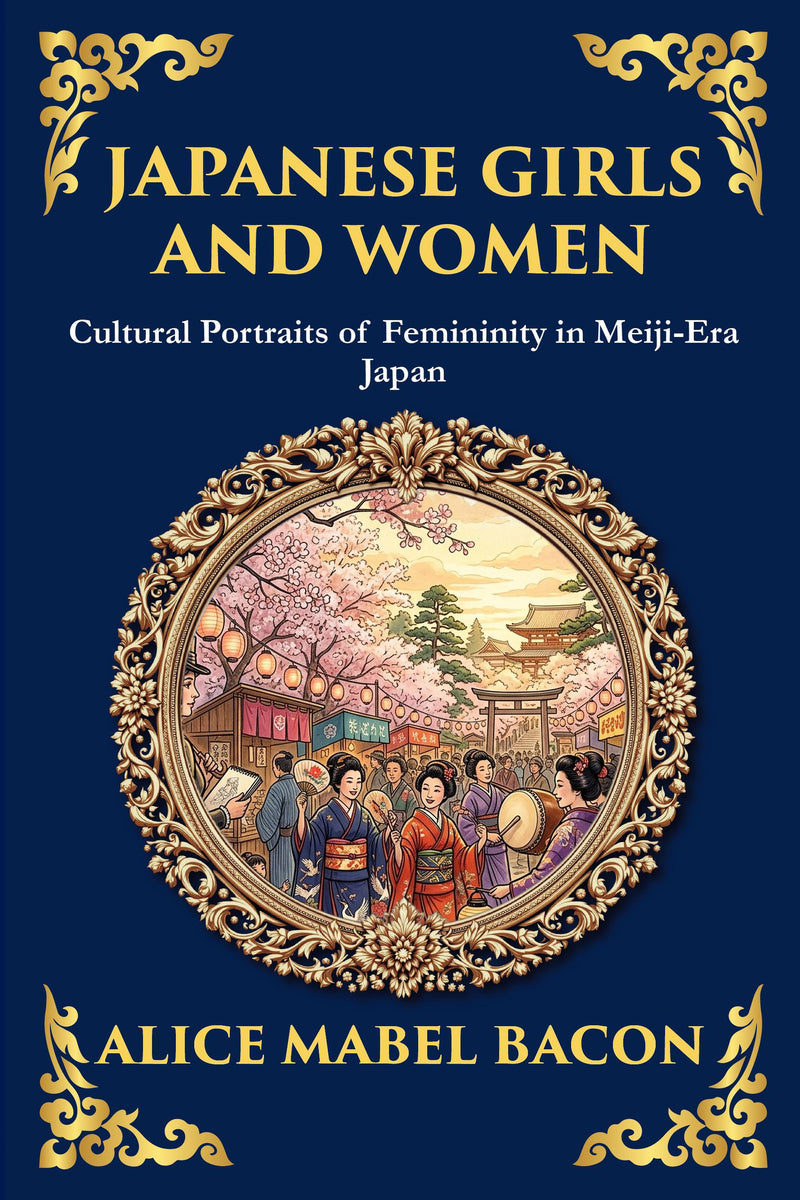
Japanese Girls and Women
What does it truly mean to be a woman in a changing world? In Japanese Girls and Women, Alice Mabel Bacon presents an intimate, insightful portrait of Japanese womanhood during the transformative Meiji era.
or free app
10,000+ hrs library
30-day guarantee
The complete Japanese Girls and Women appears in modern English through Library of Alexandria Press, available online with audiobook narration included for members.
Have you ever wondered why cultural transformation begins with the lives of women? Japanese Girls and Women is a remarkable account of womanhood in Meiji-era Japan, offering a nuanced, first-hand exploration of how women navigated societal expectations during one of the country’s most pivotal historical shifts. Authored by Alice Mabel Bacon—an educator, reform advocate, and one of the first Western women to live within Japanese society—the book blends personal observation with historical insight to reveal the true heart of Japanese femininity.
As Japan moved from feudal isolation to global engagement, women stood at the crossroads of tradition and change. Bacon explores every stage of life with clarity and empathy: The innocent joy of childhood in traditional Japanese homes The restrained discipline of girlhood education and arranged marriages The elegance and misunderstood role of geishas in cultural life The emergence of women’s education and the beginnings of reform The quiet resilience of mothers and the centrality of family structure Bacon’s writing is both respectful and revealing, highlighting how social roles, family values, and education shaped not only Japanese society—but also the very definition of womanhood itself.
What you’ll discover in this modern edition
- A Rare First-Hand Perspective – One of the earliest Western accounts written by a woman who lived among Japanese families and students.
- Portraits of Japanese Womanhood – From childhood to motherhood, geisha life to school life, every role is explored with respect and precision.
- A Glimpse into Meiji-Era Japan – Understand the historical context of modernization and how it redefined gender roles.
- An Enduring Work on Cross-Cultural Understanding – Discover the roots of modern feminism through the lens of another culture.
- A Thoughtful, Compassionate Voice – Bacon writes not as a critic, but as a student of humanity—bridging East and West with rare humility.
| Formats | eBook (EPUB + PDF) · Audiobook · Paperback · Hardcover · Large Print |
| Language | English |
| Trim size (print) | 6 × 9 in |
| Binding | Paperback — perfect-bound · Hardcover — casewrap |
| Large Print edition | Same text in a larger, easy-read type — a larger font, not a larger trim |
| Print pricing | Every physical book at our true cost — at-cost, no profit (members) |
| Library | 873 restored titles, always growing |
| Length | 72,876 words · ~4 hr 52 min reading |
| Reading level | Grade 8 · an easy, flowing read (this modern-English edition) |
| Edition | Modern English translation · 2026 |
Member reviews for this edition are collected as readers finish it — be the first. Across the library: 12,000+ books shipped, every plan covered by a 365-day print guarantee.
About this edition
A faithful, unabridged modern-English edition by The Library of Alexandria — carefully rendered for today's reader and verified paragraph-by-paragraph against the public-domain source. Available as eBook, audiobook, paperback, hardcover, and large print.
- Complete & unabridgedVerified paragraph by paragraph against the source — never a scan, never abridged.
- Modern English, faithfulReadable today, with the author’s meaning kept intact. Readable — not simplified.
- Every format, one membershipRead in your browser or the free app, or listen to the full audiobook.
Included free with your membership
Cancel anytime, one click · 30-day money-back guarantee
Edition last updated July 2026
What’s inside
Japanese Girls and Women — complete and unabridged: all 17 sections included with membership, plus the full audiobook.
Begin reading Japanese Girls and Women
In clear modern English — the complete text is included with membership.
Introduction
When Alice Mabel Bacon first set foot in Japan, she arrived not as a curious tourist nor as a detached scholar surveying an exotic land from a comfortable distance, but as something far rarer in the nineteenth century: a trusted friend invited into the intimate spaces of Japanese family life. This distinction matters enormously, and it shapes every page of the remarkable work you are about to read. Most Western accounts of Japan from this era were written by travelers who passed through quickly, glimpsing only the surfaces of a culture they could neither enter nor fully comprehend. Bacon, by contrast, had earned a place inside Japanese homes, and from that privileged vantage point she produced one of the most sympathetic, observant, and enduring portraits of Japanese womanhood ever written by a Westerner.
To read this book is to be transported back to a singular moment in human history—the closing decades of the nineteenth century, when Japan was undergoing one of the most dramatic and compressed transformations any nation has ever experienced. For more than two centuries under the Tokugawa shogunate, Japan had sealed itself off from the outside world, developing in isolation a civilization of extraordinary refinement, rigid social hierarchy, and deeply rooted custom. Then, almost overnight, the doors were thrown open. The Meiji Restoration of 1868 swept away the old feudal order and launched Japan headlong into a frantic effort to modernize, industrialize, and reposition itself among the great powers of the world. Railroads appeared where there had been footpaths. Western dress mingled with kimono on the streets of Tokyo. Ancient traditions collided with imported ideas about science, government, education, and the very nature of human society. It was, in short, a world in the midst of being remade—and Bacon was there to witness it, with a particular eye trained upon the lives of the women who stood at the heart of the Japanese household and yet whose stories had been almost entirely overlooked.
What makes Bacon’s perspective so valuable is precisely that she chose to look where others did not. The grand sweep of Meiji politics, the dramatic clash of samurai swords against modern rifles, the rise of industry and empire—these were the subjects that captured the attention of most foreign observers. Bacon turned instead toward the domestic interior, toward the daughters and mothers and grandmothers, the brides and widows, the geisha and the peasant women, the schoolgirls and the noblewomen. She understood, with an insight ahead of her time, that to understand a civilization you must understand how it treats and shapes its women, how it raises its daughters, what it asks of its wives, and how it honors or neglects its aging mothers. In tracing the arc of a Japanese woman’s life from infancy through old age, she offers us a kind of cross-section of the entire culture, illuminated from within.
It is worth pausing to understand who Alice Mabel Bacon was, because her unusual biography is inseparable from the unique quality of this work. Born in 1858 in New Haven, Connecticut, Bacon grew up in a household that was unusually open to the wider world. Her father, a Congregationalist minister, took into their home a young Japanese girl named Sutematsu Yamakawa, one of five girls sent to the United States by the Japanese government in 1871 as part of a bold experiment in education. These girls were dispatched abroad to absorb Western learning and customs so that they might one day return home to help educate Japanese women and modernize their nation. Sutematsu lived with the Bacon family for years, and the two young women became as close as sisters. Through this profound friendship, Bacon developed not merely an intellectual interest in Japan but a deep personal connection to it—a relationship of love, trust, and mutual understanding that would shape the rest of her life.
When Sutematsu returned to Japan, having graduated from Vassar College, she eventually married one of the most prominent men in the country and entered the highest circles of Japanese society. The bonds of friendship endured across the ocean, and in time Bacon herself was invited to Japan, where she lived and worked as a teacher. She taught at the Peeresses’ School, an institution for the daughters of the Japanese nobility, and later helped found a school for the education of Japanese women. These experiences gave her access that virtually no other Western writer of her era possessed. She was not peering through a window at Japanese life; she was inside the house, sharing meals, observing family routines, watching children grow, and listening to the confidences of women who had come to trust her completely.
This intimacy explains the book’s most distinctive and admirable qualities. Where so many foreign writers of the period approached Japan with condescension, treating its people as quaint curiosities or as objects of anthropological study, Bacon writes with genuine affection and respect. She does not flinch from describing the hardships and injustices that Japanese women endured—indeed, she is often pointed in her criticism of customs she finds cruel or limiting—but her criticism springs from sympathy rather than disdain. She wants her readers to see Japanese women as full human beings, with inner lives, intelligence, dignity, and worth equal to that of any woman in the West. In an age riddled with racial prejudice and cultural arrogance, this was no small accomplishment.
At the same time, the modern reader should approach the book with an awareness of its historical context. Bacon was a product of her time, and certain assumptions of nineteenth-century Western thought inevitably color her observations. She sometimes measures Japanese customs against an American or Christian standard, and she occasionally generalizes in ways that contemporary scholarship would qualify. Yet it is precisely this tension—between her deep affection for Japan and the cultural lens through which she could not entirely escape viewing it—that makes the book so fascinating as a historical document. We are reading not only about Japanese women but also about how an unusually open-minded American woman of the late nineteenth century tried to understand a culture profoundly different from her own. The book becomes a kind of double mirror, reflecting both the observed and the observer.
This modern adaptation has been prepared with great care to make Bacon’s insights accessible to today’s reader. The original text, written in the formal and sometimes ornate prose of the late nineteenth century, has been thoughtfully rendered into clearer, more fluid language without sacrificing the substance, nuance, or spirit of the author’s observations. Archaic phrasings have been smoothed, lengthy and convoluted sentences clarified, and the structure made more inviting to those accustomed to contemporary writing. Yet the goal throughout has been preservation rather than transformation: to let Bacon speak to a new generation in a voice they can readily hear, while keeping faith with everything she observed and felt. Nothing essential has been lost, and a great deal has been made newly luminous.
A Journey Through the Stages of a Woman's Life
The genius of Bacon’s approach lies in her decision to organize her portrait around the natural progression of a woman’s life. Rather than offering a dry catalog of customs and institutions, she follows the Japanese female through her successive roles and stations, allowing the reader to experience the culture as it would have been experienced by the women themselves. We begin with the very arrival of a girl into the world and the expectations—and disappointments—that surrounded the birth of a daughter rather than a son. We move through the years of childhood, with their games, their festivals, their gradual instruction in the arts of being female within Japanese society. We witness the education a girl received, the values impressed upon her, and the careful molding of her character toward the ideals of obedience, gentleness, grace, and self-effacement that the culture prized so highly.
From childhood, Bacon carries us forward into the momentous transition of marriage—an institution that, in Meiji Japan, bore little resemblance to the romantic ideal that animated Western notions of matrimony. Marriages were arranged, often between families who saw in the union a strategic alliance, and the bride frequently entered her husband’s household as something close to a stranger, expected to subordinate herself entirely to her new family and especially to her mother-in-law. Bacon describes these arrangements with a clear eye, neither romanticizing them nor reducing them to mere oppression. She helps us understand the logic of the system from within, the genuine bonds of duty and affection that could grow within it, and the very real burdens it placed upon the women who lived it.
Through the chapters that follow, we encounter the Japanese wife in her domestic sphere, the management of the household, the raising of children, and the complex web of obligations that bound her to husband, in-laws, and ancestors. We meet women in their later years, the grandmothers and elder matrons who, having endured the trials of youth and the subordination of married life, at last attained a measure of authority and respect within the family. Bacon is particularly perceptive about how a woman’s status shifted across her lifetime, how the powerlessness of the young bride could gradually give way to the considerable influence of the established matriarch.
But Bacon does not confine herself to the women of the home. She ranges widely across the social spectrum, devoting attention to the great variety of female experience in Japan. She writes of the women of the court and the nobility, with their refined accomplishments and their constrained existence. She describes the peasant women whose lives of hard agricultural labor stood in stark contrast to the sheltered ladies of the upper classes. She examines the position of women in the world of work and commerce, and she turns her attention, with notable frankness for her era, to the figures who occupied the margins and the shadows of respectable society—the entertainers, the geisha, and the women caught up in systems of exploitation that she does not shy away from condemning.
Throughout, she is attentive to the great drama of her age: the collision between tradition and modernity. The Japan she observed was changing rapidly, and the lives of women were being reshaped by new ideas about education, new opportunities, and new tensions between old expectations and emerging possibilities. Bacon writes with a sense of standing at a threshold, watching as a centuries-old way of life began to give way to something new. She speculates, sometimes hopefully and sometimes anxiously, about what the future might hold for Japanese women as their nation hurtled toward modernity. This gives the book an almost prophetic quality; reading it now, with the full knowledge of the transformations that the twentieth century would bring to Japan, we can appreciate both the accuracy of some of her observations and the limits of any observer’s ability to foresee the future.
What emerges from all of this is not a collection of disconnected facts but a richly textured, deeply human portrait. Bacon possessed a gift for the telling detail and the illuminating anecdote. She describes the particular festivals that marked the Japanese year and the special roles that girls and women played within them. She paints vivid scenes of domestic life—the arrangement of the home, the preparation of food, the rituals of hospitality, the care of children. She conveys the texture of daily existence with a novelist’s eye for atmosphere and a journalist’s instinct for the revealing particular. The reader comes away feeling not merely informed about Japanese women but genuinely acquainted with them, as if having spent time in their company.
Cancel anytime, one click · 30-day money-back guarantee
Founding annual rate available now — your price locks for life when you join.
Not ready? Get this free chapter by email — read it anytime.
✓ Sent — check your inbox for Japanese Girls and Women.
Questions about Japanese Girls and Women
What is Japanese Girls and Women about?
What does it truly mean to be a woman in a changing world? In Japanese Girls and Women, Alice Mabel Bacon presents an intimate, insightful portrait of Japanese womanhood during the transformative Meiji era. As Japan emerged from centuries of isolation into rapid modernization, the lives of women were caught between tradition and progress.
Who wrote Japanese Girls and Women?
Japanese Girls and Women was written by Alice Mabel Bacon. This edition presents the complete work in clear modern English, faithfully rendered from the public-domain original by Library of Alexandria Press.
Is Japanese Girls and Women free to read?
The opening chapter is free to read on this page. Members read and listen to the complete work — and the entire library — free, and can order any physical book at our true print cost.
How long is Japanese Girls and Women?
17 chapters (~72,876 words) — about 4 hr 52 min of reading in this modern-English edition.
Is this an abridged version of Japanese Girls and Women?
No. This is the complete, unabridged Japanese Girls and Women, carefully rendered into clear modern English and verified paragraph-by-paragraph against the public-domain source — nothing is cut or summarised.
What formats does Japanese Girls and Women come in?
Japanese Girls and Women is available as eBook, paperback, hardcover and large print. eBook and audiobook are included with membership; printed editions ship at our true print cost.
Shipping & returns
Billing & membership
More from the library


Explore Classic & Literary
- Dream Psychology: Psychoanalysis for Beginners · Sigmund Freud
- Great Expectations · Charles Dickens
- The Brothers Karamazov · Fyodor Dostoyevsky
- The Great Gatsby · F. Scott Fitzgerald
- Wild Flowers Worth Knowing · Neltje Blanchan
- Italian Hours · Henry James
- A Popular History of France from the Earliest Times, Volume 5 · François Guizot
- A history of English literature: A practical text-book · Edward Albert
- Italian Highways and Byways from a Motor Car · M. F. Mansfield
- The Heart-Cry of Jesus · Byron J. Rees
- Castes and Tribes of Southern India. Vol. 6 of 7 · Edgar Thurston
- Against the Grain · J.-K. Huysmans
- Dombey and Son · Charles Dickens
- How to Invest Money · George Garr Henry
- The Great Controversy Between Christ and Satan · Ellen Gould Harmon White
- One Hundred Proofs That the Earth Is Not a Globe · William Carpenter
- Southern Literature From 1579–1895 · Louise Manly
- The Renaissance: Studies in Art and Poetry · Walter Pater
- Mark Twain’s Speeches · Mark Twain
- Tacitus on Germany · Cornelius Tacitus
- The Rosary · Florence L. Barclay
- Peculiarities of American Cities · Willard W. Glazier
- Tennis for Girls · Florence A. Ballin
- The World’s Greatest Books — Volume 02 — Fiction
- Shirley · Charlotte Brontë
- Daisy Miller: A Study · Henry James
- Louis Lambert · Honoré de Balzac
- Historic Jamaica · Frank Cundall
- The Gambler · Fyodor Dostoyevsky
- The Mayor of Casterbridge · Thomas Hardy
Japanese Girls and Women
Japanese Girls and Women
Cultural Portraits of Femininity in Meiji-Era Japan
Alice Mabel Bacon
Contents
- Introduction
- Preface to the Revised Edition
- Preface to the First Edition
- Chapter 1
- Chapter 2
- Chapter 3
- Chapter 4
- Chapter 5
- Chapter 6
- Chapter 7
- Chapter 8
- Chapter 9
- Chapter 10
- Chapter 11
- Chapter 12
- Chapter 13
- Epilogue.
Introduction
When Alice Mabel Bacon first set foot in Japan, she arrived not as a curious tourist nor as a detached scholar surveying an exotic land from a comfortable distance, but as something far rarer in the nineteenth century: a trusted friend invited into the intimate spaces of Japanese family life. This distinction matters enormously, and it shapes every page of the remarkable work you are about to read. Most Western accounts of Japan from this era were written by travelers who passed through quickly, glimpsing only the surfaces of a culture they could neither enter nor fully comprehend. Bacon, by contrast, had earned a place inside Japanese homes, and from that privileged vantage point she produced one of the most sympathetic, observant, and enduring portraits of Japanese womanhood ever written by a Westerner.
To read this book is to be transported back to a singular moment in human history—the closing decades of the nineteenth century, when Japan was undergoing one of the most dramatic and compressed transformations any nation has ever experienced. For more than two centuries under the Tokugawa shogunate, Japan had sealed itself off from the outside world, developing in isolation a civilization of extraordinary refinement, rigid social hierarchy, and deeply rooted custom. Then, almost overnight, the doors were thrown open. The Meiji Restoration of 1868 swept away the old feudal order and launched Japan headlong into a frantic effort to modernize, industrialize, and reposition itself among the great powers of the world. Railroads appeared where there had been footpaths. Western dress mingled with kimono on the streets of Tokyo. Ancient traditions collided with imported ideas about science, government, education, and the very nature of human society. It was, in short, a world in the midst of being remade—and Bacon was there to witness it, with a particular eye trained upon the lives of the women who stood at the heart of the Japanese household and yet whose stories had been almost entirely overlooked.
What makes Bacon’s perspective so valuable is precisely that she chose to look where others did not. The grand sweep of Meiji politics, the dramatic clash of samurai swords against modern rifles, the rise of industry and empire—these were the subjects that captured the attention of most foreign observers. Bacon turned instead toward the domestic interior, toward the daughters and mothers and grandmothers, the brides and widows, the geisha and the peasant women, the schoolgirls and the noblewomen. She understood, with an insight ahead of her time, that to understand a civilization you must understand how it treats and shapes its women, how it raises its daughters, what it asks of its wives, and how it honors or neglects its aging mothers. In tracing the arc of a Japanese woman’s life from infancy through old age, she offers us a kind of cross-section of the entire culture, illuminated from within.
It is worth pausing to understand who Alice Mabel Bacon was, because her unusual biography is inseparable from the unique quality of this work. Born in 1858 in New Haven, Connecticut, Bacon grew up in a household that was unusually open to the wider world. Her father, a Congregationalist minister, took into their home a young Japanese girl named Sutematsu Yamakawa, one of five girls sent to the United States by the Japanese government in 1871 as part of a bold experiment in education. These girls were dispatched abroad to absorb Western learning and customs so that they might one day return home to help educate Japanese women and modernize their nation. Sutematsu lived with the Bacon family for years, and the two young women became as close as sisters. Through this profound friendship, Bacon developed not merely an intellectual interest in Japan but a deep personal connection to it—a relationship of love, trust, and mutual understanding that would shape the rest of her life.
When Sutematsu returned to Japan, having graduated from Vassar College, she eventually married one of the most prominent men in the country and entered the highest circles of Japanese society. The bonds of friendship endured across the ocean, and in time Bacon herself was invited to Japan, where she lived and worked as a teacher. She taught at the Peeresses’ School, an institution for the daughters of the Japanese nobility, and later helped found a school for the education of Japanese women. These experiences gave her access that virtually no other Western writer of her era possessed. She was not peering through a window at Japanese life; she was inside the house, sharing meals, observing family routines, watching children grow, and listening to the confidences of women who had come to trust her completely.
This intimacy explains the book’s most distinctive and admirable qualities. Where so many foreign writers of the period approached Japan with condescension, treating its people as quaint curiosities or as objects of anthropological study, Bacon writes with genuine affection and respect. She does not flinch from describing the hardships and injustices that Japanese women endured—indeed, she is often pointed in her criticism of customs she finds cruel or limiting—but her criticism springs from sympathy rather than disdain. She wants her readers to see Japanese women as full human beings, with inner lives, intelligence, dignity, and worth equal to that of any woman in the West. In an age riddled with racial prejudice and cultural arrogance, this was no small accomplishment.
At the same time, the modern reader should approach the book with an awareness of its historical context. Bacon was a product of her time, and certain assumptions of nineteenth-century Western thought inevitably color her observations. She sometimes measures Japanese customs against an American or Christian standard, and she occasionally generalizes in ways that contemporary scholarship would qualify. Yet it is precisely this tension—between her deep affection for Japan and the cultural lens through which she could not entirely escape viewing it—that makes the book so fascinating as a historical document. We are reading not only about Japanese women but also about how an unusually open-minded American woman of the late nineteenth century tried to understand a culture profoundly different from her own. The book becomes a kind of double mirror, reflecting both the observed and the observer.
This modern adaptation has been prepared with great care to make Bacon’s insights accessible to today’s reader. The original text, written in the formal and sometimes ornate prose of the late nineteenth century, has been thoughtfully rendered into clearer, more fluid language without sacrificing the substance, nuance, or spirit of the author’s observations. Archaic phrasings have been smoothed, lengthy and convoluted sentences clarified, and the structure made more inviting to those accustomed to contemporary writing. Yet the goal throughout has been preservation rather than transformation: to let Bacon speak to a new generation in a voice they can readily hear, while keeping faith with everything she observed and felt. Nothing essential has been lost, and a great deal has been made newly luminous.
A Journey Through the Stages of a Woman's Life
The genius of Bacon’s approach lies in her decision to organize her portrait around the natural progression of a woman’s life. Rather than offering a dry catalog of customs and institutions, she follows the Japanese female through her successive roles and stations, allowing the reader to experience the culture as it would have been experienced by the women themselves. We begin with the very arrival of a girl into the world and the expectations—and disappointments—that surrounded the birth of a daughter rather than a son. We move through the years of childhood, with their games, their festivals, their gradual instruction in the arts of being female within Japanese society. We witness the education a girl received, the values impressed upon her, and the careful molding of her character toward the ideals of obedience, gentleness, grace, and self-effacement that the culture prized so highly.
From childhood, Bacon carries us forward into the momentous transition of marriage—an institution that, in Meiji Japan, bore little resemblance to the romantic ideal that animated Western notions of matrimony. Marriages were arranged, often between families who saw in the union a strategic alliance, and the bride frequently entered her husband’s household as something close to a stranger, expected to subordinate herself entirely to her new family and especially to her mother-in-law. Bacon describes these arrangements with a clear eye, neither romanticizing them nor reducing them to mere oppression. She helps us understand the logic of the system from within, the genuine bonds of duty and affection that could grow within it, and the very real burdens it placed upon the women who lived it.
Through the chapters that follow, we encounter the Japanese wife in her domestic sphere, the management of the household, the raising of children, and the complex web of obligations that bound her to husband, in-laws, and ancestors. We meet women in their later years, the grandmothers and elder matrons who, having endured the trials of youth and the subordination of married life, at last attained a measure of authority and respect within the family. Bacon is particularly perceptive about how a woman’s status shifted across her lifetime, how the powerlessness of the young bride could gradually give way to the considerable influence of the established matriarch.
But Bacon does not confine herself to the women of the home. She ranges widely across the social spectrum, devoting attention to the great variety of female experience in Japan. She writes of the women of the court and the nobility, with their refined accomplishments and their constrained existence. She describes the peasant women whose lives of hard agricultural labor stood in stark contrast to the sheltered ladies of the upper classes. She examines the position of women in the world of work and commerce, and she turns her attention, with notable frankness for her era, to the figures who occupied the margins and the shadows of respectable society—the entertainers, the geisha, and the women caught up in systems of exploitation that she does not shy away from condemning.
Throughout, she is attentive to the great drama of her age: the collision between tradition and modernity. The Japan she observed was changing rapidly, and the lives of women were being reshaped by new ideas about education, new opportunities, and new tensions between old expectations and emerging possibilities. Bacon writes with a sense of standing at a threshold, watching as a centuries-old way of life began to give way to something new. She speculates, sometimes hopefully and sometimes anxiously, about what the future might hold for Japanese women as their nation hurtled toward modernity. This gives the book an almost prophetic quality; reading it now, with the full knowledge of the transformations that the twentieth century would bring to Japan, we can appreciate both the accuracy of some of her observations and the limits of any observer’s ability to foresee the future.
What emerges from all of this is not a collection of disconnected facts but a richly textured, deeply human portrait. Bacon possessed a gift for the telling detail and the illuminating anecdote. She describes the particular festivals that marked the Japanese year and the special roles that girls and women played within them. She paints vivid scenes of domestic life—the arrangement of the home, the preparation of food, the rituals of hospitality, the care of children. She conveys the texture of daily existence with a novelist’s eye for atmosphere and a journalist’s instinct for the revealing particular. The reader comes away feeling not merely informed about Japanese women but genuinely acquainted with them, as if having spent time in their company.
For a Japanese baby, the start of life is not very different from that of babies in the West. The birth of a child, whether a girl or a boy, is a cause for great celebration. Because only boys can carry on the family name and inherit titles and estates, they are seen as more important, but many parents are still overjoyed to welcome a daughter into the family.
As soon as the baby is born, a special messenger is sent to notify close relatives and friends, while formal announcement letters are sent to more distant acquaintances. Everyone notified must visit the newborn early on to welcome them into the world, bringing or sending a gift. Toys or pieces of cotton, silk, or crepe for the baby’s clothes are considered appropriate. Every gift must be accompanied by fish or eggs for good luck. When eggs are sent, they are neatly arranged in a covered box, which might contain thirty, forty, or even one hundred eggs. The baby—especially if it is the first child in the family—receives many gifts in the first few weeks of life. At a certain point, the family must formally acknowledge these gifts and send return presents, which usually happens when the baby is about thirty days old.
Both the baby and the mother have a difficult time during the first few weeks. The baby is passed from person to person, fussed over, and talked to so much by visitors that they must find the world an overwhelming place. The mother is also denied the rest and quiet she needs; she exhausts herself with the excitement of seeing friends and the physical effort of performing the formal bows and greetings required by etiquette.
End of the free sample
Keep reading, free
Members read and listen to the complete book — and the entire library. Cancel anytime, one click · 30-day money-back guarantee.