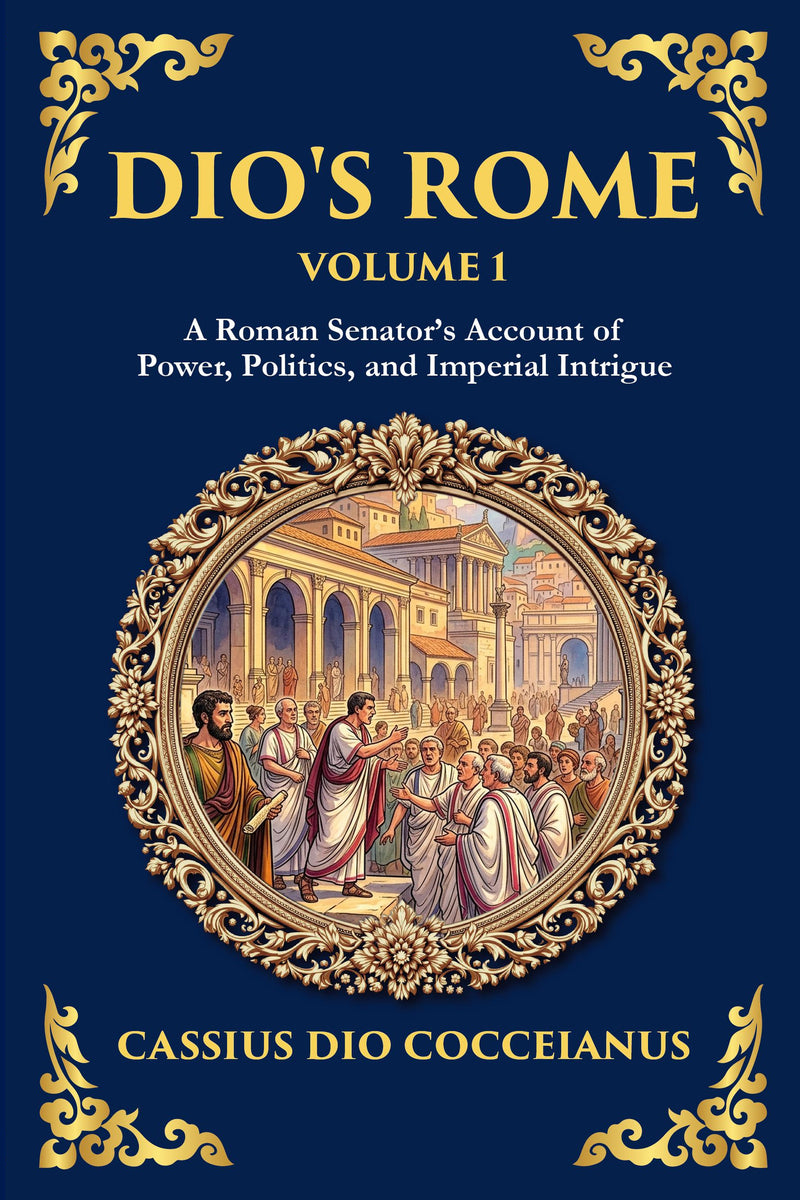
Dio’s Rome, Volume 1 — Large Print
Cassius Dio From the Senate floor to the battlefield, from the rise of Caesar to the intrigues of emperors, Dio’s Rome offers one of the most vivid, detailed, and insider accounts of the Roman Empire ever recorded.
or free app
10,000+ hrs library
30-day guarantee
The complete Dio's Rome, Volume 1 appears in modern English through Library of Alexandria Press, available online with audiobook narration included for members.
Have you ever wondered why the rise and fall of Rome still mirrors modern power today? Dio’s Rome, Volume 1 opens a door into the corridors of ancient authority, presenting Roman history through the penetrating eyes of one of its most important insiders: Cassius Dio Cocceianus. A senator and historian born in the 2nd century CE, Dio wrote an ambitious 80- volume chronicle covering nearly a thousand years of Roman history.
This first volume begins with the mythic origins of the city, the founding of the Republic, and the growing pains of a civilization destined for empire. But this isn’t dry history—Dio's account is alive with drama, political maneuvering, corruption, civil war, and complex philosophical reflection. It reads like a political thriller infused with hard-earned wisdom from within the Roman elite.
What you’ll discover in this modern edition
- The Origins of Rome’s Power Explore the stories of Romulus and Remus, early kings, and the political transformations that built a republic.
| Formats | eBook (EPUB + PDF) · Audiobook · Paperback · Hardcover · Large Print |
| Language | English |
| Trim size (print) | 6 × 9 in |
| Binding | Paperback — perfect-bound · Hardcover — casewrap |
| Large Print edition | Same text in a larger, easy-read type — a larger font, not a larger trim |
| Print pricing | Every physical book at our true cost — at-cost, no profit (members) |
| Library | 873 restored titles, always growing |
| Length | 78,538 words · ~5 hr 14 min reading |
| Reading level | Grade 10 · a comfortable read (this modern-English edition) |
| Edition | Modern English translation · 2026 |
Member reviews for this edition are collected as readers finish it — be the first. Across the library: 12,000+ books shipped, every plan covered by a 365-day print guarantee.
About this edition
A faithful, unabridged modern-English edition by The Library of Alexandria — carefully rendered for today's reader and verified paragraph-by-paragraph against the public-domain source. Available as eBook, audiobook, paperback, hardcover, and large print.
- Complete & unabridgedVerified paragraph by paragraph against the source — never a scan, never abridged.
- Modern English, faithfulReadable today, with the author’s meaning kept intact. Readable — not simplified.
- Every format, one membershipRead in your browser or the free app, or listen to the full audiobook.
Included free with your membership
Cancel anytime, one click · 30-day money-back guarantee
Edition last updated July 2026
What’s inside
Dio’s Rome, Volume 1 — Large Print — complete and unabridged: all 34 sections included with membership, plus the full audiobook.
Begin reading Dio’s Rome, Volume 1 — Large Print
In clear modern English — the complete text is included with membership.
Introduction
There is a particular kind of authority that comes only from standing inside the machinery of power while writing about it. Cassius Dio possessed exactly this authority. He was not a poet imagining the grandeur of Rome from a distance, nor a moralist scolding it from the sidelines, nor a chronicler stitching together rumors he half-believed. He was a Roman senator, a man who sat in the chamber where decisions of war and succession were debated, who served as consul, who governed provinces, who watched emperors rise and fall, and who lived long enough to understand that the spectacle of imperial Rome was both more magnificent and more terrifying than any outsider could imagine. When he set out to write the history of Rome from its mythical founding to his own lifetime, he did so as someone who knew precisely how the levers of state worked—and how easily those levers could crush the men who pulled them.
The volume you are about to read is the first installment of that immense undertaking, a work that originally spanned eighty books and covered nearly a thousand years of Roman history. Composed in Greek, the literary language of the educated elite throughout the eastern Mediterranean, Dio’s Roman History was the labor of decades. He claimed to have spent ten years gathering his materials and twelve more writing them up, and even that staggering investment of effort tells us something important about the man: he was patient, methodical, and utterly serious about the responsibility of recording the truth as he understood it. This was not a hasty work, nor a flattering one commissioned to please a patron. It was the considered testimony of a man who believed that the story of Rome deserved to be told completely, honestly, and with the insight that only someone who had lived within its institutions could provide.
What makes Dio so valuable—and what makes this opening volume such a rewarding place to begin—is the rare combination of perspectives he brings to the page. He was a Greek by culture and a Roman by citizenship and career, a position that allowed him to see Rome both from within and from a certain critical distance. He admired Roman discipline, Roman law, and the genius for organization that allowed a single city to govern the known world. Yet he was never blind to the cruelty, the corruption, and the self-destruction that ran through Roman political life like a vein of poison through marble. He had watched, firsthand, how the concentration of power in a single man could produce both stability and horror. This dual awareness gives his history a tone that modern readers will find surprisingly congenial: he is neither a cheerleader nor a cynic, but a clear-eyed observer trying to understand how power actually behaves when it is unconstrained.
To understand why Dio writes the way he does, it helps to know something of the life he led. He was born around the year 164 in Nicaea, a city in the province of Bithynia in what is now northwestern Turkey. His family was distinguished and wealthy; his father had served as a senator and governor, and Dio followed the same path of public service, moving to Rome and entering the senatorial career that would define his life. He held the office of praetor, served twice as consul—the second time as a colleague of the emperor himself, a singular honor—and governed important provinces including Africa, Dalmatia, and Pannonia. This was not the résumé of a man on the margins. Dio was, by any measure, a member of the imperial establishment, present at the center of Roman affairs during one of the most turbulent stretches of the empire’s history.
And what a turbulent stretch it was. Dio lived through the reigns of more than a dozen emperors, several of whom were murdered, deposed, or driven to suicide. He witnessed the assassination of the emperor Commodus, the chaotic auction of the imperial throne to the highest bidder, and the bloody civil wars that followed. He served under emperors who were capable and conscientious, and under others who were unstable, paranoid, and dangerous to be near. He understood, in a way that few historians ever have, what it actually felt like to attend a senate meeting where the wrong expression on your face might be reported to a suspicious ruler, where flattery was a survival skill, and where the line between honor and execution could be measured in a single ill-timed word.
This lived experience shaped everything about how he wrote history. When Dio describes the dynamics of ambition, the corrosive effects of fear, the way that men who gain absolute power tend to lose their grip on reality, he is not speculating. He is drawing on what he had seen with his own eyes. He famously recounted having a vision or dream in which a divine presence instructed him to write history, and whether we read that as genuine belief or literary convention, it points to the sense of mission that animated his work. He felt called to set down the record, to preserve for posterity an account of how Rome had become what it was, and to do so with a candor that the dangers of his own time often made difficult.
This first volume reaches back to the very origins of the Roman story—to the legendary kings, to the foundation myths, to the early struggles that shaped the Roman character long before the city became the master of the Mediterranean. For Dio, these beginnings were not merely quaint tales of a distant past. They were the seedbed of everything that came after. He believed that the institutions, the values, and the fatal tendencies of Rome were planted in its earliest days, and that to understand the empire of his own time you had to understand the republic that preceded it, and the monarchy that preceded that. His history is, in this sense, an extended argument about cause and consequence—about how the choices made by one generation echo through the centuries that follow.
Modern readers should be prepared for the way Dio handles his early material. Because the sources for Rome’s most ancient history were themselves a tangle of legend, oral tradition, and patriotic embellishment, Dio often presents stories whose factual basis is uncertain. He was aware of this difficulty and sometimes signals his own doubts. But he understood something that the best historians always understand: that the stories a people tells about its origins reveal as much truth as the bare facts ever could. The legends of Rome’s founding, the tales of its early heroes and villains, the myths of its kings—these expressed the values that Romans held dear and the anxieties that haunted them. Dio preserves them not because he believes every detail, but because they are essential to understanding the Roman mind.
It is worth pausing to consider how Dio’s work has reached us. The original eighty books did not all survive intact. Some portions have come down to us in their entirety, while others exist only in fragments, in summaries made by later Byzantine scholars, or in the abridgments of medieval epitomators who condensed his sprawling text into more manageable forms. The opening books, dealing with the earliest history, are among those that survive in a more fragmentary or summarized state. This means that the text you are reading sometimes reflects the work of those later hands who preserved Dio’s account by compressing it. Yet even in this condensed form, Dio’s distinctive voice and judgment shine through. The thread of his analysis, his interest in the mechanics of power, his attention to the moral character of leaders, remains unmistakable. What we have lost in completeness, we have not entirely lost in substance.
This edition has been prepared as a modern translation, adapted for the contemporary reader, and that phrase deserves some explanation, because it speaks directly to the experience you are about to have. Ancient historical prose, particularly when rendered in older English translations, can be a forbidding thing. The Greek of Dio’s original is dense, formal, and built around rhetorical conventions that were prized in his own day but that can feel alien and exhausting to a modern audience. Earlier translations, often produced in the nineteenth century, frequently preserved this density faithfully but at the cost of accessibility, burying Dio’s keen observations beneath thickets of archaic vocabulary, tangled syntax, and sentences that wind on for half a page before reaching their point.
The purpose of a modern adaptation is to clear away those obstacles without sacrificing the substance of what Dio has to say. The aim is to let his intelligence, his wit, and his hard-won insight reach you directly, in language that flows naturally for a reader of today. This does not mean the history has been dumbed down or stripped of its richness. It means that the barriers between you and the author have been lowered as much as possible, so that you can engage with his ideas rather than fighting through the medium that carries them. Think of it as the difference between viewing a great painting through a grimy, yellowed varnish and viewing it after a careful cleaning has restored its original colors. The painting is the same; your ability to see it is transformed.
You will find, as you read, that the rewards of this approach are considerable. Dio is a wonderful guide to the ancient world precisely because he is so interested in human nature. He understood that history is made by people—by their ambitions and fears, their loyalties and betrayals, their moments of courage and their failures of nerve. He is endlessly attentive to character, and he has a gift for the telling detail that brings a figure to life. He notices how men behave under pressure, how power changes them, how the public face they present to the world often conceals something quite different underneath. Reading him, you begin to feel that you understand not just what happened in Rome, but why it happened—and what it might have felt like to be there.
There are a few things worth keeping in mind as you make your way through this volume, so that you can appreciate it on its own terms. The first is that Dio wrote within a tradition of historiography that valued certain conventions we no longer practice. He composed speeches and put them into the mouths of historical figures, not as verbatim transcripts but as a way of dramatizing the issues at stake and exploring the motives of his characters. This was standard practice among ancient historians, going back to Thucydides, and it was understood by ancient readers as a legitimate literary technique rather than a fabrication. When you encounter these set-piece speeches, read them as Dio’s attempt to illuminate the reasoning and rhetoric of a particular moment, his way of letting you inside the heads of the men who shaped events. They are among the most revealing passages in the entire work.
A second thing to bear in mind is that Dio, like all historians, wrote from a particular point of view shaped by his own time, class, and experience. He was a member of the senatorial aristocracy, and his sympathies often lay with that class and its traditions. He tended to judge emperors by how they treated the senate and whether they respected the dignity of its members. He could be harsh toward popular movements and toward rulers who courted the favor of the common people at the expense of the elite. None of this should be held against him, but it is useful to be aware of his vantage point. Every historian sees the world from somewhere, and recognizing where Dio stands helps you read him more intelligently, weighing his judgments rather than simply accepting them. The best way to engage with any great historian is in a spirit of thoughtful dialogue, taking seriously what they say while remaining alert to the perspective from which they say it.
A third consideration is the sheer scope of the enterprise you are joining. This volume is the beginning of a journey through one of the longest and most ambitious works of history to survive from the ancient world. Dio set out to do nothing less than tell the entire story of Rome, and to do so with an analytical depth that few of his predecessors had attempted. As you read, you are participating in a project of extraordinary intellectual ambition—an attempt by one remarkable mind to make sense of a thousand years of human experience, of the rise of a small city into a world empire, and of the profound transformation by which a republic of citizens became an autocracy of emperors. The questions Dio grappled with—how power should be distributed, what makes a government stable, why even well-intentioned leaders can become tyrants, how societies decay from within—are questions that remain urgently relevant today. His Rome can feel startlingly close to our own world, and that uncanny familiarity is part of what makes him so worth reading.
Cancel anytime, one click · 30-day money-back guarantee
Founding annual rate available now — your price locks for life when you join.
Not ready? Get this free chapter by email — read it anytime.
✓ Sent — check your inbox for Dio’s Rome, Volume 1 — Large Print.
Questions about Dio’s Rome, Volume 1 — Large Print
What is Dio's Rome, Volume 1 about?
Cassius Dio From the Senate floor to the battlefield, from the rise of Caesar to the intrigues of emperors, Dio’s Rome offers one of the most vivid, detailed, and insider accounts of the Roman Empire ever recorded. Written by Cassius Dio—a Roman senator, consul, and historian—this monumental work chronicles the inner workings of Rome’s political machinery from a perspective few others could offer. Volume 1 of this newly formatted edition dives into the early days of the Republic and the foundational myths of Roman
Who wrote Dio's Rome, Volume 1?
Dio's Rome, Volume 1 was written by Cassius Dio Cocceianus. This edition presents the complete work in clear modern English, faithfully rendered from the public-domain original by Library of Alexandria Press.
Is Dio's Rome, Volume 1 free to read?
The opening chapter is free to read on this page. Members read and listen to the complete work — and the entire library — free, and can order any physical book at our true print cost.
How long is Dio's Rome, Volume 1?
34 chapters (~78,538 words) — about 5 hr 14 min of reading in this modern-English edition.
Is this an abridged version of Dio's Rome, Volume 1?
No. This is the complete, unabridged Dio's Rome, Volume 1, carefully rendered into clear modern English and verified paragraph-by-paragraph against the public-domain source — nothing is cut or summarised.
What formats does Dio's Rome, Volume 1 come in?
Dio's Rome, Volume 1 is available as eBook, paperback, hardcover and large print. eBook and audiobook are included with membership; printed editions ship at our true print cost.
Shipping & returns
Billing & membership
More from the library


Explore Classic & Literary
- Dream Psychology: Psychoanalysis for Beginners · Sigmund Freud
- Great Expectations · Charles Dickens
- The Brothers Karamazov · Fyodor Dostoyevsky
- The Great Gatsby · F. Scott Fitzgerald
- Wild Flowers Worth Knowing · Neltje Blanchan
- Italian Hours · Henry James
- A Popular History of France from the Earliest Times, Volume 5 · François Guizot
- A history of English literature: A practical text-book · Edward Albert
- Italian Highways and Byways from a Motor Car · M. F. Mansfield
- The Heart-Cry of Jesus · Byron J. Rees
- Castes and Tribes of Southern India. Vol. 6 of 7 · Edgar Thurston
- Against the Grain · J.-K. Huysmans
- Dombey and Son · Charles Dickens
- How to Invest Money · George Garr Henry
- The Great Controversy Between Christ and Satan · Ellen Gould Harmon White
- One Hundred Proofs That the Earth Is Not a Globe · William Carpenter
- Southern Literature From 1579–1895 · Louise Manly
- The Renaissance: Studies in Art and Poetry · Walter Pater
- Mark Twain’s Speeches · Mark Twain
- Tacitus on Germany · Cornelius Tacitus
- The Rosary · Florence L. Barclay
- Peculiarities of American Cities · Willard W. Glazier
- Tennis for Girls · Florence A. Ballin
- The World’s Greatest Books — Volume 02 — Fiction
- Shirley · Charlotte Brontë
- Daisy Miller: A Study · Henry James
- Louis Lambert · Honoré de Balzac
- Historic Jamaica · Frank Cundall
- The Gambler · Fyodor Dostoyevsky
- The Mayor of Casterbridge · Thomas Hardy
Dio’s Rome, Volume 1 — Large Print
Dio’s Rome, Volume 1 — Large Print
A Roman Senator’s Account of Power, Politics, and Imperial Intrigue
Cassius Dio Cocceianus
Contents
- Introduction
- Chapter 1
- Chapter 2
- Chapter 3
- Chapter 4
- Chapter 5
- Chapter 6
- Chapter 7
- Chapter 8
- Chapter 9
- Chapter 10
- Chapter 11
- Chapter 12
- Chapter 13
- Chapter 14
- Chapter 15
- Chapter 16
- Chapter 17
- Chapter 18
- Chapter 19
- Chapter 20
- Chapter 21
- Chapter 22
- Chapter 23
- Chapter 24
- Chapter 25
- Chapter 26
- Chapter 27
- Chapter 28
- Chapter 29
- Chapter 30
- Chapter 31
- Chapter 32
- Chapter 33
Introduction
There is a particular kind of authority that comes only from standing inside the machinery of power while writing about it. Cassius Dio possessed exactly this authority. He was not a poet imagining the grandeur of Rome from a distance, nor a moralist scolding it from the sidelines, nor a chronicler stitching together rumors he half-believed. He was a Roman senator, a man who sat in the chamber where decisions of war and succession were debated, who served as consul, who governed provinces, who watched emperors rise and fall, and who lived long enough to understand that the spectacle of imperial Rome was both more magnificent and more terrifying than any outsider could imagine. When he set out to write the history of Rome from its mythical founding to his own lifetime, he did so as someone who knew precisely how the levers of state worked—and how easily those levers could crush the men who pulled them.
The volume you are about to read is the first installment of that immense undertaking, a work that originally spanned eighty books and covered nearly a thousand years of Roman history. Composed in Greek, the literary language of the educated elite throughout the eastern Mediterranean, Dio’s Roman History was the labor of decades. He claimed to have spent ten years gathering his materials and twelve more writing them up, and even that staggering investment of effort tells us something important about the man: he was patient, methodical, and utterly serious about the responsibility of recording the truth as he understood it. This was not a hasty work, nor a flattering one commissioned to please a patron. It was the considered testimony of a man who believed that the story of Rome deserved to be told completely, honestly, and with the insight that only someone who had lived within its institutions could provide.
What makes Dio so valuable—and what makes this opening volume such a rewarding place to begin—is the rare combination of perspectives he brings to the page. He was a Greek by culture and a Roman by citizenship and career, a position that allowed him to see Rome both from within and from a certain critical distance. He admired Roman discipline, Roman law, and the genius for organization that allowed a single city to govern the known world. Yet he was never blind to the cruelty, the corruption, and the self-destruction that ran through Roman political life like a vein of poison through marble. He had watched, firsthand, how the concentration of power in a single man could produce both stability and horror. This dual awareness gives his history a tone that modern readers will find surprisingly congenial: he is neither a cheerleader nor a cynic, but a clear-eyed observer trying to understand how power actually behaves when it is unconstrained.
To understand why Dio writes the way he does, it helps to know something of the life he led. He was born around the year 164 in Nicaea, a city in the province of Bithynia in what is now northwestern Turkey. His family was distinguished and wealthy; his father had served as a senator and governor, and Dio followed the same path of public service, moving to Rome and entering the senatorial career that would define his life. He held the office of praetor, served twice as consul—the second time as a colleague of the emperor himself, a singular honor—and governed important provinces including Africa, Dalmatia, and Pannonia. This was not the résumé of a man on the margins. Dio was, by any measure, a member of the imperial establishment, present at the center of Roman affairs during one of the most turbulent stretches of the empire’s history.
And what a turbulent stretch it was. Dio lived through the reigns of more than a dozen emperors, several of whom were murdered, deposed, or driven to suicide. He witnessed the assassination of the emperor Commodus, the chaotic auction of the imperial throne to the highest bidder, and the bloody civil wars that followed. He served under emperors who were capable and conscientious, and under others who were unstable, paranoid, and dangerous to be near. He understood, in a way that few historians ever have, what it actually felt like to attend a senate meeting where the wrong expression on your face might be reported to a suspicious ruler, where flattery was a survival skill, and where the line between honor and execution could be measured in a single ill-timed word.
This lived experience shaped everything about how he wrote history. When Dio describes the dynamics of ambition, the corrosive effects of fear, the way that men who gain absolute power tend to lose their grip on reality, he is not speculating. He is drawing on what he had seen with his own eyes. He famously recounted having a vision or dream in which a divine presence instructed him to write history, and whether we read that as genuine belief or literary convention, it points to the sense of mission that animated his work. He felt called to set down the record, to preserve for posterity an account of how Rome had become what it was, and to do so with a candor that the dangers of his own time often made difficult.
This first volume reaches back to the very origins of the Roman story—to the legendary kings, to the foundation myths, to the early struggles that shaped the Roman character long before the city became the master of the Mediterranean. For Dio, these beginnings were not merely quaint tales of a distant past. They were the seedbed of everything that came after. He believed that the institutions, the values, and the fatal tendencies of Rome were planted in its earliest days, and that to understand the empire of his own time you had to understand the republic that preceded it, and the monarchy that preceded that. His history is, in this sense, an extended argument about cause and consequence—about how the choices made by one generation echo through the centuries that follow.
Modern readers should be prepared for the way Dio handles his early material. Because the sources for Rome’s most ancient history were themselves a tangle of legend, oral tradition, and patriotic embellishment, Dio often presents stories whose factual basis is uncertain. He was aware of this difficulty and sometimes signals his own doubts. But he understood something that the best historians always understand: that the stories a people tells about its origins reveal as much truth as the bare facts ever could. The legends of Rome’s founding, the tales of its early heroes and villains, the myths of its kings—these expressed the values that Romans held dear and the anxieties that haunted them. Dio preserves them not because he believes every detail, but because they are essential to understanding the Roman mind.
It is worth pausing to consider how Dio’s work has reached us. The original eighty books did not all survive intact. Some portions have come down to us in their entirety, while others exist only in fragments, in summaries made by later Byzantine scholars, or in the abridgments of medieval epitomators who condensed his sprawling text into more manageable forms. The opening books, dealing with the earliest history, are among those that survive in a more fragmentary or summarized state. This means that the text you are reading sometimes reflects the work of those later hands who preserved Dio’s account by compressing it. Yet even in this condensed form, Dio’s distinctive voice and judgment shine through. The thread of his analysis, his interest in the mechanics of power, his attention to the moral character of leaders, remains unmistakable. What we have lost in completeness, we have not entirely lost in substance.
This edition has been prepared as a modern translation, adapted for the contemporary reader, and that phrase deserves some explanation, because it speaks directly to the experience you are about to have. Ancient historical prose, particularly when rendered in older English translations, can be a forbidding thing. The Greek of Dio’s original is dense, formal, and built around rhetorical conventions that were prized in his own day but that can feel alien and exhausting to a modern audience. Earlier translations, often produced in the nineteenth century, frequently preserved this density faithfully but at the cost of accessibility, burying Dio’s keen observations beneath thickets of archaic vocabulary, tangled syntax, and sentences that wind on for half a page before reaching their point.
The purpose of a modern adaptation is to clear away those obstacles without sacrificing the substance of what Dio has to say. The aim is to let his intelligence, his wit, and his hard-won insight reach you directly, in language that flows naturally for a reader of today. This does not mean the history has been dumbed down or stripped of its richness. It means that the barriers between you and the author have been lowered as much as possible, so that you can engage with his ideas rather than fighting through the medium that carries them. Think of it as the difference between viewing a great painting through a grimy, yellowed varnish and viewing it after a careful cleaning has restored its original colors. The painting is the same; your ability to see it is transformed.
You will find, as you read, that the rewards of this approach are considerable. Dio is a wonderful guide to the ancient world precisely because he is so interested in human nature. He understood that history is made by people—by their ambitions and fears, their loyalties and betrayals, their moments of courage and their failures of nerve. He is endlessly attentive to character, and he has a gift for the telling detail that brings a figure to life. He notices how men behave under pressure, how power changes them, how the public face they present to the world often conceals something quite different underneath. Reading him, you begin to feel that you understand not just what happened in Rome, but why it happened—and what it might have felt like to be there.
There are a few things worth keeping in mind as you make your way through this volume, so that you can appreciate it on its own terms. The first is that Dio wrote within a tradition of historiography that valued certain conventions we no longer practice. He composed speeches and put them into the mouths of historical figures, not as verbatim transcripts but as a way of dramatizing the issues at stake and exploring the motives of his characters. This was standard practice among ancient historians, going back to Thucydides, and it was understood by ancient readers as a legitimate literary technique rather than a fabrication. When you encounter these set-piece speeches, read them as Dio’s attempt to illuminate the reasoning and rhetoric of a particular moment, his way of letting you inside the heads of the men who shaped events. They are among the most revealing passages in the entire work.
A second thing to bear in mind is that Dio, like all historians, wrote from a particular point of view shaped by his own time, class, and experience. He was a member of the senatorial aristocracy, and his sympathies often lay with that class and its traditions. He tended to judge emperors by how they treated the senate and whether they respected the dignity of its members. He could be harsh toward popular movements and toward rulers who courted the favor of the common people at the expense of the elite. None of this should be held against him, but it is useful to be aware of his vantage point. Every historian sees the world from somewhere, and recognizing where Dio stands helps you read him more intelligently, weighing his judgments rather than simply accepting them. The best way to engage with any great historian is in a spirit of thoughtful dialogue, taking seriously what they say while remaining alert to the perspective from which they say it.
A third consideration is the sheer scope of the enterprise you are joining. This volume is the beginning of a journey through one of the longest and most ambitious works of history to survive from the ancient world. Dio set out to do nothing less than tell the entire story of Rome, and to do so with an analytical depth that few of his predecessors had attempted. As you read, you are participating in a project of extraordinary intellectual ambition—an attempt by one remarkable mind to make sense of a thousand years of human experience, of the rise of a small city into a world empire, and of the profound transformation by which a republic of citizens became an autocracy of emperors. The questions Dio grappled with—how power should be distributed, what makes a government stable, why even well-intentioned leaders can become tyrants, how societies decay from within—are questions that remain urgently relevant today. His Rome can feel startlingly close to our own world, and that uncanny familiarity is part of what makes him so worth reading.
When he was about forty years old, Cassius Dio Cocceianus, a Roman senator and praetor, wrote a short pamphlet about the dreams and omens that made General Septimius Severus believe he would become emperor—a goal he eventually achieved. One evening, the emperor sent the author a note of thanks. This success stayed with Dio in his dreams, where a guiding angel encouraged him to write a detailed history of the reign of the unworthy Commodus, which had just ended. Once again, Dio was thrilled by the praise from both the emperor and the public. Driven by a passion for publishing and a strong desire to be remembered by history—a wish that came true—he took on the massive task of writing a complete account of Roman events, starting from the beginning and continuing as far as fate would allow. He immediately began gathering materials, a process that took ten active years from A.D. 200 to 210. The actual writing took another twelve years, interrupted by his government duties, and brought his narrative up to the start of the reign of his original patron, the first Severus. All these details come from Dio’s own account, found in what is now chapter twenty-three of book seventy-two, as recorded by the detailed chronicler Ioannes Xiphilinus.
By A.D. 223, Dio had either served as consul for the first time or had already completed his term. During this time, Elagabalus had died, and Alexander Severus had taken the throne. The remaining books (seventy-three through eighty) must have been written under this emperor, as Dio finished his history in 229. Since he was nearly eighty years old by then and wrote nothing after Alexander’s reign, we can conclude that he did not outlive the emperor, who died in 235. In total, he left behind eighty books covering the period from 1064 B.C. to 229 A.D. Today, only books thirty-six through sixty survive in full, covering the years 68 B.C. to 47 A.D. The final twenty books, sixty-one to eighty, exist only in fairly reliable summaries and excerpts. For the first thirty-five books, we have only tiny scraps and fragments. Our next task is to trace how this great work fell apart and in what form it has been preserved for us today.
End of the free sample
Keep reading, free
Members read and listen to the complete book — and the entire library. Cancel anytime, one click · 30-day money-back guarantee.