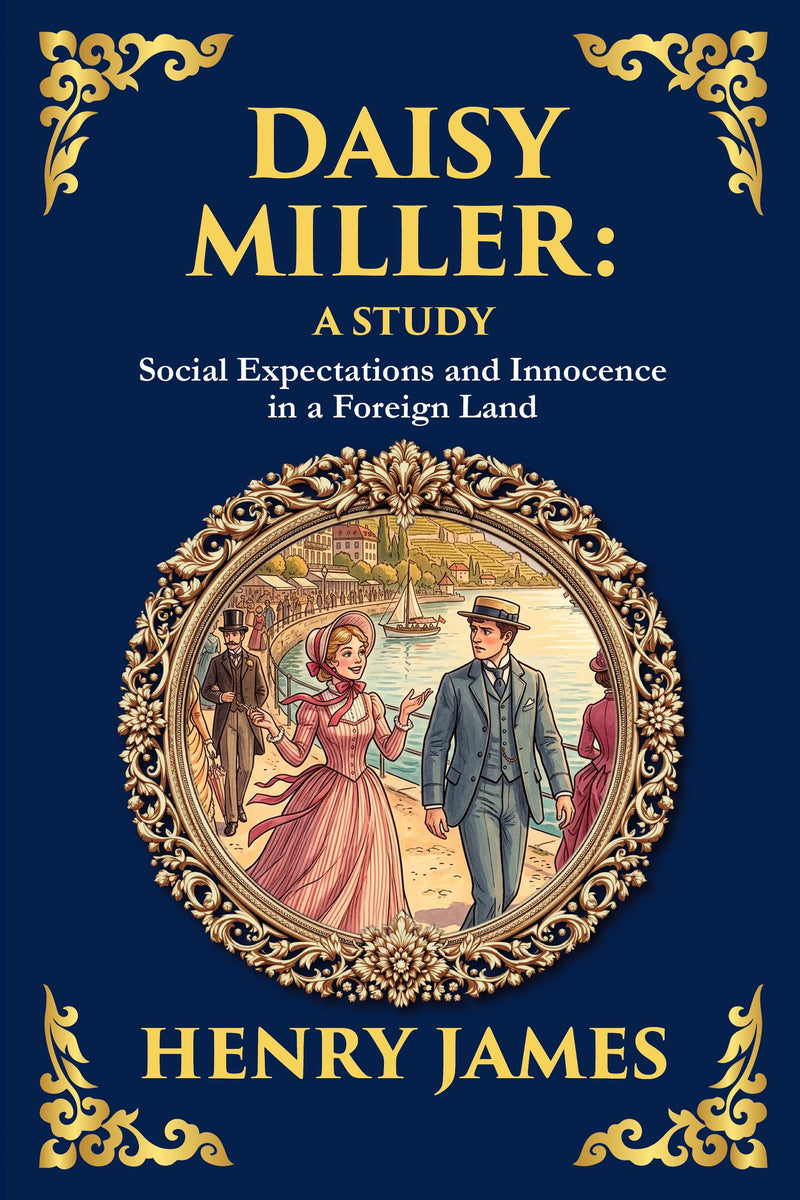
Daisy Miller: A Study — Large Print
A young American woman abroad. A society that watches and whispers. A tragedy that unfolds in plain sight. In Daisy Miller: A Study, Henry James presents a powerful portrait of innocence colliding with the rigid expectations of European society.
or free app
10,000+ hrs library
30-day guarantee
The complete Daisy Miller: A Study appears in modern English through Library of Alexandria Press, available online with audiobook narration included for members.
What if your friendliness becomes the evidence everyone uses against you?
At a hotel in Vevey, Switzerland, Daisy Miller wants to enjoy Europe on her own terms. Frederick Winterbourne, a young American long settled in Geneva, is drawn to her confidence. But his aunt, Mrs Costello, refuses to meet the Millers. Daisy speaks openly and follows her wishes; Winterbourne wonders how to read her.
In Rome, Daisy’s friendship with the handsome Mr Giovanelli brings her under closer scrutiny. Mrs Walker tries to guide her, while Winterbourne measures her conduct against his circle’s rules. In Henry James’s short novel, quiet conversations carry sharp judgments. What matters more: Daisy’s belief in her own honesty, or the reputation others build around her?
What you'll discover
- A woman who resists – Meet Daisy, whose wish to enjoy herself runs against the expectations surrounding her.
- A watcher in doubt – See through Winterbourne’s eyes as attraction and social habit pull his judgment apart.
- From Vevey to Rome – Follow Daisy from a Swiss lakeside hotel into a society quick to judge.
- The weight of gossip – Notice how ordinary meetings become tests of character when reputation matters more than understanding.
- Questions without easy answers – Weigh innocence against carelessness in a story that leaves room for your own judgment.
Perfect for readers who love short, precise stories about manners, pride and misjudgment, and anyone curious about Americans in Europe.
Open the first page and meet Daisy before you decide what to think of her.
| Formats | eBook (EPUB + PDF) · Audiobook · Paperback · Hardcover · Large Print |
| Language | English |
| Trim size (print) | 6 × 9 in |
| Binding | Paperback — perfect-bound · Hardcover — casewrap |
| Large Print edition | Same text in a larger, easy-read type — a larger font, not a larger trim |
| Print pricing | Every physical book at our true cost — at-cost, no profit (members) |
| Library | 873 restored titles, always growing |
| Length | 23,803 words · ~1 hr 35 min reading |
| Reading level | Grade 3 · an easy, flowing read (this modern-English edition) |
| Edition | Modern English translation · 2026 |
Member reviews for this edition are collected as readers finish it — be the first. Across the library: 12,000+ books shipped, every plan covered by a 365-day print guarantee.
About this edition
A faithful, unabridged modern-English edition by The Library of Alexandria — carefully rendered for today's reader and verified paragraph-by-paragraph against the public-domain source. Available as eBook, audiobook, paperback, hardcover, and large print.
- Complete & unabridgedVerified paragraph by paragraph against the source — never a scan, never abridged.
- Modern English, faithfulReadable today, with the author’s meaning kept intact. Readable — not simplified.
- Every format, one membershipRead in your browser or the free app, or listen to the full audiobook.
Included free with your membership
Cancel anytime, one click · 30-day money-back guarantee
Edition last updated July 2026
What’s inside
Daisy Miller: A Study — Large Print — complete and unabridged: all 3 sections included with membership, plus the full audiobook.
Begin reading Daisy Miller: A Study — Large Print
In clear modern English — the complete text is included with membership.
Introduction
There are certain books that seem small at first glance—slender, unassuming, easily finished in an afternoon—yet contain within their modest pages a depth of feeling and complexity of observation that rewards a lifetime of rereading. The work you are about to encounter belongs unmistakably to this category. First published in 1878, when its author was a young man not yet fully established in the literary firmament he would eventually come to dominate, this brief novella catapulted Henry James to a kind of fame he had not previously known. It became, almost overnight, a sensation on both sides of the Atlantic—debated in drawing rooms, argued over in correspondence, defended and attacked with surprising heat. That such intensity of reaction should have attached itself to so quiet a story tells us something essential about the nerve it touched, a nerve that, in many ways, remains exposed and tender even now.
What makes this slim volume so enduring is not the size of its events but the precision of its perceptions. James was a writer who understood that the most consequential dramas of human life often unfold not in battles or catastrophes but in the smallest social gestures: a glance withheld, an invitation declined, a word spoken too freely, a reputation quietly assessed and silently condemned. In the pages that follow, you will find no villains in the conventional sense, no dramatic confrontations of the kind that fill more sensational fiction. Instead, you will encounter something far more subtle and, ultimately, far more devastating—a study, as the original subtitle promised, of how a community comes to judge an individual, and of how that individual, in her freedom and her unwillingness to be governed, becomes both a mystery and a problem to those around her.
This particular edition has been thoughtfully prepared as a modern translation, adapted for the contemporary reader. It is worth pausing to consider what such an adaptation means and why it matters. Henry James, especially in his later years, became famous—or infamous—for a prose style of extraordinary intricacy, full of elaborate qualifications, suspended clauses, and sentences that seem to circle their subject like a careful observer reluctant to commit to a single, simple statement. Even in this early work, written before his style reached its most labyrinthine extremes, the reader of the original may sometimes find the cadences of nineteenth-century formality a barrier to the immediate emotional connection that the story so richly deserves. The aim of this adaptation is to lower that barrier without diminishing the experience—to allow the freshness, the wit, the sly humor, and the heartbreaking poignancy of the narrative to reach you directly, unobstructed by the linguistic conventions of a vanished era. The intention is never to simplify the story’s meaning, which remains as layered and ambiguous as ever, but rather to ensure that nothing stands between you and the genuine pleasures and provocations of the text.
To enter this story is to step into a particular and peculiar world—the world of wealthy, leisured Americans who, in the latter half of the nineteenth century, traveled across Europe in great numbers, settling for months or years at a time in the great cities and resort towns of the Continent. These were people of means but not always of fixed purpose, drifting from Geneva to Rome, from the lakeside hotels of Switzerland to the ancient ruins of Italy, carrying with them their American sensibilities and encountering, often uneasily, the older, more rigid social codes of the Old World. James himself was a profound and lifelong student of this collision between American innocence and European experience, between the freshness of the New World and the accumulated, sometimes suffocating, traditions of the Old. It was the great theme of his career, and here, in early and crystalline form, we find it presented with a clarity he would rarely surpass.
The genius of the narrative lies in its method of observation. We do not see events directly so much as we see them reflected through the consciousness of an observer—a young American man, himself something of an expatriate, who has lived long enough abroad to have absorbed many of Europe’s social assumptions while still retaining traces of his American origins. Through his eyes, we watch a young woman arrive on the scene, and through his attempts to understand her, to categorize her, to decide what kind of person she is and what her behavior signifies, we are drawn into the central drama of the book. This is, fundamentally, a story about interpretation—about the way we read other people, the conclusions we draw from their conduct, and the often unbridgeable gap between who someone truly is and who we imagine them to be.
This is what makes the experience of reading so quietly thrilling. We, like the observer at the center of the tale, are constantly trying to make sense of a young woman whose behavior puzzles and unsettles those around her. Is she innocent or calculating? Is she ignorant of the rules she breaks, or does she break them deliberately, out of some deeper conviction or some careless indifference? Is she a free spirit to be admired, or a reckless girl to be pitied, or a social danger to be avoided? The brilliance of the construction is that these questions are never resolved into easy answers. James refuses to hand us a verdict. Instead, he places us in the uncomfortable and illuminating position of the judge, forcing us to confront our own assumptions, our own readiness to condemn or to forgive, our own susceptibility to the very prejudices the story so delicately exposes.
There is, throughout, a community of watchers—a society of fellow Americans abroad who have established themselves in Europe and who guard the boundaries of acceptable behavior with the fierce vigilance of those who feel their own status to be uncertain. These are not the native Europeans, interestingly, but the transplanted Americans, who in their anxiety to be accepted by the older world have become, in many cases, more rigid and more censorious than the Europeans themselves. They observe, they whisper, they extend or withhold their social favor, and in doing so they wield a power that, though invisible, proves immensely consequential. To read this book attentively is to become aware of the extraordinary cruelty that can hide behind the polished surface of polite society—the way a smile can wound, the way an exclusion can devastate, the way a reputation can be made or destroyed by nothing more substantial than a pattern of glances and murmurs.
The setting itself participates in the meaning. The story moves between the cool, orderly precincts of Switzerland and the warmer, more ancient, more morally ambiguous atmosphere of Italy, and these locations are never merely backdrops. The crisp Alpine air of the opening contrasts with the romantic, perilous beauty of Rome, with its crumbling monuments and its sense of accumulated history pressing down upon the living. The very stones of these places seem to carry weight, to embody the contrast between freshness and decay, between the new and the old, between liberty and constraint. As you read, you may find yourself attending not only to the people but to the places they inhabit, and to the subtle ways in which the physical world reflects and intensifies the human dramas playing out within it.
The Question of Innocence and the Price of Freedom
At the heart of this study lies a question that has lost none of its urgency in the nearly century and a half since it was first posed: what does it mean to be innocent, and what does the world do to those who insist upon their own freedom? The young woman at the center of the narrative is, above all, a free creature—free in her movements, free in her speech, free in her associations, free in her refusal to be told what she may and may not do. She comes from a world, the rising commercial America of her time, where the old hierarchies have less force, where a young woman of means might move through life with a confidence and an independence that would scandalize the more tradition-bound society she encounters abroad. Her freedom is, in a sense, an American freedom—the freedom of a new kind of person in a new kind of nation, unaware or unwilling to acknowledge that the rules of the old world still hold sway in the circles she has entered.
What the story explores with such painful subtlety is the collision between this freedom and the expectations of a society that cannot or will not understand it. The community that surrounds her interprets her independence as impropriety, her openness as a lack of breeding, her refusal to conform as a kind of moral failing. And yet the reader is never quite sure whether these judgments are correct. This is the central ambiguity, the unresolved tension that gives the book its lasting power. Is she truly innocent—a guileless girl who simply does not understand the codes she is violating? Or is there something more willful, more knowing, in her conduct? Does she suffer because she is misunderstood, or because she courts misunderstanding, or because the very categories the society uses to judge her are inadequate to capture the reality of who she is?
These questions matter because they are not confined to the nineteenth century or to the rarefied world of expatriate Americans. They speak to something perennial in human experience—the way every society polices the behavior of its members, particularly the behavior of young women, and the way independence and nonconformity are so often punished, especially when they belong to those who lack the protection of established status or unambiguous propriety. The modern reader, encountering this story for the first time, may be struck by how contemporary its concerns feel. The anxieties about reputation, the swift and often unfair judgments rendered by a watchful community, the gap between appearance and reality, the cruelty that can masquerade as concern for proper conduct—all of these remain as recognizable today as they were when James first set them down.
It is important to say a word here about the author’s remarkable restraint, for it is one of the great achievements of the book and one of the qualities that this edition has worked hard to preserve. James does not tell us what to think. He does not editorialize, does not impose a moral, does not step forward to defend or to condemn his central figure. Instead, he holds her at a distance, presenting her always through the partial, uncertain, sometimes self-deceiving perceptions of the observer through whom we view her. This means that the reader must do the work of judgment, and in doing so, must become aware of the difficulty—the near impossibility—of truly knowing another person. We see her flirtations, her excursions, her defiances, her moments of apparent vulnerability, but we never have direct access to her inner life. She remains, to the very end, something of a mystery, and it is precisely this mystery that makes her so unforgettable.
This narrative strategy is no accident. James was deeply interested in the limits of human understanding, in the ways we project our own assumptions onto others and mistake those projections for knowledge. The observer at the center of the story is, in his way, as much the subject of the book as the young woman he tries to understand. His hesitations, his shifting judgments, his alternating attraction and disapproval, his ultimate failure to grasp the truth of the situation until it is too late—all of this is rendered with exquisite precision. As you read, you may find yourself identifying with him, sharing his confusion, drawing the same conclusions he draws, only to have those conclusions challenged or complicated. And in this shared experience of misjudgment lies one of the book’s deepest lessons: how easily we condemn what we do not understand, and how high the cost of that condemnation can be.
Cancel anytime, one click · 30-day money-back guarantee
Founding annual rate available now — your price locks for life when you join.
Not ready? Get this free chapter by email — read it anytime.
✓ Sent — check your inbox for Daisy Miller: A Study — Large Print.
Questions about Daisy Miller: A Study — Large Print
What is Daisy Miller about?
It is about a young American woman travelling in Switzerland and Italy whose open, friendly manner shocks the American community abroad. The story follows how Winterbourne and others judge her, and what that judgment costs.
When was Daisy Miller written and is it a true story?
Henry James published it in 1878. It is fiction, though James drew on what he saw of American travellers in Europe, and the story is said to have grown from an anecdote he heard in Rome.
Why is it called A Study?
The subtitle shows that James treats Daisy as a close study of a type, the independent American girl abroad, and of how society reacts to her. It signals careful observation more than plot.
Is Daisy Miller innocent or reckless?
James leaves the question open on purpose. Daisy seems honest and free of calculation, but she also ignores the rules of her setting. Winterbourne cannot decide, and readers still argue about it.
Shipping & returns
Billing & membership
More from the library


Explore Classic & Literary
- Resurrection · Leo Tolstoy
- Crime and Punishment · Fyodor Dostoyevsky
- Anna Karenina · Leo Tolstoy
- Moby-Dick · Herman Melville
- Great Expectations · Charles Dickens
- The Brothers Karamazov · Fyodor Dostoyevsky
- The Great Gatsby · F. Scott Fitzgerald
- McTeague: A Story of San Francisco — Large Print · Frank Norris
- McTeague: A Story of San Francisco · Frank Norris
- The Country House — Large Print · John Galsworthy
- Ethan Frome — Large Print · Edith Wharton
- Bartleby, the Scrivener: A Story of Wall-Street · Herman Melville
- Mrs. Dalloway — Large Print · Virginia Woolf
- Resurrection — Large Print · Leo Tolstoy
- Against the Grain — Large Print · Joris-Karl Huysmans
- The Red Badge of Courage: An Episode of the American Civil War · Stephen Crane
- Bartleby, the Scrivener: A Story of Wall-Street — Large Print · Herman Melville
- The Red Badge of Courage: An Episode of the American Civil War — Large Print · Stephen Crane
- North and South · Elizabeth Gaskell
- Barry Lyndon · William Makepeace Thackeray
- Barry Lyndon — Large Print · William Makepeace Thackeray
- North and South — Large Print · Elizabeth Gaskell
- Dombey and Son — Large Print · Charles Dickens
- My Ántonia — Large Print · Willa Cather
- Jane Eyre: An Autobiography · Charlotte Brontë
- Penrod — Large Print · Booth Tarkington
- Tess of the d'Urbervilles: A Pure Woman — Large Print · Thomas Hardy
- The Belle of Bowling Green · Amelia E. Barr
- The Possessed: Or, The Devils — Large Print · Fyodor Dostoyevsky
- Penrod · Booth Tarkington
Daisy Miller: A Study — Large Print
Daisy Miller: A Study — Large Print
Social Expectations and Innocence in a Foreign Land
Henry James
Contents
- Introduction
- Part 1
- Part 2
Introduction
There are certain books that seem small at first glance—slender, unassuming, easily finished in an afternoon—yet contain within their modest pages a depth of feeling and complexity of observation that rewards a lifetime of rereading. The work you are about to encounter belongs unmistakably to this category. First published in 1878, when its author was a young man not yet fully established in the literary firmament he would eventually come to dominate, this brief novella catapulted Henry James to a kind of fame he had not previously known. It became, almost overnight, a sensation on both sides of the Atlantic—debated in drawing rooms, argued over in correspondence, defended and attacked with surprising heat. That such intensity of reaction should have attached itself to so quiet a story tells us something essential about the nerve it touched, a nerve that, in many ways, remains exposed and tender even now.
What makes this slim volume so enduring is not the size of its events but the precision of its perceptions. James was a writer who understood that the most consequential dramas of human life often unfold not in battles or catastrophes but in the smallest social gestures: a glance withheld, an invitation declined, a word spoken too freely, a reputation quietly assessed and silently condemned. In the pages that follow, you will find no villains in the conventional sense, no dramatic confrontations of the kind that fill more sensational fiction. Instead, you will encounter something far more subtle and, ultimately, far more devastating—a study, as the original subtitle promised, of how a community comes to judge an individual, and of how that individual, in her freedom and her unwillingness to be governed, becomes both a mystery and a problem to those around her.
This particular edition has been thoughtfully prepared as a modern translation, adapted for the contemporary reader. It is worth pausing to consider what such an adaptation means and why it matters. Henry James, especially in his later years, became famous—or infamous—for a prose style of extraordinary intricacy, full of elaborate qualifications, suspended clauses, and sentences that seem to circle their subject like a careful observer reluctant to commit to a single, simple statement. Even in this early work, written before his style reached its most labyrinthine extremes, the reader of the original may sometimes find the cadences of nineteenth-century formality a barrier to the immediate emotional connection that the story so richly deserves. The aim of this adaptation is to lower that barrier without diminishing the experience—to allow the freshness, the wit, the sly humor, and the heartbreaking poignancy of the narrative to reach you directly, unobstructed by the linguistic conventions of a vanished era. The intention is never to simplify the story’s meaning, which remains as layered and ambiguous as ever, but rather to ensure that nothing stands between you and the genuine pleasures and provocations of the text.
To enter this story is to step into a particular and peculiar world—the world of wealthy, leisured Americans who, in the latter half of the nineteenth century, traveled across Europe in great numbers, settling for months or years at a time in the great cities and resort towns of the Continent. These were people of means but not always of fixed purpose, drifting from Geneva to Rome, from the lakeside hotels of Switzerland to the ancient ruins of Italy, carrying with them their American sensibilities and encountering, often uneasily, the older, more rigid social codes of the Old World. James himself was a profound and lifelong student of this collision between American innocence and European experience, between the freshness of the New World and the accumulated, sometimes suffocating, traditions of the Old. It was the great theme of his career, and here, in early and crystalline form, we find it presented with a clarity he would rarely surpass.
The genius of the narrative lies in its method of observation. We do not see events directly so much as we see them reflected through the consciousness of an observer—a young American man, himself something of an expatriate, who has lived long enough abroad to have absorbed many of Europe’s social assumptions while still retaining traces of his American origins. Through his eyes, we watch a young woman arrive on the scene, and through his attempts to understand her, to categorize her, to decide what kind of person she is and what her behavior signifies, we are drawn into the central drama of the book. This is, fundamentally, a story about interpretation—about the way we read other people, the conclusions we draw from their conduct, and the often unbridgeable gap between who someone truly is and who we imagine them to be.
This is what makes the experience of reading so quietly thrilling. We, like the observer at the center of the tale, are constantly trying to make sense of a young woman whose behavior puzzles and unsettles those around her. Is she innocent or calculating? Is she ignorant of the rules she breaks, or does she break them deliberately, out of some deeper conviction or some careless indifference? Is she a free spirit to be admired, or a reckless girl to be pitied, or a social danger to be avoided? The brilliance of the construction is that these questions are never resolved into easy answers. James refuses to hand us a verdict. Instead, he places us in the uncomfortable and illuminating position of the judge, forcing us to confront our own assumptions, our own readiness to condemn or to forgive, our own susceptibility to the very prejudices the story so delicately exposes.
There is, throughout, a community of watchers—a society of fellow Americans abroad who have established themselves in Europe and who guard the boundaries of acceptable behavior with the fierce vigilance of those who feel their own status to be uncertain. These are not the native Europeans, interestingly, but the transplanted Americans, who in their anxiety to be accepted by the older world have become, in many cases, more rigid and more censorious than the Europeans themselves. They observe, they whisper, they extend or withhold their social favor, and in doing so they wield a power that, though invisible, proves immensely consequential. To read this book attentively is to become aware of the extraordinary cruelty that can hide behind the polished surface of polite society—the way a smile can wound, the way an exclusion can devastate, the way a reputation can be made or destroyed by nothing more substantial than a pattern of glances and murmurs.
The setting itself participates in the meaning. The story moves between the cool, orderly precincts of Switzerland and the warmer, more ancient, more morally ambiguous atmosphere of Italy, and these locations are never merely backdrops. The crisp Alpine air of the opening contrasts with the romantic, perilous beauty of Rome, with its crumbling monuments and its sense of accumulated history pressing down upon the living. The very stones of these places seem to carry weight, to embody the contrast between freshness and decay, between the new and the old, between liberty and constraint. As you read, you may find yourself attending not only to the people but to the places they inhabit, and to the subtle ways in which the physical world reflects and intensifies the human dramas playing out within it.
The Question of Innocence and the Price of Freedom
At the heart of this study lies a question that has lost none of its urgency in the nearly century and a half since it was first posed: what does it mean to be innocent, and what does the world do to those who insist upon their own freedom? The young woman at the center of the narrative is, above all, a free creature—free in her movements, free in her speech, free in her associations, free in her refusal to be told what she may and may not do. She comes from a world, the rising commercial America of her time, where the old hierarchies have less force, where a young woman of means might move through life with a confidence and an independence that would scandalize the more tradition-bound society she encounters abroad. Her freedom is, in a sense, an American freedom—the freedom of a new kind of person in a new kind of nation, unaware or unwilling to acknowledge that the rules of the old world still hold sway in the circles she has entered.
What the story explores with such painful subtlety is the collision between this freedom and the expectations of a society that cannot or will not understand it. The community that surrounds her interprets her independence as impropriety, her openness as a lack of breeding, her refusal to conform as a kind of moral failing. And yet the reader is never quite sure whether these judgments are correct. This is the central ambiguity, the unresolved tension that gives the book its lasting power. Is she truly innocent—a guileless girl who simply does not understand the codes she is violating? Or is there something more willful, more knowing, in her conduct? Does she suffer because she is misunderstood, or because she courts misunderstanding, or because the very categories the society uses to judge her are inadequate to capture the reality of who she is?
These questions matter because they are not confined to the nineteenth century or to the rarefied world of expatriate Americans. They speak to something perennial in human experience—the way every society polices the behavior of its members, particularly the behavior of young women, and the way independence and nonconformity are so often punished, especially when they belong to those who lack the protection of established status or unambiguous propriety. The modern reader, encountering this story for the first time, may be struck by how contemporary its concerns feel. The anxieties about reputation, the swift and often unfair judgments rendered by a watchful community, the gap between appearance and reality, the cruelty that can masquerade as concern for proper conduct—all of these remain as recognizable today as they were when James first set them down.
It is important to say a word here about the author’s remarkable restraint, for it is one of the great achievements of the book and one of the qualities that this edition has worked hard to preserve. James does not tell us what to think. He does not editorialize, does not impose a moral, does not step forward to defend or to condemn his central figure. Instead, he holds her at a distance, presenting her always through the partial, uncertain, sometimes self-deceiving perceptions of the observer through whom we view her. This means that the reader must do the work of judgment, and in doing so, must become aware of the difficulty—the near impossibility—of truly knowing another person. We see her flirtations, her excursions, her defiances, her moments of apparent vulnerability, but we never have direct access to her inner life. She remains, to the very end, something of a mystery, and it is precisely this mystery that makes her so unforgettable.
This narrative strategy is no accident. James was deeply interested in the limits of human understanding, in the ways we project our own assumptions onto others and mistake those projections for knowledge. The observer at the center of the story is, in his way, as much the subject of the book as the young woman he tries to understand. His hesitations, his shifting judgments, his alternating attraction and disapproval, his ultimate failure to grasp the truth of the situation until it is too late—all of this is rendered with exquisite precision. As you read, you may find yourself identifying with him, sharing his confusion, drawing the same conclusions he draws, only to have those conclusions challenged or complicated. And in this shared experience of misjudgment lies one of the book’s deepest lessons: how easily we condemn what we do not understand, and how high the cost of that condemnation can be.
In the small Swiss town of Vevey, there is a very comfortable hotel. In fact, there are many hotels, because the town’s main business is hosting tourists. As many travelers recall, the town sits on the edge of a strikingly blue lake—a spot that every tourist should visit. Along the shore, there is a continuous row of these establishments in every style. Some are modern “grand hotels” with bright white facades, a hundred balconies, and a dozen flags waving from the roof. Others are old-fashioned Swiss guesthouses with names written in German-style lettering on pink or yellow walls, featuring clunky summerhouses in the corners of their gardens. However, one hotel in Vevey is famous, even legendary, standing out from its newer neighbors with an atmosphere of both luxury and timelessness. During June, American travelers are very common here; it could even be said that Vevey feels like an American resort during this time. Certain sights and sounds remind one of Newport or Saratoga. There are fashionable young girls fluttering about, the rustle of muslin skirts, the sound of dance music in the mornings, and high-pitched voices echoing constantly. At the excellent “Trois Couronnes” inn, you get this impression and might imagine you are at the Ocean House or Congress Hall. But at the “Trois Couronnes,” there are also details that clash with that American feel: tidy German waiters who look like embassy secretaries, Russian princesses relaxing in the garden, small Polish boys walking hand-in-hand with their tutors, and a view of the sunny peak of the Dent du Midi and the scenic towers of the Castle of Chillon.
End of the free sample
Keep reading, free
Members read and listen to the complete book — and the entire library. Cancel anytime, one click · 30-day money-back guarantee.