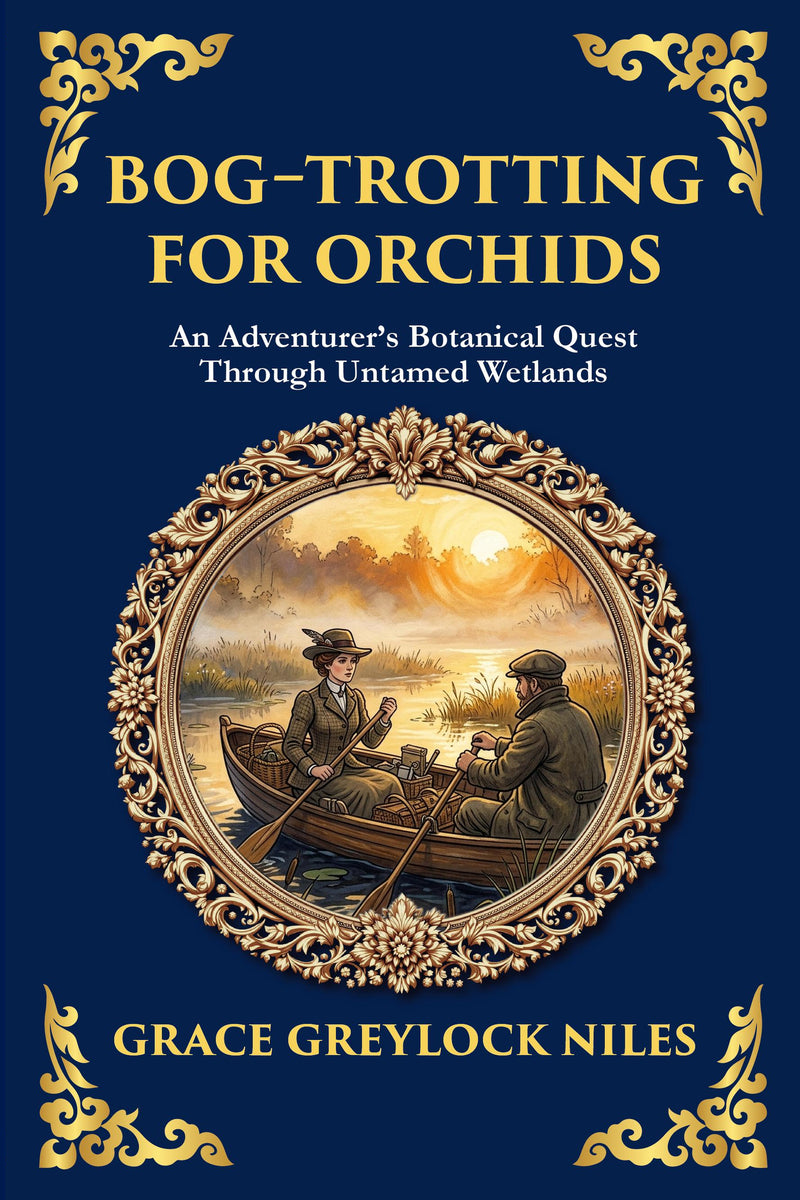
Bog-trotting for Orchids
Bog-trotting for Orchids is a lyrical blend of natural history, adventure, and poetic observation. Join Grace Greylock Niles—botanist, explorer, and writer—as she journeys through the bogs, fens, and swamps of the Northeastern United States in pursuit of one of nature’s most elusive treasures: wild orchids.
or free app
10,000+ hrs library
30-day guarantee
The complete Bog-trotting for Orchids appears in modern English through Library of Alexandria Press, available online with audiobook narration included for members.
Have you ever wondered why the wildest beauty often hides in the hardest places to reach? Bog-trotting for Orchids is Grace Greylock Niles’s enchanting ode to the wetlands, where mossy paths and mist-shrouded pools conceal botanical wonders waiting to be found. First published in the early 20th century, this forgotten gem of nature writing chronicles Niles’s explorations through America’s northeastern bogs in search of wild orchids—flowers that demand patience, passion, and a willingness to tread where few dare.
This beautifully crafted narrative is more than a field guide—it’s a philosophical reflection on solitude, curiosity, and the quiet magic of the natural world. With every page, Niles invites readers to slow down and see not just plants, but the poetry of nature’s design.
What you’ll discover in this modern edition
- The Thrill of the Hunt for Native Orchids Follow the author's treks into remote wetlands in search of rarities like the Showy Lady’s Slipper, Calypso, and Dragon’s Mouth.
| Formats | eBook (EPUB + PDF) · Audiobook · Paperback · Hardcover · Large Print |
| Language | English |
| Trim size (print) | 6 × 9 in |
| Binding | Paperback — perfect-bound · Hardcover — casewrap |
| Large Print edition | Same text in a larger, easy-read type — a larger font, not a larger trim |
| Print pricing | Every physical book at our true cost — at-cost, no profit (members) |
| Library | 873 restored titles, always growing |
| Length | 58,267 words · ~3 hr 53 min reading |
| Reading level | Grade 10 · a comfortable read (this modern-English edition) |
| Edition | Modern English translation · 2026 |
Member reviews for this edition are collected as readers finish it — be the first. Across the library: 12,000+ books shipped, every plan covered by a 365-day print guarantee.
About this edition
A faithful, unabridged modern-English edition by The Library of Alexandria — carefully rendered for today's reader and verified paragraph-by-paragraph against the public-domain source. Available as eBook, audiobook, paperback, hardcover, and large print.
- Complete & unabridgedVerified paragraph by paragraph against the source — never a scan, never abridged.
- Modern English, faithfulReadable today, with the author’s meaning kept intact. Readable — not simplified.
- Every format, one membershipRead in your browser or the free app, or listen to the full audiobook.
Included free with your membership
Cancel anytime, one click · 30-day money-back guarantee
Edition last updated July 2026
What’s inside
Bog-trotting for Orchids — complete and unabridged: all 21 sections included with membership, plus the full audiobook.
Begin reading Bog-trotting for Orchids
In clear modern English — the complete text is included with membership.
Introduction
There is a particular kind of person who, upon encountering a marsh that most travelers would skirt with disgust, will instead roll up their sleeves, plunge ankle-deep into the muck, and begin to smile. Grace Greylock Niles was unmistakably one of these people. The book you are about to read is the testament of a woman who found, in the very places others avoided, a wonderland of color, structure, and astonishing biological invention. Where the ordinary observer saw stagnant water and treacherous footing, Niles saw cathedrals built of moss, jeweled blossoms hidden in the green gloom, and a world of living things engaged in dramas of survival and beauty as compelling as any human story.
To open these pages is to accept an invitation into a vanished mode of seeing. It is to walk beside a naturalist who lived at the turn of the twentieth century, when the wild wetlands of the American Northeast still stretched broad and undrained, when a determined woman with a collecting basket and an iron constitution could disappear into the bogs for whole days at a time, and emerge transformed by what she had witnessed. This is a book about orchids, yes—but it is also a book about devotion, about the patience required to truly know a landscape, and about the rare and precious gift of attention that the best naturalists possess.
To understand the spirit that animates this work, it helps to understand a little of the woman who wrote it and the era in which she lived. Grace Greylock Niles came of age during a remarkable flowering of American natural history—a period when the study of plants and animals was not yet wholly the province of credentialed professionals locked away in university laboratories, but remained open to the passionate amateur, the keen-eyed local observer, the self-taught botanist who knew their home ground intimately. Niles belonged to this tradition, and she belonged to it proudly. She was a New Englander by temperament and by territory, drawing the name “Greylock” from the great mountain that presides over the northwestern corner of Massachusetts, and she wrote with the deep-rooted authority of someone describing the country of her own heart.
In her day, the pursuit of wildflowers and ferns had become something of a national enthusiasm. Field clubs flourished. Amateurs corresponded with one another across great distances, exchanging specimens and observations, debating identifications, and slowly assembling the great mosaic of knowledge about the continent’s flora. Women, in particular, found in botany one of the few sciences that society deemed suitable for their participation—a circumstance that, however restrictive in its origins, produced a generation of extraordinary female naturalists whose contributions to the field were both substantial and lasting. Niles stands among them as a figure of unusual energy and literary skill. She was not content merely to catalog and press her specimens; she wanted to convey the living experience of the search, the thrill of discovery, the sensuous texture of the places where these plants grew.
This ambition is what lifts her work above the level of a mere field guide or technical treatise. Niles understood, perhaps instinctively, that to describe an orchid stripped from its context is to describe only a fraction of its truth. An orchid is not simply a flower; it is a flower in a particular place, growing in a particular relationship to the soil and the water and the surrounding vegetation, blooming at a particular moment in the turning of the seasons. To know it fully, one must go to where it lives, must endure the conditions it endures, must learn the secret signs that betray its presence to the initiated eye. And so she went—into the sphagnum bogs and the alder swamps, the wet meadows and the shaded woodland seeps, the very places that gave this book its wonderfully evocative title.
That phrase, “bog-trotting,” deserves a moment’s appreciation. It carries within it a whole attitude toward the natural world. To trot through a bog is to move with a certain joyful determination, to refuse to be deterred by mud and mosquitoes and the constant risk of sinking, to treat the wetland not as an obstacle but as a destination, a playground, a beloved haunt. There is something almost athletic in the image, something defiantly cheerful. Niles was clearly a woman who took genuine pleasure in the physical challenge of her quarry. The orchids she sought did not grow in convenient gardens or along well-trodden paths. They hid themselves in the least accessible corners of the landscape, and reaching them demanded grit, stamina, and a willingness to get thoroughly, gloriously dirty. The title promises adventure, and the book delivers it.
It is worth dwelling, too, on why orchids in particular should have inspired such fervor. Among all the families of flowering plants, the orchids occupy a special place in the human imagination. They are plants of extraordinary diversity and refinement, having evolved some of the most intricate and ingenious structures in all the botanical world. Their flowers are often bizarre, sometimes uncannily resembling insects or faces or fantastical creatures, and they have developed astonishing partnerships with the pollinators that visit them. Many orchids are rare, demanding, and slow to grow, dependent upon delicate relationships with fungi in the soil that make them notoriously difficult to transplant or cultivate. To find a wild orchid in bloom is, even today, a moment of genuine wonder. To find one in the era before highways and suburbs and the great draining of the wetlands—when these plants flourished in numbers and varieties we can scarcely imagine—must have been a recurring revelation. Niles experienced this revelation again and again, and her great achievement is that she found the words to make us feel it too.
The orchids of the temperate American wetlands are, admittedly, more modest than their flamboyant tropical cousins. They do not festoon the branches of jungle trees in cascades of improbable color. They are smaller, subtler, more easily overlooked. But to the discerning eye they are no less beautiful for their reticence. There are the lady’s slippers, those pouch-flowered marvels named for their resemblance to a dainty shoe, ranging from the modest to the magnificent. There are the fringed orchids, whose blossoms dissolve into delicate, lacelike fringes along their margins. There are the rein orchids and the rattlesnake plantains and the grass-pinks and the pogonias and the arethusas, each with its own character, its own preferred habitat, its own season of glory. Niles knew them all, and she introduces them to us with the warmth of someone presenting old and cherished friends.
What strikes the modern reader most forcefully, perhaps, is the intimacy of Niles’s relationship with these plants and places. She does not write as a tourist passing through. She writes as a resident, a long-term observer, someone who returns to the same bogs year after year and notes the subtle changes, the comings and goings, the ebb and flow of bloom across the seasons. This deep familiarity gives her descriptions a richness and authority that no fleeting visitor could achieve. She knows which bog holds which treasure, knows when to expect the first blossoms and when the show will fade, knows the companion plants that grow alongside her orchids and the larger ecology of which they form a part. Reading her, we come to understand that true natural knowledge is not acquired quickly. It is the fruit of long acquaintance, of patient looking, of love sustained over years.
A Modern Translation and What It Preserves
This edition presents Niles’s work as a modern translation, adapted for the contemporary reader, and a word about what this means—and what it does not mean—will help you settle into the experience that follows. The original text was written in a prose style characteristic of its period: rich, ornate, leisurely, given to long sentences and elaborate constructions, freighted with the literary and cultural references that an educated reader of the early twentieth century would have absorbed as a matter of course. It was also a text written for an audience that shared many assumptions about the natural world, about scientific classification, and about the proper conduct of a naturalist that have since shifted considerably.
The aim of this adaptation has been to make Niles’s voice clear and accessible to readers today, without sacrificing the qualities that made her writing distinctive and delightful in the first place. The lush descriptive passages, the evident joy in the hunt, the sharp observations and the warm humor—all of these have been preserved and, where the original language threatened to obscure them behind antiquated phrasing, gently brought into focus. The intention is not to modernize Niles out of recognition, nor to strip her prose of its period charm, but rather to remove the small frictions that might otherwise stand between you and the substance of her enthusiasm. Think of it as clearing the trail just enough that you can follow her into the bog without stumbling over every root and bramble of obsolete usage.
There is an honesty owed to readers about works of this vintage, and it concerns the scientific framework within which Niles operated. The names of plants change over time as botanists refine their understanding of how species are related to one another. A plant that Niles knew by one Latin name may today be classified under another, placed in a different genus, split into several species, or merged with what was once considered distinct. The science of plant classification has been transformed since her day, particularly with the advent of genetic analysis, which has revealed relationships and distinctions invisible to even the keenest observer of the past. Where this matters, the careful reader may wish to consult a contemporary reference, but for the most part these shifts in nomenclature do not diminish the value of Niles’s observations. A flower is a flower regardless of the label we attach to it, and her descriptions of form, color, habitat, and behavior remain as accurate and useful as they ever were.
More significantly, this is a book that emerged from a different relationship between human beings and the natural world than the one we inhabit today—and here lies one of the most thought-provoking dimensions of reading it now. In Niles’s era, the collecting of wildflowers was an entirely accepted, indeed celebrated, practice. Naturalists gathered specimens freely, dug up plants to transplant into their own gardens or to press for their herbaria, and saw little harm in doing so. The wetlands seemed inexhaustible, the orchids endlessly abundant, the supply of natural beauty beyond any possibility of depletion. We now know how tragically mistaken that assumption proved to be.
The wild orchids of North America have suffered grievously in the century since Niles trotted through her beloved bogs. The greatest threat was never the collector, devoted as the collectors were, but the wholesale destruction of habitat: the draining of wetlands for agriculture and development, the filling of bogs and swamps, the alteration of water tables, the fragmentation of the landscape by roads and cities and the relentless expansion of human settlement. Many of the places Niles describes with such loving particularity no longer exist as she knew them. Some have vanished entirely beneath pavement and lawn. Others survive only as remnants, diminished and degraded, their orchid populations a faint shadow of their former glory. Today, many of the species she gathered so freely are rare, protected by law, and the digging or picking of wild orchids is in most cases both illegal and ethically indefensible.
This casts Niles’s book in a poignant and complicated light. On one hand, it is a record of a world that has been largely lost, a window onto an abundance we can no longer witness. On the other hand, it documents the very attitudes—the casual collecting, the assumption of inexhaustibility—that contributed, in their small way, to the losses we now mourn. The modern reader should approach these aspects of the text not with condemnation but with understanding, and with a clear-eyed awareness of how far our knowledge and our values have evolved. Niles loved these plants with her whole heart; she simply lived before the hard lesson of conservation had been fully learned. Reading her now, we can honor her passion while also recognizing the responsibility that has fallen to our own generation: not to gather and possess, but to protect and restore.
Cancel anytime, one click · 30-day money-back guarantee
Founding annual rate available now — your price locks for life when you join.
Not ready? Get this free chapter by email — read it anytime.
✓ Sent — check your inbox for Bog-trotting for Orchids.
Questions about Bog-trotting for Orchids
What is Bog-trotting for Orchids about?
Bog-trotting for Orchids is a lyrical blend of natural history, adventure, and poetic observation. Join Grace Greylock Niles—botanist, explorer, and writer—as she journeys through the bogs, fens, and swamps of the Northeastern United States in pursuit of one of nature’s most elusive treasures: wild orchids. With a voice both scholarly and spirited, Niles paints vivid portraits of rare flora and the untamed landscapes that cradle them.
Who wrote Bog-trotting for Orchids?
Bog-trotting for Orchids was written by Grace Greylock Niles. This edition presents the complete work in clear modern English, faithfully rendered from the public-domain original by Library of Alexandria Press.
Is Bog-trotting for Orchids free to read?
The opening chapter is free to read on this page. Members read and listen to the complete work — and the entire library — free, and can order any physical book at our true print cost.
How long is Bog-trotting for Orchids?
21 chapters (~58,267 words) — about 3 hr 53 min of reading in this modern-English edition.
Is this an abridged version of Bog-trotting for Orchids?
No. This is the complete, unabridged Bog-trotting for Orchids, carefully rendered into clear modern English and verified paragraph-by-paragraph against the public-domain source — nothing is cut or summarised.
What formats does Bog-trotting for Orchids come in?
Bog-trotting for Orchids is available as eBook, paperback, hardcover and large print. eBook and audiobook are included with membership; printed editions ship at our true print cost.
Shipping & returns
Billing & membership
More from the library


Explore Classic & Literary
- Dream Psychology: Psychoanalysis for Beginners · Sigmund Freud
- Great Expectations · Charles Dickens
- The Brothers Karamazov · Fyodor Dostoyevsky
- The Great Gatsby · F. Scott Fitzgerald
- Wild Flowers Worth Knowing · Neltje Blanchan
- Italian Hours · Henry James
- A Popular History of France from the Earliest Times, Volume 5 · François Guizot
- A history of English literature: A practical text-book · Edward Albert
- Italian Highways and Byways from a Motor Car · M. F. Mansfield
- The Heart-Cry of Jesus · Byron J. Rees
- Castes and Tribes of Southern India. Vol. 6 of 7 · Edgar Thurston
- Against the Grain · J.-K. Huysmans
- Dombey and Son · Charles Dickens
- How to Invest Money · George Garr Henry
- The Great Controversy Between Christ and Satan · Ellen Gould Harmon White
- One Hundred Proofs That the Earth Is Not a Globe · William Carpenter
- Southern Literature From 1579–1895 · Louise Manly
- The Renaissance: Studies in Art and Poetry · Walter Pater
- Mark Twain’s Speeches · Mark Twain
- Tacitus on Germany · Cornelius Tacitus
- The Rosary · Florence L. Barclay
- Peculiarities of American Cities · Willard W. Glazier
- Tennis for Girls · Florence A. Ballin
- The World’s Greatest Books — Volume 02 — Fiction
- Shirley · Charlotte Brontë
- Daisy Miller: A Study · Henry James
- Louis Lambert · Honoré de Balzac
- Historic Jamaica · Frank Cundall
- The Gambler · Fyodor Dostoyevsky
- The Mayor of Casterbridge · Thomas Hardy
Bog-trotting for Orchids
Bog-trotting for Orchids
An Adventurer’s Botanical Quest Through Untamed Wetlands
Grace Greylock Niles
Contents
- Introduction
- Preface by the Author
- Chapter 1
- Chapter 2
- Chapter 3
- Chapter 4
- Chapter 5
- Chapter 6
- Chapter 7
- Chapter 8
- Chapter 9
- Chapter 10
- Chapter 11
- Chapter 12
- Chapter 13
- Chapter 14
- Chapter 15
- Chapter 16
- Chapter 17
- Chapter 18
- Chapter 19
Introduction
There is a particular kind of person who, upon encountering a marsh that most travelers would skirt with disgust, will instead roll up their sleeves, plunge ankle-deep into the muck, and begin to smile. Grace Greylock Niles was unmistakably one of these people. The book you are about to read is the testament of a woman who found, in the very places others avoided, a wonderland of color, structure, and astonishing biological invention. Where the ordinary observer saw stagnant water and treacherous footing, Niles saw cathedrals built of moss, jeweled blossoms hidden in the green gloom, and a world of living things engaged in dramas of survival and beauty as compelling as any human story.
To open these pages is to accept an invitation into a vanished mode of seeing. It is to walk beside a naturalist who lived at the turn of the twentieth century, when the wild wetlands of the American Northeast still stretched broad and undrained, when a determined woman with a collecting basket and an iron constitution could disappear into the bogs for whole days at a time, and emerge transformed by what she had witnessed. This is a book about orchids, yes—but it is also a book about devotion, about the patience required to truly know a landscape, and about the rare and precious gift of attention that the best naturalists possess.
To understand the spirit that animates this work, it helps to understand a little of the woman who wrote it and the era in which she lived. Grace Greylock Niles came of age during a remarkable flowering of American natural history—a period when the study of plants and animals was not yet wholly the province of credentialed professionals locked away in university laboratories, but remained open to the passionate amateur, the keen-eyed local observer, the self-taught botanist who knew their home ground intimately. Niles belonged to this tradition, and she belonged to it proudly. She was a New Englander by temperament and by territory, drawing the name “Greylock” from the great mountain that presides over the northwestern corner of Massachusetts, and she wrote with the deep-rooted authority of someone describing the country of her own heart.
In her day, the pursuit of wildflowers and ferns had become something of a national enthusiasm. Field clubs flourished. Amateurs corresponded with one another across great distances, exchanging specimens and observations, debating identifications, and slowly assembling the great mosaic of knowledge about the continent’s flora. Women, in particular, found in botany one of the few sciences that society deemed suitable for their participation—a circumstance that, however restrictive in its origins, produced a generation of extraordinary female naturalists whose contributions to the field were both substantial and lasting. Niles stands among them as a figure of unusual energy and literary skill. She was not content merely to catalog and press her specimens; she wanted to convey the living experience of the search, the thrill of discovery, the sensuous texture of the places where these plants grew.
This ambition is what lifts her work above the level of a mere field guide or technical treatise. Niles understood, perhaps instinctively, that to describe an orchid stripped from its context is to describe only a fraction of its truth. An orchid is not simply a flower; it is a flower in a particular place, growing in a particular relationship to the soil and the water and the surrounding vegetation, blooming at a particular moment in the turning of the seasons. To know it fully, one must go to where it lives, must endure the conditions it endures, must learn the secret signs that betray its presence to the initiated eye. And so she went—into the sphagnum bogs and the alder swamps, the wet meadows and the shaded woodland seeps, the very places that gave this book its wonderfully evocative title.
That phrase, “bog-trotting,” deserves a moment’s appreciation. It carries within it a whole attitude toward the natural world. To trot through a bog is to move with a certain joyful determination, to refuse to be deterred by mud and mosquitoes and the constant risk of sinking, to treat the wetland not as an obstacle but as a destination, a playground, a beloved haunt. There is something almost athletic in the image, something defiantly cheerful. Niles was clearly a woman who took genuine pleasure in the physical challenge of her quarry. The orchids she sought did not grow in convenient gardens or along well-trodden paths. They hid themselves in the least accessible corners of the landscape, and reaching them demanded grit, stamina, and a willingness to get thoroughly, gloriously dirty. The title promises adventure, and the book delivers it.
It is worth dwelling, too, on why orchids in particular should have inspired such fervor. Among all the families of flowering plants, the orchids occupy a special place in the human imagination. They are plants of extraordinary diversity and refinement, having evolved some of the most intricate and ingenious structures in all the botanical world. Their flowers are often bizarre, sometimes uncannily resembling insects or faces or fantastical creatures, and they have developed astonishing partnerships with the pollinators that visit them. Many orchids are rare, demanding, and slow to grow, dependent upon delicate relationships with fungi in the soil that make them notoriously difficult to transplant or cultivate. To find a wild orchid in bloom is, even today, a moment of genuine wonder. To find one in the era before highways and suburbs and the great draining of the wetlands—when these plants flourished in numbers and varieties we can scarcely imagine—must have been a recurring revelation. Niles experienced this revelation again and again, and her great achievement is that she found the words to make us feel it too.
The orchids of the temperate American wetlands are, admittedly, more modest than their flamboyant tropical cousins. They do not festoon the branches of jungle trees in cascades of improbable color. They are smaller, subtler, more easily overlooked. But to the discerning eye they are no less beautiful for their reticence. There are the lady’s slippers, those pouch-flowered marvels named for their resemblance to a dainty shoe, ranging from the modest to the magnificent. There are the fringed orchids, whose blossoms dissolve into delicate, lacelike fringes along their margins. There are the rein orchids and the rattlesnake plantains and the grass-pinks and the pogonias and the arethusas, each with its own character, its own preferred habitat, its own season of glory. Niles knew them all, and she introduces them to us with the warmth of someone presenting old and cherished friends.
What strikes the modern reader most forcefully, perhaps, is the intimacy of Niles’s relationship with these plants and places. She does not write as a tourist passing through. She writes as a resident, a long-term observer, someone who returns to the same bogs year after year and notes the subtle changes, the comings and goings, the ebb and flow of bloom across the seasons. This deep familiarity gives her descriptions a richness and authority that no fleeting visitor could achieve. She knows which bog holds which treasure, knows when to expect the first blossoms and when the show will fade, knows the companion plants that grow alongside her orchids and the larger ecology of which they form a part. Reading her, we come to understand that true natural knowledge is not acquired quickly. It is the fruit of long acquaintance, of patient looking, of love sustained over years.
A Modern Translation and What It Preserves
This edition presents Niles’s work as a modern translation, adapted for the contemporary reader, and a word about what this means—and what it does not mean—will help you settle into the experience that follows. The original text was written in a prose style characteristic of its period: rich, ornate, leisurely, given to long sentences and elaborate constructions, freighted with the literary and cultural references that an educated reader of the early twentieth century would have absorbed as a matter of course. It was also a text written for an audience that shared many assumptions about the natural world, about scientific classification, and about the proper conduct of a naturalist that have since shifted considerably.
The aim of this adaptation has been to make Niles’s voice clear and accessible to readers today, without sacrificing the qualities that made her writing distinctive and delightful in the first place. The lush descriptive passages, the evident joy in the hunt, the sharp observations and the warm humor—all of these have been preserved and, where the original language threatened to obscure them behind antiquated phrasing, gently brought into focus. The intention is not to modernize Niles out of recognition, nor to strip her prose of its period charm, but rather to remove the small frictions that might otherwise stand between you and the substance of her enthusiasm. Think of it as clearing the trail just enough that you can follow her into the bog without stumbling over every root and bramble of obsolete usage.
There is an honesty owed to readers about works of this vintage, and it concerns the scientific framework within which Niles operated. The names of plants change over time as botanists refine their understanding of how species are related to one another. A plant that Niles knew by one Latin name may today be classified under another, placed in a different genus, split into several species, or merged with what was once considered distinct. The science of plant classification has been transformed since her day, particularly with the advent of genetic analysis, which has revealed relationships and distinctions invisible to even the keenest observer of the past. Where this matters, the careful reader may wish to consult a contemporary reference, but for the most part these shifts in nomenclature do not diminish the value of Niles’s observations. A flower is a flower regardless of the label we attach to it, and her descriptions of form, color, habitat, and behavior remain as accurate and useful as they ever were.
More significantly, this is a book that emerged from a different relationship between human beings and the natural world than the one we inhabit today—and here lies one of the most thought-provoking dimensions of reading it now. In Niles’s era, the collecting of wildflowers was an entirely accepted, indeed celebrated, practice. Naturalists gathered specimens freely, dug up plants to transplant into their own gardens or to press for their herbaria, and saw little harm in doing so. The wetlands seemed inexhaustible, the orchids endlessly abundant, the supply of natural beauty beyond any possibility of depletion. We now know how tragically mistaken that assumption proved to be.
The wild orchids of North America have suffered grievously in the century since Niles trotted through her beloved bogs. The greatest threat was never the collector, devoted as the collectors were, but the wholesale destruction of habitat: the draining of wetlands for agriculture and development, the filling of bogs and swamps, the alteration of water tables, the fragmentation of the landscape by roads and cities and the relentless expansion of human settlement. Many of the places Niles describes with such loving particularity no longer exist as she knew them. Some have vanished entirely beneath pavement and lawn. Others survive only as remnants, diminished and degraded, their orchid populations a faint shadow of their former glory. Today, many of the species she gathered so freely are rare, protected by law, and the digging or picking of wild orchids is in most cases both illegal and ethically indefensible.
This casts Niles’s book in a poignant and complicated light. On one hand, it is a record of a world that has been largely lost, a window onto an abundance we can no longer witness. On the other hand, it documents the very attitudes—the casual collecting, the assumption of inexhaustibility—that contributed, in their small way, to the losses we now mourn. The modern reader should approach these aspects of the text not with condemnation but with understanding, and with a clear-eyed awareness of how far our knowledge and our values have evolved. Niles loved these plants with her whole heart; she simply lived before the hard lesson of conservation had been fully learned. Reading her now, we can honor her passion while also recognizing the responsibility that has fallen to our own generation: not to gather and possess, but to protect and restore.
“It is not just the walking itself, but keeping yourself in the right spiritual and physical state to find joy and excitement in such a simple, natural activity.”—Burroughs, Pepacton.
All winter, I had looked forward to seeing the flowers bloom in the Etchowog Bogs. On May 25th, I arrived at the old farm on Mount Œta. I had left New York on May 14th, fully prepared for trekking through bogs with hunting boots, rubber gloves, short skirts, and a plant collecting box.
My route took me through New Haven and Hartford, crossing through Connecticut and Massachusetts. Along the way, I stopped for a short visit with a friend in New Haven. In her garden, I saw a small piece of the Taconic woodlands coming to life. There, lined up perfectly, were five modest Yellow Lady’s Slippers (Cypripedium hirsutum), which are part of the orchid family. Along the same edge, clusters of Showy Lady’s Slippers (Cypripedium reginæ) were pushing their dew-covered tips into the sunlight. Although they bloom later than other related species in New England, this type usually peaks around June 20th.
On the east side of the garden, there was an impressive row of ferns with twenty or more root clusters, including several rare types. Among them was a strange, strap-like leaf that most people wouldn’t even recognize as a fern unless they were an expert collector. This is the rare Walking Fern (Camptosorus rhizophyllus); its scientific name means “bent heap,” which describes the plant’s appearance well. The leaf is four to twelve inches long, growing from a heart-shaped base. It sends out a long, narrow runner that takes root at the end, effectively taking a “step” forward. This happens three or four times, often creating a beautiful carpet over the cold gray limestone rocks it prefers in the wild.
End of the free sample
Keep reading, free
Members read and listen to the complete book — and the entire library. Cancel anytime, one click · 30-day money-back guarantee.