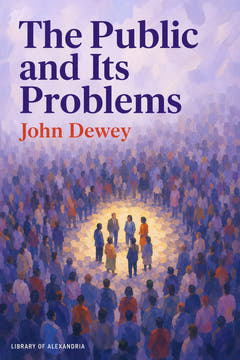
Summary
Summary of The Public and Its Problems
The Public and Its Problems at a glance
Summary: 7 min to read
- Reading time
- About 3 h 25 min2 h 40 min fast, 4 h 5 min slow
- Length
- 48,700 words
- Library level
- Challenging long sentences, a rich vocabulary
- First published
- 1927by John Dewey
Reading time at 238 words a minute (fast 300, slow 200). How long the classics take to read · Updated
Free for 3 months
Get the full summary of The Public and Its Problems, free
- 200,000+ classics as eBooks, audiobooks and 15-minute summaries, and print and large print at cost
- Up to 5 readers in your home on one plan
Key ideas
Key idea 1
The public has gone missing
Why do citizens stay away from elections while governments keep passing laws? Dewey does not blame laziness. He suggests that the public has become lost inside a world whose workings it cannot see. Before asking how to improve government, he asks who the public actually is.
His argument joins diagnosis with method: discover how people become a public, how that public becomes a state, and what might help citizens recognize their shared concerns again.
Key idea 2
Political ideas help shape political facts
Kings, presidents, and judges perform actions we can observe, yet people disagree deeply about what the state means.
Start free to read
Key idea 3
Shared consequences bring a public together
A conversation affecting only its participants is private.
Start free to read
Key idea 4
Changing conditions require changing political forms
A state must answer to the consequences people actually share.
Start free to read
Key idea 5
Connection alone does not create community
Rail, wire, and trade have linked people into a Great Society without making them a Great Community.
Start free to read
Key idea 6
Democracy cannot assume fully informed citizens
Democracy means more than choosing officials.
Start free to read
Key idea 7
Inquiry needs communication people can feel
A public needs free inquiry into social life and free circulation of what that inquiry discovers.
Start free to read
Key idea 8
Experts must work with public experience
Experts can discover facts, but isolation from ordinary people can turn them into a group serving private interests.
Start free to read
Key idea 9
Public life requires continuing shared inquiry
Dewey's argument begins with people acting together and affecting others.
Start free to read
The rest of the summary, written and spoken, and the whole book: free to start.
Read the rest free
Who it’s for
This book suits readers who ask how democracy really works, and who want a thinker from a century ago to sharpen their view of news, voting, experts, and neighborhoods today.
What this book is
Why do so many citizens stay home on election day, even as governments pass more laws than ever? John Dewey asked this in the 1920s, when only about half of eligible Americans voted. His answer is not that people are lazy. He says the public itself has gone missing, lost inside a world it cannot see.
The Public and Its Problems grew out of lectures Dewey gave at Kenyon College in Ohio in January 1926. Dewey was an American philosopher, and here he asks what a public is, how it becomes a state, and what could bring it back. You get a diagnosis and a method together.
In this summary
- 1The public has gone missingFree
- 2Political ideas help shape political facts
- 3Shared consequences bring a public together
- 4Changing conditions require changing political forms
- 5Connection alone does not create community
- 6Democracy cannot assume fully informed citizens
- 7Inquiry needs communication people can feel
- 8Experts must work with public experience
- 9Public life requires continuing shared inquiry
Facts and theories of the state cannot be separated
Dewey begins with a puzzle. Political facts are easy to list, since kings, presidents, and judges all do things we can observe. Yet theories of the state clash wildly. One says it is the highest form of shared life, another that it is organized oppression.
A simple remedy seems available. Keep only verified facts. Dewey says this cannot work, because political facts exist partly because people hold beliefs about them, and those habits change when beliefs change. Legislators and judges act on a theory, and their decisions then change the facts that follow.
So a theory of the state is not a spectator's comment. It is a force inside the thing it describes. Social facts and our ideas about them shape each other, so honest inquiry needs a clear standard and not just a list.
That’s 1 of 9 key points.
The rest of the summary, written and spoken, and the whole book: free to start.
- Nothing to pay today · Renews every year
- We email you before you pay
- Cancel online in two clicks
Take this summary with you
Send to Kindle downloads the file and opens Amazon's page: drop the file there.
Check yourself
What brings a public into being for Dewey?
Right. “Dewey defines the public as all those affected by indirect consequences so strongly that those consequences need regular care.”Not quite. “Dewey defines the public as all those affected by indirect consequences so strongly that those consequences need regular care.”
Why is the modern public in eclipse?
Right. “The public is in eclipse because modern life produces more consequences than people can see, trace, or share.”Not quite. “The public is in eclipse because modern life produces more consequences than people can see, trace, or share.”
What role should experts play in democracy?
Right. “So experts should discover and publish facts, not make policy for others.”Not quite. “So experts should discover and publish facts, not make policy for others.”
Go deeper: the whole of The Public and Its Problems
About 3 h 30 min to read.Start freePaperback, hardcover and large print, printed for you at cost, are on their way.Email me when it is printed
About this edition
Every format is free to start, and print and large print are at cost.
- LengthAbout 48,700 words
- Reading timeAbout 3 h 25 min
- FormatseBook, large-print eBook, audiobook, 15-minute summary
- LanguagesEnglish and 9 other languages
Questions about The Public and Its Problems
What is The Public and Its Problems about?
It asks what a public is, how it becomes a state, and why modern democracy seems to have lost its public. Dewey argues that industry created vast, hidden connections between people, and that shared inquiry and communication must form the public anew.
What does Dewey mean by the public?
The public is all the people indirectly and seriously affected by the consequences of other people's actions, to the point that those consequences need regular care. It becomes a state when it organizes itself through officials who look after those shared interests.
What is the Great Community in Dewey's book?
It is Dewey's name for a society where people understand and share the wide consequences of their joint action. The Great Society of rail, wire, and trade already exists, but it becomes a community only through full communication and inquiry.
When was The Public and Its Problems written?
It grew from lectures Dewey gave at Kenyon College in Ohio in January 1926, then revised and expanded. It answers American debates of the 1920s about voting, parties, experts, and business, but its questions still fit public life today.
What is the main message of the book?
Democracy is not only voting machinery. It is a way of living together that depends on free inquiry, honest news, an experimental attitude, and close local communities where ideas are shared and tested in conversation.
Cite this edition
Dewey, John. The Public and Its Problems. Library of Alexandria, 2026, libraryofalexandria.com/products/the-public-and-its-problems.
Dewey, J. (2026). The public and its problems. Library of Alexandria. https://libraryofalexandria.com/products/the-public-and-its-problems (Original work published 1927)
Dewey, John. The Public and Its Problems. Library of Alexandria, 2026. https://libraryofalexandria.com/products/the-public-and-its-problems.
@book{dewey2026public,
  author = {Dewey, John},
  title = {The Public and Its Problems},
  publisher = {Library of Alexandria},
  year = {2026},
  url = {https://libraryofalexandria.com/products/the-public-and-its-problems},
  note = {First published 1927}
}
Free for 3 months
Get the full summary of The Public and Its Problems, free
- 200,000+ classics as eBooks, audiobooks and 15-minute summaries, and print and large print at cost
- Up to 5 readers in your home on one plan





