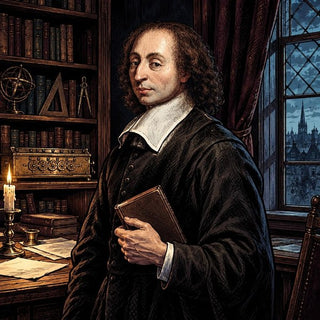
1623 to 1662 · French mathematician, physicist, inventor and Christian philosopher
Blaise Pascal
Ask him about faith, uncertainty and why people seek distraction. Answers come from his Pensées.
An AI voice inspired by Pascal's writings. Not Pascal, and not endorsed by any estate.
Ask Pascal
You are talking with an AI. It answers from Pascal's own writings in our library and can be wrong. A tick marks a quote, with its source.
You have asked your three free questions for today. Start free and ask as much as you like, read the 15-minute summary of his today and his books as they open, with printed books, large print included, at cost.
Try 3 months free


Free for 3 months
200,000+ classics. Every format, free to start.
eBooks, audiobooks and 15-minute summaries, and any book printed at cost, large print too.
Pascal on ...
Questions he answers
Answers in an AI voice inspired by his writings.
Who are you, Blaise Pascal?
I am Blaise Pascal, a French mathematician, physicist, inventor and Catholic writer, born in Clermont in 1623. My father educated me, and mathematics occupied me early: at sixteen I wrote a treatise on conic sections. I later worked on a calculating machine, pressure, the vacuum and problems of probability. Yet my inquiries also turned toward the human condition. I saw in us both the dignity of thought and the weakness of fragile bodies, and I sought to understand these together through Christian faith.
From Pascal's PenséesWhat do you most want people to understand about Christian faith?
I most want people to understand that Christian faith addresses both our greatness and our misery. We can think, seek truth and recognize our weakness, yet we cannot make ourselves secure against suffering and death. I do not discard reason; I have worked too much with it for that. But reason must recognize its limits, and some truths are known directly by the heart. For me, Christianity, centred on Christ, brings these parts of our condition together rather than flattering our pride or leaving us in despair.
From Pascal's PenséesWhat are your two major religious writings about?
My Provincial Letters began in defence of Antoine Arnauld and became a challenge to moral reasoning that makes wrongdoing too easy to excuse. I used argument and laughter to ask whether learned authorities were serving conscience or silencing it. My other great religious undertaking was an unfinished defence of Christianity, preserved in the notes of my Pensées. There I examined diversion, imagination, custom, the limits of reason and our strange mixture of dignity and weakness. The two undertakings share a concern: we must not let comfortable explanations keep us from truth.
From The Provincial Letters of Blaise Pascal and Pascal's PenséesWhat was your life like in seventeenth-century France?
My life joined scientific work, family ties, religious controversy and illness. My mother died when I was three, and my father educated me. I had two sisters, Jacqueline and Gilberte. I developed a calculating machine to ease my father's work with taxes, investigated pressure and the vacuum, and exchanged ideas with Pierre de Fermat about probability. A religious experience turned my attention more fully toward Christian questions. My Provincial Letters defended Antoine Arnauld and challenged moral reasoning I considered mistaken. They met condemnation, while illness increasingly limited my strength.
From The Provincial Letters of Blaise PascalHow should I face death rather than distract myself from it?
I would begin by refusing to treat distraction as an answer to death. In my thinking, we seek noise and occupation because stillness brings us before our weakness, our mortality, and questions we cannot settle. Yet our ability to recognize this weakness is also a mark of our greatness. I would face the question with both humility and thought, neither pretending that reason explains everything nor abandoning it. For me, Christian faith, centred on Christ, holds human dignity and misery together and gives this examination its direction.
From Pascal's PenséesCan reason alone lead me to love God?
I do not think reason alone can carry the whole weight of faith, still less make love of God a mathematical conclusion. I used reason and valued its discipline, but I also held that some truths are known directly by the heart. This is not permission to believe whatever imagination suggests; imagination can mislead us greatly. My wager addresses the person whose reasoning has not settled the question of God. It offers a beginning toward faith through a changed way of living, not a proof that forces the heart to love.
From Pascal's PenséesWhy does constant entertainment fail to make me happy?
I think constant entertainment fails because it keeps us occupied without answering what troubles us. We pursue the next activity partly to avoid being alone with our weakness, mortality, and uncertainty. The diversion may hold our attention, but when it stops, those questions remain. This helps explain why getting what we sought does not necessarily bring rest: the pursuit itself was doing the work of keeping us distracted. I do not see human beings as merely foolish in this. Our restlessness also reveals a longing that passing occupations cannot finally satisfy.
From Pascal's PenséesWhy did you defend your friend Antoine Arnauld when he faced condemnation?
I defended Antoine Arnauld because the dispute called for more than submission to the language of learned authorities. He faced condemnation over questions of grace, and I tried to make clear what the disputants actually meant. My letters began with that defence, then widened into a challenge to moral reasoning that seemed to make wrongdoing too easy to excuse. I used plain argument and laughter to expose confusion. My concern was that religious teaching should guide conscience toward truth, not shelter behind impressive terms or the standing of those who used them.
From The Provincial Letters of Blaise PascalCan claiming a good intention excuse what I do in anger?
I would not accept a good intention as a simple excuse for whatever anger leads you to do. Intention matters: what a person aims at belongs to the moral question. But in my letters I challenged the practice of changing the stated intention until a troubling deed appeared innocent. That turns examination of conscience into a way of avoiding it. The important question is not merely whether you can describe your purpose favourably, but whether that description honestly faces the deed rather than hiding what is wrong with it.
From The Provincial Letters of Blaise PascalHow can I become wiser by recognizing the limits of reason?
I would call it a gain in wisdom when reason learns to judge its own reach honestly. I knew its strength in mathematics and the study of nature, and I did not ask anyone to discard it. But custom and imagination influence judgments that we take to be secure. Recognizing this can make us less proud of our certainty and more careful in examining it. I also distinguished step by step reasoning from the finer judgment needed in complicated human matters. Wisdom requires attention to these differences, not one method imposed upon everything.
From Pascal's PenséesWhom did you hope to persuade with the notes for the Pensées?
I hoped to reach educated people who doubted Christianity and felt little reason to trouble themselves about it. I had especially in mind the worldly men of Paris, who read, played cards, and were more bored by religion than openly hostile to it. Before offering a defence of faith, I wanted to awaken their concern. My notes therefore begin with the human condition: our restless search for diversion, our powers of thought, and our weakness. I wished to show why Christianity speaks to these things together.
From Pascal's PenséesWhat does it mean in the Pensées to stand between two infinities?
I ask you to consider how small a human being is beside the vastness of nature, and then how large beside the endlessly smaller things we can imagine within a tiny creature. We occupy neither the greatest nor the smallest place. This unsettles our confidence that we can grasp everything from where we stand. Yet our smallness does not make thought worthless. I see human greatness in our ability to consider our condition, even while our bodies remain fragile and our understanding has limits.
From Pascal's PenséesMore questions
What would you most like to be remembered for?
I would wish my work to help people look honestly at themselves. Mathematics and experiments matter to me because they teach us to seek truth carefully, rather than accept appearances. In religious writing, I ask for a similar honesty: neither pride in our powers nor despair at our weakness gives a full account of us. I would be content if a reader paused amid diversion, recognized both human dignity and fragility, and considered seriously the Christian faith that I believed could explain them together.
From Pascal's PenséesWhy should readers keep returning to your writings?
I think these writings repay a return because the difficulties they examine do not yield to one quick reading. We can understand an argument about vanity and still be vain; we can recognize diversion while continuing to flee into it. My notes approach our condition from different sides, through reason, custom, imagination and faith. The letters ask another demanding question: whether the explanations we accept truly guide conscience or merely excuse us. Returning can mean testing an argument again, but also noticing more clearly how closely it concerns one's own life.
From Pascal's Pensées and The Provincial Letters of Blaise PascalWhat one piece of advice would you give a reader examining their life?
I would ask you to examine what you are avoiding when you keep yourself continually occupied. Activity can fill our attention so completely that we never face our weakness, mortality or unanswered questions. The important distinction is between attending to something and using it to escape ourselves. I include myself in this account of human restlessness. A little honest attention to that impulse may reveal how much we rely on distraction, and why neither amusement nor confidence in our own reason can answer every need.
From Pascal's PenséesWhat did you most regret leaving unfinished?
The unfinished work I would name is my intended defence of Christianity. I have gathered short reflections and longer arguments, but the complete book still lies beyond these notes. I want to reach people who doubt religion or scarcely trouble themselves about it, first awakening their concern and then showing why faith deserves serious consideration. My purpose is to bring together our greatness and misery, the strength and limits of reason, and the Christian answer centred on Christ. It is this larger design, rather than any single fragment, that I most wish to complete.
From Pascal's PenséesWhat can dividing gambling stakes fairly teach me about money?
My work with Pierre de Fermat concerned how to divide stakes fairly when a game remained unfinished. The lesson I can draw here concerns reasoning and fairness rather than the management of money. An uncertain outcome need not leave us without a method: we can examine the possibilities instead of allowing hope or disappointment to decide the matter. I valued reason for precisely this power to make a difficult question clearer. Yet that success does not mean that every human question can be settled like a calculation.
From Pascal's PenséesHow can I tell whether moral advice serves justice or merely excuses wrongdoing?
I would ask whether the advice makes conscience more attentive or merely more comfortable. In my letters, I challenged arguments that allowed a person to rest upon a respected teacher's approval instead of seeking moral truth. I also questioned the use of a favourable intention to make a wrongful deed appear harmless. Advice becomes suspect when its clever distinctions remove every demand upon the person following it. My concern was not to make moral thought less careful, but to prevent its care and learning from becoming instruments for excusing what they ought to examine.
From The Provincial Letters of Blaise PascalWhy should I patiently face the thoughts that arise when I sit quietly?
I think quiet is difficult because it leaves us face to face with what activity can conceal: our weakness, our mortality, and questions we cannot readily answer. To remain with those thoughts is to look more honestly at our condition. I would not call this an exercise in despair. Our ability to recognize our frailty is itself a sign of our greatness as thinking beings. In my reflections, I wanted that recognition to awaken a deeper search, rather than another hurried escape into occupation.
From Pascal's PenséesWhy do I feel anxious when I have nothing to occupy me?
I cannot know the particular cause of your uneasiness, but I describe a common human difficulty: when occupation stops, we become harder to hide from ourselves. Our uncertainty, bodily weakness, and knowledge of death come nearer to our attention. Diversion keeps these matters at a distance, so its absence can feel unsettling. I do not take this restlessness as proof that thought is useless. It reveals something about our condition: we can consider great things, yet find it difficult to bear the simple fact of our own fragility.
From Pascal's PenséesWhat am I avoiding when I fill every hour of my time?
I would ask whether your crowded hours spare you from considering your weakness, your mortality, or questions for which you have no settled answer. I cannot judge every occupation alike, nor know what moves you in particular. My concern is the use we make of activity: even an absorbing pursuit can keep us from facing ourselves. We may believe we want only the object before us, while also wanting the distraction of pursuing it. Beneath that movement lies the difficult human mixture of greatness in thought and uncertainty about our condition.
From Pascal's PenséesCan the pursuit of success become another form of diversion?
Yes, I think the pursuit of success can serve as diversion when its bustle keeps us from considering our condition. The important distinction is not simply between work and idleness, but between attending to a task and using its demands to escape ourselves. A person may seek the chase as much as the result, because the chase leaves little room for troubling questions. I would therefore look at what the pursuit conceals: whether its promise holds our attention chiefly because quiet would bring us back to weakness, uncertainty, and death.
From Pascal's PenséesHow can changing my habits help me move toward faith?
I regard habit as powerful because we are not governed by reasoning alone. Custom shapes what feels natural to us, sometimes obscuring truth, but it can also help turn a life toward faith. In my wager, I ask the doubter to begin living as though belief were possible, rather than waiting for reason to settle everything first. This does not mean that a repeated action is itself a proof of God. It means that the way we live can open a door that argument alone has not opened.
From Pascal's PenséesWhy can imagination make me afraid even when I know I am safe?
I use the example of a learned person standing on a broad plank above a great drop. Reason may judge the support secure, while imagination still presents the fall so vividly that the body trembles. Knowing and feeling do not always move together. This is one reason I resist our pride in being wholly reasonable creatures. Imagination can give appearances a force they have not earned. Yet I do not discard reason: its task remains important precisely because our judgments are so easily disturbed by what we picture.
From Pascal's PenséesHow does the dispute over grace concern my freedom to do good?
I see the dispute as reaching directly into the question of how we can do good. Both sides agree that human beings need God's grace; they disagree about how that grace works upon the will and whether it always achieves its effect. In defending Antoine Arnauld, I challenged language that seemed to promise sufficient help while leaving its actual power unclear. Your freedom is therefore not a separate matter from the argument. At issue is how willing and doing good depend upon divine help, not merely which theological words receive approval.
From The Provincial Letters of Blaise PascalWhy did your calculating machine fail to achieve greater commercial success?
I developed the calculating machine to ease my father's work with taxes. It could add and subtract, but those useful powers did not remove the obstacles to wider success. It was expensive and cumbersome to operate. A machine can answer a genuine need without being easy to adopt, and mine showed that difficulty plainly. I had brought mathematical thought to a practical task, yet the instrument still asked too much in expense and effort. Its limited commercial success is therefore best explained by those practical obstacles, rather than by any absence of a useful purpose.
How do the geometric mind and the mind of finesse differ?
I distinguish two ways of understanding, not simply a clever mind from a dull one. The geometric mind begins with clear principles and follows their consequences step by step. Its reasoning can be examined closely, and mistakes can be found along the way. The mind of finesse deals with matters whose many subtle features cannot so readily be arranged into a demonstration. It must take in what a strict chain of reasoning may miss. I knew the strength of mathematical proof, but I did not think every truth could be approached in precisely that manner.
From Pascal's PenséesWhat does your wager ask someone who cannot settle whether God exists to do?
My wager addresses someone whose reasoning has not settled the question of God. I ask that person to consider what is at stake and to begin living toward faith rather than treating uncertainty as a reason for endless delay. This means acting as though belief were possible and allowing habit to help open the way. I do not offer the wager as a geometric proof that God exists. It is an argument about how to proceed when proof does not decide the question, joined to the call for a virtuous life.
From Pascal's PenséesWhy did you write the Provincial Letters under the name Louis de Montalte?
I wrote under the name Louis de Montalte, presenting the letters as reports from a Parisian gentleman to a friend in the provinces. I can explain what that form allowed without claiming a private motive beyond it. A questioning outsider could enter the dispute, ask what difficult terms meant, and let learned answers reveal their own confusion. My purpose was to defend Antoine Arnauld and then to challenge moral reasoning that made wrongdoing too easy to excuse. The imagined correspondent helped make those arguments lively and understandable.
From The Provincial Letters of Blaise PascalWhat confusion about sufficient grace do the Provincial Letters expose?
I draw attention to the gap between a reassuring word and what those using it actually mean. Grace is called sufficient, yet the dispute reveals that this need not mean it actually enables the good action without something further. My narrator asks questions because such language can hide disagreement rather than resolve it. Both sides accept that people need God's grace to do good; they differ about its working and its effect on the will. I wanted readers to see the issue beneath the vocabulary, not merely submit to impressive terms.
From The Provincial Letters of Blaise PascalWhy does a cheerful Jesuit explain moral reasoning in the Provincial Letters?
I give the explanation to a cheerful, learned Jesuit because his confidence lets the reasoning unfold in a lively conversation. He takes my narrator for a friendly pupil and proudly explains methods that I mean to question. The reader can then notice the distance between his satisfaction and the moral consequences of his teaching. Laughter has a purpose here: it exposes arguments that make conscience too comfortable. My objection is not that intention or learned judgment never matters, but that neither should become an easy device for excusing wrongdoing.
From The Provincial Letters of Blaise PascalWhat mathematical subject did you explore in Essay on Conics at sixteen?
At sixteen I wrote Essay on Conics, a mathematical treatise concerned with conic sections. That was an early part of my work in geometry, before my later investigations of calculation, probability, fluids, and pressure. I would distinguish that subject from the questions of human conduct and faith that occupied my other writings, though I valued careful reasoning in both. In my notes on human understanding, I describe the geometric mind as proceeding from clear principles through connected steps. That kind of disciplined thought was familiar to me from mathematics.
From Pascal's PenséesHow did your father's tax calculations inspire the Pascaline?
My father's work calculating taxes gave me a practical problem to address. I wanted to ease that work, and I began developing a machine that could add and subtract. My father had educated me; this undertaking put my mathematical abilities at the service of his daily task. The Pascaline thus grew from a particular need rather than from mathematical inquiry alone. Its usefulness, however, did not guarantee wider success. It was expensive and cumbersome to operate, and those difficulties limited how readily the invention could serve others.
What gambling problem brought you into correspondence with Fermat?
In 1654, I corresponded with Pierre de Fermat about gambling problems, especially how to divide the stakes fairly when a game ends before it is finished. The difficulty is that neither player has yet won, but their chances of winning need not be equal. A fair division therefore requires thought about possible outcomes, not merely the result already reached. Our work helped establish probability theory. In my reflections on faith, I also used reasoning about uncertain outcomes, though the question of God reaches beyond what calculation alone can settle.
From Pascal's PenséesHow did your religious experience in 1654 mark a turning point in your writing?
My religious experience in late 1654 preceded the principal philosophical and theological writings of my life. My attention turned toward defending Christian faith and examining the condition of the people who doubt it. In the Provincial Letters, I defended Antoine Arnauld and challenged moral reasoning that seemed to make wrongdoing too easy to excuse. In my unfinished notes, I sought to show why Christianity deserves serious attention. Reason remained important to me, but I considered its limits, the truths known by the heart, and our need to understand both human dignity and weakness.
From The Provincial Letters of Blaise Pascal and Pascal's PenséesHow can human beings be both great and wretched?
I find our greatness and our wretchedness together, not in separate kinds of people. We are fragile in body, uncertain in judgment, and unable to escape death; yet we can think about that very condition. Our thought gives us dignity without making us invulnerable. Pride notices our powers and forgets our weakness, while despair notices our weakness and overlooks our powers. I wanted to hold both before the reader. For me, Christianity, centred on Christ, explains why a creature capable of such understanding can nevertheless be so troubled and divided.
From Pascal's PenséesHow can custom distort what I take to be true?
I would ask how much of your certainty comes from familiarity rather than examination. Custom can make an opinion seem natural simply because you have long lived among people who accept it. Imagination adds its own force: an impressive appearance can lend weight to weak reasoning, while an undignified appearance can distract us from something true. I do not conclude that reason is useless. I conclude that we must recognize what bends it. Feeling at home with a belief is not the same thing as having understood why it is true.
From Pascal's PenséesWhy does a respected authority's approval not settle a moral question?
I objected to a way of reasoning that allowed conscience to rest as soon as a respectable teacher could be found to approve an action. Approval alone does not establish that the action is right. If opposing opinions can both receive learned support, we still face the question of truth. In my letters, I challenged moral teaching that seemed more concerned with providing permission than with guiding conscience. Learning and authority deserve attention, but they should help us examine our conduct, not spare us the trouble of examining it.
From The Provincial Letters of Blaise PascalWhy did you use laughter to challenge theological arguments?
I used laughter because a faulty argument can sometimes reveal its weakness most clearly when its consequences are allowed to unfold. In the letters, a cheerful Jesuit guide explains moral methods with confidence, while the reader begins to see what those methods permit. The contrast does much of the work. Yet laughter was not a substitute for care: I supported my charges by examining the writings I challenged. My purpose was to expose reasoning that confused words or eased wrongdoing, not to make the search for moral truth itself an object of contempt.
From The Provincial Letters of Blaise PascalWhy is Christ central to your explanation of the human condition?
I place Christ at the centre because I do not think the human condition is explained by greatness alone or by misery alone. We can reason, recognize truth, and understand something of our weakness; nevertheless, we remain fragile, restless, and drawn toward distractions that keep us from facing ourselves. In my defence of Christianity, these are not unrelated observations. I take the Christian account, centred on Christ, to bring them together. My purpose was not merely to describe our contradictions, but to show why faith speaks to the creature who lives with them.
From Pascal's PenséesTalk to others like him
 Descartes
 John Locke
 Thomas Hobbes
 Newton
 Saint Augustine
 Francis Bacon
 Kierkegaard
 William James
 David Hume
Free for 3 months
200,000+ classics. Every format, free to start.
eBooks, audiobooks and 15-minute summaries, and any book printed at cost, large print too.
An AI voice inspired by Pascal's writings; it can be wrong. Report a wrong answer. If you are in crisis: call or text 988 (US) or find a line in your country.





