Summary
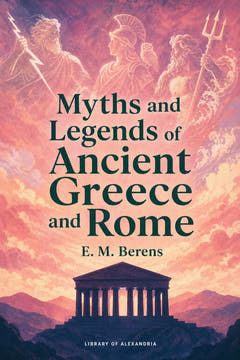
Summary of Myths and Legends of Ancient Greece and Rome
Myths and Legends of Ancient Greece and Rome at a glance
Summary: 8 min to read
- Reading time
- About 6 h 30 min5 h 10 min fast, 7 h 45 min slow
- Length
- 93,300 words
- Library level
- Challenging long sentences, a rich vocabulary
- First published
- 1880by E. M. Berens
Reading time at 238 words a minute (fast 300, slow 200). How long the classics take to read · Updated
Free for 3 months
Get the full summary of Myths and Legends of Ancient Greece and Rome, free
- 200,000+ classics as eBooks, audiobooks and 15-minute summaries, and print and large print at cost
- Up to 5 readers in your home on one plan
Key ideas
Key idea 1
The gods give nature human faces
The Greek gods look like people, but they are stronger, more beautiful and unable to die. They marry, sleep and have children, while also feeling jealousy, anger and the desire for revenge. Their children with mortals become the heroes, or demigods.
Through these beings, the Greeks give nature a human face. Thunder expresses the sky god’s anger, and a raging sea reveals the sea god’s fury. This link between natural forces and familiar feelings helps explain the stories that follow.
Key idea 2
Fear drives rulers against their children
The world begins with Chaos, followed by sky and earth and the first divine families.
Start free to read
Key idea 3
A mother's grief changes the earth
When Hades carries Persephone into the underworld, her mother Demeter refuses to let grain grow.
Start free to read
Key idea 4
Spirits inhabit the everyday world
Beyond the great gods lies a world filled with smaller powers.
Start free to read
Key idea 5
Shared rituals bring beliefs into life
The myths belong not only to stories but also to public life.
Start free to read
Key idea 6
Heroes need more than courage
The Legends turn toward heroes sent into danger.
Start free to read
Key idea 7
Strength cannot free heroes from fate
Heracles shows extraordinary strength from infancy, yet Hera’s hatred follows him.
Start free to read
Key idea 8
Private desires become a public war
The Trojan story grows from a prophecy, a contest among goddesses and Paris’s decision to carry Helen to Troy.
Start free to read
Key idea 9
Divine help and pride shape heroes
Across the gods’ family tree and the adventures of heroes, a shared pattern emerges.
Start free to read
The rest of the summary, written and spoken, and the whole book: free to start.
Read the rest free
Go deeper: the whole of Myths and Legends of Ancient Greece and Rome
About 6 h 50 min to read.Start freeWho it’s for
Readers who enjoy stories of gods, monsters and heroes, students meeting classical names for the first time, and anyone curious about the myths behind art and everyday words.
What this book is
Picture a father who swallows each of his children the moment they are born. His wife wraps a stone in baby clothes and hands it over in place of the newest child. That small trick starts the rise of Zeus, and it is only one of hundreds of stories in Myths and Legends of Ancient Greece and Rome by E. M. Berens.
Berens wrote the book for schoolchildren and general readers, and she tells it with respect for every belief. The Myths describe the gods, goddesses and spirits. The Legends follow the heroes, from Perseus and Jason to Heracles, Theseus and the great war at Troy. You also learn why these names fill poems, paintings and everyday speech.
In this summary
- 1The gods give nature human facesFree
- 2Fear drives rulers against their children
- 3A mother's grief changes the earth
- 4Spirits inhabit the everyday world
- 5Shared rituals bring beliefs into life
- 6Heroes need more than courage
- 7Strength cannot free heroes from fate
- 8Private desires become a public war
- 9Divine help and pride shape heroes
The gods look human but never die
Berens begins by asking what kind of beings the Greek gods were. They look like people, only taller, more beautiful and far stronger. They marry, have children, eat and sleep. Their blood is a bright fluid called ichor.
They also share human feelings. They can be vengeful, jealous and sly, and they punish anyone who scorns their worship. Some join with mortals, and their children are the heroes, or demigods. The firm line between gods and people is that gods never die.
The Greeks read nature through them. Thunder meant the sky god was angry, and a raging sea meant the sea god was in a fury. Dawn was a goddess with rosy fingers drawing back the veil of night. Berens adds that some gods may have been remarkable people whom later generations made divine.
The Greek gods are nature and human nature given faces, and that is the key to every myth.
That’s 1 of 9 key points.
The rest of the summary, written and spoken, and the whole book: free to start.
- Nothing to pay today · Renews every year
- We email you before you pay
- Cancel online in two clicks
Take this summary with you
Send to Kindle downloads the file and opens Amazon's page: drop the file there.
Check yourself
What is the firm distinction between gods and people?
Right. “The firm line between gods and people is that gods never die.”Not quite. “The firm line between gods and people is that gods never die.”
Why does Demeter withhold the grain?
Right. “In her anger she withholds the grain until the earth lies barren.”Not quite. “In her anger she withholds the grain until the earth lies barren.”
What pattern should readers notice in the heroes’ adventures?
Right. “Notice how often a hero's success depends on a divine helper and how often his pride brings him down.”Not quite. “Notice how often a hero's success depends on a divine helper and how often his pride brings him down.”
Go deeper: the whole of Myths and Legends of Ancient Greece and Rome
About 6 h 50 min to read.Start freePaperback, hardcover and large print, printed for you at cost, are on their way.Email me when it is printed
About this edition
Every format is free to start, and print and large print are at cost.
- LengthAbout 93,300 words
- Reading timeAbout 6 h 30 min
Questions about Myths and Legends of Ancient Greece and Rome
What is Myths and Legends of Ancient Greece and Rome about?
It is a guide to the gods, goddesses, spirits and heroes of classical mythology. The first half covers the myths of the deities and their Roman counterparts. The second half retells the legends of heroes such as Perseus, Jason, Heracles, Theseus and the Trojan War.
Who are the Greek and Roman equivalents of each other's gods?
Berens pairs the gods throughout. Zeus is Jupiter, Hera is Juno, Athene is Minerva, Poseidon is Neptune, Aphrodite is Venus, Ares is Mars, Hermes is Mercury, and Demeter is Ceres. Many entries name a Roman counterpart and explain how its worship or character differed.
Is this a collection of true stories?
These are ancient myths and legends rather than history. Berens retells them from classical writers such as Homer, Hesiod and Ovid, and offers explanations of how nature, early heroes and poetic imagination may have shaped them. The book itself dates from the nineteenth century.
Is the book easy to read for beginners?
Yes, in its approach, because it was written as an introduction for school students and general readers. The language is clear, each god or hero has a short chapter, and the stories are told in order, so you can pick any section.
What is the main message of Greek mythology in this book?
Berens shows that myths were the ancients' way of explaining nature, human feeling and the moral order. Pride is punished, hospitality is rewarded, and fate limits even gods. The tales also record the rituals and customs of daily life.
Cite this edition
Berens, E. M. Myths and Legends of Ancient Greece and Rome. Library of Alexandria, 2026, libraryofalexandria.com/products/myths-and-legends-of-ancient-greece-and-rome.
Berens, E. M. (2026). Myths and legends of ancient Greece and Rome. Library of Alexandria. https://libraryofalexandria.com/products/myths-and-legends-of-ancient-greece-and-rome (Original work published 1880)
Berens, E. M. Myths and Legends of Ancient Greece and Rome. Library of Alexandria, 2026. https://libraryofalexandria.com/products/myths-and-legends-of-ancient-greece-and-rome.
@book{berens2026myths,
  author = {Berens, E. M.},
  title = {Myths and Legends of Ancient Greece and Rome},
  publisher = {Library of Alexandria},
  year = {2026},
  url = {https://libraryofalexandria.com/products/myths-and-legends-of-ancient-greece-and-rome},
  note = {First published 1880}
}
Free for 3 months
Get the full summary of Myths and Legends of Ancient Greece and Rome, free
- 200,000+ classics as eBooks, audiobooks and 15-minute summaries, and print and large print at cost
- Up to 5 readers in your home on one plan





