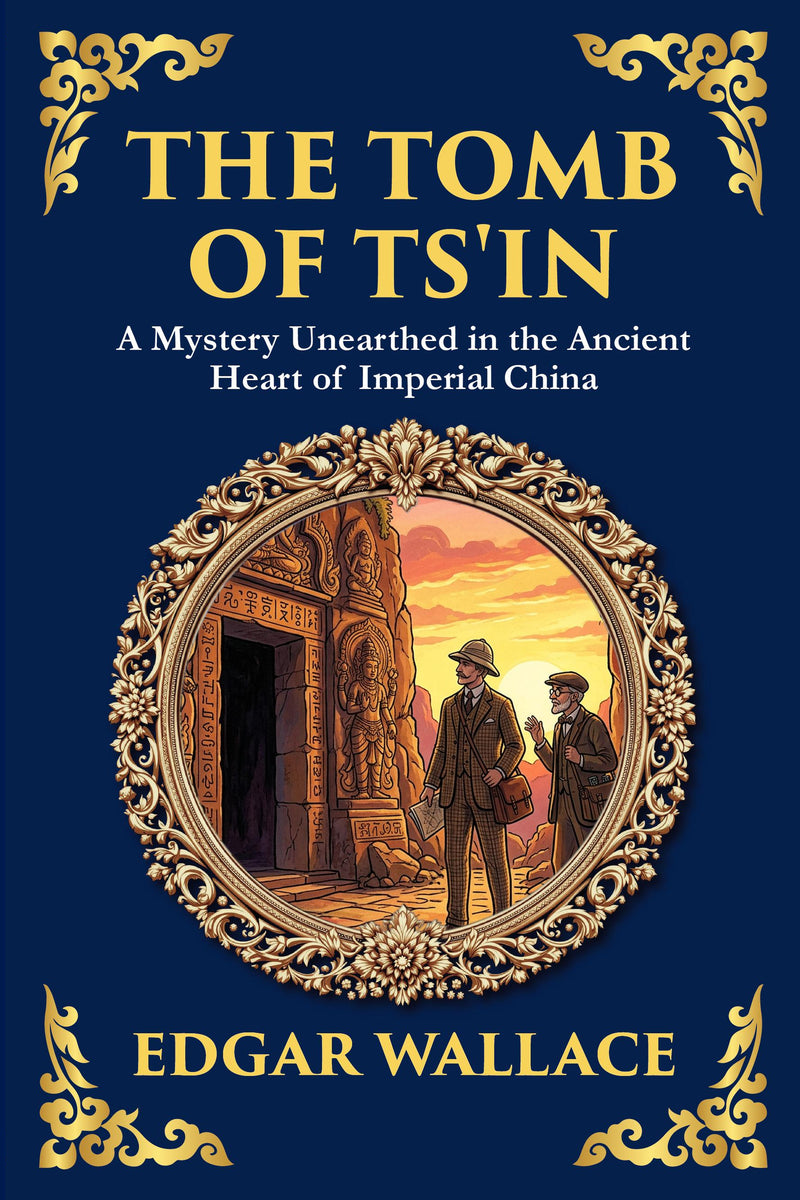
The Tomb of Ts'in — Large Print
Hidden beneath centuries of silence lies a tomb shrouded in legend, guarded by curses, and drenched in mystery. In The Tomb of Ts’in, Edgar Wallace weaves a gripping tale of discovery, danger, and destiny that stretches across empires and ages.
or free app
10,000+ hrs library
30-day guarantee
The complete The Tomb of Ts’in appears in modern English through Library of Alexandria Press, available online with audiobook narration included for members.
What if opening a sealed tomb means uncovering more than anyone is ready to face?
In Edgar Wallace’s The Tomb of Ts'in, Captain Stanley and his scholarly companions search for the final resting place of Ts’in Shi Huang. Their expedition leads into a world of hidden chambers, secret scrolls, and cryptic clues. What begins as a hunt for buried history becomes a dangerous test of curiosity.
Riddles and betrayal complicate the search, while supernatural threats blur the boundary between legend and reality. Stanley faces a struggle between ambition, honor, and fear. With plain language, short scenes, and a steady push toward surprise, Wallace turns the promise of discovery into a question: what might this knowledge cost?
What you'll discover
- A tomb full of questions – Enter hidden chambers where each clue offers discovery and the possibility of danger.
- Curiosity with a cost – Follow a search that tests the boundary between seeking knowledge and disturbing protected secrets.
- A captain under pressure – Watch Stanley weigh ambition against honor as fear shadows the expedition.
- Legend meets mystery – Explore a tale where ancient burial secrets and supernatural threats draw close together.
- China through Wallace’s eyes – Encounter an early twentieth-century adventure shaped by Western ideas about ancient China.
Perfect for readers who enjoy short, brisk mysteries in distant settings, and anyone curious about how early twentieth-century writers picture ancient China.
Open the first page now and follow Captain Stanley toward the secrets of the tomb.
| Formats | eBook (EPUB + PDF) · Audiobook · Paperback · Hardcover · Large Print |
| Language | English |
| Trim size (print) | 6 × 9 in |
| Binding | Paperback — perfect-bound · Hardcover — casewrap |
| Large Print edition | Same text in a larger, easy-read type — a larger font, not a larger trim |
| Print pricing | Every physical book at our true cost — at-cost, no profit (members) |
| Library | 873 restored titles, always growing |
| Length | 52,519 words · ~3 hr 30 min reading |
| Reading level | Grade 9 · a comfortable read (this modern-English edition) |
| Edition | Modern English translation · 2026 |
Member reviews for this edition are collected as readers finish it — be the first. Across the library: 12,000+ books shipped, every plan covered by a 365-day print guarantee.
About this edition
A faithful, unabridged modern-English edition by The Library of Alexandria — carefully rendered for today's reader and verified paragraph-by-paragraph against the public-domain source. Available as eBook, audiobook, paperback, hardcover, and large print.
- Complete & unabridgedVerified paragraph by paragraph against the source — never a scan, never abridged.
- Modern English, faithfulReadable today, with the author’s meaning kept intact. Readable — not simplified.
- Every format, one membershipRead in your browser or the free app, or listen to the full audiobook.
Included free with your membership
Cancel anytime, one click · 30-day money-back guarantee
Edition last updated July 2026
What’s inside
The Tomb of Ts'in — Large Print — complete and unabridged: all 22 sections included with membership, plus the full audiobook.
Begin reading The Tomb of Ts'in — Large Print
In clear modern English — the complete text is included with membership.
Introduction
There are some authors whose names become bywords for an entire kind of reading pleasure, and Edgar Wallace is surely among them. To speak his name in the early decades of the twentieth century was to summon up a particular sensation: the late-night turning of pages, the lamp burning low, the breath held in anticipation of the next revelation. He was, in his prime, one of the most widely read men in the English-speaking world, a writer so prolific and so popular that publishers and readers alike could barely keep pace with his output. It was said, only half in jest, that one in every four books read in Britain during his heyday bore his name on the spine. He wrote with a velocity that astonished his contemporaries, dictating story after story with a cigarette holder clamped between his teeth and a pot of sweet tea forever at his elbow, and yet for all that speed he possessed an instinct for suspense that few of his rivals could match. The novel you now hold in your hands belongs to that golden current of his imagination, and it carries within it all the hallmarks that made him beloved: the breathless pace, the cunning construction, the relish for the exotic and the mysterious, and above all the irresistible compulsion to know what happens next.
This particular work transports the reader far from the foggy streets of London that Wallace knew so intimately and into a realm that, to his original audience, must have seemed almost impossibly remote and glamorous. The title itself promises a journey into the ancient heart of imperial China, into the shadowed corridors of history where emperors slept beneath mountains of earth and treasures lay guarded by silence and superstition alike. For a readership accustomed to the drawing-room crime and the urban underworld that Wallace so often portrayed, such a setting offered the thrill of the unfamiliar, the allure of a civilization vast and venerable and steeped in mystery. The tomb of the title evokes a particular fascination that ran deep through the popular imagination of the period — a fascination with buried antiquity, with the secrets that lie sealed beneath the dust of centuries, and with the dangers, both natural and human, that attend any attempt to disturb them. This is a book that understands the powerful magic of the hidden chamber, the locked door, the artefact whose value is matched only by the peril it attracts.
To open these pages is to step back into an era when the world still felt larger than it does today, when distant lands could not be summoned in an instant onto a glowing screen, and when the very names of faraway places carried an enchantment that stirred the blood. Wallace wrote for an audience hungry for adventure, eager to be carried away from the ordinary and into the extraordinary, and he served that hunger with extraordinary generosity. He understood, perhaps better than any writer of his generation, that the chief duty of the storyteller is to entertain, to grip the attention and never to let it go. He had little patience for the slow and the ponderous, and his stories move with the directness of a man who knows precisely where he is going and is determined to take you there with him. You will find in this book that same headlong energy, that same refusal to linger when the action calls, and you will find too that beneath the surface of the entertainment there runs a current of genuine craft, a structural cleverness that rewards the reader who pays attention.
A Master of Suspense and His Restless Age
To understand and to fully savour the experience that awaits you in these pages, it is worth pausing to consider the remarkable man who created them and the equally remarkable world in which he wrote. Edgar Wallace was born in 1875 into circumstances of genuine hardship. The illegitimate son of a pair of struggling actors, he was given over to be raised by a Billingsgate fish porter and his wife, and he grew up amid the rough vitality of working-class London. His formal education was scant, and he left school young to make his way in a series of menial occupations before enlisting in the army. It was a life that might have closed every door of opportunity, yet Wallace possessed an irrepressible drive and an inexhaustible curiosity, and from these humble beginnings he raised himself by sheer force of will into one of the most famous and successful authors of his time. His path took him through journalism — he served as a war correspondent during the Second Boer War in South Africa, where he honed the swift, vivid, economical prose that would later become his trademark — and from there into the writing of fiction, where he found his true calling and his lasting fame.
What set Wallace apart was not merely his productivity, astonishing though that was. It was his almost preternatural ability to anticipate and to satisfy what his readers wanted. He had an unerring sense for the rhythm of a story, for the placement of a revelation, for the precise moment at which to spring a surprise or to tighten the screw of tension. He wrote thrillers, mysteries, adventure stories, and tales of crime and detection, and he wrote them with such fluency and confidence that he seemed to pour them forth as naturally as breathing. His books were devoured by readers of every class and station; they were turned into plays that filled the theatres and, in the years to come, into films that filled the cinemas. By the time of his death in 1932 — which came, fittingly enough, while he was working in Hollywood on the screenplay that would become the classic motion picture about a giant ape and the Empire State Building — he had become a cultural phenomenon, a name as recognizable as any in the literary world.
The period in which this novel was first written and read was one of extraordinary ferment and change. The world stood on the brink of upheavals that would transform it utterly, and yet there remained, in the popular literature of the time, a sense of confidence, of romance, and of boundless possibility. This was the great age of the adventure story, when readers thrilled to tales of lost civilizations, of treasure hunts in remote corners of the earth, of intrepid Europeans venturing into lands that they regarded as exotic and untamed. It was an age fascinated by archaeology and by the unearthing of ancient secrets, an age in which the digging up of the past seemed to promise both wonder and danger in equal measure. The setting of this book — the ancient and imperial reaches of China — would have carried a particular charge for the readers of the day, evoking a civilization of immense antiquity and grandeur, mysterious and impenetrable, governed by codes and customs utterly different from those of the West.
It is important, as a modern reader, to approach a work of this vintage with a degree of historical understanding and a measure of generosity. Wallace was a man of his time, and his stories inevitably reflect the attitudes, assumptions, and prejudices of the era in which they were written. The way that distant cultures and foreign peoples were portrayed in the popular fiction of the early twentieth century differs, sometimes markedly, from the sensibilities we hold today. To read such a book now is to encounter not only a thrilling story but also a window into the imagination of a bygone age, into the hopes and fears and fascinations of a world very different from our own. This is part of the pleasure and part of the value of returning to these older works. They allow us to travel not only in space, to the far-flung locales they depict, but also in time, to the minds of the men and women who first read them by gaslight and candle, and who found in them the same escape and excitement that we seek today. There is a particular richness in this double journey, and the discerning reader will find much to reflect upon as well as much to enjoy.
This edition has been prepared as a modern translation and adaptation, carefully attended to so that the contemporary reader may move through the story with ease and pleasure. The aim throughout has been to preserve the spirit, the energy, and the inimitable flavour of Wallace’s storytelling while smoothing away those obstacles of antiquated phrasing or obscure reference that might otherwise impede the modern eye. The result, it is hoped, is a reading experience that retains all the breathless excitement of the original while feeling fresh and accessible to those encountering it for the first time. You need bring nothing to these pages but your willingness to be entertained; the rest the author will supply in abundance.
The Pleasures That Await Within These Pages
What, then, can the reader expect to find as the story unfolds? Without disturbing a single one of the surprises that the author has so carefully arranged — for it would be a grave disservice to reveal in advance the twists and turns that constitute the very heart of the pleasure — it is possible to speak in general terms of the kind of experience that lies ahead. This is, first and foremost, a tale designed to grip. From its opening pages, Wallace establishes the atmosphere of intrigue and anticipation that he commanded so masterfully, drawing the reader in with the promise of mystery and the suggestion of dangers yet to come. He was never a writer to waste time on lengthy preliminaries; his stories tend to begin in motion, with the wheels already turning and the stakes already established, and they sweep the reader along with a momentum that proves difficult to resist.
The exotic setting is itself one of the great attractions of this particular work. Wallace had a gift for evoking place, for conjuring with a few well-chosen strokes the sense of a world utterly distinct from the everyday. The ancient and imperial backdrop against which the events of this story play out lends them an aura of grandeur and antiquity, a sense that the characters move against a vast and weighty stage upon which the dramas of centuries have been enacted. The tomb of the title is more than a mere location; it is a presence, a thing of mystery and menace, the focal point around which the action revolves and the secret upon which so much depends. There is something deeply satisfying about a story built around such a central enigma, a buried treasure or hidden truth that draws the characters — and the reader — ever onward toward its revelation. Wallace understood the powerful appeal of such a structure, the way in which a single great mystery can organize and energize an entire narrative, and he exploited it here to splendid effect.
You will encounter, too, the vivid and varied characters that populate Wallace’s fiction. He had a particular talent for creating figures who, however briefly they appear, lodge themselves in the memory: the resourceful hero, the cunning villain, the figure whose true loyalties remain in doubt until the final pages. His characterizations are not those of the slow and subtle psychological novel; they are bold, clear, and immediately legible, drawn with the confident hand of a storyteller who knows that in a tale of suspense the reader must always understand who the players are and what they want. Yet within these clear outlines there is room for surprise, for the revelation that a character is not quite what they seemed, that motives are more tangled and allegiances more shifting than first appeared. This interplay between clarity and concealment is one of the great pleasures of the mystery genre, and Wallace was among its supreme practitioners.
Above all, what awaits the reader is the sheer narrative drive that was Wallace’s defining gift. He wrote, as one of his admirers once observed, as though the devil were at his heels, and that urgency communicates itself directly to the reader. The chapters are short, the scenes are crisp, and the action moves forward with a relentless forward pressure that makes the book almost impossible to set aside. This is what is meant by the term “page-turner” in its truest and most honest sense: a story so artfully constructed, so cunningly paced, that the reader is compelled by an irresistible curiosity to discover what comes next, and then what comes after that, until the small hours of the morning have arrived and the last page has been reached almost before one realized the journey had begun. Wallace knew the secret of this kind of writing, and he practiced it with a skill that has rarely been equalled.
Cancel anytime, one click · 30-day money-back guarantee
Founding annual rate available now — your price locks for life when you join.
Not ready? Get this free chapter by email — read it anytime.
✓ Sent — check your inbox for The Tomb of Ts'in — Large Print.
Questions about The Tomb of Ts'in — Large Print
Who wrote The Tomb of Ts'in?
The book was written by Edgar Wallace, a British author of thrillers and adventure fiction who died in 1932. He was among the most widely read popular writers of his time and wrote at great speed.
What kind of book is The Tomb of Ts'in?
It is a mystery and adventure tale. Readers can expect a brisk pace, a sense of danger and a hidden secret at its centre, as in much of Wallace's popular fiction.
What does Ts'in mean in the title?
Ts'in is an older English spelling of Qin, the Chinese dynasty that unified China in the third century before the common era. Its first emperor is linked with a vast burial site.
Is The Tomb of Ts'in a true story?
No, it is a work of fiction. The Qin dynasty and its tombs are real history, but the tale itself is an invention by an author writing for entertainment in the early twentieth century.
Shipping & returns
Billing & membership
More from the library


Explore Adventure
- The Prince and the Pauper · Mark Twain
- Tarzan of the Apes · Edgar Rice Burroughs
- Peter Pan · J. M. Barrie
- Moby-Dick · Herman Melville
- The Virginian: A Horseman of the Plains — Large Print · Owen Wister
- Italian Hours — Large Print · Henry James
- Italian Hours · Henry James
- The Riddle of the Sands — Large Print · Erskine Childers
- The Lost World — Large Print · Arthur Conan Doyle
- Anabasis — Large Print · Xenophon
- White Fang — Large Print · Jack London
- The Three Musketeers — Large Print · Alexandre Dumas; Auguste Maquet
- Candide · Voltaire
- Candide — Large Print · Voltaire
- Peter Pan — Large Print · J. M. Barrie
- Red Nails — Large Print · Robert E. Howard
- Gulliver of Mars — Large Print · Edwin Lester Arnold
- Out of Time's Abyss — Large Print · Edgar Rice Burroughs
- Jewels of Gwahlur — Large Print · Robert E. Howard
- The Doomsman — Large Print · Van Tassel Sutphen
- Armageddon—2419 A.D. · Philip Francis Nowlan
- Armageddon—2419 A.D. — Large Print · Philip Francis Nowlan
- The Hunniwell Boys and the Platinum Mystery — Large Print · L. P. Wyman
- The Railway Children — Large Print · E. Nesbit
- She — Large Print · H. Rider Haggard
- The People of the Black Circle — Large Print · Robert E. Howard
- The Thirty-Nine Steps — Large Print · John Buchan
- Around the World in Eighty Days — Large Print · Jules Verne
- The Hour of the Dragon — Large Print · Robert E. Howard
- The Prince and the Pauper — Large Print · Mark Twain
The Tomb of Ts'in — Large Print
The Tomb of Ts'in — Large Print
A Mystery Unearthed in the Ancient Heart of Imperial China
Edgar Wallace
Contents
- Introduction
- Preface by the Author
- Chapter 1
- Chapter 2
- Chapter 3
- Chapter 4
- Chapter 5
- Chapter 6
- Chapter 7
- Chapter 8
- Chapter 9
- Chapter 10
- Chapter 11
- Chapter 12
- Chapter 13
- Chapter 14
- Chapter 15
- Chapter 16
- Chapter 17
- Chapter 18
- Chapter 19
- Chapter 20
Introduction
There are some authors whose names become bywords for an entire kind of reading pleasure, and Edgar Wallace is surely among them. To speak his name in the early decades of the twentieth century was to summon up a particular sensation: the late-night turning of pages, the lamp burning low, the breath held in anticipation of the next revelation. He was, in his prime, one of the most widely read men in the English-speaking world, a writer so prolific and so popular that publishers and readers alike could barely keep pace with his output. It was said, only half in jest, that one in every four books read in Britain during his heyday bore his name on the spine. He wrote with a velocity that astonished his contemporaries, dictating story after story with a cigarette holder clamped between his teeth and a pot of sweet tea forever at his elbow, and yet for all that speed he possessed an instinct for suspense that few of his rivals could match. The novel you now hold in your hands belongs to that golden current of his imagination, and it carries within it all the hallmarks that made him beloved: the breathless pace, the cunning construction, the relish for the exotic and the mysterious, and above all the irresistible compulsion to know what happens next.
This particular work transports the reader far from the foggy streets of London that Wallace knew so intimately and into a realm that, to his original audience, must have seemed almost impossibly remote and glamorous. The title itself promises a journey into the ancient heart of imperial China, into the shadowed corridors of history where emperors slept beneath mountains of earth and treasures lay guarded by silence and superstition alike. For a readership accustomed to the drawing-room crime and the urban underworld that Wallace so often portrayed, such a setting offered the thrill of the unfamiliar, the allure of a civilization vast and venerable and steeped in mystery. The tomb of the title evokes a particular fascination that ran deep through the popular imagination of the period — a fascination with buried antiquity, with the secrets that lie sealed beneath the dust of centuries, and with the dangers, both natural and human, that attend any attempt to disturb them. This is a book that understands the powerful magic of the hidden chamber, the locked door, the artefact whose value is matched only by the peril it attracts.
To open these pages is to step back into an era when the world still felt larger than it does today, when distant lands could not be summoned in an instant onto a glowing screen, and when the very names of faraway places carried an enchantment that stirred the blood. Wallace wrote for an audience hungry for adventure, eager to be carried away from the ordinary and into the extraordinary, and he served that hunger with extraordinary generosity. He understood, perhaps better than any writer of his generation, that the chief duty of the storyteller is to entertain, to grip the attention and never to let it go. He had little patience for the slow and the ponderous, and his stories move with the directness of a man who knows precisely where he is going and is determined to take you there with him. You will find in this book that same headlong energy, that same refusal to linger when the action calls, and you will find too that beneath the surface of the entertainment there runs a current of genuine craft, a structural cleverness that rewards the reader who pays attention.
A Master of Suspense and His Restless Age
To understand and to fully savour the experience that awaits you in these pages, it is worth pausing to consider the remarkable man who created them and the equally remarkable world in which he wrote. Edgar Wallace was born in 1875 into circumstances of genuine hardship. The illegitimate son of a pair of struggling actors, he was given over to be raised by a Billingsgate fish porter and his wife, and he grew up amid the rough vitality of working-class London. His formal education was scant, and he left school young to make his way in a series of menial occupations before enlisting in the army. It was a life that might have closed every door of opportunity, yet Wallace possessed an irrepressible drive and an inexhaustible curiosity, and from these humble beginnings he raised himself by sheer force of will into one of the most famous and successful authors of his time. His path took him through journalism — he served as a war correspondent during the Second Boer War in South Africa, where he honed the swift, vivid, economical prose that would later become his trademark — and from there into the writing of fiction, where he found his true calling and his lasting fame.
What set Wallace apart was not merely his productivity, astonishing though that was. It was his almost preternatural ability to anticipate and to satisfy what his readers wanted. He had an unerring sense for the rhythm of a story, for the placement of a revelation, for the precise moment at which to spring a surprise or to tighten the screw of tension. He wrote thrillers, mysteries, adventure stories, and tales of crime and detection, and he wrote them with such fluency and confidence that he seemed to pour them forth as naturally as breathing. His books were devoured by readers of every class and station; they were turned into plays that filled the theatres and, in the years to come, into films that filled the cinemas. By the time of his death in 1932 — which came, fittingly enough, while he was working in Hollywood on the screenplay that would become the classic motion picture about a giant ape and the Empire State Building — he had become a cultural phenomenon, a name as recognizable as any in the literary world.
The period in which this novel was first written and read was one of extraordinary ferment and change. The world stood on the brink of upheavals that would transform it utterly, and yet there remained, in the popular literature of the time, a sense of confidence, of romance, and of boundless possibility. This was the great age of the adventure story, when readers thrilled to tales of lost civilizations, of treasure hunts in remote corners of the earth, of intrepid Europeans venturing into lands that they regarded as exotic and untamed. It was an age fascinated by archaeology and by the unearthing of ancient secrets, an age in which the digging up of the past seemed to promise both wonder and danger in equal measure. The setting of this book — the ancient and imperial reaches of China — would have carried a particular charge for the readers of the day, evoking a civilization of immense antiquity and grandeur, mysterious and impenetrable, governed by codes and customs utterly different from those of the West.
It is important, as a modern reader, to approach a work of this vintage with a degree of historical understanding and a measure of generosity. Wallace was a man of his time, and his stories inevitably reflect the attitudes, assumptions, and prejudices of the era in which they were written. The way that distant cultures and foreign peoples were portrayed in the popular fiction of the early twentieth century differs, sometimes markedly, from the sensibilities we hold today. To read such a book now is to encounter not only a thrilling story but also a window into the imagination of a bygone age, into the hopes and fears and fascinations of a world very different from our own. This is part of the pleasure and part of the value of returning to these older works. They allow us to travel not only in space, to the far-flung locales they depict, but also in time, to the minds of the men and women who first read them by gaslight and candle, and who found in them the same escape and excitement that we seek today. There is a particular richness in this double journey, and the discerning reader will find much to reflect upon as well as much to enjoy.
This edition has been prepared as a modern translation and adaptation, carefully attended to so that the contemporary reader may move through the story with ease and pleasure. The aim throughout has been to preserve the spirit, the energy, and the inimitable flavour of Wallace’s storytelling while smoothing away those obstacles of antiquated phrasing or obscure reference that might otherwise impede the modern eye. The result, it is hoped, is a reading experience that retains all the breathless excitement of the original while feeling fresh and accessible to those encountering it for the first time. You need bring nothing to these pages but your willingness to be entertained; the rest the author will supply in abundance.
The Pleasures That Await Within These Pages
What, then, can the reader expect to find as the story unfolds? Without disturbing a single one of the surprises that the author has so carefully arranged — for it would be a grave disservice to reveal in advance the twists and turns that constitute the very heart of the pleasure — it is possible to speak in general terms of the kind of experience that lies ahead. This is, first and foremost, a tale designed to grip. From its opening pages, Wallace establishes the atmosphere of intrigue and anticipation that he commanded so masterfully, drawing the reader in with the promise of mystery and the suggestion of dangers yet to come. He was never a writer to waste time on lengthy preliminaries; his stories tend to begin in motion, with the wheels already turning and the stakes already established, and they sweep the reader along with a momentum that proves difficult to resist.
The exotic setting is itself one of the great attractions of this particular work. Wallace had a gift for evoking place, for conjuring with a few well-chosen strokes the sense of a world utterly distinct from the everyday. The ancient and imperial backdrop against which the events of this story play out lends them an aura of grandeur and antiquity, a sense that the characters move against a vast and weighty stage upon which the dramas of centuries have been enacted. The tomb of the title is more than a mere location; it is a presence, a thing of mystery and menace, the focal point around which the action revolves and the secret upon which so much depends. There is something deeply satisfying about a story built around such a central enigma, a buried treasure or hidden truth that draws the characters — and the reader — ever onward toward its revelation. Wallace understood the powerful appeal of such a structure, the way in which a single great mystery can organize and energize an entire narrative, and he exploited it here to splendid effect.
You will encounter, too, the vivid and varied characters that populate Wallace’s fiction. He had a particular talent for creating figures who, however briefly they appear, lodge themselves in the memory: the resourceful hero, the cunning villain, the figure whose true loyalties remain in doubt until the final pages. His characterizations are not those of the slow and subtle psychological novel; they are bold, clear, and immediately legible, drawn with the confident hand of a storyteller who knows that in a tale of suspense the reader must always understand who the players are and what they want. Yet within these clear outlines there is room for surprise, for the revelation that a character is not quite what they seemed, that motives are more tangled and allegiances more shifting than first appeared. This interplay between clarity and concealment is one of the great pleasures of the mystery genre, and Wallace was among its supreme practitioners.
Above all, what awaits the reader is the sheer narrative drive that was Wallace’s defining gift. He wrote, as one of his admirers once observed, as though the devil were at his heels, and that urgency communicates itself directly to the reader. The chapters are short, the scenes are crisp, and the action moves forward with a relentless forward pressure that makes the book almost impossible to set aside. This is what is meant by the term “page-turner” in its truest and most honest sense: a story so artfully constructed, so cunningly paced, that the reader is compelled by an irresistible curiosity to discover what comes next, and then what comes after that, until the small hours of the morning have arrived and the last page has been reached almost before one realized the journey had begun. Wallace knew the secret of this kind of writing, and he practiced it with a skill that has rarely been equalled.
A man strolled aimlessly through Hyde Park, looking as though he had nowhere particular to go. He was tall and stood straight, with his shoulders back and his chin tilted up—a posture typical of those who have served in the military. His face was lean and handsome, weathered by intense sun and biting winds. Even though the day was cold and a strong breeze blew across the open areas of the park, he wore neither a heavy coat nor a scarf. His upturned mustache and bushy eyebrows gave him a tough appearance, while his worn-out suit, despite being neatly pressed and ironed, suggested that he had fallen on hard times.
If you looked closely, you would have seen small patches on the bottom of his trousers. He had a habit of brushing his heels together as he walked, which quickly wore out clothes that were already old.
He walked casually, swinging a gold-topped malacca cane—which looked strangely fancy compared to the rest of him—and whistling a soft, melodic tune.
The park was nearly empty because it was getting dark and the weather was unpleasant. Every so often, the gusty wind blew down a few snowflakes under a gloomy, grey sky.
He arrived at the Ranger’s House and checked a cheap metal watch. It was attached to him by nothing more than a wide ribbon that looked suspiciously like a woman’s shoelace.
The watch had stopped, so he paused to wind it with slow, careful precision. Once finished, he resumed his walk, heading toward the Serpentine.
He stood for a moment, happily looking out over the gloomy stretch of water. Three miserable waterfowl paddled toward him, hoping for food, but they swam away feeling even more defeated, as he offered them nothing but a cheerful little whistle.
End of the free sample
Keep reading, free
Members read and listen to the complete book — and the entire library. Cancel anytime, one click · 30-day money-back guarantee.