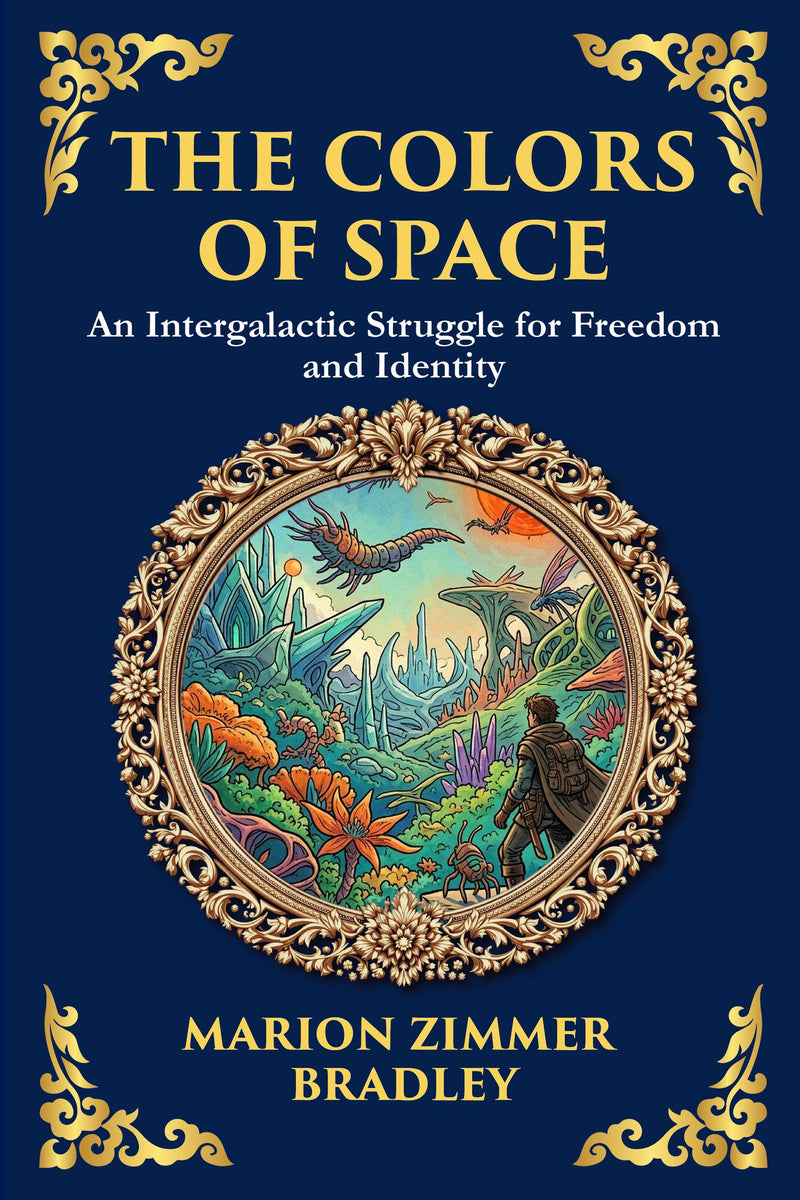
The Colors of Space
In The Colors of Space, science fiction legend Marion Zimmer Bradley weaves a gripping tale of courage, conspiracy, and self-discovery.
or free app
10,000+ hrs library
30-day guarantee
The complete The Colors of Space appears in modern English through Library of Alexandria Press, available online with audiobook narration included for members.
Have you ever wondered why the fight for freedom is often written in the stars? Marion Zimmer Bradley’s The Colors of Space is a visionary science fiction masterpiece that combines high-stakes interstellar adventure with a profound exploration of courage, loyalty, and identity. Written by one of science fiction’s most celebrated authors, this story continues to resonate with readers seeking thrilling narratives and meaningful themes.
When Bart Steele, a young man with a rare gift, stumbles upon a conspiracy involving the alien Lhari, he finds himself on the run. The Lhari control faster-than-light travel, giving them immense power over humanity. Yet Bart’s knowledge and abilities make him a key player in a galactic struggle that could shift the balance of power forever.
Disguised as one of the Lhari, he embarks on a daring infiltration mission, discovering shocking secrets about both species—and himself.
What you’ll discover in this modern edition
- An Unforgettable Hero’s Journey – Follow Bart Steele’s evolution from an ordinary young man into a courageous leader.
- A Thrilling Space Opera Mystery – Conspiracies, espionage, and danger at every turn in a universe full of political intrigue.
- Themes of Freedom and Prejudice – Explore Bradley’s thought-provoking commentary on fear, power, and unity.
- A Vividly Imagined Universe – Experience the grandeur of interstellar travel and alien cultures in rich, classic sci-fi detail.
- A Classic From a Master Storyteller – Discover why Marion Zimmer Bradley remains a beloved figure in science fiction.
| Formats | eBook (EPUB + PDF) · Audiobook · Paperback · Hardcover · Large Print |
| Language | English |
| Trim size (print) | 6 × 9 in |
| Binding | Paperback — perfect-bound · Hardcover — casewrap |
| Large Print edition | Same text in a larger, easy-read type — a larger font, not a larger trim |
| Print pricing | Every physical book at our true cost — at-cost, no profit (members) |
| Library | 873 restored titles, always growing |
| Length | 47,246 words · ~3 hr 9 min reading |
| Reading level | Grade 7 · an easy, flowing read (this modern-English edition) |
| Edition | Modern English translation · 2026 |
Member reviews for this edition are collected as readers finish it — be the first. Across the library: 12,000+ books shipped, every plan covered by a 365-day print guarantee.
About this edition
A faithful, unabridged modern-English edition by The Library of Alexandria — carefully rendered for today's reader and verified paragraph-by-paragraph against the public-domain source. Available as eBook, audiobook, paperback, hardcover, and large print.
- Complete & unabridgedVerified paragraph by paragraph against the source — never a scan, never abridged.
- Modern English, faithfulReadable today, with the author’s meaning kept intact. Readable — not simplified.
- Every format, one membershipRead in your browser or the free app, or listen to the full audiobook.
Included free with your membership
Cancel anytime, one click · 30-day money-back guarantee
Edition last updated July 2026
What’s inside
The Colors of Space — complete and unabridged: all 15 sections included with membership, plus the full audiobook.
Begin reading The Colors of Space
In clear modern English — the complete text is included with membership.
Introduction
There are certain books that arrive in a reader’s life at exactly the right moment, and there are others that seem to wait patiently across decades, ready to mean something new to each generation that picks them up. The novel you are about to begin belongs firmly to the second category. First published in the late 1950s, it emerged during one of the most fertile and electric periods in the history of science fiction—a time when the genre was bursting with optimism, anxiety, and an almost childlike wonder at the possibilities of the cosmos. The space race had not yet been won by anyone, the moon was still an unreachable silver disc, and the very idea that human beings might one day travel between the stars carried a thrill that is difficult to fully recapture today. Into that atmosphere of excitement and possibility stepped a young writer who would go on to become one of the most influential and beloved voices in speculative fiction, and who here, in a relatively compact and propulsive adventure, distilled many of the themes that would animate her entire career.
What makes this particular work so rewarding is the way it manages to be two things at once. On its surface, it is a fast-moving, accessible adventure story of the kind that has delighted readers of all ages for generations. It moves with the confidence and momentum of the best pulp-era storytelling, never lingering too long, never weighing itself down with unnecessary digression. Yet beneath that swift current of plot lies a surprisingly deep and serious meditation on freedom, on identity, on the meaning of difference, and on the ways in which power can be hoarded by the few at the expense of the many. The subtitle of this edition—An Intergalactic Struggle for Freedom and Identity—is not a marketing flourish. It is an honest description of what lies at the heart of the tale. The author understood, perhaps better than many of her contemporaries, that the most enduring science fiction is never really about the technology. It is about people, and about the choices people make when they are confronted with a universe far larger and stranger than they had imagined.
This modern translation and adaptation has been prepared with one overriding goal in mind: to give today’s reader the smoothest, most immersive possible passage into a story that deserves to be read by new audiences. The original text, for all its brilliance, carries the unmistakable cadences of its era. Certain idioms, certain rhythms of dialogue, certain assumptions about what a reader would or would not need explained, can occasionally create small points of friction for a contemporary audience encountering the work for the first time. Our editorial intention has been to remove that friction wherever it serves the reader, while preserving with great care the voice, the spirit, and the essential character of the writing. This is not a rewriting of the book, nor a reimagining of it. It is a gentle modernization—a careful smoothing of the path so that the story itself can shine through with the clarity and force it was always meant to have. The adventure remains exactly as the author conceived it. The emotional beats land exactly where she placed them. What changes is only the ease with which a reader living in the twenty-first century can fall into the narrative and stay there, undistracted, until the final page.
To understand why this book matters, it helps to know a little about the woman who wrote it. The author would later become world-famous for sweeping, ambitious works of fantasy and science fiction that explored gender, society, telepathy, and the clash between vastly different cultures. She built entire fictional worlds with histories, languages, and social structures so detailed that readers spent decades immersed in them. But before all of that, before the great cycles of novels that made her name a household word among genre devotees, there were leaner and more intimate works like this one. Reading it now is a little like discovering an early sketch by a great painter: you can see, in the bold and economical strokes, the unmistakable signature of the talent that would later flower into something grand. The preoccupations are already here. The fascination with outsiders, with those who do not quite belong, with the moment a young person discovers that the world is not what they were told it was—all of these themes, which would echo throughout her later masterpieces, are present in this book in a remarkably pure and concentrated form.
A Story of Discovery and the Courage to See Clearly
At its core, this is a story about awakening. Without revealing the particulars of the plot—for the pleasures of this book depend heavily on discovery, and it would be a disservice to spoil them—it is fair to say that the novel concerns a young protagonist who is thrust into circumstances that force a profound reconsideration of everything once taken for granted. This is one of the oldest and most powerful narrative shapes in all of literature: the journey from innocence to experience, from a comfortable but limited understanding of the world to a fuller, harder, and ultimately more liberating knowledge. The setting is the vastness of space, the canvas is interstellar travel, and the stakes involve nothing less than the structure of an entire civilization. But the emotional engine of the story is intimate and human. It is about a person learning to trust their own perceptions, learning to question authority, and learning that the truth—however uncomfortable—is always worth pursuing.
The title itself, with its evocation of color, points toward one of the book’s central concerns. The author was deeply interested in perception: in how we see the universe, in what we are permitted to see, and in who decides what is visible and what is kept hidden. Color, in this novel, becomes far more than a visual phenomenon. It becomes a metaphor for knowledge, for difference, for the rich variety of experience that exists in a universe far more wondrous than any single perspective can contain. There is a quiet but insistent argument running through the book that a universe perceived in only a narrow band of possibilities is a diminished universe, and that true freedom means expanding the range of what one is able to perceive and understand. This is heady material to find at the heart of what reads, on its surface, like a brisk space adventure—and that is precisely the kind of layered richness that has kept readers returning to this author’s work for more than half a century.
The interstellar setting is rendered with a wonderful sense of scope and possibility. The reader is carried across enormous distances, introduced to the mechanics of travel between the stars, and immersed in a future where humanity has spread far beyond its home world. Yet the author never lets the grandeur of the cosmos overwhelm the human scale of the story. The technology serves the characters, not the other way around. There is a refreshing lack of the cold, clinical detachment that sometimes creeps into science fiction concerned primarily with hardware and engineering. Here, the wonders of the future are always filtered through the eyes and emotions of people who are trying to make their way through a difficult and often dangerous world. This is what gives the book its lasting warmth, and it is a quality that the present edition has taken pains to preserve in every line.
One of the most striking aspects of the novel, particularly given the period in which it was written, is its sophisticated engagement with questions of power and exploitation. The “struggle for freedom” named in the subtitle is no abstract thing. It is woven into the very fabric of the society the author depicts—a society in which certain knowledge is guarded, certain capabilities are restricted, and a privileged few maintain their position by controlling what the many are allowed to know. The young protagonist’s journey is, in part, a journey toward understanding the nature of this control, and toward grasping the possibility that things might be otherwise. There is a powerful, almost subversive energy to this aspect of the story. It invites the reader to ask uncomfortable questions about who benefits from secrecy, about the relationship between knowledge and liberty, and about the cost of challenging entrenched systems of power. These are not the concerns of a frivolous adventure tale. They are the concerns of a writer who took ideas seriously, even when wrapping those ideas in the bright, propulsive packaging of popular fiction.
It would be easy, given all this talk of themes and ideas, to give the impression that this is a difficult or demanding book. It is not. One of its great virtues is its sheer readability. The prose moves. The chapters are compact and well-paced. The plot grips early and does not let go. The author had an unerring instinct for pacing, for knowing exactly when to accelerate and when to allow a quieter moment to breathe. A reader can finish this book in a few enjoyable sittings and come away feeling thoroughly entertained, with the deeper resonances of the story working on them quietly, almost subliminally, long after the final page is turned. This is the mark of a master storyteller: the ability to deliver substance without sacrificing pleasure, to provoke thought without ever becoming heavy-handed or didactic. The ideas are there for those who wish to engage with them, but they never get in the way of the story. They emerge naturally from it, the way meaning emerges from any genuinely well-told tale.
The Enduring Relevance of a Mid-Century Vision
There is a particular pleasure in reading science fiction from earlier eras, and it is a pleasure worth describing, because it shapes the way one ought to approach a book like this one. When we read a novel written more than half a century ago about the future, we are in fact reading two stories at once. There is the story the author intended to tell—the adventure, the characters, the imagined world. And there is a second, accidental story: the story of how a particular moment in human history imagined the times to come. We see what people in the mid-twentieth century hoped for and feared, what they believed was possible and what they thought lay forever beyond reach. We notice the things they got remarkably right and the things they could not have anticipated. This double vision is one of the deep and quiet joys of reading older speculative fiction, and it is a joy that this edition hopes to make fully available to the modern reader.
This particular novel rewards that double reading handsomely. The author’s vision of interstellar civilization is shaped by the optimism and the anxieties of her age, and recognizing this enriches rather than diminishes the experience. The dream of human expansion into the stars, the fascination with what lies beyond the boundaries of the known, the conviction that courage and intelligence can triumph over even the most daunting obstacles—these reflect the spirit of an era that believed deeply in the power of human ingenuity. At the same time, the book’s wariness about concentrated power, its suspicion of secrecy, and its insistence on the right of individuals to know the truth about their own world feel almost startlingly contemporary. We live, after all, in an age preoccupied with questions of information, of who controls it and who is denied access to it. The concerns that animate this novel have not faded with time. If anything, they have grown more urgent. A book written before humanity had even reached the moon turns out to have a great deal to say about questions we are still grappling with today.
This is the test of any work of art that aspires to last: does it continue to speak, across the gulf of years, to readers whose lives and circumstances its author could never have foreseen? By that measure, this novel passes with distinction. The specifics of its technology may belong to an earlier imagination of the future—and there is real charm in that, a retro-futurist beauty that readers have come to cherish—but the human truths at its center are timeless. The longing for freedom, the courage required to question authority, the loneliness of the outsider, the exhilaration of discovery, the moral weight of knowledge: these things do not date. They are as alive on the page now as they were when the ink was first dry, and they will remain alive for readers a hundred years hence.
Cancel anytime, one click · 30-day money-back guarantee
Founding annual rate available now — your price locks for life when you join.
Not ready? Get this free chapter by email — read it anytime.
✓ Sent — check your inbox for The Colors of Space.
Questions about The Colors of Space
What is The Colors of Space about?
In The Colors of Space, science fiction legend Marion Zimmer Bradley weaves a gripping tale of courage, conspiracy, and self-discovery. When a young man finds himself entangled in a galactic struggle between humanity and an alien race known as the Lhari, he must choose between loyalty to his people and the greater truth that could reshape the universe. Rich with mystery, action, and philosophical depth, this classic novel explores what it truly means to be free in a galaxy divided by fear and prejudice.
Who wrote The Colors of Space?
The Colors of Space was written by Marion Zimmer Bradley. This edition presents the complete work in clear modern English, faithfully rendered from the public-domain original by Library of Alexandria Press.
Is The Colors of Space free to read?
The opening chapter is free to read on this page. Members read and listen to the complete work — and the entire library — free, and can order any physical book at our true print cost.
How long is The Colors of Space?
15 chapters (~47,246 words) — about 3 hr 9 min of reading in this modern-English edition.
Is this an abridged version of The Colors of Space?
No. This is the complete, unabridged The Colors of Space, carefully rendered into clear modern English and verified paragraph-by-paragraph against the public-domain source — nothing is cut or summarised.
What formats does The Colors of Space come in?
The Colors of Space is available as eBook, paperback, hardcover and large print. eBook and audiobook are included with membership; printed editions ship at our true print cost.
Shipping & returns
Billing & membership
More from the library


Explore Adventure
- The Prince and the Pauper · Mark Twain
- Tarzan of the Apes · Edgar Rice Burroughs
- Peter Pan · J. M. Barrie
- Moby-Dick · Herman Melville
- The Virginian: A Horseman of the Plains — Large Print · Owen Wister
- Italian Hours — Large Print · Henry James
- Italian Hours · Henry James
- The Riddle of the Sands — Large Print · Erskine Childers
- The Lost World — Large Print · Arthur Conan Doyle
- Anabasis — Large Print · Xenophon
- White Fang — Large Print · Jack London
- The Three Musketeers — Large Print · Alexandre Dumas; Auguste Maquet
- Candide · Voltaire
- The Tomb of Ts'in — Large Print · Edgar Wallace
- Candide — Large Print · Voltaire
- Peter Pan — Large Print · J. M. Barrie
- Red Nails — Large Print · Robert E. Howard
- Gulliver of Mars — Large Print · Edwin Lester Arnold
- Out of Time's Abyss — Large Print · Edgar Rice Burroughs
- Jewels of Gwahlur — Large Print · Robert E. Howard
- The Doomsman — Large Print · Van Tassel Sutphen
- Armageddon—2419 A.D. · Philip Francis Nowlan
- Armageddon—2419 A.D. — Large Print · Philip Francis Nowlan
- The Hunniwell Boys and the Platinum Mystery — Large Print · L. P. Wyman
- The Railway Children — Large Print · E. Nesbit
- She — Large Print · H. Rider Haggard
- The People of the Black Circle — Large Print · Robert E. Howard
- The Thirty-Nine Steps — Large Print · John Buchan
- Around the World in Eighty Days — Large Print · Jules Verne
- The Hour of the Dragon — Large Print · Robert E. Howard
The Colors of Space
The Colors of Space
An Intergalactic Struggle for Freedom and Identity
Marion Zimmer Bradley
Contents
- Introduction
- Chapter 1
- Chapter 2
- Chapter 3
- Chapter 4
- Chapter 5
- Chapter 6
- Chapter 7
- Chapter 8
- Chapter 9
- Chapter 10
- Chapter 11
- Chapter 12
- Chapter 13
- Chapter 14
Introduction
There are certain books that arrive in a reader’s life at exactly the right moment, and there are others that seem to wait patiently across decades, ready to mean something new to each generation that picks them up. The novel you are about to begin belongs firmly to the second category. First published in the late 1950s, it emerged during one of the most fertile and electric periods in the history of science fiction—a time when the genre was bursting with optimism, anxiety, and an almost childlike wonder at the possibilities of the cosmos. The space race had not yet been won by anyone, the moon was still an unreachable silver disc, and the very idea that human beings might one day travel between the stars carried a thrill that is difficult to fully recapture today. Into that atmosphere of excitement and possibility stepped a young writer who would go on to become one of the most influential and beloved voices in speculative fiction, and who here, in a relatively compact and propulsive adventure, distilled many of the themes that would animate her entire career.
What makes this particular work so rewarding is the way it manages to be two things at once. On its surface, it is a fast-moving, accessible adventure story of the kind that has delighted readers of all ages for generations. It moves with the confidence and momentum of the best pulp-era storytelling, never lingering too long, never weighing itself down with unnecessary digression. Yet beneath that swift current of plot lies a surprisingly deep and serious meditation on freedom, on identity, on the meaning of difference, and on the ways in which power can be hoarded by the few at the expense of the many. The subtitle of this edition—An Intergalactic Struggle for Freedom and Identity—is not a marketing flourish. It is an honest description of what lies at the heart of the tale. The author understood, perhaps better than many of her contemporaries, that the most enduring science fiction is never really about the technology. It is about people, and about the choices people make when they are confronted with a universe far larger and stranger than they had imagined.
This modern translation and adaptation has been prepared with one overriding goal in mind: to give today’s reader the smoothest, most immersive possible passage into a story that deserves to be read by new audiences. The original text, for all its brilliance, carries the unmistakable cadences of its era. Certain idioms, certain rhythms of dialogue, certain assumptions about what a reader would or would not need explained, can occasionally create small points of friction for a contemporary audience encountering the work for the first time. Our editorial intention has been to remove that friction wherever it serves the reader, while preserving with great care the voice, the spirit, and the essential character of the writing. This is not a rewriting of the book, nor a reimagining of it. It is a gentle modernization—a careful smoothing of the path so that the story itself can shine through with the clarity and force it was always meant to have. The adventure remains exactly as the author conceived it. The emotional beats land exactly where she placed them. What changes is only the ease with which a reader living in the twenty-first century can fall into the narrative and stay there, undistracted, until the final page.
To understand why this book matters, it helps to know a little about the woman who wrote it. The author would later become world-famous for sweeping, ambitious works of fantasy and science fiction that explored gender, society, telepathy, and the clash between vastly different cultures. She built entire fictional worlds with histories, languages, and social structures so detailed that readers spent decades immersed in them. But before all of that, before the great cycles of novels that made her name a household word among genre devotees, there were leaner and more intimate works like this one. Reading it now is a little like discovering an early sketch by a great painter: you can see, in the bold and economical strokes, the unmistakable signature of the talent that would later flower into something grand. The preoccupations are already here. The fascination with outsiders, with those who do not quite belong, with the moment a young person discovers that the world is not what they were told it was—all of these themes, which would echo throughout her later masterpieces, are present in this book in a remarkably pure and concentrated form.
A Story of Discovery and the Courage to See Clearly
At its core, this is a story about awakening. Without revealing the particulars of the plot—for the pleasures of this book depend heavily on discovery, and it would be a disservice to spoil them—it is fair to say that the novel concerns a young protagonist who is thrust into circumstances that force a profound reconsideration of everything once taken for granted. This is one of the oldest and most powerful narrative shapes in all of literature: the journey from innocence to experience, from a comfortable but limited understanding of the world to a fuller, harder, and ultimately more liberating knowledge. The setting is the vastness of space, the canvas is interstellar travel, and the stakes involve nothing less than the structure of an entire civilization. But the emotional engine of the story is intimate and human. It is about a person learning to trust their own perceptions, learning to question authority, and learning that the truth—however uncomfortable—is always worth pursuing.
The title itself, with its evocation of color, points toward one of the book’s central concerns. The author was deeply interested in perception: in how we see the universe, in what we are permitted to see, and in who decides what is visible and what is kept hidden. Color, in this novel, becomes far more than a visual phenomenon. It becomes a metaphor for knowledge, for difference, for the rich variety of experience that exists in a universe far more wondrous than any single perspective can contain. There is a quiet but insistent argument running through the book that a universe perceived in only a narrow band of possibilities is a diminished universe, and that true freedom means expanding the range of what one is able to perceive and understand. This is heady material to find at the heart of what reads, on its surface, like a brisk space adventure—and that is precisely the kind of layered richness that has kept readers returning to this author’s work for more than half a century.
The interstellar setting is rendered with a wonderful sense of scope and possibility. The reader is carried across enormous distances, introduced to the mechanics of travel between the stars, and immersed in a future where humanity has spread far beyond its home world. Yet the author never lets the grandeur of the cosmos overwhelm the human scale of the story. The technology serves the characters, not the other way around. There is a refreshing lack of the cold, clinical detachment that sometimes creeps into science fiction concerned primarily with hardware and engineering. Here, the wonders of the future are always filtered through the eyes and emotions of people who are trying to make their way through a difficult and often dangerous world. This is what gives the book its lasting warmth, and it is a quality that the present edition has taken pains to preserve in every line.
One of the most striking aspects of the novel, particularly given the period in which it was written, is its sophisticated engagement with questions of power and exploitation. The “struggle for freedom” named in the subtitle is no abstract thing. It is woven into the very fabric of the society the author depicts—a society in which certain knowledge is guarded, certain capabilities are restricted, and a privileged few maintain their position by controlling what the many are allowed to know. The young protagonist’s journey is, in part, a journey toward understanding the nature of this control, and toward grasping the possibility that things might be otherwise. There is a powerful, almost subversive energy to this aspect of the story. It invites the reader to ask uncomfortable questions about who benefits from secrecy, about the relationship between knowledge and liberty, and about the cost of challenging entrenched systems of power. These are not the concerns of a frivolous adventure tale. They are the concerns of a writer who took ideas seriously, even when wrapping those ideas in the bright, propulsive packaging of popular fiction.
It would be easy, given all this talk of themes and ideas, to give the impression that this is a difficult or demanding book. It is not. One of its great virtues is its sheer readability. The prose moves. The chapters are compact and well-paced. The plot grips early and does not let go. The author had an unerring instinct for pacing, for knowing exactly when to accelerate and when to allow a quieter moment to breathe. A reader can finish this book in a few enjoyable sittings and come away feeling thoroughly entertained, with the deeper resonances of the story working on them quietly, almost subliminally, long after the final page is turned. This is the mark of a master storyteller: the ability to deliver substance without sacrificing pleasure, to provoke thought without ever becoming heavy-handed or didactic. The ideas are there for those who wish to engage with them, but they never get in the way of the story. They emerge naturally from it, the way meaning emerges from any genuinely well-told tale.
The Enduring Relevance of a Mid-Century Vision
There is a particular pleasure in reading science fiction from earlier eras, and it is a pleasure worth describing, because it shapes the way one ought to approach a book like this one. When we read a novel written more than half a century ago about the future, we are in fact reading two stories at once. There is the story the author intended to tell—the adventure, the characters, the imagined world. And there is a second, accidental story: the story of how a particular moment in human history imagined the times to come. We see what people in the mid-twentieth century hoped for and feared, what they believed was possible and what they thought lay forever beyond reach. We notice the things they got remarkably right and the things they could not have anticipated. This double vision is one of the deep and quiet joys of reading older speculative fiction, and it is a joy that this edition hopes to make fully available to the modern reader.
This particular novel rewards that double reading handsomely. The author’s vision of interstellar civilization is shaped by the optimism and the anxieties of her age, and recognizing this enriches rather than diminishes the experience. The dream of human expansion into the stars, the fascination with what lies beyond the boundaries of the known, the conviction that courage and intelligence can triumph over even the most daunting obstacles—these reflect the spirit of an era that believed deeply in the power of human ingenuity. At the same time, the book’s wariness about concentrated power, its suspicion of secrecy, and its insistence on the right of individuals to know the truth about their own world feel almost startlingly contemporary. We live, after all, in an age preoccupied with questions of information, of who controls it and who is denied access to it. The concerns that animate this novel have not faded with time. If anything, they have grown more urgent. A book written before humanity had even reached the moon turns out to have a great deal to say about questions we are still grappling with today.
This is the test of any work of art that aspires to last: does it continue to speak, across the gulf of years, to readers whose lives and circumstances its author could never have foreseen? By that measure, this novel passes with distinction. The specifics of its technology may belong to an earlier imagination of the future—and there is real charm in that, a retro-futurist beauty that readers have come to cherish—but the human truths at its center are timeless. The longing for freedom, the courage required to question authority, the loneliness of the outsider, the exhilaration of discovery, the moral weight of knowledge: these things do not date. They are as alive on the page now as they were when the ink was first dry, and they will remain alive for readers a hundred years hence.
The Lhari spaceport didn’t belong on Earth.
Bart Steele had thought that a long time ago when he first saw it. He had been just a twelve-year-old kid then, excited to visit Earth for the first time—the legendary home of humanity before the Space Age and the planet of his distant ancestors. The very first thing he saw when he stepped off the starship was the Lhari spaceport.
Right then, he had thought, It doesn’t belong on Earth.
When he told his father, the man’s expression became strange, bitter, and distant.
“A lot of people would agree with you, son,” Captain Rupert Steele had said softly. “The problem is, if the Lhari spaceport weren’t on Earth, we wouldn’t be here either. Keep that in mind.”
Five years later, Bart remembered those words as he stepped off the moving sidewalk. He turned to wait for Tommy Kendron, who was grabbing his luggage from the center strip of the roadway. Bart and Tommy had graduated from the Space Academy of Earth the day before. Tommy, who was born on the ninth planet of the star Capella, was taking the Lhari starship back to his distant home. Meanwhile, Bart’s father was returning to Earth on that same ship to meet his son.
Five years,* Bart thought. *That’s a long time. I wonder if Dad will even recognize me?
“I’ve got it,” Tommy chuckled, lifting the plastic cases. “Lhari ships don’t allow much luggage. Certainly not more than I can carry myself.”
The two young men stood in front of the spaceport gate for a moment. The gate was high, pointed, and made of a clear, colorless material like glass. Above it was a jagged symbol that looked like a lightning bolt; in the Lhari language, it was the sign for their home world.
End of the free sample
Keep reading, free
Members read and listen to the complete book — and the entire library. Cancel anytime, one click · 30-day money-back guarantee.