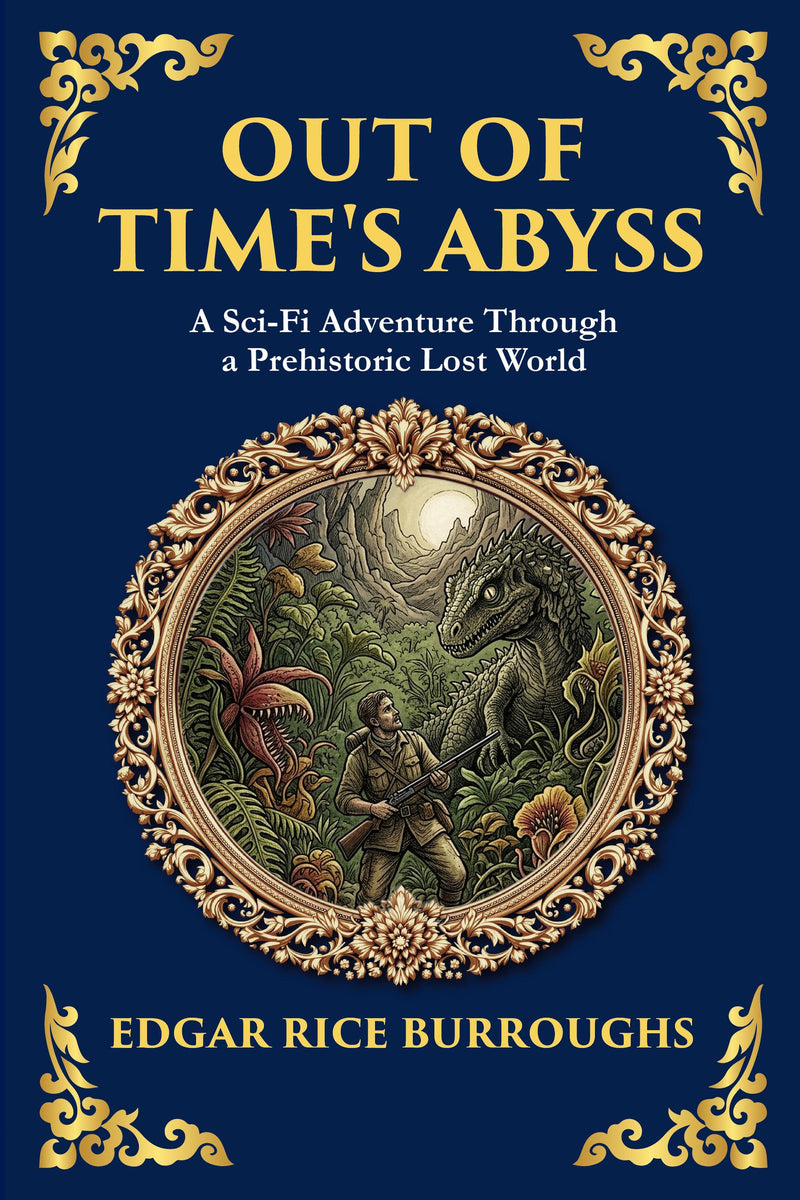
Out of Time's Abyss
Deep in the uncharted South Pacific lies Caspak—an island shrouded in mystery, ruled by beasts long extinct, and untouched by the evolution of the modern world.
or free app
10,000+ hrs library
30-day guarantee
The complete Out of Time's Abyss appears in modern English through Library of Alexandria Press, available online with audiobook narration included for members.
What if crossing an island means crossing the ages—and the skies belong to winged hunters?
In Out of Time's Abyss, Edgar Rice Burroughs takes you to Caspak, a hidden island sealed behind high cliffs. Dense forest and an inland sea shelter great beasts and early human tribes. Here, evolution unfolds across geography rather than time, and each stretch of ground raises a new question about how life changes.
Separated from his companions, Lieutenant Bradley faces a struggle far from help. The winged Wieroos capture him, forcing him to use wit and strength to seek escape and uncover their society's secrets. Along the way, he meets the brave Co-Tan, and the possibility of love takes root in a world ruled by danger.
What you'll discover
- An island beyond reach – Step behind Caspak's cliffs into a warm, crowded wilderness of forest, water, and hidden threats.
- Evolution across the map – Explore a bold imagined world where geography takes the place of time in shaping life.
- Hunters in the sky – Face the Wieroos alongside Bradley as captivity turns survival into a test of resourcefulness.
- Love amid the danger – Meet Co-Tan, whose courage brings a human connection to Bradley's struggle in this hostile land.
- The boundary of humanity – Look beneath the chases to questions about what separates human beings from beasts.
Perfect for readers who enjoy early science fiction, lost world tales, and fast adventure built around a bold scientific idea.
Open the first page now and follow Bradley into the strange, dangerous world behind Caspak's cliffs.
| Formats | eBook (EPUB + PDF) · Audiobook · Paperback · Hardcover · Large Print |
| Language | English |
| Trim size (print) | 6 × 9 in |
| Binding | Paperback — perfect-bound · Hardcover — casewrap |
| Large Print edition | Same text in a larger, easy-read type — a larger font, not a larger trim |
| Print pricing | Every physical book at our true cost — at-cost, no profit (members) |
| Library | 873 restored titles, always growing |
| Length | 36,783 words · ~2 hr 27 min reading |
| Reading level | Grade 3 · an easy, flowing read (this modern-English edition) |
| Edition | Modern English translation · 2026 |
Member reviews for this edition are collected as readers finish it — be the first. Across the library: 12,000+ books shipped, every plan covered by a 365-day print guarantee.
About this edition
A faithful, unabridged modern-English edition by The Library of Alexandria — carefully rendered for today's reader and verified paragraph-by-paragraph against the public-domain source. Available as eBook, audiobook, paperback, hardcover, and large print.
- Complete & unabridgedVerified paragraph by paragraph against the source — never a scan, never abridged.
- Modern English, faithfulReadable today, with the author’s meaning kept intact. Readable — not simplified.
- Every format, one membershipRead in your browser or the free app, or listen to the full audiobook.
Included free with your membership
Cancel anytime, one click · 30-day money-back guarantee
Edition last updated July 2026
What’s inside
Out of Time's Abyss — complete and unabridged: all 6 sections included with membership, plus the full audiobook.
Begin reading Out of Time's Abyss
In clear modern English — the complete text is included with membership.
Introduction
There are stories that quietly slip into the reader’s hands and others that arrive carrying the weight of an entire literary tradition behind them. The novel you are about to read belongs firmly to the second category. It is the third and final movement of one of the most audacious adventure sequences ever committed to the page, a tale woven from the dreams of a man who believed, perhaps more than any other writer of his generation, that the imagination of the reader was a boundless frontier waiting to be colonized by wonder. To open these pages is to step onto the threshold of a world that has fascinated and frightened audiences for more than a century, a world hidden behind towering cliffs and treacherous seas, where the rules of nature themselves seem to have been rewritten by some unknowable hand.
This modern translation and adaptation has been prepared with a single purpose in mind: to bring the breathless momentum, the strange beauty, and the unrelenting suspense of Edgar Rice Burroughs’s original vision to a contemporary readership without sacrificing the qualities that have made his work endure. The language has been refreshed, the rhythms gently modernized, and the occasional thicket of antiquated phrasing cleared away so that the story can move with the urgency its author always intended. What remains is the pure, distilled essence of one of the early twentieth century’s most beloved pulp adventures, presented in a form that invites the modern reader to lose themselves entirely in its pages. Before you begin that journey, it may be worth pausing to consider where this story comes from, why it has lasted, and what makes it such a singular pleasure to read even now, generations after it first appeared.
Edgar Rice Burroughs occupies a peculiar and important place in the history of popular fiction. Born in Chicago in 1875, he came to writing relatively late and almost by accident, having tried his hand at a remarkable variety of occupations before discovering, in his mid-thirties, that he possessed an extraordinary gift for spinning yarns. He had been a cowboy, a gold dredger, a railroad policeman, a pencil-sharpener salesman, and a soldier in the United States Cavalry, among other things. None of these pursuits made him wealthy or content. What they did, however, was furnish him with a deep reservoir of restlessness and a hunger for the kind of adventure that ordinary life so rarely supplies. When he finally turned to fiction, that hunger came pouring out onto the page in a torrent of imagination that would reshape an entire genre.
Burroughs is best remembered today as the creator of two of the most recognizable characters in all of popular culture: Tarzan of the Apes, the feral nobleman raised in the African jungle, and John Carter of Mars, the Civil War veteran transported to a dying red planet of warring civilizations. These creations alone would have secured his legacy. But Burroughs was not a man content to mine a single vein. His imagination ranged across the cosmos and beneath the earth, into the hollow interior of our own planet and out to the moons of distant worlds. He wrote with astonishing speed and prolific energy, producing scores of novels across multiple interlocking series, and in doing so he essentially invented the template for modern pulp adventure: the heroic protagonist, the exotic and dangerous setting, the relentless cascade of cliffhangers, the love that blossoms amid peril, and the deep, almost mythic sense that the world is vast and strange and full of marvels waiting just beyond the edge of the map.
It is worth dwelling for a moment on what made Burroughs so successful, because it bears directly on the experience of reading the book before you. He understood, perhaps better than any of his contemporaries, that the engine of a great adventure story is forward motion. His narratives almost never pause to catch their breath. A hero escapes one deadly predicament only to tumble headlong into another, and the reader is swept along by the sheer velocity of events. Yet this was never mere mechanical plotting. Burroughs married his propulsive storytelling to genuinely inventive world-building, constructing elaborate ecosystems, cultures, languages, and histories for the imaginary realms his characters explored. He was a worldmaker in the truest sense, and his settings have a vividness and internal consistency that lifts them far above the disposable entertainments of his era.
The series to which this novel belongs represents some of his most concentrated and inventive work. Conceived during the years surrounding the First World War, it springs from a premise that was already a beloved staple of speculative fiction by the time Burroughs took it up: the lost world, the hidden land where the deep past survives into the present, where creatures thought extinct still roam and the long-buried epochs of the earth’s history coexist in a single impossible place. But where lesser writers might have been content simply to populate such a setting with monsters and leave it at that, Burroughs did something far more ambitious. He built into the very fabric of his lost world a mystery so strange, so original, and so unsettling that it transforms the entire enterprise from a simple monster adventure into something closer to a meditation on life, evolution, identity, and the terrifying possibility of a natural order entirely unlike our own.
That central mystery is the beating heart of the trilogy, and it is precisely the sort of thing that should not be spoiled in advance. Suffice it to say that the land at the center of these stories operates according to laws that the characters can scarcely comprehend, and that the slow, dawning realization of how this world truly works is one of the great pleasures the series has to offer. The first two volumes established the setting and introduced its dangers; this third and concluding volume carries the saga toward its climax, drawing together threads that have been patiently laid down across the preceding books and bringing the reader at last to the deepest and most jealously guarded secrets of this haunting place.
Burroughs wrote during what is often called the golden age of pulp magazines, when inexpensive periodicals printed on rough paper carried serialized fiction to an enormous and eager popular audience. These magazines were the mass entertainment of their day, the streaming services and blockbuster franchises of the early twentieth century, and Burroughs was one of their reigning kings. His stories appeared in installments, each ending on a knife-edge designed to compel readers to buy the next issue. This serial structure left its mark on his prose. The chapters are taut, each one a self-contained burst of incident, and the narrative is engineered to keep the reader perpetually leaning forward, desperate to know what happens next. Reading him today, one can still feel the pulse of that original serialization, the sense of a story built to seize and hold attention through any means necessary. It is a quality that translates beautifully to the modern age, where our appetite for cliffhangers and binge-worthy storytelling has, if anything, only intensified.
It would be a mistake, however, to dismiss Burroughs as a mere purveyor of cheap thrills. Beneath the surface excitement of his work runs a current of real philosophical curiosity. He was fascinated by questions of nature versus nurture, by the boundary between civilization and savagery, by what it means to be human and how thin the membrane is that separates us from the beasts. His heroes are often men torn between worlds, between the refinements of society and the raw imperatives of survival, and his stories return again and again to the theme of an individual proving their worth not through inherited privilege but through courage, intelligence, and the will to endure. There is a democratic, almost frontier-spirited optimism running through his fiction, a belief that character is forged in adversity and that the measure of a person is taken in moments of extremity. These themes give his adventures a moral weight that has helped them survive long after the magazines that first printed them crumbled to dust.
The setting of this trilogy deserves special attention, for it is one of the most fully realized imaginary lands in all of early speculative fiction. Burroughs constructed it with a care and thoroughness that rewards close reading. This is no vague, generic jungle of stock dangers, but a place with its own geography, its own peculiar climate, its own intricate web of predator and prey, and its own ascending ladder of life. The land is ringed by formidable natural barriers that have kept it sealed off from the outside world, preserving within its boundaries forms of life that have vanished everywhere else. To the human characters who find themselves trapped inside, it is at once a paradise and a prison, a place of staggering beauty and ceaseless terror.
What elevates this world above the ordinary lost-land fantasy is the way Burroughs imagines the relationship between its inhabitants and their environment. The creatures here are not simply scattered at random across the landscape. They exist within a system, a kind of grand biological logic that the human visitors only gradually come to understand. The longer one spends in this land, the more one realizes that nothing about it is accidental, that there is a hidden architecture governing the distribution of life from the steaming lowlands to the high northern reaches. The dawning comprehension of this architecture is woven into the fabric of the storytelling itself, so that the reader’s growing understanding mirrors that of the characters. It is a remarkably sophisticated narrative strategy, and it gives the trilogy a unity and depth that few of its imitators ever achieved.
The dangers of this world are vivid and visceral. There are great reptilian predators, savage beasts of every description, and human and near-human tribes at various stages of development, some of them friendly, many of them lethally hostile. Burroughs had a genuine talent for rendering physical action, and the set pieces in these books, the chases and battles and narrow escapes, are choreographed with cinematic clarity. One can almost see them unfolding on a screen, and indeed Burroughs’s work has long been a wellspring of inspiration for filmmakers and storytellers across every medium. The visual imagination on display is extraordinary, and this modern adaptation has taken care to preserve the clarity and impact of those crucial scenes, so that the reader can experience them with all the immediacy they deserve.
Yet for all its violence and danger, the world of this trilogy is also a place of strange wonder and even beauty. Burroughs lavishes attention on the landscape itself, on the play of light over the water, the lushness of the vegetation, the eerie majesty of the cliffs that wall the land off from the rest of creation. There is a romantic sensibility at work here, a sense of awe at the sheer fecundity and mystery of life. The characters do not merely struggle to survive; they marvel at what they find, and that capacity for wonder is one of the things that makes them such engaging companions on the journey. In the hands of a cynic, a lost world full of monsters might be merely grim. In Burroughs’s hands, it becomes something closer to a fever dream, a place where the deepest fears and the deepest enchantments of the human imagination meet and intertwine.
This concluding volume is, in many ways, the most ambitious of the three. Having established his world and explored its lower reaches in the earlier books, Burroughs uses this final installment to penetrate to its uttermost mysteries, to reveal at last the full strangeness of the order he has been hinting at all along. New characters and new perspectives are introduced, broadening the scope of the saga and casting earlier events in a fresh and surprising light. The narrative reaches toward a resolution that is both satisfying and provocative, tying off the threads of the larger story while leaving the reader with much to ponder about the nature of the world Burroughs has created. It rewards those who have read the earlier volumes, but it also stands as a thrilling adventure in its own right, propulsive and self-contained enough to be enjoyed on its own terms.
Cancel anytime, one click · 30-day money-back guarantee
Founding annual rate available now — your price locks for life when you join.
Not ready? Get this free chapter by email — read it anytime.
✓ Sent — check your inbox for Out of Time's Abyss.
Questions about Out of Time's Abyss
What is Out of Time's Abyss about?
It is a lost world adventure set on Caspak, a hidden island in the southern ocean. Stranded travellers face dangerous beasts, hostile tribes and winged flying men in a land where life seems to rise through stages.
Is Out of Time's Abyss part of a series?
Yes. It is the third book of Edgar Rice Burroughs's Caspak trilogy, which began with The Land That Time Forgot and continued with The People That Time Forgot. Reading them in order helps.
When was Out of Time's Abyss written?
Burroughs's Caspak stories first appeared in magazine form in 1918, in the pulp era. They are fiction and not a true account, and they reflect the interest of that time in evolution and lost worlds.
Who are the Wieroo?
The Wieroo are winged flying men who live on Caspak. In the trilogy they are a separate and dangerous people, set apart from the earthbound tribes that the travellers meet on the ground.
Shipping & returns
Billing & membership
More from the library


Explore Adventure
- The Prince and the Pauper · Mark Twain
- Tarzan of the Apes · Edgar Rice Burroughs
- Peter Pan · J. M. Barrie
- Moby-Dick · Herman Melville
- The Virginian: A Horseman of the Plains — Large Print · Owen Wister
- Italian Hours — Large Print · Henry James
- Italian Hours · Henry James
- The Riddle of the Sands — Large Print · Erskine Childers
- The Lost World — Large Print · Arthur Conan Doyle
- Anabasis — Large Print · Xenophon
- White Fang — Large Print · Jack London
- The Three Musketeers — Large Print · Alexandre Dumas; Auguste Maquet
- Candide · Voltaire
- The Tomb of Ts'in — Large Print · Edgar Wallace
- Candide — Large Print · Voltaire
- Peter Pan — Large Print · J. M. Barrie
- Red Nails — Large Print · Robert E. Howard
- Gulliver of Mars — Large Print · Edwin Lester Arnold
- Out of Time's Abyss — Large Print · Edgar Rice Burroughs
- Jewels of Gwahlur — Large Print · Robert E. Howard
- The Doomsman — Large Print · Van Tassel Sutphen
- Armageddon—2419 A.D. · Philip Francis Nowlan
- Armageddon—2419 A.D. — Large Print · Philip Francis Nowlan
- The Hunniwell Boys and the Platinum Mystery — Large Print · L. P. Wyman
- The Railway Children — Large Print · E. Nesbit
- She — Large Print · H. Rider Haggard
- The People of the Black Circle — Large Print · Robert E. Howard
- The Thirty-Nine Steps — Large Print · John Buchan
- Around the World in Eighty Days — Large Print · Jules Verne
- The Hour of the Dragon — Large Print · Robert E. Howard
Out of Time's Abyss
Out of Time's Abyss
A Sci-Fi Adventure Through a Prehistoric Lost World
Edgar Rice Burroughs
Contents
- Introduction
- Chapter 1
- Chapter 2
- Chapter 3
- Chapter 4
- Chapter 5
Introduction
There are stories that quietly slip into the reader’s hands and others that arrive carrying the weight of an entire literary tradition behind them. The novel you are about to read belongs firmly to the second category. It is the third and final movement of one of the most audacious adventure sequences ever committed to the page, a tale woven from the dreams of a man who believed, perhaps more than any other writer of his generation, that the imagination of the reader was a boundless frontier waiting to be colonized by wonder. To open these pages is to step onto the threshold of a world that has fascinated and frightened audiences for more than a century, a world hidden behind towering cliffs and treacherous seas, where the rules of nature themselves seem to have been rewritten by some unknowable hand.
This modern translation and adaptation has been prepared with a single purpose in mind: to bring the breathless momentum, the strange beauty, and the unrelenting suspense of Edgar Rice Burroughs’s original vision to a contemporary readership without sacrificing the qualities that have made his work endure. The language has been refreshed, the rhythms gently modernized, and the occasional thicket of antiquated phrasing cleared away so that the story can move with the urgency its author always intended. What remains is the pure, distilled essence of one of the early twentieth century’s most beloved pulp adventures, presented in a form that invites the modern reader to lose themselves entirely in its pages. Before you begin that journey, it may be worth pausing to consider where this story comes from, why it has lasted, and what makes it such a singular pleasure to read even now, generations after it first appeared.
Edgar Rice Burroughs occupies a peculiar and important place in the history of popular fiction. Born in Chicago in 1875, he came to writing relatively late and almost by accident, having tried his hand at a remarkable variety of occupations before discovering, in his mid-thirties, that he possessed an extraordinary gift for spinning yarns. He had been a cowboy, a gold dredger, a railroad policeman, a pencil-sharpener salesman, and a soldier in the United States Cavalry, among other things. None of these pursuits made him wealthy or content. What they did, however, was furnish him with a deep reservoir of restlessness and a hunger for the kind of adventure that ordinary life so rarely supplies. When he finally turned to fiction, that hunger came pouring out onto the page in a torrent of imagination that would reshape an entire genre.
Burroughs is best remembered today as the creator of two of the most recognizable characters in all of popular culture: Tarzan of the Apes, the feral nobleman raised in the African jungle, and John Carter of Mars, the Civil War veteran transported to a dying red planet of warring civilizations. These creations alone would have secured his legacy. But Burroughs was not a man content to mine a single vein. His imagination ranged across the cosmos and beneath the earth, into the hollow interior of our own planet and out to the moons of distant worlds. He wrote with astonishing speed and prolific energy, producing scores of novels across multiple interlocking series, and in doing so he essentially invented the template for modern pulp adventure: the heroic protagonist, the exotic and dangerous setting, the relentless cascade of cliffhangers, the love that blossoms amid peril, and the deep, almost mythic sense that the world is vast and strange and full of marvels waiting just beyond the edge of the map.
It is worth dwelling for a moment on what made Burroughs so successful, because it bears directly on the experience of reading the book before you. He understood, perhaps better than any of his contemporaries, that the engine of a great adventure story is forward motion. His narratives almost never pause to catch their breath. A hero escapes one deadly predicament only to tumble headlong into another, and the reader is swept along by the sheer velocity of events. Yet this was never mere mechanical plotting. Burroughs married his propulsive storytelling to genuinely inventive world-building, constructing elaborate ecosystems, cultures, languages, and histories for the imaginary realms his characters explored. He was a worldmaker in the truest sense, and his settings have a vividness and internal consistency that lifts them far above the disposable entertainments of his era.
The series to which this novel belongs represents some of his most concentrated and inventive work. Conceived during the years surrounding the First World War, it springs from a premise that was already a beloved staple of speculative fiction by the time Burroughs took it up: the lost world, the hidden land where the deep past survives into the present, where creatures thought extinct still roam and the long-buried epochs of the earth’s history coexist in a single impossible place. But where lesser writers might have been content simply to populate such a setting with monsters and leave it at that, Burroughs did something far more ambitious. He built into the very fabric of his lost world a mystery so strange, so original, and so unsettling that it transforms the entire enterprise from a simple monster adventure into something closer to a meditation on life, evolution, identity, and the terrifying possibility of a natural order entirely unlike our own.
That central mystery is the beating heart of the trilogy, and it is precisely the sort of thing that should not be spoiled in advance. Suffice it to say that the land at the center of these stories operates according to laws that the characters can scarcely comprehend, and that the slow, dawning realization of how this world truly works is one of the great pleasures the series has to offer. The first two volumes established the setting and introduced its dangers; this third and concluding volume carries the saga toward its climax, drawing together threads that have been patiently laid down across the preceding books and bringing the reader at last to the deepest and most jealously guarded secrets of this haunting place.
Burroughs wrote during what is often called the golden age of pulp magazines, when inexpensive periodicals printed on rough paper carried serialized fiction to an enormous and eager popular audience. These magazines were the mass entertainment of their day, the streaming services and blockbuster franchises of the early twentieth century, and Burroughs was one of their reigning kings. His stories appeared in installments, each ending on a knife-edge designed to compel readers to buy the next issue. This serial structure left its mark on his prose. The chapters are taut, each one a self-contained burst of incident, and the narrative is engineered to keep the reader perpetually leaning forward, desperate to know what happens next. Reading him today, one can still feel the pulse of that original serialization, the sense of a story built to seize and hold attention through any means necessary. It is a quality that translates beautifully to the modern age, where our appetite for cliffhangers and binge-worthy storytelling has, if anything, only intensified.
It would be a mistake, however, to dismiss Burroughs as a mere purveyor of cheap thrills. Beneath the surface excitement of his work runs a current of real philosophical curiosity. He was fascinated by questions of nature versus nurture, by the boundary between civilization and savagery, by what it means to be human and how thin the membrane is that separates us from the beasts. His heroes are often men torn between worlds, between the refinements of society and the raw imperatives of survival, and his stories return again and again to the theme of an individual proving their worth not through inherited privilege but through courage, intelligence, and the will to endure. There is a democratic, almost frontier-spirited optimism running through his fiction, a belief that character is forged in adversity and that the measure of a person is taken in moments of extremity. These themes give his adventures a moral weight that has helped them survive long after the magazines that first printed them crumbled to dust.
The setting of this trilogy deserves special attention, for it is one of the most fully realized imaginary lands in all of early speculative fiction. Burroughs constructed it with a care and thoroughness that rewards close reading. This is no vague, generic jungle of stock dangers, but a place with its own geography, its own peculiar climate, its own intricate web of predator and prey, and its own ascending ladder of life. The land is ringed by formidable natural barriers that have kept it sealed off from the outside world, preserving within its boundaries forms of life that have vanished everywhere else. To the human characters who find themselves trapped inside, it is at once a paradise and a prison, a place of staggering beauty and ceaseless terror.
What elevates this world above the ordinary lost-land fantasy is the way Burroughs imagines the relationship between its inhabitants and their environment. The creatures here are not simply scattered at random across the landscape. They exist within a system, a kind of grand biological logic that the human visitors only gradually come to understand. The longer one spends in this land, the more one realizes that nothing about it is accidental, that there is a hidden architecture governing the distribution of life from the steaming lowlands to the high northern reaches. The dawning comprehension of this architecture is woven into the fabric of the storytelling itself, so that the reader’s growing understanding mirrors that of the characters. It is a remarkably sophisticated narrative strategy, and it gives the trilogy a unity and depth that few of its imitators ever achieved.
The dangers of this world are vivid and visceral. There are great reptilian predators, savage beasts of every description, and human and near-human tribes at various stages of development, some of them friendly, many of them lethally hostile. Burroughs had a genuine talent for rendering physical action, and the set pieces in these books, the chases and battles and narrow escapes, are choreographed with cinematic clarity. One can almost see them unfolding on a screen, and indeed Burroughs’s work has long been a wellspring of inspiration for filmmakers and storytellers across every medium. The visual imagination on display is extraordinary, and this modern adaptation has taken care to preserve the clarity and impact of those crucial scenes, so that the reader can experience them with all the immediacy they deserve.
Yet for all its violence and danger, the world of this trilogy is also a place of strange wonder and even beauty. Burroughs lavishes attention on the landscape itself, on the play of light over the water, the lushness of the vegetation, the eerie majesty of the cliffs that wall the land off from the rest of creation. There is a romantic sensibility at work here, a sense of awe at the sheer fecundity and mystery of life. The characters do not merely struggle to survive; they marvel at what they find, and that capacity for wonder is one of the things that makes them such engaging companions on the journey. In the hands of a cynic, a lost world full of monsters might be merely grim. In Burroughs’s hands, it becomes something closer to a fever dream, a place where the deepest fears and the deepest enchantments of the human imagination meet and intertwine.
This concluding volume is, in many ways, the most ambitious of the three. Having established his world and explored its lower reaches in the earlier books, Burroughs uses this final installment to penetrate to its uttermost mysteries, to reveal at last the full strangeness of the order he has been hinting at all along. New characters and new perspectives are introduced, broadening the scope of the saga and casting earlier events in a fresh and surprising light. The narrative reaches toward a resolution that is both satisfying and provocative, tying off the threads of the larger story while leaving the reader with much to ponder about the nature of the world Burroughs has created. It rewards those who have read the earlier volumes, but it also stands as a thrilling adventure in its own right, propulsive and self-contained enough to be enjoyed on its own terms.
This is the story of Bradley after he departed from Fort Dinosaur, located on the west shore of the massive lake at the center of the island.
On September 4, 1916, he left with four other men—Sinclair, Brady, James, and Tippet—to scout the bottom of the barrier cliffs for a spot they could climb.
Under a bloated sun and through the thick air of Caspak, the five men trekked northwest from Fort Dinosaur. At times they waded through waist-high jungle grasses filled with countless beautiful flowers; at other times they crossed open meadows and park-like plains, before diving back into dense forests of eucalyptus, acacia, and giant tree ferns with feathery fronds waving gently a hundred feet overhead.
All around them—on the ground, among the trees, and in the sky—the endless variety of Caspak’s wildlife crawled, swung, and flew. They were constantly threatened by terrifying creatures and rarely let their rifles get cold. However, even in the short time they had lived on Caprona, they had grown numb to the danger, chatting and laughing as they walked like soldiers on a summer stroll.
“This reminds me of South Clark Street,” noted Brady, who had once worked on a traffic squad in Chicago. Since nobody asked him why, he added that it was “because it’s no place for an Irishman.”
“Then South Clark Street and heaven have something in common,” Sinclair suggested. James and Tippet laughed, but their attention was suddenly shifted when a terrifying growl erupted from a thick cluster of bushes ahead.
“One of those monsters from the Bible,” Tippet muttered as they stopped, guns ready, waiting for the almost certain attack.
End of the free sample
Keep reading, free
Members read and listen to the complete book — and the entire library. Cancel anytime, one click · 30-day money-back guarantee.