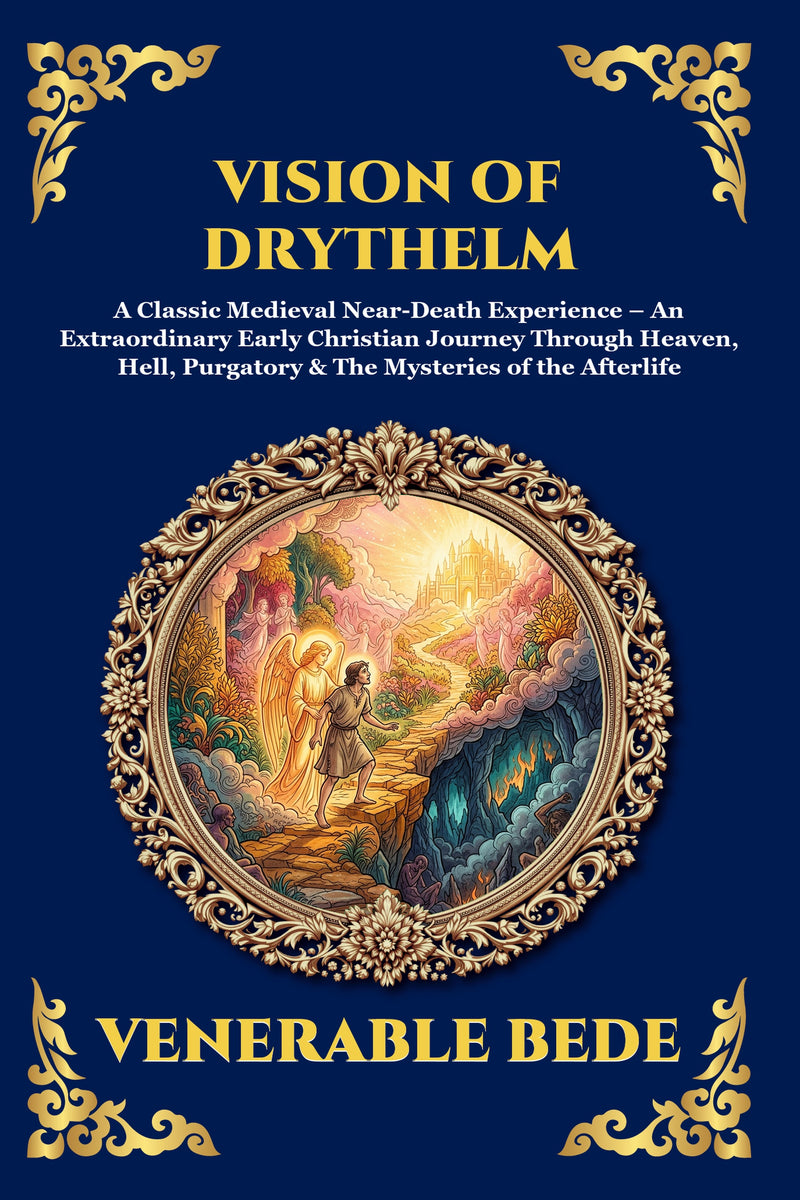
Vision of Drythelm
A Northumbrian man named Drythelm died and returned to life with a harrowing vision of the afterlife, as recorded by the Venerable Bede. Excluded from many religious canons, this account explores themes of repentance and eternal consequence with stark clarity.
or free app
10,000+ hrs library
30-day guarantee
From the Venerable Bede's 731 AD Ecclesiastical History comes this complete modern-English Vision of Drythelm translation, readable online with audiobook narration included for members.
The Vision of Drythelm claims to record an eighth-century man's miraculous journey through death and back to life, revealing detailed glimpses of heaven, hell, and purgatory.
The Vision of Drythelm provides a compelling modern translation of one of the most powerful and vivid accounts of the afterlife from the early Middle Ages. Recorded by the renowned historian the Venerable Bede in his Ecclesiastical History of the English People, this text tells the remarkable story of Drythelm, a devout Northumbrian family man who falls ill, dies, and miraculously awakens the next morning with a haunting message from beyond the veil.
Far more than a simple historical curiosity, the Vision of Drythelm delves into profound themes of repentance, spiritual purification, and the eternal consequences of our earthly actions. Guided by a shining, angelic figure, Drythelm is shown a terrifying valley of alternating fire and piercing ice, the gaping, demonic mouth of the pit, a fragrant meadow of waiting souls, and the blinding light of the heavenly kingdom. Upon his return to the land of the living, his life is radically transformed, leading him to abandon his worldly possessions for a life of extreme asceticism and continuous prayer.
What You Will Discover in This Modern Translation
- A Harrowing Journey Through the Afterlife: Follow Drythelm’s steps as he witnesses the distinct realms of the dead, providing one of the earliest clear depictions of what would later be known as purgatory.
- Encounters with Angels and Demons: Experience the intense spiritual warfare as dark spirits attempt to drag souls into the abyss, only to be driven back by blinding divine light.
- Lessons on Repentance and Redemption: Learn timeless principles about the weight of sin, the necessity of penance, and the boundless mercy of God.
- A Window into Medieval Christian Beliefs: Gain a deeper understanding of how the early English church understood mortality, divine justice, and the soul’s journey after death.
Whether you are exploring this work for its immense historical value, its striking theological imagery, or its gripping narrative of near-death survival, the Vision of Drythelm offers inspiration and foundational knowledge for all.
Step into a story of profound spiritual awakening and discover the timeless lessons of the afterlife. Begin your journey today.
| Formats | eBook (EPUB + PDF) · Audiobook · Paperback · Hardcover · Large Print |
| Language | English |
| Trim size (print) | 6 × 9 in |
| Binding | Paperback — perfect-bound · Hardcover — casewrap |
| Large Print edition | Same text in a larger, easy-read type — a larger font, not a larger trim |
| Print pricing | Every physical book at our true cost — at-cost, no profit (members) |
| Library | 873 restored titles, always growing |
| Composed | 8th century AD |
| Original language | Latin |
| Source tradition | Latin manuscript tradition of Bede's Ecclesiastical History |
| Translation basis | Public-domain scholarly translation, rendered in clear modern English |
| Length | 4,969 words · ~20 min reading |
| Reading level | Grade 13 · rich, literary prose (this modern-English edition) |
| Edition | Modern English translation · 2026 |
Member reviews for this edition are collected as readers finish it — be the first. Across the library: 12,000+ books shipped, every plan covered by a 365-day print guarantee.
About this edition
The complete, unabridged text in clear modern English — faithful to the original, never simplified. Every paragraph is checked against the source, so nothing is cut, summarised, or paraphrased away. It reads cleanly for today while keeping the original meaning intact.
The Vision of Drythelm survives as part of Bede's Ecclesiastical History of the English People in Latin manuscript tradition. This edition derives from the standard public-domain scholarly translation and renders it in clear modern English.
- Complete & unabridgedVerified paragraph by paragraph against the source — never a scan, never abridged.
- Modern English, faithfulReadable today, with the author’s meaning kept intact. Readable — not simplified.
- Every format, one membershipRead in your browser or the free app, or listen to the full audiobook.
Included free with your membership
Cancel anytime, one click · 30-day money-back guarantee
Edition last updated June 2026
What’s inside
Vision of Drythelm — complete and unabridged: all 4 sections included with membership, plus the full audiobook.
Begin reading Vision of Drythelm
In clear modern English — the complete text is included with membership.
Chapter 1
At this time a remarkable miracle took place in Britain, one that recalled the wonders of earlier ages. So that the living might be saved from the death of the soul, a certain man who had been dead for a time came back to life and described many extraordinary things he had seen. Some of these I have thought worth recording briefly here. There was a head of household in that part of Northumbria called Cunningham, who lived a devout life, as did all the members of his family. This man fell ill, and as his condition worsened day by day he was brought to the point of death, and died in the early part of the night. But in the morning, at first light, he suddenly came back to life and sat up. All those who had been sitting around the body weeping fled in terror; only his wife, who loved him most, stayed with him, though she was shaking and overcome with fear.
He comforted her and said, "Do not be afraid, for I have truly risen from death and am permitted to live among men again. But I am not to live as I lived before — from this point on my life will be very different."
He rose at once and went to the chapel of the village, where he remained in prayer until daylight. He then divided all his possessions into three equal parts: one he gave to his wife, one to his children, and the third, which was his own share, he immediately distributed among the poor. Not long afterward he went to the monastery of Melrose, which is almost entirely enclosed by a bend in the river Tweed, and having had his head shaved he moved into a private cell that the abbot had prepared for him. There he remained until the day of his death, in such extraordinary contrition of mind and body that even if he had never spoken a word, his manner of life would have made plain that he had seen things both terrible and wonderful, things of which other men knew nothing.
This is what he said he had seen. "The one who led me had a shining face and wore a bright garment, and we walked in silence, as it seemed to me, toward the northeast. As we went on we came to a valley of great breadth and depth, stretching away to an infinite length. On the left it was filled with dreadful flames; on the right it was no less terrible, swept by violent hail and bitter cold snow flying in every direction. Both sides were full of human souls, which seemed to be hurled back and forth from one side to the other as if by a violent storm. When the wretches could no longer bear the extremity of the heat, they leaped into the midst of the cutting cold; and finding no relief there, they leaped back again into the middle of the unquenchable flames. This went on without pause, as far as the eye could see, with a countless multitude of tormented souls tossed to and fro in both directions. I began to think that this might perhaps be hell, whose unbearable flames I had so often heard described. My guide, who walked ahead of me, answered my thought, saying, 'Do not think so, for this is not the hell you imagine.'
"When he had led me, badly shaken by that dreadful sight, gradually to the far end of the valley, I suddenly saw the place begin to grow dim and fill with darkness. As I entered it, the darkness thickened by degrees until I could see nothing at all except the darkness itself and the form and garment of the one who led me. As we pressed on through the shadows of that night, there suddenly appeared before us great balls of black flame rising as if out of an enormous pit and falling back down into it again. When I had been brought to that place, my guide suddenly vanished and left me alone in the midst of the darkness and that terrible sight. The balls of fire continued without pause, rising up and falling back into the depths of the abyss, and I saw that all the flames as they rose were filled with human souls, which like sparks carried up with smoke were sometimes flung high into the air, and then, when the force of the fire died away, fell back down into the depths below. An unbearable stench poured out with the vapors and filled all those dark places.
"I stood there for a long time in great fear, not knowing what to do, which way to turn, or what end awaited me. Then suddenly I heard behind me the sound of a most hideous and wretched wailing, and at the same time a loud mocking laughter, like that of a rough crowd jeering at captured enemies. As that noise grew louder and drew closer, I made out a gang of evil spirits dragging the howling and lamenting souls of men into the midst of the darkness, while the spirits themselves laughed and exulted. Among those souls, as far as I could tell, there was one who appeared to be a clergyman, one who was a layman, and one who was a woman. The evil spirits dragging them descended into the midst of the burning pit, and as they went deeper down I could no longer distinguish the wailing of the men from the laughter of the devils, though a confused mingling of both sounds still rang in my ears. Meanwhile some of the dark spirits came up out of that flaming abyss and rushed toward me, surrounding me on all sides, tormenting me with their glaring eyes and the foul fire that poured from their mouths and nostrils. They threatened to seize me with the burning tongs they carried in their hands, yet they did not dare touch me, though they terrified me. Hemmed in on every side by enemies and darkness, and looking desperately in every direction for help, I saw behind me, along the way I had come, something like the light of a star shining in the darkness. It grew steadily brighter and moved swiftly toward me, and as it drew near all those evil spirits who had been trying to carry me off with their tongs scattered and fled.
"The one whose approach put them to flight was the same guide who had led me before. He turned now toward the right and began to lead me in a direction that seemed to be toward the southeast, and having quickly brought me out of the darkness, he led me into a region of clear and open light. As he guided me through that brightness, I saw a great wall before us, whose length and height in every direction seemed altogether without limit. I began to wonder why we were approaching the wall, since I could see no door, no window, and no path through it. But when we reached it, we were suddenly — I cannot say by what means — standing on top of it. Within the wall lay a vast and beautiful meadow, so full of fragrant flowers that the sweetness of its scent immediately drove away the stench of the dark furnace that had penetrated me to the bone. The light in that place was so great that it seemed to surpass the brightness of daylight or of the sun at its highest point at noon. The meadow was filled with countless throngs of people dressed in white, and many groups were seated together in joy. As my guide led me through the midst of those happy souls, I began to think that this might perhaps be the kingdom of heaven, of which I had heard so much. He answered my thought, saying, 'This is not the kingdom of heaven, as you suppose.'
When we had passed those mansions of blessed souls and gone farther on, I discovered before me a far more beautiful light, and within it heard sweet voices singing, and so wonderful a fragrance came from that place that the fragrance I had thought most delightful before now seemed quite ordinary by comparison — just as the extraordinary brightness of the flowery field, measured against this new light, appeared dim and insignificant. When I began to hope we would enter that delightful place, my guide suddenly stopped, then turned back and led me home by the way we had come.
When we returned to those joyful mansions of the souls clothed in white, he said to me, "Do you know what all these things are that you have seen?" I answered that I did not, and he replied: "That valley you saw, so dreadful with its consuming flames and cutting cold, is the place where the souls of those are tried and punished who delayed confessing and amending their sins, and only turned to repentance at the point of death, departing this life at the last moment. Nevertheless, because they did confess and repent even at their death, they shall all be received into the kingdom of heaven on the day of judgment. Many, moreover, are relieved before the day of judgment through the prayers, alms, and fasting of the living, and most especially through the offering of masses. That fiery and stinking pit you saw is the mouth of hell, into which whoever falls shall never be delivered for all eternity. This flowery place, where you see those most beautiful young people, so radiant and joyful, is where the souls are received of those who depart the body having lived well, but who are not so perfect as to deserve immediate entry into the kingdom of heaven. Yet they shall all, on the day of judgment, see Christ and share in the joys of his kingdom. Those who are perfect in thought, word, and deed pass as soon as they leave the body directly into the kingdom of heaven, near to which lies that place where you heard the sound of sweet singing, with its fragrant odor and bright light. As for you, who are now to return to your body and live among men again — if you will take care to examine your actions closely and direct your speech and conduct in righteousness and simplicity, you shall after death have a place of rest among these joyful companies of blessed souls. When I left you for a time, it was to learn what was to become of you." When he had said this to me, I was deeply reluctant to return to my body, so delighted was I with the sweetness and beauty of the place I beheld and with the company of those I saw there. Yet I dared not ask him any questions, and in the meantime, all at once, I found myself alive among men.
These things, and others besides, which this man of God had seen, he would not relate to the slothful or those who lived carelessly, but only to those who, being moved by dread of torment or drawn by hope of heavenly joy, would make use of his words to grow in piety. Near his cell lived a monk named Hemgils, eminent in the priesthood, which he honored by his good works. He was still living at the time of this writing, leading a solitary life in Ireland and sustaining his declining years on coarse bread and cold water. He often visited that man, and by asking him many questions learned from him all the particulars of what he had seen when separated from his body. It is through Hemgils's account that we too came to know the few particulars we have briefly set down here. The man also related his visions to King Aldfrid, a man of great learning in every respect, who heard him so willingly and attentively that at the king's request he was admitted into the monastery of Melrose and received the monastic tonsure. The king, whenever he happened to be in those parts, would very often come to hear him. At that time the religious and humble abbot and priest Ethelwald presided over the monastery, and he now worthily holds the episcopal see of the church of Lindisfarne.
A more private place of residence was assigned to him within the monastery, where he could devote himself to the service of his Creator in continual prayer. As that place lay on the bank of a river, he would often go down into the water to do penance in his body, many times plunging completely beneath the surface and remaining there saying psalms or prayers for as long as he could endure it, standing sometimes up to his waist and sometimes up to his neck in the water. When he came out onto the bank, he never removed his cold and frozen garments but wore them until they grew warm and dry on his body.
In winter, when half-broken pieces of ice floated around him — ice he had broken himself to make room to stand or to immerse himself in the river — those who watched would say, "It is wonderful, brother Drithelm, for so he was called, that you are able to endure such bitter cold." He would answer simply, for he was a man of great simplicity and modest intelligence, "I have seen greater cold."
And when they said, "It is remarkable that you will endure such austerity," he replied, "I have seen greater austerity."
And so he continued, driven by an indefatigable longing for heavenly bliss, to subdue his aging body with daily fasting until the day he was called away, and in this way he advanced the salvation of many by his words and his example.
Cancel anytime, one click · 30-day money-back guarantee
Founding annual rate available now — your price locks for life when you join.
Not ready? Get this free chapter by email — read it anytime.
✓ Sent — check your inbox for Vision of Drythelm.
Questions about Vision of Drythelm
What is the Vision of Drythelm about?
The Vision of Drythelm recounts how a Northumbrian man died, experienced a guided tour of the afterlife including places of punishment and reward, then returned to life and became a monk, as recorded by Bede.
Did the Venerable Bede actually write this account?
Yes, Bede included Drythelm's vision in his Ecclesiastical History of the English People around 731 AD, presenting it as a contemporary account he had investigated and verified through witnesses.
Why isn't the Vision of Drythelm in the Bible?
The Vision of Drythelm was written in 8th-century England, centuries after biblical canonization. It appears in Bede's historical work as a recorded vision, not as scripture claiming divine authorship.
Is Vision of Drythelm free to read?
The opening of the text is free to read below. Members read and listen to the complete work — and the entire Lost & Forbidden Library — free.
What is Vision of Drythelm?
Have you ever wondered why medieval visions of the afterlife continue to fascinate and terrify readers to this day?
How long is Vision of Drythelm?
4 chapters (~2,318 words) in this restored edition.
Shipping & returns
Billing & membership
More from the library


Explore The Lost & Forbidden Library
- 1 Enoch · Attributed to Enoch
- 1–4 Maccabees · Various Jewish authors
- 2 Baruch · Attributed to Baruch
- 2 Enoch · Attributed to Enoch
- 2 Esdras · Attributed to the prophet Ezra
- 3 Baruch · Attributed to Baruch ben Neriah
- 4 Baruch · Attributed to Baruch ben Neriah
- A Valentinian Exposition · Attributed to a follower of Val...
- Acta Archelai · Attributed to Hegemonius
- Acts of Andrew · Anonymous (Early Christian Apoc...
- Acts of Andrew and Matthias in the City of the Cannibals · Attributed to early Christian a...
- Acts of Barnabas · Attributed to John Mark
- Acts of Bartholomew
- Acts of John · Anonymous (Early Christian Apoc...
- Acts of Matthias · Anonymous early Christian writers
- Acts of Paul · Attributed to an unknown early ...
- Acts of Paul and Thecla · Attributed to Onesiphorus
- Acts of Peter
- Acts of Peter and Andrew · Attributed to various early Chr...
- Acts of Peter and Paul · Attributed to Leucius Charinus
- Acts of Peter and Simon · Attributed to Leucius Charinus
- Acts of Peter and the Twelve Apostles · Attributed to early Christian a...
- Acts of Philip · Anonymous (Early Christian Apoc...
- Acts of Pilate (Gospel of Nicodemus) · Attributed to various early Chr...
- Acts of Saturninus
- Acts of Thaddaeus · Attributed to Thaddaeus the Apo...
- Acts of Thomas
- Acts of Titus · Anonymous early Christian writer
- Acts of Xanthippe, Polyxena, and Rebecca
- Allogenes · Anonymous (Early Gnostic Mystic)
Vision of Drythelm
The Vision of Drythelm
The Northumbrian Who Died and Returned — Bede's Account of the Man of Cunningham Led by a Shining Guide Through the Valley of Fire and Ice, the Pit of Hell, the Flowery Place of Waiting Souls, and the Wall of Light, Who Came Back to Life and Gave Away His Goods to Enter the Monastery of Melrose (from the Ecclesiastical History of the English People)
Library of Alexandria Press
The Vision of Drythelm
© Copyright 2026 Library of Alexandria Press. All rights reserved.
Published by Library of Alexandria Press
Printed in the United States of America
It is not legal to copy, share, or send any part of this document in either digital or printed form without written permission from the publisher, except short quotes in a book review.
Table of Contents
Introduction
The World That Shaped the Vision
Why This Vision Still Speaks
Chapter 1
Introduction
Sometime around the year 696 AD, in the kingdom of Northumbria in what is now northern England, a man died. He was a respected householder, known for his piety and his care for the poor, a man of modest but genuine virtue living in an age when the Christian faith was still finding its footing among the Germanic peoples of Britain. He died in the evening, and by morning he had come back to life. What he reported upon his return — the landscapes he had traversed, the beings he had encountered, the terrifying and beautiful vistas that had opened before him in the space between death and life — would be recorded by one of the greatest scholars of the early medieval world and would echo through the centuries as one of the most remarkable spiritual testimonies ever set down in writing.
The man's name was Drythelm. His guide and chronicler was the Venerable Bede, the Northumbrian monk whose monumental work, the Ecclesiastical History of the English People, remains to this day our single most important source for the history of early Christian Britain. Bede was not a credulous man. He was a rigorous thinker, a careful historian, a scholar of scripture and science alike, and he took the account of Drythelm seriously enough to include it in full in his masterwork, presenting it not as legend or allegory but as a genuine event reported by a living witness whom he considered trustworthy. That endorsement alone should give us pause. When one of the most learned men of the eighth century stakes his reputation on a story, the story deserves our closest attention.
What you hold in your hands is an invitation to enter one of history's most extraordinary narratives — a journey through realms that the medieval mind understood with absolute seriousness and that the modern mind continues to find compelling, disturbing, and strangely familiar. The account of Drythelm's experience is brief in its original form, occupying only a handful of pages in Bede's history, but its density is remarkable. Within those pages are contained an entire cosmology of the afterlife, a moral vision of breathtaking clarity, and a human story of transformation so complete that it challenges everything we think we know about what it means to live, to die, and to return.
The story belongs to a genre that scholars now call the 'near-death experience,' though that modern clinical term barely scratches the surface of what Drythelm underwent. Researchers in the late twentieth century, most famously Raymond Moody in his groundbreaking 1975 book Life After Life, catalogued a set of recurring features in the reports of people who had been resuscitated after clinical death: the sensation of leaving the body, movement through darkness toward light, encounters with luminous beings, a panoramic review of one's life, visits to realms of extraordinary beauty or terror, and a reluctant return to the living world accompanied by a profound sense of purpose. What is astonishing — and what gives this ancient account its particular power — is that Drythelm's experience, recorded more than twelve centuries before Moody's research, contains virtually every one of these elements. The parallels are not superficial. They are structural, emotional, and deeply specific in ways that resist easy explanation.
Yet to reduce Drythelm's vision to a mere historical precursor of modern near-death research would be to impoverish it enormously. The account is saturated with the theological imagination of early medieval Christianity, and that imagination is itself a world worth entering. Drythelm did not simply float through a vague luminous space and return with warm feelings about the universe. He was taken on a guided tour — a purposeful, structured journey through four distinct regions of the afterlife, each one corresponding to a different moral and spiritual condition of the soul. He saw things that horrified him. He saw things that filled him with a joy he could barely describe. He was given explanations by his guide, a radiant figure in white, and those explanations constitute a complete and coherent theology of what happens to human souls after death — a theology that would prove enormously influential in the centuries that followed.
The influence of this account on later literature and theology can hardly be overstated. Scholars have long noted the striking similarities between Drythelm's journey and the great visionary literature of the Middle Ages, including the twelfth-century Vision of Tundale, the thirteenth-century Vision of Thurkill, and most famously of all, the Divine Comedy of Dante Alighieri. Whether Dante read Bede directly, or encountered the Drythelm material through intermediary sources, is a matter of scholarly debate. What is not debatable is that the structural imagination of the afterlife that Drythelm's account helped to establish — the graduated regions of punishment and purification, the guiding figure, the overwhelming sensory detail, the moral taxonomy of souls — is the same imagination that produced the Inferno, the Purgatorio, and the Paradiso. To read Drythelm is, in a very real sense, to read the deep roots of one of the greatest works of literature ever written.
But the account is not merely a literary or historical curiosity. It is, at its core, a human story — and a deeply moving one. A man dies. He is taken somewhere. He sees things that shatter his previous understanding of reality. He comes back changed, irrevocably and completely. He gives away his possessions. He leaves his wife and children. He enters a monastery. He spends the rest of his life in a cell beside a river, immersing himself in the icy water to pray, winter and summer, until the cold that would have killed an ordinary man becomes simply the background of his devotion. When asked why he subjects himself to such austerity, he replies — and this is one of the most quietly devastating lines in all of early medieval literature — that he has seen things far colder than this. The man who returns from death is not the man who died. Something happened to him. Something real, whatever its ultimate nature, reshaped him from the inside out.
That transformation is perhaps the most compelling aspect of the entire account. We live in an age that is deeply skeptical of religious experience and deeply hungry for it at the same time. We have more material comfort than any previous generation in human history, and we are, by many measures, more anxious, more purposeless, and more frightened of death than almost any people who have ever lived. We have largely lost the frameworks that previous ages used to make sense of mortality, and we have not yet found adequate replacements. Into that vacuum, accounts like Drythelm's speak with a strange and urgent power. They do not ask us to accept any particular theological system. They ask us to consider the possibility that the universe is larger, stranger, and more morally serious than our ordinary assumptions allow. They ask us to look at our lives from the outside, as Drythelm was compelled to look at them, and to ask what we are actually doing with the time we have been given.
Chapter 1
At this time a remarkable miracle took place in Britain, one that recalled the wonders of earlier ages. So that the living might be saved from the death of the soul, a certain man who had been dead for a time came back to life and described many extraordinary things he had seen. Some of these I have thought worth recording briefly here. There was a head of household in that part of Northumbria called Cunningham, who lived a devout life, as did all the members of his family. This man fell ill, and as his condition worsened day by day he was brought to the point of death, and died in the early part of the night. But in the morning, at first light, he suddenly came back to life and sat up. All those who had been sitting around the body weeping fled in terror; only his wife, who loved him most, stayed with him, though she was shaking and overcome with fear.
He comforted her and said, "Do not be afraid, for I have truly risen from death and am permitted to live among men again. But I am not to live as I lived before — from this point on my life will be very different."
He rose at once and went to the chapel of the village, where he remained in prayer until daylight. He then divided all his possessions into three equal parts: one he gave to his wife, one to his children, and the third, which was his own share, he immediately distributed among the poor. Not long afterward he went to the monastery of Melrose, which is almost entirely enclosed by a bend in the river Tweed, and having had his head shaved he moved into a private cell that the abbot had prepared for him. There he remained until the day of his death, in such extraordinary contrition of mind and body that even if he had never spoken a word, his manner of life would have made plain that he had seen things both terrible and wonderful, things of which other men knew nothing.
This is what he said he had seen. "The one who led me had a shining face and wore a bright garment, and we walked in silence, as it seemed to me, toward the northeast. As we went on we came to a valley of great breadth and depth, stretching away to an infinite length. On the left it was filled with dreadful flames; on the right it was no less terrible, swept by violent hail and bitter cold snow flying in every direction. Both sides were full of human souls, which seemed to be hurled back and forth from one side to the other as if by a violent storm. When the wretches could no longer bear the extremity of the heat, they leaped into the midst of the cutting cold; and finding no relief there, they leaped back again into the middle of the unquenchable flames. This went on without pause, as far as the eye could see, with a countless multitude of tormented souls tossed to and fro in both directions. I began to think that this might perhaps be hell, whose unbearable flames I had so often heard described. My guide, who walked ahead of me, answered my thought, saying, 'Do not think so, for this is not the hell you imagine.'
"When he had led me, badly shaken by that dreadful sight, gradually to the far end of the valley, I suddenly saw the place begin to grow dim and fill with darkness. As I entered it, the darkness thickened by degrees until I could see nothing at all except the darkness itself and the form and garment of the one who led me. As we pressed on through the shadows of that night, there suddenly appeared before us great balls of black flame rising as if out of an enormous pit and falling back down into it again. When I had been brought to that place, my guide suddenly vanished and left me alone in the midst of the darkness and that terrible sight. The balls of fire continued without pause, rising up and falling back into the depths of the abyss, and I saw that all the flames as they rose were filled with human souls, which like sparks carried up with smoke were sometimes flung high into the air, and then, when the force of the fire died away, fell back down into the depths below. An unbearable stench poured out with the vapors and filled all those dark places.
"I stood there for a long time in great fear, not knowing what to do, which way to turn, or what end awaited me. Then suddenly I heard behind me the sound of a most hideous and wretched wailing, and at the same time a loud mocking laughter, like that of a rough crowd jeering at captured enemies. As that noise grew louder and drew closer, I made out a gang of evil spirits dragging the howling and lamenting souls of men into the midst of the darkness, while the spirits themselves laughed and exulted. Among those souls, as far as I could tell, there was one who appeared to be a clergyman, one who was a layman, and one who was a woman. The evil spirits dragging them descended into the midst of the burning pit, and as they went deeper down I could no longer distinguish the wailing of the men from the laughter of the devils, though a confused mingling of both sounds still rang in my ears. Meanwhile some of the dark spirits came up out of that flaming abyss and rushed toward me, surrounding me on all sides, tormenting me with their glaring eyes and the foul fire that poured from their mouths and nostrils. They threatened to seize me with the burning tongs they carried in their hands, yet they did not dare touch me, though they terrified me. Hemmed in on every side by enemies and darkness, and looking desperately in every direction for help, I saw behind me, along the way I had come, something like the light of a star shining in the darkness. It grew steadily brighter and moved swiftly toward me, and as it drew near all those evil spirits who had been trying to carry me off with their tongs scattered and fled.
"The one whose approach put them to flight was the same guide who had led me before. He turned now toward the right and began to lead me in a direction that seemed to be toward the southeast, and having quickly brought me out of the darkness, he led me into a region of clear and open light. As he guided me through that brightness, I saw a great wall before us, whose length and height in every direction seemed altogether without limit. I began to wonder why we were approaching the wall, since I could see no door, no window, and no path through it. But when we reached it, we were suddenly — I cannot say by what means — standing on top of it. Within the wall lay a vast and beautiful meadow, so full of fragrant flowers that the sweetness of its scent immediately drove away the stench of the dark furnace that had penetrated me to the bone. The light in that place was so great that it seemed to surpass the brightness of daylight or of the sun at its highest point at noon. The meadow was filled with countless throngs of people dressed in white, and many groups were seated together in joy. As my guide led me through the midst of those happy souls, I began to think that this might perhaps be the kingdom of heaven, of which I had heard so much. He answered my thought, saying, 'This is not the kingdom of heaven, as you suppose.'
When we had passed those mansions of blessed souls and gone farther on, I discovered before me a far more beautiful light, and within it heard sweet voices singing, and so wonderful a fragrance came from that place that the fragrance I had thought most delightful before now seemed quite ordinary by comparison — just as the extraordinary brightness of the flowery field, measured against this new light, appeared dim and insignificant. When I began to hope we would enter that delightful place, my guide suddenly stopped, then turned back and led me home by the way we had come.
When we returned to those joyful mansions of the souls clothed in white, he said to me, "Do you know what all these things are that you have seen?" I answered that I did not, and he replied: "That valley you saw, so dreadful with its consuming flames and cutting cold, is the place where the souls of those are tried and punished who delayed confessing and amending their sins, and only turned to repentance at the point of death, departing this life at the last moment. Nevertheless, because they did confess and repent even at their death, they shall all be received into the kingdom of heaven on the day of judgment. Many, moreover, are relieved before the day of judgment through the prayers, alms, and fasting of the living, and most especially through the offering of masses. That fiery and stinking pit you saw is the mouth of hell, into which whoever falls shall never be delivered for all eternity. This flowery place, where you see those most beautiful young people, so radiant and joyful, is where the souls are received of those who depart the body having lived well, but who are not so perfect as to deserve immediate entry into the kingdom of heaven. Yet they shall all, on the day of judgment, see Christ and share in the joys of his kingdom. Those who are perfect in thought, word, and deed pass as soon as they leave the body directly into the kingdom of heaven, near to which lies that place where you heard the sound of sweet singing, with its fragrant odor and bright light. As for you, who are now to return to your body and live among men again — if you will take care to examine your actions closely and direct your speech and conduct in righteousness and simplicity, you shall after death have a place of rest among these joyful companies of blessed souls. When I left you for a time, it was to learn what was to become of you." When he had said this to me, I was deeply reluctant to return to my body, so delighted was I with the sweetness and beauty of the place I beheld and with the company of those I saw there. Yet I dared not ask him any questions, and in the meantime, all at once, I found myself alive among men.
These things, and others besides, which this man of God had seen, he would not relate to the slothful or those who lived carelessly, but only to those who, being moved by dread of torment or drawn by hope of heavenly joy, would make use of his words to grow in piety. Near his cell lived a monk named Hemgils, eminent in the priesthood, which he honored by his good works. He was still living at the time of this writing, leading a solitary life in Ireland and sustaining his declining years on coarse bread and cold water. He often visited that man, and by asking him many questions learned from him all the particulars of what he had seen when separated from his body. It is through Hemgils's account that we too came to know the few particulars we have briefly set down here. The man also related his visions to King Aldfrid, a man of great learning in every respect, who heard him so willingly and attentively that at the king's request he was admitted into the monastery of Melrose and received the monastic tonsure. The king, whenever he happened to be in those parts, would very often come to hear him. At that time the religious and humble abbot and priest Ethelwald presided over the monastery, and he now worthily holds the episcopal see of the church of Lindisfarne.
A more private place of residence was assigned to him within the monastery, where he could devote himself to the service of his Creator in continual prayer. As that place lay on the bank of a river, he would often go down into the water to do penance in his body, many times plunging completely beneath the surface and remaining there saying psalms or prayers for as long as he could endure it, standing sometimes up to his waist and sometimes up to his neck in the water. When he came out onto the bank, he never removed his cold and frozen garments but wore them until they grew warm and dry on his body.
In winter, when half-broken pieces of ice floated around him — ice he had broken himself to make room to stand or to immerse himself in the river — those who watched would say, "It is wonderful, brother Drithelm, for so he was called, that you are able to endure such bitter cold." He would answer simply, for he was a man of great simplicity and modest intelligence, "I have seen greater cold."
And when they said, "It is remarkable that you will endure such austerity," he replied, "I have seen greater austerity."
And so he continued, driven by an indefatigable longing for heavenly bliss, to subdue his aging body with daily fasting until the day he was called away, and in this way he advanced the salvation of many by his words and his example.
End of the free sample
Keep reading, free
Members read and listen to the complete book — and the entire library. Cancel anytime, one click · 30-day money-back guarantee.