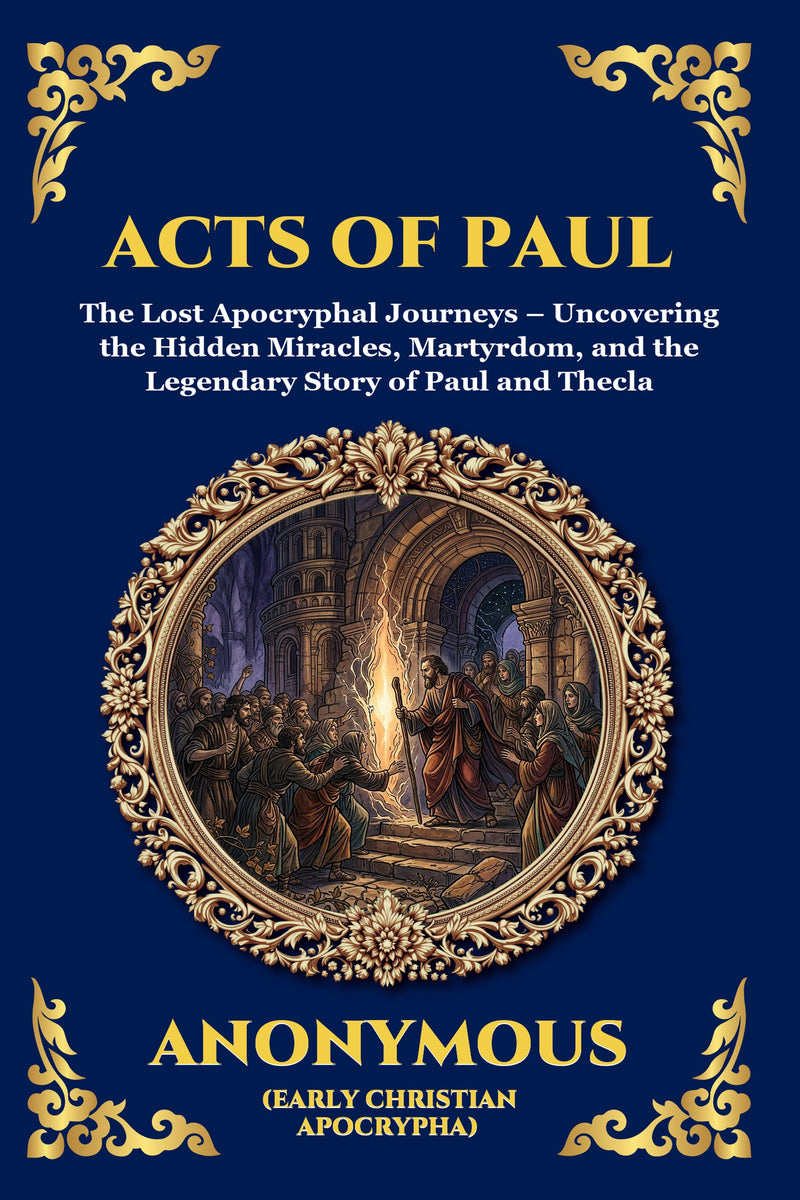
Acts of Paul
Written in the second century, Acts of Paul recounts thrilling adventures and miracles omitted from the New Testament. With stories like the iconic "Acts of Paul and Thecla," this text captivated early Christians, offering a vivid portrayal of devotion, romance, and martyrdom.
or free app
10,000+ hrs library
30-day guarantee
This 2nd-century apocryphal text, the Acts of Paul, receives a complete modern English translation from Library of Alexandria Press, readable online with included audiobook narration.
The Acts of Paul was excluded from the biblical canon despite its widespread popularity in early Christian communities, deemed too fantastical by church authorities who favored more restrained apostolic narratives.
In The Acts of Paul, readers are invited to step beyond the canonical Book of Acts and explore a vibrant, dramatic, and fiercely devoted apocryphal world. Written in the second century, this text was incredibly popular among early Christians, designed to satisfy a deep curiosity about the continued journeys, miraculous deeds, and final days of the great Apostle to the Gentiles.
Far more than a simple historical supplement, this text introduces a rich tapestry of early Christian romance and martyrdom. At its heart lies the famous "Acts of Paul and Thecla," the story of an iconic noblewoman who is captivated by Paul's teachings, survives miraculous trials in the gladiatorial arena, and emerges as a powerful, independent teacher of the faith. From breathtaking escapes from death to an encounter with a baptized lion, these stories showcase an era where faith was a matter of life, death, and daily miracles.
What You Will Discover in This Modern Translation
- The Legendary Story of Thecla: Follow the inspiring journey of Thecla of Iconium, a young woman who defies societal norms, faces wild beasts and fire, and becomes one of the most venerated female figures in early Christian tradition.
- Astonishing Apocryphal Miracles: Explore vivid, legendary accounts of Paul’s travels, including his profound preaching, miraculous healings, and incredible interactions with the natural world and wild animals.
- The Martyrdom of Paul: Read the dramatic, apocryphal conclusion to the Apostle's life, detailing his confrontation with the Roman Emperor Nero and the miraculous events surrounding his execution.
- A Window into Ancient Christian Devotion: Gain a deeper understanding of the values, struggles, and fierce ascetic ideals that characterized the early, persecuted Christian communities.
Whether you are exploring this work for its immense historical value, its role in shaping early Christian folklore, or its captivating storytelling, The Acts of Paul offers a deeply moving reading experience.
Step into the hidden history of the early church and discover the timeless, daring legends of The Acts of Paul. Begin your journey today.
| Formats | eBook (EPUB + PDF) · Audiobook · Paperback · Hardcover · Large Print |
| Language | English |
| Trim size (print) | 6 × 9 in |
| Binding | Paperback — perfect-bound · Hardcover — casewrap |
| Large Print edition | Same text in a larger, easy-read type — a larger font, not a larger trim |
| Print pricing | Every physical book at our true cost — at-cost, no profit (members) |
| Library | 873 restored titles, always growing |
| Composed | 2nd century AD |
| Original language | Greek |
| Source tradition | Greek papyrus fragments and Coptic manuscript tradition |
| Translation basis | Public-domain scholarly translation, rendered in clear modern English |
| Length | 10,206 words · ~41 min reading |
| Reading level | Grade 8 · clear and comfortable (this modern-English edition) |
| Edition | Modern English translation · 2026 |
Member reviews for this edition are collected as readers finish it — be the first. Across the library: 12,000+ books shipped, every plan covered by a 365-day print guarantee.
About this edition
The complete, unabridged text in clear modern English — faithful to the original, never simplified. Every paragraph is checked against the source, so nothing is cut, summarised, or paraphrased away. It reads cleanly for today while keeping the original meaning intact.
The Acts of Paul survives in Greek papyrus fragments and Coptic manuscripts from various locations. This edition derives from the standard public-domain scholarly translation and renders it in clear modern English.
- Complete & unabridgedVerified paragraph by paragraph against the source — never a scan, never abridged.
- Modern English, faithfulReadable today, with the author’s meaning kept intact. Readable — not simplified.
- Every format, one membershipRead in your browser or the free app, or listen to the full audiobook.
Included free with your membership
Cancel anytime, one click · 30-day money-back guarantee
Edition last updated June 2026
What’s inside
Acts of Paul — complete and unabridged: all 39 sections included with membership, plus the full audiobook.
Begin reading Acts of Paul
In clear modern English — the complete text is included with membership.
Chapter 1
Paul went into the house where the dead boy lay. But Phila, the wife of Panchares, was furious and said to her husband in a rage: You have gone to the wild beasts — you did not father this son. Where is my child?
He had no desire for food, only to bury the boy. But Panchares stood before everyone and prayed at the ninth hour, until the people of the city came to carry the boy out. When he had finished praying, Paul came and saw, and spoke of Jesus Christ, and of the boy, and of the prayer.
A great crowd had gathered. After eight days they believed that he had raised the boy up. But when Paul had stayed on among them, they questioned him, and the men listened to what he said. They sent for Panchares and cried out: We believe you, Panchares — save the city from all these things they are saying.
Panchares said to them: Consider whether your good deeds are not possible without bearing witness to God, who has given his Son for our salvation. And I too believe, my brothers, that there is no other God but Jesus Christ, the Son of the Blessed, to whom be glory forever. Amen.
But when they saw that he would not come over to their side, they went after Paul, seized him, dragged him back into the city, abused him, pelted him with stones, and drove him out of their city and out of their country. Panchares, however, would not return evil for evil. He shut the door of his house and went inside with his wife, and they fasted. When evening came, Paul came to him and said: God has given us Jesus Christ.
Chapter 2
When Paul went up to Iconium after fleeing from Antioch, he was accompanied by Demas and Hermogenes the coppersmith, who were full of hypocrisy and flattered Paul as though they loved him. But Paul, looking only to the goodness of Christ, did them no harm and loved them well, so that he made every effort to open to them all the oracles of the Lord — the teaching and the interpretation of the Gospel, the birth and resurrection of the Beloved — and he recounted to them word by word the great works of Christ, how they had been revealed to him, and how Christ was born of the virgin Mary, of the seed of David.
Now a certain man named Onesiphorus, hearing that Paul had come to Iconium, went out with his children Simmias and Zeno and his wife Lectra to meet him, intending to receive him into his house. Titus had described to him what Paul looked like, since Onesiphorus had never seen him in the flesh, but only in the spirit.
He went along the royal road that leads to Lystra and stood there waiting, watching everyone who passed, measuring them against Titus's description. Then he saw Paul approaching — a man small in stature, with thinning hair, bowed legs, and a sturdy build; his eyebrows met in the middle and his nose was slightly hooked, and he was full of grace. Sometimes he had the appearance of an ordinary man, and sometimes his face was like the face of an angel.
When Paul saw Onesiphorus he smiled, and Onesiphorus said: Welcome, servant of the blessed God. Paul replied: Grace be with you and with your household. But Demas and Hermogenes were envious, and their hypocrisy grew all the more bitter, so that Demas said: Are we not servants of the Blessed as well? Why did you not greet us the same way? Onesiphorus answered: I see no fruit of righteousness in you. But if you are what you claim, then come also into my house and refresh yourselves.
Chapter 3
When Paul entered the house of Onesiphorus, there was great joy, with kneeling and breaking of bread, and the word of God concerning self-restraint and the resurrection. For Paul said: Blessed are the pure in heart, for they shall see God. Blessed are those who keep the flesh chaste, for they shall become the temple of God. Blessed are the continent, for to them God shall speak. Blessed are those who have renounced this world, for they shall be pleasing to God. Blessed are those who have wives as though they had none, for they shall inherit God. Blessed are those who have the fear of God, for they shall become angels of God.
Blessed are those who tremble at the word of God, for they shall be comforted.
Chapter 4
Blessed are those who receive the wisdom of Jesus Christ, for they shall be called sons of the Most High. Blessed are those who have kept their baptism pure, for they shall rest with the Father and with the Son. Blessed are those who have grasped the understanding of Jesus Christ, for they shall dwell in light. Blessed are those who for the love of God have turned away from the ways of this world, for they shall judge angels, and shall be blessed at the right hand of the Father. Blessed are the merciful, for they shall obtain mercy and shall not see the bitter day of judgment. Blessed are the bodies of the virgins, for they shall be well-pleasing to God and shall not lose the reward of their chastity, for the word of the Father shall be for them a work of salvation in the day of his Son, and they shall have rest forever and ever.
Chapter 5
And as Paul was saying these things in the midst of the church assembled in the house of Onesiphorus, a young virgin named Thecla — whose mother was Theocleia, and who was betrothed to a man named Thamyris — sat at the nearby window and listened night and day to Paul's teaching about chastity. She did not move from the window, but was drawn ever deeper by faith, filled with great joy. And when she saw many women and virgins going in to Paul, she too longed earnestly to be counted worthy to stand before him face to face and hear the word of Christ; for she had not yet seen what Paul looked like, but had only heard his voice.
Chapter 6
Since she would not move from the window, her mother sent for Thamyris, and he came with great joy, as though he were already about to take her as his wife. Thamyris said to Theocleia, "Where is my Thecla?" And Theocleia said, "I have a strange new story to tell you, Thamyris. For three days and three nights Thecla has not risen from the window, neither to eat nor to drink. She stares as though fixed on some joyful sight, and she is so absorbed in a stranger who teaches deceptive and unsettling words that I am astonished to see the great modesty of this girl so badly shaken.
"Thamyris, this man is turning the whole city of Iconium upside down, and your Thecla along with it — for all the women and the young men flock to him and are taught by him. He tells them, 'You must fear one God alone and live in chastity.' And my daughter too, like a spider at the window, is caught in his words, seized by a new longing and a troubling passion. She hangs on everything he says, and the girl is captivated. Go to her and speak with her, for she is betrothed to you."
So Thamyris went to her, loving her and yet frightened by the trance she was in, and said, "Thecla, my betrothed, why do you sit like this? What is this passion that holds you spellbound? Come back to your Thamyris and be ashamed of yourself." Her mother said the same: "Thecla, why do you sit there staring downward, saying nothing, like someone struck senseless?" And they wept bitterly — Thamyris because he was losing a wife, Theocleia because she was losing a daughter, and the maidservants because they were losing a mistress. The whole house was filled with grief and confusion. Yet through all of it Thecla did not turn away, but kept her attention fixed on the words of Paul.
Chapter 7
Thamyris leapt up and went out into the street and watched those who went in to Paul and came out. He saw two men quarreling bitterly with one another and said to them, "Men, tell me who you are, and who is this man inside with you, who leads the souls of young men and maidens astray, deceiving them into thinking there should be no marriages but that they should remain as they are. I promise to give you much money if you will tell me about him, for I am one of the leading men of this city."
Demas and Hermogenes said to him, "Who this man is we do not know, but he robs young men of their wives and maidens of their husbands, saying, 'There is no resurrection for you unless you remain chaste and do not defile the flesh but keep it pure.'"
Thamyris said to them, "Come into my house, men, and refresh yourselves with me." They went in to a lavish banquet, with much wine and great wealth and a splendid table. Thamyris plied them with drink, for he loved Thecla and wished to take her as his wife. During the dinner Thamyris said, "Tell me, men, what is his teaching, so that I too may know it, for I am greatly troubled about Thecla — she is so devoted to this stranger, and I am being cheated of my marriage."
Demas and Hermogenes said, "Bring him before Castelius the governor as one who stirs up the crowds with the new doctrine of the Christians. He will destroy him, and then you will have your wife Thecla. And we will teach you about this resurrection he proclaims — that it has already taken place in the children we now have, and that we rise again when we come to the knowledge of the true God."
Chapter 8
But when Thamyris heard this from them, he was filled with envy and rage. He rose up early and went to the house of Onesiphorus with the rulers and officers and a great crowd carrying staves, and said to Paul, "You have destroyed the city of the Iconians, and the woman who was betrothed to me, so that she will not have me. Let us go before Castelius the governor." And all the crowd said, "Away with this sorcerer, for he has corrupted all our wives." And the multitude rose up together against him.
And Thamyris, standing before the judgment seat, cried out and said, "O proconsul, this is the man — we do not know where he comes from — who does not allow maidens to marry. Let him declare before you why he teaches such things." And Demas and Hermogenes said to Thamyris, "Say that he is a Christian, and so you will destroy him." But the governor kept his composure and summoned Paul, saying to him, "Who are you, and what do you teach? For it is no small accusation that these men bring against you."
And Paul raised his voice and said, "If I am examined today concerning what I teach, then listen, O proconsul. The living God — the God of vengeance, the jealous God, the God who has need of nothing, yet desires the salvation of men — has sent me to turn them away from corruption and uncleanness and all pleasure that leads to death, so that they may sin no more. Therefore God has sent his own Child, whom I proclaim and teach, so that men may have hope in him who alone has had compassion on a world lost in error; so that men may no longer stand under judgment, but may have faith and the fear of God and the knowledge of self-restraint and the love of truth. If, then, I teach the things that have been revealed to me by God, what wrong do I do, O proconsul?" When the governor had heard this, he ordered Paul to be bound and taken away to prison until he should have time to hear him more carefully.
Chapter 9
But Thecla, in the night, took off her bracelets and gave them to the doorkeeper, and when the door was opened for her she went into the prison and gave the jailer a silver mirror, and so made her way to Paul and sat at his feet and heard him speak of the wonderful works of God. And Paul had no fear at all, but walked in full confidence in God; and her own faith grew stronger as she kissed his chains.
Now when Thecla was missed by her family and by Thamyris, they searched for her through the streets as though she were lost. One of the fellow-servants of the doorkeeper reported that she had gone out in the night. They questioned the doorkeeper, and he told them she had gone to the stranger who was held in the prison. They went as he directed and found her there, bound to Paul, as it were, by love. They left at once, gathered a crowd around them, and brought the matter before the governor.
Cancel anytime, one click · 30-day money-back guarantee
Founding annual rate available now — your price locks for life when you join.
Not ready? Get this free chapter by email — read it anytime.
✓ Sent — check your inbox for Acts of Paul.
Questions about Acts of Paul
Why was the Acts of Paul excluded from the New Testament canon?
The Acts of Paul was excluded from the canon due to concerns about its fictional nature and theological content that differed from accepted apostolic tradition, as noted by early church fathers like Tertullian.
What stories are included in the Acts of Paul?
The Acts of Paul contains the famous Acts of Paul and Thecla, Paul's correspondence with the Corinthians, and accounts of Paul's martyrdom, featuring miraculous events and dramatic conversion stories.
Who actually wrote the Acts of Paul?
According to Tertullian, the Acts of Paul was written by an unnamed presbyter in Asia Minor who composed it out of love for Paul, though he was disciplined for creating this fictional work.
Is Acts of Paul free to read?
The opening of the text is free to read below. Members read and listen to the complete work — and the entire Lost & Forbidden Library — free.
What is Acts of Paul?
Have you ever wondered why some of the most thrilling and miraculous adventures of the Apostle Paul were left out of the New Testament?
How long is Acts of Paul?
39 chapters (~10,255 words) in this restored edition.
Shipping & returns
Billing & membership
More from the library


Explore The Lost & Forbidden Library
- 1 Enoch · Attributed to Enoch
- 1–4 Maccabees · Various Jewish authors
- 2 Baruch · Attributed to Baruch
- 2 Enoch · Attributed to Enoch
- 2 Esdras · Attributed to the prophet Ezra
- 3 Baruch · Attributed to Baruch ben Neriah
- 4 Baruch · Attributed to Baruch ben Neriah
- A Valentinian Exposition · Attributed to a follower of Val...
- Acta Archelai · Attributed to Hegemonius
- Acts of Andrew · Anonymous (Early Christian Apoc...
- Acts of Andrew and Matthias in the City of the Cannibals · Attributed to early Christian a...
- Acts of Barnabas · Attributed to John Mark
- Acts of Bartholomew
- Acts of John · Anonymous (Early Christian Apoc...
- Acts of Matthias · Anonymous early Christian writers
- Acts of Paul and Thecla · Attributed to Onesiphorus
- Acts of Peter
- Acts of Peter and Andrew · Attributed to various early Chr...
- Acts of Peter and Paul · Attributed to Leucius Charinus
- Acts of Peter and Simon · Attributed to Leucius Charinus
- Acts of Peter and the Twelve Apostles · Attributed to early Christian a...
- Acts of Philip · Anonymous (Early Christian Apoc...
- Acts of Pilate (Gospel of Nicodemus) · Attributed to various early Chr...
- Acts of Saturninus
- Acts of Thaddaeus · Attributed to Thaddaeus the Apo...
- Acts of Thomas
- Acts of Titus · Anonymous early Christian writer
- Acts of Xanthippe, Polyxena, and Rebecca
- Allogenes · Anonymous (Early Gnostic Mystic)
- Antitheses of Marcion · Attributed to Marcion of Sinope
Acts of Paul
The Acts of Paul
The Apostle's Mission and Martyrdom — With the Story of Thecla, the Letter to the Corinthians, and His Death at Rome
Library of Alexandria Press
The Acts of Paul
© Copyright 2026 Library of Alexandria Press. All rights reserved.
Published by Library of Alexandria Press
Printed in the United States of America
It is not legal to copy, share, or send any part of this document in either digital or printed form without written permission from the publisher, except short quotes in a book review.
Table of Contents
Introduction
Chapter 1
Chapter 2
Chapter 3
Chapter 4
Chapter 5
Chapter 6
Chapter 7
Chapter 8
Chapter 9
Chapter 10
Chapter 11
Chapter 12
Chapter 13
Chapter 14
Chapter 15
Chapter 16
Chapter 17
Chapter 18
Chapter 19
Chapter 20
Chapter 21
Chapter 22
Chapter 23
Chapter 24
Chapter 25
Chapter 26
Chapter 27
Chapter 28
Chapter 29
Chapter 30
Chapter 31
Chapter 32
Chapter 33
Chapter 34
Chapter 35
Chapter 36
Chapter 37
Chapter 38
Introduction
There is a version of early Christianity that most people have never encountered. It does not live in the canonical letters of Paul, nor in the carefully curated narratives of the Acts of the Apostles as preserved in the New Testament. It exists, instead, in a body of texts that were read aloud in house churches across the ancient Mediterranean world, texts that were copied by devoted hands, carried across deserts, translated into half a dozen languages, and treasured by communities of believers who found in them something urgent, something alive, something that the more official documents did not quite capture. These texts were eventually pushed to the margins of Christian tradition, labeled apocryphal, and in some cases actively suppressed. But they never entirely disappeared. And what they contain is extraordinary.
The document at the heart of this book — known to scholars as the Acts of Paul — is one of the most fascinating, most controversial, and most underappreciated pieces of early Christian literature ever produced. Written in the second century, probably sometime around 160 to 190 CE, it presents a portrait of the apostle Paul that is simultaneously more dramatic, more mystical, more egalitarian, and in many ways more human than anything preserved in the New Testament canon. It tells stories of miraculous escapes and divine interventions. It features a remarkable young woman named Thecla who becomes one of the most celebrated heroines in all of early Christian memory. It includes letters, visions, a lion who receives baptism, and a martyrdom scene of breathtaking power. And it was, for several centuries, read and revered by enormous numbers of Christians across the known world.
Yet for most modern readers — even those with a serious interest in early Christianity, in biblical history, or in the life of Paul himself — this text remains almost entirely unknown. It does not appear in Sunday sermons. It is not discussed in most popular books about the apostolic age. When Paul is mentioned in contemporary culture, the conversation almost always centers on his canonical letters: Romans, Corinthians, Galatians, the great theological edifices that have shaped Western thought for two millennia. The other Paul — the Paul of legend, of miracle, of dramatic confrontation with lions and emperors, of deep friendship with a young woman who cuts her hair, dresses as a man, and preaches the gospel with an authority that rivals his own — this Paul has been waiting in the shadows for a very long time.
This book is an invitation to step into those shadows and let your eyes adjust to a different kind of light.
To understand why these stories matter, it helps to think carefully about what we mean when we use the word 'apocryphal.' In common usage, the word has come to mean something like 'probably not true' or 'of doubtful authenticity.' We say that a story is apocryphal the way we might say it is a rumor — entertaining perhaps, but not to be taken seriously. But this is a modern misunderstanding of a much more complex historical reality. In the ancient world, the line between canonical and apocryphal was not drawn cleanly or quickly. It was contested, debated, and drawn differently in different communities. Texts that we now regard as apocryphal were, in their time, read alongside what would become canonical scripture, sometimes with equal or greater enthusiasm. The Acts of Paul was cited by Origen, discussed by Tertullian, and known to Eusebius. These are not fringe figures. These are the intellectual giants of early Christianity. The fact that a text like this eventually fell outside the boundaries of the official canon tells us a great deal about the politics of early Christian identity formation — but it tells us relatively little about the text's importance, its influence, or its historical and spiritual value.
What the apocryphal acts — and this one in particular — actually represent is something precious and irreplaceable: a window into the diversity of early Christian experience. The Christianity that eventually became dominant, the Christianity that produced the creeds and the councils and the great cathedrals, was not the only Christianity that existed in the first and second centuries. There were communities that emphasized different virtues, told different stories, organized themselves in different ways, and understood the message of Jesus and his apostles through very different lenses. The Acts of Paul emerged from one such community — or perhaps from several overlapping communities — and it preserves their voice with remarkable vividness. To read it is not merely to encounter an interesting historical artifact. It is to sit down with people who lived and breathed and argued and prayed and wept, people for whom these stories were not ancient history but living faith.
The narrative itself is structured as a series of episodes tracing Paul's journeys through the cities of the ancient Mediterranean world — Antioch, Iconium, Ephesus, Corinth, Rome — encountering believers and opponents, performing miracles, preaching a gospel that places remarkable emphasis on sexual renunciation, bodily resurrection, and the radical equality of souls before God. The episodes are loosely connected, and scholars believe that the text as we have it is actually a compilation of originally separate documents that circulated independently before being woven together. The most famous of these is the story of Thecla, which was so popular that it eventually circulated on its own as the Acts of Paul and Thecla, and which generated a cult of veneration around Thecla herself that lasted for centuries and spread from Asia Minor to Egypt to the far reaches of the Byzantine world.
But there are other episodes of equal fascination. There is the correspondence between Paul and the Corinthians — a set of letters not found in the New Testament — which addresses theological controversies about the nature of the resurrection and the reality of Christ's human body. There is the dramatic confrontation in Ephesus, where Paul is thrown to the beasts in the arena and encounters a lion he had previously baptized — a scene that is at once theologically rich and almost comically vivid in its storytelling. And there is the martyrdom of Paul in Rome, a scene of such dignity and power that it has moved readers across the centuries, a scene in which the apostle faces death not with resignation but with a kind of luminous confidence that transforms everyone who witnesses it.
Taken together, these episodes constitute not just a biography of Paul but a theology — a way of understanding what it means to follow Christ, to resist the powers of the world, to embrace a life that is radically oriented toward something beyond the ordinary calculations of survival and social acceptance. The Paul of these stories is not primarily a theologian constructing doctrinal systems. He is a wanderer, a wonder-worker, a man of extraordinary personal magnetism who leaves behind him a trail of transformed lives and outraged authorities. He is, in the deepest sense of the word, an apostle — one who is sent, who goes, who does not stop going even when the road leads directly toward death.
Reading these stories today, one is struck above all by their energy. There is something almost cinematic about the way they move — the rapid shifts of scene, the vivid characterizations, the moments of sudden danger and equally sudden deliverance. Ancient readers clearly loved them for this quality, and modern readers, I think, will find it equally compelling. But beneath the surface excitement there is also genuine theological depth. The questions these stories wrestle with — about the body and the soul, about gender and authority, about the relationship between divine power and human vulnerability, about what it costs to live by conviction in a world that does not share your values — are not questions that have become less urgent with the passage of time. If anything, they feel more urgent now than ever.
A Text Recovered From Silence
The story of how these texts came to be known to modern scholarship is itself a remarkable tale, one that involves crumbling papyri, dedicated philologists, and the slow, painstaking work of reconstruction that has occupied generations of specialists. For most of Christian history, the Acts of Paul was known primarily through references in other ancient sources — the complaints of Tertullian, who objected to the authority it seemed to grant to women; the cautious acknowledgments of Eusebius, who placed it among the disputed texts; the citations of later writers who found in it material useful for various theological arguments. The text itself, in its complete form, had been lost.
What changed everything was the discovery, in the late nineteenth and early twentieth centuries, of papyrus manuscripts in Egypt — manuscripts that had survived the centuries buried in the dry desert soil, preserved by conditions that would have destroyed them anywhere else in the ancient world. Among these discoveries were fragments of the Acts of Paul, including a substantial portion now known as the Hamburg Papyrus and another significant portion known as the Coptic Papyrus. These finds allowed scholars to begin the work of reconstructing the text, piecing together the original narrative from fragments that had been separated by centuries and thousands of miles. It was painstaking, sometimes frustrating work, and the reconstruction remains incomplete. There are gaps in the narrative, passages that have not survived, episodes that we know existed because they are mentioned in other sources but of which we have no direct textual evidence.
This incompleteness is itself historically significant. It reminds us that what we have is not a pristine, perfectly preserved document but a survivor — something that made it through centuries of neglect, active suppression, and the simple ravages of time by the slimmest of margins. Every fragment that has been recovered represents an act of historical rescue, a small victory against the entropy that has claimed so much of the ancient world's literary production. And the fragments we have are rich enough — vivid enough, theologically substantial enough, narratively compelling enough — to give us a genuine sense of what the whole must have been.
The scholarly conversation around this text has been lively and sometimes contentious. Questions about its date, its authorship, its geographical origin, its theological orientation, and its relationship to other early Christian documents have generated an enormous secondary literature, and the debates are far from settled. What can be said with reasonable confidence is that the text was composed in Greek, probably in Asia Minor, probably in the second half of the second century, and that it drew on earlier traditions about Paul — some of which may be historically reliable, others of which are clearly legendary elaborations. The author — or authors, since many scholars believe the text is composite — was someone with genuine literary skill, a strong theological agenda, and a deep familiarity with the Pauline tradition as it had developed in the communities of Asia Minor.
The question of authorship is particularly interesting because the text itself, in one of its most famous passages, addresses it directly. Tertullian tells us that the Acts of Paul was written by a presbyter in Asia who composed it out of love for Paul — and who, when discovered, was removed from his office. This is a remarkable piece of information, if accurate. It suggests that the text was understood from early on as a pious fiction rather than a historical record, and that even those who valued it were aware of its constructed nature. It also suggests something about the world in which it circulated — a world in which the authority of texts was contested, in which the line between legitimate tradition and unauthorized composition was being actively negotiated, and in which love for a revered figure could motivate acts of literary creation that were simultaneously sincere and transgressive.
The theological agenda of the text is one of its most discussed features. The Acts of Paul is deeply committed to a vision of Christian life centered on sexual renunciation — what scholars call encratism, from the Greek word for self-control or continence. Paul's preaching in these stories consistently emphasizes the blessedness of virginity and the spiritual dangers of sexual activity, even within marriage. This is a position that goes significantly beyond anything in the canonical Pauline letters, where Paul famously expresses a preference for celibacy but explicitly acknowledges that marriage is not sinful. In the Acts of Paul, the rhetoric is considerably more intense, and it has consequences — most dramatically in the story of Thecla, who breaks off her engagement to follow Paul's teaching and embrace a life of virginal dedication.
This encratite tendency has led some scholars to associate the text with specific sectarian movements within early Christianity — with Marcionites, or with the communities associated with figures like Tatian, who compiled the Diatessaron and was known for his rigorous asceticism. Others have argued that encratism was simply more widespread in second-century Christianity than later orthodoxy liked to acknowledge, and that the Acts of Paul represents a mainstream current of thought that was later marginalized rather than a fringe position that was always eccentric. This debate matters because it affects how we understand the text's relationship to the broader history of Christianity — whether it is a window into a suppressed minority tradition or a reflection of attitudes that were once widely shared and only gradually became controversial.
What is clear, regardless of how one resolves these scholarly debates, is that the text's theology is not merely a set of abstract propositions. It is embodied in stories, in characters, in dramatic situations that make the theological stakes viscerally real. When Thecla sits at her window, night after night, listening to Paul preach through the wall, refusing to eat or sleep, transfixed by a message that has overturned everything she thought her life was going to be — this is not just an illustration of a theological principle. It is a human experience rendered with genuine psychological insight. And when the authorities of Iconium drag her before the magistrate, when her own mother calls for her execution, when she stands naked in the arena facing wild beasts — the theological questions about the body, about purity, about the cost of conviction, are not abstract at all. They are written in flesh and fear and extraordinary courage.
This is why the text has continued to find readers across the centuries, even in periods when it was officially disapproved. It speaks to something that doctrinal formulations alone cannot reach — the experience of being a person who has staked everything on a conviction that the world around them does not share, who has walked away from safety and comfort and social belonging in pursuit of something that cannot be fully explained or defended but only lived. This experience is not limited to any particular time or culture. It is one of the permanent possibilities of human existence, and literature that renders it with honesty and power will always find an audience.
Why These Stories Still Matter
There is a question that serious readers will inevitably bring to a book like this, and it deserves to be addressed directly: why should we care? Not in the abstract, historical sense — the historical importance of early Christian apocrypha is well established in academic circles — but in the personal, existential sense. Why should a modern reader, with all the demands and distractions of contemporary life, invest time and attention in stories that are two thousand years old, that were excluded from the official canon, that deal with theological controversies that might seem remote from present concerns? What is in these pages for someone who is not a specialist in early Christianity, not a scholar of ancient texts, but simply a curious, thoughtful person who wants to understand something real and important?
The answer, I think, begins with the figure of Paul himself. Paul of Tarsus is one of the most consequential human beings who ever lived. His letters shaped the theology of Western Christianity in ways that are still working themselves out. His ideas about grace, about law, about the relationship between faith and works, about the nature of the church as the body of Christ — these ideas have been argued over, interpreted, misinterpreted, weaponized, and illuminated for two thousand years, and they are still alive in contemporary religious and cultural debates. To understand Paul is to understand something fundamental about the civilization that produced modernity, for good and for ill.
But the canonical Paul — the Paul of Romans and Galatians and the Corinthian correspondence — is in some ways a very difficult figure to know personally. He speaks at such a high level of theological abstraction, with such intensity of argument, that the human being behind the letters can be hard to see. The Paul of legend — the Paul who walks into cities and transforms them, who faces down governors and gladiators, who inspires a young woman to defy her family and her society and her own future — this Paul is easier to feel. He has a physical presence, a personal magnetism, a way of moving through the world that the letters, for all their brilliance, do not quite convey. The legendary Paul and the theological Paul are not contradictions. They are complementary portraits of the same extraordinary person, and reading them together gives us something richer than either alone can provide.
Then there is Thecla. In the history of early Christianity, Thecla occupies a unique and fascinating position. She is not an apostle in the canonical sense. She does not appear in the New Testament. And yet for several centuries she was venerated as a saint of the first rank, celebrated as 'equal to the apostles,' her shrine at Seleucia in Asia Minor one of the great pilgrimage destinations of the ancient Christian world. Gregory of Nazianzus wrote about her. Methodius of Olympus devoted a major theological work to her. Egeria, the fourth-century pilgrim whose travel diary is one of the most charming documents of late antiquity, visited her shrine with evident devotion. The cult of Thecla was not a minor curiosity. It was a major phenomenon of ancient Christianity, and it was rooted entirely in the story preserved in the Acts of Paul.
What Thecla represents — and why her story has continued to resonate with readers across the centuries, including many modern feminist scholars who have found in her a figure of remarkable significance — is a vision of female agency and spiritual authority that the mainstream Christian tradition has often struggled to accommodate. She is not passive. She does not wait for permission. She makes her own decisions, faces her own dangers, and ultimately receives from Paul himself a commission to teach and baptize. She is, in the fullest sense, a protagonist — not a supporting character in someone else's story but the center of her own. The fact that her story was eventually marginalized, that the text containing it was pushed out of the canon, that her authority to baptize was specifically cited by Tertullian as a reason to reject the text — all of this is part of a larger story about the suppression of female religious authority in early Christianity, a story that historians and theologians are still working to understand and reckon with.
Beyond the specific figures of Paul and Thecla, the text as a whole raises questions that are genuinely urgent for contemporary readers. Questions about the relationship between institutional authority and personal conviction. Questions about the cost of living by values that put you in conflict with the dominant culture. Questions about the body — about what it means to be an embodied creature, about the relationship between physical existence and spiritual aspiration, about how we understand suffering and endurance and the limits of what human beings can bear. Questions about community — about what draws people together around a shared vision, and what happens to those communities when they are persecuted, when they disagree among themselves, when the charismatic figure who inspired them is gone.
These are not questions that belong to the second century alone. They are questions that belong to every century, including ours. And there is something about encountering them in a text like this — in a text that is ancient enough to have genuine historical distance from our own moment, but human enough to feel immediately recognizable — that can be genuinely illuminating. Reading about Thecla standing in the arena, about Paul facing execution with serenity, about communities of believers trying to live by convictions that their neighbors find incomprehensible, we are not just learning about the past. We are holding up a mirror to something permanent in human experience.
There is also, it must be said, the sheer pleasure of the stories themselves. The Acts of Paul is not a dry theological treatise. It is, at its best, gripping narrative — full of adventure, suspense, vivid characterization, and moments of genuine humor. The episode of the baptized lion is not only theologically interesting; it is also, by any reasonable standard, one of the most delightfully unexpected scenes in all of ancient literature. The correspondence between Paul and the Corinthians crackles with the energy of real theological argument. The martyrdom of Paul achieves a kind of austere beauty that is genuinely moving. These are stories that were designed to be heard aloud, in community, by people who cared deeply about what they meant — and they still carry that quality of urgency and aliveness.
What this book offers is an encounter with all of this — with the text itself, with its history, with its theology, with its extraordinary cast of characters, and with the world that produced it and was shaped by it. It is an encounter that has been made as accessible as possible, written for readers who bring curiosity and intelligence but not necessarily specialist knowledge. The goal is not to overwhelm with scholarly apparatus — though the scholarly conversation is rich and important and will be engaged where it matters — but to give readers the experience of genuinely meeting this text, perhaps for the first time, and feeling its power.
Early Christianity was not a single, unified phenomenon. It was a conversation — sometimes harmonious, sometimes fiercely contentious — among communities that shared certain core commitments but differed enormously in their practices, their emphases, their stories, and their understanding of what it meant to follow the risen Christ. The texts that eventually became the New Testament canon represent one set of voices in that conversation — important voices, authoritative voices, but not the only voices. The apocryphal acts represent other voices, voices that were marginalized and in some cases silenced but never entirely lost. To read them is to hear the conversation more fully, to understand early Christianity in its genuine diversity, and to appreciate both how much was preserved and how much was lost in the process of canon formation.
The stories you are about to encounter were treasured by real people — people who found in them courage and consolation, who read them in the face of persecution and uncertainty, who passed them on to their children and their communities because they believed they contained something true and vital and worth preserving. Those people deserve to be heard. And the stories themselves — with their energy and their beauty and their genuine theological depth — deserve to be read. Turn the page, and let them speak.
The Acts of Paul
Chapter 1
Paul went into the house where the dead boy lay. But Phila, the wife of Panchares, was furious and said to her husband in a rage: You have gone to the wild beasts — you did not father this son. Where is my child?
He had no desire for food, only to bury the boy. But Panchares stood before everyone and prayed at the ninth hour, until the people of the city came to carry the boy out. When he had finished praying, Paul came and saw, and spoke of Jesus Christ, and of the boy, and of the prayer.
A great crowd had gathered. After eight days they believed that he had raised the boy up. But when Paul had stayed on among them, they questioned him, and the men listened to what he said. They sent for Panchares and cried out: We believe you, Panchares — save the city from all these things they are saying.
Panchares said to them: Consider whether your good deeds are not possible without bearing witness to God, who has given his Son for our salvation. And I too believe, my brothers, that there is no other God but Jesus Christ, the Son of the Blessed, to whom be glory forever. Amen.
But when they saw that he would not come over to their side, they went after Paul, seized him, dragged him back into the city, abused him, pelted him with stones, and drove him out of their city and out of their country. Panchares, however, would not return evil for evil. He shut the door of his house and went inside with his wife, and they fasted. When evening came, Paul came to him and said: God has given us Jesus Christ.
End of the free sample
Keep reading, free
Members read and listen to the complete book — and the entire library. Cancel anytime, one click · 30-day money-back guarantee.