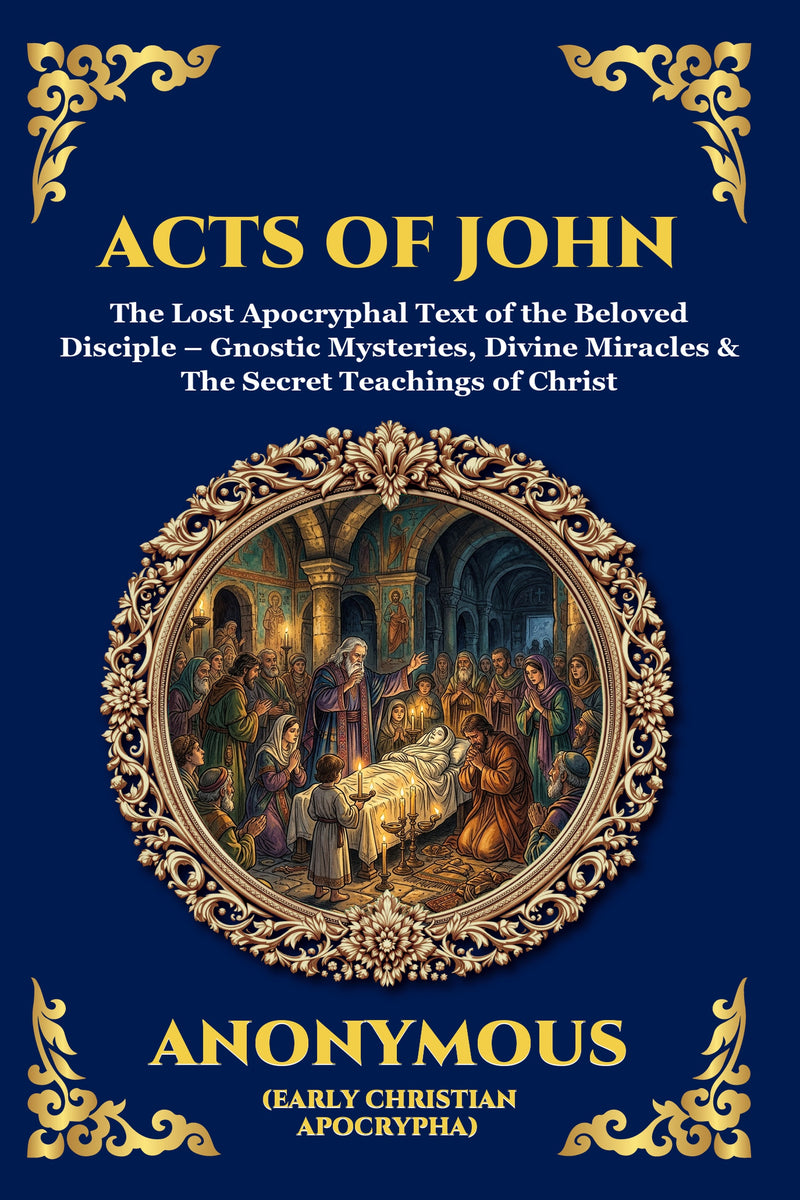
Acts of John
The Acts of John recounts the Apostle's extraordinary miracles and mystical visions during his missions in Ephesus, challenging early Christian orthodoxy. Condemned and destroyed by the early church, its vivid portrayal of Christ as a mystical figure was deemed too provocative for inclusion in the Bible.
or free app
10,000+ hrs library
30-day guarantee
The Acts of John, condemned as heretical by the Second Council of Nicaea in 787 AD, receives a complete modern-English translation in this Library of Alexandria Press edition, accessible online with audiobook narration for members.
The Acts of John represents one of ancient Christianity's most mystical and controversial apocryphal texts, blending miraculous narratives with esoteric teachings that challenged orthodox doctrine.
In the vast and fascinating world of ancient religious literature, the Acts of John stands out as one of the most vivid, magical, and provocative texts ever written. Believed to have circulated widely among early Christian communities, this apocryphal narrative follows John the Apostle on his dramatic and often perilous missionary journeys through the ancient pagan strongholds of Ephesus. But this is no ordinary apostolic history. This text presents a breathtakingly mystical vision of Christ that pushed the boundaries of early theology and ultimately led to the book's condemnation.
In this lost manuscript, Jesus is not bound by the limitations of flesh and blood. He is described as a polymorphic being—a divine entity who changes his physical appearance at will, appearing simultaneously as a small child to one disciple and an old man to another. He is a being of pure spirit who leaves no footprints when he walks and whose body has no physical substance. The text also unveils the famous and mesmerizing "Hymn of the Dance," a secret, esoteric ritual where Jesus leads his disciples in a mystical circle dance the night before his crucifixion, singing cosmic truths about the nature of suffering and salvation.
Blending high spiritual philosophy with jaw-dropping displays of power, the Acts of John details the apostle raising the dead, healing the sick, miraculously destroying the altar of the great Temple of Artemis, and even commanding nature itself. It is an extraordinary window into the docetic and Gnostic currents of early Christianity, challenging readers to rethink the nature of the divine.
What You Will Discover in This Translation
- The Polymorphic Christ — Explore the startling ancient belief that Jesus could change his shape, age, and form, existing as an untouchable being of pure light.
- The Mystical Round Dance — Read the secret, hypnotic hymn sung by Christ and his apostles in a sacred circle before the Passion.
- Epic Miracles in Ephesus — Witness John's legendary supernatural battles against pagan priests, including the miraculous destruction of the Temple of Artemis.
- Deep Gnostic Wisdom — Gain insight into the hidden spiritual teachings regarding the illusion of the material world and the purity of the human soul.
- A Window into Forbidden Apocrypha — Understand the diverse, magical, and esoteric traditions that shaped early Christian identity before the closing of the biblical canon.
Whether you are exploring this work for its immense historical significance, its captivating supernatural storytelling, or its profound esoteric insights, the Acts of John offers a truly transformative reading experience.
Step beyond the canonical scriptures and discover the hidden miracles of the beloved disciple. Begin your journey today.
| Formats | eBook (EPUB + PDF) · Audiobook · Paperback · Hardcover · Large Print |
| Language | English |
| Trim size (print) | 6 × 9 in |
| Binding | Paperback — perfect-bound · Hardcover — casewrap |
| Large Print edition | Same text in a larger, easy-read type — a larger font, not a larger trim |
| Print pricing | Every physical book at our true cost — at-cost, no profit (members) |
| Library | 873 restored titles, always growing |
| Composed | 2nd century AD |
| Original language | Greek |
| Source tradition | Fragmentary Greek manuscripts and Latin translations |
| Translation basis | Public-domain scholarly translation, rendered in clear modern English |
| Length | 23,085 words · ~1 hr 32 min reading |
| Reading level | Grade 10 · a confident, adult read (this modern-English edition) |
| Edition | Modern English translation · 2026 |
Member reviews for this edition are collected as readers finish it — be the first. Across the library: 12,000+ books shipped, every plan covered by a 365-day print guarantee.
About this edition
The complete, unabridged text in clear modern English — faithful to the original, never simplified. Every paragraph is checked against the source, so nothing is cut, summarised, or paraphrased away. It reads cleanly for today while keeping the original meaning intact.
The Acts of John survives in fragmentary Greek manuscripts and later Latin translations. This edition draws from the standard public-domain scholarly translation and renders the available portions in clear modern English.
- Complete & unabridgedVerified paragraph by paragraph against the source — never a scan, never abridged.
- Modern English, faithfulReadable today, with the author’s meaning kept intact. Readable — not simplified.
- Every format, one membershipRead in your browser or the free app, or listen to the full audiobook.
Included free with your membership
Cancel anytime, one click · 30-day money-back guarantee
Edition last updated June 2026
What’s inside
Acts of John — complete and unabridged: all 49 sections included with membership, plus the full audiobook.
Begin reading Acts of John
In clear modern English — the complete text is included with membership.
Chapter 1
Now John was hurrying to Ephesus, moved by a vision. Damonicus, and Aristodemus his kinsman, and a very wealthy man named Cleobius, and the wife of Marcellus, barely managed to keep him one day in Miletus, resting there with him. Very early the next morning they set out, and when they had already covered about four miles of the journey, a voice came from heaven that all of us heard, saying: John, you are about to give glory to your Lord in Ephesus — something you will come to understand, you and all the brothers who are with you, and certain of those already there who will believe through you. John turned this over in his mind, rejoicing inwardly at what might await him in Ephesus, and said: Lord, here I am, going according to your will. Let what you desire come to pass.
Chapter 2
As we drew near to the city, Lycomedes, the praetor of the Ephesians, a wealthy man, came to meet us. He fell at John's feet and begged him, saying: Is your name John? The God you preach has sent you to help my wife, who has been struck with palsy these seven days and lies beyond all cure. Glorify your God by healing her, and have pity on us. For while I was considering what course to take in this matter, someone stood beside me and said: Lycomedes, stop entertaining the thought that is fighting against you, for it is an evil one — do not give in to it. I have compassion on my handmaid Cleopatra, and I have sent from Miletus a man named John, who will raise her up and restore her to you whole. Do not delay, then, servant of the God who has revealed himself to me, but go quickly to my wife, who has nothing left but the breath in her body.
John set out at once from the gate, together with the brothers who were with him and with Lycomedes, and went to his house. Cleobius said to his young men: Go to my kinsman Callippus and arrange comfortable lodging with him — for I have come here with his son — so that we may find everything in good order.
Chapter 3
When Lycomedes came with John into the house where his wife lay, he threw himself at John's feet again and cried: "Look, my lord — see the ruin of her beauty, see her youth, see the celebrated flower of my poor wife, whom all Ephesus used to admire. Wretched man that I am, I have suffered envy, I have been brought low, the eye of my enemies has struck me down. I never wronged anyone, though I could have harmed many — I always guarded against that, taking care that I should never see any evil or misfortune like this. What good, then, has Cleopatra gained from all my caution? What have I gained from being known as a pious man until this day? No — I suffer more than the impious, because I must look at you, Cleopatra, lying in such a state. The sun in its course will no longer see me talking with you. I will go before you, Cleopatra, and rid myself of life. I will not spare myself, though my life is still young. I will stand before Justice and declare that I was right to abandon her, for I can charge her with judging unjustly. I will have my revenge on her when I come before her as a ghost stripped of life. I will say to her: You forced me to leave the light when you robbed me of Cleopatra. You made me into a corpse when you sent me this misfortune. You compelled me to defy Providence by cutting off all my joy in life."
With still more words of this kind, Lycomedes turned to Cleopatra, drew close to the bed, and cried out and wept bitterly. But John pulled him away and said: "Stop this lamenting and these unworthy words. You must not disobey the one who appeared to you. Know that you will receive your wife back. Stand with us, then — we who have come here on her account — and pray to the God whom you saw revealing himself to you in your dreams. Come, Lycomedes — wake up, open your soul. Shake off this heavy sleep. Beseech the Lord, entreat him for your wife, and he will raise her up." But Lycomedes collapsed on the floor, weeping and overcome with grief.
Chapter 4
John wept and cried out: "Alas for the fresh betrayal of my vision! For the new temptation that has been laid for me, the new scheme of the one who plots against me! Did the voice from heaven that came to me on the road devise this for me? Was this what it foretold would happen here — that I would be delivered up to this great crowd of citizens on account of Lycomedes? The man lies without breath, and I know well they will not let me leave this house alive. Why do you delay, Lord? Why have you shut off your gracious promise from us? Do not, I beg you, Lord, give cause for triumph to the one who rejoices in the suffering of others; do not give cause for dancing to the one who always mocks us. Let your holy name and your mercy make haste. Raise up these two dead ones whose death is being laid at my door."
Even as John cried out in this way, the people of Ephesus came running together to the house of Lycomedes, having heard that he was dead. John, seeing the great crowd that had gathered, said to the Lord: "Now is the time for refreshment and for confidence in you, O Christ. Now is the time for us who are sick to receive the help that comes from you, O physician who heals freely. Keep my coming here safe from mockery. I beg you, Jesus, help this great multitude, that it may come to you who are Lord of all things. Look upon their distress; look upon those who lie here. From among those who have assembled for this very purpose, prepare holy vessels for your service, when they behold your gift. For you yourself have said, O Christ, 'Ask, and it shall be given to you.' We ask of you therefore, O King — not gold, not silver, not wealth, not property, nor anything of what belongs to this earth and passes away — but two souls, through whom you will turn those gathered here toward your way, your teaching, your freedom, and your most excellent promise. For when they see your power in the raising of the dead, some of them will be saved. Give them, then, hope in you." And so he went in to Cleopatra and said: "Arise in the name of Jesus Christ."
Chapter 5
And he came to her and touched her face and said: Cleopatra, He who is feared by every ruler, every creature and every power, the abyss and all darkness, and unsmiling death, and the height of heaven, and the circles of hell, and the resurrection of the dead, and the sight of the blind, and the whole power of the prince of this world, and the pride of the ruler — He says: Arise, and do not become a stumbling block to those who are unwilling to believe, nor a source of grief to souls that are able to hope and to be saved.
And Cleopatra at once cried out with a loud voice: I arise, master — save your handmaid. Now when she had risen, she who had lain incurable for seven days, the city of the Ephesians was shaken by the sight no one had dared to expect. And Cleopatra asked about her husband Lycomedes, but John said to her: Cleopatra, if you keep your soul calm and steadfast, you shall have Lycomedes your husband standing here beside you before long — provided you are not disturbed or shaken by what has happened, but believe in my God, who through me will restore him to you alive. Come with me now into your other bedchamber, and you shall see him — a dead body indeed, but raised again by the power of my God.
And Cleopatra went with John into her bedchamber, and when she saw Lycomedes lying dead for her sake, she could not speak. She ground her teeth and bit her tongue and closed her eyes, and tears poured down her face; yet with calmness she gave heed to the apostle. But John had compassion on Cleopatra when he saw that she was neither raging nor out of her mind, and he called upon the perfect and condescending mercy of God, saying:
Chapter 6
Lord Jesus Christ, you see the weight of this grief, you see the need; you see Cleopatra screaming her soul out in silence, holding back inside her an anguish she can barely contain. And I know that for Lycomedes' sake she too will die upon his body.
She said quietly to John: That is exactly what I have in mind, master, and nothing else.
The apostle went to the couch where Lycomedes lay, and taking Cleopatra's hand he said: Cleopatra, because of the crowd that is here and the relatives who have come in, cry out with a strong voice and say to your husband: Rise up and glorify the name of God, for he gives back the dead to the dead.
She went to her husband and said to him what she had been told, and at once he was raised up. When he arose he fell to the floor and kissed John's feet, but John lifted him up, saying: Man, do not kiss my feet but the feet of God, by whose power you have both been raised.
Lycomedes said to John: I beg and implore you, by the God in whose name you have raised us, to stay with us, together with all those who are with you. Cleopatra likewise caught his feet and said the same.
John said to them: Tomorrow I will be with you. They said to him again: We will have no hope in your God, and will have been raised for nothing, if you do not stay with us.
Cleobius, Aristodemus, and Damonicus were moved to the heart and said to John: Let us stay with them, so that they may continue without stumbling in their faith toward the Lord. And so he remained there with the brethren.
Chapter 7
There came together a great gathering of people on John's account, and while he was speaking to those present, Lycomedes, who had a friend who was a skilled painter, hurried off to find him and said: You can see I am in a great rush to reach you — come quickly to my house and paint the man I will point out to you, without his knowing it.
The painter gave someone the necessary materials and colors, and said to Lycomedes: Show him to me, and leave the rest to me without worry.
Lycomedes pointed John out to the painter, brought him close, and shut him in a room from which the apostle of Christ could be observed. Lycomedes himself stayed with the blessed man, feasting on the faith and the knowledge of our God, and rejoiced all the more at the thought that he would soon possess his likeness in a portrait.
The painter made an outline of John on the first day and went away. On the next day he filled it in with colors and delivered the finished portrait to Lycomedes, who received it with great joy. He took it and set it up in his own bedchamber, hung it with garlands, and placed lamps and altars before it. Some time later John noticed this, and said to him: My beloved child, what is it that you always do when you come in from the bath into your bedchamber alone? Do I not pray with you and the rest of the brothers? Or is there something you are hiding from us?
Saying this, and speaking to him in a playful tone, he went into the bedchamber and saw the portrait of an old man crowned with garlands, with lamps and altars set before it. He called Lycomedes to him and said: Lycomedes, what is the meaning of this portrait? Can it be one of your gods that is painted here? For I see that you are still living in the old pagan way.
Lycomedes answered him: My only God is the one who raised me and my wife from death. But if, after that God, it is right to call those who have done us good by the name of gods — then it is you, father, whom I have had painted in that portrait, whom I crown and love and revere as the one who has become my guide to what is good.
John, who had never at any time seen his own face, said to him: You are mocking me, child. Am I really like that in appearance, so far above your Lord? How can you persuade me that the portrait resembles me?
Cancel anytime, one click · 30-day money-back guarantee
Founding annual rate available now — your price locks for life when you join.
Not ready? Get this free chapter by email — read it anytime.
✓ Sent — check your inbox for Acts of John.
Questions about Acts of John
Why was the Acts of John excluded from the biblical canon?
The Acts of John was excluded from the biblical canon due to its docetic teachings suggesting Christ's body was not fully physical, along with magical elements and mystical doctrines that conflicted with developing orthodox Christian theology.
What stories and teachings does the Acts of John contain?
The Acts of John recounts miraculous healings, the destruction of the Temple of Artemis in Ephesus, mystical visions of Christ, and esoteric teachings including the famous 'Hymn of Jesus' describing a cosmic dance around the cross.
Is the Acts of John historically reliable about the Apostle John?
The Acts of John is not considered historically reliable by scholars. Written in the 2nd century AD, it reflects later theological developments and legendary traditions rather than authentic apostolic history or teachings.
Is Acts of John free to read?
The opening of the text is free to read below. Members read and listen to the complete work — and the entire Lost & Forbidden Library — free.
What is Acts of John?
Have you ever wondered why the most miraculous and mystical accounts of the Apostle John were forbidden and actively destroyed by the early orthodox church?
How long is Acts of John?
49 chapters (~19,720 words) in this restored edition.
Shipping & returns
Billing & membership
More from the library


Explore The Lost & Forbidden Library
- 1 Enoch · Attributed to Enoch
- 1–4 Maccabees · Various Jewish authors
- 2 Baruch · Attributed to Baruch
- 2 Enoch · Attributed to Enoch
- 2 Esdras · Attributed to the prophet Ezra
- 3 Baruch · Attributed to Baruch ben Neriah
- 4 Baruch · Attributed to Baruch ben Neriah
- A Valentinian Exposition · Attributed to a follower of Val...
- Acta Archelai · Attributed to Hegemonius
- Acts of Andrew · Anonymous (Early Christian Apoc...
- Acts of Andrew and Matthias in the City of the Cannibals · Attributed to early Christian a...
- Acts of Barnabas · Attributed to John Mark
- Acts of Bartholomew
- Acts of Matthias · Anonymous early Christian writers
- Acts of Paul · Attributed to an unknown early ...
- Acts of Paul and Thecla · Attributed to Onesiphorus
- Acts of Peter
- Acts of Peter and Andrew · Attributed to various early Chr...
- Acts of Peter and Paul · Attributed to Leucius Charinus
- Acts of Peter and Simon · Attributed to Leucius Charinus
- Acts of Peter and the Twelve Apostles · Attributed to early Christian a...
- Acts of Philip · Anonymous (Early Christian Apoc...
- Acts of Pilate (Gospel of Nicodemus) · Attributed to various early Chr...
- Acts of Saturninus
- Acts of Thaddaeus · Attributed to Thaddaeus the Apo...
- Acts of Thomas
- Acts of Titus · Anonymous early Christian writer
- Acts of Xanthippe, Polyxena, and Rebecca
- Allogenes · Anonymous (Early Gnostic Mystic)
- Antitheses of Marcion · Attributed to Marcion of Sinope
Acts of John
The Acts of John
The Apostle at Ephesus — Miracles, the Hymn of Jesus, and the Vision of the Cross of Light
Library of Alexandria Press
The Acts of John
© Copyright 2026 Library of Alexandria Press. All rights reserved.
Published by Library of Alexandria Press
Printed in the United States of America
It is not legal to copy, share, or send any part of this document in either digital or printed form without written permission from the publisher, except short quotes in a book review.
Table of Contents
Introduction
Chapter 1
Chapter 2
Chapter 3
Chapter 4
Chapter 5
Chapter 6
Chapter 7
Chapter 8
Chapter 9
Chapter 10
Chapter 11
Chapter 12
Chapter 13
Chapter 14
Chapter 15
Chapter 16
Chapter 17
Chapter 18
Chapter 19
Chapter 20
Chapter 21
Chapter 22
Chapter 23
Chapter 24
Chapter 25
Chapter 26
Chapter 27
Chapter 28
Chapter 29
Chapter 30
Chapter 31
Chapter 32
Chapter 33
Chapter 34
Chapter 35
Chapter 36
Chapter 37
Chapter 38
Chapter 39
Chapter 40
Chapter 41
Chapter 42
Chapter 43
Chapter 44
Chapter 45
Chapter 46
Chapter 47
Chapter 48
Introduction
There are books that survive because institutions protect them. There are books that survive because they were copied into the great libraries of the ancient world, translated across languages, and handed down through centuries of careful stewardship. And then there are books that survive in spite of everything — texts that were condemned, burned, buried, and forgotten, yet somehow refused to disappear entirely. The work you now hold belongs to that rarest and most extraordinary category. It is a text that was once read aloud in candlelit rooms by communities who considered it sacred scripture, a text that church councils later voted to suppress, and a text that modern scholarship has only gradually and painstakingly reassembled from fragments scattered across monasteries, papyrus collections, and dusty manuscript archives spanning three continents.
To read this document is to step into one of the most fascinating and contested territories in the entire history of religion. It is to encounter a version of early Christianity that is startlingly different from anything most readers will have encountered before — a Christianity that is mystical, embodied, philosophically daring, and shot through with a luminous sense of divine mystery that the later orthodox tradition would work very hard to suppress. It is to meet the figure of Jesus not as he appears in the canonical Gospels, but as he was understood by at least some of his earliest followers: a being whose relationship to the physical world was ambiguous, paradoxical, and endlessly provocative.
And it is to meet John — the Beloved Disciple, the Eagle of the Evangelists, the figure who in the canonical tradition leans against Jesus at the Last Supper and outlives all the other apostles to write his gospel on the island of Patmos. In this text, John is not merely a witness or a narrator. He is the central figure, the one through whom the deepest mysteries are transmitted, the disciple who receives teachings that the others are not ready to hear. He is old when we first encounter him in the fully reconstructed narrative, and he carries within him decades of memory, reflection, and spiritual experience. His voice — intimate, wondering, sometimes bewildered, sometimes blazing with certainty — is one of the most distinctive and compelling in all of ancient religious literature.
The story of how this text came to be lost, condemned, and then rediscovered is itself a remarkable narrative that tells us as much about the history of Christianity as anything contained within the document's pages. In the early centuries of the common era, the movement that would eventually become orthodox Christianity was not a single unified institution but a sprawling, diverse, and often contentious collection of communities spread across the Mediterranean world. These communities shared certain core convictions — the significance of Jesus, the expectation of divine transformation, the importance of love and community — but they disagreed, sometimes violently, about almost everything else. They disagreed about the nature of God, about the meaning of Jesus's death, about the relationship between matter and spirit, about the proper role of women in religious leadership, about whether salvation was available to all or only to the spiritually advanced.
Into this ferment of competing ideas and communities, a remarkable body of literature poured forth. Christians wrote gospels, letters, apocalypses, acts of the apostles, theological treatises, and liturgical texts in enormous quantities. Many of these texts claimed apostolic authority — the authority of someone who had known Jesus personally, or who had received teachings directly from the risen Christ. The texts that eventually made it into the New Testament canon represent only a small fraction of this enormous literary output, and the process by which they were selected was neither swift nor simple. It was a process that took centuries, involved considerable controversy, and resulted in the exclusion of a great many texts that had been considered authoritative and even sacred by large numbers of Christians.
Among the texts that did not make the final cut were a group of narratives that scholars now collectively call the Apocryphal Acts of the Apostles. These are extended narrative accounts of the missionary journeys, miraculous deeds, teachings, and deaths of various apostles — Peter, Paul, Andrew, Thomas, and John among them. They were enormously popular in the early Christian centuries, read by ordinary believers and theologians alike, and they circulated alongside the texts that would eventually become canonical. The account associated with John was among the most widely read and most theologically provocative of all of them. Clement of Alexandria, one of the most learned Christian thinkers of the second century, knew it and quoted from it. Eusebius of Caesarea, the great church historian, mentioned it. And in 787 CE, the Second Council of Nicaea formally condemned it, declaring that it should not merely be set aside but actively destroyed — a fate that speaks volumes about how threatening the institutional church found its contents.
That condemnation did not entirely succeed. Fragments survived in various forms — quoted by writers who wanted to refute the text's ideas, preserved in manuscript collections that escaped the attention of church authorities, copied by communities on the margins of orthodoxy who continued to find in it a living source of spiritual nourishment. Modern scholars have worked for generations to gather these fragments, compare them, and reconstruct as complete a version of the text as the surviving evidence allows. The result is what you have before you: not a perfect reconstruction, not a text that can be read with the same confidence we bring to a document that has survived intact, but something genuinely extraordinary nonetheless — a window into a world of early Christian thought and experience that has no parallel anywhere else in ancient literature.
A Gospel Hidden in Plain Sight
To understand what makes this text so remarkable, it helps to have some sense of the theological world from which it emerged. The second century CE was a period of extraordinary intellectual creativity in the Mediterranean world, and nowhere was that creativity more explosive than in the various movements that scholars have come to group under the broad and somewhat imprecise label of Gnosticism. This is a term that covers an enormous range of different teachers, communities, and texts, and historians debate endlessly about whether it is useful as a category at all. But for our purposes, it points toward a cluster of ideas that appear with striking consistency across a wide range of early Christian and Jewish texts: the conviction that the material world is not the ultimate reality, that human beings contain within them a spark of divine light that has become trapped in matter, that salvation consists not in moral improvement or ritual observance but in gnosis — direct, experiential knowledge of one's own divine nature and of the God who transcends the created order.
These ideas were not invented by second-century Christians. They drew on deep currents in Platonic philosophy, in Jewish mysticism, in the religious traditions of Egypt and Mesopotamia. But they found in the figure of Jesus a powerful new focal point, and they generated a body of literature that is among the most philosophically sophisticated and spiritually intense produced in the ancient world. The Nag Hammadi library, discovered in Egypt in 1945, gave the modern world its first extensive direct access to this literature, and the decades since that discovery have transformed our understanding of early Christianity beyond recognition. What had previously been known only through the hostile summaries of orthodox heresiologists — writers whose job was to catalog and refute heterodox ideas — could now be read in its own voice, on its own terms.
The text associated with John belongs to this world, though it resists easy categorization within it. It is not a systematic theological treatise. It is not primarily a philosophical argument. It is, at its heart, a narrative — a story of journeys and encounters, of miracles performed and teachings given, of a community gathered around a figure of extraordinary spiritual power. It has the texture of lived experience, of memory and wonder, of the kind of storytelling that happens when communities gather to remember and celebrate their founding moments. And yet woven through that narrative texture are passages of such theological density and spiritual daring that they have fascinated and troubled readers for nearly two thousand years.
Chief among these is the extraordinary hymn that appears near the center of the text — a piece of liturgical poetry associated with the night before Jesus's crucifixion, in which the disciples dance in a circle around their teacher while he sings verses of cosmic significance. This passage, known to scholars as the Hymn of the Dance or the Round Dance of the Cross, is unlike anything else in ancient Christian literature. It presents Jesus speaking in paradoxes that dissolve every fixed category — I am and I am not, I was wounded and I was not wounded, I fled and I remained — and it invites the reader into a mode of understanding that goes beyond ordinary rational comprehension. It is a piece of mystical poetry of the highest order, and its preservation alone would make this text invaluable.
But there is much more than this one famous passage. The narrative is filled with scenes that challenge, provoke, and illuminate. There are miracles of a kind quite different from those in the canonical Gospels — miracles that seem designed less to demonstrate divine power than to raise questions about the nature of reality itself. There are teachings that the disciples struggle to understand, not because they lack intelligence but because what is being communicated exceeds the ordinary capacity of language to convey. There are moments of profound intimacy between John and Jesus that have generated centuries of commentary and speculation. And there are passages in which the text's understanding of Jesus's physical nature becomes startlingly explicit — passages that place this document squarely within the tradition of what theologians call Docetism, the view that Jesus's human body was in some sense an appearance rather than a fully material reality.
This Docetic tendency is one of the main reasons the text was condemned by later orthodoxy, which had committed itself firmly to the full humanity of Jesus as a theological non-negotiable. But it is important to understand that for the communities that produced and cherished this text, their understanding of Jesus was not a denial of his reality but an affirmation of a different and, in their view, deeper kind of reality. They were not saying that Jesus did not matter or that his presence in the world was illusory. They were saying that the categories of physical and spiritual, material and divine, were themselves inadequate to capture what Jesus was. They were pushing at the edges of what language can do when it tries to speak about the sacred, and the result is a body of writing that remains philosophically alive and spiritually challenging in ways that much more orthodox literature does not.
The text's portrait of John himself is equally rich and complex. Here is a man who has spent a lifetime trying to understand what he witnessed, who returns again and again to memories that he cannot fully interpret, who is willing to admit that he was confused, that he did not always understand, that the figure at the center of his experience remained in many ways mysterious to him even after decades of reflection. This honesty is one of the most appealing things about the text. It does not present John as a man who has all the answers. It presents him as a man who has been permanently transformed by an encounter with something that exceeds his capacity for full comprehension, and who has spent his life trying to share that transformative experience with others. There is something deeply human in this portrait, and something that speaks directly across the centuries to anyone who has ever tried to put into words an experience that resists articulation.
Reading Across Two Thousand Years
Approaching any ancient text requires a kind of imaginative hospitality — a willingness to suspend the assumptions of our own world and enter, as fully as we can, into the world that produced the text. This is always a challenge, and it is a particularly acute challenge with a text like this one, which comes from a world so different from our own in its basic assumptions about reality, about the nature of the divine, about the relationship between the human and the cosmic. But it is a challenge worth accepting, because the rewards are considerable. Readers who are willing to meet this text on its own terms — who are willing to sit with its paradoxes rather than resolving them prematurely, who are willing to let its imagery work on them rather than immediately translating it into more familiar categories — will find themselves in the presence of something genuinely extraordinary.
One thing that helps is to understand the genre conventions within which the text operates. The Apocryphal Acts are a distinctive literary form that blends elements of ancient romance narrative, philosophical dialogue, aretalogy (accounts of miraculous deeds), and liturgical text. They are not biographies in any modern sense, and they are not straightforward historical accounts. They are, in a deep sense, theological arguments made through narrative — ways of exploring and communicating ideas about the nature of salvation, the meaning of Jesus, and the proper shape of the Christian life through the medium of story rather than abstract proposition. When we read them as theology-in-narrative rather than as history, they become far more coherent and far more interesting.
It also helps to approach the text's miracles with a certain flexibility of interpretation. Modern readers, formed by centuries of scientific rationalism, tend to read miracle accounts either as straightforward historical reports (which creates one set of problems) or as obvious fiction (which creates another). Neither of these approaches does justice to the way miracle stories functioned in the ancient world. For the communities that told and retold these stories, miracles were not primarily evidence for a particular metaphysical claim. They were signs — events that pointed beyond themselves to a deeper reality, that opened a window onto the sacred dimension of existence. To read the miracle stories in this text as signs rather than as either history or fiction is to read them in the way their authors intended, and it transforms the reading experience considerably.
The question of the text's relationship to history is one that scholars have debated extensively, and it is worth saying something about it here. There is no serious scholarly consensus that this document preserves reliable historical memories of an actual figure named John who was an actual disciple of an actual Jesus. The text was composed — in its original form, by authors whose identities we do not know — probably in the second century CE, which means it was written more than a century after the events it purports to describe. It shows clear signs of having been shaped by the theological concerns of that later period rather than by direct historical memory. This does not mean it is without historical value — it tells us an enormous amount about the beliefs, practices, and spiritual experiences of second-century Christian communities — but it means that readers should not approach it as they would approach a primary historical source.
What the text does preserve, with remarkable vividness, is the spiritual and theological imagination of early Christians who were grappling with the most fundamental questions about the nature of reality, the meaning of human existence, and the possibility of transformation. These are not questions that have become less urgent in the intervening centuries. If anything, the collapse of traditional religious certainties in the modern world has made them more urgent. And one of the most striking things about this ancient text is how directly it speaks to modern sensibilities — how its emphasis on direct experience over institutional authority, on inner transformation over external conformity, on the paradoxical and mysterious nature of the divine over neat theological systems, resonates with the spiritual searching of our own time.
This is not to say that the text is secretly a modern document, or that we should read it through the lens of contemporary spirituality and ignore its ancient context. That would be its own kind of distortion. The text is rooted in a specific historical moment, in specific philosophical traditions, in specific community practices that are quite different from anything in the modern world. To read it well is to hold both things simultaneously — to honor its historical particularity and to remain open to the ways in which it speaks across that particularity to something more enduring. The best reading of ancient religious texts is always a kind of dialogue, in which the distance between the reader's world and the text's world is neither collapsed nor allowed to become an unbridgeable chasm.
There is also the question of the text's relationship to the canonical Gospel of John, which has fascinated scholars for generations. The two documents share certain vocabulary, certain theological emphases, certain images and motifs. Both are deeply concerned with the theme of divine light descending into a world of darkness. Both emphasize the importance of love as the defining characteristic of the community gathered around Jesus. Both have a highly developed and philosophically sophisticated understanding of Jesus as a cosmic figure who transcends ordinary human categories. Whether these similarities reflect a common source, a common community, or simply the broad influence of Johannine theology on a wide range of early Christian texts is a question that scholars continue to debate. What is clear is that reading the two texts alongside each other illuminates both of them in ways that reading either one in isolation does not.
The manuscript tradition of this text is complex and fragmentary in ways that require some explanation. What survives does not come to us in a single, complete manuscript but in a variety of different sources — Greek fragments, a Coptic version, Latin translations, quotations in the works of ancient writers who knew the text, and a later bowdlerized version that was evidently produced by someone who wanted to preserve the narrative framework while removing the most theologically heterodox content. Scholars have worked for generations to compare these sources, identify interpolations and later additions, and reconstruct something as close as possible to an original text. The result of this scholarly labor is what you have before you, presented in a translation that aims to be both faithful to the ancient sources and genuinely readable in modern English.
No translation of an ancient text is ever fully satisfactory, and this one is no exception. Ancient Greek — the language in which the earliest surviving portions of this text are preserved — is a language with a richness of nuance and a flexibility of construction that resists straightforward rendering in English. Theological terms that have precise meanings in their original context become slippery when translated, and the translator must constantly make choices about how much to domesticate the text for modern readers and how much to preserve its foreignness. Readers who wish to engage with the scholarly debates about specific passages will find ample guidance in the notes and bibliography.
What awaits you in the pages that follow is one of the most remarkable documents to survive from the ancient world — a text that was loved and feared in equal measure, that was read by communities who staked their spiritual lives on its teachings, and that was suppressed precisely because those in power recognized how profoundly it challenged the version of Christianity they were working to establish. It is a text that raises questions it does not fully answer, that points toward mysteries it does not fully resolve, and that invites its readers into a mode of spiritual engagement that is as demanding as it is rewarding. It is, in the deepest sense, a living text — one that has survived two millennia of suppression and neglect not because of any institutional protection but because of the intrinsic power of what it contains.
Come to it with patience. Come to it with an open mind and a willingness to be surprised. Come to it ready to encounter a version of the sacred story that is stranger, more beautiful, and more philosophically adventurous than anything you may have expected. And come to it with the awareness that you are joining a long line of readers stretching back nearly two thousand years — readers who found in these pages something that spoke to the deepest questions of their existence and who passed the text on, often at considerable personal risk, so that others might have the same experience. That chain of transmission, fragile as it has been at many points, has brought this extraordinary document to your hands. What happens next is between you and the text.
The Acts of John
Chapter 1
Now John was hurrying to Ephesus, moved by a vision. Damonicus, and Aristodemus his kinsman, and a very wealthy man named Cleobius, and the wife of Marcellus, barely managed to keep him one day in Miletus, resting there with him. Very early the next morning they set out, and when they had already covered about four miles of the journey, a voice came from heaven that all of us heard, saying: John, you are about to give glory to your Lord in Ephesus — something you will come to understand, you and all the brothers who are with you, and certain of those already there who will believe through you. John turned this over in his mind, rejoicing inwardly at what might await him in Ephesus, and said: Lord, here I am, going according to your will. Let what you desire come to pass.
Chapter 2
As we drew near to the city, Lycomedes, the praetor of the Ephesians, a wealthy man, came to meet us. He fell at John's feet and begged him, saying: Is your name John? The God you preach has sent you to help my wife, who has been struck with palsy these seven days and lies beyond all cure. Glorify your God by healing her, and have pity on us. For while I was considering what course to take in this matter, someone stood beside me and said: Lycomedes, stop entertaining the thought that is fighting against you, for it is an evil one — do not give in to it. I have compassion on my handmaid Cleopatra, and I have sent from Miletus a man named John, who will raise her up and restore her to you whole. Do not delay, then, servant of the God who has revealed himself to me, but go quickly to my wife, who has nothing left but the breath in her body.
John set out at once from the gate, together with the brothers who were with him and with Lycomedes, and went to his house. Cleobius said to his young men: Go to my kinsman Callippus and arrange comfortable lodging with him — for I have come here with his son — so that we may find everything in good order.
End of the free sample
Keep reading, free
Members read and listen to the complete book — and the entire library. Cancel anytime, one click · 30-day money-back guarantee.