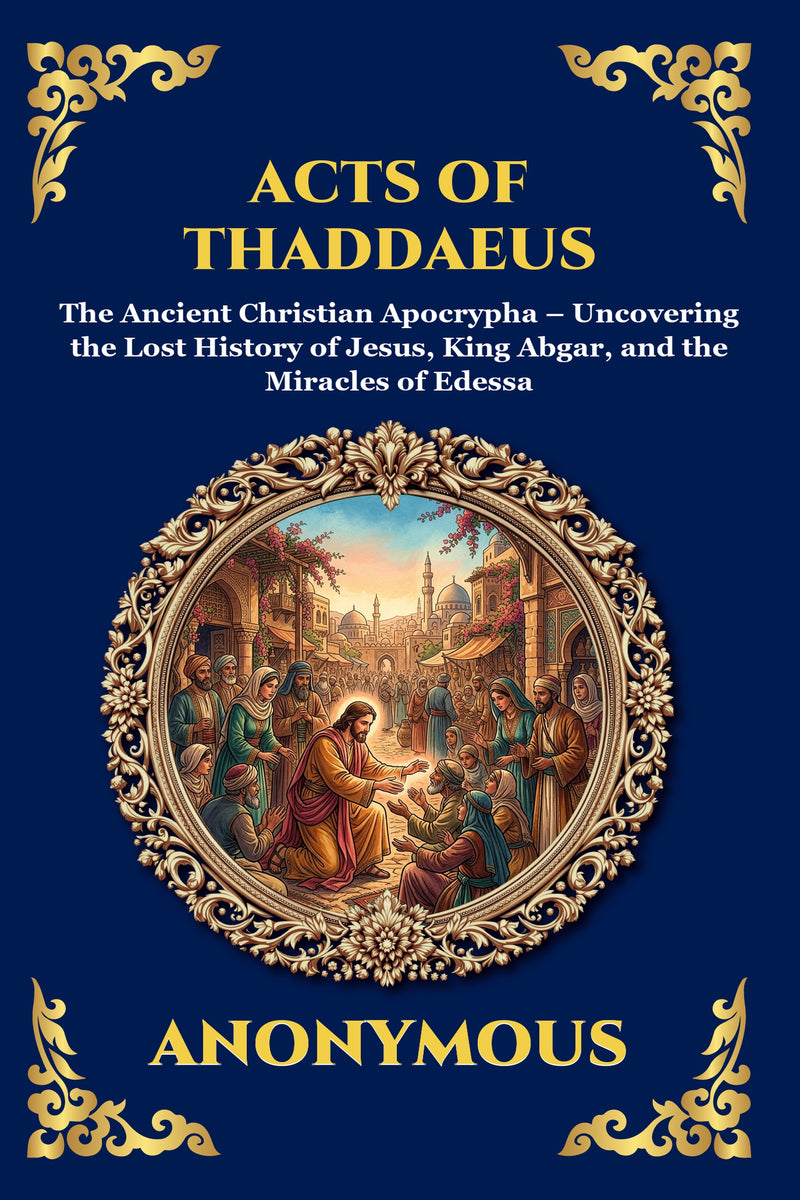
Acts of Thaddaeus
The Acts of Thaddaeus tells of King Abgar V of Edessa, who, stricken by illness, writes to Jesus seeking a cure. Excluded from the Bible, this text reveals how Thaddaeus's mission in response reshaped the spiritual history of the East.
or free app
10,000+ hrs library
30-day guarantee
This ancient Christian apocryphal text, the Acts of Thaddaeus, is presented as a complete modern English translation, readable online with included audiobook narration for members.
The Acts of Thaddaeus stands as one of Christianity's most captivating apocryphal narratives, weaving together divine healing, royal correspondence, and apostolic mission in ancient Mesopotamia.
The Acts of Thaddaeus offers a mesmerizing journey into one of the most intriguing legends of the ancient Christian world. This extraordinary apocryphal text recounts the story of King Abgar V of Edessa, a ruler afflicted by an incurable disease, who sends a desperate letter to Jesus of Nazareth begging for healing. The reply he receives—and the subsequent mission of the Apostle Thaddaeus—sets the stage for a miraculous series of events that would forever change the spiritual landscape of the East.
Far more than a simple historical footnote, this ancient narrative provides a crucial window into the diverse and rich traditions of early Syriac Christianity. It explores the origins of the famous "Image of Edessa" (the Mandylion), a miraculous imprint of the face of Christ, and details the apostolic preaching that led to the conversion of an entire city.
In this comprehensive modern translation, readers will uncover the profound themes of blind faith, divine authority, and the miraculous power of the early apostles. The text challenges our understanding of early Christian canon and invites us to explore the vibrant, miracle-filled stories that circulated among the earliest believers.
What You Will Discover in This Modern Translation
- The Correspondence Between Jesus and King Abgar — Read the legendary letters exchanged between a desperate earthly king and the divine healer.
- The Apostolic Mission of Thaddaeus — Follow the journey of the apostle as he travels to Edessa to fulfill the promise made by Christ.
- The Miracles of Edessa — Witness the profound healings and spiritual awakenings that led to the conversion of a kingdom.
- The Legend of the Holy Image — Discover the early origins of the miraculous cloth bearing the true likeness of Christ.
- A Window into Early Christianity — Gain a deeper understanding of the non-canonical texts that shaped the faith, culture, and history of the Eastern Church.
Whether you are exploring this work for its historical value, its theological implications, or its rich storytelling, the Acts of Thaddaeus offers invaluable inspiration and guidance.
Step into a story of unparalleled faith and discover the timeless legends of the Acts of Thaddaeus. Begin your journey today.
| Formats | eBook (EPUB + PDF) · Audiobook · Paperback · Hardcover · Large Print |
| Language | English |
| Trim size (print) | 6 × 9 in |
| Binding | Paperback — perfect-bound · Hardcover — casewrap |
| Large Print edition | Same text in a larger, easy-read type — a larger font, not a larger trim |
| Print pricing | Every physical book at our true cost — at-cost, no profit (members) |
| Library | 873 restored titles, always growing |
| Composed | 4th-6th century AD |
| Original language | Syriac |
| Source tradition | Syriac manuscript tradition |
| Translation basis | Public-domain scholarly translation, rendered in clear modern English |
| Length | 3,817 words · ~15 min reading |
| Reading level | Grade 14 · rich, literary prose (this modern-English edition) |
| Edition | Modern English translation · 2026 |
Member reviews for this edition are collected as readers finish it — be the first. Across the library: 12,000+ books shipped, every plan covered by a 365-day print guarantee.
About this edition
The complete, unabridged text in clear modern English — faithful to the original, never simplified. Every paragraph is checked against the source, so nothing is cut, summarised, or paraphrased away. It reads cleanly for today while keeping the original meaning intact.
The Acts of Thaddaeus survives primarily in Syriac manuscript traditions, with versions also preserved in Greek and Latin. This edition derives from the standard public-domain scholarly translation and renders it in clear modern English.
- Complete & unabridgedVerified paragraph by paragraph against the source — never a scan, never abridged.
- Modern English, faithfulReadable today, with the author’s meaning kept intact. Readable — not simplified.
- Every format, one membershipRead in your browser or the free app, or listen to the full audiobook.
Included free with your membership
Cancel anytime, one click · 30-day money-back guarantee
Edition last updated June 2026
What’s inside
Acts of Thaddaeus — complete and unabridged: all 4 sections included with membership, plus the full audiobook.
Begin reading Acts of Thaddaeus
In clear modern English — the complete text is included with membership.
Chapter 1
Lebbaeus, who is also called Thaddaeus, was from the city of Edessa — the metropolis of Osroene, in the interior of the Armenian-Syrian region — a Hebrew by birth, accomplished and deeply learned in the holy scriptures. He came to Jerusalem to worship during the days of John the Baptist, and having heard John's preaching and witnessed his angelic way of life, he was baptized, and was given the name Thaddaeus. When he saw Christ appear, and heard His teaching, and witnessed His wonderful works, he followed Him and became His disciple; and Christ chose him as one of the twelve, the tenth apostle according to the evangelists Matthew and Mark.
In those days the governor of the city of Edessa was a man named Abgar. The fame of Christ had spread abroad — the miracles He performed and the teaching He gave — and when Abgar heard of it he was astonished and longed to see Christ, but could not leave his city and his duties. Around the time of the Passion, when the Jews were plotting against Jesus, Abgar was struck by an incurable disease and sent a letter to Christ by his courier Ananias, which read as follows: To Jesus called Christ, from Abgar, governor of the Edessenes, an unworthy servant. Reports of the great wonders you perform have reached me — that you heal the blind, the lame, and the paralyzed, and cure all who are possessed by demons. I therefore beg your goodness to come to us, and in doing so to escape the plots which the wicked Jews, driven by envy, are laying against you. My city is small, but large enough for us both. Abgar also instructed Ananias to observe Christ carefully and take note of His appearance, His height, His hair, and everything about Him.
Ananias went and delivered the letter, and tried hard to fix Christ's appearance in his mind, but found he was unable to do so. Christ, knowing this as one who knows the heart, asked to wash Himself. A towel was brought to Him, and after washing He wiped His face with it, and His image was imprinted upon the linen. He gave it to Ananias and said: Take this back, along with this message, to the one who sent you. Peace to you and your city! For it is for this reason that I have come — to suffer for the world, and to rise again, and to raise up the forefathers. And after I have been taken up into heaven, I will send you my disciple Thaddaeus, who will enlighten you and lead you into all truth, both you and your city.
When Ananias returned, Abgar received him, fell down and adored the likeness, and was cured of his disease even before Thaddaeus arrived.
After the Passion, the Resurrection, and the Ascension, Thaddaeus went to Abgar. Finding him in good health, he gave him a full account of the incarnation of Christ and baptized him along with his entire household. He then instructed great numbers of people — Hebrews and Greeks, Syrians and Armenians — and baptized them in the name of the Father, and of the Son, and of the Holy Spirit, anointing them with the holy oil. He gave them the holy mysteries of the sacred body and blood of our Lord Jesus Christ, and delivered to them the law of Moses to keep and observe, and urged them to pay close attention to everything that had been taught by the apostles in Jerusalem. Year by year they gathered together for the Passover, and again he imparted to them the Holy Spirit.
Thaddaeus and Abgar together destroyed the idol-temples and built churches. He ordained one of his disciples as bishop, along with presbyters and deacons, and established for them the order of psalmody and the holy liturgy. Then he left them and traveled to the city of Amis, the great metropolis of the Mesopotamian Syrians, situated beside the river Tigris. He went into the synagogue of the Jews there with his disciples on the Sabbath day, and after the reading of the law the high priest said to Thaddaeus and his companions: Who are you, and where do you come from? Why are you here?
Thaddaeus replied: No doubt you have heard of what took place in Jerusalem concerning Jesus Christ. We are His disciples and witnesses of the wonderful things He did and taught, and of how the chief priests, out of hatred, handed Him over to Pilate, the procurator of Judaea. Pilate examined Him, found no case against Him, and wished to release Him; but they cried out, If you release him, you are no friend of Caesar, for he claims to be a king. Afraid of this, Pilate washed his hands before the crowd and said, I am innocent of this man's blood; see to it yourselves. The chief priests answered and said, His blood be upon us and upon our children. And so Pilate handed Him over to them. They took Him, spat upon Him along with the soldiers, mocked Him cruelly, crucified Him, and laid Him in the tomb, sealing it securely and setting guards over it. But on the third day, before dawn, He rose, leaving His burial cloths behind in the tomb. He was seen first by His mother and the other women, and then by Peter and John, the first of my fellow disciples, and after that by us, the twelve, who ate and drank with Him after His resurrection for many days. He sent us out in His name to proclaim repentance and forgiveness of sins to all nations, so that those who were baptized and received the preaching of the kingdom of heaven would rise incorruptible at the end of this age. And He gave us power to cast out demons, to heal every disease and every ailment, and to raise the dead.
When the crowds heard this, they brought out their sick and their demoniacs. Thaddaeus went among them with his disciples, laid his hand on each one, and healed them all by calling on the name of Christ. The demoniacs were healed even before Thaddaeus came near them, the spirits departing as he approached. For many days people came running from all directions to see what Thaddaeus was doing, and hearing his teaching, many believed and were baptized, confessing their sins.
He remained with them for five years, built a church, appointed one of his disciples as bishop along with presbyters and deacons, prayed over them, and then departed. He traveled through the cities of Syria, teaching and healing all the sick, and through his teaching he brought many cities and regions to Christ. Continuing to teach and preach the gospel with his disciples, and healing the sick as he went, he came at last to Berytus, a city of Phoenicia on the sea. There he taught and brought many to the light of faith, and fell asleep on the twenty-first day of the month of August. The disciples gathered together and buried him with great honor. Many sick were healed, and they gave glory to the Father, and the Son, and the Holy Spirit, for ever and ever. Amen.
Cancel anytime, one click · 30-day money-back guarantee
Founding annual rate available now — your price locks for life when you join.
Not ready? Get this free chapter by email — read it anytime.
✓ Sent — check your inbox for Acts of Thaddaeus.
Questions about Acts of Thaddaeus
Why was the Acts of Thaddaeus excluded from the biblical canon?
The Acts of Thaddaeus was excluded from the biblical canon as early Christian authorities questioned its apostolic authorship and historical reliability. Like other apocryphal acts, it was composed centuries after the apostolic period and contained legendary elements that distinguished it from accepted scripture.
What is the story of King Abgar's correspondence with Jesus?
The Acts of Thaddaeus recounts how King Abgar V of Edessa, suffering from illness, allegedly wrote to Jesus requesting healing. The text describes Jesus's reply and the subsequent mission of the apostle Thaddaeus to Edessa, though historians consider this correspondence legendary rather than historical.
Is the Acts of Thaddaeus historically reliable?
Modern scholarship views the Acts of Thaddaeus as legendary rather than historically accurate. While it reflects early Christian traditions about the spread of Christianity to Edessa, the correspondence between Abgar and Jesus is considered a pious fiction created centuries after the events it purports to describe.
Is Acts of Thaddaeus free to read?
The opening of the text is free to read below. Members read and listen to the complete work — and the entire Lost & Forbidden Library — free.
What is Acts of Thaddaeus?
Have you ever wondered why certain ancient texts were left out of the Bible, and what secrets they hold about the early days of Christianity?
How long is Acts of Thaddaeus?
4 chapters (~1,208 words) in this restored edition.
Shipping & returns
Billing & membership
More from the library


Explore The Lost & Forbidden Library
- 1 Enoch · Attributed to Enoch
- 1–4 Maccabees · Various Jewish authors
- 2 Baruch · Attributed to Baruch
- 2 Enoch · Attributed to Enoch
- 2 Esdras · Attributed to the prophet Ezra
- 3 Baruch · Attributed to Baruch ben Neriah
- 4 Baruch · Attributed to Baruch ben Neriah
- A Valentinian Exposition · Attributed to a follower of Val...
- Acta Archelai · Attributed to Hegemonius
- Acts of Andrew · Anonymous (Early Christian Apoc...
- Acts of Andrew and Matthias in the City of the Cannibals · Attributed to early Christian a...
- Acts of Barnabas · Attributed to John Mark
- Acts of Bartholomew
- Acts of John · Anonymous (Early Christian Apoc...
- Acts of Matthias · Anonymous early Christian writers
- Acts of Paul · Attributed to an unknown early ...
- Acts of Paul and Thecla · Attributed to Onesiphorus
- Acts of Peter
- Acts of Peter and Andrew · Attributed to various early Chr...
- Acts of Peter and Paul · Attributed to Leucius Charinus
- Acts of Peter and Simon · Attributed to Leucius Charinus
- Acts of Peter and the Twelve Apostles · Attributed to early Christian a...
- Acts of Philip · Anonymous (Early Christian Apoc...
- Acts of Pilate (Gospel of Nicodemus) · Attributed to various early Chr...
- Acts of Saturninus
- Acts of Thomas
- Acts of Titus · Anonymous early Christian writer
- Acts of Xanthippe, Polyxena, and Rebecca
- Allogenes · Anonymous (Early Gnostic Mystic)
- Antitheses of Marcion · Attributed to Marcion of Sinope
Acts of Thaddaeus
The Acts of Thaddaeus
King Abgar of Edessa, the Letter to the Lord, and the Image Not Made by Hands — The Apostle's Healing and the Conversion of the City
Library of Alexandria Press
The Acts of Thaddaeus
© Copyright 2026 Library of Alexandria Press. All rights reserved.
Published by Library of Alexandria Press
Printed in the United States of America
It is not legal to copy, share, or send any part of this document in either digital or printed form without written permission from the publisher, except short quotes in a book review.
Table of Contents
Introduction
The World Behind the Words
Why This Text Still Matters
Chapter 1
Introduction
There is a moment, familiar to anyone who has spent time in the archives of early Christianity, when a text reaches across nearly two millennia and grips you by the collar. It does not matter how many ancient documents you have read, how many faded manuscripts you have squinted at under lamplight, or how many scholarly footnotes you have dutifully absorbed. When a story this old, this strange, and this consequential lands in your hands, something primal stirs. You are holding a fragment of a world that shaped everything that came after it, and yet a world that most people have never heard of. That is the experience waiting for you in the pages that follow.
The text at the center of this book is known as the Acts of Thaddaeus, and it belongs to a sprawling, contentious, endlessly fascinating category of early Christian literature that scholars call the apocrypha — writings that circulated in the early church, that were read, debated, treasured, and sometimes suppressed, but that never made it into the canonical New Testament as we know it today. The word apocrypha comes from the Greek for 'hidden things,' and there is something poetically appropriate about that etymology, because these texts have spent centuries hiding in plain sight: preserved in monastery libraries, copied by devoted scribes, quoted by church fathers, and yet persistently overlooked by the general reading public. They are the shadow archive of early Christianity, and they contain some of the most astonishing stories ever told about Jesus, his followers, and the world in which the faith first took root.
To understand why the Acts of Thaddaeus matters so profoundly, you need to understand the world into which it speaks. The first and second centuries of the Common Era were a period of extraordinary religious ferment. The Roman Empire stretched from Britain to Mesopotamia, and within its borders — and well beyond them — dozens of religious movements competed for followers, patronage, and legitimacy. Judaism was undergoing its own traumatic transformation in the aftermath of the destruction of the Temple in Jerusalem in 70 CE. Mystery cults from Egypt, Persia, and Asia Minor were attracting converts from every social class. And Christianity, still in its earliest, most fluid form, was spreading along trade routes and military roads, carried by merchants, soldiers, freed slaves, and wandering preachers who were often indistinguishable from the wandering philosophers and wonder-workers who populated the ancient Mediterranean world.
In this environment, stories were not merely entertainment. They were theology. They were argument. They were evidence. When early Christians told stories about what Jesus had said and done, about what his apostles had accomplished after his death and resurrection, they were making claims about the nature of God, the meaning of salvation, and the authority of their particular community over rivals who told different stories. The canonical Gospels and the letters of Paul represent one strand of this storytelling tradition — the strand that eventually won the argument about which texts were authoritative. But the apocryphal texts represent other strands, other communities, other ways of understanding what Christianity was and what it meant to follow Jesus in a world that was largely hostile to the new faith.
The Acts of Thaddaeus is a relatively brief text, but its brevity is deceptive. It is dense with historical implication, theological suggestion, and narrative drama. At its heart is a story that was enormously popular in the early church and that continued to exercise a powerful hold on Christian imagination well into the medieval period: the story of the correspondence between Jesus and Abgar V, king of Edessa, a city-state located in what is now southeastern Turkey, near the modern city of Şanlıurfa. According to this tradition, Abgar was suffering from a terrible illness — some sources describe it as leprosy, others as gout, others as a more general and mysterious wasting disease — and he had heard reports of Jesus's miraculous healings. In response, he sent a letter to Jesus, asking him to come to Edessa and cure him. Jesus replied with a letter of his own, praising Abgar's faith, explaining that he could not come in person because his earthly mission required him to remain in Judea, but promising to send one of his disciples after the resurrection. True to this promise, the apostle Thaddaeus — one of the Twelve, also known as Jude or Lebbaeus in other gospel traditions — eventually made his way to Edessa, healed the king, and converted the city to Christianity.
This is, on the surface, a story about a miracle and a conversion. But it is also something much more: it is a story about legitimacy. The kingdom of Edessa, known more formally as Osroene, occupied a strategically and culturally significant position on the frontier between the Roman and Parthian empires. It was a crossroads city, a place where Greek, Aramaic, Syriac, and Persian cultures met and mingled. If this story is true — or even if it was widely believed to be true — then it means that one of the oldest Christian communities in the world was not founded by a disciple who wandered in from the west following Paul's missionary journeys, but by an apostle who came directly from Jesus's inner circle, fulfilling a personal promise made by Jesus himself. It means that the church of Edessa had a pedigree that no other Christian community outside of Jerusalem could match. It means, in short, that Edessa was special.
The implications of that claim reverberated through centuries of church history. Edessa became one of the great centers of early Christianity, a city that produced brilliant theologians, remarkable liturgical traditions, and a distinctive form of Christian culture expressed in the Syriac language — a dialect of Aramaic closely related to the language Jesus himself most likely spoke. The great hymn-writer Ephrem the Syrian, one of the most important poets in the history of Christianity, lived and worked in Edessa. The Peshitta, the standard Bible of Syriac-speaking Christians, was produced in the Edessene tradition. And all of this Christian culture was, according to the tradition preserved in this text, rooted in the miraculous encounter between Thaddaeus and King Abgar.
But the story does not stop with a healing and a baptism. It opens outward into questions that have fascinated historians, theologians, and art historians for centuries. One of the most tantalizing elements of the Abgar tradition — not always present in every version of the text, but deeply embedded in the broader tradition surrounding it — is the claim that Jesus sent not only a letter to Abgar, but an image: a miraculous portrait of his own face, made without human hands, that was preserved in Edessa as a sacred relic. This image, known in Greek as the Mandylion and in Syriac tradition as the Image of Edessa, became one of the most important and contested relics in the history of Christianity. Its story intersects with the history of Byzantine iconoclasm, the Crusades, the development of Christian art, and — in one of history's more extraordinary possible connections — the Shroud of Turin. To read this text carefully is to pull on a thread that unravels into some of the most dramatic episodes in the history of religion.
Chapter 1
Lebbaeus, who is also called Thaddaeus, was from the city of Edessa — the metropolis of Osroene, in the interior of the Armenian-Syrian region — a Hebrew by birth, accomplished and deeply learned in the holy scriptures. He came to Jerusalem to worship during the days of John the Baptist, and having heard John's preaching and witnessed his angelic way of life, he was baptized, and was given the name Thaddaeus. When he saw Christ appear, and heard His teaching, and witnessed His wonderful works, he followed Him and became His disciple; and Christ chose him as one of the twelve, the tenth apostle according to the evangelists Matthew and Mark.
In those days the governor of the city of Edessa was a man named Abgar. The fame of Christ had spread abroad — the miracles He performed and the teaching He gave — and when Abgar heard of it he was astonished and longed to see Christ, but could not leave his city and his duties. Around the time of the Passion, when the Jews were plotting against Jesus, Abgar was struck by an incurable disease and sent a letter to Christ by his courier Ananias, which read as follows: To Jesus called Christ, from Abgar, governor of the Edessenes, an unworthy servant. Reports of the great wonders you perform have reached me — that you heal the blind, the lame, and the paralyzed, and cure all who are possessed by demons. I therefore beg your goodness to come to us, and in doing so to escape the plots which the wicked Jews, driven by envy, are laying against you. My city is small, but large enough for us both. Abgar also instructed Ananias to observe Christ carefully and take note of His appearance, His height, His hair, and everything about Him.
Ananias went and delivered the letter, and tried hard to fix Christ's appearance in his mind, but found he was unable to do so. Christ, knowing this as one who knows the heart, asked to wash Himself. A towel was brought to Him, and after washing He wiped His face with it, and His image was imprinted upon the linen. He gave it to Ananias and said: Take this back, along with this message, to the one who sent you. Peace to you and your city! For it is for this reason that I have come — to suffer for the world, and to rise again, and to raise up the forefathers. And after I have been taken up into heaven, I will send you my disciple Thaddaeus, who will enlighten you and lead you into all truth, both you and your city.
When Ananias returned, Abgar received him, fell down and adored the likeness, and was cured of his disease even before Thaddaeus arrived.
After the Passion, the Resurrection, and the Ascension, Thaddaeus went to Abgar. Finding him in good health, he gave him a full account of the incarnation of Christ and baptized him along with his entire household. He then instructed great numbers of people — Hebrews and Greeks, Syrians and Armenians — and baptized them in the name of the Father, and of the Son, and of the Holy Spirit, anointing them with the holy oil. He gave them the holy mysteries of the sacred body and blood of our Lord Jesus Christ, and delivered to them the law of Moses to keep and observe, and urged them to pay close attention to everything that had been taught by the apostles in Jerusalem. Year by year they gathered together for the Passover, and again he imparted to them the Holy Spirit.
Thaddaeus and Abgar together destroyed the idol-temples and built churches. He ordained one of his disciples as bishop, along with presbyters and deacons, and established for them the order of psalmody and the holy liturgy. Then he left them and traveled to the city of Amis, the great metropolis of the Mesopotamian Syrians, situated beside the river Tigris. He went into the synagogue of the Jews there with his disciples on the Sabbath day, and after the reading of the law the high priest said to Thaddaeus and his companions: Who are you, and where do you come from? Why are you here?
Thaddaeus replied: No doubt you have heard of what took place in Jerusalem concerning Jesus Christ. We are His disciples and witnesses of the wonderful things He did and taught, and of how the chief priests, out of hatred, handed Him over to Pilate, the procurator of Judaea. Pilate examined Him, found no case against Him, and wished to release Him; but they cried out, If you release him, you are no friend of Caesar, for he claims to be a king. Afraid of this, Pilate washed his hands before the crowd and said, I am innocent of this man's blood; see to it yourselves. The chief priests answered and said, His blood be upon us and upon our children. And so Pilate handed Him over to them. They took Him, spat upon Him along with the soldiers, mocked Him cruelly, crucified Him, and laid Him in the tomb, sealing it securely and setting guards over it. But on the third day, before dawn, He rose, leaving His burial cloths behind in the tomb. He was seen first by His mother and the other women, and then by Peter and John, the first of my fellow disciples, and after that by us, the twelve, who ate and drank with Him after His resurrection for many days. He sent us out in His name to proclaim repentance and forgiveness of sins to all nations, so that those who were baptized and received the preaching of the kingdom of heaven would rise incorruptible at the end of this age. And He gave us power to cast out demons, to heal every disease and every ailment, and to raise the dead.
When the crowds heard this, they brought out their sick and their demoniacs. Thaddaeus went among them with his disciples, laid his hand on each one, and healed them all by calling on the name of Christ. The demoniacs were healed even before Thaddaeus came near them, the spirits departing as he approached. For many days people came running from all directions to see what Thaddaeus was doing, and hearing his teaching, many believed and were baptized, confessing their sins.
He remained with them for five years, built a church, appointed one of his disciples as bishop along with presbyters and deacons, prayed over them, and then departed. He traveled through the cities of Syria, teaching and healing all the sick, and through his teaching he brought many cities and regions to Christ. Continuing to teach and preach the gospel with his disciples, and healing the sick as he went, he came at last to Berytus, a city of Phoenicia on the sea. There he taught and brought many to the light of faith, and fell asleep on the twenty-first day of the month of August. The disciples gathered together and buried him with great honor. Many sick were healed, and they gave glory to the Father, and the Son, and the Holy Spirit, for ever and ever. Amen.
End of the free sample
Keep reading, free
Members read and listen to the complete book — and the entire library. Cancel anytime, one click · 30-day money-back guarantee.