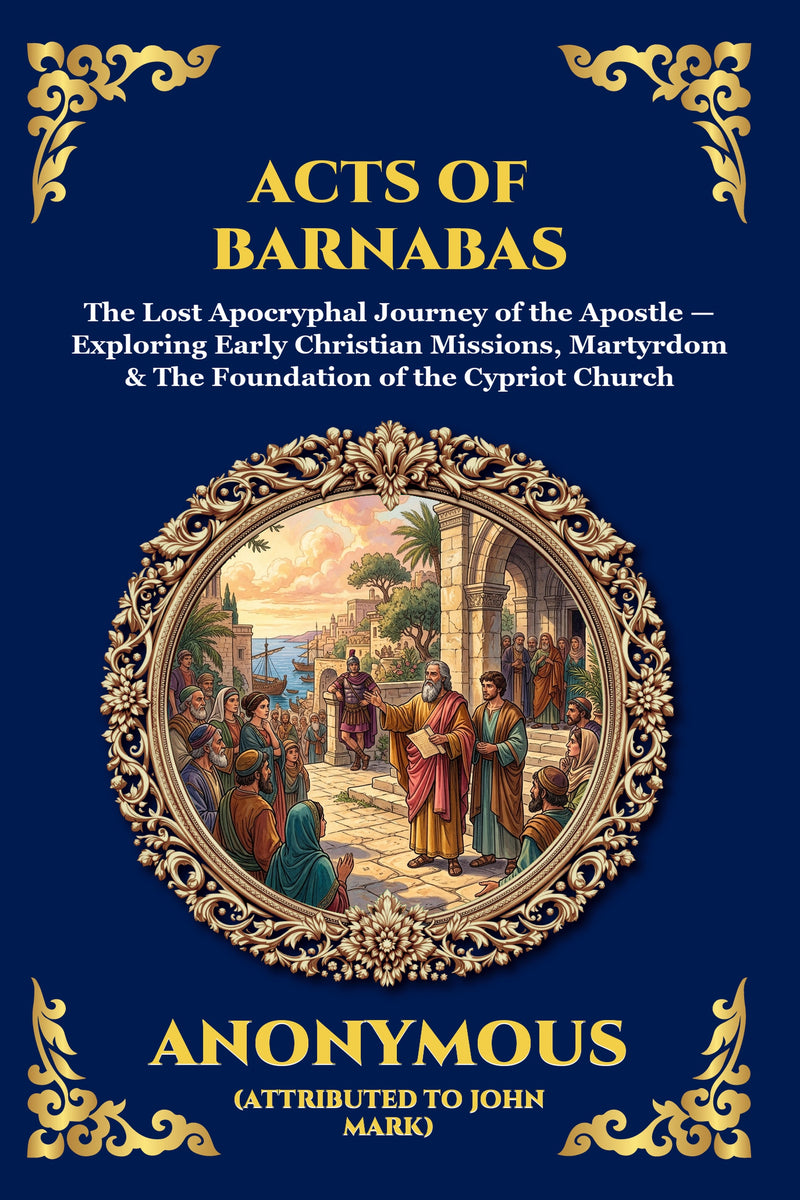
Acts of Barnabas
The Acts of Barnabas reveals the untold journey of Apostle Barnabas and John Mark as they navigate treacherous seas and spread their faith in Cyprus. Excluded from the New Testament, it provides a rare perspective on the early church's missionary efforts beyond Paul's shadow.
or free app
10,000+ hrs library
30-day guarantee
Acts of Barnabas, a 5th-6th century Christian text, receives complete modern-English translation in this Library of Alexandria Press edition, available online with audiobook narration for members.
The Acts of Barnabas claims to reveal the untold missionary journeys and eventual martyrdom of the Apostle Barnabas after his separation from Paul.
The Acts of Barnabas offers a fascinating and action-packed continuation of the early Christian saga. In the canonical scriptures, the partnership between the Apostle Paul and Barnabas famously fractures over a disagreement involving John Mark. While the standard biblical narrative follows Paul, this remarkable apocryphal text picks up the other side of the story. Written from the perspective of John Mark, it details their perilous and miraculous voyage to the island of Cyprus, offering a rare glimpse into the independent missionary work of a foundational early church leader.
This ancient text plunges readers into the fierce spiritual and cultural battles of the first-century Mediterranean. As Barnabas and Mark travel from city to city, they do not just preach; they engage in dramatic spiritual warfare. They confront pagan priests, heal the sick, and face off against Elymas the sorcerer, all while enduring intense persecution from local authorities. The narrative culminates in the powerful and deeply moving account of Barnabas’s martyrdom in Salamis, where he is bound and thrown into a fire, clutching a copy of the Gospel of Matthew to his chest.
For modern readers, this document is far more than a historical curiosity. It is a foundational text for the Church of Cyprus and a testament to the immense risks taken by the earliest Christians. This modern exploration of the Acts of Barnabas makes the ancient text accessible, bringing to life the passion, the danger, and the miraculous events that defined the birth of a global religion.
What You’ll Discover in This Book
- The Independent Journey of Barnabas: Follow the untold story of what happened after Barnabas and Paul separated, exploring his vital missionary work across the Mediterranean.
- The Foundation of the Cypriot Church: Discover the legendary origins of Christianity on the island of Cyprus, detailing the specific cities visited and the establishment of early congregations.
- Apostolic Miracles and Spiritual Warfare: Read gripping accounts of divine interventions, healings, and the fierce confrontations with hostile sorcerers and pagan traditions.
- The Ultimate Sacrifice of Martyrdom: Experience the powerful and tragic account of Barnabas’s execution by fire, highlighting the profound courage and unshakeable faith of the early martyrs.
Whether you are a scholar of biblical apocrypha, a student of church history, or a seeker drawn to tales of radical devotion, the Acts of Barnabas is an essential read. Uncover the lost journey of a great apostle and witness the fiery birth of the early Christian church. Begin your journey today.
| Formats | eBook (EPUB + PDF) · Audiobook · Paperback · Hardcover · Large Print |
| Language | English |
| Trim size (print) | 6 × 9 in |
| Binding | Paperback — perfect-bound · Hardcover — casewrap |
| Large Print edition | Same text in a larger, easy-read type — a larger font, not a larger trim |
| Print pricing | Every physical book at our true cost — at-cost, no profit (members) |
| Library | 873 restored titles, always growing |
| Composed | 5th-6th century AD |
| Original language | Greek |
| Source tradition | Greek manuscript tradition |
| Translation basis | Public-domain scholarly translation, rendered in clear modern English |
| Length | 2,688 words · ~11 min reading |
| Reading level | Grade 9 · clear and comfortable (this modern-English edition) |
| Edition | Modern English translation · 2026 |
Member reviews for this edition are collected as readers finish it — be the first. Across the library: 12,000+ books shipped, every plan covered by a 365-day print guarantee.
About this edition
The complete, unabridged text in clear modern English — faithful to the original, never simplified. Every paragraph is checked against the source, so nothing is cut, summarised, or paraphrased away. It reads cleanly for today while keeping the original meaning intact.
The Acts of Barnabas survives in Greek manuscripts from the medieval period. This edition derives from the standard public-domain scholarly translation and renders it in clear modern English.
- Complete & unabridgedVerified paragraph by paragraph against the source — never a scan, never abridged.
- Modern English, faithfulReadable today, with the author’s meaning kept intact. Readable — not simplified.
- Every format, one membershipRead in your browser or the free app, or listen to the full audiobook.
Included free with your membership
Cancel anytime, one click · 30-day money-back guarantee
Edition last updated June 2026
What’s inside
Acts of Barnabas — complete and unabridged: all 9 sections included with membership, plus the full audiobook.
Begin reading Acts of Barnabas
In clear modern English — the complete text is included with membership.
Chapter 1
Since the coming of our Saviour Jesus Christ — that unwearied, benevolent, and mighty Shepherd, Teacher, and Physician — I have beheld and witnessed the ineffable, holy, and unspotted mystery of the Christians, who hold their hope in holiness and have been sealed. And because I have served him with zeal, I have judged it necessary to give an account of the mysteries I have heard and seen.
I, John, accompanied the holy apostles Barnabas and Paul. I had formerly been a servant of Cyrillus, the high priest of Jupiter, but I had now received the gift of the Holy Spirit through Paul and Barnabas and Silas, who were worthy of their calling, and who baptized me in Iconium. After my baptism, I saw a man standing before me clothed in white raiment, and he said to me: Be of good courage, John, for your name shall surely be changed to Mark, and your glory shall be proclaimed throughout all the world. The darkness that was in you has passed away, and you have been given understanding to know the mysteries of God.
When I saw this vision I was seized with great terror, and I went and fell at the feet of Barnabas and told him all the mysteries I had seen and heard from that man. The apostle Paul was not present when I disclosed these mysteries. Barnabas said to me: Tell no one of the miracle you have seen. For the Lord also stood by me this very night and said: Be of good courage; as you have given your life for my name, facing death and banishment from your own people, so shall you be made perfect. And as for the servant who is with you, take him along with you, for he carries certain mysteries. Now then, my child, keep to yourself the things you have seen and heard, for a time will come when you are to reveal them.
Chapter 2
I, having been instructed by him in these things, remained in Iconium for many days. There was a holy and devout man there who had taken us in, and whose house Paul had consecrated. From there we went to Seleucia, and after staying three days we sailed to Cyprus, where I served them as we traveled through the whole island. Setting sail from Cyprus, we landed at Perga in Pamphylia. I stayed there for about two months, wanting to sail west, but the Holy Spirit would not allow it. So I turned back and went looking for the apostles, and when I learned they were in Antioch, I went to them.
I found Paul in Antioch, laid up in bed from the exhaustion of the journey. When he saw me, he was deeply grieved at my long delay in Pamphylia. Barnabas came and encouraged him, and they shared bread together, and Paul ate a little. They preached the word of the Lord and brought many Jews and Greeks to the light. I kept close to them, but I was afraid to approach Paul, both because he considered me to have wasted time in Pamphylia and because he was thoroughly angry with me. I threw myself on my knees before him on the ground to beg his forgiveness, but he would not hear it. Even after three Sabbaths spent in entreaty and prayer on my knees, I could not prevail with him on my own behalf, for his great grievance against me was that I had kept back certain parchments while I was in Pamphylia.
When they had finished their teaching in Antioch, on the first day of the week they took counsel together to set out for the regions of the East, and after that to go into Cyprus and visit all the churches where they had spoken the word of God. Barnabas urged Paul to go first to Cyprus and look in on his own people in his home village, and Lucius urged him to visit his city of Cyrene as well. But Paul had a vision in his sleep that he should make haste to Jerusalem, because the brothers there were expecting him. Barnabas pressed for them to go to Cyprus, spend the winter there, and then go up to Jerusalem for the feast. A sharp dispute arose between them. Barnabas also urged me to come with them, since I had been their servant from the beginning and had served them throughout all Cyprus until they reached Perga in Pamphylia, where I had then stayed on for many days. But Paul cried out against Barnabas, saying it was impossible for me to go with them. Those who were with us urged me to accompany them as well, since I had made a vow to follow them to the end. Paul finally said to Barnabas: if you want to take John, who is also called Mark, then go a different way, for he will not come with us. Barnabas, coming to himself, replied: the grace of God does not abandon one who has once served the Gospel and traveled with us. If it is agreeable to you, Father Paul, I will take him and go. And Paul said: go in the grace of Christ, and we will go in the power of the Spirit.
Chapter 3
Therefore they bent their knees and prayed to God. Paul groaned aloud and wept, and Barnabas wept likewise, and they said to one another: It would have been good for us, as at the beginning, so also at the end, to work together among men. But since it has seemed good to you, Father Paul, pray for me that my labor may be brought to a worthy completion; for you know how I have served you in the grace of Christ that has been given to you. For I go to Cyprus, and I hasten toward my end; for I know that I shall see your face no more, O Father Paul. And falling to the ground at his feet, he wept for a long time. And Paul said to him: The Lord stood by me also this night and said, Do not prevent Barnabas from going to Cyprus, for there it has been prepared for him to enlighten many; and go yourself, in the grace that has been given to you, to Jerusalem to worship in the holy place, and there it shall be shown to you where your martyrdom has been prepared. And we embraced one another, and Barnabas took me with him.
Having come down to Laodicea, we sought to cross over to Cyprus, and finding a ship bound for Cyprus, we embarked. When we had set sail, the wind proved contrary. We came to Corasium, and going down to the shore where there was a spring, we rested there, keeping ourselves out of sight, so that no one might know that Barnabas had parted from Paul. Setting sail again from Corasium, we came to the regions of Isauria, and from there to a certain island called Pityusa. A storm came on and we remained there three days. A devout man named Euphemus received us as his guests, and Barnabas instructed him and all his household at length in the faith.
From there we sailed past the Aconesiae and came to the city of Anemurium. Going into the city, we found two Greeks, who came up to us and asked where we were from and who we were. Barnabas said to them: If you wish to know where we are from and who we are, put off the clothing you are wearing, and I will clothe you with a garment that never grows soiled, in which there is nothing unclean, but which is altogether radiant. They were astonished at these words and asked: What is this garment you intend to give us? Barnabas said to them: If you confess your sins and submit yourselves to our Lord Jesus Christ, you will receive that garment, which is incorruptible and everlasting. Pierced to the heart by the Holy Spirit, they fell at his feet, entreating him and saying: We beg you, father, give us that garment, for we believe in the living and true God whom you proclaim. He led them down to the spring and baptized them in the name of the Father, and of the Son, and of the Holy Spirit. And they knew that they had been clothed with power and with a holy robe. Barnabas took one robe from me and put it on the one man, and put his own robe on the other. They brought money to him, and Barnabas at once distributed it to the poor. Through these two men the sailors also were able to receive much benefit.
Chapter 4
We came down to the shore, and Barnabas spoke the word of God to those gathered there. He blessed them, we said our farewells, and went on board the ship. One of them, a man named Stephanus, wanted to come with us, but Barnabas would not allow it. We crossed over and sailed down to Cyprus by night, and when we reached the place called Crommyacita we found Timon and Ariston, who were temple servants, and they took us in as their guests.
Timon was suffering from a severe fever. We laid our hands on him and called upon the name of the Lord Jesus, and his fever left him at once. Barnabas had received from Matthew a book of the word of God together with an account of miracles and teachings. Wherever we went, Barnabas would lay this book upon the sick, and it immediately healed them of their afflictions.
When we came to Lapithus, an idol festival was being held in the theatre, and they would not let us enter the city, so we rested for a while outside the gate. Timon, now recovered from his illness, had come with us. We left Lapithus and traveled through the mountains until we reached the city of Lampadistus, which was Timon's hometown. There we also found Heracleius, and he welcomed us. He was from the city of Tamasus and had come to visit his relatives. Barnabas looked at him closely and recognized him, having met him before at Citium with Paul. The Holy Spirit had been given to this man at his baptism, and his name had been changed to Heracleides. Barnabas ordained him bishop over Cyprus, confirmed the church at Tamasus, and left him in the house of the brothers who lived there.
Chapter 5
And having crossed the mountain called Chionodes, we came to Old Paphos, and there found Rhodon, a temple servant, who had himself believed and joined us. We also met a certain Jew named Barjesus coming from Paphos, who recognized Barnabas as one who had formerly traveled with Paul. He did not want us to enter Paphos, so we turned away and came to Curium.
There we found that a certain abominable festival was being held on the road near the city, where a great crowd of men and women were running naked. There was great deception and error in that place. Barnabas turned and rebuked it, and the western part collapsed, so that many were wounded and many also died, and the rest fled to the temple of Apollo, which stood close by in the city and was called sacred. When we drew near the temple, a great multitude of Jews who were there, having been stirred up by Barjesus, stood outside the city and would not allow us to enter. So we spent the evening under a tree near the city and rested there.
Chapter 6
And the following day we came to a village where Aristoclianus lived. He had been a leper, cleansed at Antioch, and Paul and Barnabas had ordained him as a bishop and sent him to his village in Cyprus, because there were many Greeks there. He welcomed us into a cave in the mountain, and we stayed there one day. From there we came to Amathus, where a great crowd of Greeks was gathered at the temple on the mountain — women of low character and men pouring out libations. There too Barjesus had gotten ahead of us and turned the Jewish community against us, and would not allow us to enter the city. But a certain widow woman, eighty years old, who lived outside the city and did not worship the idols, came out to meet us and brought us into her house for an hour. When we left, we shook the dust from our feet in front of that temple where the abominable libations had been poured out.
We left that place and traveled through desert country, with Timon still accompanying us. When we reached Citium, we found a great uproar there as well, centered on their hippodrome. Learning this, we went out of the city, and all of us shook the dust from our feet, for no one would receive us. We rested for only an hour at the gate near the aqueduct, and then moved on.
Chapter 7
We set sail from Citium and came to Salamis, landing at the place known as the Islands, where there was a site full of idols and where great festivals and libations were being held. We found Heracleides there again, and instructed him to proclaim the Gospel of God, to establish churches, and to appoint ministers in them. Then we went into Salamis and came to the synagogue near the place called Biblia. When we had entered it, Barnabas unrolled the Gospel he had received from Matthew his fellow-worker and began to teach the Jews.
Cancel anytime, one click · 30-day money-back guarantee
Founding annual rate available now — your price locks for life when you join.
Not ready? Get this free chapter by email — read it anytime.
✓ Sent — check your inbox for Acts of Barnabas.
Questions about Acts of Barnabas
Why wasn't the Acts of Barnabas included in the New Testament?
The Acts of Barnabas was composed centuries after the apostolic period and was excluded from the biblical canon due to its late composition and lack of apostolic authority, unlike the earlier canonical Acts of the Apostles.
Did John Mark actually write the Acts of Barnabas?
Modern scholars reject the traditional attribution to John Mark. The Acts of Barnabas was likely written by an unknown Christian author in the 5th-6th centuries AD, long after the historical John Mark's lifetime.
What does the Acts of Barnabas contain?
The Acts of Barnabas narrates the missionary journeys of Barnabas and John Mark in Cyprus, including Barnabas's martyrdom. It provides legendary accounts of early Christian mission work beyond the canonical biblical narratives.
Is Acts of Barnabas free to read?
The opening of the text is free to read below. Members read and listen to the complete work — and the entire Lost & Forbidden Library — free.
What is Acts of Barnabas?
Have you ever wondered why the most dramatic stories of the original apostles were excluded from the standard New Testament? The Acts of Barnabas offers a fascinating and action-packed continuation of the early Christian saga.
How long is Acts of Barnabas?
9 chapters (~2,691 words) in this restored edition.
Shipping & returns
Billing & membership
More from the library


Explore The Lost & Forbidden Library
- 1 Enoch · Attributed to Enoch
- 1–4 Maccabees · Various Jewish authors
- 2 Baruch · Attributed to Baruch
- 2 Enoch · Attributed to Enoch
- 2 Esdras · Attributed to the prophet Ezra
- 3 Baruch · Attributed to Baruch ben Neriah
- 4 Baruch · Attributed to Baruch ben Neriah
- A Valentinian Exposition · Attributed to a follower of Val...
- Acta Archelai · Attributed to Hegemonius
- Acts of Andrew · Anonymous (Early Christian Apoc...
- Acts of Andrew and Matthias in the City of the Cannibals · Attributed to early Christian a...
- Acts of Bartholomew
- Acts of John · Anonymous (Early Christian Apoc...
- Acts of Matthias · Anonymous early Christian writers
- Acts of Paul · Attributed to an unknown early ...
- Acts of Paul and Thecla · Attributed to Onesiphorus
- Acts of Peter
- Acts of Peter and Andrew · Attributed to various early Chr...
- Acts of Peter and Paul · Attributed to Leucius Charinus
- Acts of Peter and Simon · Attributed to Leucius Charinus
- Acts of Peter and the Twelve Apostles · Attributed to early Christian a...
- Acts of Philip · Anonymous (Early Christian Apoc...
- Acts of Pilate (Gospel of Nicodemus) · Attributed to various early Chr...
- Acts of Saturninus
- Acts of Thaddaeus · Attributed to Thaddaeus the Apo...
- Acts of Thomas
- Acts of Titus · Anonymous early Christian writer
- Acts of Xanthippe, Polyxena, and Rebecca
- Allogenes · Anonymous (Early Gnostic Mystic)
- Antitheses of Marcion · Attributed to Marcion of Sinope
Acts of Barnabas
The Acts of Barnabas
The Journeyings and Martyrdom of the Apostle of Cyprus — Narrated by John Mark: The Parting from Paul, the Voyage Through Cyprus, the Confronting of Idols and the Magician Barjesus, and the Burning of Barnabas at Salamis, Whose Bones Mark Bore Away by Night to Egypt
Library of Alexandria Press
The Acts of Barnabas
© Copyright 2026 Library of Alexandria Press. All rights reserved.
Published by Library of Alexandria Press
Printed in the United States of America
It is not legal to copy, share, or send any part of this document in either digital or printed form without written permission from the publisher, except short quotes in a book review.
Table of Contents
Introduction
Chapter 1
Chapter 2
Chapter 3
Chapter 4
Chapter 5
Chapter 6
Chapter 7
Chapter 8
Introduction
There is a particular kind of silence that settles over lost things. Not the silence of absence, but the silence of waiting — of something that has been overlooked, misplaced, or deliberately set aside, patient in the dark until someone comes looking. The document at the heart of this book has lived in precisely that kind of silence for the better part of fifteen centuries. It has been catalogued, dismissed, occasionally referenced in footnotes, and largely ignored by the mainstream of biblical scholarship. And yet, for those willing to slow down and listen to it carefully, it speaks with a voice that is startlingly vivid, historically suggestive, and theologically provocative. It speaks of journeys taken across the ancient Mediterranean world, of arguments between friends, of miracles performed in dusty market squares, of a man who died for what he believed on an island that still bears the memory of his passing.
The text known as the Acts of Barnabas occupies a peculiar and underappreciated corner of early Christian literature. It belongs to a broad family of writings that scholars group under the umbrella term 'New Testament Apocrypha' — texts that circulated in the early centuries of the Christian movement, that were read with devotion by significant communities of believers, and that were ultimately excluded from the canonical scriptures that most Christians know today. To call these works 'apocryphal' is not to dismiss them. The word itself, derived from the Greek apokryphos, simply means 'hidden' or 'set apart.' And while the canonical process that produced the New Testament was a long, complex, and sometimes contentious affair, the texts left outside that canon did not simply vanish. They continued to be copied, translated, debated, and treasured. They tell us things about early Christianity that the canonical texts do not — and sometimes cannot — tell us.
Among these apocryphal acts, a genre that flourished particularly in the second through fifth centuries, the story of Barnabas stands in a class of its own. Most readers of the New Testament will know Barnabas as a supporting figure — generous, warm-hearted, a bridge-builder in the early Jerusalem community who vouched for the newly converted Paul when the other apostles were still afraid of him. He appears in the Acts of the Apostles as a man of extraordinary moral credibility, someone whose very name, as Luke takes care to tell us, meant 'son of encouragement.' He travels with Paul on the first great missionary journey through Cyprus and Asia Minor. He argues with Paul, parts ways with him over the question of John Mark, and then — as far as the canonical narrative is concerned — largely disappears from the story. The New Testament gives us the beginning of Barnabas but not his end. It gives us his character but not his fate. It gives us his partnership with Paul but not the independent mission that, by all historical accounts, he went on to pursue.
This is where the text before you steps in. Written in the voice of a companion and eyewitness — a figure named John Mark, the same young man whose departure from the first missionary journey had caused the rift between Paul and Barnabas — it claims to offer what the canonical Acts deliberately or inadvertently omitted: the story of what happened next. After the separation. After the argument. After Barnabas turned his face back toward Cyprus, the island of his birth, and set out to complete a mission that would define the rest of his life and, ultimately, claim it.
To read this text is to step into a world that feels simultaneously foreign and familiar. The Mediterranean of late antiquity was a place of extraordinary cultural complexity — a mosaic of languages, religions, philosophies, and political allegiances held together by Roman power and connected by Roman roads and Roman sea lanes. Into this world, the early Christian missionaries moved with remarkable energy and courage, carrying a message that was offensive to some, incomprehensible to others, and electrifying to a surprising number. The apocryphal acts as a genre capture something of this world with a directness and immediacy that more formal theological writing often lacks. They are, in a sense, the adventure literature of early Christianity — stories of travel and danger, of confrontation and conversion, of the miraculous breaking into the ordinary.
The account of Barnabas's final journey has all of these qualities. It moves with narrative urgency through recognizable Mediterranean landscapes — the harbors and hills of Cyprus, the synagogues where Barnabas preaches from a copy of Matthew's Gospel that he carries with him, the marketplaces where he heals the sick and draws crowds. It introduces us to figures both historical and legendary. It dramatizes the tensions between Jewish communities and the emerging Christian movement in ways that feel psychologically real and historically plausible. And it builds, with gathering momentum, toward a conclusion that is both violent and luminous — a martyrdom that became, for the Cypriot church, the founding act of its identity and independence.
That founding act matters enormously, and not only in the realm of piety and legend. The question of whether the church of Cyprus was apostolically founded — whether it could trace its origins directly to one of the original witnesses to the risen Christ — was a question with profound political and ecclesiastical consequences. In the fifth century, when the patriarchate of Antioch sought to assert authority over the Cypriot church, the bishops of Cyprus fought back. Their argument rested in significant part on the claim that their church had been established by Barnabas himself, an apostle of the first rank, and that it therefore owed allegiance to no later patriarchal authority. The discovery — or, as some scholars have argued, the convenient rediscovery — of Barnabas's tomb at a critical moment in this dispute was not coincidental. Nor was the circulation of a text that told his story in authoritative, eyewitness terms. History and hagiography, in the ancient world, were rarely as separate as modern readers might wish them to be.
This does not mean we should read the text cynically, as nothing more than ecclesiastical propaganda dressed up in apostolic clothing. That would be to misunderstand both the text and the world that produced it. The people who wrote, copied, and read these accounts were not cynics. They were believers, and the stories they told served purposes that were simultaneously political, devotional, theological, and communal. To dismiss the Acts of Barnabas because it was useful to a particular church at a particular moment in its history would be to apply a standard that would eliminate most of what we know about the ancient world. Every text has a context. Every story serves a purpose. The interesting questions are not whether these things are true but what the purposes were, how they shaped the telling, and what survives beneath and within them that speaks to something more enduring.
The World Behind the Text
To understand what the Acts of Barnabas is, it helps enormously to understand what it is not. It is not a straightforward historical chronicle in the modern sense. It does not aim at the kind of detached, evidence-based reconstruction of events that contemporary historians aspire to — though it does, interestingly, aspire to something like eyewitness authority. It is not a theological treatise, though it carries theological freight on every page. It is not pure fiction, though it employs the tools of storytelling with considerable skill. It is, rather, a document that belongs to a specific literary tradition with its own conventions, purposes, and pleasures, and reading it well requires some familiarity with that tradition.
The apocryphal acts as a genre emerged in the second century and proliferated through the third, fourth, and fifth. They were written in Greek, the lingua franca of the early church, though many were quickly translated into Latin, Syriac, Coptic, Ethiopic, Armenian, and other languages, reflecting the extraordinary geographic spread of early Christianity. The most famous examples — the Acts of Peter, the Acts of Paul, the Acts of John, the Acts of Andrew, the Acts of Thomas — were known and read across the Mediterranean world and beyond. They shared certain common features: a focus on a single apostolic hero, a narrative of travel through specific and often verifiable geographic locations, dramatic encounters with both receptive converts and hostile opponents, miraculous healings and exorcisms, and frequently a martyrdom that served as the climactic seal of the apostle's witness.
These texts served multiple functions simultaneously. They were entertaining — genuinely so, in a world without novels in the modern sense, where narrative literature of any kind was a relative rarity for ordinary people. They were devotional, providing models of faith, courage, and self-sacrifice for communities that might themselves face persecution. They were catechetical, embedding theological instruction within dramatic narrative in ways that made it memorable and accessible. And they were identity-forming, giving communities a sense of their own origins, their own connection to the apostolic generation, their own place in the great story of God's work in the world.
The Acts of Barnabas fits comfortably within this tradition while also displaying some distinctive features that have led scholars to date it, in its current form, to the late fourth or fifth century — though many believe it incorporates earlier traditions that may go back considerably further. The claim to eyewitness authorship by John Mark is a common convention of the genre, but it is deployed here with particular care. The narrator is present throughout, observing, recording, occasionally expressing his own emotions and reactions. He is not an omniscient narrator but a limited, human one — a man who loved Barnabas, who traveled with him, who watched him die, and who felt the weight of that loss. This narrative intimacy is one of the text's most appealing qualities, and it gives the account an emotional texture that distinguishes it from more formulaic examples of the genre.
The geographic specificity of the text is another notable feature. Cyprus is not a vague backdrop but a richly particularized setting, with named cities, recognizable routes, and local details that suggest either genuine familiarity with the island or access to sources that had such familiarity. Salamis, the great port city on the eastern coast, where Barnabas begins his mission; Lapithos, on the northern coast; Amathus, in the south — these are not invented locations but real places with real histories, and the text moves through them with a confidence that rewards geographical investigation. For readers who know Cyprus, or who take the trouble to look at ancient maps, the journey described has a plausibility that is striking.
The Jewish communities of Cyprus play a significant role in the narrative, and here the text touches on historical realities that are independently attested. Cyprus had a substantial Jewish population in the first century, and the island was the site of one of the most catastrophic events of the Jewish-Roman wars — the revolt of 115-117 CE, during which the Jewish community of Cyprus rose in rebellion and was subsequently expelled from the island entirely. The tensions between Jewish communities and the early Christian movement, which had begun as a Jewish sect and was increasingly defining itself in opposition to the synagogue, are woven into the fabric of the story in ways that reflect genuine historical pressures. The figure of Bar-Jesus, the Jewish magician who appears as Barnabas's primary antagonist, is not simply a stock villain but a figure who embodies a specific historical anxiety — the competition between emerging Christianity and the various forms of Jewish religious life and leadership that it was simultaneously indebted to and in conflict with.
Understanding the text also requires some engagement with the figure of Barnabas himself — not as a legendary saint but as a historical person, insofar as we can recover him. The historical Barnabas is attested in Paul's letters as well as in the Acts of the Apostles, and what those sources tell us is genuinely interesting. He was a Levite, a member of the priestly tribe, from Cyprus — which means he came from a diaspora Jewish family with roots in the island. His given name was Joseph, and the nickname Barnabas was bestowed on him by the Jerusalem community, perhaps in recognition of his gifts as a teacher and encourager. He was among the first to practice the radical economic sharing that characterized the Jerusalem community, selling a field he owned and laying the proceeds at the apostles' feet. He was the one who brought Paul into the Jerusalem community when everyone else was afraid of the former persecutor. He was Paul's companion on the first missionary journey, during which they traveled through Cyprus and then into Asia Minor.
The quarrel between Paul and Barnabas, described with unusual candor in Acts 15, is one of the most humanly compelling moments in the entire New Testament. The two men disagreed about whether to take John Mark — Barnabas's cousin — on a second journey, after Mark had abandoned them during the first. Paul refused. Barnabas insisted. The disagreement was sharp enough that the partnership ended, and the two went their separate ways. Paul took Silas and headed north and west. Barnabas took Mark and sailed for Cyprus. It is at this point that the canonical narrative effectively loses track of Barnabas. He appears briefly in Paul's letters, always as a figure of respect and authority, but the story of what he did after the separation is simply not told in any source that made it into the canon. The apocryphal text picks up precisely here, and whatever its historical value, it is responding to a genuine gap — a silence in the record that invited filling.
The question of Barnabas's death is particularly interesting. He is one of the relatively few major figures of early Christianity whose martyrdom is not attested in the New Testament or in the earliest post-apostolic sources. The tradition that he was martyred in Cyprus — stoned to death by a mob in Salamis, with the involvement of the Jewish community — appears in several sources, including the Acts of Barnabas itself, and has been accepted as plausible by many scholars, though it cannot be independently verified. What is striking is the consistency of the tradition: Barnabas died in Cyprus, he died violently, and his body was buried by John Mark in a tomb that would later become one of the most significant pilgrimage sites in the eastern Mediterranean. The discovery of that tomb, with a copy of Matthew's Gospel laid upon the breast of the remains, in the late fifth century, was the event that secured the autocephaly of the Cypriot church — its right to govern itself without submission to any external patriarch. Whether the discovery was genuine, staged, or somewhere in between, it was an event of enormous consequence, and the text before you is inseparable from it.
Reading Across the Centuries
There is a temptation, when approaching a text like this, to spend so much time on questions of authenticity, dating, and historical reliability that the text itself gets lost. Scholars are professionally obligated to ask these questions, and they are important ones. But they are not the only questions worth asking, and for many readers they are not the most rewarding ones. A text that has survived for fifteen centuries, that was important enough to copy and preserve and translate across multiple languages and cultures, that shaped the self-understanding of an entire Christian community and played a role in one of the major ecclesiastical disputes of late antiquity — such a text deserves to be read, not just analyzed. It deserves the kind of attention that takes it seriously as a piece of writing, as a human document, as a story.
And it is, above all, a story. A story about a man who went home. Barnabas was a Cypriot, and the journey described in this text is in some sense a return — to the island of his birth, to the communities he knew, to a landscape that was part of his own formation. There is something deeply human about this dimension of the narrative. The great missionary journeys of the apostolic age tend to be imagined as movements outward — away from home, into the unknown, toward the ends of the earth. But Barnabas's final journey moves inward, toward the center of his own identity. He goes to Cyprus not as a stranger bringing news of a foreign God but as a native son returning with a message that transforms everything he knew from the beginning. That tension — between the familiar and the transformed, between homecoming and mission, between love for a place and the disruptive power of the gospel — gives the narrative an emotional depth that rewards careful reading.
The relationship between Barnabas and John Mark, as depicted in the text, is another source of richness. Mark is the narrator, and he writes about Barnabas with the particular combination of admiration and grief that belongs to someone who has watched a beloved mentor die. But he is also, implicitly, a figure of his own complexity. He is the young man who failed on the first journey — who turned back, for reasons the New Testament does not explain, and whose failure cost Barnabas his partnership with Paul. His presence on this second journey is therefore freighted with significance. He is being given a second chance, and he knows it. The text does not make this explicit — it does not need to — but it is present in the texture of the narrative, in the way Mark describes his own actions and reactions, in the particular quality of his devotion to Barnabas.
The miracles described in the text deserve attention too, not as problems to be explained away or defended as literally historical, but as elements of a narrative world with its own logic and meaning. In the apocryphal acts, miracles function as signs — not proofs in the modern evidentialist sense, but dramatic enactments of the power that the missionary carries and the reality that his message proclaims. When Barnabas heals the sick, he is not simply performing a medical service. He is making visible, in the bodies of suffering people, the transformation that the gospel promises for the whole of creation. The healing of bodies is a parable of the healing of the world, and the crowds who gather to watch and wonder are responding not just to the spectacle but to the hope that the spectacle embodies.
The antagonists in the story are equally worth taking seriously. The figure who opposes Barnabas most persistently and most dangerously is not a Roman official or a pagan philosopher but a member of the Jewish community — a man with his own convictions, his own loyalties, his own reasons for seeing Barnabas as a threat. The conflict between them is not simply a conflict between good and evil but between two visions of what faithfulness to the God of Israel requires. This is historically authentic in a way that many later Christian tellings of such stories are not. The early Christian movement was, above all, a Jewish argument — an argument about the meaning of scripture, the identity of the Messiah, the shape of the covenant community, the nature of God's promises to Israel. The Acts of Barnabas, whatever its limitations, preserves something of that argument's intensity and complexity.
For readers coming to this text from a background in Christian faith, there is much here that will resonate and much that will surprise. The Barnabas of this text is recognizably the Barnabas of the New Testament — generous, courageous, deeply rooted in the Jewish scriptures, committed to the inclusion of Gentiles in the community of faith. But he is also a figure of the late antique church, shaped by centuries of theological development and ecclesiastical controversy that the historical Barnabas could not have known. Reading him is an exercise in temporal layering — in seeing how a tradition accumulates meaning over time, how each generation finds in the figures of the past the resources it needs for its own struggles.
For readers coming from a background in history or religious studies, the text offers a different set of pleasures and provocations. It is a case study in the formation of apostolic legend, in the relationship between ecclesiastical politics and hagiographic narrative, in the way that communities construct their own origins and invest those origins with authority. It raises questions about the nature of historical evidence, the reliability of tradition, and the complex interplay between memory and imagination in the transmission of the past. These are not merely academic questions. They are questions that matter for how we understand the origins of Christianity itself, and the Acts of Barnabas, precisely because it occupies the borderland between history and legend, illuminates them with unusual clarity.
For readers who come simply as lovers of story — who are drawn by the promise of a journey through the ancient Mediterranean, a portrait of friendship and faith, a narrative that builds toward violence and grace — the text offers pleasures that require no scholarly apparatus to enjoy. It is a good story, told with conviction and skill, about a man who deserves to be better known. Barnabas was not a minor figure in the history of early Christianity. He was, by any reasonable assessment, one of the most important people in the first generation of the movement — a bridge-builder, a risk-taker, a man whose instinct for inclusion and encouragement shaped the communities he served and the colleagues he mentored. The fact that he has been overshadowed by Paul, whose letters dominate the New Testament and whose theological genius has defined Christian thinking for two millennia, is an accident of canon formation, not a judgment on his significance.
This book aims to restore Barnabas to something like his proper place — not by making inflated claims for the historical accuracy of the apocryphal text, but by taking that text seriously as a witness to how early Christians understood and honored one of their founding figures. It offers the text itself in a new translation that prioritizes clarity and readability without sacrificing fidelity to the original. It provides historical and theological commentary that opens up the world behind the text without overwhelming the text itself. And it situates the story within the broader context of early Christian missions, the development of the apocryphal acts as a genre, and the specific history of the Cypriot church — a history that is, in many ways, inseparable from the story of Barnabas himself.
The island of Cyprus today still bears the marks of his memory. The monastery of Saint Barnabas, built over the site where his tomb was discovered in the fifth century, stands in the flat plain near Famagusta — now in the northern, Turkish-controlled part of the island, inaccessible to the Greek Cypriot church that venerates him. There is a particular poignancy to this situation: the apostle whose story was used to secure the independence of the Cypriot church now rests, in memory if not in verified fact, in a part of the island that has itself experienced a kind of exile. History has a way of circling back on itself, of finding new resonances in old stories. The Acts of Barnabas, read today, is not merely a document of the past. It is a story about faith and loss, about homecoming and martyrdom, about the communities we build and the memories we keep, that speaks with unexpected directness to the present.
What follows is an invitation to enter that story — to walk with Barnabas and Mark through the streets of ancient Salamis, to stand in the synagogues where the argument about Jesus was still raw and urgent, to feel the heat of the Mediterranean sun and the weight of the Gospel of Matthew carried like a talisman against the dark. It is an invitation to take seriously a text that has waited too long in the shadows, and to discover in it not just a window into the ancient world but a mirror in which something recognizable and enduring looks back. The journey is about to begin. It will not end where you expect.
The Acts of Barnabas
Chapter 1
Since the coming of our Saviour Jesus Christ — that unwearied, benevolent, and mighty Shepherd, Teacher, and Physician — I have beheld and witnessed the ineffable, holy, and unspotted mystery of the Christians, who hold their hope in holiness and have been sealed. And because I have served him with zeal, I have judged it necessary to give an account of the mysteries I have heard and seen.
I, John, accompanied the holy apostles Barnabas and Paul. I had formerly been a servant of Cyrillus, the high priest of Jupiter, but I had now received the gift of the Holy Spirit through Paul and Barnabas and Silas, who were worthy of their calling, and who baptized me in Iconium. After my baptism, I saw a man standing before me clothed in white raiment, and he said to me: Be of good courage, John, for your name shall surely be changed to Mark, and your glory shall be proclaimed throughout all the world. The darkness that was in you has passed away, and you have been given understanding to know the mysteries of God.
When I saw this vision I was seized with great terror, and I went and fell at the feet of Barnabas and told him all the mysteries I had seen and heard from that man. The apostle Paul was not present when I disclosed these mysteries. Barnabas said to me: Tell no one of the miracle you have seen. For the Lord also stood by me this very night and said: Be of good courage; as you have given your life for my name, facing death and banishment from your own people, so shall you be made perfect. And as for the servant who is with you, take him along with you, for he carries certain mysteries. Now then, my child, keep to yourself the things you have seen and heard, for a time will come when you are to reveal them.
End of the free sample
Keep reading, free
Members read and listen to the complete book — and the entire library. Cancel anytime, one click · 30-day money-back guarantee.