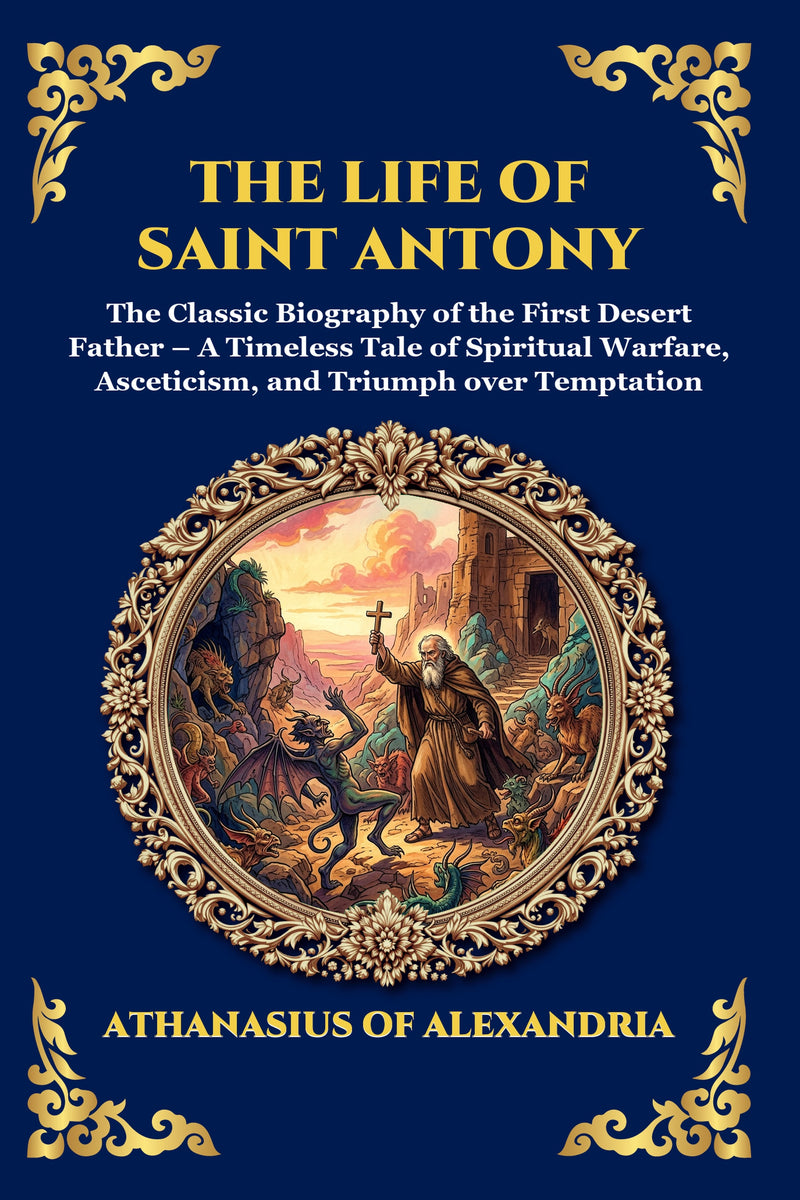
The Life of Saint Antony
Born into wealth, Antony of Egypt gave it all away to confront demons in the desert and shape Christian monasticism. Athanasius of Alexandria's biography, left out of the Bible, tells how Antony's radical faith inspired generations to seek God in solitude and simplicity.
or free app
10,000+ hrs library
30-day guarantee
Athanasius of Alexandria's 4th century biography "The Life of Saint Antony" is available as a complete modern-English translation, readable online with audiobook included, making this foundational work of Christian monasticism accessible to contemporary readers.
In The Life of Saint Antony, a young Egyptian nobleman abandons his inheritance to retreat into the desert, where demons assault him with terrifying visions and physical torments.
In The Life of Saint Antony, Athanasius of Alexandria presents the definitive biography of one of the most remarkable figures in early Christian history. Born into a wealthy Egyptian family in the third century, Antony stunned his community by giving away his vast inheritance to embrace a life of severe asceticism. Retiring deeper and deeper into the desolate wilderness, he sought to completely detach himself from the corruptions of the material world. However, the desert was not a place of quiet retreat, but a fierce spiritual battlefield.
This timeless biography chronicles Antony’s harrowing encounters with demonic forces that sought to break his resolve through terrifying apparitions, physical beatings, and relentless psychological temptation. Athanasius vividly captures the supernatural warfare that defined Antony's isolation, showing how the hermit's unwavering faith, fasting, and continuous prayer ultimately brought him victory and profound inner peace. As word of his holiness spread, thousands flocked to the desert, drawn by his miracles, his wisdom, and his luminous purity, effectively launching the monastic movement that would shape the Western world.
Far more than a historical record, this powerful text serves as a masterclass in spiritual resilience. It explores the deepest vulnerabilities of the human mind and the incredible strength that can be unlocked through absolute surrender to a higher purpose. Athanasius's masterful storytelling weaves theology, biography, and supernatural thriller into a narrative that has captivated readers for over a millennium and a half.
What You Will Discover in This Classic Biography
- The Call of the Desert — Follow Antony’s radical transformation from a wealthy young man to a solitary hermit living in tombs and ruined forts.
- Legendary Spiritual Warfare — Witness the vivid and terrifying accounts of Antony’s battles with demons taking the forms of wild beasts, alluring women, and terrifying monsters.
- The Birth of Monasticism — Learn how one man’s desire for isolation inadvertently created a massive spiritual movement, turning the barren desert into a city of ascetics.
- Timeless Wisdom on Temptation — Gain profound insights into identifying, resisting, and overcoming the psychological and spiritual traps that plague the human condition.
- The Power of Miracles and Healing — Read about the incredible spiritual gifts Antony developed, from divine healing to profound discernment of spirits.
Whether you are studying early church history, seeking guidance on the path of asceticism, or simply fascinated by tales of extreme human endurance, The Life of Saint Antony offers an unforgettable reading experience.
Step into the blistering sands of the Egyptian desert and discover a timeless classic that explores the absolute limits of faith, discipline, and the human spirit. Begin your journey today.
| Formats | eBook (EPUB + PDF) · Audiobook · Paperback · Hardcover · Large Print |
| Language | English |
| Trim size (print) | 6 × 9 in |
| Binding | Paperback — perfect-bound · Hardcover — casewrap |
| Large Print edition | Same text in a larger, easy-read type — a larger font, not a larger trim |
| Print pricing | Every physical book at our true cost — at-cost, no profit (members) |
| Library | 873 restored titles, always growing |
| Composed | 4th century AD (c. 360) |
| Original language | Greek |
| Source tradition | Greek manuscript tradition with early Latin translations |
| Translation basis | Public-domain scholarly translation, rendered in clear modern English |
| Length | 23,383 words · ~1 hr 34 min reading |
| Reading level | Grade 10 · a confident, adult read (this modern-English edition) |
| Edition | Modern English translation · 2026 |
Member reviews for this edition are collected as readers finish it — be the first. Across the library: 12,000+ books shipped, every plan covered by a 365-day print guarantee.
About this edition
The complete, unabridged text in clear modern English — faithful to the original, never simplified. Every paragraph is checked against the source, so nothing is cut, summarised, or paraphrased away. It reads cleanly for today while keeping the original meaning intact.
The Life of Saint Antony survives in Greek manuscripts and early Latin translations from the fourth century onward. This edition derives from the standard public-domain scholarly translation and renders it in clear modern English.
- Complete & unabridgedVerified paragraph by paragraph against the source — never a scan, never abridged.
- Modern English, faithfulReadable today, with the author’s meaning kept intact. Readable — not simplified.
- Every format, one membershipRead in your browser or the free app, or listen to the full audiobook.
Included free with your membership
Cancel anytime, one click · 30-day money-back guarantee
Edition last updated June 2026
What’s inside
The Life of Saint Antony — complete and unabridged: all 44 sections included with membership, plus the full audiobook.
Begin reading The Life of Saint Antony
In clear modern English — the complete text is included with membership.
Chapter 1
Antony was by descent an Egyptian. His parents were of good family and possessed considerable wealth, and as they were Christians, he was raised in the same faith. In infancy he was brought up with his parents, knowing nothing beyond them and his home. When he grew into boyhood and advanced in years, he could not endure to learn letters and had no desire to associate with other boys. His whole wish was, as it is written of Jacob, to live a plain man at home. He attended the Lord's house with his parents, and neither as a child was he idle, nor when older did he despise them. He was obedient to his father and mother and attentive to what was read, keeping in his heart whatever was profitable in what he heard. Though he was brought up in moderate comfort, he never troubled his parents for varied or luxurious food, nor did he take pleasure in such things. He was content simply with what he found and sought nothing further.
After the death of his father and mother he was left alone with one little sister. He was about eighteen or twenty years old, and the care of the home and of his sister rested on him. It was not six months after his parents had died when, going as usual into the Lord's house, he fell to thinking as he walked, reflecting on how the Apostles had left everything and followed the Savior, and how those in the Acts had sold their possessions and laid the proceeds at the Apostles' feet for distribution to the needy, and what great hope was laid up for them in heaven. Turning these things over in his mind, he entered the church. The Gospel was being read, and he heard the Lord saying to the rich man, "If you would be perfect, go and sell what you have and give to the poor, and come follow me, and you shall have treasure in heaven." Antony, as though God had brought the saints to his mind and the passage had been read on his account, went out immediately from the church and gave the ancestral lands to the villagers — three hundred acres, productive and very fair — so that they should no longer be a burden to himself and his sister. All the rest of his movable property he sold, and having gathered together a considerable sum of money, he gave it to the poor, keeping back only a little for his sister's sake.
Chapter 2
And again, when he went into the church and heard the Lord's words, "Do not be anxious for tomorrow," he could stay no longer. He went out and gave those remaining things to the poor as well. He entrusted his sister to faithful and trusted virgins and placed her in a convent to be raised there. From that point on he devoted himself entirely to the discipline of the soul, outside his own house, watching over himself and training himself with patience. For there were not yet many monasteries in Egypt at that time, and no monk had any knowledge of the distant desert. All who wished to give heed to themselves practiced their discipline in solitude near their own village. Now in the next village there lived an old man who had led the life of a hermit from his youth. Antony, when he had seen this man, imitated him in his piety. At first he began to live in places just outside the village. Then, whenever he heard of a good man anywhere, he went out to seek him like a prudent bee, and did not turn back to his own dwelling until he had found him. He would return carrying from that good man, as it were, provisions for his journey along the way of virtue. So living there at first, he confirmed his resolve not to return to his father's house or to the memory of his family, but to keep all his desire and energy fixed on perfecting his discipline. He worked with his hands, having heard the words, "Let him who is idle not eat," and spent part of what he earned on bread and gave the rest to the needy. He was constant in prayer, knowing that a man ought to pray in secret and without ceasing. He had paid such close attention to the readings of Scripture that nothing that was written slipped from his mind, but he remembered everything, and in time his memory served him in place of books.
Living in this way, Antony was beloved by all. He submitted himself sincerely to the good men he visited and learned carefully in what each one surpassed him in zeal and discipline. He observed the graciousness of one, the unceasing prayer of another. He took note of one man's freedom from anger and another's loving-kindness. He watched one for his vigilance in keeping watch through the night, another for his devotion to study. One he admired for his endurance, another for his fasting and sleeping on the ground. The meekness of one and the long-suffering of another he observed with care, while he took note of the piety toward Christ and the mutual love that animated all of them. Thus filled, he returned to his own place of discipline, and from that time on he strove to bring together in himself the qualities of each, eager to show in his own person the virtues of all. With others of his own age he had no rivalry, except in this one thing: that he should not fall behind them in the pursuit of what is higher. And he pursued this in such a way as to hurt no one's feelings, but rather to make them rejoice over him. So all the people of that village, and the good men in whose company he lived, when they saw what manner of man he was, used to call him God-beloved. Some welcomed him as a son, others as a brother.
Chapter 3
But the devil, who hates and envies all that is good, could not endure to see such resolve in a young man, and set out to do to him what he had always done to others. First he tried to draw him away from the discipline, whispering reminders of his wealth, concern for his sister, the claims of family, the love of money, the love of glory, the various pleasures of the table and the other comforts of life, and finally the difficulty of virtue and the labor it demands. He suggested too the weakness of the body and the length of the road ahead. In short, he stirred up a great cloud of doubt in Antony's mind, hoping to shake him from his settled purpose. But when the enemy saw that he was no match for Antony's determination — that he was the one being conquered, overthrown by the young man's great faith and worn down by his constant prayers — he fell back at last on the weapons that are, as it is written, in the navel of his belly, boasting in them, for they are his first snare for the young. He attacked the young man, disturbing him by night and harassing him by day, so that even bystanders could see the struggle going on between them. The devil would suggest foul thoughts, and Antony would counter them with prayers; the devil would kindle lust, and Antony, as one who seemed to blush at the very idea, would fortify his body with faith, prayers, and fasting. The devil, wretched creature, even took on the shape of a woman one night and imitated all her ways in order to beguile Antony. But Antony kept his mind fixed on Christ and on the nobility Christ inspires, and reflecting on the spiritual dignity of the soul, he quenched the burning coal of the enemy's deceit. Again the enemy dangled the ease of pleasure before him. But Antony, like a man filled with righteous anger and grief, turned his thoughts to the threatened fire and the undying worm, and setting these against his adversary, passed through the temptation unscathed. All this was a source of shame to his foe. For the devil, who fancied himself like God, was now being mocked by a young man; he who had boasted his power over flesh and blood was being put to flight by a man still living in the flesh. For the Lord was working with Antony — the Lord who for our sake took on flesh and gave the body victory over the devil, so that all who truly fight can say, "Not I, but the grace of God which was with me."
At last, when the dragon could not overthrow Antony even by these means, and saw himself driven out of the young man's heart, he gnashed his teeth, as it is written, and in a kind of frenzy appeared to Antony as a black boy, taking on a visible form that matched the darkness of his mind. Cringing before him, he no longer plied him with insinuating thoughts — for guileful as he was, he had been beaten at that game — but spoke at last in a human voice and said, "Many I have deceived, many I have cast down; but now, attacking you and your labors as I had so many others, I have proved weak." When Antony asked who it was that spoke to him, the figure answered in a pitiful voice, "I am the friend of fornication, and I stir up incitements to it in the young. I am called the spirit of lust. How many who wished to live chastely have I deceived! How many who were pure have I seduced by my incitements! I am the one on whose account the prophet rebukes those who have fallen, saying, 'You have been led astray by the spirit of whoredom.' For by me they were tripped up. I am the one who has troubled you so often and been overthrown by you so often." Antony gave thanks to the Lord and then said to him with confidence, "You are utterly contemptible, for you are black-hearted and weak as a child. From this day I shall have no more trouble from you, for the Lord is my helper, and I shall look down on my enemies." At these words the black one fled at once, shuddering at them and no longer daring to come anywhere near the man.
Chapter 4
This was Antony's first struggle against the devil — or rather, this victory was the Savior's work in Antony, who condemned sin in the flesh so that the ordinance of the law might be fulfilled in us who walk not after the flesh but after the Spirit. Yet Antony, though the evil one had fallen, did not from that point relax his vigilance or make light of him; nor did the enemy, as though conquered, cease to lay snares for him. For the devil went around again like a lion, seeking some occasion against him. Antony had learned from the Scriptures that the devil's devices are many, and so he continued his discipline with great zeal, reckoning that though the devil had not been able to deceive his heart through bodily pleasure, he would try to ensnare him by other means. For the demon loves sin. All the more, then, Antony disciplined his body and kept it in subjection, lest having conquered on one side he should be dragged down on the other. He resolved to accustom himself to a severer way of life.
Many marveled at this, but he himself bore the labor easily, for the eagerness of soul that had long dwelt in him had produced a good habit, so that taking only a little guidance from others he showed great zeal in the matter. He kept vigil to such a degree that he often went through the whole night without sleep — and not once only, but often, to the wonder of all who knew him. He ate once a day, after sunset, sometimes once in two days, and often only once in four. His food was bread and salt, his drink water only. Of meat and wine it is needless even to speak, since no such thing was found among the other earnest men. A rush mat served him for a bed, but for the most part he lay on the bare ground. He would not anoint himself with oil, saying it was fitting for young men to be earnest in their training and not to seek what would soften and weaken the body, but rather to accustom it to labor, mindful of the Apostle's words: "When I am weak, then am I strong." For, he said, the strength of the soul is sound when the pleasures of the body are diminished.
He had also arrived at this truly wonderful conclusion: that progress in virtue, and withdrawal from the world for its sake, ought not to be measured by time, but by desire and fixity of purpose. He himself gave no thought to the past, but day by day, as though he were at the very beginning of his discipline, applied greater effort toward advancement, often repeating to himself the saying: "Forgetting the things which are behind and stretching forward to the things which are before." He was also mindful of the words spoken by the prophet Elijah: "The Lord lives, before whose presence I stand today." He observed that in saying "today" the prophet did not reckon up the time that had gone by, but daily, as though ever making a fresh start, eagerly strove to make himself fit to appear before God — pure in heart and ever ready to submit to His counsel, and to Him alone. And he used to say to himself that from the life of the great Elijah the hermit ought to see his own life as in a mirror.
Cancel anytime, one click · 30-day money-back guarantee
Founding annual rate available now — your price locks for life when you join.
Not ready? Get this free chapter by email — read it anytime.
✓ Sent — check your inbox for The Life of Saint Antony.
Questions about The Life of Saint Antony
Why isn't The Life of Saint Antony in the Bible?
The Life of Saint Antony is a biographical work written by Athanasius about Saint Antony, not a text considered for biblical canonization. It's a historical biography documenting the founder of Christian monasticism, preserved through church historical literature rather than scriptural collections.
Did Athanasius of Alexandria really write this biography?
Scholarly consensus attributes The Life of Saint Antony to Athanasius of Alexandria, the influential fourth-century bishop who knew Antony personally. The work's theological perspective and historical details align with Athanasius's other writings and his documented relationship with the desert father.
What does The Life of Saint Antony actually contain?
The Life of Saint Antony chronicles Antony's transformation from wealthy young Egyptian to desert hermit, his spiritual battles with demons, his role founding Christian monasticism, and his influence on early Christianity through radical asceticism and contemplative practice.
Is The Life of Saint Antony free to read?
The opening of the text is free to read below. Members read and listen to the complete work — and the entire Lost & Forbidden Library — free.
What is The Life of Saint Antony?
Have you ever wondered why some individuals are willing to leave everything behind, braving ultimate isolation and profound hardship, simply to seek a closer relationship with the divine?
How long is The Life of Saint Antony?
44 chapters (~23,480 words) in this restored edition.
Shipping & returns
Billing & membership
More from the library


Explore The Lost & Forbidden Library
- 1 Enoch · Attributed to Enoch
- 1–4 Maccabees · Various Jewish authors
- 2 Baruch · Attributed to Baruch
- 2 Enoch · Attributed to Enoch
- 2 Esdras · Attributed to the prophet Ezra
- 3 Baruch · Attributed to Baruch ben Neriah
- 4 Baruch · Attributed to Baruch ben Neriah
- A Valentinian Exposition · Attributed to a follower of Val...
- Acta Archelai · Attributed to Hegemonius
- Acts of Andrew · Anonymous (Early Christian Apoc...
- Acts of Andrew and Matthias in the City of the Cannibals · Attributed to early Christian a...
- Acts of Barnabas · Attributed to John Mark
- Acts of Bartholomew
- Acts of John · Anonymous (Early Christian Apoc...
- Acts of Matthias · Anonymous early Christian writers
- Acts of Paul · Attributed to an unknown early ...
- Acts of Paul and Thecla · Attributed to Onesiphorus
- Acts of Peter
- Acts of Peter and Andrew · Attributed to various early Chr...
- Acts of Peter and Paul · Attributed to Leucius Charinus
- Acts of Peter and Simon · Attributed to Leucius Charinus
- Acts of Peter and the Twelve Apostles · Attributed to early Christian a...
- Acts of Philip · Anonymous (Early Christian Apoc...
- Acts of Pilate (Gospel of Nicodemus) · Attributed to various early Chr...
- Acts of Saturninus
- Acts of Thaddaeus · Attributed to Thaddaeus the Apo...
- Acts of Thomas
- Acts of Titus · Anonymous early Christian writer
- Acts of Xanthippe, Polyxena, and Rebecca
- Allogenes · Anonymous (Early Gnostic Mystic)
The Life of Saint Antony
The Life of Saint Antony
Athanasius of Alexandria's Life of the Father of Monasticism — How Antony of Egypt Sold All He Had, Withdrew to the Tombs and the Desert, Wrestled the Demons in the Ruined Fort, Founded the Monastic Life, Confounded the Greek Philosophers and the Arian Heretics, and Died at One Hundred and Five
Library of Alexandria Press
The Life of Saint Antony
© Copyright 2026 Library of Alexandria Press. All rights reserved.
Published by Library of Alexandria Press
Printed in the United States of America
It is not legal to copy, share, or send any part of this document in either digital or printed form without written permission from the publisher, except short quotes in a book review.
Table of Contents
Introduction
Chapter 1
Chapter 2
Chapter 3
Chapter 4
Chapter 5
Chapter 6
Chapter 7
Chapter 8
Chapter 9
Chapter 10
Chapter 11
Chapter 12
Chapter 13
Chapter 14
Chapter 15
Chapter 16
Chapter 17
Chapter 18
Chapter 19
Chapter 20
Chapter 21
Chapter 22
Chapter 23
Chapter 24
Chapter 25
Chapter 26
Chapter 27
Chapter 28
Chapter 29
Chapter 30
Chapter 31
Chapter 32
Chapter 33
Chapter 34
Chapter 35
Chapter 36
Chapter 37
Chapter 38
Chapter 39
Chapter 40
Chapter 41
Chapter 42
Chapter 43
Introduction
There are books that inform, books that entertain, and books that change the course of history. The ancient biography you are about to read belongs to that rarest of categories: a text so transformative that its ripples can still be felt across seventeen centuries of human civilization. When Athanasius of Alexandria sat down to compose this account of his friend and spiritual hero sometime around 356 CE, he could not have known he was writing one of the most influential documents in the history of Western religion. He was simply trying to tell the truth about a man he loved and admired — a man who had chosen to walk away from everything the world offered and, in doing so, had become a figure of almost mythological proportions even within his own lifetime.
The subject of this biography, Antony of Egypt, was born around 251 CE into a prosperous Christian family in the village of Coma, near the ancient city of Heracleopolis Magna in Middle Egypt. He was not a scholar. He was not a priest. He held no official position in any institution, commanded no army, and built no monuments. By every conventional measure of importance, he should have been forgotten within a generation of his death. Instead, his story spread with extraordinary speed across the Roman world, was translated into Latin within years of its composition, and went on to inspire countless thousands of men and women to undertake lives of radical spiritual devotion. The great Augustine of Hippo, writing his own Confessions decades later, described a moment when he heard the story of Antony and felt his own comfortable, compromised life suddenly exposed as insufficient. 'What are we doing?' Augustine records a friend crying out upon hearing of Antony's example. That question — urgent, personal, impossible to deflect — is one this text has been asking its readers ever since.
To understand why this biography carries such weight, it helps to appreciate the world into which it was born. The third and fourth centuries CE were a time of extraordinary turbulence for the Roman Empire and for the Christian communities scattered across it. Persecution had been a recurring reality for believers; the emperor Decius had launched a systematic campaign against Christians in 250 CE, just a year before Antony's birth, and the Diocletianic persecution of 303–313 CE would prove even more devastating. Into this climate of pressure and compromise, Antony's example offered something startling: a form of heroism that required no sword, no political office, and no martyrdom in the traditional sense. The desert fathers and mothers who followed in his wake would come to be understood as a kind of living martyrdom — witnesses to a different order of reality, people who had died to the world's expectations and risen into something else entirely.
Athanasius himself was no ordinary biographer. As Bishop of Alexandria, he was one of the most important and controversial figures in fourth-century Christianity, a fierce defender of Nicene orthodoxy who was exiled from his see no fewer than five times by emperors who found his theological positions inconvenient. He knew Antony personally, having visited him in the desert and spent time in his company. This is not, therefore, the work of a distant hagiographer assembling legends from second-hand sources. It is, at least in part, the portrait of a friendship — a document shaped by genuine admiration, theological purpose, and the kind of intimate knowledge that only proximity can produce. Athanasius tells us that Antony himself reviewed and approved the accounts of his life that were circulating, which gives the text an unusual degree of authenticity for a document of its age.
Yet it would be a mistake to approach this text as a straightforward historical record in the modern sense. Athanasius was writing within a tradition that understood biography as a form of moral instruction, and he shaped his material accordingly. The life he presents is structured as a kind of spiritual itinerary — a map of the soul's journey from ordinary human existence through progressive stages of renunciation, combat, and ultimately a hard-won peace that the world cannot give and cannot take away. Whether every detail is literally accurate matters less, in some respects, than what the text is trying to show us: that transformation is possible, that the forces arrayed against human flourishing are real and powerful, and that they can be overcome.
The narrative that unfolds in these pages is, on one level, a simple one. A young man hears a passage from scripture that strikes him as a personal address, sells his possessions, gives the money to the poor, and withdraws from ordinary society to pursue God with the whole of his being. He lives first near his village, then in an abandoned fort in the desert, then in even deeper solitude near the Red Sea. He fasts, prays, and engages in what the text describes as ferocious spiritual combat. He emerges, repeatedly, not broken but somehow more himself than before — more luminous, more serene, more capable of the compassion and wisdom that draw people to him from across the known world. Emperors write to him. Philosophers come to debate him. The sick are healed in his presence. He lives to the age of one hundred and five, and when he dies he is, by all accounts, still fully himself — clear-eyed, upright, at peace.
But to summarize the story this way is to strip it of everything that makes it extraordinary. The texture of this text is not in its plot points but in its details: the specific quality of the darkness that descends on Antony in his early years of solitude, the precise forms that his temptations take, the way his body and spirit seem to operate according to a different physics from those around him, the conversations he holds with demons and with angels, the letters he writes to distant communities, the tears he sheds and the laughter he is sometimes described as sharing with visitors. This is a document full of strangeness, and that strangeness is not incidental — it is the point. Antony inhabits a world in which the invisible is more real than the visible, in which the stakes of every ordinary moment are cosmically high, and in which human beings are capable of a dignity and freedom that most of us have barely begun to imagine.
The World Antony Walked Away From
To fully appreciate what Antony chose and what he gave up, it is worth pausing to consider the Egypt into which he was born. The Egypt of the third century CE was not the Egypt of the pharaohs, though the monuments of that ancient civilization still rose from the desert around him. It was a Roman province, thoroughly integrated into the economic and cultural life of the empire, and yet also a place of extraordinary spiritual ferment. Alexandria, the great city to the north, was one of the intellectual capitals of the ancient world — home to the famous library, to schools of philosophy both pagan and Christian, to Jewish scholars and Neoplatonist mystics and Gnostic teachers of bewildering variety. The Egypt of Antony's childhood was a place where multiple visions of reality competed for the human soul.
Into this world, Antony was born with advantages. His family was Christian and prosperous, owning enough land to provide a comfortable life. He was, by Athanasius's account, a quiet and observant child, one who paid close attention to what he saw in church and who took seriously the stories he heard about the early disciples. He did not pursue formal education — Athanasius notes this somewhat pointedly, perhaps to emphasize that the wisdom Antony would later demonstrate was not the product of human learning — but he was not unintelligent. He was, rather, the kind of person whose intelligence runs inward rather than outward, who learns more from watching and listening and sitting with things than from the accumulation of information.
When his parents died while he was still a young man, probably in his late teens or early twenties, Antony found himself responsible for his household and for a younger sister. He was, in other words, at exactly the moment in life when most people settle into their inherited roles, when the grooves of conventional existence begin to deepen and the possibility of radical departure starts to seem less real. The world made sense in a particular way, and his place in it was reasonably clear. And then, one day, walking to church, he heard a passage from the Gospel of Matthew — the story of the rich young man whom Jesus tells to sell everything he has, give it to the poor, and follow him — and something in him recognized that these words were meant for him personally, as directly as if they had been spoken aloud in an empty room.
This moment of recognition is the hinge on which the entire story turns, and Athanasius renders it with great economy. There is no prolonged crisis, no extended period of agonized deliberation. Antony hears the words, understands them, and acts. He arranges for his sister to be cared for by a community of consecrated women, distributes his inheritance to the poor and to his neighbors, and begins the process of withdrawing from ordinary life. The speed and decisiveness of this response are themselves part of the portrait Athanasius is painting — this is a man whose interior life is so clear, whose attention is so undivided, that when he perceives a truth he moves toward it without the endless negotiation and backsliding that characterize most human attempts at change.
But Athanasius is too honest a biographer to present this as simple or painless. The early years of Antony's withdrawal are marked by intense difficulty. He seeks out older men who have already chosen lives of ascetic discipline and learns from each of them — the fasting of one, the prayer of another, the gentleness of a third, the vigils of a fourth. He is, in these early years, a student of the spiritual life, assembling a practice from the examples around him, testing what works and what does not, discovering the particular contours of his own weakness and strength. This period of apprenticeship is important because it establishes something that runs through the entire narrative: Antony is not presented as a supernatural being who arrived in the desert already perfected. He is a human being who became what he became through effort, attention, and a willingness to be taught.
The Egypt he was withdrawing from was also, it must be said, a world in which the body was understood very differently than it is in most contemporary Western frameworks. The ascetic practices that Antony embraced — extreme fasting, sleep deprivation, physical stillness, the deliberate cultivation of discomfort — can seem to modern readers like forms of self-punishment, expressions of a dualistic theology that regards the body as the enemy of the spirit. But this reading, while understandable, misses something important. The asceticism of the desert fathers was not primarily about punishing the body; it was about training the attention. The logic ran something like this: the appetites of the body, left ungoverned, tend to colonize the whole of a person's inner life, pulling attention toward comfort, pleasure, status, and security, away from the deeper currents of existence. By systematically loosening the body's grip on the attention, the ascetic was not destroying the body but liberating something in the self that the body's constant demands had been drowning out. Whether or not one accepts this logic, it is important to understand it on its own terms before judging it.
The world Antony walked away from was not, in the end, a wicked world. It was simply a world organized around the wrong things — around the accumulation of comfort and security, the management of social reputation, the satisfaction of immediate appetite. What made his departure radical was not that he was fleeing evil but that he was pursuing something that could not be found within the ordinary structures of human life, something that required a kind of emptiness and exposure that those structures were specifically designed to prevent. The desert, in this reading, is not a place of punishment but a place of availability — a place where the noise is reduced enough that something else can be heard.
Why This Story Still Matters
It would be easy, reading a text this old and this foreign to modern sensibilities, to treat it as a historical curiosity — a fascinating window into a vanished world, interesting to scholars and perhaps to the devout, but without much to say to the rest of us. This would be a serious mistake. The biography you are holding is one of those rare documents that speaks across the centuries not because it flatters its readers but because it challenges them, not because it confirms what we already believe but because it proposes a vision of human possibility that most of us have not seriously considered.
Consider the question of attention. One of the things that strikes contemporary readers most forcefully about Antony's story is the quality of presence it describes — the capacity to be fully where one is, fully engaged with what is actually happening, undistracted by the noise of competing demands. This is not merely a spiritual virtue in the abstract; it is something that the modern world has made extraordinarily difficult to achieve and that we are increasingly recognizing as central to human flourishing. The technologies of distraction that surround us — the constant connectivity, the endless stream of information and entertainment, the architecture of social comparison and status anxiety that social media has built — are, in a very real sense, the contemporary equivalent of the forces that Antony was contending with in the desert. The demons he fought were, among other things, the personification of distraction, of the restless movement of the mind away from what matters toward what merely stimulates.
The text is also remarkable for what it says about fear. A great deal of what Antony experiences in the desert can be understood as a systematic confrontation with fear in all its forms — fear of physical suffering, fear of isolation, fear of the unknown, fear of failure, fear of the forces that seem to operate just below the surface of ordinary reality. What Athanasius describes, again and again, is a man who does not deny or suppress his fear but who walks directly into it, who discovers through repeated experience that the things he feared had less power than he had given them credit for, and who emerges from each encounter with a slightly larger capacity for courage. This is not a story about a man who was never afraid. It is a story about a man who refused to let fear make his decisions for him, and who discovered, in the process, a freedom that most of us only glimpse in our best moments.
There is also the matter of community. It might seem paradoxical that a man who withdrew from society should have become one of the great community builders of his age, but this is precisely what happened. The solitude Antony sought was never a rejection of other human beings; it was a rejection of the false community that ordinary social life tends to produce — the community of mutual flattery, of shared avoidance, of the careful management of other people's opinions of oneself. The community that formed around him in the desert was something different: a gathering of people who were trying to be honest with themselves and with each other, who were willing to name their struggles and their failures, who were bound together not by shared comfort but by shared aspiration. The letters Antony wrote to distant communities, the visitors he received, the disciples he formed — all of this suggests a man whose solitude was not isolation but a kind of radical availability, a clearing of the inner space that made genuine encounter with others possible.
The influence of this text on subsequent Western culture is almost impossible to overstate. The monastic movements that spread across Europe in the centuries following Antony's death — the communities founded by Benedict, by Columba, by countless others — all trace their lineage, directly or indirectly, to the model of life that Antony pioneered and that Athanasius described. The great medieval mystics, the Franciscan movement, the Reformation's emphasis on individual conscience and the direct encounter with God, the modern contemplative revival — all of these draw, in various ways, on the stream that Antony helped to open. Even secular movements that have no interest in Christianity have been shaped by this inheritance: the Romantic valorization of solitude and nature, the modern mindfulness movement, the various counter-cultural impulses that have periodically arisen to challenge the dominant culture's equation of the good life with comfort and consumption — all of these echo, however distantly, the choice that a young Egyptian farmer made in the third century when he heard a passage from scripture and decided to take it seriously.
It is also worth noting what this text is not. It is not a manual of self-improvement. It is not a guide to productivity or personal optimization. It is not a story about a man who withdrew from the world in order to become more effective in it. Antony's withdrawal was not strategic; it was ontological. He was not trying to recharge his batteries or gain perspective so that he could return to ordinary life refreshed. He was trying to become a different kind of being — or rather, to become more fully the kind of being that he believed human beings were created to be. This distinction matters because it means that the text cannot be domesticated into the categories of self-help literature without losing precisely what makes it valuable. Its challenge is not 'here is a technique that will make your existing life better.' Its challenge is 'here is a life that calls your existing assumptions about what life is for into question.'
For the reader who approaches it with genuine openness, this is an uncomfortable text. It does not allow for easy reassurance. It does not tell you that you are fine as you are, that your current priorities are basically sound, that a few minor adjustments will bring you into alignment with what matters most. It tells you, with great gentleness but also with great clarity, that the life most of us are living is organized around a set of values that will not, in the end, deliver what they promise — and that there is another way, costly and demanding and strange, but also, for those who pursue it, marked by a joy and freedom that the ordinary life cannot provide.
Reading Athanasius's account today requires a certain kind of generosity from the reader — a willingness to take seriously a worldview that is radically different from the dominant assumptions of contemporary secular culture, a willingness to sit with strangeness rather than immediately categorizing and dismissing it. The demons that Antony encounters, the visions he experiences, the miracles attributed to him — these will strike many modern readers as the most difficult parts of the text to engage with. But it is worth asking, before setting them aside, what they might be pointing toward. The ancient world did not have our vocabulary for the interior life, for the dynamics of psychological conflict, for the ways in which the mind can be its own worst enemy. The language of spiritual combat, of demonic temptation and angelic assistance, was the language available for describing experiences that are, in some form, recognizable to anyone who has ever tried seriously to change — anyone who has felt the pull of old habits, the seductive voice of rationalization, the sudden collapse of resolve that can come just when progress seems most real.
What Antony discovered in the desert, and what Athanasius tried to capture in this text, is something that every serious spiritual tradition in human history has pointed toward: that the surface of human experience is not all there is, that beneath the noise and distraction of ordinary life there is a depth that most of us never reach, and that reaching it requires a willingness to be stripped of the comfortable illusions that we normally use to insulate ourselves from reality. This is not a comfortable message. But it is, for those who are ready to hear it, a profoundly hopeful one — because it means that the restlessness and dissatisfaction that so many people feel, the sense that something important is missing from even the most outwardly successful life, is not a sign of failure or pathology. It is a sign that we are made for more than we have settled for.
As you turn these pages, you are entering a story that has been entering people for seventeen centuries. You are joining a long conversation about what it means to be human, what it means to be free, and what it might cost to become, fully and without reservation, the person you were made to be. The man at the center of this story was, by most external measures, nobody important — a farmer's son from a village in Middle Egypt who spent most of his long life alone in the desert. But the life he lived, and the account of it that Athanasius left us, have proven to be among the most durable and transformative things that the ancient world produced. Read it slowly. Read it with your defenses down. Let it ask its questions. The answers, if they come, will be your own.
The Life of Saint Antony
Chapter 1
Antony was by descent an Egyptian. His parents were of good family and possessed considerable wealth, and as they were Christians, he was raised in the same faith. In infancy he was brought up with his parents, knowing nothing beyond them and his home. When he grew into boyhood and advanced in years, he could not endure to learn letters and had no desire to associate with other boys. His whole wish was, as it is written of Jacob, to live a plain man at home. He attended the Lord's house with his parents, and neither as a child was he idle, nor when older did he despise them. He was obedient to his father and mother and attentive to what was read, keeping in his heart whatever was profitable in what he heard. Though he was brought up in moderate comfort, he never troubled his parents for varied or luxurious food, nor did he take pleasure in such things. He was content simply with what he found and sought nothing further.
After the death of his father and mother he was left alone with one little sister. He was about eighteen or twenty years old, and the care of the home and of his sister rested on him. It was not six months after his parents had died when, going as usual into the Lord's house, he fell to thinking as he walked, reflecting on how the Apostles had left everything and followed the Savior, and how those in the Acts had sold their possessions and laid the proceeds at the Apostles' feet for distribution to the needy, and what great hope was laid up for them in heaven. Turning these things over in his mind, he entered the church. The Gospel was being read, and he heard the Lord saying to the rich man, "If you would be perfect, go and sell what you have and give to the poor, and come follow me, and you shall have treasure in heaven." Antony, as though God had brought the saints to his mind and the passage had been read on his account, went out immediately from the church and gave the ancestral lands to the villagers — three hundred acres, productive and very fair — so that they should no longer be a burden to himself and his sister. All the rest of his movable property he sold, and having gathered together a considerable sum of money, he gave it to the poor, keeping back only a little for his sister's sake.
End of the free sample
Keep reading, free
Members read and listen to the complete book — and the entire library. Cancel anytime, one click · 30-day money-back guarantee.