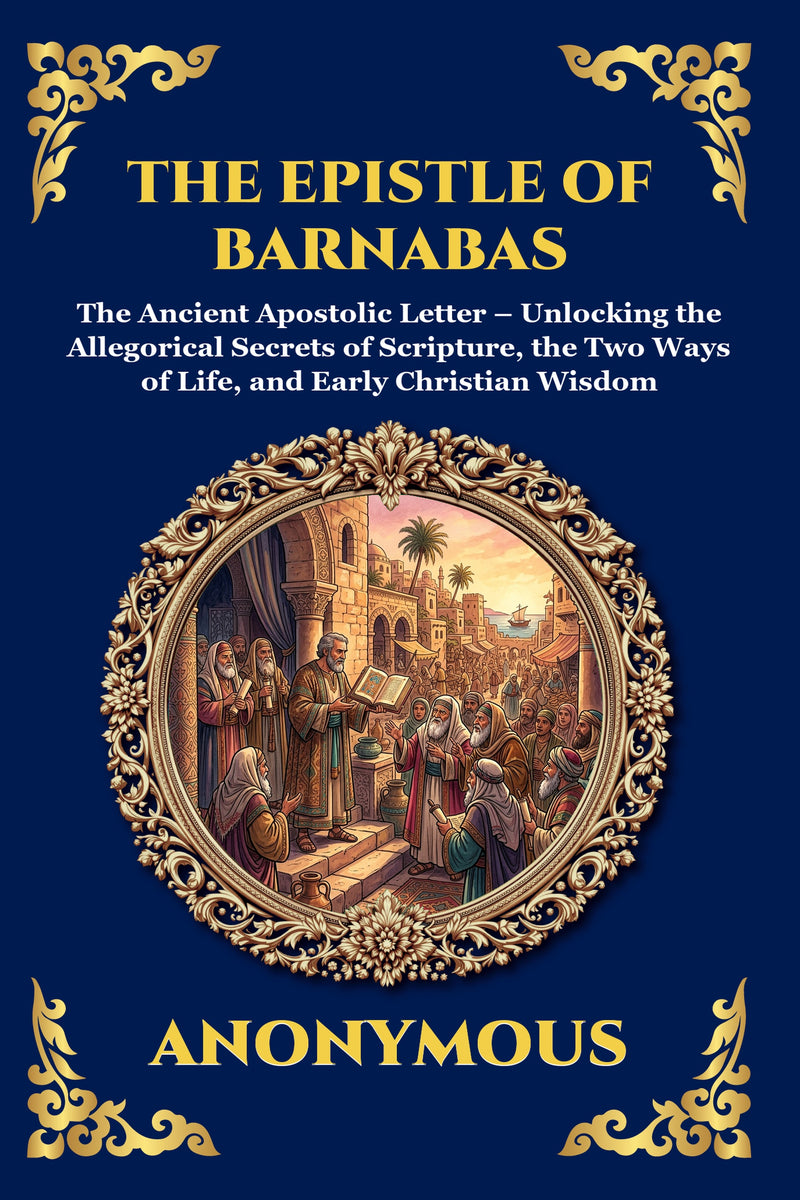
The Epistle of Barnabas
The Epistle of Barnabas reinterprets the Old Testament with allegories that shaped early Christian thought, yet it was never included in the Bible. Attributed to an apostolic companion, this text explores spiritual discernment and the symbolic meaning of ancient laws during a time of religious upheaval.
or free app
10,000+ hrs library
30-day guarantee
This influential early Christian epistle from the late 1st to early 2nd century AD, The Epistle of Barnabas, offers a complete modern-English translation readable online with audiobook included for members.
The Epistle of Barnabas was so revered by early Christians that it was included alongside canonical scripture in the fourth-century Codex Sinaiticus, one of Christianity's most important biblical manuscripts.
The Epistle of Barnabas provides a compelling modern translation of one of the most influential and debated works of the sub-apostolic age. Written during a time of profound religious upheaval, this extraordinary text, attributed to a companion of the apostles, seeks to bridge the gap between ancient Jewish tradition and the burgeoning Christian faith through the power of allegory.
Far more than a historical artifact, The Epistle of Barnabas delves into profound themes of spiritual discernment, the symbolic meaning of ancient laws, and the ethical choice between light and darkness. It challenges mainstream interpretations of scripture, offering a unique lens where every commandment and ritual is seen as a hidden sign pointing toward a deeper, universal truth. Through its famous teaching on the "Two Ways," it provides a rigorous moral compass for those navigating a world of spiritual confusion.
What You’ll Discover in This Modern Translation
- The Secret Allegories of the Law: Explore the fascinating and often surprising ways the early church reinterpreted ancient commandments as spiritual symbols for the modern soul.
- The Doctrine of the Two Ways: Discover the ancient ethical framework that contrasts the Path of Light with the Path of Darkness, providing timeless guidance for moral living.
- Hidden Wisdom and Gnosis: Read the thought-provoking reflections on divine knowledge and the spiritual maturity required to look beneath the surface of sacred texts.
- A Window into Early Christian Identity: Gain a deeper understanding of the historical and theological struggles that shaped the church’s relationship with its scriptural roots.
Whether you’re exploring this work for its historical value, its complex symbolism, or its rigorous moral lessons, The Epistle of Barnabas offers inspiration and profound guidance for all.
Step into a world of ancient mystery and discover the timeless lessons of one of Christianity’s earliest lost masterpieces. Begin your journey today.
| Formats | eBook (EPUB + PDF) · Audiobook · Paperback · Hardcover · Large Print |
| Language | English |
| Trim size (print) | 6 × 9 in |
| Binding | Paperback — perfect-bound · Hardcover — casewrap |
| Large Print edition | Same text in a larger, easy-read type — a larger font, not a larger trim |
| Print pricing | Every physical book at our true cost — at-cost, no profit (members) |
| Library | 873 restored titles, always growing |
| Composed | late 1st to early 2nd century AD |
| Original language | Greek |
| Source tradition | Codex Sinaiticus and later Greek manuscripts |
| Translation basis | Public-domain scholarly translation, rendered in clear modern English |
| Length | 9,384 words · ~38 min reading |
| Reading level | Grade 8 · clear and comfortable (this modern-English edition) |
| Edition | Modern English translation · 2026 |
Member reviews for this edition are collected as readers finish it — be the first. Across the library: 12,000+ books shipped, every plan covered by a 365-day print guarantee.
About this edition
The complete, unabridged text in clear modern English — faithful to the original, never simplified. Every paragraph is checked against the source, so nothing is cut, summarised, or paraphrased away. It reads cleanly for today while keeping the original meaning intact.
The Epistle of Barnabas survives primarily in the 4th-century Codex Sinaiticus and an 11th-century Greek manuscript. This edition derives from the standard public-domain scholarly translation and renders it in clear modern English.
- Complete & unabridgedVerified paragraph by paragraph against the source — never a scan, never abridged.
- Modern English, faithfulReadable today, with the author’s meaning kept intact. Readable — not simplified.
- Every format, one membershipRead in your browser or the free app, or listen to the full audiobook.
Included free with your membership
Cancel anytime, one click · 30-day money-back guarantee
Edition last updated June 2026
What’s inside
The Epistle of Barnabas — complete and unabridged: all 22 sections included with membership, plus the full audiobook.
Begin reading The Epistle of Barnabas
In clear modern English — the complete text is included with membership.
Chapter 1
I greet you, sons and daughters, in the name of the Lord who loved us, in peace.
The ordinances of God are great and rich toward you, and I rejoice with an exceeding and overflowing joy at your blessed and glorious spirits — so natural is the grace of the spiritual gift you have received.
For this reason I congratulate myself all the more, hoping to be saved, because I truly see the Spirit poured out among you from the rich fountain of the Lord. The longed-for sight of you filled me with wonder.
Being persuaded of this, and conscious within myself that I have spoken much among you, I know that the Lord journeyed with me on the way of righteousness — and I am wholly compelled, for my own part, to love you more than my own soul. Holding this in mind, then: if I take care to share with you some portion of what I have received, it will turn to my reward for having ministered to such spirits. And so I was eager to send you this small work, so that along with your faith your knowledge also might be made complete.
There are, then, three ordinances of the Lord: the hope of life, which is the beginning and end of our faith; righteousness, which is the beginning and end of judgment; and love expressed in gladness and rejoicing, the testimony of works of righteousness.
For the Lord made known to us through His prophets the things of the past and the present, and gave us likewise a foretaste of things to come. And seeing each of these things come to pass just as He spoke, we ought to offer a richer and higher sacrifice of reverence toward Him. As for me, I will not speak as a teacher, but as one of yourselves, and will set forth a few things by which you may find gladness in your present circumstances.
Chapter 2
Seeing then that the days are evil, and that the Active One himself holds authority, we ought to take heed to ourselves and to seek out the ordinances of the Lord.
The aids of our faith are fear and patience, and our allies are long-suffering and self-restraint.
While these remain in a pure spirit in matters relating to the Lord, wisdom, understanding, knowledge, and insight rejoice together with them.
For God has made plain to us through all the prophets that he desires neither sacrifices nor burnt offerings nor oblations. At one time he says:
"What is the multitude of your sacrifices to me, says the Lord? I am full of burnt offerings, and the fat of lambs and the blood of bulls and of goats I do not desire — not even when you come to appear before me. Who required these things at your hands? You shall tread my court no more. If you bring fine flour, it is in vain; incense is an abomination to me; your new moons and your Sabbaths I cannot endure."
These things therefore he abolished, so that the new law of our Lord Jesus Christ, being free from the yoke of compulsion, might have its offering not made by human hands.
And again he says to them: "Did I command your fathers, when they went out of the land of Egypt, to bring me burnt offerings and sacrifices?"
No — this was my command to them: "Let none of you bear a grudge of evil against his neighbor in his heart, and do not love a false oath."
We ought therefore, unless we are utterly without understanding, to perceive the gracious intention of our Father; for he speaks to us desiring that we should not go astray as they did, but should seek how we may draw near to him.
And so he speaks to us thus: "The sacrifice acceptable to God is a broken heart; the sweet-smelling savor to the Lord is a heart that glorifies its Maker." We ought therefore, brothers, to understand clearly what concerns our salvation, lest the Evil One find a way to plant error in us and fling us away from our life.
Chapter 3
He speaks again to them concerning these things: "Why do you fast for Me," says the Lord, "so that your voice is heard this day crying aloud? This is not the fast I have chosen," says the Lord; "not a man humbling his soul;
not though you bend your neck like a hoop, and put on sackcloth and make your bed of ashes — not even so shall you call it a fast that is acceptable.
But to us He says: 'Behold, this is the fast I have chosen,' says the Lord: 'loosen every bond of wickedness, untie the tight cords of forcible contracts, set the broken ones free, and tear apart every unjust bond. Break your bread with the hungry, and if you see one who is naked, clothe him; bring the shelterless into your house, and if you see a humble man, do not despise him, nor shall anyone of your household or of your own kindred.'
Then your light shall break forth in the morning, and your healing shall arise quickly, and righteousness shall go before your face, and the glory of God shall surround you.
Then you shall cry out and God shall hear you; while you are still speaking, He shall say, 'Here I am' — if you put away from yourself the yoke, the pointing of the finger, and the word of murmuring, and give your bread to the hungry wholeheartedly, and show pity to the humbled soul."
To this end, therefore, my brothers, He who is long-suffering, foreseeing that the people He had prepared in His beloved Son would believe in simplicity, revealed all these things to us beforehand, so that we might not be shipwrecked upon their law like newcomers who do not know the way.
Chapter 4
We must therefore investigate deeply the present time, and search out the things that have power to save us. Let us flee entirely from all the works of lawlessness, lest those works overpower us; and let us loathe the error of the present age, so that we may be loved for what is to come.
Let us give our soul no relaxation, no freedom to consort with sinners and wicked men, lest we become like them.
The final offense is at hand, of which the scripture speaks, as Enoch says. For to this end the Master has cut the seasons and the days short, so that His beloved might hasten and come into His inheritance.
And the prophet also speaks in this way: Ten kingdoms shall reign upon the earth, and after them another king shall arise, who shall bring three of those kings low and unite them under one.
In the same way Daniel speaks of the same thing: I saw the fourth beast to be wicked and strong and more intractable than all the beasts of the earth, and I saw how there arose from it ten horns, and from these a little horn and an outgrowth, and how it brought three of the great horns low under one.
You ought therefore to understand. Moreover I ask you one thing more, as one of yourselves who loves each of you more than my own soul: give heed to yourselves now, and do not liken yourselves to those who pile sin upon sin, saying that the covenant belongs to them as well.
It is ours; but they lost it forever, and this is how — when Moses had just received it. For the scripture says: Moses was on the mountain fasting forty days and forty nights, and he received the covenant from the Lord, tablets of stone written with the finger of the hand of the Lord.
But they lost it by turning to idols. For the Lord says: Moses, Moses, come down quickly, for your people whom you brought out of the land of Egypt have acted unlawfully. And Moses understood, and threw the two tablets from his hands; and their covenant was shattered, so that the covenant of the beloved Jesus might be sealed upon our hearts in the hope that springs from faith in Him.
Though I would gladly write many things, not as a teacher but as one who loves you and does not want you to fall short of what we possess, I was eager to write to you, being your devoted servant. Let us therefore take heed in these last days. For the whole time of our faith will profit us nothing unless we now, in this season of lawlessness and amid the offenses that are coming, offer resistance as befits sons of God, so that the Black One may find no way in.
Let us flee from all vanity and utterly hate the works of the evil way. Do not slip away privately and stand apart by yourselves, as though you were already justified, but gather together and consult one another concerning the common welfare.
For the scripture says: Woe to those who are wise in their own eyes and understanding in their own sight. Let us become spiritual, let us become a temple made perfect for God. As far as it lies in us, let us exercise ourselves in the fear of God and strive to keep His commandments, so that we may rejoice in His ordinances.
The Lord judges the world without partiality; each person will receive according to his deeds. If he is good, his righteousness will go before him on the way; if he is evil, the recompense of his evil-doing is before him — lest, if we grow slack as people who have been called, we fall asleep over our sins and the prince of evil gain power over us and thrust us out from the kingdom of the Lord.
Understand this also, my brothers. When you see that after so many signs and wonders worked in Israel they were still abandoned, let us take heed, lest we too be found, as the scripture says, among the many who are called but few who are chosen.
Chapter 5
For this reason the Lord endured to give his flesh over to corruption, so that through the forgiveness of sins we might be cleansed — a cleansing that comes through the blood of his sprinkling.
For the scripture concerning him contains some things relating to Israel and some things relating to us. It speaks in this way: He was wounded for your transgressions and bruised for our sins; by his stripes we were healed. As a sheep he was led to slaughter; as a lamb is silent before its shearer.
We ought therefore to be deeply grateful to the Lord, who has revealed the past to us, made us wise in the present, and left us not without understanding of what is to come.
Now the scripture says: Not unjustly is the net spread for the birds. He means by this that a man justly brings destruction on himself when, having knowledge of the way of righteousness, he forces himself into the way of darkness.
There is yet this also, my brothers. If the Lord, who is Lord of the whole world, endured to suffer for our souls — he to whom God said from the foundation of the world, Let us make man after our image and likeness — how then did he endure to suffer at the hands of men?
Understand this. The prophets, having received grace from him, prophesied concerning him. But he himself endured suffering in order to destroy death and to reveal the resurrection of the dead, for it was necessary that he be manifested in the flesh.
He came so that at the same time he might redeem the promise made to the fathers, and by preparing a new people for himself might show, while he was on earth, that having brought about the resurrection he will himself exercise judgment.
Furthermore, he preached, teaching Israel and performing so many wonders and miracles, and he loved that people deeply.
And when he chose his own apostles who were to proclaim his gospel — men who were sinners above every sin, so that he might show that he came not to call the righteous but sinners — then he revealed himself to be the Son of God.
For if he had not come in the flesh, men could never have looked upon him and been saved. As it is, when they look upon the sun, which will one day cease to exist and is merely the work of his hands, they cannot even bear to face its rays.
Therefore the Son of God came in the flesh for this purpose: that he might bring to completion the full measure of the sins of those who had persecuted and slain his prophets.
To this end, then, he endured. For God says of the wounds of his flesh that they came from those very people: When they strike their own shepherd, the sheep of the flock will be scattered.
But he himself desired to suffer in this way, for it was necessary that he suffer on a tree. The prophet who spoke of him said: Spare my soul from the sword; and, Pierce my flesh with nails, for the congregations of evildoers have risen up against me.
Cancel anytime, one click · 30-day money-back guarantee
Founding annual rate available now — your price locks for life when you join.
Not ready? Get this free chapter by email — read it anytime.
✓ Sent — check your inbox for The Epistle of Barnabas.
Questions about The Epistle of Barnabas
Why isn't the Epistle of Barnabas in the Bible?
The Epistle of Barnabas was excluded from the biblical canon by early church councils, though it was considered scripture by some early Christians and appears in Codex Sinaiticus alongside New Testament books.
Did the apostle Barnabas actually write this letter?
Modern scholars generally reject apostolic authorship of the Epistle of Barnabas, dating it to the late first or early second century, after the historical Barnabas would have lived.
What does the Epistle of Barnabas teach?
The Epistle of Barnabas reinterprets Old Testament laws and rituals as allegories pointing to Christ, arguing that Christians are the true inheritors of God's covenant through spiritual rather than literal understanding.
Is The Epistle of Barnabas free to read?
The opening of the text is free to read below. Members read and listen to the complete work — and the entire Lost & Forbidden Library — free.
What is The Epistle of Barnabas?
Have you ever wondered why the earliest Christians interpreted the Old Testament in a way that is almost entirely lost to modern readers?
How long is The Epistle of Barnabas?
22 chapters (~9,437 words) in this restored edition.
Shipping & returns
Billing & membership
More from the library


Explore The Lost & Forbidden Library
- 1 Enoch · Attributed to Enoch
- 1–4 Maccabees · Various Jewish authors
- 2 Baruch · Attributed to Baruch
- 2 Enoch · Attributed to Enoch
- 2 Esdras · Attributed to the prophet Ezra
- 3 Baruch · Attributed to Baruch ben Neriah
- 4 Baruch · Attributed to Baruch ben Neriah
- A Valentinian Exposition · Attributed to a follower of Val...
- Acta Archelai · Attributed to Hegemonius
- Acts of Andrew · Anonymous (Early Christian Apoc...
- Acts of Andrew and Matthias in the City of the Cannibals · Attributed to early Christian a...
- Acts of Barnabas · Attributed to John Mark
- Acts of Bartholomew
- Acts of John · Anonymous (Early Christian Apoc...
- Acts of Matthias · Anonymous early Christian writers
- Acts of Paul · Attributed to an unknown early ...
- Acts of Paul and Thecla · Attributed to Onesiphorus
- Acts of Peter
- Acts of Peter and Andrew · Attributed to various early Chr...
- Acts of Peter and Paul · Attributed to Leucius Charinus
- Acts of Peter and Simon · Attributed to Leucius Charinus
- Acts of Peter and the Twelve Apostles · Attributed to early Christian a...
- Acts of Philip · Anonymous (Early Christian Apoc...
- Acts of Pilate (Gospel of Nicodemus) · Attributed to various early Chr...
- Acts of Saturninus
- Acts of Thaddaeus · Attributed to Thaddaeus the Apo...
- Acts of Thomas
- Acts of Titus · Anonymous early Christian writer
- Acts of Xanthippe, Polyxena, and Rebecca
- Allogenes · Anonymous (Early Gnostic Mystic)
The Epistle of Barnabas
The Epistle of Barnabas
An Apostolic Fathers Letter — The Two Ways, the Spiritual Meaning of the Law and Sacrifices, the Types of Christ in the Scriptures, and the Knowledge That Sets the Faithful Free
Library of Alexandria Press
The Epistle of Barnabas
© Copyright 2026 Library of Alexandria Press. All rights reserved.
Published by Library of Alexandria Press
Printed in the United States of America
It is not legal to copy, share, or send any part of this document in either digital or printed form without written permission from the publisher, except short quotes in a book review.
Table of Contents
Introduction
Chapter 1
Chapter 2
Chapter 3
Chapter 4
Chapter 5
Chapter 6
Chapter 7
Chapter 8
Chapter 9
Chapter 10
Chapter 11
Chapter 12
Chapter 13
Chapter 14
Chapter 15
Chapter 16
Chapter 17
Chapter 18
Chapter 19
Chapter 20
Chapter 21
Introduction
There are texts that survive the centuries not merely because they were copied and preserved, but because they carry within them something that refuses to die — a quality of urgency, of intellectual fire, of genuine spiritual wrestling that speaks across every cultural boundary and temporal divide. The letter you are about to read is one of those rare documents. It comes to us from the earliest centuries of the Christian movement, from a time when the faith was still finding its feet, still working out its relationship to the ancient Jewish scriptures, still arguing passionately about what it meant to follow a crucified and risen teacher. It is a text that has been praised and condemned, included in some of the most important early Christian collections and excluded from others, and it has never quite settled into comfortable obscurity. It demands to be read, wrestled with, and taken seriously.
To understand why this letter matters so deeply, we need to appreciate the extraordinary moment in history from which it emerged. The late first and early second centuries CE were a time of seismic upheaval for Jewish and Christian communities alike. The Temple in Jerusalem had been destroyed by Roman forces in 70 CE, an event so catastrophic that it reshaped the entire religious landscape of the ancient world. Jewish communities were forced to reimagine their faith without the central institution of sacrificial worship. Christian communities, many of which had begun as Jewish reform movements, were simultaneously trying to define their own identity in relation to their Jewish heritage. Questions that had once seemed abstract became desperately practical: What did the Hebrew scriptures mean now? Who were they written for? How should they be read? What was the relationship between the old covenant and the new?
Into this crucible of debate and redefinition, our author — writing under the name of Barnabas, though almost certainly not the historical companion of Paul — sent a remarkable letter. It is a letter that takes these burning questions head-on, with a boldness and creativity that still has the power to startle readers today. The author does not shy away from controversy. He does not offer comfortable answers or diplomatic evasions. Instead, he plunges into the heart of the matter with what can only be described as intellectual passion: a deep conviction that the scriptures of Israel contain hidden meanings that have been waiting, like seeds in winter soil, for the moment of their revelation.
The work has traditionally been dated to somewhere between 70 CE and 135 CE, with many scholars favoring a composition in the late first or early second century. Some have argued for a date shortly after the destruction of the Temple, pointing to references that seem to reflect that traumatic event. Others have suggested a date closer to the Bar Kokhba revolt of 132-135 CE, when the Romans suppressed another Jewish uprising and further transformed the political and religious landscape of Judea. Wherever precisely we locate it, the letter belongs to that extraordinary ferment of early Christianity, a period when the movement was still small enough to feel embattled, still young enough to be radically creative, and still close enough to its Jewish roots to be in passionate dialogue — and sometimes passionate argument — with them.
The question of authorship is itself a fascinating window into the ancient world. The letter claims, or at least implies, a connection to Barnabas — the figure described in the Acts of the Apostles as a companion and colleague of Paul, a Levite from Cyprus who played a crucial role in the early Jerusalem community and in the mission to the Gentiles. For centuries, many readers took this attribution at face value. Clement of Alexandria, one of the great theological minds of the early church, cited the letter as the work of the apostolic Barnabas and treated it with considerable respect. Origen, another towering figure of early Christian thought, also knew the text and valued it. The great Codex Sinaiticus, one of the oldest and most important manuscripts of the Christian Bible, includes this letter immediately after the New Testament books, suggesting that at least some communities in the fourth century regarded it as scripture or near-scripture.
Yet the consensus among modern scholars is that the historical Barnabas could not have written this letter in the form we have it. The Greek is too polished, the allegorical method too developed, and certain historical references seem to point to a period after Barnabas would have been active. The author is most likely a learned Christian teacher, probably of Alexandrian background or at least deeply influenced by the Alexandrian tradition of allegorical interpretation — a tradition associated above all with the great Jewish philosopher Philo, who had developed elaborate methods for reading the Hebrew scriptures as a treasury of hidden philosophical and spiritual meanings. Whoever the author was, he was clearly a person of considerable education, theological sophistication, and burning conviction.
This question of identity, far from diminishing the text, actually enriches it. We are dealing with a document that was considered important enough to be attributed to an apostolic figure, that circulated widely in early Christian communities, and that engaged seriously with some of the most fundamental questions of the faith. The pseudonymous attribution was not, in the ancient world, an act of deception in the way we might understand it today. It was often a way of claiming a tradition, of placing oneself within a lineage of thought, of saying: this teaching stands in the stream of apostolic wisdom. Whether or not the historical Barnabas held a pen to write these words, the letter represents a genuine and significant strand of early Christian reflection.
What makes this text particularly valuable for the modern reader is precisely its strangeness, its willingness to think in ways that challenge our assumptions. We live in an age that tends to read texts literally, that values historical-critical methods of interpretation, that is often suspicious of allegory as a kind of intellectual sleight of hand. The author of this letter would have found such attitudes almost incomprehensible. For him, the literal surface of the scripture was not the primary locus of meaning. The real treasure lay beneath, in the spiritual and typological significance that the words pointed toward. When the Torah commanded the Israelites not to eat pork, he did not think this was primarily about dietary hygiene or ethnic boundary-marking. He thought it was a coded message about avoiding people who forget God when they are comfortable and only remember him when they are hungry — people who, like pigs, grunt loudly when they want something and fall silent when they are satisfied.
This kind of reading can seem bizarre, even offensive, to modern sensibilities. It can look like a wholesale rejection of Judaism, a claim that Jewish people have fundamentally misunderstood their own scriptures. And it is important to be honest about the fact that some of the letter's arguments have a polemical edge that has troubled readers across the centuries, and that contributed — however indirectly and unintentionally — to later traditions of Christian anti-Judaism. We should read with our critical faculties fully engaged, alert to both the brilliance and the dangers of the text. But we should also resist the temptation to dismiss it simply because it makes us uncomfortable. The discomfort itself is instructive. It forces us to ask hard questions about how any community reads its sacred texts, about the relationship between literal and spiritual meaning, about the ways in which different traditions claim ownership of shared scriptures.
The letter unfolds in two quite distinct sections, and this structural duality is itself one of its most interesting features. The first and longer section is a sustained exercise in allegorical biblical interpretation, working through a series of themes and texts from the Hebrew scriptures and offering readings that are consistently christological — that is, readings that find in the ancient texts anticipations, foreshadowings, and hidden references to Jesus and the new covenant. The second section is something quite different: a moral instruction organized around the ancient metaphor of the Two Ways, the way of light and the way of darkness. This section has close parallels with other early Christian and Jewish texts, most notably the Didache, another fascinating document from the same general period, and it represents a tradition of ethical teaching that was apparently widespread in early communities.
This structural duality is not a flaw or an accident. It reflects a coherent vision of what Christian life requires: both right understanding and right living, both theological clarity and ethical commitment. The author is not interested in abstract doctrine for its own sake, nor in moral rules disconnected from their spiritual foundation. He wants his readers to see clearly — to understand the deep logic of the scriptures, to grasp why history has unfolded as it has, to comprehend the nature of the covenant they have entered — and he wants that seeing to transform the way they live. Knowledge and ethics, in his vision, are inseparable. To truly understand is to be changed.
A Text Born from Crisis and Creativity
To read this letter well, we need to inhabit, as fully as we can, the world in which it was written — a world of anxiety and expectation, of rapid change and fierce debate, of communities trying to hold together under external pressure while simultaneously working out their internal identity. The destruction of the Temple was not merely a political or military event. It was a theological earthquake. For centuries, the Temple had been the axis of Jewish religious life, the place where heaven and earth met, where sacrifice was offered, where the presence of God dwelt in a special way. Its loss raised urgent and agonizing questions: Had God abandoned his people? Was the covenant broken? What did the scriptures mean now that their central institution was gone?
Different Jewish communities answered these questions in different ways. The rabbis who would eventually produce the Mishnah and the Talmud developed a form of Judaism centered on Torah study, prayer, and the practices of daily life — a Judaism that could survive and flourish without the Temple. The community that produced the Dead Sea Scrolls had already, before the Temple's destruction, developed a highly sectarian self-understanding in which they saw themselves as the true Israel, a community of the covenant living in the last days. And the early Christians — many of whom were Jewish by birth and formation — developed their own set of answers, answers that inevitably involved reflection on the meaning of Jesus's death and resurrection in relation to the Temple, the covenant, and the scriptures.
The author of this letter stands firmly within this last tradition, but he brings to it a particular intensity and a particular method. His basic claim is that the scriptures of Israel were always intended to be read in the way he reads them — that the allegorical, christological interpretation he offers is not an imposition on the text but its true and original meaning, a meaning that was hidden from those who read only with the eyes of the flesh but is now revealed to those who have received the spirit. This is a bold claim, and it is one that has generated controversy from the moment it was made. But it is also a claim that needs to be understood in its own terms before it is judged.
The Alexandrian tradition of allegorical interpretation, which almost certainly influenced our author, was not a marginal or eccentric approach to texts. It was a sophisticated and respected intellectual method with deep roots in Greek philosophical culture. The Stoics had long read the myths of Homer and Hesiod as allegories of natural and moral truths, finding beneath the surface stories about gods and heroes a deeper wisdom about the cosmos and the human soul. Philo of Alexandria, working in the first century CE, applied similar methods to the Hebrew scriptures with extraordinary creativity and learning, producing readings that found in the stories of Abraham and Moses and the laws of the Torah a treasury of Platonic philosophy and spiritual wisdom. The author of our letter is working in this same broad tradition, though with specifically Christian commitments and concerns.
What distinguishes his approach is its typological character — the conviction that the events and figures and laws of the Hebrew scriptures are not merely allegories of timeless truths but specific anticipations of historical events, above all the life, death, and resurrection of Jesus. This typological reading was enormously influential in early Christian thought and continued to shape Christian biblical interpretation for many centuries. When the author finds in the sacrifice of Isaac a prefiguration of the crucifixion, when he reads the red heifer ritual as a symbolic anticipation of baptism, when he discovers in the number of Abraham's servants a hidden reference to the cross — he is not being arbitrary or capricious. He is working within a coherent hermeneutical framework that sees all of history as a unified narrative moving toward a single climax, a narrative in which earlier events are genuine pointers toward later ones.
Modern readers will inevitably have mixed reactions to these readings. Some will find them ingenious and illuminating, a reminder that texts can carry meanings that their original authors did not consciously intend, that the act of interpretation is always a creative encounter between text and reader. Others will find them forced or even dishonest, a reading-in rather than a reading-out of meaning. Both reactions are legitimate, and the tension between them is itself productive. What we should avoid is the comfortable dismissal that says: this is just ancient superstition, irrelevant to us. The questions the author is wrestling with — about how to read sacred texts, about the relationship between old and new, about the nature of covenant and community and divine purpose — are questions that have not gone away. They are, in different forms, questions that every religious community and every serious reader of ancient texts still faces.
The letter's engagement with Jewish practice is perhaps its most theologically charged dimension, and it is here that modern readers need to exercise the greatest care and critical awareness. The author argues, with considerable passion, that the Jews who followed the literal commandments of the Torah — who actually circumcised their flesh, who actually observed the dietary laws, who actually kept the Sabbath in the conventional sense — had fundamentally misunderstood what God intended. This is a startling claim, and it is one that has a long and troubling history of influence. We should be clear-eyed about the fact that arguments like this one contributed, over centuries of Christian dominance, to the marginalization and persecution of Jewish communities. The author himself, writing in a period when Christians were a small and vulnerable minority, probably did not foresee or intend such consequences. But we read with the knowledge of that history, and we should do so honestly.
At the same time, we should understand that the author's argument is not simply anti-Jewish in any straightforward sense. He is deeply immersed in the Jewish scriptures, deeply respectful of their authority, and deeply convinced that they contain the highest wisdom available to humanity. His quarrel is not with the scriptures themselves but with what he sees as a failure to read them correctly — a failure that he attributes not to the wickedness of Jewish interpreters but to the deceptions of an evil angel who led Israel astray. This is a theological explanation, however unsatisfying it may be to us, and it reflects a genuine attempt to grapple with the painful reality of division between communities that shared so much.
The section on the Two Ways, which forms the second part of the letter, offers a striking contrast to the intense allegorical argumentation of the first part. Here the prose becomes simpler, more direct, more immediately practical. The reader is presented with a clear moral framework: there is a way of light and a way of darkness, and the choice between them is the fundamental choice of human life. The way of light is characterized by love of God and neighbor, by justice and mercy and humility, by care for the poor and the vulnerable, by sexual integrity and honest dealing. The way of darkness is characterized by idolatry and violence, by pride and greed, by oppression of the weak and corruption of the innocent.
This kind of moral instruction, organized around the Two Ways metaphor, appears in several early Jewish and Christian texts, and its presence here suggests that it represents a widespread tradition of catechetical teaching — instruction given to new members of the community as they prepared to enter it fully. The metaphor itself has ancient roots, appearing in various forms in the Hebrew Bible, in Greek philosophical literature, and in the Dead Sea Scrolls. It is a universal human intuition that life presents us with fundamental choices, that there are paths that lead to flourishing and paths that lead to destruction, and that wisdom consists in learning to distinguish between them.
What is particularly striking about this section is its combination of high ethical aspiration with practical, concrete instruction. The author is not content with abstract principles. He wants to know how people actually live, how they treat their servants and their neighbors and their children, how they handle money and sex and power. This rootedness in the practicalities of daily life gives the moral teaching a freshness and an immediacy that speaks across the centuries. Whatever we make of the letter's allegorical arguments, its ethical vision — its insistence on justice, its care for the poor, its horror at the corruption of children, its emphasis on community and mutual accountability — is one that deserves to be taken seriously on its own terms.
Why This Letter Still Speaks
There is a temptation, when approaching ancient religious texts, to treat them as museum pieces — fascinating artifacts of a vanished world, worthy of scholarly attention but essentially irrelevant to the living concerns of contemporary readers. This letter resists that treatment with remarkable energy. It speaks to concerns that are perennial: How do we read texts that claim authority over our lives? How do we relate to traditions that we have inherited but not chosen? How do we maintain ethical integrity in a world that constantly pressures us to compromise? How do we hold together intellectual rigor and spiritual commitment, critical thinking and genuine faith?
The author was writing for a community under pressure — a small, marginal group trying to maintain its identity and its convictions in a world that was largely indifferent or hostile to them. He wanted to give his readers a sense of the deep logic of their situation, to show them that they were not an accident of history but participants in a drama of cosmic significance that had been unfolding since the beginning of time. He wanted to equip them intellectually, to give them the tools to engage with the scriptures confidently and creatively. And he wanted to challenge them morally, to call them to a standard of life that would distinguish them from the surrounding culture not by ethnic markers or ritual observances but by the quality of their love and their justice.
These are not small ambitions, and the letter does not always achieve them with equal success. There are moments of genuine brilliance — readings of scripture that are genuinely illuminating even when they are wildly creative, ethical exhortations that have a directness and force that still lands with power. There are also moments that feel forced or overwrought, arguments that strain credulity even by the standards of ancient allegorical interpretation, polemical passages that make the modern reader wince. But this unevenness is itself part of the text's authenticity. We are not dealing with a polished theological treatise produced by a committee. We are dealing with a real person, writing under real pressure, with genuine conviction and occasional overreach.
One of the most rewarding aspects of engaging with this letter is what it reveals about the diversity and creativity of early Christianity. We sometimes imagine the early church as a monolithic institution with a clear and settled theology, already fully formed in the first generation of believers. The reality was far more interesting and far more complex. Early Christianity was a movement of remarkable intellectual ferment, in which different communities and different teachers developed quite different approaches to the fundamental questions of faith and life. The letter we are about to read represents one significant strand of that ferment — the strand associated with allegorical interpretation, with a high doctrine of revealed knowledge, with a strong sense of the discontinuity between the old and the new.
Other strands emphasized different things: the continuity of the covenants, the importance of the literal commandments, the authority of apostolic tradition, the centrality of the eucharist, the experience of the Spirit. Reading this letter alongside other early Christian texts — the letters of Paul, the Gospel of John, the Didache, the letters of Ignatius, the Shepherd of Hermas — gives us a sense of the rich and sometimes cacophonous conversation that was early Christianity, a conversation in which this letter played a significant and distinctive role.
The letter also has much to teach us about the process by which the Christian biblical canon was formed. The fact that it was included in Codex Sinaiticus, one of the great fourth-century manuscripts of the Bible, tells us that the boundaries of the canon were not always where we now draw them. Different communities in different times and places included different texts in their collections of authoritative writings. The process by which some texts were included and others excluded was long, complex, and sometimes contentious. Understanding this history does not undermine the authority of the canonical texts that were eventually agreed upon, but it does give us a richer and more honest picture of how those texts came to occupy the position they hold.
For those who come to this letter from within a Christian tradition, it offers a bracing encounter with the roots of that tradition — roots that are sometimes surprising, sometimes uncomfortable, but always illuminating. The letter forces us to think about what we mean when we say that the Old Testament and the New Testament form a unified whole, about how we read the Hebrew scriptures in the light of Christ, about the relationship between law and grace, letter and spirit, history and allegory. These are not merely academic questions. They are questions that go to the heart of Christian identity and Christian practice.
For those who come from Jewish backgrounds, the letter offers a window into the early Christian appropriation of Jewish scriptures — a process that was sometimes respectful and sometimes polemical, sometimes creative and sometimes distorting, but always deeply engaged with the tradition it was interpreting. Understanding how early Christians read the Hebrew scriptures is essential for understanding the history of Jewish-Christian relations, with all its tragedy and complexity, and for building the kind of honest dialogue that those relations now require.
For those who come with no particular religious commitment, the letter offers something else: a fascinating case study in the interpretation of sacred texts, in the way that communities construct meaning from inherited traditions, in the relationship between intellectual creativity and religious authority. The author's allegorical method raises in acute form questions that are relevant far beyond the religious sphere: How do we read texts? What is the relationship between the author's intention and the reader's interpretation? Can a text mean something that its original author did not intend? These are questions that literary theorists, philosophers, and cultural critics have been wrestling with for decades, and the ancient allegorists were wrestling with them long before.
There is, finally, something deeply moving about the very fact of this letter's survival. It was written in a world that has utterly vanished — a world of Roman imperial power, of Jewish-Christian controversy, of small communities meeting in houses and arguing passionately about the meaning of ancient texts. The communities for which it was written are long gone. The specific controversies it addressed have been transformed beyond recognition. And yet the letter survives, copied and recopied across the centuries, finding readers in every generation who have recognized in it something worth preserving, something that speaks to the enduring human desire to understand, to belong, to live well, and to find in the ancient words a light for the present moment.
As you begin to read, we invite you to bring your full self to the encounter — your critical intelligence, your historical curiosity, your ethical sensitivity, and your openness to being surprised. This is not a text that rewards passive reading. It demands engagement, argument, even resistance. It will challenge your assumptions about how ancient texts work, about the relationship between the literal and the spiritual, about the nature of covenant and community. It will offer you ethical challenges that are as fresh and demanding as anything in more familiar religious literature. And it will give you a vivid, immediate sense of what it felt like to be part of that extraordinary early Christian movement — uncertain, embattled, creative, passionate, and convinced that the most important things in the world were at stake in the way one read a very old book.
That conviction — that the reading of sacred texts is a matter of life and death, that how we interpret the past shapes who we are in the present, that intellectual clarity and ethical commitment are inseparable — is one that transcends the specific historical moment of this letter's composition. It is a conviction that speaks to anyone who has ever wrestled seriously with a text, with a tradition, with the question of how to live. In that sense, this ancient letter is not merely a historical document. It is an invitation to a conversation that is still very much alive. Turn the page, and enter it.
The Epistle of Barnabas
Chapter 1
I greet you, sons and daughters, in the name of the Lord who loved us, in peace.
The ordinances of God are great and rich toward you, and I rejoice with an exceeding and overflowing joy at your blessed and glorious spirits — so natural is the grace of the spiritual gift you have received.
For this reason I congratulate myself all the more, hoping to be saved, because I truly see the Spirit poured out among you from the rich fountain of the Lord. The longed-for sight of you filled me with wonder.
Being persuaded of this, and conscious within myself that I have spoken much among you, I know that the Lord journeyed with me on the way of righteousness — and I am wholly compelled, for my own part, to love you more than my own soul. Holding this in mind, then: if I take care to share with you some portion of what I have received, it will turn to my reward for having ministered to such spirits. And so I was eager to send you this small work, so that along with your faith your knowledge also might be made complete.
There are, then, three ordinances of the Lord: the hope of life, which is the beginning and end of our faith; righteousness, which is the beginning and end of judgment; and love expressed in gladness and rejoicing, the testimony of works of righteousness.
For the Lord made known to us through His prophets the things of the past and the present, and gave us likewise a foretaste of things to come. And seeing each of these things come to pass just as He spoke, we ought to offer a richer and higher sacrifice of reverence toward Him. As for me, I will not speak as a teacher, but as one of yourselves, and will set forth a few things by which you may find gladness in your present circumstances.
End of the free sample
Keep reading, free
Members read and listen to the complete book — and the entire library. Cancel anytime, one click · 30-day money-back guarantee.