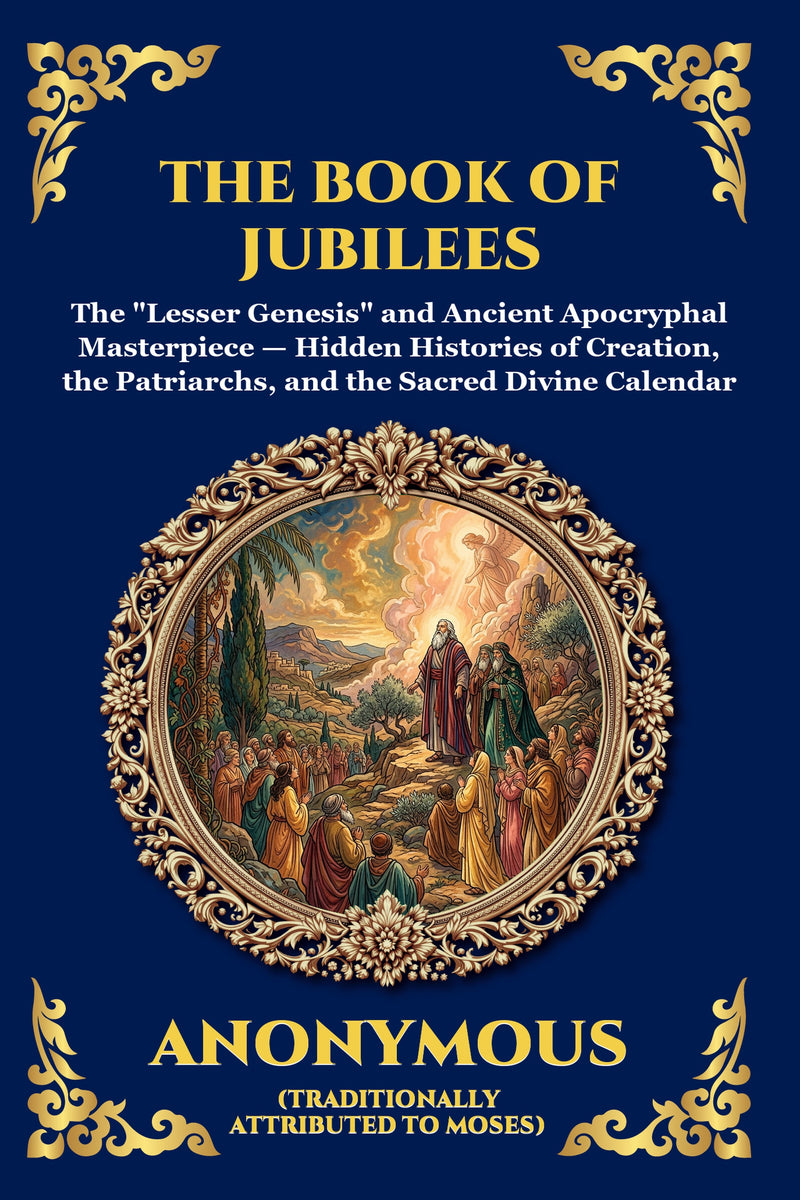
The Book of Jubilees
The Book of Jubilees, often called the "Lesser Genesis," offers a detailed retelling of biblical events from creation to the exodus, filling in gaps left by Genesis. Revered by early Jewish communities, it was excluded from the Bible, yet treasured for its answers to ancient mysteries.
or free app
10,000+ hrs library
30-day guarantee
The Book of Jubilees is presented here as a complete modern-English translation, readable online with audiobook included, making this ancient retelling of Genesis accessible to contemporary readers.
The Book of Jubilees stands as one of ancient literature's most ambitious attempts to rewrite sacred history with divine precision. This extraordinary text transforms familiar biblical stories into a meticulously detailed chronological framework.
The Book of Jubilees provides a captivating and expansive answer. Often called the "Lesser Genesis," this ancient apocryphal masterpiece presents a profound retelling of the biblical narrative from the creation of the world to the Israelites' exodus from Egypt. Traditionally presented as a secret revelation delivered to Moses on Mount Sinai by the Angel of the Presence, this text was highly revered by early Jewish communities, including the authors of the Dead Sea Scrolls.
Far more than a simple retelling, The Book of Jubilees weaves a rich tapestry of missing details, answering centuries-old questions about the patriarchs, the rebellion of the fallen angels, and the establishment of divine law. It introduces a highly structured, 364-day solar calendar, portraying time itself as a sacred cycle ordained by heaven. Through its vivid narratives and theological depth, this text offers a unique window into the mind of the ancient believers who sought to protect their faith and heritage in a rapidly changing world.
What You Will Discover in This Modern Translation
- Hidden Details of the Patriarchs — Uncover expanded stories and previously untold events in the lives of Adam, Enoch, Noah, Abraham, and Moses.
- The Origins of Evil and the Watchers — Explore the ancient traditions surrounding the fallen angels, their descent to earth, and the cosmic battles that shaped human history.
- The Sacred Divine Calendar — Understand the profound significance of the 364-day solar calendar and the strict observance of holy festivals and jubilees.
- A Window into Ancient Mysticism — Gain valuable context on early Jewish theology, the concept of divine covenants, and the profound beliefs that influenced later biblical literature.
Whether you are a scholar of biblical history, a theology student, or a seeker of ancient mysteries, The Book of Jubilees offers an indispensable journey into the spiritual past.
Uncover the hidden histories of creation and the patriarchs. Begin your journey today.
| Formats | eBook (EPUB + PDF) · Audiobook · Paperback · Hardcover · Large Print |
| Language | English |
| Trim size (print) | 6 × 9 in |
| Binding | Paperback — perfect-bound · Hardcover — casewrap |
| Large Print edition | Same text in a larger, easy-read type — a larger font, not a larger trim |
| Print pricing | Every physical book at our true cost — at-cost, no profit (members) |
| Library | 873 restored titles, always growing |
| Composed | 2nd century BC |
| Original language | Hebrew, surviving complete in Ge'ez (Ethiopic) |
| Source tradition | Ethiopic manuscript tradition and Hebrew fragments from Qumran |
| Translation basis | R.H. Charles (1917), rendered in clear modern English |
| Length | 49,611 words · ~3 hr 18 min reading |
| Reading level | Grade 10 · a confident, adult read (this modern-English edition) |
| Edition | Modern English translation · 2026 |
Member reviews for this edition are collected as readers finish it — be the first. Across the library: 12,000+ books shipped, every plan covered by a 365-day print guarantee.
About this edition
The complete, unabridged text in clear modern English — faithful to the original, never simplified. Every paragraph is checked against the source, so nothing is cut, summarised, or paraphrased away. It reads cleanly for today while keeping the original meaning intact.
This text survives primarily through Ethiopic manuscripts preserved by the Ethiopian Orthodox Church, along with Hebrew fragments from Qumran and Greek fragments. This edition derives from the standard public-domain scholarly translation and renders it in clear modern English.
- Complete & unabridgedVerified paragraph by paragraph against the source — never a scan, never abridged.
- Modern English, faithfulReadable today, with the author’s meaning kept intact. Readable — not simplified.
- Every format, one membershipRead in your browser or the free app, or listen to the full audiobook.
Included free with your membership
Cancel anytime, one click · 30-day money-back guarantee
Edition last updated June 2026
What’s inside
The Book of Jubilees — complete and unabridged: all 51 sections included with membership, plus the full audiobook.
Begin reading The Book of Jubilees
In clear modern English — the complete text is included with membership.
Chapter 1
It came to pass in the first year of the exodus of the children of Israel out of Egypt, in the third month, on the sixteenth day of the month, that God spoke to Moses, saying: "Come up to Me on the mountain, and I will give you two stone tablets of the law and of the commandment, which I have written, that you may teach them."
And Moses went up into the mountain of God, and the glory of the Lord rested on Mount Sinai, and a cloud overshadowed it for six days.
On the seventh day He called to Moses out of the midst of the cloud, and the appearance of the glory of the Lord was like a flaming fire on the top of the mountain.
And Moses was on the mountain forty days and forty nights, and God taught him the earlier and the later history of the division of all the days of the law and of the testimony.
And He said: "Turn your heart to every word I shall speak to you on this mountain, and write them in a book, so that their generations may see how I have not forsaken them for all the evil they have done in transgressing the covenant which I establish between Me and you for their generations this day on Mount Sinai.
And when all these things come upon them, they will recognize that I am more righteous than they in all My judgments and in all My actions, and they will recognize that I have truly been with them.
And you shall write down for yourself all these words which I declare to you this day, for I know their rebellion and their stubbornness, before I bring them into the land which I swore to their fathers, to Abraham and to Isaac and to Jacob, saying: 'To your descendants I will give a land flowing with milk and honey.'
And they will eat and be satisfied, and they will turn to foreign gods, which cannot deliver them from any of their troubles; and this testimony shall stand as a witness against them. For they will forget all My commandments, everything I command them, and they will walk after the Gentiles, and after their uncleanness, and after their shame, and will serve their gods, and these will prove to them an offense and a tribulation and an affliction and a snare.
And many will perish and they will be taken captive and fall into the hands of the enemy, because they have forsaken My ordinances and My commandments, and the festivals of My covenant, and My sabbaths, and My holy place which I have hallowed for Myself in their midst, and My tabernacle, and My sanctuary, which I have hallowed for Myself in the midst of the land, that I should set My name upon it and dwell there.
And they will make for themselves high places and sacred groves and carved images, and they will worship, each his own idol, going astray, and they will sacrifice their children to demons and to all the works of the error of their hearts.
And I will send witnesses to them to testify against them, but they will not listen, and they will kill the witnesses also, and they will persecute those who seek the law, and they will abolish and change everything so as to work evil before My eyes.
And I will hide My face from them, and I will deliver them into the hand of the Gentiles for captivity and for plunder and for destruction, and I will remove them from the midst of the land, and I will scatter them among the Gentiles.
And they will forget all My law and all My commandments and all My judgments, and will go astray regarding new moons, and sabbaths, and festivals, and jubilees, and ordinances.
And after this they will turn to Me from among the Gentiles with all their heart and with all their soul and with all their strength, and I will gather them from among all the Gentiles, and they will seek Me, so that I shall be found by them when they seek Me with all their heart and with all their soul.
And I will reveal to them an abundance of peace with righteousness, and I will transplant them as a plant of uprightness, with all My heart and with all My soul, and they shall be a blessing and not a curse, and they shall be the head and not the tail.
And I will build My sanctuary in their midst, and I will dwell with them, and I will be their God and they shall be My people in truth and righteousness.
And I will not forsake them nor fail them; for I am the Lord their God."
And Moses fell on his face and prayed and said: "O Lord my God, do not forsake Your people and Your inheritance, so that they should wander in the error of their hearts, and do not deliver them into the hands of their enemies, the Gentiles, lest they should rule over them and cause them to sin against You.
Let Your mercy, O Lord, be lifted up upon Your people, and create in them an upright spirit, and let not the spirit of Beliar rule over them to accuse them before You and to ensnare them from all the paths of righteousness, so that they may perish from before Your face.
But they are Your people and Your inheritance, whom You delivered with Your great power from the hands of the Egyptians: create in them a clean heart and a holy spirit, and let them not be ensnared in their sins from this time forward unto eternity."
And the Lord said to Moses: "I know their contrariness and their thoughts and their stubbornness, and they will not be obedient until they confess their own sin and the sin of their fathers.
And after this they will turn to Me in all uprightness and with all their heart and with all their soul, and I will circumcise the foreskin of their heart and the foreskin of the heart of their descendants, and I will create in them a holy spirit, and I will cleanse them so that they shall not turn away from Me from that day to eternity.
And their souls will cleave to Me and to all My commandments, and they will fulfill My commandments, and I will be their Father and they shall be My children.
And they shall all be called children of the living God, and every angel and every spirit shall know — yes, they shall know — that these are My children, and that I am their Father in righteousness and uprightness, and that I love them.
And you are to write down for yourself all these words that I declare to you on this mountain, the first and the last, all that shall come to pass in every division of the days, in the law and in the testimony, in the weeks and the jubilees, forever and ever, until I descend and dwell with them throughout eternity.
And He said to the angel of the presence: Write for Moses from the beginning of creation until My sanctuary has been built among them for all eternity.
And the Lord will appear before the eyes of all, and all shall know that I am the God of Israel and the Father of all the children of Jacob, and King on Mount Zion for all eternity. And Zion and Jerusalem shall be holy.
And the angel of the presence who went before the camp of Israel took the tablets of the divisions of the years — from the time of creation — of the law and of the testimony, of the weeks and the jubilees, reckoned year by year, according to the full count of the jubilees, from the day of creation until the heavens and the earth are renewed and all their creation according to the powers of heaven and all the creation of the earth, until the sanctuary of the Lord is established in Jerusalem on Mount Zion, and all the luminaries are renewed for healing and for peace and for blessing for all the elect of Israel, and that it may be so from that day forward through all the days of the earth.
Cancel anytime, one click · 30-day money-back guarantee
Founding annual rate available now — your price locks for life when you join.
Not ready? Get this free chapter by email — read it anytime.
✓ Sent — check your inbox for The Book of Jubilees.
Questions about The Book of Jubilees
Why isn't the Book of Jubilees in the Bible?
The Book of Jubilees was excluded from the biblical canon by most Jewish and Christian communities, though it remained authoritative for Ethiopian Orthodox Christianity and was highly valued by the Qumran community that preserved the Dead Sea Scrolls.
What does the Book of Jubilees contain?
The Book of Jubilees retells biblical history from creation through Moses, organizing events into 49-year jubilee periods. It expands Genesis narratives with additional details about patriarchs, angels, and Jewish law, presenting itself as revelation given to Moses on Mount Sinai.
Who wrote the Book of Jubilees?
The Book of Jubilees was written by an anonymous Jewish author in the 2nd century BC. The text claims to be revelation delivered by an angel to Moses, but scholars recognize it as pseudepigraphic literature from the Second Temple period.
Is The Book of Jubilees free to read?
The opening of the text is free to read below. Members read and listen to the complete work — and the entire Lost & Forbidden Library — free.
What is The Book of Jubilees?
Have you ever wondered why the ancient stories of Genesis leave so many unanswered questions? The Book of Jubilees provides a captivating and expansive answer.
How long is The Book of Jubilees?
51 chapters (~49,691 words) in this restored edition.
Shipping & returns
Billing & membership
More from the library


Explore The Lost & Forbidden Library
- 1 Enoch · Attributed to Enoch
- 1–4 Maccabees · Various Jewish authors
- 2 Baruch · Attributed to Baruch
- 2 Enoch · Attributed to Enoch
- 2 Esdras · Attributed to the prophet Ezra
- 3 Baruch · Attributed to Baruch ben Neriah
- 4 Baruch · Attributed to Baruch ben Neriah
- A Valentinian Exposition · Attributed to a follower of Val...
- Acta Archelai · Attributed to Hegemonius
- Acts of Andrew · Anonymous (Early Christian Apoc...
- Acts of Andrew and Matthias in the City of the Cannibals · Attributed to early Christian a...
- Acts of Barnabas · Attributed to John Mark
- Acts of Bartholomew
- Acts of John · Anonymous (Early Christian Apoc...
- Acts of Matthias · Anonymous early Christian writers
- Acts of Paul · Attributed to an unknown early ...
- Acts of Paul and Thecla · Attributed to Onesiphorus
- Acts of Peter
- Acts of Peter and Andrew · Attributed to various early Chr...
- Acts of Peter and Paul · Attributed to Leucius Charinus
- Acts of Peter and Simon · Attributed to Leucius Charinus
- Acts of Peter and the Twelve Apostles · Attributed to early Christian a...
- Acts of Philip · Anonymous (Early Christian Apoc...
- Acts of Pilate (Gospel of Nicodemus) · Attributed to various early Chr...
- Acts of Saturninus
- Acts of Thaddaeus · Attributed to Thaddaeus the Apo...
- Acts of Thomas
- Acts of Titus · Anonymous early Christian writer
- Acts of Xanthippe, Polyxena, and Rebecca
- Allogenes · Anonymous (Early Gnostic Mystic)
The Book of Jubilees
The Book of Jubilees
The Little Genesis — The History from Creation to Sinai Retold to Moses in Jubilee Periods: The Days of Adam, the Flood, the Lives of the Patriarchs, and the Festivals and Sabbaths of the Divided Years
Library of Alexandria Press
The Book of Jubilees
© Copyright 2026 Library of Alexandria Press. All rights reserved.
Published by Library of Alexandria Press
Printed in the United States of America
It is not legal to copy, share, or send any part of this document in either digital or printed form without written permission from the publisher, except short quotes in a book review.
Table of Contents
Introduction
Chapter 1
Chapter 2
Chapter 3
Chapter 4
Chapter 5
Chapter 6
Chapter 7
Chapter 8
Chapter 9
Chapter 10
Chapter 11
Chapter 12
Chapter 13
Chapter 14
Chapter 15
Chapter 16
Chapter 17
Chapter 18
Chapter 19
Chapter 20
Chapter 21
Chapter 22
Chapter 23
Chapter 24
Chapter 25
Chapter 26
Chapter 27
Chapter 28
Chapter 29
Chapter 30
Chapter 31
Chapter 32
Chapter 33
Chapter 34
Chapter 35
Chapter 36
Chapter 37
Chapter 38
Chapter 39
Chapter 40
Chapter 41
Chapter 42
Chapter 43
Chapter 44
Chapter 45
Chapter 46
Chapter 47
Chapter 48
Chapter 49
Chapter 50
Introduction
There are books that shaped the world quietly, from the shadows — texts that never made it into the canon most people know, yet whose fingerprints appear everywhere: in theology, in liturgy, in the deepest assumptions that religious civilizations have carried for millennia without quite knowing why. The ancient work you are about to read is one of those books. It is a text of extraordinary ambition, unusual beauty, and profound historical significance — a retelling of the earliest chapters of human history that is simultaneously faithful to its sources and wildly, brilliantly original. To read it is to step into a world where angels keep meticulous records, where time itself is a sacred architecture, and where the stories you thought you knew reveal unexpected depths, darker shadows, and stranger glories than you ever imagined.
For much of the past two thousand years, this text existed at the margins — preserved in fragments, quoted by early Christian writers who seemed almost embarrassed by how much they relied on it, copied by Ethiopian monks who treated it as scripture, and largely unknown to the Western world until the nineteenth century brought it roaring back into scholarly consciousness. Today it sits at the intersection of some of the most exciting debates in biblical scholarship, ancient history, and the study of religion: debates about where the Hebrew Bible came from, how Judaism evolved in the turbulent centuries before the Common Era, what the Dead Sea Scrolls community believed, and how the earliest Christians understood the cosmos and their place in it. And yet, for all its scholarly importance, it remains one of the least-read major religious texts in the world — a masterpiece hiding in plain sight.
That is a situation worth correcting. Because whatever one's religious commitments or lack thereof, this is a genuinely great piece of ancient literature. It has the sweep of an epic, the intimacy of a family saga, the precision of a legal code, and the visionary intensity of apocalyptic prophecy. It is simultaneously a work of deep reverence — a loving elaboration of traditions its author considered sacred — and a work of bold creative reimagination. It takes the spare, often cryptic narratives of Genesis and Exodus and fills them with color, motivation, backstory, and consequence. It answers questions that the biblical text leaves tantalizingly open. It introduces characters and conflicts that illuminate the world behind the canonical text in ways that continue to astonish readers encountering them for the first time.
The ancient title most commonly associated with this work in scholarly literature translates roughly as 'The Division of Times' or 'The Book of Divisions,' a name that points directly to one of its central obsessions: the architecture of sacred time, the division of history into jubilees and weeks of years, the insistence that the cosmos runs on a precise divine calendar that human beings ignore at their peril. But it has also been known by a more evocative name — the Lesser Genesis, or in Latin, Leptogenesis — a title that acknowledges both its relationship to the foundational text of the Hebrew Bible and its own distinct identity. It is lesser not in quality or importance but in scope: a more intimate, more detailed, more annotated version of the great story, a companion volume written by someone who had thought deeply about every sentence of the original and had much to say.
The setting established at the very beginning is worth pausing over, because it tells us immediately what kind of book this is and what kind of reading experience lies ahead. The narrative is framed as a divine dictation: Moses, on Mount Sinai, is commanded by God to write down not just the laws but the entire history of creation and the patriarchs, as revealed to him by the Angel of the Presence. This framing device is not merely a literary convention. It is a theological statement of the highest order, asserting that the history contained in these pages is not human speculation or priestly tradition but direct divine revelation — that what you are reading is, in the most literal sense, the authorized version of events as God himself understands them. The angel who speaks to Moses throughout the text is not a messenger but a narrator, and the narrative he delivers is one in which the heavenly and earthly realms are in constant, intimate contact.
This is a world densely populated with angels. They are not the vague, decorative figures of popular imagination — winged and benevolent and largely irrelevant to human affairs. They are administrators, warriors, scribes, and occasionally catastrophically fallible beings whose errors have consequences that echo through all of human history. There are angels who govern the forces of nature, angels assigned to individual nations, angels who intercede for human beings before the divine throne, and angels who fell from their proper station in ways that explain much of the suffering and wickedness that has plagued humanity since the earliest days. The cosmology on offer here is one of breathtaking complexity and internal consistency, a vision of the universe as a vast, layered, carefully administered structure in which nothing happens by accident and everything — every feast day, every genealogy, every seemingly minor narrative detail — carries weight.
Understanding where this text came from, and when, and why, is essential to appreciating what it is trying to do. The scholarly consensus places its composition in the second century BCE, most likely in the period between roughly 170 and 140 BCE, though debates about the precise dating continue. This was one of the most turbulent and consequential periods in Jewish history — the era of the Maccabean revolt, the desecration and rededication of the Temple in Jerusalem, and the fierce cultural struggle between those Jews who embraced Hellenistic culture and those who resisted it with everything they had. Into this context, a writer of remarkable learning and passionate conviction produced a text that was, among other things, a manifesto: an argument for the absolute, non-negotiable distinctiveness of the Jewish people, rooted not in recent history or political circumstance but in the very structure of creation itself.
The author — whose identity we do not know, though theories have been proposed and debated for generations — was almost certainly a priest, and almost certainly associated with the circles that would eventually produce the Dead Sea Scrolls community, or something very like it. The text shares with those scrolls a set of distinctive concerns: a solar calendar of 364 days rather than the lunar calendar used by the Jerusalem Temple establishment, a fierce insistence on the separation of Israel from the nations, a preoccupation with the proper observance of festivals and sabbaths, and a vision of history as a cosmic drama moving toward a divinely ordained conclusion. Whether the author was himself an Essene, or a proto-Essene, or simply someone whose ideas fed into that tradition, the connections are too numerous and too specific to be coincidental.
Yet to reduce this text to a historical document — interesting primarily as evidence for what second-century BCE Jewish sectarians believed — would be to do it a serious injustice. It is, first and last, a work of literature and theology, and it deserves to be read as such. The stories it tells are told with skill and care. The characters who populate its pages — Adam and Eve, Cain and Abel, Noah, Abraham, Jacob, Joseph — are rendered with a psychological specificity that goes well beyond what the canonical text provides. We learn what they felt, what they feared, what they prayed for in the darkness. We see their relationships with one another in intimate detail. We watch families love and betray and forgive one another across generations, and we feel the weight of choices that echo forward through time in ways the choosers could not have anticipated.
The calendar, which might seem like an arcane obsession to a modern reader, is in fact one of the most fascinating aspects of the entire work, and one of the most important for understanding the religious world of the period. The author's insistence on a 364-day solar calendar — a year of exactly 52 weeks, in which every festival falls on the same day of the week every year without variation — is not merely a technical preference. It is a cosmic claim. It says that the universe was designed with mathematical precision, that sacred time is built into the structure of creation itself, and that those who follow the lunar calendar are not just making a practical error but are fundamentally out of step with the divine order. The festivals, in this vision, are not human institutions that God has endorsed; they are eternal realities that existed before the world was made and that human beings are invited to participate in when they observe them correctly.
This is a book, in other words, that takes time seriously — not just the calendar, but the whole sweep of history from creation to what the author clearly believes is the approaching end of the present age. History is organized into jubilees: periods of forty-nine years, seven weeks of seven years each, a structure borrowed from the biblical legislation about the jubilee year but applied here to the entirety of human time. Every event is dated precisely within this framework. We know not just that something happened but when it happened, in which jubilee, in which week of years, in which year of that week. This obsessive chronological precision is not pedantry. It is an expression of the conviction that history has a shape, that it is going somewhere, and that knowing where you are in the structure of time is essential to knowing how to live.
A Text Recovered from the Margins
The story of how this text survived, disappeared, and was recovered is itself a remarkable narrative — one that spans continents, centuries, and the full range of human responses to sacred literature, from veneration to suppression to scholarly obsession. In the early centuries of the Common Era, the work was widely known and widely used. Early Christian writers quoted it, sometimes extensively. The church fathers Origen, Epiphanius, and Jerome all knew it. It was cited in early Christian debates about chronology, about the nature of angels, about the proper dating of biblical events. The Ethiopian church, which preserved so many texts that were lost elsewhere, eventually incorporated it into its biblical canon, where it remains to this day — one of the very few communities in the world that has never stopped reading this ancient work as authoritative scripture.
In the Latin West and the Greek East, however, it gradually faded from view. As the biblical canon solidified and the boundaries between scripture and apocrypha became more firmly policed, texts like this one — which claimed divine authority but had not made the canonical cut — became increasingly marginal and eventually largely inaccessible. For most of the medieval period, European readers had no access to it at all. It was a ghost in the footnotes of patristic literature, a text that scholars knew had once existed but could not read.
The rediscovery began in the nineteenth century, when European scholars started gaining access to the Ethiopian biblical tradition and the Ge'ez manuscripts that preserved it. The first complete translation of the Ethiopic text into a European language appeared in the 1850s, and the scholarly world reacted with something close to astonishment. Here was an ancient Jewish text of enormous scope and sophistication, clearly very old, clearly related to traditions that had shaped both Judaism and Christianity in their formative periods, and almost entirely unknown to the modern world. The excitement was immediate and lasting. Within decades, it had become one of the most studied texts in the field of Second Temple Judaism — the period roughly from the return from Babylonian exile in the sixth century BCE to the destruction of the Second Temple in 70 CE, a period of extraordinary religious creativity and diversity.
The discovery of the Dead Sea Scrolls beginning in 1947 transformed the scholarly understanding of this ancient work in ways that are still being worked through today. Among the thousands of fragments recovered from the caves near Qumran were portions of this very text — not in Ethiopic translation but in Hebrew, the language in which it was almost certainly originally composed. These fragments confirmed what scholars had long suspected: that the Ethiopic tradition had preserved the text with remarkable fidelity, and that what we are reading today is genuinely ancient, genuinely Jewish, and genuinely important. The Qumran community clearly valued it highly — more copies of it were found at Qumran than of most books of the Hebrew Bible itself, a fact that speaks volumes about its status in at least one significant strand of ancient Jewish thought.
The fragments also helped scholars refine their understanding of the text's relationship to other ancient Jewish writings — the various apocalypses, testaments, and expansions of biblical narrative that scholars group together under the heading of Old Testament Pseudepigrapha. This is a vast and fascinating body of literature, much of it roughly contemporary with the text in question, and understanding it in relation to these other works helps illuminate what was distinctive about it and what it shared with the broader intellectual world of Second Temple Judaism. It was not produced in isolation. It was part of a conversation — a rich, contentious, deeply serious conversation about the meaning of Jewish identity, the nature of the covenant, the structure of the cosmos, and the direction of history.
What the recovery of this text has given us, ultimately, is a window into a world of religious thought that was far more diverse, far more creative, and far more intellectually sophisticated than the canonical texts alone would suggest. The Judaism of the second century BCE was not a monolithic tradition but a field of competing visions, each claiming fidelity to the ancient covenant and each working out the implications of that covenant in different ways. The author of this work represents one of the most rigorous and uncompromising of those visions — a vision in which the boundaries between Israel and the nations are absolute, in which the proper observance of sacred time is a matter of cosmic significance, and in which the entire history of the world from creation to the present moment is a single, divinely authored narrative moving toward a predetermined conclusion.
Reading this text today, we are reading something that shaped the world in ways both direct and indirect. Its influence on early Christianity has been extensively documented: ideas about angels, about the fall of the Watchers, about the nature of sin and its transmission across generations, about the structure of sacred time — all of these appear in early Christian literature in forms that suggest direct or indirect dependence on this tradition. Its influence on the development of Jewish mysticism, particularly the traditions associated with Merkabah mysticism and later Kabbalah, is harder to trace but equally real. The vision of a cosmos organized into hierarchical layers, populated by angelic beings of various ranks and functions, governed by a divine throne of overwhelming glory — this is the world of this ancient text, and it is also the world of much of the most creative religious thought in both Jewish and Christian traditions for centuries afterward.
There is something humbling about this realization. We tend to think of the canonical texts as the foundation and everything else as derivative — commentary, elaboration, secondary material. But the history of religion is more complicated than that. Traditions feed each other in all directions. Ideas that appear in texts like this one shaped the way canonical texts were read, interpreted, and applied. The boundaries between scripture and apocrypha, between the authoritative and the peripheral, are human constructions — useful, important, but not absolute. And sometimes, as with this work, what has been placed at the periphery turns out to be essential for understanding the center.
How to Read What Follows
Approaching an ancient text like this one requires a certain adjustment of expectations — not a lowering of them, but a reorientation. This is not a modern novel, and it does not work by the conventions of modern fiction. It does not build suspense in the way we are accustomed to, does not develop character through the accumulation of psychological detail in the way that post-Enlightenment literature does, does not resolve its tensions in the neat narrative arcs that contemporary readers instinctively look for. It works by other means, according to other values, toward other ends. Learning to read it on its own terms is one of the great pleasures it offers, and it is a pleasure that repays the small effort required.
The most important thing to understand is that this is a text written for people who already knew the stories. The author is not introducing Genesis and Exodus to an audience unfamiliar with them. He is elaborating, clarifying, and reinterpreting them for an audience that knew them well — perhaps too well, in the sense of knowing them so familiarly that they had stopped really reading them. One of the great achievements of this ancient work is the way it makes familiar material strange again, forces the reader to see it freshly, to notice things that the spare original narrative passes over in silence. Why did Cain kill Abel, really? What was the nature of the sin of the Watchers, and what were its consequences? Why did God choose Abraham, and what did that choice cost? These are questions the canonical text raises but does not fully answer, and the author addresses them with a combination of traditional lore, logical inference, and creative imagination that is consistently illuminating.
The genealogies and chronological lists, which can seem forbidding at first, are worth reading with attention rather than skimming. In the world of this text, genealogy is theology. Who is descended from whom matters enormously, because it determines identity, obligation, and destiny. The careful tracking of generations is not bureaucratic pedantry but a way of showing that history has a structure, that the covenant is transmitted through specific human lineages, and that the present moment is connected to the moment of creation by an unbroken chain of human lives and divine promises. When you understand this, the lists become something other than obstacles — they become a kind of poetry, a numerical meditation on the continuity of sacred history.
The angels deserve special attention, because they are among the most distinctive and memorable features of the entire work. The author's angelology is rich and complex, drawing on traditions that appear elsewhere in Second Temple literature but synthesizing them in a distinctive way. The angels are not abstractions or metaphors. They are real beings with real agency, capable of genuine choice and genuine error. The story of the Watchers — the angels who descended to earth, took human wives, and generated a race of giants whose violence helped bring on the Flood — is one of the most powerful and disturbing narratives in the entire text, and it is handled with a psychological seriousness that gives it genuine literary weight. But there are also angels of great beauty and dignity: the Angel of the Presence who narrates the entire work, the angels who celebrate the Sabbath and the festivals alongside the people of Israel, the guardian angels who watch over the patriarchs in moments of danger. The angelic world in these pages is as varied, as morally complex, and as genuinely interesting as the human world it mirrors and interposes itself into.
One figure who appears in this text and who has fascinated readers across the centuries deserves special mention: Mastema, the prince of evil spirits, the great adversary who tests human beings, incites the nations against Israel, and serves as the dark counterpart to the divine order. He is not quite identical to the Satan of later tradition, but he is clearly a precursor — a being who operates within the divine permission but whose purposes are destructive, who finds his opportunities in human weakness and divine testing. His presence in the narrative gives it a dramatic tension that it would otherwise lack, and his interactions with the patriarchs — particularly his role in the near-sacrifice of Isaac — are among the most theologically charged moments in the entire work.
The ethical vision of the text is demanding and uncompromising, and modern readers may sometimes find it difficult. The fierce insistence on the separation of Israel from the nations, the harsh judgments pronounced on those who violate the boundaries of the covenant, the occasional violence that is presented not just as historically inevitable but as divinely sanctioned — these are aspects of the text that require honest engagement rather than either uncritical acceptance or dismissive rejection. They are the product of a specific historical moment, a community under existential pressure, a writer who believed with every fiber of his being that the survival of the covenant people depended on the maintenance of clear boundaries. Understanding that context does not require endorsing every conclusion the author draws, but it does require taking seriously the fears and convictions that shaped those conclusions.
At the same time, the text contains passages of extraordinary tenderness and moral beauty. The deathbed speeches of the patriarchs, in which they pass on their wisdom to their children and grandchildren, are among the most moving pieces of ancient Jewish literature. The vision of the world restored — of a time when human beings will live in harmony with one another and with the creation, when sorrow and pain will be abolished and the divine presence will dwell openly among humanity — is expressed with a lyrical intensity that has lost none of its power across the millennia. The author believed that history was moving toward this restoration, that the covenant was not just a set of obligations but a promise, and that the promise would be kept. Whatever one makes of that belief, the passion with which it is expressed is impossible not to feel.
There is also, woven throughout the text, a deep love of the natural world — of the rhythms of seasons and harvests, of the beauty of the night sky with its precisely ordered movements, of the land itself as a sacred gift. The author's insistence on the solar calendar is partly an expression of this love: a conviction that the natural order is not just a backdrop to human history but a participant in it, that the sun and moon and stars are themselves part of the divine administration of the cosmos, that to be in tune with the sacred calendar is to be in tune with the universe itself. This is not a text that despises the material world or looks forward to its annihilation. It looks forward to its healing.
As you begin to read, it may help to think of yourself as joining a conversation that has been going on for more than two thousand years — a conversation about the meaning of sacred history, the nature of divine justice, the obligations of covenant, and the shape of human destiny. The author of this ancient work was himself joining a conversation that was already ancient in his time, reaching back to the earliest memories of his people and forward to a future he believed was imminent. Readers across the centuries — Ethiopian monks, Qumran sectarians, early Christian theologians, medieval Jewish mystics, modern scholars, and now you — have all been participants in that conversation, each bringing their own questions and their own understanding, each finding in the text things that speak to their particular moment.
What you are about to read is not a simple text, but it is a rewarding one. It will challenge your assumptions, expand your sense of what ancient religious literature can do, and introduce you to a vision of the world that is alien in some respects and startlingly familiar in others. It will make you think differently about stories you thought you knew. It will introduce you to a cosmos more populous, more structured, and more morally serious than the one most modern readers carry in their imaginations. And it will, if you give it the attention it deserves, leave you with a sense of having encountered something genuinely ancient and genuinely alive — a voice from the deep past that still has things to say, questions to ask, and visions to offer that no amount of time has made irrelevant.
The angel is waiting to begin. Moses is ready to write. The history of the world, from the first moment of creation to the threshold of the promised land, is about to unfold in all its strangeness and beauty and moral weight. Turn the page, and listen.
The Book of Jubilees
Chapter 1
It came to pass in the first year of the exodus of the children of Israel out of Egypt, in the third month, on the sixteenth day of the month, that God spoke to Moses, saying: "Come up to Me on the mountain, and I will give you two stone tablets of the law and of the commandment, which I have written, that you may teach them."
And Moses went up into the mountain of God, and the glory of the Lord rested on Mount Sinai, and a cloud overshadowed it for six days.
On the seventh day He called to Moses out of the midst of the cloud, and the appearance of the glory of the Lord was like a flaming fire on the top of the mountain.
And Moses was on the mountain forty days and forty nights, and God taught him the earlier and the later history of the division of all the days of the law and of the testimony.
And He said: "Turn your heart to every word I shall speak to you on this mountain, and write them in a book, so that their generations may see how I have not forsaken them for all the evil they have done in transgressing the covenant which I establish between Me and you for their generations this day on Mount Sinai.
And when all these things come upon them, they will recognize that I am more righteous than they in all My judgments and in all My actions, and they will recognize that I have truly been with them.
And you shall write down for yourself all these words which I declare to you this day, for I know their rebellion and their stubbornness, before I bring them into the land which I swore to their fathers, to Abraham and to Isaac and to Jacob, saying: 'To your descendants I will give a land flowing with milk and honey.'
And they will eat and be satisfied, and they will turn to foreign gods, which cannot deliver them from any of their troubles; and this testimony shall stand as a witness against them. For they will forget all My commandments, everything I command them, and they will walk after the Gentiles, and after their uncleanness, and after their shame, and will serve their gods, and these will prove to them an offense and a tribulation and an affliction and a snare.
And many will perish and they will be taken captive and fall into the hands of the enemy, because they have forsaken My ordinances and My commandments, and the festivals of My covenant, and My sabbaths, and My holy place which I have hallowed for Myself in their midst, and My tabernacle, and My sanctuary, which I have hallowed for Myself in the midst of the land, that I should set My name upon it and dwell there.
And they will make for themselves high places and sacred groves and carved images, and they will worship, each his own idol, going astray, and they will sacrifice their children to demons and to all the works of the error of their hearts.
And I will send witnesses to them to testify against them, but they will not listen, and they will kill the witnesses also, and they will persecute those who seek the law, and they will abolish and change everything so as to work evil before My eyes.
And I will hide My face from them, and I will deliver them into the hand of the Gentiles for captivity and for plunder and for destruction, and I will remove them from the midst of the land, and I will scatter them among the Gentiles.
And they will forget all My law and all My commandments and all My judgments, and will go astray regarding new moons, and sabbaths, and festivals, and jubilees, and ordinances.
And after this they will turn to Me from among the Gentiles with all their heart and with all their soul and with all their strength, and I will gather them from among all the Gentiles, and they will seek Me, so that I shall be found by them when they seek Me with all their heart and with all their soul.
And I will reveal to them an abundance of peace with righteousness, and I will transplant them as a plant of uprightness, with all My heart and with all My soul, and they shall be a blessing and not a curse, and they shall be the head and not the tail.
And I will build My sanctuary in their midst, and I will dwell with them, and I will be their God and they shall be My people in truth and righteousness.
And I will not forsake them nor fail them; for I am the Lord their God."
And Moses fell on his face and prayed and said: "O Lord my God, do not forsake Your people and Your inheritance, so that they should wander in the error of their hearts, and do not deliver them into the hands of their enemies, the Gentiles, lest they should rule over them and cause them to sin against You.
Let Your mercy, O Lord, be lifted up upon Your people, and create in them an upright spirit, and let not the spirit of Beliar rule over them to accuse them before You and to ensnare them from all the paths of righteousness, so that they may perish from before Your face.
But they are Your people and Your inheritance, whom You delivered with Your great power from the hands of the Egyptians: create in them a clean heart and a holy spirit, and let them not be ensnared in their sins from this time forward unto eternity."
And the Lord said to Moses: "I know their contrariness and their thoughts and their stubbornness, and they will not be obedient until they confess their own sin and the sin of their fathers.
And after this they will turn to Me in all uprightness and with all their heart and with all their soul, and I will circumcise the foreskin of their heart and the foreskin of the heart of their descendants, and I will create in them a holy spirit, and I will cleanse them so that they shall not turn away from Me from that day to eternity.
And their souls will cleave to Me and to all My commandments, and they will fulfill My commandments, and I will be their Father and they shall be My children.
And they shall all be called children of the living God, and every angel and every spirit shall know — yes, they shall know — that these are My children, and that I am their Father in righteousness and uprightness, and that I love them.
And you are to write down for yourself all these words that I declare to you on this mountain, the first and the last, all that shall come to pass in every division of the days, in the law and in the testimony, in the weeks and the jubilees, forever and ever, until I descend and dwell with them throughout eternity.
And He said to the angel of the presence: Write for Moses from the beginning of creation until My sanctuary has been built among them for all eternity.
And the Lord will appear before the eyes of all, and all shall know that I am the God of Israel and the Father of all the children of Jacob, and King on Mount Zion for all eternity. And Zion and Jerusalem shall be holy.
And the angel of the presence who went before the camp of Israel took the tablets of the divisions of the years — from the time of creation — of the law and of the testimony, of the weeks and the jubilees, reckoned year by year, according to the full count of the jubilees, from the day of creation until the heavens and the earth are renewed and all their creation according to the powers of heaven and all the creation of the earth, until the sanctuary of the Lord is established in Jerusalem on Mount Zion, and all the luminaries are renewed for healing and for peace and for blessing for all the elect of Israel, and that it may be so from that day forward through all the days of the earth.
End of the free sample
Keep reading, free
Members read and listen to the complete book — and the entire library. Cancel anytime, one click · 30-day money-back guarantee.