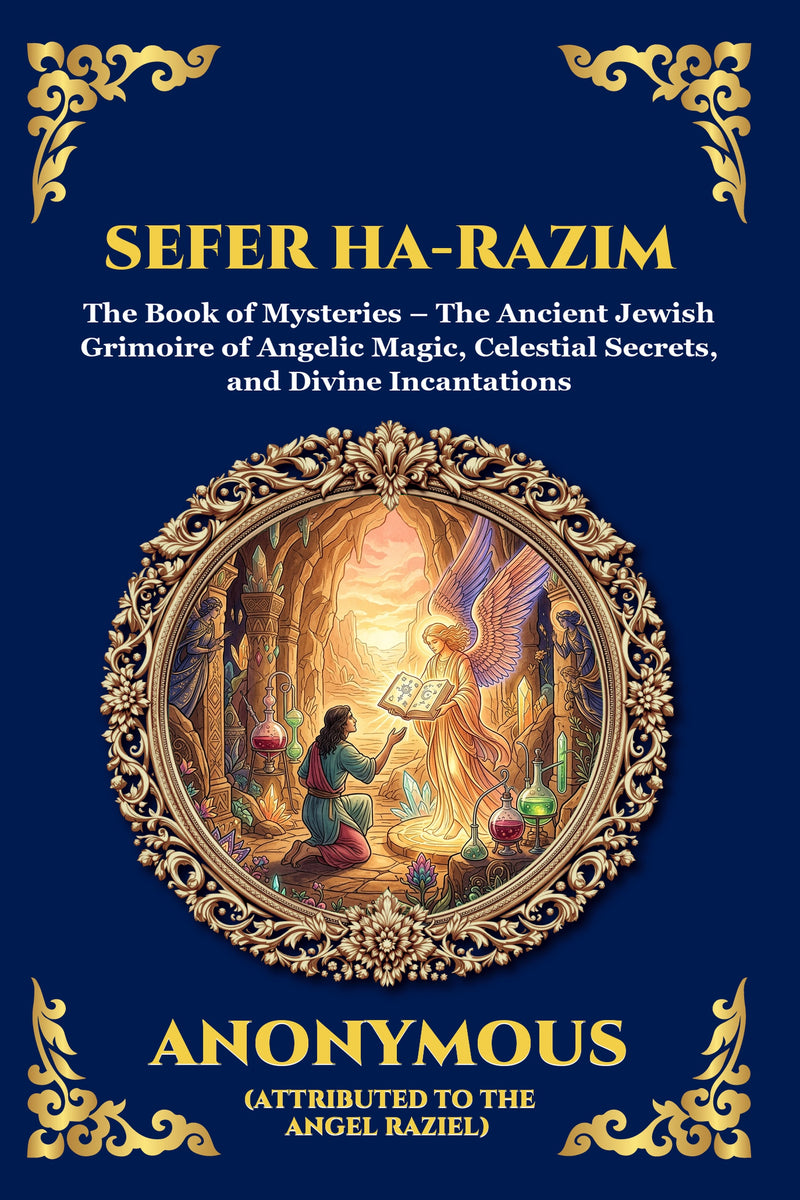
Sefer ha-Razim
Sefer ha-Razim offers a detailed map of the heavens and the secret names of angels believed to command celestial forces, a practical guide to ancient magic. Excluded from most canonical texts, it claims to contain wisdom handed down to Noah by the angel Raziel.
or free app
10,000+ hrs library
30-day guarantee
Complete modern English translation of Sefer ha-Razim, the 3rd-7th century mystical text from the Cairo Geniza, available online with audiobook narration for members.
Sefer ha-Razim stands as the earliest surviving Hebrew magical text, preserving ancient Jewish mystical practices that bridge biblical tradition and practical magic.
In Sefer ha-Razim, or The Book of Mysteries, readers are granted access to one of the most fascinating and fiercely guarded grimoires of early Jewish mysticism. Long hidden from the public eye, this ancient magical text is said to have been handed down directly to Noah by the angel Raziel, providing him with the cosmic blueprints and celestial rituals necessary to understand the hidden mechanisms of the universe.
Unlike purely theological texts or philosophical meditations, Sefer ha-Razim is a highly practical manual of ancient magic. It provides a breathtaking, detailed map of the seven firmaments of heaven, meticulously listing the names, ranks, and duties of the angels residing in each realm. More importantly, it provides the specific rituals, incantations, and magical recipes required to call upon these celestial beings. Whether the goal was to heal a deadly illness, protect against enemies, foresee the future, or bring justice to wrongdoers, this book served as the ultimate magical toolkit for the esoteric seeker of antiquity.
Blending elements of Jewish mystical tradition with the wider magical practices of the Greco-Roman world, this text offers a profound glimpse into the everyday hopes, fears, and spiritual daring of the ancient mind. It reveals a universe that is vibrantly alive, deeply responsive to human interaction, and governed by secret words of power.
What You Will Discover in This Ancient Grimoire
- The Map of the Heavens — Journey through the seven celestial firmaments and understand the complex hierarchy of the angelic realms.
- The Secret Names of Angels — Discover the specific names of the angels of fire, healing, war, and wisdom, and learn their unique cosmic duties.
- Ancient Magical Recipes — Read the authentic incantations, spells, and rituals used in antiquity for healing, protection, success, and uncovering hidden knowledge.
- The Legend of Raziel and Noah — Explore the fascinating origin story of how this divine knowledge was passed from the angelic realm to humanity.
- A Window into Ancient Mysticism — Gain unprecedented insight into the intersection of early Jewish mysticism, astrology, and practical magic.
Whether you are a scholar of esoteric history, a student of the occult, or simply captivated by ancient mysteries, Sefer ha-Razim offers an unforgettable journey into the realms of celestial magic.
Unlock the secrets of the angels. Begin your journey into the Book of Mysteries today.
| Formats | eBook (EPUB + PDF) · Audiobook · Paperback · Hardcover · Large Print |
| Language | English |
| Trim size (print) | 6 × 9 in |
| Binding | Paperback — perfect-bound · Hardcover — casewrap |
| Large Print edition | Same text in a larger, easy-read type — a larger font, not a larger trim |
| Print pricing | Every physical book at our true cost — at-cost, no profit (members) |
| Library | 873 restored titles, always growing |
| Composed | 3rd-7th century AD |
| Original language | Hebrew |
| Source tradition | Medieval Hebrew manuscripts, primarily from the Cairo Geniza |
| Translation basis | Mordecai Margalioth critical edition (1966), rendered in clear modern English |
| Length | 14,248 words · ~57 min reading |
| Reading level | Grade 12 · rich, literary prose (this modern-English edition) |
| Edition | Modern English translation · 2026 |
Member reviews for this edition are collected as readers finish it — be the first. Across the library: 12,000+ books shipped, every plan covered by a 365-day print guarantee.
About this edition
The complete, unabridged text in clear modern English — faithful to the original, never simplified. Every paragraph is checked against the source, so nothing is cut, summarised, or paraphrased away. It reads cleanly for today while keeping the original meaning intact.
Sefer ha-Razim survives primarily in medieval Hebrew manuscripts, with the earliest complete text from the Cairo Geniza fragments. This edition derives from the standard scholarly translation and renders the ancient magical formulae in clear modern English.
- Complete & unabridgedVerified paragraph by paragraph against the source — never a scan, never abridged.
- Modern English, faithfulReadable today, with the author’s meaning kept intact. Readable — not simplified.
- Every format, one membershipRead in your browser or the free app, or listen to the full audiobook.
Included free with your membership
Cancel anytime, one click · 30-day money-back guarantee
Edition last updated June 2026
What’s inside
Sefer ha-Razim — complete and unabridged: all 17 sections included with membership, plus the full audiobook.
Begin reading Sefer ha-Razim
In clear modern English — the complete text is included with membership.
A Tradition Hidden in Plain Sight
The history of this text's transmission is a story of survival against extraordinary odds. Judaism in late antiquity and the medieval period was a tradition under constant external pressure — subject to persecution, displacement, and the systematic destruction of its libraries and communities. That any text from this period survived at all is remarkable. That a text dealing explicitly with magical practice survived is little short of miraculous, given the additional hostility it faced from within the Jewish community itself, where rabbinic authorities periodically condemned magical practice as incompatible with proper religious observance.
And yet it survived. It survived because it was useful. It survived because the people who possessed it valued it enough to copy it by hand, to carry it across deserts and oceans, to hide it when necessary and share it when possible. The manuscript tradition is complex and varied: different versions of the text show signs of expansion, revision, and adaptation as it passed through different communities and different centuries. Some versions include material not found in others; some omit passages that elsewhere appear essential. This variability is not a problem to be solved but a feature to be appreciated. It tells us that the text was alive — that it was being used, interpreted, and adapted by real practitioners rather than simply preserved as a dead artifact.
The scholarly recovery of this tradition is itself a fascinating story. For centuries, the text was known primarily through references in other works — a citation here, a quotation there, a disapproving mention in a rabbinic responsum warning against its use. It was only in the modern period, as Jewish studies developed as an academic discipline and as the great manuscript collections of European and Middle Eastern libraries were systematically catalogued and studied, that the full scope of the tradition became apparent. The pioneering work of scholars like Mordecai Margalioth, whose critical edition of the Hebrew text appeared in the 1960s, made it possible for the first time to read the work as a whole and to appreciate its coherence and sophistication.
What those scholars found was not a random collection of spells and superstitions but a carefully organized system — a complete cosmological and practical manual grounded in a coherent set of theological assumptions. The seven-heaven structure that organizes the text is not arbitrary. It reflects a specific understanding of how divine power flows through creation: from the highest heaven, where the divine presence itself dwells, down through successive realms of decreasing intensity but increasing accessibility, until it reaches the sublunary world of human experience. Each level of this hierarchy has its own character, its own angelic governors, its own relationship to specific aspects of human life and need. Understanding this structure is not merely an academic exercise. It is the key to understanding why the text works the way it does — why certain formulas appear in certain sections, why certain materials and times are specified for certain operations, why the whole thing hangs together as a unified system rather than a grab bag of miscellaneous magical recipes.
The relationship between this text and the broader tradition of Jewish mysticism — what would eventually crystallize into Kabbalah — is complex and deeply interesting. The Merkavah mystics of late antiquity, who sought ecstatic ascent to the divine throne through intense meditation and ritual practice, were working in the same conceptual space as the compilers of this grimoire. Both traditions took seriously the reality of the angelic world, both developed elaborate systems for navigating that world, and both understood the ultimate goal of such navigation to be a closer relationship with the divine. The differences are real but should not be overstated: Merkavah mysticism tended toward the contemplative and the visionary, while the magical tradition tended toward the practical and the operative. But these were tendencies, not absolute distinctions, and the same individual could participate in both.
Later Kabbalah, which developed primarily in medieval Spain and Provence before spreading throughout the Jewish world, drew on both of these earlier currents while transforming them in significant ways. The kabbalists developed a far more elaborate theoretical framework — the ten sefirot, the four worlds, the complex system of divine names and their permutations — but they did not abandon the practical dimension. Kabbalistic magic, known as practical Kabbalah, remained a living tradition well into the early modern period, and its practitioners were fully aware of their debt to earlier texts like the one you are about to read. In a very real sense, this grimoire is one of the foundation stones of the entire Western esoteric tradition — a tradition that would eventually include not only Jewish mysticism but Christian Hermeticism, Renaissance magic, Rosicrucianism, Freemasonry, and the various occult revivals of the nineteenth and twentieth centuries.
This influence was not always acknowledged, and it was not always transmitted in ways that preserved its original context and meaning. As magical ideas and practices crossed cultural boundaries, they were often stripped of their theological grounding and repackaged in new frameworks that served the needs and assumptions of their new audiences. The divine names that appear in this text — names that for their original users carried the full weight of the covenant relationship between Israel and its God — became, in later European magical tradition, mere technical terms, syllables of power divorced from any specific religious context. This process of decontextualization is understandable but regrettable, because it obscures the most important thing about the original text: that it is not a technology of power but a theology of relationship. The practitioner who approaches the angels does so not as a technician manipulating impersonal forces but as a human being addressing personal presences — beings who have their own characters, their own preferences, their own relationship to the divine will that governs all things.
Reading the Grimoire Today
Why should a modern reader care about any of this? It is a fair question, and it deserves a serious answer. We live in an age of unprecedented scientific knowledge — an age in which the mechanisms of the physical world have been mapped in extraordinary detail, in which the chemical processes of thought and emotion have been partially decoded, in which the vast reaches of the cosmos have been measured and catalogued with instruments that would have seemed magical to any previous generation. In such an age, what can a text like this one offer that could not be better obtained from a neuroscience textbook or a physics journal?
The answer, I think, begins with a recognition of what science does and does not do. Science is extraordinarily good at answering questions about how the physical world works. It is less well equipped to answer questions about meaning — about why the world exists, what human life is for, how we should relate to the mystery that surrounds and underlies everything we can measure and observe. These are the questions that religious and mystical traditions have always addressed, and they are questions that do not become less urgent simply because we have learned a great deal about the mechanics of the universe. If anything, the more we learn about the physical world, the more acutely we feel the need for frameworks that can hold and interpret that knowledge in relation to the deepest human concerns: love, death, justice, beauty, purpose.
This text addresses those concerns directly and with great sophistication. Its cosmology may not correspond to what modern astronomy tells us about the structure of the universe, but its fundamental intuition — that reality is layered, that there are dimensions of existence that transcend ordinary sensory experience, that the human being is not a closed system but an open one capable of relationship with presences and powers beyond the merely physical — is one that many thoughtful people in every age have found compelling. The specific cultural forms in which that intuition is expressed here are ancient and particular, but the intuition itself is perennial.
There is also the matter of historical and cultural understanding. This text is a primary source for one of the most important and least understood dimensions of Jewish religious life: the magical tradition. For too long, the history of Judaism has been told primarily through its legal and theological literature — the Talmud, the codes, the philosophical treatises — while the magical and mystical dimensions of Jewish practice have been marginalized or ignored. This distortion has consequences not only for our understanding of Judaism but for our understanding of the broader history of religion in the West, since so many of the magical and mystical traditions of Christianity and Islam were shaped by Jewish sources that mainstream scholarship has been reluctant to take seriously.
Reading this text with care and attention is thus an act of historical recovery — a way of listening to voices that have been systematically silenced or distorted, of understanding a dimension of human experience that our own cultural assumptions have made it difficult to see clearly. This is valuable work regardless of one's own religious commitments or lack thereof. The historian, the anthropologist, the philosopher of religion, the student of literature, the practicing Jew or Christian or Muslim, the secular seeker of wisdom — all of these readers will find something of genuine value here, provided they are willing to approach the text on its own terms rather than forcing it into categories that it does not fit.
Those own terms include, above all, a commitment to practice. This is not a text designed primarily to be read and appreciated. It is a text designed to be used. The formulas, invocations, and ritual instructions it contains were intended to be enacted — spoken aloud, performed with specific materials at specific times, repeated with the kind of focused intention that transforms mere recitation into genuine prayer. Modern readers who approach the text purely as an intellectual exercise will get something from it, but they will miss its deepest dimension. The text speaks most fully to those who are willing to meet it halfway — to bring to it not only their analytical intelligence but their imagination, their devotion, and their willingness to be changed by what they encounter.
This does not mean that one must be a believing Jew, or indeed a believer of any particular kind, to engage meaningfully with the text. The history of Western esotericism is full of examples of people who worked with Jewish magical and mystical material from outside the Jewish tradition and found it genuinely transformative. What it does mean is that one must be willing to take the text seriously — to treat its cosmology and its theology as worthy of genuine engagement rather than condescending dismissal, to approach its rituals with something of the respect and intentionality that their original practitioners brought to them.
The translation and presentation of this text in the edition you are reading has been guided by these principles. Every effort has been made to render the Hebrew as accurately and as vividly as possible — to preserve not only the meaning of the words but their rhythm, their texture, their incantatory power. Where technical terms resist simple translation, explanatory notes provide the necessary context. Where the text's assumptions about the structure of the cosmos or the nature of angels differ significantly from modern assumptions, those differences are acknowledged and explained without being resolved into false equivalences. The goal throughout has been to make the text as accessible as possible to the modern reader without domesticating it — without smoothing away the strangeness and the challenge that are essential to its character.
Because that strangeness is, in the end, one of its greatest gifts. We live in a culture that is extraordinarily good at making everything familiar, at absorbing even the most radical challenges to its assumptions and converting them into comfortable entertainment. Ancient texts like this one resist that process. They come from a world genuinely different from our own — a world with different assumptions about the nature of reality, different understandings of what it means to be human, different relationships to the sacred and the mysterious. Engaging seriously with such a text is a way of expanding our sense of what is possible — of discovering that the world is larger and stranger and more full of wonder than our ordinary habits of thought allow us to see.
The angels whose names fill these pages — Aniel, Tagriel, Orphaniel, and scores of others — are not characters in a fantasy novel. They are, within the framework of this tradition, real presences: aspects of divine power that have been given form and name and function in the service of creation. Whether one chooses to understand them literally, symbolically, psychologically, or in some other way, they repay attention. They have been calling to human beings for millennia. They are calling still. Turn the page, speak the names, and listen.
Names and Roles of the Seven Overseers and Their Angels
The name of the first firmament is called Shamayim. Within it are encampments filled with wrath. Seven thrones are prepared there, and upon them are seated overseers; around them on all sides, encampments of angels are stationed, obedient to those who practice magic — to everyone who has learned to stand and pour libations to their names and invoke them by their names at the time when prayer is heard, so as to make a magical rite succeed. Over all these encampments of angels, these seven overseers rule, dispatching them for every sort of business so that they will hasten and bring success.
Cancel anytime, one click · 30-day money-back guarantee
Founding annual rate available now — your price locks for life when you join.
Not ready? Get this free chapter by email — read it anytime.
✓ Sent — check your inbox for Sefer ha-Razim.
Questions about Sefer ha-Razim
Why was Sefer ha-Razim excluded from Jewish canonical texts?
Sefer ha-Razim was excluded from the Jewish canon because it focuses on practical magic and angel invocation rather than Torah law or prophecy. Rabbinic authorities generally discouraged magical practices, preferring texts that emphasized ethical and legal teachings over esoteric rituals.
What magical practices does Sefer ha-Razim actually contain?
Sefer ha-Razim contains incantations for healing, protection, and divination, along with detailed descriptions of seven heavens and their ruling angels. It provides specific ritual instructions, angel names, and magical formulae that practitioners believed could influence earthly and celestial affairs.
Who actually wrote Sefer ha-Razim and when?
Sefer ha-Razim was composed by unknown Jewish authors between the 3rd-7th centuries AD, though it claims angelic authorship through Raziel to Noah. The text reflects late antique Jewish magical traditions that blended biblical themes with Hellenistic and Near Eastern esoteric practices.
Is Sefer ha-Razim free to read?
The opening of the text is free to read below. Members read and listen to the complete work — and the entire Lost & Forbidden Library — free.
What is Sefer ha-Razim?
Have you ever wondered why ancient seekers believed they could command the forces of the heavens using the secret names of angels?
How long is Sefer ha-Razim?
17 chapters (~12,147 words) in this restored edition.
Shipping & returns
Billing & membership
More from the library


Explore The Lost & Forbidden Library
- 1 Enoch · Attributed to Enoch
- 1–4 Maccabees · Various Jewish authors
- 2 Baruch · Attributed to Baruch
- 2 Enoch · Attributed to Enoch
- 2 Esdras · Attributed to the prophet Ezra
- 3 Baruch · Attributed to Baruch ben Neriah
- 4 Baruch · Attributed to Baruch ben Neriah
- A Valentinian Exposition · Attributed to a follower of Val...
- Acta Archelai · Attributed to Hegemonius
- Acts of Andrew · Anonymous (Early Christian Apoc...
- Acts of Andrew and Matthias in the City of the Cannibals · Attributed to early Christian a...
- Acts of Barnabas · Attributed to John Mark
- Acts of Bartholomew
- Acts of John · Anonymous (Early Christian Apoc...
- Acts of Matthias · Anonymous early Christian writers
- Acts of Paul · Attributed to an unknown early ...
- Acts of Paul and Thecla · Attributed to Onesiphorus
- Acts of Peter
- Acts of Peter and Andrew · Attributed to various early Chr...
- Acts of Peter and Paul · Attributed to Leucius Charinus
- Acts of Peter and Simon · Attributed to Leucius Charinus
- Acts of Peter and the Twelve Apostles · Attributed to early Christian a...
- Acts of Philip · Anonymous (Early Christian Apoc...
- Acts of Pilate (Gospel of Nicodemus) · Attributed to various early Chr...
- Acts of Saturninus
- Acts of Thaddaeus · Attributed to Thaddaeus the Apo...
- Acts of Thomas
- Acts of Titus · Anonymous early Christian writer
- Acts of Xanthippe, Polyxena, and Rebecca
- Allogenes · Anonymous (Early Gnostic Mystic)
Sefer ha-Razim
Sefer ha-Razim
The Book of Mysteries – The Ancient Jewish Grimoire of Angelic Magic, Celestial Secrets, and Divine Incantations
Library of Alexandria Press
Sefer ha-Razim
© Copyright 2026 Library of Alexandria Press. All rights reserved.
Published by Library of Alexandria Press
Printed in the United States of America
It is not legal to copy, share, or send any part of this document in either digital or printed form without written permission from the publisher, except short quotes in a book review.
Table of Contents
Introduction
A Tradition Hidden in Plain Sight
Reading the Grimoire Today
Names and Roles of the Seven Overseers and Their Angels
Rites and Operations for Each Encampment
Angels of the Second Firmament Described
Angels of the Steps and Their Operations
Description of the Third Firmament and Its Princes
Names, Offices, and Magical Operations of the Three Princes
Names of Angels Leading the Sun
Rites for Beholding the Sun
Description of the Fifth Firmament and Its Angels
Angels of the Months and Their Revelations
Catalogue of Angelic Encampment Heads
Rite of the Ring for Safe Journey
Description of the Seventh Firmament and Its Hosts
The Angelic Hymn of Praise
Introduction
There are books that instruct, books that entertain, and books that transform. And then there are books so ancient, so layered with accumulated mystery and spiritual power, that the very act of reading them feels like stepping across a threshold into another world entirely. The text you hold in your hands belongs to this last and rarest category. It is a work that has survived wars, exiles, burnings, and the slow erosion of centuries. It has been whispered about in the candlelit studies of medieval kabbalists, sought by sorcerers and scholars alike, and attributed to no less a figure than Solomon himself — the wisest king who ever lived, the builder of the Temple, the man whom God blessed with dominion not only over the visible world but over the invisible one as well.
To understand what you are about to read, you must first understand something about the world that produced it. The ancient Jewish imagination was not a timid thing. It did not confine the divine to a single distant heaven, separated from human experience by an unbridgeable gulf. Instead, it conceived of reality as a vast, layered structure — a cosmos teeming with intelligences, forces, and presences that moved between the human and the divine like messengers on an endless celestial staircase. Angels were not merely decorative figures in this worldview. They were the living architecture of creation itself: beings of fire and light assigned to govern the movements of stars, the turning of seasons, the rise and fall of kingdoms, the healing of the sick, and the protection of the righteous. To know their names was not superstition. It was science. It was theology. It was power.
This is the intellectual and spiritual universe from which our text emerges. Scholars place its composition somewhere between the sixth and eighth centuries of the Common Era, though its roots reach far deeper — into the mystical currents of Second Temple Judaism, into the Merkavah tradition of heavenly ascent, into the ancient Near Eastern magical practices that predated monotheism itself and were gradually absorbed, transformed, and sanctified by it. The text was likely compiled in the land of Israel or in the great Jewish academies of Babylonia, drawing on oral traditions and fragmentary written sources that had circulated among initiated practitioners for generations before anyone thought to gather them into a single coherent volume.
The attribution to Solomon is, of course, a literary convention rather than a historical claim — one that the book itself acknowledges with a kind of winking sophistication. In the ancient world, attributing a text to a famous sage or king was a way of signaling its authority, its antiquity, and its connection to a tradition of genuine wisdom. Solomon was the ideal patron for a work of angelic magic because the biblical tradition had already established him as a master of hidden knowledge. The Book of Kings tells us that he spoke of trees and animals and fish, that his wisdom exceeded that of all the peoples of the east. Later tradition expanded this portrait dramatically: Solomon commanded demons to build his Temple, rode a flying carpet, and possessed a ring engraved with the divine name that gave him power over all spirits. By placing this grimoire in his hands, the anonymous compilers were not lying about authorship. They were making a claim about lineage — about the unbroken chain of esoteric transmission that connected their own time to the golden age of Israel's greatest king.
The structure of the work reflects the cosmological vision that animates it. The text is organized around the seven heavens — a schema that appears in numerous ancient Jewish and early Christian sources and that maps the spiritual universe with the same confidence that a medieval cartographer mapped the physical one. Each heaven is a distinct realm, governed by its own angelic princes, populated by its own order of celestial beings, and associated with its own set of powers, purposes, and ritual applications. The practitioner who wishes to work with these forces must know which heaven to address, which angels to invoke, which hours of the day or night are most propitious, and which materials, words, and actions will open the necessary channels of communication.
What makes this text so remarkable — and so different from the later European grimoires that would draw on its legacy — is the seamlessness with which it integrates the magical and the devotional. There is no sense here that the practitioner stands outside or against the divine order, manipulating it through transgressive means. Quite the opposite: the magic described in these pages is conceived as a form of prayer, a way of aligning oneself with the celestial hierarchy that God himself established at the moment of creation. To invoke an angel is not to coerce a supernatural being into service. It is to participate, consciously and deliberately, in the ongoing work of creation — to become, however briefly, a collaborator in the cosmic project that began when the first light separated from the first darkness.
This theological dimension is crucial for any reader who wants to understand the text on its own terms rather than projecting onto it the anxieties and assumptions of a later age. Modern readers, shaped by centuries of Enlightenment skepticism on one side and sensationalist occultism on the other, often approach ancient magical texts with a set of expectations that the texts themselves do not share. They expect either primitive superstition or dangerous transgression — either the naive beliefs of people who didn't know any better, or the sinister practices of people who knew exactly what they were doing and chose darkness anyway. The reality is far more interesting and far more human than either of these caricatures. The people who used and transmitted this text were intelligent, educated, deeply religious individuals who inhabited a world in which the boundary between the natural and the supernatural was not a wall but a membrane — permeable, dynamic, and full of possibility.
The practical applications described in the text range from the sublime to the surprisingly mundane, and this range is itself one of the most illuminating things about it. On one end of the spectrum, we find invocations designed to facilitate visionary experiences, to enable the practitioner to ascend in spirit through the heavenly realms and behold the divine glory. On the other end, we find remedies for illness, formulas for success in business, methods for finding lost objects, and — in passages that have scandalized some later readers — techniques for gaining advantage over enemies or winning the affection of a desired person. This mixture of the exalted and the everyday is not a sign of corruption or confusion. It is a sign of authenticity. Real people in real circumstances needed help with real problems, and a tradition that could not address those problems would not have survived.
The language of the text is itself a subject of fascination. The Hebrew in which it is written is a living, breathing thing — neither the pure biblical idiom of the Torah nor the systematic legal prose of the Talmud, but something in between and beyond both: a ritual language shaped by centuries of liturgical use, charged with repetition and rhythm, dense with divine names and angelic appellations that seem to carry power in their very sound. Reading the names aloud — as the practitioner is always instructed to do — one feels immediately that something is happening at the level of the body, not just the mind. The ancient world understood this. Sound was not merely a vehicle for meaning. It was a force in its own right, and the names of God and his angels were concentrations of that force, crystallized in human speech.
Names and Roles of the Seven Overseers and Their Angels
The name of the first firmament is called Shamayim. Within it are encampments filled with wrath. Seven thrones are prepared there, and upon them are seated overseers; around them on all sides, encampments of angels are stationed, obedient to those who practice magic — to everyone who has learned to stand and pour libations to their names and invoke them by their names at the time when prayer is heard, so as to make a magical rite succeed. Over all these encampments of angels, these seven overseers rule, dispatching them for every sort of business so that they will hasten and bring success.
These are the names of the seven overseers who sit upon the seven thrones: the name of the first is Wrpnyal, the name of the second is Tygrh, the name of the third is Dnhl, the name of the fourth is Klmyya, the name of the fifth is Symwr, the name of the sixth is Pskr, the name of the seventh is Bwal. All of them were created from fire, their appearance is like fire, and their fire is blazing, for from fire they emerged. Without permission, the angels who serve here do not go out to engage in magical actions. They wait until a command comes to them from one of the seven overseers, the occupants of the thrones, who rule over them. They are subject to the will of the overseers and go about only with their permission. Each and every one of them goes to his work determined to act quickly in any affair on which he may be sent, whether for good or for evil, whether for abundance or for shortage, whether for war or for peace. All of them are to be called by the names given them from the day they were created. These are the names of the seven encampments which serve the seven overseers, for each encampment serves one of the overseers.
These are the names of the angels of the first encampment, who serve Wrpnyal: Bwmdy, Amwk, Pawr, Mawt, Brwq, Tkt, Kpwn, Ssm, Anyp, Alwn, Rhgl, Pwbwn, Mygal, Dygl, Abyal, Asbh, Aptyal, Apykh, Dmn, Qtybyah, Nrntq, Prwkh, Shrwrah, Arnwb, Krby, Br, Trwawr, Mwal, Rwmapy, Gawpr, Alnw, Ywtnah, Awrpnyal, Anwk, Ptrwpy, Rqhty, Aqylah, Atnny, Asy, Gyrswm, Nynal, Abdyal, Llp, Ykty, Zkryal, Krth, Tyrly, Ksyl, Ralkh, Nanh, Gmty, Ywwn, Yhspt, Arnyal, Agdln, Kyldh, Sblh, Syqmh, Hly, An, Ntyal.
End of the free sample
Keep reading, free
Members read and listen to the complete book — and the entire library. Cancel anytime, one click · 30-day money-back guarantee.