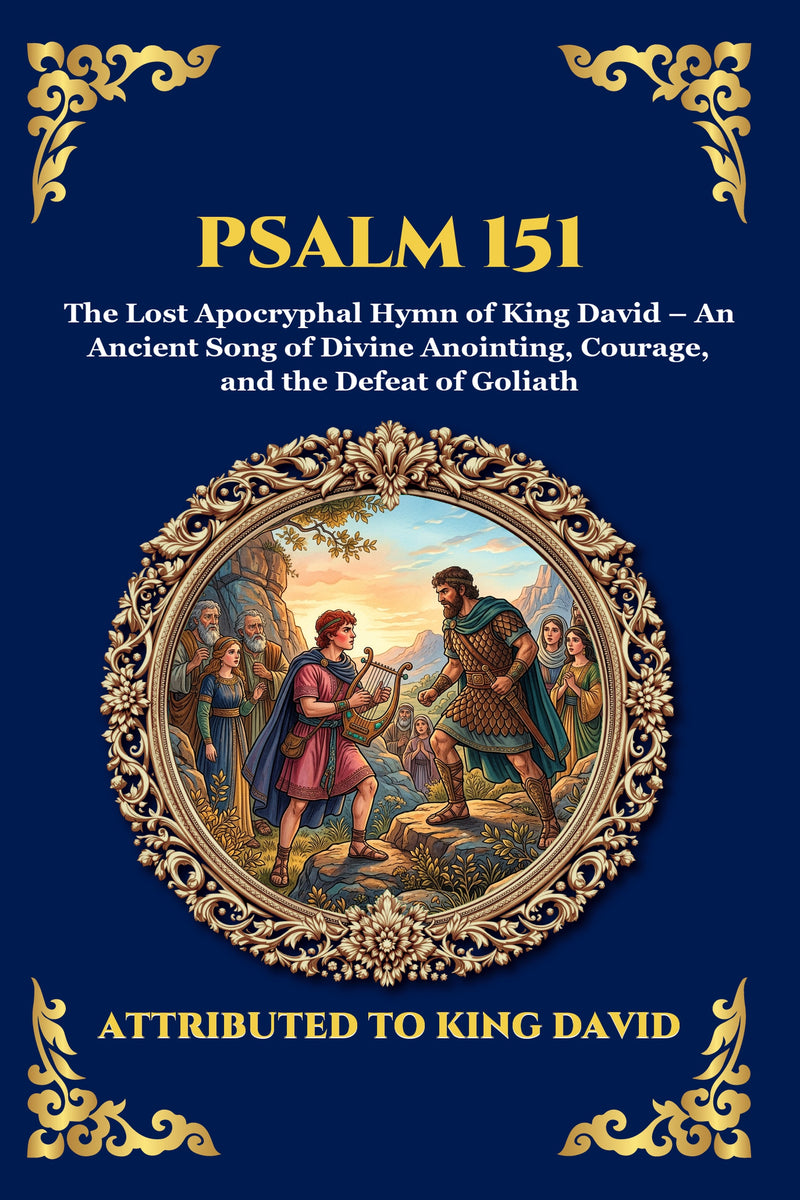
Psalm 151
Psalm 151 recounts David's rise from shepherd to giant-slayer, offering his own perspective on the anointing by Samuel and his confrontation with Goliath. Once excluded from the canonical Psalms, this text survives in the Septuagint and Dead Sea Scrolls, revealing a profound meditation on divine selection.
or free app
10,000+ hrs library
30-day guarantee
This ancient Hebrew psalm, Psalm 151, found among the Dead Sea Scrolls and preserved in the Greek Septuagint, offers a complete modern-English translation readable online with audiobook narration included for members.
Psalm 151 was excluded from the Hebrew Bible but preserved in ancient Greek and Aramaic manuscripts, creating centuries of scholarly debate about its authenticity and significance.
Psalm 151 stands as a fascinating and deeply moving piece of ancient apocryphal literature. While the canonical Book of Psalms ends at 150, this "lost" 151st psalm survives in the Septuagint, the Dead Sea Scrolls, and various ancient Christian traditions. Written from the first-person perspective of David, it recounts his humble beginnings as a shepherd, his unexpected anointing by the prophet Samuel, and his historic, triumphant confrontation with the Philistine champion, Goliath.
Far more than a simple retelling of a famous battle, Psalm 151 is a profound meditation on divine selection. It beautifully articulates the contrast between the pride of the mighty and the humility of the chosen. David sings of crafting his own instruments to praise the heavens, emphasizing his devotion long before he was handed a sword or a crown. When the ultimate crisis arises, he does not rely on traditional armor or worldly tactics; his victory is framed entirely as an act of divine intervention and unshakable faith.
This modern translation brings the ancient, poetic words of this apocryphal hymn to life, ensuring its themes of courage, devotion, and divine empowerment resonate with today's readers. It serves as a vital companion for anyone studying biblical history, the Psalms, or the enduring human story of overcoming insurmountable odds.
What You’ll Discover in This Modern Translation
- The Heart of a Shepherd: Explore David’s early life, his profound connection to nature, and his musical devotion to the Creator before he became a king.
- The Mystery of Divine Anointing: Understand the spiritual significance of David being chosen over his older, seemingly more qualified and physically imposing brothers.
- The Defeat of the Giant: Relive the epic confrontation with Goliath through the personal, poetic reflections of the victor, highlighting faith over physical strength.
- A Window into Ancient Traditions: Gain valuable insights into the Dead Sea Scrolls and the apocryphal writings that expanded upon beloved biblical narratives.
Whether you are exploring this work for its historical context, its literary beauty, or its deep spiritual resonance, Psalm 151 offers a timeless reminder that faith can conquer the most terrifying of challenges. Step into a legacy of courage and discover the ancient song that continues to inspire the underdog in us all. Begin your journey today.
| Formats | eBook (EPUB + PDF) · Audiobook · Paperback · Hardcover · Large Print |
| Language | English |
| Trim size (print) | 6 × 9 in |
| Binding | Paperback — perfect-bound · Hardcover — casewrap |
| Large Print edition | Same text in a larger, easy-read type — a larger font, not a larger trim |
| Print pricing | Every physical book at our true cost — at-cost, no profit (members) |
| Library | 873 restored titles, always growing |
| Original language | Hebrew, with Greek translation |
| Source tradition | Greek Septuagint and Hebrew manuscripts from Qumran |
| Translation basis | Public-domain scholarly translation, rendered in clear modern English |
| Length | 3,001 words · ~12 min reading |
| Reading level | Grade 12 · rich, literary prose (this modern-English edition) |
| Edition | Modern English translation · 2026 |
Member reviews for this edition are collected as readers finish it — be the first. Across the library: 12,000+ books shipped, every plan covered by a 365-day print guarantee.
About this edition
The complete, unabridged text in clear modern English — faithful to the original, never simplified. Every paragraph is checked against the source, so nothing is cut, summarised, or paraphrased away. It reads cleanly for today while keeping the original meaning intact.
Psalm 151 survives in the Greek Septuagint, Hebrew manuscripts from Qumran, and various ancient Christian traditions. This edition derives from the standard public-domain scholarly translation and renders it in clear modern English.
- Complete & unabridgedVerified paragraph by paragraph against the source — never a scan, never abridged.
- Modern English, faithfulReadable today, with the author’s meaning kept intact. Readable — not simplified.
- Every format, one membershipRead in your browser or the free app, or listen to the full audiobook.
Included free with your membership
Cancel anytime, one click · 30-day money-back guarantee
Edition last updated June 2026
What’s inside
Psalm 151 — complete and unabridged: all 5 sections included with membership, plus the full audiobook.
Begin reading Psalm 151
In clear modern English — the complete text is included with membership.
The World That Shaped the Hymn
To read any ancient text well, you need to understand the world that produced it. And the world that produced this hymn was one of the most turbulent, creative, and consequential in human history. The ancient Near East in the centuries surrounding the emergence of the Israelite monarchy was a place of constant upheaval — empires rising and falling, peoples migrating and clashing, old religious orders giving way to new ones. Into this volatile landscape came a small, fiercely independent people who made a claim that must have seemed, to their neighbors, either magnificently courageous or simply delusional: that the God who had created the heavens and the earth had entered into a particular covenant with them, had chosen them not for their size or their power but for reasons that remained, in many ways, mysterious even to themselves.
The figure of David emerges from this world at a pivotal moment. The institution of the monarchy in ancient Israel was itself a contested development — the prophet Samuel warned the people of the dangers of wanting a king like other nations had, and the first king, Saul, proved those warnings justified in ways that were both tragic and instructive. David's rise to power is one of the most psychologically complex narratives in all of ancient literature. He is simultaneously the beloved of God and a deeply flawed human being. He is a warrior and a poet, a political genius and a moral failure, a man of extraordinary tenderness and extraordinary ruthlessness. The tradition that he composed the Psalms — or at least a significant portion of them — reflects an ancient recognition that these contradictions were not incidental to his character but essential to it, and that his music was the place where he processed them most honestly.
The specific events recalled in this hymn — his youth as a shepherd, his anointing by Samuel, his encounter with Goliath — belong to the early part of his story, before the complexity of kingship had fully revealed itself, before the great moral catastrophes that would mark his later years. There is a quality of innocence in the poem, or perhaps more accurately a quality of clarity, that reflects the perspective of a young man who has not yet had to navigate the terrible compromises of power. He knows who he is. He knows where he comes from. He knows what he has been called to do. And he knows — with a certainty that is both moving and humbling — that the strength he found in the decisive moment was not ultimately his own.
This is the theological heart of the hymn, and it is worth pausing on it. The ancient Israelite understanding of divine election was not a comfortable doctrine. It did not mean that the chosen person was the best or the brightest or the most deserving. It meant, almost by definition, that the chosen person was the one nobody else would have chosen — the youngest, the smallest, the most overlooked. The logic of divine election in the Hebrew scriptures is consistently counter-intuitive, even counter-cultural. It is not the firstborn but the second. Not the powerful but the weak. Not the obvious candidate but the one tending the sheep on the hillside while his brothers are being evaluated by the prophet. This pattern runs through the entire narrative tradition of ancient Israel, and the hymn under consideration here is one of its most concentrated and beautiful expressions.
The geographical world of the poem is also worth holding in mind as you read. The landscape of ancient Judah — the rolling hills of the Shephelah, the dramatic descent toward the Jordan Valley, the vast openness of the Judean wilderness where shepherds spent months alone with their flocks — is not merely background. It is a character in the story. The solitude of the shepherd's life, the intimacy with animals and seasons and weather, the long nights under stars undimmed by any artificial light — all of this shaped the sensibility of the poet in ways that are visible throughout the Psalms and that are particularly vivid in this hymn. The famous image of God as shepherd in the twenty-third psalm is not a metaphor invented by a city dweller. It is an image drawn from direct experience, from the knowledge of what it actually means to guide vulnerable creatures through dangerous terrain toward water and rest.
The musical culture of ancient Israel is another dimension of the world that shaped this text. The Psalms were not primarily literary compositions intended for private reading — they were songs, performed in liturgical contexts, accompanied by instruments, shaped by the rhythms and conventions of a rich musical tradition. David's reputation as a musician was as central to his identity in the ancient tradition as his reputation as a warrior or a king. The books of Samuel describe him soothing Saul's troubled spirit with his harp. The books of Chronicles describe him organizing the musical life of the Jerusalem temple with the same systematic attention he brought to military and administrative matters. The tradition that he composed the Psalms is inseparable from the tradition that he was a musician of extraordinary gifts — someone for whom music was not an ornament to life but a primary mode of understanding and expressing it.
When you read this hymn, then, you are not just reading a poem. You are hearing, however faintly across the millennia, a song. You are encountering a tradition of praise and lament and testimony that was performed in the open air, in the courts of temples, in the intimate gatherings of communities that found in shared music a way of making sense of their shared experience. The words on the page are the skeleton of something that was once alive with sound and breath and communal feeling. Part of the work of reading ancient poetry is the imaginative act of restoring that flesh to the bones — of hearing, behind the written words, the music that once carried them.
It is also worth noting the extraordinary afterlife that the figure of David has had in human culture beyond the biblical tradition. He appears in the Quran as Dawud, a prophet and musician to whom God gave the Psalms as a form of divine revelation. He is celebrated in Islamic tradition as a model of devotion and justice. In the visual arts of the Western tradition, he has been depicted by virtually every major artist from antiquity to the present — Michelangelo's colossal marble figure in Florence remains one of the most recognizable works of art in the world, a meditation on the moment before the confrontation with Goliath that captures something essential about the nature of courage. In literature, music, and film, his story has been retold in every conceivable register, from the gravely serious to the playfully irreverent. This universality is not accidental. It reflects the fact that his story touches something in the human experience that transcends the specific religious and cultural context from which it emerged.
Why This Hymn Still Speaks
There is a question that every reader of ancient religious texts eventually confronts: why does this still matter? It is a fair question, and it deserves a serious answer. We live in a world that is, in many obvious ways, radically different from the world that produced this hymn. We do not live in agrarian societies organized around tribal kinship structures. We do not fight our battles with slings and stones. We do not understand the universe through the categories of ancient Near Eastern cosmology. The gap between our world and the world of the text is real, and it would be dishonest to pretend otherwise.
And yet the hymn speaks. It speaks with a directness and an urgency that bypasses the centuries and lands with surprising force in the present moment. This is the paradox at the heart of great ancient literature: the more specifically and honestly it describes a particular human experience in a particular time and place, the more universal it becomes. The details do not distance us from the poem — they draw us into it, because they convince us that the person speaking is real, that the experience described actually happened, that we are not reading a generic meditation on abstract themes but a specific testimony from a specific life.
The emotional core of this hymn is something that every human being who has ever felt overlooked or underestimated will recognize immediately. The experience of being the youngest, the smallest, the one nobody thought to call until the prophet insisted — this is not a historical curiosity. It is one of the most common experiences in human life. Families, institutions, societies, and cultures are constantly making judgments about who matters and who does not, who is worth investing in and who can be safely ignored, who has the qualities that the moment requires and who should stay home and tend the sheep. And those judgments are, with remarkable frequency, wrong. The history of human achievement is full of people who were not supposed to be there — who arrived at the decisive moment from the wrong background, with the wrong credentials, by the wrong route — and who changed everything.
The hymn speaks to that experience with an intimacy that is almost startling. It does not offer a triumphalist narrative in which the hero always knew he was destined for greatness. It offers something more honest and more interesting: the testimony of someone who was genuinely surprised by his own story, who recognized in retrospect the shape of a purpose that had been at work in his life before he was aware of it. This is the experience of grace as it is actually lived — not as a dramatic announcement but as a slow revelation, visible only in hindsight, when you look back at the path you have traveled and realize that the seemingly random turns and unexpected encounters were not random at all.
The encounter with Goliath, which forms the climactic moment of the hymn, is one of the most powerful archetypes in human storytelling precisely because it externalizes this internal experience. The giant is real — a terrifying physical presence, a professional warrior, a representative of everything that the young shepherd is not. But the giant is also a symbol: of the obstacles that seem too large to overcome, of the voices that tell us we are not enough, of the moments in life when the gap between what is required and what we have to offer seems unbridgeable. The story of the shepherd's victory over the giant has been speaking to human beings in these terms for three thousand years, and it will continue to speak to them for three thousand more, because the experience it describes is not historical. It is perennial.
What the hymn adds to the familiar narrative is the dimension of interiority — the first-person voice of the protagonist, reflecting on his own experience with a combination of humility and wonder that is deeply affecting. This is not a third-person account of a famous victory. It is a man speaking about his own life in his own words, acknowledging the smallness of his origins, the unexpectedness of his calling, and the source of the strength that carried him through the moment of greatest danger. The theological claim at the heart of the poem — that the victory belonged not to the warrior but to the God who moved through him — is not a pious formula. It is the honest testimony of someone who was there and knows what he experienced.
For readers who come to this text from within a living religious tradition — whether Jewish, Christian, Orthodox, Catholic, Protestant, or Ethiopian — the hymn offers something that the canonical Psalter, for all its richness, does not quite provide: a direct, first-person account from David himself of the two most theologically significant moments in his early life. The anointing by Samuel and the defeat of Goliath are, of course, described in the narrative books of the Hebrew Bible. But narrative description and first-person lyric poetry are very different modes of knowing. The Psalms have always been valued precisely because they give us access to the inner life — to the emotional and spiritual experience of the person praying, not just the external events of their life. This hymn extends that access to the foundational moments of the Davidic story in a way that is both historically fascinating and devotionally powerful.
For readers who come to the text from outside any religious tradition — who are drawn to it by historical curiosity, literary interest, or simply the desire to understand one of the most influential figures in human cultural history — the hymn offers something equally valuable: a window into the self-understanding of a culture that shaped, in ways both direct and indirect, virtually every aspect of the world we inhabit. The values embedded in this poem — the dignity of the humble, the danger of arrogance, the possibility of transformation, the reality of a purpose larger than individual ambition — did not stay in ancient Judah. They traveled west and east and south, carried by communities of faith that found in them a map for navigating the human condition. To read the hymn is to encounter those values at their source, in their most concentrated and original form.
Cancel anytime, one click · 30-day money-back guarantee
Founding annual rate available now — your price locks for life when you join.
Not ready? Get this free chapter by email — read it anytime.
✓ Sent — check your inbox for Psalm 151.
Questions about Psalm 151
Why isn't Psalm 151 in most Bibles?
Psalm 151 was excluded from the Hebrew canon that became the Protestant Old Testament, though it appears in the Greek Septuagint and some Orthodox traditions. The canonical Psalter was limited to 150 psalms in the Masoretic tradition.
What does Psalm 151 contain?
Psalm 151 presents David's own account of his anointing by Samuel and his victory over Goliath, written in first person. It offers a personal reflection on his rise from shepherd boy to Israel's champion and future king.
Did King David actually write Psalm 151?
Psalm 151 is attributed to David like many canonical psalms, but scholars debate authorship of most psalmic literature. The text reflects ancient Israelite traditions about David's early life and divine calling.
Is Psalm 151 free to read?
The opening of the text is free to read below. Members read and listen to the complete work — and the entire Lost & Forbidden Library — free.
What is Psalm 151?
Have you ever wondered why the most unlikely heroes are often chosen for the greatest battles, and what goes through their minds before facing an impossible giant? Psalm 151 stands as a fascinating and deeply moving piece of ancient apocryphal literature.
How long is Psalm 151?
5 chapters (~346 words) in this restored edition.
Shipping & returns
Billing & membership
More from the library


Explore The Lost & Forbidden Library
- 1 Enoch · Attributed to Enoch
- 1–4 Maccabees · Various Jewish authors
- 2 Baruch · Attributed to Baruch
- 2 Enoch · Attributed to Enoch
- 2 Esdras · Attributed to the prophet Ezra
- 3 Baruch · Attributed to Baruch ben Neriah
- 4 Baruch · Attributed to Baruch ben Neriah
- A Valentinian Exposition · Attributed to a follower of Val...
- Acta Archelai · Attributed to Hegemonius
- Acts of Andrew · Anonymous (Early Christian Apoc...
- Acts of Andrew and Matthias in the City of the Cannibals · Attributed to early Christian a...
- Acts of Barnabas · Attributed to John Mark
- Acts of Bartholomew
- Acts of John · Anonymous (Early Christian Apoc...
- Acts of Matthias · Anonymous early Christian writers
- Acts of Paul · Attributed to an unknown early ...
- Acts of Paul and Thecla · Attributed to Onesiphorus
- Acts of Peter
- Acts of Peter and Andrew · Attributed to various early Chr...
- Acts of Peter and Paul · Attributed to Leucius Charinus
- Acts of Peter and Simon · Attributed to Leucius Charinus
- Acts of Peter and the Twelve Apostles · Attributed to early Christian a...
- Acts of Philip · Anonymous (Early Christian Apoc...
- Acts of Pilate (Gospel of Nicodemus) · Attributed to various early Chr...
- Acts of Saturninus
- Acts of Thaddaeus · Attributed to Thaddaeus the Apo...
- Acts of Thomas
- Acts of Titus · Anonymous early Christian writer
- Acts of Xanthippe, Polyxena, and Rebecca
- Allogenes · Anonymous (Early Gnostic Mystic)
Psalm 151
Psalm 151
The Supernumerary Psalm of David — The Shepherd Boy's Own Song of His Anointing by Samuel and His Victory Over the Philistine Goliath, in Both the Hebrew (Dead Sea Scrolls) and Greek (Septuagint) Versions
Library of Alexandria Press
Psalm 151
© Copyright 2026 Library of Alexandria Press. All rights reserved.
Published by Library of Alexandria Press
Printed in the United States of America
It is not legal to copy, share, or send any part of this document in either digital or printed form without written permission from the publisher, except short quotes in a book review.
Table of Contents
Introduction
The World That Shaped the Hymn
Why This Hymn Still Speaks
Chapter 1
Chapter 2
Introduction
There are books that arrive in your hands feeling already familiar, as though you have read them before in a dream or heard them sung at the edge of memory. This is one of those books. It reaches back across three millennia to recover a voice that was never truly lost — only mislaid, tucked into the margins of canonical history, preserved in fragments and whispers and the stubborn devotion of scribes who refused to let it disappear entirely. What you are holding is an attempt to bring that voice fully into the light: the voice of a young shepherd from Bethlehem who became the most celebrated king in the history of ancient Israel, and who, according to a remarkable tradition stretching from the Dead Sea to the Ethiopian highlands, composed one final hymn that the great editors of Scripture chose not to include in the canonical Book of Psalms.
The story of how this hymn survived is itself a kind of miracle. For most of Western Christian history, the collection we know as the Psalter contained exactly one hundred and fifty poems, prayers, laments, and songs of praise. That number — one hundred and fifty — acquired an almost mystical authority. It structured the liturgical calendar of monasteries, shaped the devotional lives of millions, and seemed to represent a kind of divine completeness. To suggest that there might be a one hundred and fifty-first psalm was, for many centuries, to invite either scholarly skepticism or outright theological suspicion. And yet the evidence for its existence never went away. It lingered in ancient manuscripts, surfaced in unexpected corners of the Christian world, and waited with the patient confidence of something that knows it will eventually be heard.
The Greek Septuagint — the ancient translation of the Hebrew scriptures that became the Bible of the early Christian church — includes it. The Syriac Peshitta includes it. The Ethiopian Orthodox canon, one of the oldest continuous Christian traditions in the world, includes it. And then, in one of the most electrifying moments in the history of biblical archaeology, fragments of it appeared among the Dead Sea Scrolls — written in Hebrew, the language of its composition, preserved in a cave near Qumran for roughly two thousand years. Suddenly, what had seemed like a late addition or a pious fiction revealed itself to be something far more ancient and far more significant than most scholars had dared to imagine.
This introduction is an invitation to understand why that matters — not merely as a question of textual scholarship or canonical history, but as a question of human meaning. Because the hymn in question is not an abstract theological treatise or a dry liturgical formula. It is intensely personal. It is the story of one man's life told in his own words: his smallness among his brothers, his unlikely selection by God, his time alone in the hills with his sheep and his music, his encounter with a terrifying enemy, and the moment of impossible victory that changed everything. It is a poem about being chosen when you did not expect to be chosen, about finding courage in a source deeper than yourself, and about the strange, humbling experience of discovering that your life has been shaped by a purpose you did not design.
To read it is to be reminded that the most enduring stories are rarely about the powerful and the obvious. They are about the overlooked. They are about the youngest brother sent to tend the sheep while his elders stand in the sun waiting for glory. They are about the boy who brings lunch to the battlefield and ends up fighting the battle. The shepherd-king at the heart of this poem has fascinated human beings for three thousand years not because he was perfect — he was famously, catastrophically imperfect — but because his story maps onto something universal in the human experience: the gap between who we are told we are and who we discover ourselves to be when the moment of testing arrives.
The poem itself is brief. In its canonical form, it runs to only a handful of verses. But brevity in ancient poetry is never an indication of shallowness. The Psalms as a whole teach us that a few lines, charged with the right words and animated by genuine feeling, can carry more weight than volumes of prose. This particular hymn is dense with meaning, layered with allusion, and structured with the kind of careful artistry that reveals a poet who understood exactly what he was doing. Each line earns its place. Each image does multiple work. And the cumulative effect, by the time you reach the final verse, is something that feels less like reading and more like witnessing — as though you have been standing at the edge of a valley, watching a confrontation that will echo through history.
Part of what makes the recovery of this text so compelling is the question it raises about the nature of sacred literature itself. Why do some texts make it into the canon and others do not? The answer is rarely as simple as authenticity or quality. Canonical decisions are made by human beings, in specific historical moments, for reasons that are sometimes theological, sometimes political, sometimes simply practical. The borders of the biblical text were drawn and redrawn over centuries, and the process was far messier and more contested than the smooth, authoritative surface of the finished product suggests. To encounter a text that exists just outside those borders — that was included in some traditions and excluded from others, that was preserved by some communities and ignored by others — is to glimpse the living, breathing, argumentative process by which sacred literature is made.
It is also to be reminded that exclusion from the canon does not mean exclusion from truth. Some of the most spiritually nourishing writing in the ancient world exists in what scholars call the Apocrypha or the deuterocanonical texts — books and hymns and wisdom writings that were revered by early communities of faith but did not make the final cut of the Protestant or Jewish biblical canon. These texts have enriched the devotional lives of billions of people across centuries, and they continue to offer insights that the strictly canonical texts do not. The hymn explored in this book belongs to that tradition: it is a text that was loved and preserved and sung by real communities of faith, and it deserves to be encountered with the same openness and seriousness that we bring to the texts we already know.
There is also, it must be said, something deeply exciting about the archaeological dimension of this story. The twentieth century was, in many ways, the golden age of biblical archaeology, and no discovery defined that era more dramatically than the Dead Sea Scrolls. When a young Bedouin shepherd — and the parallel with our poet-king is almost too perfect to be accidental — stumbled upon clay jars in a cave near the northwestern shore of the Dead Sea in 1947, he set in motion a chain of events that would transform our understanding of ancient Judaism, early Christianity, and the history of the biblical text. Among the thousands of fragments eventually recovered from the Qumran caves was a scroll known as the Great Psalms Scroll, and among its contents was a Hebrew version of the hymn that had previously been known only in Greek and Syriac translation.
That discovery did not resolve all the questions surrounding the text — scholarship rarely works that way — but it did something more important. It proved that the hymn had a genuine ancient Hebrew original, that it was not a late Greek composition or a pious forgery, and that it was being read and treasured by a Jewish community in the centuries immediately surrounding the birth of Christianity. It gave the text a rootedness, a historical solidity, that transformed the conversation about its significance. Suddenly it was not just a curiosity at the edge of the canon. It was a witness to the living religious culture of ancient Israel, a document that illuminated how early communities understood and celebrated the figure of David, and a poem that deserved to be read on its own terms, with full attention and genuine respect.
Chapter 1
A hallelujah of David, son of Jesse.
I was the smallest of my brothers, the youngest of my father's sons. He made me shepherd of his flock, ruler over their young. My hands made a flute, my fingers a lyre. I said to myself: I will give glory to the Lord. The mountains cannot witness to God; the hills cannot proclaim him. But the trees have cherished my words, and the flocks my deeds. Who can proclaim, who can announce, who can declare the Lord's deeds? God has seen everything; God has heard everything; God has listened. God sent his prophet to anoint me, Samuel to make me great. My brothers went out to meet him, handsome in form and appearance, tall in stature, beautiful in their hair — but the Lord God did not choose them. Instead he sent and took me from behind the flock, and anointed me with the oil of his covenant.
At the beginning of David's power, after the prophet of God had anointed him: I went out to meet the Philistine who taunted Israel, and I called upon the Lord's name. He had cursed me by his idols, but I struck him down and took away the disgrace from the people of Israel.
Chapter 2
This additional psalm is said to have been written by David when he fought Goliath in single combat.
I was the smallest among my brothers, the youngest of my father's sons. I tended my father's sheep. My hands crafted a musical instrument; my fingers tuned a lyre. Who will tell my Lord? The Lord himself — the Lord hears me. The Lord himself sent his messenger and took me from my father's flock. He poured sacred oil on my forehead and anointed me. My brothers were handsome and tall, but the Lord took no special pleasure in them. I went out to meet the Philistine, and he cursed me by his idols. But I drew his own sword from its sheath and cut off his head, and so I removed the disgrace from the people of Israel.
End of the free sample
Keep reading, free
Members read and listen to the complete book — and the entire library. Cancel anytime, one click · 30-day money-back guarantee.