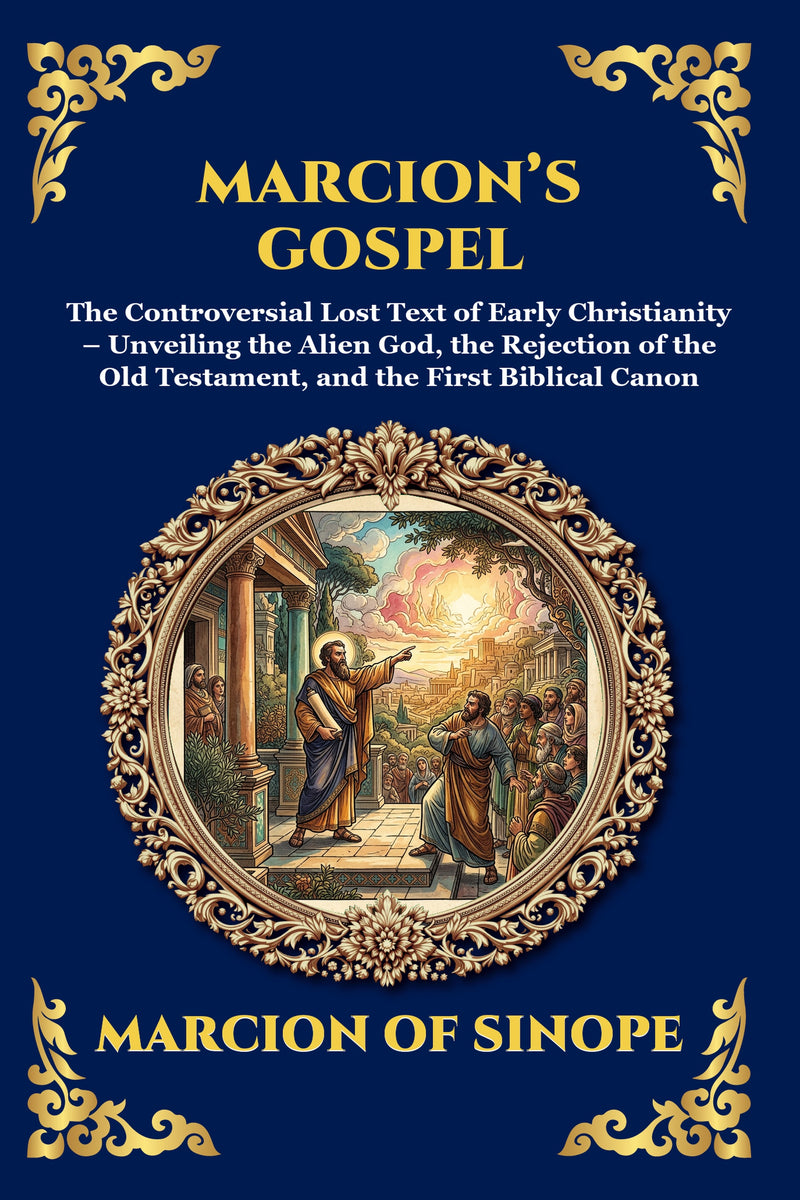
Marcion’s Gospel
In 144 AD, Marcion of Sinope was excommunicated for compiling the first Christian scripture that rejected the Old Testament entirely. His gospel, a meticulously curated text, ignited a movement that rivaled orthodox Christianity for centuries, challenging the foundations of the early church.
or free app
10,000+ hrs library
30-day guarantee
Marcion's Gospel receives its first complete modern-English reconstruction from patristic quotations, readable online with audiobook narration included for members.
Marcion's Gospel represents the earliest known attempt to create a Christian canon, predating the New Testament by decades. This radical second-century text challenged the very foundations of emerging Christianity.
Marcion's Gospel provides a compelling modern reconstruction of one of the most polarizing and influential texts in religious history. Long before the New Testament as we know it was finalized, Marcion of Sinope boldly declared that the teachings of Jesus were entirely incompatible with the harsh, retributive laws of the Hebrew Bible. In 144 AD, he was excommunicated for his beliefs, but his movement exploded in popularity, rivaling the orthodox church for centuries.
At the heart of his movement was his own meticulously curated scripture. Rejecting the Old Testament completely, Marcion compiled the first known biblical canon, consisting only of ten heavily edited epistles of Paul and a single gospel—a shorter, modified version of the Gospel of Luke, stripped of its nativity narrative and any references to the Creator God of the Jews. He argued that Christ descended directly from a higher, previously unknown realm of pure grace, sent to rescue humanity from the oppressive "Demiurge" who created the flawed physical universe.
Far more than an ancient heresy, Marcion’s theological rebellion forced the early church fathers to formally codify their own sacred texts, inadvertently shaping the modern Bible.
What You’ll Discover in This Modern Reconstruction
- The First Biblical Canon: Explore the controversial scripture that predates the official New Testament and understand how Marcion’s bold editing forced the orthodox church into action.
- The Doctrine of the Two Gods: Delve into Marcion’s fascinating theology, which contrasted the strict, flawed Creator of the material world with the Supreme God of absolute love and mercy.
- A Reconstructed Ancient Text: Read the reconstructed Evangelion, pieced together from the writings of early church fathers who sought to destroy it, providing a rare glimpse into Marcionite worship.
- Historical and Theological Context: Gain a deeper understanding of the intense ideological battles, the rise of "heresy," and the profound spiritual questions that shaped the identity of early Christianity.
Whether you are exploring this work for its immense historical value, its philosophical dualism, or its impact on biblical formation, Marcion's Gospel offers an unforgettable journey into the turbulent origins of the Christian faith. Step back into the second century and discover the lost text that challenged everything. Begin your journey today.
| Formats | eBook (EPUB + PDF) · Audiobook · Paperback · Hardcover · Large Print |
| Language | English |
| Trim size (print) | 6 × 9 in |
| Binding | Paperback — perfect-bound · Hardcover — casewrap |
| Large Print edition | Same text in a larger, easy-read type — a larger font, not a larger trim |
| Print pricing | Every physical book at our true cost — at-cost, no profit (members) |
| Library | 873 restored titles, always growing |
| Composed | c. 140-144 AD |
| Source tradition | Patristic quotations and references, primarily from Tertullian's 'Against Marcion' |
| Translation basis | Modern scholarly reconstruction based on patristic sources, rendered in clear modern English. |
| Length | 3,476 words · ~14 min reading |
| Reading level | Grade 6 · easy, accessible reading (this modern-English edition) |
| Edition | Modern English translation · 2026 |
Member reviews for this edition are collected as readers finish it — be the first. Across the library: 12,000+ books shipped, every plan covered by a 365-day print guarantee.
About this edition
The complete, unabridged text in clear modern English — faithful to the original, never simplified. Every paragraph is checked against the source, so nothing is cut, summarised, or paraphrased away. It reads cleanly for today while keeping the original meaning intact.
Marcion's Gospel does not survive as a complete manuscript but is reconstructed from quotations and references in early church fathers like Tertullian, Epiphanius, and Irenaeus. This edition renders the scholarly reconstruction in clear modern English.
- Complete & unabridgedVerified paragraph by paragraph against the source — never a scan, never abridged.
- Modern English, faithfulReadable today, with the author’s meaning kept intact. Readable — not simplified.
- Every format, one membershipRead in your browser or the free app, or listen to the full audiobook.
Included free with your membership
Cancel anytime, one click · 30-day money-back guarantee
Edition last updated June 2026
What’s inside
Marcion’s Gospel — complete and unabridged: all 26 sections included with membership, plus the full audiobook.
Begin reading Marcion’s Gospel
In clear modern English — the complete text is included with membership.
Chapter 1: Panarion 42
In the fifteenth year of the reign of Tiberius Caesar, while Pontius Pilate was governor of Judea, Jesus came down to Capernaum, a city in Galilee, and taught on the Sabbath days. And they were amazed by his teaching, because he spoke with authority.
And in the synagogue there was a man who had an evil spirit, and he cried out in a loud voice, saying, “Leave us alone! What do you want with us, Jesus? Have you come to destroy us? I know who you are: the Holy One of God.”
And Jesus rebuked him, saying, “Be quiet, and come out of him.” And when the demon had thrown the man down in front of everyone, it came out of him without hurting him.
And they were all amazed, and said to each other, “What kind of teaching is this! With authority and power he commands the evil spirits, and they come out.” And news about him spread through the whole region.
Chapter 2: The Synagogue in Nazareth
And he came to Nazareth, and went into the synagogue on the Sabbath day, and sat down. And he began to speak to them, and everyone was amazed at the words he spoke.
And he said to them, “You will surely quote this proverb to me: ‘Physician, heal yourself.’ Whatever we heard you did in Capernaum, do here in your hometown too.”
And everyone in the synagogue was furious, and they got up, forced him out of the city, and led him to the edge of the hill on which their city was built, to throw him off the cliff.
But he walked right through the middle of them and went on his way.
Chapter 3: At the Setting of the Sun
Now when the sun was setting, all those who had anyone sick with various diseases brought them to him; and he laid his hands on every one of them, and healed them. And demons also came out of many, crying out, and saying, “You are the Son of God.” And he, rebuking them, would not allow them to speak.
And when it was day, he departed and went into a remote place. And the people looked for him, and came to him, and tried to keep him from leaving them. And he said to them, “I must preach the kingdom of God to other cities also, because that is why I was sent.”
And he preached in the synagogues of Galilee.
Chapter 4: The Lake of Gennesaret
And it happened that he stood by the lake of Gennesaret, and saw two boats at the water’s edge, but the fishermen had gotten out of them and were washing their nets. And he got into one of the boats, which was Simon's, and asked him to push out a little from the land. And he sat down and taught the people from the boat.
Now when he had finished speaking, he said to Simon, “Go out into the deep water, and let down your nets for a catch.” And Simon answering said to him, “Teacher, we have worked hard all night and have caught nothing; but at your word I will let down the net.”
And when they had done this, they caught a great number of fish, and their net began to break. And they signaled to their partners, who were in the other boat, to come and help them. And they came, and filled both the boats, so that they began to sink.
When Simon Peter saw it, he fell down at Jesus' knees, saying, “Go away from me, for I am a sinful man, O Lord.” For he was astonished, and all that were with him, at the catch of fish which they had taken. And so were also James and John, the sons of Zebedee, who were partners with Simon. And Jesus said to Simon, “Do not be afraid; from now on you will catch people alive.” And when they had brought their boats to land, they left everything and followed him.
Chapter 5: Healing of the Leper
And it happened, there was a man covered with leprosy. When he saw Jesus, he fell on his face and begged him, saying, “Lord, if you are willing, you can make me clean.”
And he reached out his hand and touched him, saying, “I am willing; be clean.” And immediately the leprosy left him.
And he ordered him to tell no one, “But go, and show yourself to the priest, and offer for your cleansing, as Moses commanded, so that this may be a testimony to them.”
Chapter 6: Healing of the Paralyzed Man
Zahn omits:
And just then, some men brought a paralyzed man on a mat, and they tried to find a way to bring him in and lay him before Jesus. And not finding a way they could bring him in because of the crowd, they went up on the housetop and let him down through the tiles with his mat into the middle of the crowd, in front of Jesus.
And seeing their faith, he said to him, “Man, your sins are forgiven.” And the scribes and the Pharisees began to reason, saying, “Who is this who speaks blasphemies? Who can forgive sins, but God alone?”
But when Jesus, perceiving their thoughts, answered and said to them, “Why are you reasoning in your hearts? Which is easier, to say, ‘Your sins are forgiven,’ or to say, ‘Get up and walk’? But so that you may know that the Son of Man has authority on earth to forgive sins—”
Chapter 7: Panarion 42
“I say to you, get up, take your mat, and go to your house.” And immediately he rose up before them, took up what he had been lying on, and departed to his own house, glorifying God.
And they were all amazed, and they glorified God, and were filled with fear, saying, “We have seen remarkable things today.”
Chapter 8: The Feast of Levi the Tax Collector
And after these things he went out and saw a tax collector named Levi, sitting at the tax booth, and he said to him, “Follow me.” And he left everything, got up, and followed him.
And Levi made him a great feast in his own house, and there was a large group of tax collectors and of others who sat down with them. But their scribes and Pharisees complained to his disciples, saying, “Why do you eat and drink with tax collectors and sinners?”
And Jesus answering said to them, “Those who are healthy do not need a doctor, but those who are sick. I have not come to call the righteous, but sinners to repentance.”
And they said to him, “Why do the disciples of John fast often and make prayers, and likewise the disciples of the Pharisees, but yours eat and drink?” And he said to them, “Can you make the wedding guests fast while the bridegroom is with them? But the days will come when the bridegroom will be taken away from them, and then they will fast in those days.”
Chapter 9: The Old and the New
And he also told them a parable: “No one puts a piece of a new garment on an old garment; otherwise, the new makes a tear, and the piece that was taken out of the new does not match the old.”
“And no one puts new wine into old wineskins; otherwise, the new wine will burst the skins, and it will be spilled, and the skins will be ruined. But new wine must be put into new wineskins, and both are preserved.”
Chapter 10: The Lord of the Sabbath
And it happened on the second Sabbath after the first that he went through the grainfields, and his disciples picked the heads of grain and ate them, rubbing them in their hands. And some of the Pharisees said to them, “Why are you doing what is not lawful to do on the Sabbath days?”
And Jesus answering them said, “Have you not even read this, what David did when he was hungry, he and those who were with him: how he went into the house of God,”
Chapter 11: Panarion 42
“and took and ate the consecrated bread, and also gave it to those who were with him, which it is not lawful to eat except for the priests alone?”
And he said to them, “The Son of Man is Lord even of the Sabbath.”
Chapter 12: Panarion 42
And it also happened on another Sabbath that he entered the synagogue and taught. And there was a man whose right hand was shriveled. And the scribes and Pharisees watched him to see whether he would heal on the Sabbath day, so that they might find an accusation against him.
But he knew their thoughts and said to the man who had the shriveled hand, “Get up and stand here.” And he got up and stood there. Then Jesus said to them, “I will ask you one thing: Is it lawful on the Sabbath days to do good, or to do evil? To save life, or to destroy it?”
And looking around at them all, he said to the man, “Stretch out your hand.” And he did so, and his hand was restored as whole as the other. And they were filled with fury and discussed with one another what they might do to Jesus.
Chapter 13: The Choosing of the Twelve
And it happened in those days that he went out to a mountain to pray, and continued all night in prayer to God. And when it was day, he called his disciples to him, and from them he chose twelve, whom he also named apostles:
Simon, and Andrew his brother, James and John, Philip and Bartholomew, Matthew and Thomas, James the son of Alphaeus, and Simon called the Zealot, and Judas the brother of James, and Judas Iscariot, who also became a traitor.
Chapter 14: New Edicts of the New God
And he came down with them and stood on a level place, with the company of his disciples and a great crowd of people from all Judea and Jerusalem, and from the sea coast of Tyre and Sidon, who came to hear him and to be healed of their diseases; and those who were troubled with unclean spirits were healed.
And the whole crowd sought to touch him, for power went out from him and healed them all.
Chapter 15: Panarion 42
And he lifted up his eyes on his disciples, and said, “Blessed are you who are poor, for yours is the kingdom of God. Blessed are you who hunger now, for you shall be filled. Blessed are you who weep now, for you shall laugh.”
“Blessed are you when people hate you, and when they exclude you, and insult you, and reject your name as evil, for the Son of Man's sake. Rejoice in that day, and leap for joy, for look, your reward is great in heaven; for their fathers did the same things to the prophets.”
Chapter 16: Panarion 42
“But woe to you who are rich! For you have received your comfort. Woe to you who are full! For you shall hunger. Woe to you who laugh now! For you shall mourn and weep. Woe to you when all people speak well of you! For so their fathers did to the false prophets.”
“But I say to you who hear, love your enemies, do good to those who hate you, bless those who curse you, and pray for those who mistreat you. And to him who strikes you on the one cheek, offer the other also; and from him who takes away your cloak, do not withhold your coat either. Give to every man who asks of you; and from him who takes away your goods, do not ask for them back. And as you would want people to do to you, do the same to them.”
“For if you love those who love you, what credit is that to you? For sinners also love those that love them. And if you do good to those who do good to you, what credit is that to you? For sinners also do the same. And if you lend to those from whom you hope to receive, what credit is that to you? For sinners also lend to sinners, to receive as much again. But love your enemies, and do good, and lend, hoping for nothing in return; and your reward will be great, and you will be the children of the Most High, for he is kind to the unthankful and to the evil. Be therefore merciful, as your Father also is merciful.”
“Judge not, and you will not be judged; condemn not, and you will not be condemned; forgive, and you will be forgiven. Give, and it will be given to you; a good measure, pressed down, shaken together, and running over, will be given into your lap.”
“For with the same measure that you use, it will be measured to you again.” And he told them a parable, “Can the blind lead the blind? Will they not both fall into a ditch?”
“The disciple is not above his teacher, but everyone who is fully trained will be like his teacher. And why do you look at the speck that is in your brother's eye, but do not notice the plank that is in your own eye?”
“How can you say to your brother, ‘Brother, let me pull out the speck that is in your eye,’ when you yourself do not see the plank that is in your own eye? You hypocrite, first cast out the plank from your own eye, and then you will see clearly to pull out the speck that is in your brother's eye.”
Cancel anytime, one click · 30-day money-back guarantee
Founding annual rate available now — your price locks for life when you join.
Not ready? Get this free chapter by email — read it anytime.
✓ Sent — check your inbox for Marcion’s Gospel.
Questions about Marcion’s Gospel
What is Marcion's Gospel and how does it differ from canonical gospels?
Marcion's Gospel was an edited version of Luke's Gospel that removed references to the Hebrew Bible and Jewish law. Marcion believed Jesus came to reveal a previously unknown God of love, distinct from the creator God of the Old Testament.
Why was Marcion's Gospel excluded from the biblical canon?
Church leaders rejected Marcion's Gospel because it denied the continuity between Judaism and Christianity, rejected the Old Testament entirely, and presented a dualistic theology that contradicted orthodox Christian teaching about one God as both creator and redeemer.
How do we know what Marcion's Gospel contained if no complete copies survive?
Scholars reconstruct Marcion's Gospel from extensive quotations and detailed refutations by early church fathers like Tertullian, who quoted large portions while arguing against Marcion's theology in the early third century.
Is Marcion’s Gospel free to read?
The opening of the text is free to read below. Members read and listen to the complete work — and the entire Lost & Forbidden Library — free.
What is Marcion’s Gospel?
Have you ever wondered why the early Christian church had to fight so fiercely to decide which books belonged in the New Testament?
How long is Marcion’s Gospel?
26 chapters (~3,475 words) in this restored edition.
Shipping & returns
Billing & membership
More from the library


Explore The Lost & Forbidden Library
- 1 Enoch · Attributed to Enoch
- 1–4 Maccabees · Various Jewish authors
- 2 Baruch · Attributed to Baruch
- 2 Enoch · Attributed to Enoch
- 2 Esdras · Attributed to the prophet Ezra
- 3 Baruch · Attributed to Baruch ben Neriah
- 4 Baruch · Attributed to Baruch ben Neriah
- A Valentinian Exposition · Attributed to a follower of Val...
- Acta Archelai · Attributed to Hegemonius
- Acts of Andrew · Anonymous (Early Christian Apoc...
- Acts of Andrew and Matthias in the City of the Cannibals · Attributed to early Christian a...
- Acts of Barnabas · Attributed to John Mark
- Acts of Bartholomew
- Acts of John · Anonymous (Early Christian Apoc...
- Acts of Matthias · Anonymous early Christian writers
- Acts of Paul · Attributed to an unknown early ...
- Acts of Paul and Thecla · Attributed to Onesiphorus
- Acts of Peter
- Acts of Peter and Andrew · Attributed to various early Chr...
- Acts of Peter and Paul · Attributed to Leucius Charinus
- Acts of Peter and Simon · Attributed to Leucius Charinus
- Acts of Peter and the Twelve Apostles · Attributed to early Christian a...
- Acts of Philip · Anonymous (Early Christian Apoc...
- Acts of Pilate (Gospel of Nicodemus) · Attributed to various early Chr...
- Acts of Saturninus
- Acts of Thaddaeus · Attributed to Thaddaeus the Apo...
- Acts of Thomas
- Acts of Titus · Anonymous early Christian writer
- Acts of Xanthippe, Polyxena, and Rebecca
- Allogenes · Anonymous (Early Gnostic Mystic)
Marcion’s Gospel
Marcion’s Gospel
The Controversial Lost Text of Early Christianity – Unveiling the Alien God, the Rejection of the Old Testament, and the First Biblical Canon
Library of Alexandria Press
Marcion’s Gospel
© Copyright 2026 Library of Alexandria Press. All rights reserved.
Published by Library of Alexandria Press
Printed in the United States of America
It is not legal to copy, share, or send any part of this document in either digital or printed form without written permission from the publisher, except short quotes in a book review.
Table of Contents
Introduction
Chapter 1
Chapter 2
Chapter 3
Chapter 4
Chapter 5
Chapter 6
Chapter 7
Chapter 8
Chapter 9
Chapter 10
Chapter 11
Chapter 12
Chapter 13
Chapter 14
Chapter 15
Chapter 16
Chapter 17
Chapter 18
Chapter 19
Chapter 20
Chapter 21
Chapter 22
Chapter 23
Chapter 24
Chapter 25
Introduction
Somewhere in the middle of the second century, a wealthy shipowner from the Black Sea port of Sinope arrived in Rome with a head full of dangerous ideas and a purse heavy enough to make the Roman church take notice. His name was Marcion, and within a few years of his arrival, he would be expelled from that same community, his donated funds returned, and his name transformed into a byword for heresy. Yet the movement he founded spread with astonishing speed across the Roman Empire, outlasted him by centuries, and forced the emerging institution of orthodox Christianity to define itself with a clarity and urgency it had never before felt compelled to muster. To dismiss Marcion as a footnote, a cautionary tale, or a theological dead end is to misread the entire landscape of early Christian history. He was, in the estimation of many modern scholars, the single most consequential figure in the formation of what we now call the New Testament — not because his ideas were adopted, but precisely because they were rejected.
The story of Marcion is, at its core, a story about a problem that has never entirely gone away. How do you reconcile a God who commands genocide with a God who preaches forgiveness? How do you square the wrathful, jealous deity of Exodus and Deuteronomy with the loving Father described in the parables of Jesus? For most Christians, ancient and modern, the answer has involved sophisticated interpretive strategies — allegory, typology, the idea of progressive revelation, the notion that the same God speaks differently across different ages. Marcion looked at these strategies and found them intellectually dishonest. His solution was radical, clean, and, to his opponents, absolutely terrifying: the God of the Hebrew scriptures and the God revealed by Jesus Christ were simply not the same being. They were two entirely different divine entities. The creator of the material world — the God of Abraham, Isaac, and Jacob — was a lesser, flawed, perhaps even malevolent power. The true God, the highest God, the utterly alien and previously unknown God, had sent Jesus not to fulfill the law but to rescue humanity from it.
This was not a minor theological quibble. It was a seismic rupture at the foundations of what Christianity was and could become. And to support his position, Marcion did something that no one before him had done with such deliberate systematism: he assembled a collection of authoritative texts. He selected the letters of Paul — the apostle he regarded as the only one who had truly understood Jesus — and he took a version of what we now call the Gospel of Luke, stripping away what he considered later interpolations designed to tie Jesus to the Jewish scriptures. The result was the first known Christian biblical canon: a defined, bounded list of sacred writings that carried doctrinal authority. The orthodox church, stung into action, eventually responded by constructing its own canon — broader, more inclusive of the Hebrew heritage, carefully curated to refute everything Marcion stood for. In a very real sense, every Bible on every shelf in the world today exists partly in reaction to a man whom the church declared a heretic nearly two thousand years ago.
What makes this history so endlessly fascinating — and so urgent for anyone who wants to understand Christianity at its roots — is how much of it we have had to reconstruct from the ruins. Marcion's own writings did not survive. His gospel, the text at the center of everything he believed and taught, was not preserved by his followers in any manuscript tradition that has come down to us intact. We know it almost entirely through the writings of his enemies, particularly the North African theologian Tertullian, whose massive work Against Marcion is the single most detailed surviving refutation, and through Epiphanius of Salamis, whose Panarion — a kind of encyclopedia of heresies — quotes extensively from the Marcionite gospel in the course of demolishing it. This is the peculiar archaeology of early Christian controversy: the heretic's voice survives only in the mouths of those who hated him. And yet, with careful scholarship, with the tools of textual criticism and historical reconstruction, it is possible to hear that voice again, to reassemble the outlines of what Marcion's gospel actually said, and to ask what it meant.
That work of reconstruction has accelerated dramatically in recent decades. Scholars like John Knox, Adolf von Harnack, Jason BeDuhn, and Markus Vinzent have approached the Marcionite texts with fresh eyes, sometimes reaching conclusions that are as controversial in academic circles as Marcion himself was in his own time. BeDuhn's meticulous reconstruction of the First New Testament, as he calls it, argues that Marcion's gospel was not simply a truncated version of canonical Luke but may in some respects preserve an earlier textual tradition — that Marcion was not always cutting things out but that later editors were sometimes adding things in. Vinzent has gone even further, suggesting that Marcion's gospel may have been a source for Luke rather than a derivative of it. These are not fringe positions held by eccentrics; they are serious scholarly arguments supported by detailed textual analysis, and they have the power to reframe everything we think we know about how the Gospels came to be.
This book is an invitation to enter that world — a world of theological passion, institutional conflict, textual mystery, and historical consequence. It is a world in which the boundaries of scripture were not fixed but fiercely contested, in which the identity of God was not assumed but argued over in the streets and meeting houses of cities from Rome to Antioch to Alexandria. It is a world in which a single individual's reading of Paul's letters could generate a movement that would survive for centuries in the deserts of Syria and the mountains of Armenia. And it is a world that speaks, with surprising directness, to questions that have never stopped mattering: What is the relationship between justice and mercy? Between law and grace? Between the God we inherit from tradition and the God we encounter in experience? Marcion's answers were, by most measures, wrong — or at least, they were judged to be wrong by the tradition that prevailed. But the questions he asked were the right ones, and they deserve to be taken seriously.
A Man, a Movement, and a Missing Text
To understand why Marcion mattered so much, it helps to understand the world he walked into. When he arrived in Rome, probably sometime around 140 CE, Christianity was not yet a religion in the sense we would recognize today. It was a loose and extraordinarily diverse collection of communities, each shaped by local traditions, competing apostolic claims, and widely varying interpretations of who Jesus was and what his life, death, and reported resurrection meant. There was no agreed-upon New Testament. There was no single institutional authority capable of defining orthodoxy. There were gospels — many of them — circulating in different communities, some of which would eventually be canonized, others of which would be lost or suppressed. There were letters attributed to Paul, some genuine, some almost certainly not, and their meaning was disputed. There were Jewish Christians who continued to observe the Torah and Gentile Christians who had never observed it. There were communities deeply embedded in the Hebrew prophetic tradition and communities that wanted nothing to do with it. Into this ferment, Marcion arrived with a system — a coherent, logically consistent theological framework that cut through the ambiguity with a blade.
Marcion's theology began with a reading of Paul that was, in some respects, simply an intensification of what Paul himself had written. Paul had insisted, in Galatians and Romans, that the law could not save, that justification came through faith alone, that the era of the Torah had been superseded by the era of grace. Marcion took this and pushed it to its logical extreme. If the law was not the path to salvation, then the God who gave the law was not the God of salvation. The God of Sinai, who demanded blood sacrifice and ethnic exclusivity, who hardened Pharaoh's heart and ordered the slaughter of the Canaanites, was simply not the same being as the Father of whom Jesus spoke — the one who loved enemies, who welcomed prodigals, who forgave sins without demanding restitution. For Marcion, this was not a paradox to be resolved through interpretation. It was a plain fact, evident to anyone willing to read the texts honestly.
The theological term scholars use for Marcion's position is dualism — the idea that there are two ultimate divine principles rather than one. But Marcion's dualism was different from the cosmic warfare dualism of, say, the Persian Zoroastrian tradition, where a good god and an evil god are locked in eternal combat. For Marcion, the creator god — the Demiurge, to use the Greek term that others applied to this figure — was not exactly evil. He was just, in the strict legal sense. He gave what was deserved. He punished transgression and rewarded obedience. He was, in a word, fair. But fairness, Marcion insisted, is not the same as goodness. The highest God, the alien God who had no prior relationship with humanity, who owed us nothing and had made none of us, chose to intervene in human history out of pure, unmotivated love. He sent Jesus — not born of woman, in Marcion's view, but appearing suddenly as a fully formed adult in the fifteenth year of Tiberius's reign — to announce the good news of a God who had nothing to do with the creation of this suffering world and yet was willing to redeem its inhabitants from it.
The text through which Marcion communicated this vision was his gospel, which he called simply the Gospel — the Evangelion. He apparently believed it was the original, authentic account of Jesus's ministry, preserved in its pure form against the corruptions introduced by Judaizing Christians who wanted to tie Jesus to the Hebrew prophetic tradition. His version began abruptly, without a birth narrative, without genealogies, without any of the material that in canonical Luke anchors Jesus in the lineage of David and the promises made to Abraham. Jesus simply appears, fully divine, fully purposeful, in Capernaum. What follows is a carefully selected account of his teaching and actions — one that, according to the reconstructions scholars have assembled from the anti-Marcionite sources, shared a great deal of content with canonical Luke but differed in telling ways, sometimes in single words, sometimes in whole passages, always in directions that supported Marcion's theological vision.
The loss of this text is one of the great tragedies of early Christian literary history — or, depending on your perspective, one of the great victories of orthodox suppression. We cannot read it as Marcion's followers read it, with fresh eyes and no knowledge of what the canonical gospels would eventually say. We can only approach it through the distorting lens of polemic, through the quotations and paraphrases of men who were professionally committed to proving it wrong. And yet, even through that lens, something remarkable is visible. The Marcionite gospel was not a crude forgery or a simple subtraction. It was a coherent, theologically sophisticated document that presented a Jesus who was radical, merciful, and utterly unconcerned with the ritual and ethnic categories of Second Temple Judaism. Whether that Jesus was the historical Jesus, or a theological construction, or something in between, is a question that modern scholarship has not resolved — and may never fully resolve. But it is a question worth asking, and asking seriously.
What is perhaps most striking about Marcion's legacy is the institutional response it provoked. The emerging proto-orthodox church did not simply ignore him or wait for his movement to fade. It mobilized. Justin Martyr wrote against him. Irenaeus of Lyon devoted substantial portions of his Against Heresies to refuting his positions. Tertullian produced five books of detailed, sometimes savage, sometimes brilliant polemic. Origen addressed Marcionite arguments throughout his career. Ephrem the Syrian wrote hymns against Marcionite communities in Mesopotamia. This was not the response of an institution confident in its own position. This was the response of a tradition that recognized, at some level, that Marcion had identified real tensions at the heart of its own scriptures — tensions that could not be wished away but had to be argued against, again and again, across generations.
Why This Story Still Matters
There is a temptation, when studying figures like Marcion, to treat them as purely historical curiosities — interesting specimens from a distant era, relevant to specialists but not to anyone trying to make sense of religion, ethics, or human experience in the present day. That temptation should be resisted, because the questions Marcion raised have not aged. They have, if anything, grown more pressing.
The problem of the Old Testament God has never been more publicly debated than it is in our own era. The so-called New Atheist movement of the early twenty-first century made the moral character of the biblical deity a central exhibit in its case against religion, citing the same passages — the genocide of the Canaanites, the binding of Isaac, the plagues of Egypt — that troubled Marcion in the second century. The responses from theologians and apologists have been sophisticated and varied, but they have not silenced the question. Meanwhile, within Christian communities themselves, the relationship between the two testaments remains a source of genuine theological tension. How should Christians read the laws of Leviticus? What authority does the Mosaic covenant retain? How do passages commanding the stoning of adulterers or the enslavement of conquered peoples relate to the ethical vision of the Sermon on the Mount? These are not abstract questions. They shape real debates about sexuality, gender, violence, and the nature of justice in communities around the world.
Marcion's answer — cut the knot, declare the two Gods separate, and be done with it — was rejected by the mainstream tradition, and for reasons that are not without force. The rejection of the Hebrew scriptures would have meant the loss of an extraordinarily rich moral and narrative tradition, a tradition that gave Christianity its vocabulary of covenant, prophecy, justice, and hope. It would have severed the roots that gave the Jesus story its depth and resonance. And it would have opened the door to a kind of gnostic escapism — a religion that despised the material world, denied the goodness of creation, and offered salvation as an escape from embodied existence rather than a transformation of it. These are real dangers, and the orthodox tradition was right to take them seriously. But the fact that Marcion's solution was wrong does not mean his diagnosis was mistaken. The tension he identified is real, and every serious reader of the Bible has to grapple with it.
Beyond the theological questions, the story of Marcion raises profound issues about the nature of scripture itself — about how texts become authoritative, how canons are formed, and what it means to declare a collection of writings sacred. The process by which the New Testament came into being was not a simple, transparent, Spirit-guided revelation. It was a contested, politically charged, historically contingent process in which competing communities fought over which texts represented authentic apostolic tradition. Marcion was a major catalyst in that process. His decision to define a closed list of authoritative writings forced the proto-orthodox church to think systematically about which texts it considered authoritative and why. The canon that eventually emerged — the twenty-seven books of the New Testament as we know it today — was not finalized until centuries after Marcion's death. But the conversation he started, the pressure he applied, was a significant force in pushing that process forward.
For historians of religion, the Marcion case is also a masterclass in how heresy and orthodoxy are constructed. The boundary between acceptable and unacceptable belief is never simply given; it is drawn, and the drawing involves power, politics, and the suppression of alternatives. This does not mean that the distinctions are meaningless or that all theological positions are equally valid. But it does mean that the history of Christianity cannot be told honestly without attending to the roads not taken, the voices that were silenced, the texts that were burned. Marcion's gospel is one of those silenced voices. Recovering it — even imperfectly, even partially — is an act of historical justice, and it changes the way we see the tradition that survived.
There is also something deeply human about Marcion's project that deserves acknowledgment. He was, at his core, a man who had encountered the figure of Jesus and been overwhelmed by what he found there — a vision of grace so radical, so unconditional, so free of the transactional logic that governs most human relationships and most religious systems, that he could not reconcile it with the world he saw around him or the God described in the scriptures he had inherited. His response was extreme, and his theology was in many ways distorted by that extremity. But the experience at its root — the experience of encountering something in the Christian gospel that seems almost too good to be true, too generous to fit into any familiar framework — is an experience that millions of people across centuries have recognized as their own. Marcion pushed that experience to a breaking point. In doing so, he illuminated something essential about the nature of grace, and about the difficulty of holding together the God of power and the God of love.
This book does not ask you to become a Marcionite. It does not argue that Marcion was right and the orthodox tradition was wrong. What it does ask is that you take seriously the possibility that a figure long dismissed as a dangerous heretic was also a serious thinker, a careful reader of texts, and a man grappling with questions that matter. It asks you to sit with the discomfort of a Christianity that might have developed very differently — that, in the hands of a different history, might have looked nothing like what we know today. And it asks you to consider what that alternative history reveals about the Christianity that did prevail: its choices, its compromises, its genius, and its unresolved tensions.
The pages that follow will take you into the world of second-century Christianity with as much detail and vividness as the sources allow. They will introduce you to the key figures in the Marcionite controversy — not just Marcion himself, but the opponents who defined themselves against him, the scholars who have worked to recover his texts, and the communities that kept his movement alive long after Rome had declared him anathema. They will walk you through the theological arguments, making them as clear and accessible as possible without sacrificing their genuine complexity. And they will explore the textual evidence — the painstaking work of reconstruction that has allowed scholars to read, however imperfectly, a gospel that was supposed to have been erased from history.
The history of Christianity is, in large part, the history of arguments — arguments about who God is, what Jesus meant, how human beings should live, and what texts should be trusted to answer these questions. Marcion was one of the most consequential participants in those arguments, and he was arguing at the moment when the stakes were highest, when the answers were least settled, when the tradition was most fluid and most open to being shaped in radically different directions. To understand him is to understand something fundamental about how Christianity became what it is — and to glimpse, however briefly, what it might have been instead.
That glimpse is worth the journey. Let us begin.
Chapter 1
Panarion 42
In the fifteenth year of the reign of Tiberius Caesar, while Pontius Pilate was governor of Judea, Jesus came down to Capernaum, a city in Galilee, and taught on the Sabbath days. And they were amazed by his teaching, because he spoke with authority.
And in the synagogue there was a man who had an evil spirit, and he cried out in a loud voice, saying, “Leave us alone! What do you want with us, Jesus? Have you come to destroy us? I know who you are: the Holy One of God.”
And Jesus rebuked him, saying, “Be quiet, and come out of him.” And when the demon had thrown the man down in front of everyone, it came out of him without hurting him.
And they were all amazed, and said to each other, “What kind of teaching is this! With authority and power he commands the evil spirits, and they come out.” And news about him spread through the whole region.
Chapter 2
The Synagogue in Nazareth
And he came to Nazareth, and went into the synagogue on the Sabbath day, and sat down. And he began to speak to them, and everyone was amazed at the words he spoke.
And he said to them, “You will surely quote this proverb to me: ‘Physician, heal yourself.’ Whatever we heard you did in Capernaum, do here in your hometown too.”
And everyone in the synagogue was furious, and they got up, forced him out of the city, and led him to the edge of the hill on which their city was built, to throw him off the cliff.
But he walked right through the middle of them and went on his way.
End of the free sample
Keep reading, free
Members read and listen to the complete book — and the entire library. Cancel anytime, one click · 30-day money-back guarantee.