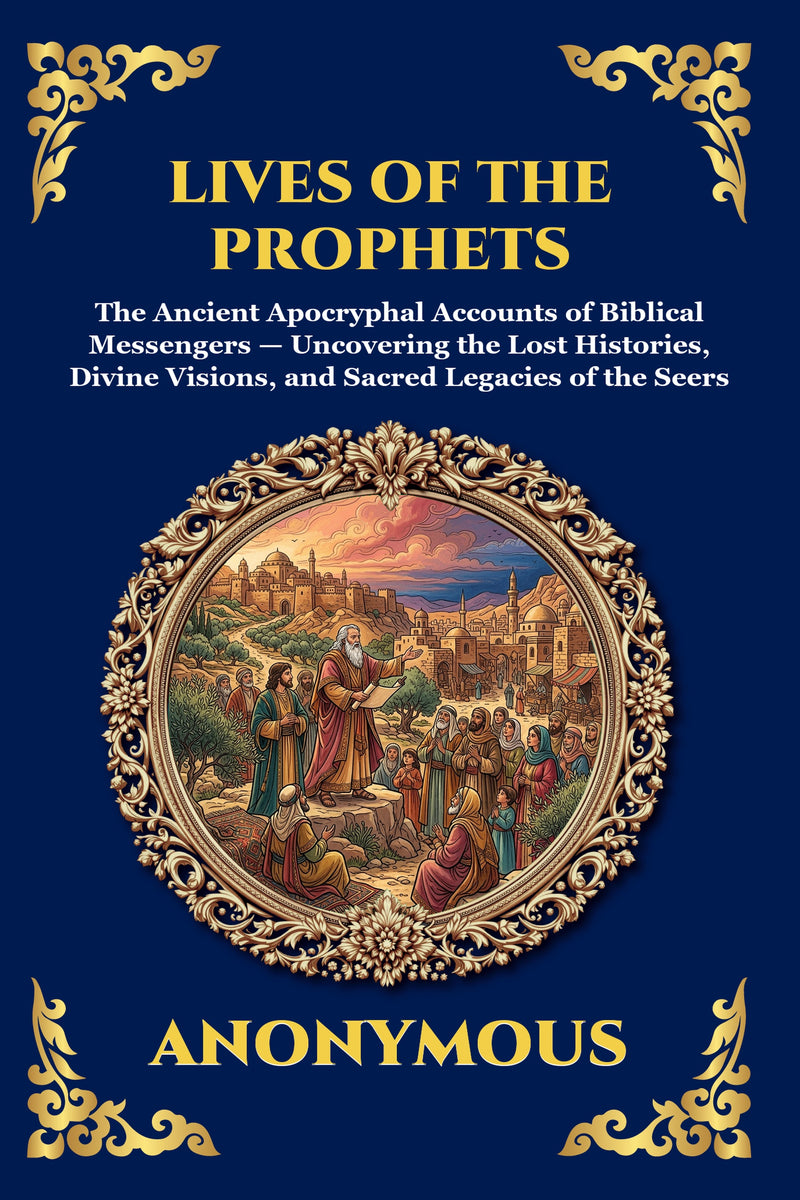
Lives of the Prophets
The Lives of the Prophets reveals the forgotten miracles and final resting places of biblical messengers whose stories were excluded from the canon. This ancient text offers a rare glimpse into the sacrifices and divine loyalty of prophets whose voices shaped spiritual history.
or free app
10,000+ hrs library
30-day guarantee
The Library of Alexandria edition presents the complete Lives of the Prophets in modern English translation, readable online with audiobook narration included for members.
The Lives of the Prophets claims to reveal the hidden biographical details and extraordinary experiences of biblical prophets that traditional scriptures leave untold.
The Lives of the Prophets provides a compelling modern translation of one of the most fascinating works of apocryphal history. This ancient text, attributed to an anonymous historian, recounts the untold lives, extraordinary miracles, and ultimate resting places of the major and minor prophets.
Far more than a simple historical chronicle, The Lives of the Prophets delves into profound themes of loyalty to the divine, perseverance through persecution, and the immense sacrifices made in the pursuit of delivering spiritual truth to a fallen world. It explores the deeply personal burdens these seers carried, offering a rare glimpse into the humanity behind their legendary status. By bridging the ancient traditions with timeless spiritual truths, this text serves as a vital key to understanding the foundation of early religious thought and the unshakeable resilience of those chosen to speak for the divine.
What You’ll Discover in This Modern Translation
- The Hidden Histories of the Seers: Follow the inspiring and often tragic life stories of the great prophets as they carry out their divine missions and fight for religious integrity.
- Divine Visions and Prophecies: Explore extraordinary accounts of heavenly revelations and the power of divine foresight amidst a world of doubt and adversity.
- Lessons on Faith and Sacrifice: Learn timeless principles about resilience, standing up for ultimate truths, and making moral choices in the face of insurmountable odds.
- A Window into Ancient Apocryphal Literature: Gain a deeper understanding of the historical and spiritual significance of the non-canonical texts that shaped early religious identity.
Whether you’re exploring this work for its historical value, moral lessons, or spiritual insight, The Lives of the Prophets offers inspiration and guidance for all.
Step into a story of unparalleled devotion and discover the timeless lessons of these ancient messengers. Begin your journey today.
| Formats | eBook (EPUB + PDF) · Audiobook · Paperback · Hardcover · Large Print |
| Language | English |
| Trim size (print) | 6 × 9 in |
| Binding | Paperback — perfect-bound · Hardcover — casewrap |
| Large Print edition | Same text in a larger, easy-read type — a larger font, not a larger trim |
| Print pricing | Every physical book at our true cost — at-cost, no profit (members) |
| Library | 873 restored titles, always growing |
| Composed | 1st century AD |
| Original language | Greek |
| Source tradition | Greek manuscript tradition |
| Translation basis | Public-domain scholarly translation, rendered in clear modern English |
| Length | 5,848 words · ~23 min reading |
| Reading level | Grade 10 · a confident, adult read (this modern-English edition) |
| Edition | Modern English translation · 2026 |
Member reviews for this edition are collected as readers finish it — be the first. Across the library: 12,000+ books shipped, every plan covered by a 365-day print guarantee.
About this edition
The complete, unabridged text in clear modern English — faithful to the original, never simplified. Every paragraph is checked against the source, so nothing is cut, summarised, or paraphrased away. It reads cleanly for today while keeping the original meaning intact.
Lives of the Prophets survives primarily in Greek manuscripts, with versions also preserved in Latin, Syriac, and other ancient languages. This edition derives from the standard public-domain scholarly translation and renders it in clear modern English.
- Complete & unabridgedVerified paragraph by paragraph against the source — never a scan, never abridged.
- Modern English, faithfulReadable today, with the author’s meaning kept intact. Readable — not simplified.
- Every format, one membershipRead in your browser or the free app, or listen to the full audiobook.
Included free with your membership
Cancel anytime, one click · 30-day money-back guarantee
Edition last updated June 2026
What’s inside
Lives of the Prophets — complete and unabridged: all 32 sections included with membership, plus the full audiobook.
Begin reading Lives of the Prophets
In clear modern English — the complete text is included with membership.
The World Behind the Words
To appreciate what these accounts meant to their original audiences, it helps to understand something about the ancient world's relationship to holy figures and holy places. For modern Western readers, shaped by centuries of Protestant skepticism about relics and saints, there can be something uncomfortable about the Vitae Prophetarum's intense interest in where prophets were buried, what miracles their tombs performed, and how their physical remains continued to exercise power long after their deaths. This discomfort is worth examining, because it stands in the way of a genuine encounter with the text.
In the ancient Mediterranean world, and indeed in most of the world for most of human history, the boundary between the living and the dead was understood very differently than it tends to be understood in modern secular culture. The dead were not simply gone. They remained present, in some sense, in the places where they were buried, in the objects associated with them, in the communities that remembered them. Holy figures — people who had been especially close to the divine during their lifetimes — were understood to retain that closeness after death, and their tombs became places where the membrane between the human and the divine was thin, where healing could happen, where prayers might be answered, where the power of God that had worked through them in life might still be accessed.
This is the world in which the prophetic legends collected in the Vitae Prophetarum make perfect sense. When the text tells us that the tomb of a particular prophet was a site of miraculous healing, it is not making a claim that would have seemed bizarre or superstitious to its original audience. It is making a claim that fit naturally into a widely shared understanding of how holiness worked, of how the divine presence moved in the world, of what it meant to be a person through whom God had spoken. The prophets were not merely historical figures to be studied and admired from a distance. They were living presences, available to their communities through prayer and pilgrimage and the veneration of their memories.
This understanding of prophetic presence also shaped the way these communities read the canonical scriptures. For modern readers, the prophetic books of the Hebrew Bible are primarily literary and theological texts — collections of oracles, visions, and poems that are studied for their theological content and their historical context. For ancient readers, they were also windows into the lives of extraordinary human beings, and those lives were understood to be as significant as the words those human beings had spoken. The question of who Isaiah was as a person, where he came from, how he died, what his relationship to the royal court of Jerusalem had been — these were not merely biographical curiosities. They were theologically important, because the character and the fate of the prophet were understood to illuminate the character of the prophetic message.
This is why the Vitae Prophetarum and texts like it were produced and preserved. They were not attempts to add fictional decoration to the biblical story. They were attempts to recover and transmit information that communities believed was real and important — information about the human beings through whom God had chosen to speak, information that the canonical texts had preserved only incompletely. Whether that information was historically accurate in any modern sense is, again, not quite the right question. What matters is that it was believed to be true, and that belief shaped how communities prayed, how they organized their sacred spaces, how they understood their own relationship to the prophetic tradition.
The geographical dimension of these accounts deserves particular attention. One of the most striking features of the Vitae Prophetarum is its detailed interest in where prophets were born and where they were buried. This is not incidental. In the ancient world, sacred geography was a serious matter. The land of Israel was understood to be a land saturated with divine presence, a landscape in which every hill and spring and tomb might be the site of an encounter with the holy. Pilgrimage to the tombs of the prophets was a real practice, attested in multiple ancient sources, and the Vitae Prophetarum can be read in part as a kind of guidebook to that sacred landscape — a text that told pilgrims not just where to go but why those places mattered, what had happened there, what power lingered in the earth above the bones of the holy dead.
Jesus himself, according to the Gospel of Matthew, refers to the practice of building and adorning the tombs of the prophets, a reference that only makes sense if such tombs were well-known landmarks in the landscape of first-century Palestine. The Jewish historian Josephus mentions the tomb of Isaiah. The Church Father Epiphanius of Salamis, writing in the fourth century, provides detailed information about prophetic burial sites that overlaps significantly with the Vitae Prophetarum. All of this points to a living tradition of prophetic veneration that stretched across centuries and that the Vitae Prophetarum both reflects and helped to shape.
There is also a deeply human dimension to these accounts that deserves to be acknowledged. The prophets of ancient Israel were, by any measure, extraordinary figures — people who claimed to have received direct communication from the divine, who stood before kings and delivered unwelcome messages, who endured persecution, exile, and in some cases death for the sake of what they believed they had been called to say. The canonical texts give us their words. The apocryphal traditions give us something of their lives — their origins, their struggles, their endings. And in doing so, they make these figures more fully human, more fully present, more fully available as models and companions for people navigating their own struggles with faith and doubt and the demands of a world that does not always reward faithfulness.
Reading these accounts, one is struck again and again by the sheer variety of prophetic experience they represent. There is no single template for the prophetic life in these traditions. Some prophets come from priestly families; others are farmers or shepherds. Some are welcomed by their contemporaries; others are violently rejected. Some die peacefully in old age; others are martyred. Some perform spectacular miracles; others exercise a quieter kind of influence. This variety is itself theologically significant. It suggests that the communities who preserved these traditions understood prophecy not as a single, standardized experience but as a diverse phenomenon, one that took different shapes in different lives and different historical moments, but that always involved the same fundamental dynamic: a human being, with all their particularity and limitation, being claimed by a power greater than themselves and sent to speak a word that the world needed to hear.
That dynamic, it turns out, is not as remote from contemporary experience as it might initially seem. The questions these accounts raise — about the relationship between divine calling and human vulnerability, about the cost of speaking truth to power, about what it means to be faithful in a world that often punishes faithfulness — are not questions that belong only to the ancient world. They are perennial questions, and they are part of what makes these texts worth reading today, not just as historical curiosities but as living contributions to an ongoing conversation about what it means to be human in a world that sometimes feels saturated with the divine and sometimes feels utterly abandoned by it.
How to Read What Follows
A word about method and approach will help orient the reader to what lies ahead. This book is not a work of academic scholarship in the narrow sense, though it draws on the best available scholarship at every point. It is an attempt to make a body of material that has been confined to specialist literature accessible to a general reader who is curious, thoughtful, and willing to engage with texts that do not always yield their meaning easily. The approach throughout is one of respectful engagement — taking these accounts seriously as expressions of genuine religious imagination and genuine historical memory, without either dismissing them as mere legend or treating them as straightforward historical reports.
Each of the prophetic figures treated in the pages that follow is approached on their own terms, with attention to what the ancient accounts say, to the historical and cultural context in which those accounts were produced, and to the ways in which the traditions surrounding each figure developed and changed over time. Where the Vitae Prophetarum and the canonical scriptures diverge, those divergences are noted and explored rather than papered over. Where the ancient accounts raise questions that cannot be definitively answered, those questions are acknowledged rather than resolved artificially. The goal throughout is not to provide easy answers but to open up a conversation that has been going on for millennia and that is richer and more complex than most people realize.
The reader will encounter, in the pages ahead, accounts that are sometimes strange, sometimes beautiful, sometimes disturbing, and sometimes all three at once. There are stories of miraculous births and miraculous deaths, of visions so intense they left their recipients physically transformed, of prayers so powerful they altered the course of rivers and the behavior of wild animals. There are also stories of very human suffering — of loneliness and rejection, of the anguish of carrying a message that no one wants to hear, of the particular pain of watching the people you love make choices that you can see will destroy them. Both dimensions are important. The miraculous and the human are not in competition in these accounts. They are intertwined, as they tend to be in the lives of people who take seriously the possibility that the world is not sealed against the divine.
It is also worth saying something about the question of faith. This book is not written from a position of confessional advocacy for any particular religious tradition, but it is written with genuine respect for the traditions in which these texts were produced and preserved. The people who told these stories about Isaiah and Jeremiah and Ezekiel and their companions were not naive or credulous in the pejorative sense. They were thoughtful, often highly educated, deeply serious people who were grappling with fundamental questions about the nature of reality, the existence of God, the meaning of history, and the possibility of human transformation. Their answers to those questions were shaped by assumptions very different from those of modern secular culture, but the questions themselves are ones that serious people in every age have had to confront.
Reading these accounts with that recognition in mind opens up something important. It becomes possible to engage with them not just as historical documents to be analyzed but as contributions to a conversation that is still going on — a conversation about what it means to live in a world where the possibility of the sacred cannot quite be ruled out, where human beings sometimes seem to be addressed by something beyond themselves, where the lives of extraordinary individuals continue to exert a kind of gravitational pull on the imagination of communities long after those individuals have died. That is the conversation this book hopes to join, and to invite its readers to join.
One final observation before the journey begins. There is something quietly radical about the enterprise of recovering these lost or neglected traditions. The canonical scriptures of Judaism and Christianity are among the most studied texts in human history. They have been translated into thousands of languages, commented upon by thousands of scholars, preached from millions of pulpits. And yet, even within this extraordinarily well-documented tradition, there are gaps, silences, questions that the canonical texts leave unanswered. The apocryphal and pseudepigraphical traditions that grew up around the canonical core were, in large part, attempts to address those gaps — to provide communities with the fuller picture they craved of the figures who had shaped their faith.
Recovering those traditions today is not an act of subversion. It is an act of historical honesty. It means acknowledging that the religious traditions we have inherited are richer and more complex than any single collection of texts can capture, that the people who shaped those traditions were engaged in ongoing conversations and debates about meaning and memory and authority, and that some of what was said in those conversations deserves to be heard again. The prophets of ancient Israel spoke into specific historical moments, but the traditions that grew up around them speak into something larger — into the enduring human need to believe that history is not random, that suffering is not meaningless, that the words spoken by remarkable human beings in remarkable moments of divine encounter continue to echo across the centuries and can still, if we listen carefully enough, be heard.
What follows is an invitation to listen. The voices are ancient. The questions they raise are not. Open the pages, and let the journey begin.
Job
Job had three names: Job, which means "the justifier"; Aloqa, because he was exposed to the attacks of Satan; and Jobab, son of Zarah. Zarah was his father, who was the son of Reuel. Reuel was the son of Esau, and Esau was the son of Isaac, and Isaac was the son of Abraham. Job was therefore the fifth generation from Abraham. He lived in the land of Uz, which was the portion of Uz the son of Aram the son of Shem. This land was given by Noah to Shem as an inheritance stretching from the entrance of Egypt to the Euphrates and to Damascus. Shem fathered Uz and Hul, and Hul was the builder of Damascus. The city of Job was in the land of Mattenin, and he gave it to the half-tribe of Manasseh, on the east of the Jordan. For this reason the book calls him one of the sons of the East, meaning east of the Jordan. His mother was a Bozrahite and his wife an Arabian. The name of his son was Hanon, and his daughters were named Jemima, Keziah, and Keren-happuch. Job was a king, a priest, and a prophet. That there were kings of his city is shown by the kings who succeeded him. That he was a priest is shown by his offering sacrifices to God. That he was a prophet is shown by the prophecy contained in his book. He prophesied for one hundred and forty years. He lived two hundred and fifty-five years, and was born one thousand six hundred and twenty-five years before the coming of Christ in the body.
Cancel anytime, one click · 30-day money-back guarantee
Founding annual rate available now — your price locks for life when you join.
Not ready? Get this free chapter by email — read it anytime.
✓ Sent — check your inbox for Lives of the Prophets.
Questions about Lives of the Prophets
Why was Lives of the Prophets excluded from the biblical canon?
Lives of the Prophets was composed after the Hebrew Bible's formation and represents later Jewish traditions about the prophets. Early Christian communities valued it but did not consider it apostolic or prophetic scripture for canonical inclusion.
What does Lives of the Prophets actually contain?
Lives of the Prophets provides biographical details about Old Testament prophets including their origins, ministries, deaths, and burial places. It preserves ancient Jewish traditions about figures like Isaiah, Jeremiah, Ezekiel, and the twelve minor prophets not found elsewhere.
Who wrote Lives of the Prophets?
Lives of the Prophets was written by an anonymous Jewish author in the first century AD. The work reflects Palestinian Jewish traditions and was later adopted by Christian communities who added some material about New Testament figures.
Is Lives of the Prophets free to read?
The opening of the text is free to read below. Members read and listen to the complete work — and the entire Lost & Forbidden Library — free.
What is Lives of the Prophets?
Have you ever wondered why some of the greatest biblical messengers remain shrouded in mystery, their final days and hidden visions lost to time?
How long is Lives of the Prophets?
32 chapters (~3,678 words) in this restored edition.
Shipping & returns
Billing & membership
More from the library


Explore The Lost & Forbidden Library
- 1 Enoch · Attributed to Enoch
- 1–4 Maccabees · Various Jewish authors
- 2 Baruch · Attributed to Baruch
- 2 Enoch · Attributed to Enoch
- 2 Esdras · Attributed to the prophet Ezra
- 3 Baruch · Attributed to Baruch ben Neriah
- 4 Baruch · Attributed to Baruch ben Neriah
- A Valentinian Exposition · Attributed to a follower of Val...
- Acta Archelai · Attributed to Hegemonius
- Acts of Andrew · Anonymous (Early Christian Apoc...
- Acts of Andrew and Matthias in the City of the Cannibals · Attributed to early Christian a...
- Acts of Barnabas · Attributed to John Mark
- Acts of Bartholomew
- Acts of John · Anonymous (Early Christian Apoc...
- Acts of Matthias · Anonymous early Christian writers
- Acts of Paul · Attributed to an unknown early ...
- Acts of Paul and Thecla · Attributed to Onesiphorus
- Acts of Peter
- Acts of Peter and Andrew · Attributed to various early Chr...
- Acts of Peter and Paul · Attributed to Leucius Charinus
- Acts of Peter and Simon · Attributed to Leucius Charinus
- Acts of Peter and the Twelve Apostles · Attributed to early Christian a...
- Acts of Philip · Anonymous (Early Christian Apoc...
- Acts of Pilate (Gospel of Nicodemus) · Attributed to various early Chr...
- Acts of Saturninus
- Acts of Thaddaeus · Attributed to Thaddaeus the Apo...
- Acts of Thomas
- Acts of Titus · Anonymous early Christian writer
- Acts of Xanthippe, Polyxena, and Rebecca
- Allogenes · Anonymous (Early Gnostic Mystic)
Lives of the Prophets
Lives of the Prophets
The Ancient Apocryphal Accounts of Biblical Messengers — Uncovering the Lost Histories, Divine Visions, and Sacred Legacies of the Seers
Library of Alexandria Press
Lives of the Prophets
© Copyright 2026 Library of Alexandria Press. All rights reserved.
Published by Library of Alexandria Press
Printed in the United States of America
It is not legal to copy, share, or send any part of this document in either digital or printed form without written permission from the publisher, except short quotes in a book review.
Table of Contents
Introduction
The World Behind the Words
How to Read What Follows
Job
Moses
Joshua
Samuel
David
Solomon
Elijah
Elisha
Isaiah
Hosea
Amos
Micah
Obadiah
Joel
Jonah
Nahum
Habakkuk
Zephaniah
Haggai
Zechariah
Malachi
Daniel
Ezekiel
Jeremiah
Nathan
Ahijah
Jehoiakim
Azariah
Additional Prophets
Introduction
There is a particular kind of silence that settles over a reader when they realize they are holding something ancient. Not merely old in the way that last century's newspapers are old, or even in the way that medieval manuscripts are old, but ancient in the bone-deep sense — ancient in the way that starlight is old, having traveled so far and for so long that its source may no longer even exist. That is the feeling that accompanies an encounter with the texts gathered and explored in this volume. These are accounts that circulated among communities of faith long before the boundaries of sacred scripture were formally drawn, stories that were told and retold around fires and in synagogues and in the early house-churches of the Mediterranean world, passed from hand to hand and lip to ear with the reverence that human beings reserve for things they believe matter enormously.
The figures at the center of these accounts — the prophets of ancient Israel and the surrounding world — are, for many readers, already familiar in outline. Isaiah, Jeremiah, Ezekiel, Daniel, Elijah, Elisha, and their companions occupy prominent places in the Hebrew Bible and the Christian Old Testament. They appear in the Quran. They are invoked in liturgy, quoted in sermons, and painted on the ceilings of Renaissance chapels. And yet, for all their cultural visibility, the canonical texts tell us surprisingly little about them as human beings. We know what they said, or at least what was recorded of what they said. We know something of the historical moments in which they lived. But the texture of their lives — where they were born, how they died, what miracles attended their earthly journeys, what visions shook them in the night — these details were largely left to other traditions to supply.
That is precisely where the texts explored in this book enter the picture. Scholars refer to them variously as pseudepigrapha, apocrypha, or parabiblical literature, terms that can sound intimidating but which simply describe writings that existed alongside, outside of, or in conversation with the texts that eventually became canonical scripture. Among the richest of these surviving documents is a Greek text known as the Vitae Prophetarum — the Lives of the Prophets — a collection of short biographical notices about the major and minor prophets of ancient Israel. It is a text that has been studied by specialists for well over a century, yet remains almost entirely unknown to general readers. This book is an attempt to change that, to bring this remarkable document and the wider world of prophetic tradition out of the seminar room and into the hands of anyone who has ever wondered what lies beneath the surface of the biblical story.
The Vitae Prophetarum as we have it is a relatively compact document, but its compactness is deceptive. Packed into its brief notices are details that range from the historically plausible to the wildly miraculous, from sober geographical information about burial sites to breathtaking accounts of signs and wonders. Some of what it contains can be corroborated by other ancient sources. Much of it cannot. Some of it contradicts the canonical accounts in ways that are theologically provocative. All of it is fascinating, because all of it represents the living memory of communities who cared deeply about these figures and who preserved traditions that the compilers of the biblical canon, for whatever reason, chose not to include.
To read these accounts is to step into a different relationship with figures you may think you already know. Isaiah, in the canonical text, is the great poet-prophet of Jerusalem, the author of some of the most sublime religious verse in the history of human literature. In the Vitae Prophetarum, he is also a man who meets a specific and terrible end, sawed in two by a wooden saw at the command of the wicked king Manasseh — a tradition that, while not found in the Hebrew Bible itself, is alluded to in the New Testament letter to the Hebrews and was clearly widespread in ancient Jewish and Christian communities. Jeremiah, the weeping prophet of the canonical tradition, appears here as a figure of extraordinary supernatural power, a man whose prayers protected his people even in exile and whose bones, according to one tradition, had the power to drive away serpents. Ezekiel, the visionary par excellence of the Hebrew Bible, is given a biography that deepens and complicates the already astonishing canonical account. And so it goes, prophet by prophet, each familiar name acquiring new depth, new shadow, new light.
This is not a book that asks you to accept these accounts as historically accurate in every detail, or even in most details. That is not the right question to bring to texts like these. The right question is what they tell us about the communities that produced and preserved them — what these people believed about the nature of prophecy, about the relationship between God and human beings, about the significance of holy lives and holy deaths, about the power that lingered in sacred places and sacred remains. Approached with that question in mind, the Vitae Prophetarum and the traditions surrounding it become a window into a world of faith that is both deeply foreign and surprisingly recognizable.
It is also worth saying plainly at the outset that these texts are not marginal curiosities. They are not the eccentric productions of fringe groups who lost the argument about what Christianity or Judaism should look like. They circulated widely. They were read and valued by mainstream communities. They influenced art, liturgy, theology, and popular piety across centuries and across the boundaries of what we now think of as separate religious traditions. Understanding them is not a matter of antiquarian interest alone. It is a matter of understanding how the great Abrahamic faiths actually developed, as opposed to how they are sometimes imagined to have developed in a straight, clean line from text to tradition.
The world in which these accounts were produced and circulated was a world in ferment. The period stretching roughly from the second century BCE to the fourth or fifth century CE was one of the most intellectually and spiritually turbulent in human history. The great empires of the ancient Near East had given way to Hellenistic kingdoms and then to Rome. Judaism had survived the catastrophic destruction of the Jerusalem Temple in 70 CE and was in the process of reinventing itself around the study of Torah and the authority of the rabbis. Christianity was spreading across the Mediterranean world with astonishing speed, drawing on Jewish traditions even as it developed its own distinctive identity. And in between and around and through all of this, an enormous body of literature was being produced — stories, visions, prayers, apocalypses, wisdom texts, biographical legends — that defies easy categorization but that collectively represents one of the great outpourings of religious imagination in human history.
The Vitae Prophetarum sits squarely in the middle of this world. Scholars debate its precise date of composition, its original language, and the religious community that first produced it. Some argue for a Jewish origin, pointing to details that seem to reflect specifically Jewish concerns and traditions. Others argue that the text as we have it is a Christian composition, or at least a heavily Christianized revision of an earlier Jewish source. The most likely answer, as is so often the case with ancient texts, is that it is both — that it began in one community, was taken up and adapted by another, and that trying to draw a sharp line between its Jewish and Christian elements is probably a category error, a projection of later boundaries onto a world that did not yet have them.
What is not in dispute is the text's extraordinary reach. It survives in multiple Greek recensions, meaning multiple versions that differ from one another in significant ways, suggesting that it was copied, revised, and expanded over a long period by communities who felt free to add to it and adapt it to their own needs. It also survives in translations into Latin, Syriac, Armenian, Ethiopic, and other languages — a testimony to how widely it was read and how seriously it was taken. And it left traces in an enormous range of later literature, from the Church Fathers to medieval hagiography to Byzantine liturgical texts. To follow those traces is to discover just how deeply these prophetic legends shaped the imagination of the ancient and medieval world.
Job
Job had three names: Job, which means "the justifier"; Aloqa, because he was exposed to the attacks of Satan; and Jobab, son of Zarah. Zarah was his father, who was the son of Reuel. Reuel was the son of Esau, and Esau was the son of Isaac, and Isaac was the son of Abraham. Job was therefore the fifth generation from Abraham. He lived in the land of Uz, which was the portion of Uz the son of Aram the son of Shem. This land was given by Noah to Shem as an inheritance stretching from the entrance of Egypt to the Euphrates and to Damascus. Shem fathered Uz and Hul, and Hul was the builder of Damascus. The city of Job was in the land of Mattenin, and he gave it to the half-tribe of Manasseh, on the east of the Jordan. For this reason the book calls him one of the sons of the East, meaning east of the Jordan. His mother was a Bozrahite and his wife an Arabian. The name of his son was Hanon, and his daughters were named Jemima, Keziah, and Keren-happuch. Job was a king, a priest, and a prophet. That there were kings of his city is shown by the kings who succeeded him. That he was a priest is shown by his offering sacrifices to God. That he was a prophet is shown by the prophecy contained in his book. He prophesied for one hundred and forty years. He lived two hundred and fifty-five years, and was born one thousand six hundred and twenty-five years before the coming of Christ in the body.
End of the free sample
Keep reading, free
Members read and listen to the complete book — and the entire library. Cancel anytime, one click · 30-day money-back guarantee.