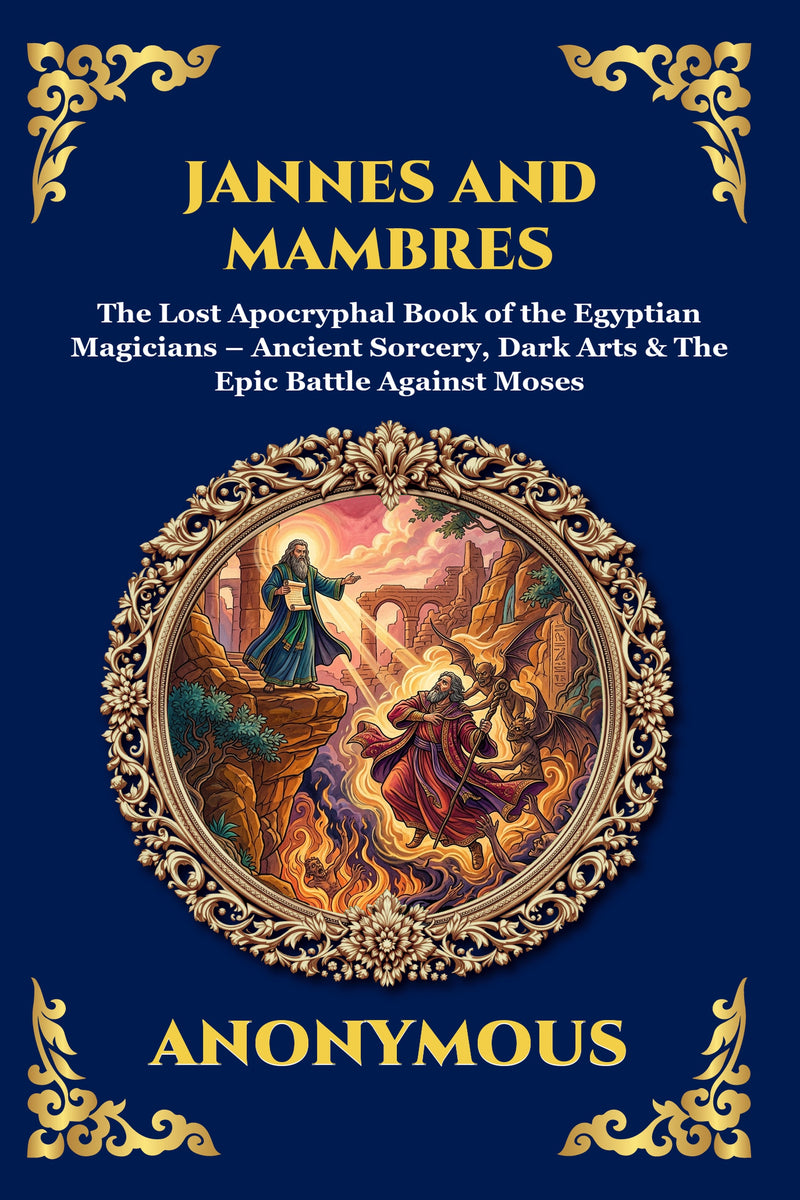
Jannes and Mambres
Jannes and Mambres, the sorcerers who challenged Moses, find their full story revealed in this ancient manuscript. Once omitted from the biblical canon, it chronicles their rise and fall, offering a rare glimpse into the spiritual battles of Pharaoh's court.
or free app
10,000+ hrs library
30-day guarantee
The complete Book of Jannes and Mambres—the Egyptian magicians who opposed Moses (referenced in 2 Timothy 3:8)—is available in modern English translation online with audiobook narration for members.
The Book of Jannes and Mambres reveals the untold story of Pharaoh's magicians who opposed Moses in ancient Egypt. This gripping piece of ancient apocryphal literature shifts the focus from the triumphant Israelites to their mystical adversaries.
In the shadows of the canonical Exodus story lies a fascinating and terrifying legend. The Book of Jannes and Mambres is a gripping piece of ancient apocryphal literature that shifts the focus from the triumphant Israelites to the tragic, doomed figures of Pharaoh’s greatest sorcerers. For centuries, Jannes and Mambres have been referenced in passing as the ultimate symbols of false prophecy and occult power. Now, this translated text brings their full, harrowing story into the light.
This ancient manuscript provides a front-row seat to the epic spiritual warfare waged in the courts of Egypt. It details the dark sorceries the brothers employed, their initial successes in mimicking divine miracles, and the terrifying moment they realized their magic was useless against the Creator. Furthermore, the text plunges into the afterlife, recounting the chilling descent of the magicians into the underworld.
Blending ancient mythology, theological warning, and dark supernatural drama, this text expands our understanding of biblical history and the human condition.
What You Will Discover in This Text
- The Epic Confrontation — Witness the legendary clash between the dark arts of Egypt and the divine miracles of Moses.
- The Secrets of Egyptian Sorcery — Explore the ancient world's perception of magic and curses.
- The Descent into the Underworld — Follow the tragic fate of the magicians as they face judgment beyond the grave.
- Timeless Moral Lessons — Learn truths about the dangers of hubris and the inevitability of divine justice.
Step into the shadows of ancient Egypt and discover the lost tale of the magicians who dared to fight God. Begin your journey today.
| Formats | eBook (EPUB + PDF) · Audiobook · Paperback · Hardcover · Large Print |
| Language | English |
| Trim size (print) | 6 × 9 in |
| Binding | Paperback — perfect-bound · Hardcover — casewrap |
| Large Print edition | Same text in a larger, easy-read type — a larger font, not a larger trim |
| Print pricing | Every physical book at our true cost — at-cost, no profit (members) |
| Library | 873 restored titles, always growing |
| Length | 3,260 words · ~13 min reading |
| Reading level | Grade 8 · clear and comfortable (this modern-English edition) |
| Edition | Modern English translation · 2026 |
Member reviews for this edition are collected as readers finish it — be the first. Across the library: 12,000+ books shipped, every plan covered by a 365-day print guarantee.
About this edition
The complete, unabridged text in clear modern English — faithful to the original, never simplified. Every paragraph is checked against the source, so nothing is cut, summarised, or paraphrased away. It reads cleanly for today while keeping the original meaning intact.
- Complete & unabridgedVerified paragraph by paragraph against the source — never a scan, never abridged.
- Modern English, faithfulReadable today, with the author’s meaning kept intact. Readable — not simplified.
- Every format, one membershipRead in your browser or the free app, or listen to the full audiobook.
Included free with your membership
Cancel anytime, one click · 30-day money-back guarantee
Edition last updated June 2026
What’s inside
Jannes and Mambres — complete and unabridged: all 10 sections included with membership, plus the full audiobook.
Begin reading Jannes and Mambres
In clear modern English — the complete text is included with membership.
Chapter 1
In the days when the children of Israel groaned under their bondage in Egypt, there were two brothers who stood among the greatest of Pharaoh's servants. Their names were Jannes and Mambres, and they were magicians of surpassing skill, learned in all the secret arts of Egypt, versed in the hidden writings and the ancient mysteries that had been passed down through generations of wise men. No others in all the land could rival them in the working of signs, and Pharaoh kept them close to his throne as men who could bend the hidden forces of the world to his will.
They had grown up in the shadow of power, drinking deep of Egyptian wisdom as young men drink water in the heat of the day. They knew the movements of the stars and the properties of herbs and stones. They knew the words that could compel spirits and the rites by which a man might look beyond the veil of ordinary sight. All the learning of Egypt was theirs, and they were proud of it, for they had earned their pride through long years of study and discipline.
When Jannes spoke, the other magicians fell silent and listened. When Mambres worked a sign, men marveled and drew back in awe. Together they were the twin pillars of Pharaoh's occult power, and they believed that no force in heaven or earth could overcome what they had mastered.
Chapter 2
Then came the day when a man appeared before Pharaoh's court unlike any other. His name was Moses, the son of Amram, and he came with his brother Aaron at his side. Moses had been raised in the very house of Pharaoh, and he knew the tongue of Egypt well, having drunk in all the wisdom of that land in his youth. Yet there was something about him now that was different from anything the men of Egypt had known before. In the face of Moses burned something the magicians could not name — a brightness that surpassed the light of the sun and of lightning, so that those who fixed their eyes upon him thought they were looking at a god.
Yet he was also a man, and a stammering man at that, one who stuttered when he spoke, and this gave some among the Egyptians cause to despise him. The court was divided. Some who heard his words and saw the light upon him said that he had surely come down from heaven. Others dismissed him entirely, saying that if there were any great power in him, he would at least have healed his own tongue. So the men of Pharaoh's court argued among themselves, and Pharaoh himself, when he first looked upon Moses, felt a trembling pass through him that he could not explain, like a man standing at the edge of a great drop.
Moses came before Pharaoh and declared the command of God: that the children of Israel were to be released from their bondage and allowed to go free. When Pharaoh heard this, rage rose up in him and he turned to blasphemy, for he was a king who had never been commanded by any power he acknowledged above himself. The news spread through the city and reached the ears of the nobles, and among them there were some who said quietly that this was the command of God and must be obeyed whatever the cost. But Pharaoh would not hear it.
Instead he summoned his magicians. He called them all together, Jannes and Mambres foremost among them, and spoke to them plainly. The time had come, he said, for them to put forth whatever power they possessed for the common good. When war comes, mighty men are needed. When disease spreads, the skill of physicians is required. And now, when this stammering man from the wilderness threatened the dignity of Egypt before all the world, the skill of the magicians was what was needed. They were not to let Egypt be shamed.
Chapter 3
Jannes and Mambres heard their king and were not afraid. They had faced difficult challenges before and had always prevailed. They conferred together in low voices, reviewing what they knew, calling to mind the deepest arts they had been taught. Then they stepped forward, ready to meet whatever Moses and Aaron might do.
Aaron cast down his rod before Pharaoh, and it became a serpent. The court murmured. But Jannes and Mambres cast down their own rods, and these also became serpents, writhing on the floor of the great hall. The courtiers breathed again. Yet even as they watched, Aaron's serpent swallowed the serpents of the magicians, and a silence fell over the room that no one quite knew how to break.
Pharaoh hardened his heart and would not let the people go.
Then Moses and Aaron went to the river, and at the word of God the waters of Egypt turned to blood. The fish died, the river stank, and the Egyptians could not drink from it. But Jannes and Mambres worked their arts and did likewise with what water remained to them, and Pharaoh told himself that his magicians were the equal of Moses. He turned away, went into his house, and would not listen.
When frogs came up out of the waters and covered the land, Jannes and Mambres again matched the sign, calling up more frogs by their enchantments. They stood before Pharaoh with steady faces and assured him that the power of Egypt's wisdom was not broken.
But then came the gnats, rising from the dust of the earth at Aaron's word until they covered man and beast throughout all the land. Jannes and Mambres labored at their arts. They spoke their words and performed their rites, but the gnats would not come at their calling. They tried again, and again nothing answered them. At last they looked at one another, and then they looked at Pharaoh, and they said what they had never expected to say: this is the finger of God.
They said it quietly, and Pharaoh did not want to hear it, and he hardened his heart again. But Jannes and Mambres had said it, and the words could not be unsaid.
Chapter 4
Yet even having said it, they did not turn away from Pharaoh's service. Pride is a deep root, and it does not come up easily even when a man has seen something that should humble him. Jannes and Mambres told themselves that they had been honest in acknowledging what they could not do, and that this honesty was itself a kind of wisdom. They told themselves that the God of Moses was powerful, yes, but that they were still the greatest of men in their own art, and that their art still had value, and that Pharaoh still needed them.
So they remained at court while the plagues fell upon Egypt one after another. They watched the swarms of flies, the death of the livestock, the darkness that could be felt. They watched Pharaoh negotiate and then refuse, promise and then harden himself again. And through it all they remained, because they did not know what else to be if they were not what they had always been.
The whole multitude of the magicians of Egypt had gathered to see a new marvel when Moses first appeared, and many of them had gone away again when the contest turned against them. But Jannes and Mambres stayed. They were wiser than all the others, or so they believed, and their wisdom told them that to flee was beneath them. They had withstood Moses and Aaron. They had matched some of the signs. They had not been entirely defeated, or so they told themselves in the long nights when the sound of Egyptian mourning drifted through the darkness.
The righteousness of God, however, is patient with deceivers only until the appointed time. The Truth bears long with those who resist it, waiting for them to repent. But when men grow puffed up and think themselves safe in their defiance, then the hour of reckoning comes upon them suddenly, and they are cast down.
Chapter 5
Moses stretched out his hand toward the sky, and boils broke out on man and beast throughout all Egypt — festering sores that the magicians could not stand before, for the sores were upon them also. Jannes and Mambres, who had stood so long in Pharaoh's hall with their heads high, could not even present themselves before Moses, for the boils were upon them as upon every other Egyptian.
But Moses did not stop there. He struck Jannes and Mambres with sores beyond what the other Egyptians suffered, for they had been the chief instruments of resistance, the men who had most deliberately set themselves against the word of God. And the mother of one of them was taken in that time of judgment, removed from the world in the reckoning that fell upon those who had hardened themselves against what they knew to be true.
Jannes bore his suffering in silence at first, as a proud man does. He lay in his chamber and endured the pain and told himself it would pass. But it did not pass. The sores worsened, and fever came with them, and Jannes began to understand that he was dying. He had been the wisest of all the magicians of Egypt. He had known more than any other man of the hidden arts. He had stood before Pharaoh and before Moses and had not flinched. And now he was lying on his bed, burning with fever, and all his wisdom could do nothing for him.
In those last days, as the life ebbed out of him, Jannes thought about what he had done and what he had refused to do. He had seen the finger of God. He had said so himself, with his own mouth. He had known, in the moment when his arts failed against the gnats, that he was in the presence of something that no human skill could match. And yet he had stayed. He had gone on serving Pharaoh. He had gone on telling himself that his wisdom and his art still mattered, even after he had seen that they did not matter against the power that moved through Moses.
He had been wiser than all the wise men of Egypt, and his wisdom had not been enough, because he had used it in the wrong service. He had withstood Moses and Aaron, who did great signs and wonders, and he had done so not out of ignorance but out of pride. He had known better, and he had chosen worse. This was the thought that lay heaviest on him as the fever burned.
Jannes died in his chamber, and his brother Mambres closed his eyes and mourned for him with a grief that had no bottom to it, for Mambres had loved his brother above all other things in the world.
Chapter 6
Mambres sat with his grief for many days. He went through the motions of living — he ate when food was brought to him, he slept when exhaustion overcame him — but his mind was always with Jannes. They had been together from the beginning. Everything Mambres knew of the magical arts, he had learned alongside his brother. Every triumph they had shared, every moment of pride before Pharaoh's court, every night of study over the ancient books — all of it had been the two of them together. And now Jannes was gone, and Mambres did not know how to be alone.
He thought about where Jannes was. He had spent his life studying the hidden things, and among those hidden things was the knowledge of what lies beyond death. He knew that the soul does not simply cease when the body fails. He knew that there are places where the dead go, and he knew something of the arts by which the living might reach across that boundary and speak with those who had passed beyond it.
He had never used those arts for himself before. He had used them in Pharaoh's service, for purposes of power and knowledge. But now he thought of using them for something else entirely — to hear his brother's voice one more time, to know that Jannes had not simply gone into silence, to ask him what it was like on the other side of death.
He told himself that this was love, and it was. But it was also the old habit of a man who had always reached for hidden knowledge when he was afraid, who had always turned to his art when the world became too much to bear.
Chapter 7
Mambres went to the place where Jannes had kept his most secret possessions. There were the magical books of his brother — the great volumes in which Jannes had recorded everything he had learned and discovered over a lifetime of study. These were not books that anyone else had ever been permitted to read. Jannes had guarded them jealously, for they contained the deepest of his arts, the knowledge that had made him the greatest magician in Egypt.
Mambres opened them.
Cancel anytime, one click · 30-day money-back guarantee
Founding annual rate available now — your price locks for life when you join.
Not ready? Get this free chapter by email — read it anytime.
✓ Sent — check your inbox for Jannes and Mambres.
Questions about Jannes and Mambres
Who were Jannes and Mambres in biblical tradition?
Jannes and Mambres are named in 2 Timothy 3:8 as the Egyptian magicians who opposed Moses before Pharaoh. While the Bible mentions them briefly, later Jewish and Christian traditions developed extensive legends about these figures.
Why was the Book of Jannes and Mambres excluded from the biblical canon?
The Book of Jannes and Mambres was composed later than the biblical period and was considered apocryphal by early Christian authorities. It focuses on the antagonists rather than supporting core biblical narratives about Moses and the Exodus.
Is Jannes and Mambres free to read?
The opening of the text is free to read below. Members read and listen to the complete work — and the entire Lost & Forbidden Library — free.
What is Jannes and Mambres?
Have you ever wondered why the greatest magicians of ancient Egypt failed to stop the Exodus, and what truly happened to them after their ultimate defeat? In the shadows of the canonical Exodus story lies a fascinating and terrifying legend.
How long is Jannes and Mambres?
10 chapters (~3,273 words) in this restored edition.
Which formats are available?
eBook and audiobook (included with membership), plus paperback, hardcover and large-print editions printed at cost.
Shipping & returns
Billing & membership
More from the library


Explore The Lost & Forbidden Library
- 1 Enoch · Attributed to Enoch
- 1–4 Maccabees · Various Jewish authors
- 2 Baruch · Attributed to Baruch
- 2 Enoch · Attributed to Enoch
- 2 Esdras · Attributed to the prophet Ezra
- 3 Baruch · Attributed to Baruch ben Neriah
- 4 Baruch · Attributed to Baruch ben Neriah
- A Valentinian Exposition · Attributed to a follower of Val...
- Acta Archelai · Attributed to Hegemonius
- Acts of Andrew · Anonymous (Early Christian Apoc...
- Acts of Andrew and Matthias in the City of the Cannibals · Attributed to early Christian a...
- Acts of Barnabas · Attributed to John Mark
- Acts of Bartholomew
- Acts of John · Anonymous (Early Christian Apoc...
- Acts of Matthias · Anonymous early Christian writers
- Acts of Paul · Attributed to an unknown early ...
- Acts of Paul and Thecla · Attributed to Onesiphorus
- Acts of Peter
- Acts of Peter and Andrew · Attributed to various early Chr...
- Acts of Peter and Paul · Attributed to Leucius Charinus
- Acts of Peter and Simon · Attributed to Leucius Charinus
- Acts of Peter and the Twelve Apostles · Attributed to early Christian a...
- Acts of Philip · Anonymous (Early Christian Apoc...
- Acts of Pilate (Gospel of Nicodemus) · Attributed to various early Chr...
- Acts of Saturninus
- Acts of Thaddaeus · Attributed to Thaddaeus the Apo...
- Acts of Thomas
- Acts of Titus · Anonymous early Christian writer
- Acts of Xanthippe, Polyxena, and Rebecca
- Allogenes · Anonymous (Early Gnostic Mystic)
Jannes and Mambres
Jannes and Mambres
The Egyptian Magicians Who Withstood Moses — A Modern Reconstruction from the Surviving Fragments
Library of Alexandria Press
Jannes and Mambres
© Copyright 2026 Library of Alexandria Press. All rights reserved.
Published by Library of Alexandria Press
Printed in the United States of America
It is not legal to copy, share, or send any part of this document in either digital or printed form without written permission from the publisher, except short quotes in a book review.
Table of Contents
Introduction
Chapter 1
Chapter 2
Chapter 3
Chapter 4
Chapter 5
Chapter 6
Chapter 7
Chapter 8
Chapter 9
Introduction
There are books that survive the centuries through sheer force of institutional will — copied by monks, preserved in cathedral libraries, defended by councils and creeds. And then there are books that survive despite everything: despite condemnation, despite deliberate destruction, despite the slow erosion of time and indifference. The text you are about to encounter belongs emphatically to the second category. It is a work that was read by early Christians, debated by rabbis, cited by church fathers, and yet was never admitted into any canon. It circulated in fragments, whispered about in commentaries, referenced in letters between scholars who had heard of it but could not quite lay their hands on a complete copy. For well over a thousand years, it was effectively lost. What has been reconstructed — painstakingly, from papyrus fragments, from quotations embedded in other texts, from the traces it left in the literary imagination of late antiquity — is one of the most extraordinary documents to emerge from the ancient world.
To understand why this particular work matters so profoundly, you need to begin not with the text itself but with a single line buried in the New Testament. In the second letter to Timothy, the apostle Paul reaches for a historical analogy to describe false teachers who corrupt the minds of the faithful. He writes: 'Just as Jannes and Jambres opposed Moses, so these men also oppose the truth.' The reference is casual, almost offhand — the kind of allusion a writer makes when he assumes his readers will immediately recognize the names. And yet those names appear nowhere in the Hebrew Bible. Nowhere in the Torah, in any of its accounts of Moses confronting Pharaoh, in any of the plagues and wonders and contests of power that define the Exodus narrative, do we find Jannes and Jambres. They are the anonymous magicians of Pharaoh's court, the men who replicated Moses's miracles and then failed to replicate them, who are described simply as 'the sorcerers of Egypt' without ever being named. Paul names them as though everyone knows who they are. Which means that in the first century of the common era, everyone did.
This is the first great mystery surrounding this lost apocryphal work: the existence of a fully developed tradition about these two figures that ran parallel to the biblical text for centuries, never entering scripture but never disappearing either. Jewish tradition, drawing on sources we can only partially reconstruct, had given names, personalities, backstories, and fates to the magicians who challenged Moses. By the time Paul wrote his letter, Jannes and Jambres were not obscure footnotes — they were cultural touchstones, figures whose story was apparently well enough known that a single allusion could carry enormous rhetorical weight. And somewhere in that tradition, a text existed. A book. An account of who these men were, what they did, what happened to them, and what it all meant.
The reconstruction of that book is a detective story that spans nearly two millennia of scholarship, and it is a story worth telling in some detail before you encounter the text itself. Because understanding how this work was lost, how traces of it survived, and how modern scholars have pieced those traces back together will fundamentally change the way you read what follows. This is not simply an ancient curiosity. It is a window into an entire world of religious imagination that existed alongside the canonical scriptures, that shaped how millions of people in the ancient Mediterranean understood the nature of magic, the limits of human power, the justice of God, and the ultimate fate of those who set themselves against the divine will.
The ancient world was saturated with texts that did not make it into any official collection of sacred writings. Judaism in the Second Temple period — roughly the five centuries before the destruction of the Temple in 70 CE — was extraordinarily fertile in its production of religious literature. The works we call the Pseudepigrapha, the writings attributed to ancient figures like Enoch, Abraham, Moses, and the patriarchs, represent only a fraction of what was actually written and circulated. Many texts are known only by title, referenced in other works that themselves survive only partially. Many more have been entirely lost, leaving no trace at all. The recovery of the Dead Sea Scrolls in 1947 dramatically expanded our sense of just how rich and varied this literary world was — and how much of it remains unknown to us. The account of Jannes and Jambres belongs to this broader phenomenon of Jewish apocryphal literature, texts that were cherished, read, argued over, and eventually either suppressed or simply forgotten as the boundaries of canon hardened.
Early Christianity inherited this rich apocryphal tradition and added to it prolifically. The first several centuries of the common era saw an explosion of texts purporting to fill in the gaps left by canonical scripture — gospels, acts, epistles, apocalypses, and narrative expansions of Old Testament stories. Some of these texts were eventually condemned as heretical. Others simply faded from view as the church consolidated its scriptural inheritance. But many of them continued to circulate on the margins, read by monks and scholars who were drawn to their imaginative richness even when they were skeptical of their authority. The text concerning the two Egyptian magicians occupied exactly this ambiguous space: too interesting to be entirely ignored, too unorthodox to be officially embraced.
What makes the story of Jannes and Jambres so compelling to ancient readers — and, I would argue, to modern ones as well — is that it does something the canonical Exodus narrative conspicuously does not do. It tells the story from the other side. The Book of Exodus is, among many other things, a story about power: the power of a God who will not be mocked, the power of a leader chosen against his own will to confront the greatest empire of the ancient world, the power of a people to endure suffering and emerge transformed. The magicians of Pharaoh's court appear in that story as obstacles, as foils, as evidence that the wonders Moses performs are not mere conjuring tricks. They replicate the staff-into-serpent, the water-into-blood, the plague of frogs. And then they cannot replicate the lice, and they say to Pharaoh, 'This is the finger of God,' and they disappear from the narrative entirely. We never learn what happens to them. We never learn what they thought, what they felt, whether they suffered the plagues along with the rest of Egypt, whether they lived or died. The canonical text has no interest in them as people. They are props in someone else's story.
The apocryphal tradition refused to accept this. It was fascinated by these men precisely because they were on the wrong side — because they were skilled, because they were powerful, because they came close enough to matching Moses that the confrontation was genuinely dramatic, and because their ultimate failure raised profound questions about the nature of the dark arts they practiced. What is the difference between the power Moses wields and the power the magicians wield? Is it simply a matter of which deity stands behind the practitioner? Or is there something fundamentally different about the two kinds of power — something that means one must ultimately prevail over the other? And what does it mean for a man of genuine ability, a man who has devoted his life to mastering arcane knowledge, to encounter something that defeats him utterly? These are not trivial questions. They go to the heart of how ancient people understood the relationship between human skill and divine authority, between learned technique and genuine miracle, between the impressive and the truly sacred.
The Fragments and Their Finders
The physical survival of this text is itself a remarkable story. The most important material evidence comes from a Greek papyrus discovered in Egypt — a discovery that, like so many of the great papyrological finds of the nineteenth and early twentieth centuries, came about through a combination of scholarly expedition, local trade, and a fair measure of luck. The Chester Beatty papyri, acquired by the American mining magnate and collector Alfred Chester Beatty in the 1930s, contained among their number a fragmentary Greek text that scholars recognized as belonging to the tradition of Jannes and Jambres. The papyrus dates to approximately the third or fourth century of the common era, making it one of the oldest surviving witnesses to a text that was almost certainly composed several centuries earlier. It is incomplete, damaged, frustrating in the gaps it leaves — but it is unmistakably a narrative text, and it is unmistakably about the two Egyptian magicians.
The papyrus fragments give us portions of what appears to be a continuous narrative, written in the kind of Greek that was the common literary language of the eastern Mediterranean world in the Hellenistic and early Roman periods. This is not the elevated Greek of classical literature, but neither is it crude or unsophisticated. It is the Greek of educated people who were writing for other educated people, people who knew their Homer and their Jewish scriptures and who moved comfortably between the two cultural worlds that defined the intellectual life of Alexandria and the other great cities of the ancient Near East. The text shows signs of having been composed originally in a Semitic language — Hebrew or Aramaic — and translated into Greek, though scholars debate the details of this question. What is clear is that it belongs to the same literary world as works like the Wisdom of Solomon, the Letter of Aristeas, and the various Jewish novels and histories that were produced in the centuries around the turn of the common era.
Beyond the papyrus, the text survives in a remarkable variety of indirect forms. The church father Origen, writing in the third century, refers to a 'Book of Jannes and Jambres' as a text that was widely known and read, though he is careful to note its non-canonical status. The Gelasian Decree, a Latin document associated with the early medieval church that lists texts considered apocryphal or heretical, includes 'the book which is called the Penitence of Jannes and Mambres' — using the variant spelling of the second name that appears in some traditions. This reference is particularly intriguing because it suggests that the text, or at least one version of it, had a specific focus on the theme of repentance: that one or both of the magicians ultimately came to recognize the error of their ways and sought some form of reconciliation with the divine power they had opposed. The Talmud and various midrashic texts contain passages that clearly draw on the same tradition, giving us glimpses of how the story was understood and developed within rabbinic Judaism. The Damascus Document found among the Dead Sea Scrolls mentions the two magicians by name, confirming that the tradition was well established within Judaism by at least the first century BCE.
What emerges from this mosaic of references and fragments is a picture of a text that was genuinely influential in the ancient world — not a marginal curiosity but a work that shaped how educated people in the Mediterranean basin thought about the Exodus story and its implications. The fact that it was eventually lost, or rather that it survived only in these scattered traces, tells us something important about the process by which religious canons are formed and enforced. Texts that challenge the neat moral architecture of canonical narrative — that ask us to sympathize with the antagonists, that explore the inner lives of those who serve the wrong side — tend to make religious authorities uncomfortable. The story of Jannes and Jambres was not condemned because it was theologically dangerous in the way that Gnostic texts were condemned. It was simply too complicated, too willing to take the magicians seriously as human beings, to fit comfortably into a tradition that needed its heroes and villains clearly distinguished.
The scholarly work of reconstruction has been painstaking and ongoing. Albert Pietersma, whose critical edition of the papyrus fragments remains the essential scholarly reference, spent years working through the damaged Greek text, comparing it with the indirect witnesses, and attempting to establish what the original document might have looked like. His work, and the work of other scholars who have built on it, has given us something that is genuinely remarkable: not a complete text, but a substantially reconstructed one, with enough of the narrative intact to give a real sense of the work's scope, its literary quality, and its theological concerns. The gaps remain, and any honest presentation of this material must acknowledge them. But the reconstruction is rich enough to support genuine literary and historical analysis — and, more importantly for the reader who is about to encounter it, rich enough to be genuinely gripping.
One of the most fascinating aspects of the reconstructed text is what it reveals about the ancient understanding of magic and its relationship to legitimate religious practice. The world of the ancient Near East was one in which the boundary between magic and religion was porous in ways that are difficult for modern readers to fully appreciate. The practices we call magical — the use of ritual formulas, sacred objects, specialized knowledge, and invocations of divine or supernatural powers to achieve specific ends — were not categorically distinct from what we call religious practice. They were part of a continuum of techniques for engaging with the invisible powers that governed the world. What distinguished legitimate religious practice from illegitimate magic was not primarily a matter of technique but of authorization: whose power did you invoke, and were you authorized to invoke it? Moses and the magicians of Pharaoh's court were, in this sense, engaged in the same basic kind of activity. The difference was that Moses acted with the explicit authorization of the God of Israel, while the magicians drew on other sources of power — sources that the text, naturally, regards as inferior and ultimately impotent.
But the apocryphal tradition was not content with this simple contrast. It was interested in the magicians as practitioners, as men who had spent their lives developing genuine expertise in the arcane arts of Egypt, who understood the deep structures of the invisible world in ways that most people did not, and who encountered in Moses something that their expertise could not account for. This is a much more interesting theological position than the one the canonical text implies. It does not simply say that Moses's God is more powerful than the gods the magicians serve. It explores what it actually feels like to be on the receiving end of that superior power — the confusion, the denial, the gradual and terrible recognition that you are dealing with something categorically different from anything you have encountered before.
The text also engages with questions about fate, death, and what lies beyond it. Ancient accounts of necromancy — the attempt to communicate with or summon the dead — appear to play a role in the narrative, and this connects the work to a broader tradition of ancient literature concerned with the permeability of the boundary between the living and the dead. The underworld traditions of Egypt, Greece, and the Near East all contributed to the imaginative world in which this text was composed, and the result is a work that is genuinely syncretic in the best sense: it draws on multiple traditions to create something that is richer and stranger than any single tradition could have produced on its own.
Why This Story Still Matters
It would be easy to present this text as a purely historical artifact — an interesting document that tells us something about ancient religious culture but has no particular claim on our attention today. That would be a serious mistake. The questions this work raises are not questions that belong to the ancient world alone. They are questions about power and its limits, about the relationship between skill and grace, about what happens to people who devote themselves to the wrong cause with genuine dedication, about whether redemption is possible for those who have spent their lives in the service of darkness. These are questions that every generation has to answer for itself, and the ancient text addresses them with a directness and a psychological acuity that remains startling.
Consider what it means to build your identity around a form of expertise and then discover that your expertise is inadequate. The magicians of Pharaoh's court were not charlatans. The text is clear about this, and it is one of the things that makes the narrative so compelling. They were skilled men, trained in traditions that had real power, capable of genuine wonders. When they first encounter Moses, they can match him. They are not immediately overwhelmed. The contest is real. And this is precisely what makes their eventual failure so devastating — not just strategically, not just politically, but existentially. Their entire understanding of how the world works, of what power is and where it comes from and how it can be obtained and wielded, is called into question by what they witness. The text explores this crisis with remarkable sensitivity, and in doing so it speaks to something that is not at all limited to ancient Egyptian magicians: the experience of having your fundamental assumptions about reality overturned by an encounter with something you cannot explain.
There is also the question of complicity. Jannes and Jambres serve Pharaoh, and Pharaoh is, in the Exodus narrative, one of the great villains of world literature — a man whose hardness of heart leads to the suffering and death of his own people, who refuses again and again to acknowledge what is plainly before him. The magicians are part of his apparatus of power. They are, in a real sense, complicit in the oppression of the Israelites, in the resistance to the divine will, in the catastrophe that unfolds over the course of the plagues. And yet the apocryphal tradition does not simply condemn them. It asks what it means to serve a system of power that you did not create, to be embedded in structures of authority and expertise that you inherited, to find yourself on the wrong side of history not through any single dramatic choice but through a thousand small accommodations and assumptions. This is a question with obvious contemporary resonance, and the ancient text addresses it with more nuance than we might expect.
The theme of repentance — signaled by the title preserved in the Gelasian Decree — adds another layer of complexity. If one or both of the magicians ultimately seeks reconciliation with the divine, what does that look like? Can a man who has spent his life practicing the dark arts, who has served a tyrant, who has actively worked to prevent the liberation of an enslaved people, find forgiveness? The text apparently believed that this question was worth taking seriously, and its willingness to take it seriously places it in conversation with some of the deepest currents of religious thought in the ancient world. The Jewish and Christian traditions both have profound things to say about the possibility of repentance and transformation, and this work engages with those themes in ways that are neither simple nor sentimental.
There is something else worth noting about the particular moment in history when this text was composed and circulated. The centuries around the turn of the common era were a time of intense anxiety about magic — about who had the right to perform it, what distinguished legitimate religious practice from dangerous sorcery, and how ordinary people could protect themselves from practitioners of the dark arts. The Roman world was full of magicians, and Roman law periodically attempted to regulate or suppress magical practice, with limited success. Jewish and early Christian communities were deeply concerned about the boundary between genuine miracle and mere magic, between the power of God and the power of demons. A text that explored these questions through the story of the most famous magical contest in the Hebrew scriptures was not engaging in idle antiquarianism. It was speaking directly to the concerns of its contemporary audience.
The Egyptian setting of the story adds yet another dimension. Egypt was, in the ancient imagination, the homeland of magic — the place where the deepest and most dangerous arcane knowledge had been developed and preserved. The Greek magical papyri, a remarkable collection of ritual texts from Roman Egypt, give us a vivid sense of how this tradition actually looked in practice: a complex blend of Egyptian, Greek, Jewish, and other elements, drawing on multiple divine names and ritual techniques in an eclectic pursuit of power. The magicians of Pharaoh's court, as imagined by the apocryphal tradition, are heirs to this tradition — men who stand at the apex of the most sophisticated magical culture in the ancient world. When Moses defeats them, he is not defeating provincial sorcerers. He is defeating the best that human magical knowledge can produce. The theological point could not be made more dramatically.
Reading this reconstructed text today requires a particular kind of imaginative generosity. You are reading something that is genuinely ancient, that comes from a world with assumptions and values quite different from our own, that was written for an audience whose religious and cultural context we can only partially reconstruct. You are also reading something that is incomplete — a work preserved in fragments, with gaps that scholars have done their best to bridge but that remain real. And you are reading something that was, for most of its history, hidden: not part of the official record, not transmitted through the great institutional channels that preserved the canonical scriptures, but surviving in the margins and the shadows, in damaged papyri and passing references, in the memory of scholars who had heard of it without quite being able to find it.
All of this is part of what makes the experience of reading it so extraordinary. There is a particular quality of attention that ancient texts demand — a willingness to slow down, to sit with difficulty and ambiguity, to resist the urge to impose modern categories on ancient materials. But there is also, when you read a text like this, a genuine thrill of discovery. You are encountering something that most people in the modern world have never read, something that was known to Paul and Origen and the rabbis of the Talmud and the monks who compiled the Gelasian Decree, something that shaped the religious imagination of the ancient Mediterranean world and then disappeared from view for centuries. That is not a small thing. That is an encounter with a lost world.
The story of Jannes and Jambres is, at its core, a story about what happens when human power confronts something greater than itself. It is a story about the limits of knowledge, the inadequacy of technique, the vulnerability of pride, and the strange mercy that can be found even in defeat. It is a story that the ancient world felt compelled to tell, even though — perhaps because — it was not the story that the official texts authorized. And it is a story that, once you have read it, you will find yourself thinking about in unexpected contexts: in moments when your own expertise fails you, when the frameworks you have built to understand the world turn out to be insufficient, when you find yourself on the wrong side of something larger than you anticipated.
The text that follows is the product of centuries of transmission, fragmentation, and scholarly reconstruction. It bears the marks of all those processes — the gaps, the uncertainties, the places where the papyrus is too damaged to read and the scholars must make their best guesses. But it also bears the marks of its original composition: the vivid characterization, the theological seriousness, the narrative drive, the willingness to ask uncomfortable questions. It is, in the fullest sense of the word, a discovery — and the experience of reading it is unlike the experience of reading any other ancient text. Prepare yourself for something strange, something powerful, and something that has been waiting a very long time to be read.
Jannes and Mambres
Chapter 1
In the days when the children of Israel groaned under their bondage in Egypt, there were two brothers who stood among the greatest of Pharaoh's servants. Their names were Jannes and Mambres, and they were magicians of surpassing skill, learned in all the secret arts of Egypt, versed in the hidden writings and the ancient mysteries that had been passed down through generations of wise men. No others in all the land could rival them in the working of signs, and Pharaoh kept them close to his throne as men who could bend the hidden forces of the world to his will.
They had grown up in the shadow of power, drinking deep of Egyptian wisdom as young men drink water in the heat of the day. They knew the movements of the stars and the properties of herbs and stones. They knew the words that could compel spirits and the rites by which a man might look beyond the veil of ordinary sight. All the learning of Egypt was theirs, and they were proud of it, for they had earned their pride through long years of study and discipline.
When Jannes spoke, the other magicians fell silent and listened. When Mambres worked a sign, men marveled and drew back in awe. Together they were the twin pillars of Pharaoh's occult power, and they believed that no force in heaven or earth could overcome what they had mastered.
Chapter 2
Then came the day when a man appeared before Pharaoh's court unlike any other. His name was Moses, the son of Amram, and he came with his brother Aaron at his side. Moses had been raised in the very house of Pharaoh, and he knew the tongue of Egypt well, having drunk in all the wisdom of that land in his youth. Yet there was something about him now that was different from anything the men of Egypt had known before. In the face of Moses burned something the magicians could not name — a brightness that surpassed the light of the sun and of lightning, so that those who fixed their eyes upon him thought they were looking at a god.
Yet he was also a man, and a stammering man at that, one who stuttered when he spoke, and this gave some among the Egyptians cause to despise him. The court was divided. Some who heard his words and saw the light upon him said that he had surely come down from heaven. Others dismissed him entirely, saying that if there were any great power in him, he would at least have healed his own tongue. So the men of Pharaoh's court argued among themselves, and Pharaoh himself, when he first looked upon Moses, felt a trembling pass through him that he could not explain, like a man standing at the edge of a great drop.
Moses came before Pharaoh and declared the command of God: that the children of Israel were to be released from their bondage and allowed to go free. When Pharaoh heard this, rage rose up in him and he turned to blasphemy, for he was a king who had never been commanded by any power he acknowledged above himself. The news spread through the city and reached the ears of the nobles, and among them there were some who said quietly that this was the command of God and must be obeyed whatever the cost. But Pharaoh would not hear it.
Instead he summoned his magicians. He called them all together, Jannes and Mambres foremost among them, and spoke to them plainly. The time had come, he said, for them to put forth whatever power they possessed for the common good. When war comes, mighty men are needed. When disease spreads, the skill of physicians is required. And now, when this stammering man from the wilderness threatened the dignity of Egypt before all the world, the skill of the magicians was what was needed. They were not to let Egypt be shamed.
End of the free sample
Keep reading, free
Members read and listen to the complete book — and the entire library. Cancel anytime, one click · 30-day money-back guarantee.