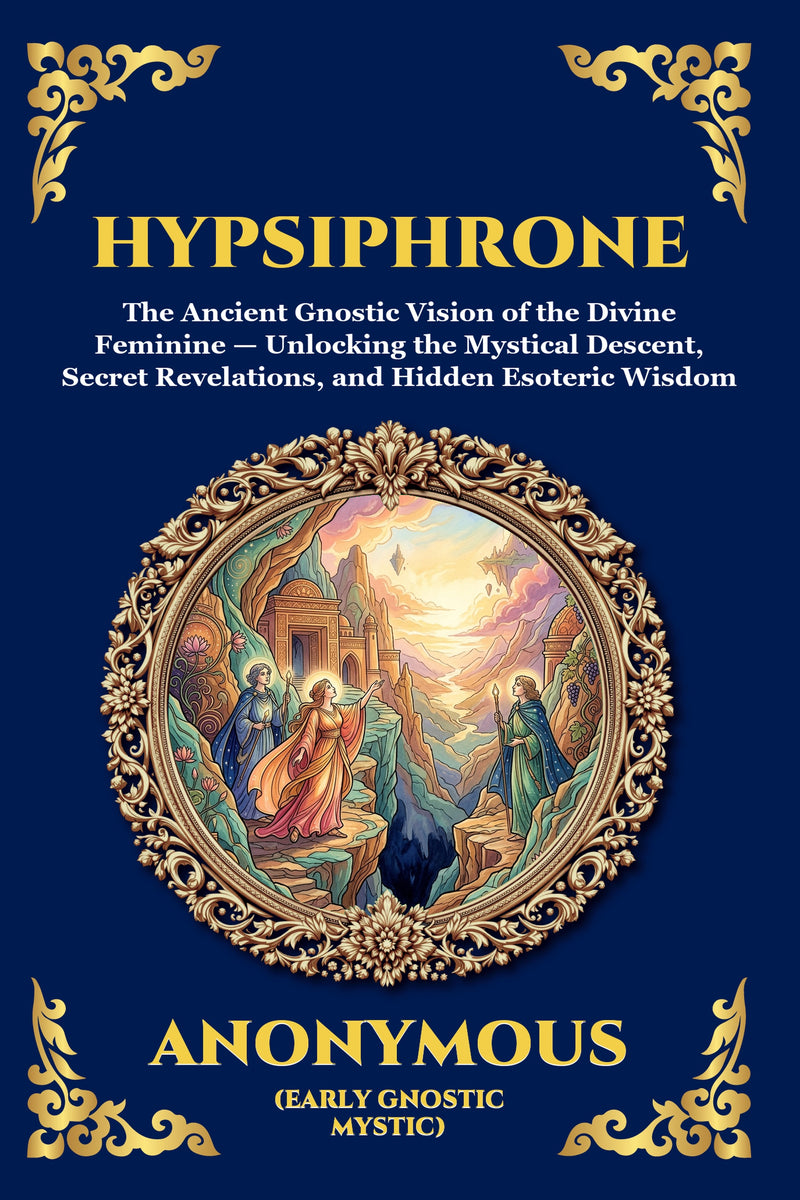
Hypsiphrone
Hypsiphrone, found in the Nag Hammadi library, explores a celestial female entity whose name means "High-Minded." This fragmented Gnostic text reveals a cosmology where divine feminine principles were celebrated, long before orthodox traditions erased these ancient spiritual nuances.
or free app
10,000+ hrs library
30-day guarantee
This fragmentary Gnostic text Hypsiphrone from the 2nd-3rd century Nag Hammadi codices offers a complete modern-English translation for online reading with included audiobook narration.
When early Christian authorities condemned Gnostic texts as heretical, the mystical treatise "Hypsiphrone" survived only in fragmentary copies hidden in desert monasteries and buried libraries.
Long before the rigid doctrines of orthodox traditions erased the nuances of ancient spirituality, early Gnostic communities celebrated a vastly different cosmology—one where the divine was expressed through both masculine and feminine principles. Hypsiphrone is a breathtaking, albeit fragmented, masterpiece of this ancient esoteric tradition. Discovered among the treasures of the Nag Hammadi library, this highly symbolic text details the journey of a celestial female entity whose very name translates to "High-Minded."
Far from being a conventional religious narrative, this manuscript is a deeply philosophical exploration of the soul's relationship to the material world. It follows the mystical descent of Hypsiphrone as she leaves the pure, unblemished realm of the divine Pleroma and enters the lower spheres of existence.
What You Will Discover in This Ancient Revelation
- The Mystery of the Divine Feminine: Explore the esoteric Gnostic teachings that elevate the feminine principle.
- The Mystical Descent of the Soul: Follow the symbolic journey of Hypsiphrone as she leaves the pure heavenly realms to bring light to the material world.
- A Window into Sethian Gnosticism: Gain a deeper understanding of the radical, deeply spiritual communities that preserved these profound visionary texts.
Step beyond the shadows of the material world and unlock the esoteric secrets of the divine feminine. Begin your journey into ancient Gnostic wisdom today.
| Formats | eBook (EPUB + PDF) · Audiobook · Paperback · Hardcover · Large Print |
| Language | English |
| Trim size (print) | 6 × 9 in |
| Binding | Paperback — perfect-bound · Hardcover — casewrap |
| Large Print edition | Same text in a larger, easy-read type — a larger font, not a larger trim |
| Print pricing | Every physical book at our true cost — at-cost, no profit (members) |
| Library | 873 restored titles, always growing |
| Composed | 2nd-3rd century AD |
| Original language | Coptic |
| Source tradition | Nag Hammadi Codex XI |
| Translation basis | Public-domain scholarly translation, rendered in clear modern English |
| Length | 2,420 words · ~10 min reading |
| Reading level | Grade 13 · rich, literary prose (this modern-English edition) |
| Edition | Modern English translation · 2026 |
Member reviews for this edition are collected as readers finish it — be the first. Across the library: 12,000+ books shipped, every plan covered by a 365-day print guarantee.
About this edition
The complete, unabridged text in clear modern English — faithful to the original, never simplified. Every paragraph is checked against the source, so nothing is cut, summarised, or paraphrased away. It reads cleanly for today while keeping the original meaning intact.
Hypsiphrone survives in Nag Hammadi Codex XI, discovered in Egypt in 1945. This edition derives from the standard scholarly translation of the Coptic fragments and renders the available text in clear modern English.
- Complete & unabridgedVerified paragraph by paragraph against the source — never a scan, never abridged.
- Modern English, faithfulReadable today, with the author’s meaning kept intact. Readable — not simplified.
- Every format, one membershipRead in your browser or the free app, or listen to the full audiobook.
Included free with your membership
Cancel anytime, one click · 30-day money-back guarantee
Edition last updated June 2026
What’s inside
Hypsiphrone — complete and unabridged: all 4 sections included with membership, plus the full audiobook.
Begin reading Hypsiphrone
In clear modern English — the complete text is included with membership.
The World That Produced This Vision
To understand any ancient text, we need to understand the world that produced it — not as a dry exercise in historical contextualization, but as an act of imaginative empathy. The people who wrote, copied, read, and treasured these Gnostic documents were not abstract historical figures. They were human beings living through a period of intense social, political, and spiritual upheaval, and the texts they produced were their attempts to make sense of that upheaval at the deepest possible level.
The Roman Empire in the first through fourth centuries CE was a world of extraordinary religious pluralism and equally extraordinary religious violence. Traditional Roman religion was losing its hold on the imagination of educated people, who were increasingly drawn to philosophical schools — Platonism, Stoicism, Neoplatonism — that offered more sophisticated accounts of the divine and the human. At the same time, the mystery religions of the East — the cults of Isis, Mithras, Cybele — were spreading throughout the empire, offering their initiates the experience of personal transformation and direct encounter with the divine. Judaism was undergoing its own traumatic transformation in the wake of the destruction of the Temple in Jerusalem in 70 CE. And the movement that would eventually become Christianity was still in the process of defining itself, still contested and multiple, still capable of producing visions of Jesus and of the divine that would later be declared heretical and suppressed.
It was in this ferment that Gnosticism flourished. And it is important to understand that the word 'Gnosticism' is itself a modern scholarly construction — a convenient label for a diverse and contested set of movements that the people involved in them would not necessarily have recognized as belonging to a single category. What they shared was less a creed than a sensibility: a conviction that the surface of things was not the truth of things, that official religion was not the whole story, that somewhere beneath or beyond the visible world there was a deeper reality that could be accessed through the right kind of knowledge, the right kind of practice, the right kind of visionary experience.
The role of the feminine in this world is one of the most fascinating and contested aspects of Gnostic studies. In many Gnostic texts, the divine feminine is not marginal but central. The highest divine realm is often understood as containing both masculine and feminine principles in perfect unity. The figure of Sophia — Wisdom, a feminine noun in Greek — plays a pivotal role in many Gnostic mythologies, as the divine being whose longing, whose error, whose fall into matter sets the whole cosmic drama in motion. In some traditions, the Holy Spirit is understood as feminine. In others, the revealer figure who brings saving knowledge to humanity is a woman, or a feminine divine being, or a figure who combines masculine and feminine in ways that challenge every conventional category.
This is the tradition into which our text steps — and in which it makes its most radical move. The revealer here is not a male prophet or apostle. She is Hypsiphrone, a figure whose very name insists on the elevation of consciousness, and whose experience of descent and revelation is narrated in the first person with an intimacy and directness that is rare in ancient religious literature. To have a feminine figure as the primary vehicle of divine revelation was not, in the Gnostic world, as unusual as it might seem to readers formed by mainstream Western religious traditions. But it was still significant. It was still a statement. It was still a way of insisting that the divine could speak through and to and as a woman — that the feminine was not a secondary or derivative category of the spiritual but a primary one.
The specific form of the text — a first-person account of visionary descent and revelation — also places it within a rich and ancient tradition of what scholars call apocalyptic literature. The word 'apocalypse' in Greek means simply 'unveiling' or 'revelation,' and apocalyptic texts are texts in which a human figure is taken up into a higher realm, or receives a visit from a divine messenger, and is shown things that are normally hidden from human sight: the structure of the heavens, the fate of the soul after death, the ultimate meaning of history, the nature of the divine itself. This tradition runs through Jewish literature — the Book of Enoch, the Book of Daniel, the Apocalypse of Abraham — and through early Christian literature — the Book of Revelation, the Apocalypse of Paul — and into Gnostic literature, where it takes on its own distinctive character.
What makes the Gnostic apocalypses distinctive is their intense focus on the inner life of the visionary, on the subjective experience of encounter with the divine, and on the transformative effect of that encounter on the consciousness of the one who undergoes it. In many Gnostic visionary texts, the journey is not primarily outward — to a heavenly throne room, to a cosmic battlefield — but inward, into the depths of the self, where the divine spark is hidden. The revelation that is received is not primarily information about external events but recognition of what the self truly is. This is gnosis in its most immediate form: not doctrine about the divine but direct experience of it.
Understanding this context — the religious pluralism of the Roman world, the Gnostic insistence on direct experiential knowledge, the tradition of apocalyptic revelation, the centrality of the divine feminine in many Gnostic systems — is essential preparation for reading the text that follows. It allows us to hear the voice of Hypsiphrone not as a bizarre anomaly from a dead and alien world, but as a recognizable human voice, asking recognizable human questions, in a language and a conceptual framework that, once we learn to read it, turns out to be surprisingly close to questions that still haunt us today.
How to Read a Broken Text
There is one more thing that needs to be said before we enter the text itself, and it concerns the nature of what we are actually dealing with when we read an ancient Gnostic document. This is not a novel. It is not a philosophical treatise with a clear argument and a logical structure. It is not a scripture in the sense that most modern readers understand that word — a fixed, authoritative, carefully preserved text whose every word has been weighed and transmitted with meticulous care. It is something stranger and more fragile than any of those things: a damaged fragment of a manuscript that was copied, probably multiple times, by scribes who may or may not have fully understood what they were copying, preserved by accident in a dry Egyptian climate, discovered by chance by a local farmer, and then passed through a series of hands — some scholarly, some not — before finally arriving in a form where it could be studied and translated.
The Coptic manuscript that contains this text is damaged. There are lacunae — gaps, holes, missing sections — where the papyrus has deteriorated and the words are simply gone. Scholars have made careful attempts to reconstruct what might have stood in those gaps, based on the surrounding context, on parallel passages in related texts, on knowledge of Coptic grammar and vocabulary and the conventions of Gnostic literature. But these reconstructions are educated guesses, not certainties. When you read a translation of this text, you are reading not just the ancient author's words but also the interpretive decisions of generations of scholars, each of whom brought their own knowledge, assumptions, and blind spots to the task.
This might seem like a reason for discouragement — why read a text that is so broken, so uncertain, so difficult to pin down? But I want to suggest that it is actually one of the most interesting things about the text, and one of the reasons why it rewards sustained attention. A broken text is an invitation to active reading. It cannot be consumed passively. It demands that you bring your own imagination and intelligence to the gaps, that you think carefully about what might have been there, that you hold your interpretations lightly and remain open to surprise. In this sense, reading a fragmentary ancient text is not unlike the kind of meditative, attentive reading that the Gnostics themselves seem to have practiced — a reading that is less about extracting information than about entering into a relationship with the text, allowing it to work on you, allowing it to open questions rather than close them.
There is also something deeply appropriate about the fact that a text concerned with hidden things, with secret revelations, with knowledge that is not available to everyone, should itself be partially hidden — that its full meaning should be partially obscured, requiring effort and attention and a willingness to sit with uncertainty. The ancient Gnostics were not, by and large, interested in making things easy. They believed that genuine knowledge required effort, that the divine did not give itself to the passive or the incurious, that the journey toward truth was exactly that — a journey, with all the difficulty and uncertainty and occasional exhilaration that the word implies.
This book is designed to be a guide on that journey. It is not a technical scholarly commentary, though it draws on the best available scholarship. It is not a work of speculative spirituality that ignores the historical and philological complexities of the text. It is an attempt to do something genuinely difficult: to hold the scholarly and the experiential together, to take the text seriously both as a historical artifact and as a living document, one that still has something to say to anyone willing to listen carefully enough.
The chapters that follow will take you through the text section by section, offering translations, explanations, and reflections that aim to make the ancient world of this vision as vivid and as intellectually accessible as possible. We will explore the cosmological framework that underlies the narrative — the hierarchy of divine beings, the structure of the heavenly realms, the nature of the fall and the possibility of return. We will examine the figure of Hypsiphrone herself in depth, asking what it means that the revealer is feminine, what her descent signifies, and what her reception of secret knowledge tells us about the Gnostic understanding of the relationship between the human and the divine. We will look at the specific language and imagery of the text — the fire and blood, the mysterious figures who appear to the visionary, the strange and beautiful names that populate the Gnostic heavens — and try to understand what these images meant to the people who first encountered them.
We will also, throughout, be asking a larger question — the question that any serious engagement with ancient religious literature eventually forces us to ask: What does this have to do with us? Not in a superficial or self-help sense, not as an excuse to project our own concerns onto an ancient text that deserves to be understood on its own terms, but in the deeper sense: What can this vision, this voice from the ancient world, tell us about the perennial human experience of feeling lost in matter, of longing for something higher, of receiving moments of unexpected illumination that seem to come from beyond the ordinary boundaries of the self? These are not questions that belong only to the ancient world. They are questions that belong to anyone who has ever lain awake at night wondering what, exactly, they are, and where, exactly, they came from.
The voice that speaks in the pages ahead is ancient, yes. It comes from a world very different from our own, shaped by assumptions and categories that we will need to learn before we can fully hear what it is saying. But underneath all of that — underneath the Coptic language and the Gnostic cosmology and the damaged papyrus and the centuries of silence — there is something recognizable. There is a human being, or a figure who speaks for something in human beings, who has undergone an experience of descent and return, of loss and revelation, of confusion and sudden, overwhelming clarity. There is someone who has been somewhere that most people never go, and who has come back with news. The news is strange. It is demanding. It does not fit easily into any of the categories we normally use to organize our understanding of the world. But it is worth hearing. It has been waiting a very long time to be heard again.
Open the text with patience. Open it with curiosity. Open it with the willingness to be surprised, to be confused, to sit with questions that do not immediately resolve into answers. This is, after all, what the ancient Gnostics themselves would have asked of you. Gnosis is not given to the passive. It is not delivered on demand. It arrives — when it arrives — to those who have prepared themselves to receive it, who have done the work of clearing away the assumptions and the certainties and the comfortable familiarity that normally insulate us from genuine encounter with the unknown. Consider this introduction the beginning of that preparation. What follows is the encounter itself.
Cancel anytime, one click · 30-day money-back guarantee
Founding annual rate available now — your price locks for life when you join.
Not ready? Get this free chapter by email — read it anytime.
✓ Sent — check your inbox for Hypsiphrone.
Questions about Hypsiphrone
What is Hypsiphrone and why was it excluded from the biblical canon?
Hypsiphrone is a fragmentary Gnostic text featuring a divine feminine figure whose name means 'High-Minded.' It was excluded from the biblical canon because it emerged from Gnostic communities whose theological perspectives differed significantly from orthodox Christianity.
How much of the original Hypsiphrone text survives?
Hypsiphrone exists only in fragments preserved in Nag Hammadi Codex XI. The surviving portions are quite limited, making it one of the more incomplete texts from the Nag Hammadi collection discovered in 1945.
Is Hypsiphrone free to read?
The opening of the text is free to read below. Members read and listen to the complete work — and the entire Lost & Forbidden Library — free.
What is Hypsiphrone?
Have you ever wondered why the earliest mystical traditions placed such profound importance on the divine feminine and the descent of celestial beings?
How long is Hypsiphrone?
4 chapters (~230 words) in this restored edition.
Which formats are available?
eBook and audiobook (included with membership), plus paperback, hardcover and large-print editions printed at cost.
Shipping & returns
Billing & membership
More from the library


Explore The Lost & Forbidden Library
- 1 Enoch · Attributed to Enoch
- 1–4 Maccabees · Various Jewish authors
- 2 Baruch · Attributed to Baruch
- 2 Enoch · Attributed to Enoch
- 2 Esdras · Attributed to the prophet Ezra
- 3 Baruch · Attributed to Baruch ben Neriah
- 4 Baruch · Attributed to Baruch ben Neriah
- A Valentinian Exposition · Attributed to a follower of Val...
- Acta Archelai · Attributed to Hegemonius
- Acts of Andrew · Anonymous (Early Christian Apoc...
- Acts of Andrew and Matthias in the City of the Cannibals · Attributed to early Christian a...
- Acts of Barnabas · Attributed to John Mark
- Acts of Bartholomew
- Acts of John · Anonymous (Early Christian Apoc...
- Acts of Matthias · Anonymous early Christian writers
- Acts of Paul · Attributed to an unknown early ...
- Acts of Paul and Thecla · Attributed to Onesiphorus
- Acts of Peter
- Acts of Peter and Andrew · Attributed to various early Chr...
- Acts of Peter and Paul · Attributed to Leucius Charinus
- Acts of Peter and Simon · Attributed to Leucius Charinus
- Acts of Peter and the Twelve Apostles · Attributed to early Christian a...
- Acts of Philip · Anonymous (Early Christian Apoc...
- Acts of Pilate (Gospel of Nicodemus) · Attributed to various early Chr...
- Acts of Saturninus
- Acts of Thaddaeus · Attributed to Thaddaeus the Apo...
- Acts of Thomas
- Acts of Titus · Anonymous early Christian writer
- Acts of Xanthippe, Polyxena, and Rebecca
- Allogenes · Anonymous (Early Gnostic Mystic)
Hypsiphrone
Hypsiphrone
A Gnostic Vision of the Soul's Descent from the Realm of Purity
Library of Alexandria Press
Hypsiphrone
© Copyright 2026 Library of Alexandria Press. All rights reserved.
Published by Library of Alexandria Press
Printed in the United States of America
It is not legal to copy, share, or send any part of this document in either digital or printed form without written permission from the publisher, except short quotes in a book review.
Table of Contents
Introduction
The World That Produced This Vision
How to Read a Broken Text
Chapter 1
Introduction
Somewhere in the sands of Egypt, sealed in a clay jar and buried beneath centuries of silence, a voice waited. It was the voice of a woman — or something far greater than a woman — speaking from a place beyond the ordinary boundaries of time and matter, delivering a message so strange, so luminous, and so urgently personal that those who first received it must have felt the ground shift beneath their feet. When the Nag Hammadi library was discovered in 1945, scholars found themselves holding not merely a collection of ancient manuscripts but an entire lost world: a cosmos populated by divine beings, secret revelations, and visions of reality that the mainstream traditions of both Judaism and early Christianity had worked hard to suppress, reframe, or simply forget. Among those texts — some long, some fragmentary, some defying every category of genre and theology that modern readers bring to ancient literature — sits one of the most mysterious and least understood documents in the entire collection. It is brief. It is broken. And it is extraordinary.
The text we are about to explore is a short, damaged, and deeply enigmatic Coptic document that presents itself as a revelation received by a figure named Hypsiphrone. The name itself is a clue and a provocation. In Greek, it carries connotations of 'high-minded,' 'lofty in thought,' or 'she whose mind reaches upward.' This is not incidental naming. In the world of ancient Gnostic literature, names are theological statements. They are compressed cosmologies. When a revealer figure is given a name that means something like 'the one whose consciousness ascends,' we are being told from the very first word that this text is concerned with the movement of the soul — its origins in a luminous realm above, its descent into the material world, and the possibility of its return. The name announces a journey before the journey has even begun.
For most of the twentieth century, this text was treated as a curiosity — too short, too damaged, too obscure to warrant sustained attention. Scholars catalogued it, noted its parallels with other Sethian Gnostic texts, observed that it seemed to share thematic territory with works like Allogenes, Marsanes, and the Three Steles of Seth, and then largely moved on to texts that offered more complete narratives and more legible theological systems. This was, in retrospect, a significant mistake. Not because the text is secretly a masterpiece of ancient literature in the conventional sense, but because its very fragmentation, its haunting incompleteness, its strange mixture of visionary experience and theological declaration, makes it a uniquely powerful window into the spiritual imagination of people who were living at one of the most consequential crossroads in the history of Western religion.
We are speaking of the first few centuries of the Common Era — a period of extraordinary religious creativity and conflict, when the Roman Empire provided an unlikely incubator for dozens of competing visions of the divine, human nature, and salvation. In Alexandria, in Antioch, in Rome itself, thinkers and mystics were asking questions that felt absolutely urgent: Why does the world contain so much suffering? If there is a good God, why is matter so resistant, so painful, so imprisoning? What is the self, really — and where does it come from? Is there a way out of the cycle of ignorance and forgetting that seems to define ordinary human life? These were not abstract philosophical puzzles. They were lived questions, felt in the body, wrestled with in communities of seekers who gathered in private homes, who passed around texts that the authorities — religious and political — would have preferred to suppress.
The Gnostic movements that produced texts like the one we are about to study were not a single unified religion. They were a constellation of related spiritual impulses, sharing certain key convictions: that the material world was not the creation of the highest God but of a lesser, ignorant, or even malevolent divine power; that human beings contained within them a spark of genuine divine light, trapped in matter and forgetfulness; that salvation came not through faith or ritual alone but through gnosis — a Greek word meaning 'knowledge,' but a very specific kind of knowledge, intimate and transformative, more like recognition than information. To know, in the Gnostic sense, was to remember what you truly were. It was to wake up inside a dream and realize that the dream was not your home.
Within this broad and diverse movement, the strand known as Sethian Gnosticism is particularly rich and philosophically sophisticated. Named for Seth, the third son of Adam and Eve, who in these traditions becomes a kind of spiritual ancestor of the enlightened human race, Sethian texts share a complex mythological framework involving a series of divine beings, a catastrophic fall from a higher realm, and the possibility of return through visionary ascent. The text we are exploring belongs, most scholars agree, to this Sethian world — though it sits at the edge of it, in a place where the mythological framework becomes almost transparent, where what shines through is something more immediate, more personal, more like the raw experience of someone who has actually undergone the kind of visionary journey that other texts merely describe.
This is what makes the document so compelling, and why it deserves the kind of sustained, careful, and imaginatively engaged attention that this book attempts to offer. It is not simply a theological treatise. It is a record — fragmentary, yes, but vivid — of an encounter between a human consciousness and something vast, something that the ancient world called divine. The figure of Hypsiphrone is not merely a literary device or a theological placeholder. She is a presence. She speaks in the first person. She describes her experience from the inside. And what she describes — a descent into the world of blood and fire, a reception of secret revelations, a series of encounters with mysterious figures who bring her knowledge she did not previously possess — reads less like a systematic theology and more like the account of someone who has been somewhere most people never go, and who has returned with news.
Reading this text today, in the twenty-first century, requires a particular kind of intellectual and imaginative flexibility. We need to be willing to take seriously a worldview that is radically different from the assumptions of modern secular culture — and also radically different from the mainstream religious traditions that most Western readers will be most familiar with. The God of Gnostic literature is not the God of Sunday school. The world of Gnostic cosmology is not the world of conventional Christian or Jewish theology. And the human self, as these texts understand it, is not the autonomous rational individual of Enlightenment philosophy. To enter this literature is to enter a genuinely alien imaginative universe — and that is precisely what makes it so valuable. It defamiliarizes everything. It forces us to ask, again, the questions we thought we had already answered: What is the world? What am I? What does it mean to know something truly? What would it feel like to wake up?
Chapter 1
The writing that records what Hypsiphrone witnessed when it was disclosed to her within her place of purity.
She hears her brothers — Phainops and Siphron — as they confer with one another in a mystery.
I held the highest rank, and then I departed from my place of purity and came down into the world. Those who remained within my place of purity recounted these matters to me. I came out into the world, and they told me, "Hypsiphrone has abandoned her place of purity once more."
At that, Phainops, the one whose breath enters her fountain of blood, heard it and stretched out toward her. He said, "I am Phainops."
He spoke of falling into error, of desire, and of those who stay behind — or that he might behold a man, one with the appearance of blood, or of fire, with something held within his hands. Then I answered him, "Phainops has not approached me; he has not fallen into error."
I beheld a man. As for what he spoke, Phainops drew near. I looked upon him, and he asked me, "Hypsiphrone, why do you keep your distance from me? Come with me, and I will teach you about these matters."
I went after him, because great fear was in me. He described to me a fountain of blood that is made manifest through burning. He spoke.
End of the free sample
Keep reading, free
Members read and listen to the complete book — and the entire library. Cancel anytime, one click · 30-day money-back guarantee.