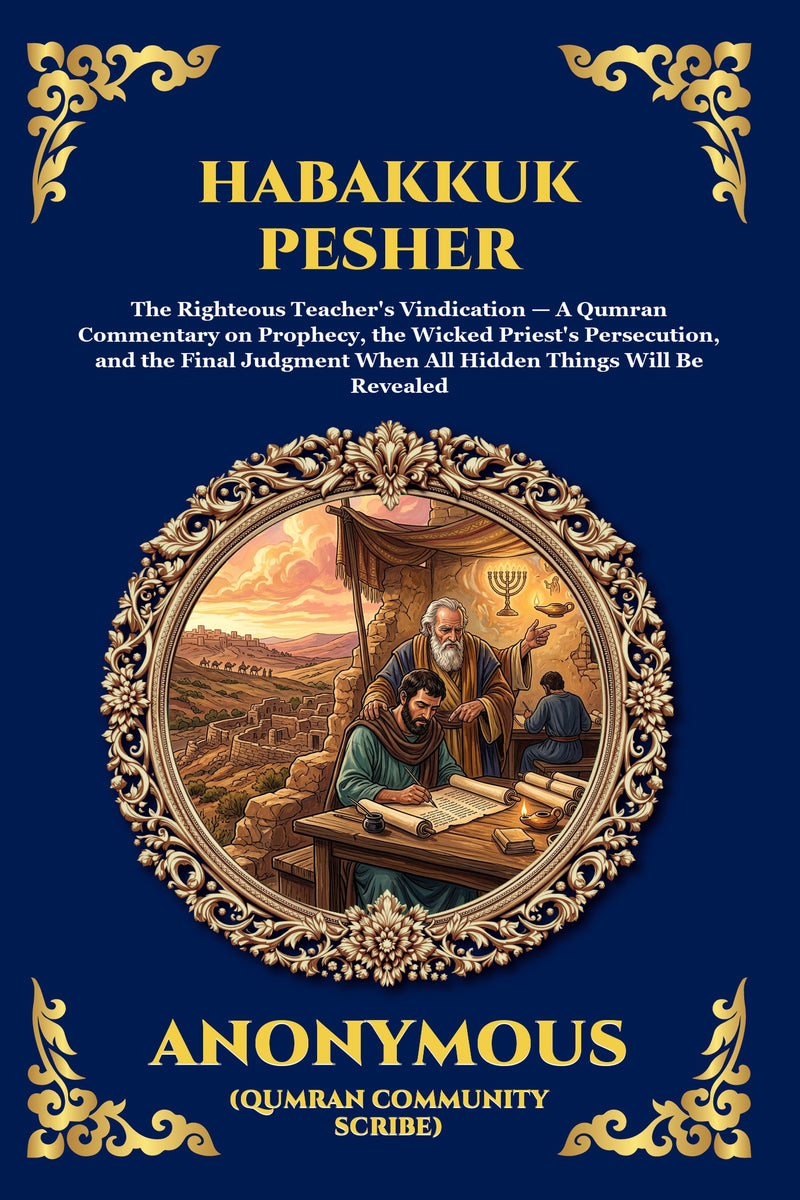
Habakkuk Pesher
The Habakkuk Pesher interprets the biblical Book of Habakkuk through the lens of first-century BCE turmoil, linking apocalyptic visions to real-world events. Excluded from the biblical canon, this text decodes prophecy to reveal the fierce rivalry surrounding the enigmatic Teacher of Righteousness in the Qumran sect.
or free app
10,000+ hrs library
30-day guarantee
The Habakkuk Pesher, a 1st century BCE Dead Sea Scroll commentary found in Qumran Cave 1 in 1947, offers complete modern-English translation readable online with audiobook narration included through membership.
The Habakkuk Pesher claims to reveal the hidden, prophetic meaning of the biblical book of Habakkuk through the lens of a first-century Jewish sect.
In the Habakkuk Pesher, we are granted an unprecedented and intimate window into the worldview of the Qumran sect—the secretive, isolated desert community responsible for the Dead Sea Scrolls. This remarkable text takes the ancient biblical Book of Habakkuk and applies its apocalyptic visions directly to the political, social, and religious crises of the first century BCE.
Far more than a simple commentary, the Habakkuk Pesher acts as a cryptographic key to the past. It decodes the prophetic scriptures to explain the sect’s contemporary reality, detailing the fierce rivalry between their revered leader, the Teacher of Righteousness, and their adversary, the Wicked Priest in Jerusalem. It speaks vividly of the terrifying advance of the Kittim (widely interpreted by scholars as the Roman Empire) and the looming cosmic battle between the forces of light and darkness.
By studying this profound document, modern readers can understand how early Jewish sectarian movements interpreted scripture not as static, distant history, but as living, breathing prophecy happening right before their very eyes. The text reveals a community living on the razor's edge of the apocalypse, striving to remain spiritually pure in a world they believed was destined for imminent divine judgment.
This modern, carefully translated edition ensures that the profound theological and historical insights of this ancient scroll are accessible to everyone. You do not need to be a scholar of antiquity to appreciate the raw passion, the desperate faith, and the immense historical gravity contained within these pages. The Habakkuk Pesher challenges us to consider how we interpret the world around us and how unwavering faith can sustain a people against insurmountable odds.
What You’ll Discover in This Modern Translation
- The Teacher of Righteousness and the Wicked Priest — Uncover the intense, central conflict that defined the Qumran community and shaped their apocalyptic worldview.
- Decoding Prophecy in Real-Time — See exactly how ancient scholars used the Book of Habakkuk to explain the terrifying rise of the Roman Empire and the spiritual corruption in Jerusalem.
- The Apocalyptic Mindset — Explore the deep-seated belief in an impending end of days and the eternal cosmic struggle between the forces of light and darkness.
- A Window into the Dead Sea Scrolls — Gain a profound, foundational understanding of one of the most significant archaeological and religious discoveries in human history.
More than just a fragile relic of the past, the Habakkuk Pesher is a testament to the human desire to find meaning, justice, and divine purpose in chaotic times. Step into the desert caves of Qumran and discover the hidden history of a community that waited for the end of the world. Begin your journey into the Dead Sea Scrolls today.
| Formats | eBook (EPUB + PDF) · Audiobook · Paperback · Hardcover · Large Print |
| Language | English |
| Trim size (print) | 6 × 9 in |
| Binding | Paperback — perfect-bound · Hardcover — casewrap |
| Large Print edition | Same text in a larger, easy-read type — a larger font, not a larger trim |
| Print pricing | Every physical book at our true cost — at-cost, no profit (members) |
| Library | 873 restored titles, always growing |
| Composed | 1st century BCE |
| Original language | Hebrew |
| Source tradition | Dead Sea Scrolls, Qumran Cave 1 (1QpHab) |
| Translation basis | Public-domain scholarly translation, rendered in clear modern English |
| Length | 4,909 words · ~20 min reading |
| Reading level | Grade 13 · rich, literary prose (this modern-English edition) |
| Edition | Modern English translation · 2026 |
Member reviews for this edition are collected as readers finish it — be the first. Across the library: 12,000+ books shipped, every plan covered by a 365-day print guarantee.
About this edition
The complete, unabridged text in clear modern English — faithful to the original, never simplified. Every paragraph is checked against the source, so nothing is cut, summarised, or paraphrased away. It reads cleanly for today while keeping the original meaning intact.
The Habakkuk Pesher survives in Hebrew manuscripts from Qumran Cave 1, discovered in 1947. This edition derives from the standard public-domain scholarly translation and renders it in clear modern English.
- Complete & unabridgedVerified paragraph by paragraph against the source — never a scan, never abridged.
- Modern English, faithfulReadable today, with the author’s meaning kept intact. Readable — not simplified.
- Every format, one membershipRead in your browser or the free app, or listen to the full audiobook.
Included free with your membership
Cancel anytime, one click · 30-day money-back guarantee
Edition last updated June 2026
What’s inside
Habakkuk Pesher — complete and unabridged, included in full with membership, plus the full audiobook.
Begin reading Habakkuk Pesher
In clear modern English — the complete text is included with membership.
Habakkuk Pesher
Introduction
Habakkuk Pesher
Introduction
In the winter of 1946 to 1947, a Bedouin shepherd boy named Muhammad edh-Dhib was searching for a lost goat along the northwestern shore of the Dead Sea when he stumbled upon a cave that would change the course of biblical scholarship forever. Tossing a stone into the darkness out of idle curiosity, he heard not the expected silence or the scatter of pebbles, but the sharp crack of breaking pottery. Inside that cave, sealed in tall clay jars and wrapped in linen, lay manuscripts that had not been touched by human hands for nearly two thousand years. What the shepherd boy had found — though he could not yet know it — was one of the most extraordinary archaeological discoveries in human history: the Dead Sea Scrolls.
Among those ancient documents, one stands out with particular urgency and intellectual electricity. It is a text that does not merely preserve old words but actively wrestles with them, interrogates them, and forces them to speak to a moment of crisis, persecution, and apocalyptic expectation. It is a commentary — or in Hebrew, a pesher — written on the prophetic book of Habakkuk, a short but ferociously intense biblical text that itself was born from a moment of national catastrophe. Together, the ancient prophecy and its ancient commentary form a conversation across centuries, a dialogue between a prophet crying out in anguish and a community of devoted scholars who believed, with absolute conviction, that his words had been written specifically for them.
To read this text is to enter a world that feels simultaneously remote and startlingly immediate. The community that produced it lived in the harsh desert wilderness near Qumran, on the western shore of the Dead Sea, in what is now the West Bank. They were, by most scholarly accounts, a sect of Judaism — intensely devout, rigorously disciplined, and convinced that they alone had been entrusted with the true interpretation of scripture. They called themselves by various names in their documents, most notably the 'Yahad,' meaning 'the Community' or 'the Union.' They believed they were living in the final age of history, that the forces of darkness and the forces of light were locked in a cosmic struggle that would soon reach its decisive moment, and that their role in that struggle was both essential and divinely ordained.
The prophet Habakkuk had written, probably in the late seventh century BCE, in the shadow of the Babylonian empire's terrifying rise to power. His book is a raw, almost confrontational dialogue with God — a prophet demanding to know why divine justice seems absent from the world, why the wicked prosper and the righteous suffer, why violence and injustice go unpunished. God's answer, in the original text, is both reassuring and unsettling: a great reckoning is coming, carried out by an unstoppable foreign power, and those who remain faithful will endure. 'The righteous shall live by their faith,' Habakkuk declares, in a verse that would echo through centuries of Jewish, Christian, and Islamic thought.
The Qumran commentators took this ancient prophecy and read it as a living document addressed directly to their own historical moment. In the methodology of pesher interpretation, every verse of the biblical text contains a hidden meaning — a raz, or mystery — that only a divinely inspired interpreter can unlock. The commentary proceeds line by line, sometimes phrase by phrase, offering interpretations that map the biblical language onto contemporary figures and events. The Babylonians of Habakkuk's text become the Kittim — almost certainly the Romans — whose legions were sweeping across the ancient Near East with the same terrifying efficiency that the Babylonians had once displayed. The corrupt priests and faithless leaders condemned in the prophecy become identifiable, if still somewhat shadowy, figures in the Qumran community's own experience of betrayal and persecution.
What makes this document so remarkable is not merely its age, though its age is extraordinary enough — it was copied sometime in the first century BCE, making it among the oldest surviving biblical commentaries in existence. What makes it remarkable is its passionate, urgent, lived quality. This is not a detached academic exercise. The people who wrote and read this text believed they were decoding divine revelation in real time, identifying the enemies who threatened them, vindicating the leader they had followed and mourned, and confirming that their suffering had cosmic meaning. Every word they wrote was charged with the electricity of people who believed the end of history was imminent and that they had been chosen to understand it.
The central figure of the commentary — referred to with the evocative title 'the Teacher of Righteousness' — is one of the most tantalizing and debated personalities in the entire history of religious scholarship. He appears in the text not as a historical figure being described after the fact, but as a living presence whose authority, whose persecution, and whose interpretive genius are central to the community's self-understanding. He is the one to whom God made known all the mysteries of the words of the prophets. He is the one who was opposed by 'the Wicked Priest,' a figure of authority who had once been trusted but who had fallen into corruption and who had actively persecuted the Teacher and his followers. The drama between these two figures — the righteous interpreter and the corrupt establishment — pulses through the commentary with the intensity of lived experience.
Scholars have spent decades attempting to identify these figures with known historical personalities. The Wicked Priest has been variously identified with Jonathan Maccabaeus, Simon Maccabaeus, Alexander Jannaeus, and other Hasmonean rulers, depending on which historical reconstruction one finds most persuasive. The Teacher of Righteousness has proven even more elusive, though theories abound. What is certain is that the community that produced this commentary had experienced real persecution, real betrayal, and real loss — and that they had processed that experience through the lens of prophetic scripture, finding in Habakkuk's ancient words a validation of their suffering and a promise of ultimate vindication.
It is worth pausing to appreciate the sheer intellectual audacity of what these ancient commentators were doing. They were not simply reading Habakkuk as a historical document about Babylonian invasions. They were claiming that the true meaning of the text had been sealed and hidden for centuries, waiting for the right moment and the right interpreter to unlock it. This is a radical hermeneutical claim — a claim about the nature of scripture itself, about how divine communication works, about the relationship between past prophecy and present experience. It is a claim that would prove enormously influential, shaping not only later Jewish interpretive traditions but also early Christian readings of the Hebrew Bible and, through those traditions, the entire subsequent history of Western religious thought.
The physical document itself deserves a moment of attention, because there is something almost miraculous about its survival. The scroll was found in Cave 1 at Qumran, the same cave that yielded the famous Isaiah Scroll and several other important texts. It is made of leather, written in a careful, professional hand in Hebrew script, and it measures roughly 1.4 meters in length when fully unrolled. The text is remarkably well preserved — far better than many ancient documents — thanks to the extraordinary dryness of the Dead Sea region and the protective environment of the sealed clay jars. When scholars first examined it in the late 1940s and early 1950s, they were looking at a manuscript that had lain undisturbed since approximately the time of Julius Caesar. The ink was still dark. The letters were still legible. The urgency of the words was still palpable.
The World That Produced the Text
To fully appreciate what you are about to read, it helps enormously to have a sense of the world in which this commentary was written — a world of political turbulence, religious controversy, military occupation, and intense apocalyptic expectation. The second and first centuries BCE were among the most dramatic and consequential periods in the history of Judaism, a time when the faith was being pulled in multiple directions simultaneously and when the question of what it meant to be a faithful Jew was not merely academic but could determine whether you lived or died.
The Maccabean revolt of 167 to 160 BCE had liberated Judea from the Seleucid Greek empire and established the Hasmonean dynasty, a priestly family that ruled as both kings and high priests. For many Jews, this was a moment of triumphant restoration. But for others — including, almost certainly, the people who would eventually settle at Qumran — the Hasmonean regime represented a troubling compromise and, eventually, an outright betrayal. The high priesthood, in their view, had been corrupted. The temple had been defiled not just by Greek paganism but by the impure and illegitimate men who now presided over it. The sacred calendar had been altered. The laws of purity had been violated. Everything that made Israel's covenant relationship with God possible was being undermined by men who should have been its guardians.
Into this environment of religious crisis, the Teacher of Righteousness emerged as a prophetic and interpretive authority of the first order. Exactly who he was and when he lived remains a matter of scholarly debate, but the broad outlines of his story can be reconstructed from the Dead Sea Scrolls themselves. He was a priest — possibly a high priest or a candidate for that office — who gathered around him a community of followers committed to radical purity, strict legal observance, and a particular understanding of the divine calendar. He and his community eventually withdrew from Jerusalem and established themselves in the wilderness, where they could live according to their understanding of the covenant without the contaminating influence of the corrupt establishment.
The wilderness setting was not incidental. For this community, the desert carried profound theological meaning. It was the place where Israel had been formed as a people, where the covenant had been given, where the nation had been purified through forty years of wandering before entering the promised land. By going to the desert, the Qumran community was symbolically reenacting that formative experience, preparing themselves for a new entry into the promised land — not a geographical entry but an eschatological one, the dawn of the age of God's direct rule over history. The famous passage from Isaiah — 'In the wilderness prepare the way of the Lord' — was, for them, a direct description of what they were doing.
The community at Qumran was extraordinarily literate and intellectually sophisticated. Their library, which eventually comprised hundreds of manuscripts, included copies of virtually every book of the Hebrew Bible, a remarkable collection of previously unknown religious texts, legal documents, hymns, apocalyptic visions, and — crucially — commentaries on biblical books. These commentaries, the pesharim, represent a genre of literature that was apparently unique to this community, though it drew on broader Jewish interpretive traditions. The pesher form — taking a biblical text and systematically unlocking its hidden, contemporary meaning — reflects a belief system in which scripture is not a closed historical record but a living oracle, continuously relevant, continuously speaking.
The Roman arrival in Judea in 63 BCE, when Pompey marched into Jerusalem and famously entered the Holy of Holies, must have been a moment of profound significance for the Qumran community. Here, suddenly, was the fulfillment of what they had been reading in Habakkuk. The Kittim — the Romans — were exactly the kind of terrifying, unstoppable military power that the prophet had described. They came from the west. They were organized, disciplined, and seemingly invincible. They showed no mercy to the nations they conquered. They were arrogant in their power and contemptuous of other peoples' gods and traditions. Every detail of Habakkuk's description of the Chaldeans seemed to fit the Romans with uncanny precision, and the Qumran commentators were not slow to draw the parallel.
This historical context is essential for understanding the emotional register of the commentary. When the author writes about the Kittim sweeping across the land, devouring nations, and showing contempt for rulers and priests, these are not abstract theological propositions. They are descriptions of events that the community had witnessed or feared witnessing. The Roman legions were real. The threat they posed was real. The suffering of the righteous under both corrupt Jewish leadership and foreign military power was real. And the community's conviction that all of this had been foreseen, that it all fit into a divine plan that scripture had encoded centuries in advance, was their primary source of meaning and hope in the face of what might otherwise have been simply overwhelming despair.
It is also worth understanding the community's relationship to time — their sense of living at a hinge moment in history. The Dead Sea Scrolls reveal a community saturated with eschatological expectation, convinced that the final war between the Sons of Light and the Sons of Darkness was imminent. Their War Scroll describes this conflict in meticulous military detail. Their Community Rule describes the structures and disciplines appropriate for a community living in the last days. Their biblical commentaries consistently interpret prophecy as being fulfilled in their own immediate historical moment. This was not a community content to wait indefinitely. They believed the end was near, and that belief shaped everything about how they read, how they lived, and how they understood their own significance.
Understanding this mindset — urgent, apocalyptic, convinced of special election and special knowledge — is the key to reading the commentary with the depth it deserves. It is easy, from a modern secular perspective, to dismiss such thinking as naive or fanatical. But to do so is to miss the profound human experience that underlies it: the experience of people who have suffered for their convictions, who have been persecuted by those who should have protected them, who have watched the powerful prosper and the righteous struggle, and who have found in ancient words the assurance that their suffering has meaning, that justice will ultimately prevail, and that they are not alone in the darkness. These are not trivial concerns. They are among the most fundamental concerns of human existence, and the community at Qumran engaged with them with remarkable intellectual and spiritual seriousness.
Reading Across the Centuries
There is a particular kind of reading experience that only a very few texts in the world can offer — the experience of genuine encounter with a mind or a community that is both radically different from our own and startlingly familiar. The commentary you are about to read offers precisely this experience. The world it comes from is separated from ours by two millennia of history, by vast differences in culture, language, cosmology, and social organization. And yet the questions it wrestles with — about justice and injustice, about the suffering of the righteous, about the nature of corrupt power, about how to remain faithful in a faithless world, about whether history has meaning — are questions that have not aged a day.
Cancel anytime, one click · 30-day money-back guarantee
Founding annual rate available now — your price locks for life when you join.
Not ready? Get this free chapter by email — read it anytime.
✓ Sent — check your inbox for Habakkuk Pesher.
Questions about Habakkuk Pesher
What is the Habakkuk Pesher and who wrote it?
The Habakkuk Pesher is a commentary on the biblical Book of Habakkuk, written by members of the Qumran community around the first century BCE. It interprets Habakkuk's prophecies as referring to contemporary events and figures in their community's history.
Why isn't the Habakkuk Pesher in the Bible?
The Habakkuk Pesher was never considered for biblical inclusion as it is a sectarian commentary, not a prophetic or apostolic text. It represents one community's interpretation of existing scripture rather than original divine revelation recognized by mainstream Judaism or Christianity.
What does the Habakkuk Pesher contain?
The Habakkuk Pesher contains verse-by-verse commentary on Habakkuk chapters 1-2, interpreting the prophet's visions as predictions about the Qumran community's Teacher of Righteousness, their enemies, and the end times they believed were imminent in their era.
Is Habakkuk Pesher free to read?
The opening of the text is free to read below. Members read and listen to the complete work — and the entire Lost & Forbidden Library — free.
What is Habakkuk Pesher?
Have you ever wondered why ancient prophecies continue to shape our understanding of history and spirituality today?
How long is Habakkuk Pesher?
1 chapters (~4,964 words) in this restored edition.
Shipping & returns
Billing & membership
More from the library


Explore The Lost & Forbidden Library
- 1 Enoch · Attributed to Enoch
- 1–4 Maccabees · Various Jewish authors
- 2 Baruch · Attributed to Baruch
- 2 Enoch · Attributed to Enoch
- 2 Esdras · Attributed to the prophet Ezra
- 3 Baruch · Attributed to Baruch ben Neriah
- 4 Baruch · Attributed to Baruch ben Neriah
- A Valentinian Exposition · Attributed to a follower of Val...
- Acta Archelai · Attributed to Hegemonius
- Acts of Andrew · Anonymous (Early Christian Apoc...
- Acts of Andrew and Matthias in the City of the Cannibals · Attributed to early Christian a...
- Acts of Barnabas · Attributed to John Mark
- Acts of Bartholomew
- Acts of John · Anonymous (Early Christian Apoc...
- Acts of Matthias · Anonymous early Christian writers
- Acts of Paul · Attributed to an unknown early ...
- Acts of Paul and Thecla · Attributed to Onesiphorus
- Acts of Peter
- Acts of Peter and Andrew · Attributed to various early Chr...
- Acts of Peter and Paul · Attributed to Leucius Charinus
- Acts of Peter and Simon · Attributed to Leucius Charinus
- Acts of Peter and the Twelve Apostles · Attributed to early Christian a...
- Acts of Philip · Anonymous (Early Christian Apoc...
- Acts of Pilate (Gospel of Nicodemus) · Attributed to various early Chr...
- Acts of Saturninus
- Acts of Thaddaeus · Attributed to Thaddaeus the Apo...
- Acts of Thomas
- Acts of Titus · Anonymous early Christian writer
- Acts of Xanthippe, Polyxena, and Rebecca
- Allogenes · Anonymous (Early Gnostic Mystic)
Habakkuk Pesher
Habakkuk Pesher
The Ancient Dead Sea Scrolls Commentary – Decoding Biblical Prophecy and the Hidden History of the Qumran Community
Library of Alexandria Press
Habakkuk Pesher
© Copyright 2026 Library of Alexandria Press. All rights reserved.
Published by Library of Alexandria Press
Printed in the United States of America
It is not legal to copy, share, or send any part of this document in either digital or printed form without written permission from the publisher, except short quotes in a book review.
Table of Contents
Habakkuk Pesher
Habakkuk Pesher
Introduction
Habakkuk Pesher
Introduction
In the winter of 1946 to 1947, a Bedouin shepherd boy named Muhammad edh-Dhib was searching for a lost goat along the northwestern shore of the Dead Sea when he stumbled upon a cave that would change the course of biblical scholarship forever. Tossing a stone into the darkness out of idle curiosity, he heard not the expected silence or the scatter of pebbles, but the sharp crack of breaking pottery. Inside that cave, sealed in tall clay jars and wrapped in linen, lay manuscripts that had not been touched by human hands for nearly two thousand years. What the shepherd boy had found — though he could not yet know it — was one of the most extraordinary archaeological discoveries in human history: the Dead Sea Scrolls.
Among those ancient documents, one stands out with particular urgency and intellectual electricity. It is a text that does not merely preserve old words but actively wrestles with them, interrogates them, and forces them to speak to a moment of crisis, persecution, and apocalyptic expectation. It is a commentary — or in Hebrew, a pesher — written on the prophetic book of Habakkuk, a short but ferociously intense biblical text that itself was born from a moment of national catastrophe. Together, the ancient prophecy and its ancient commentary form a conversation across centuries, a dialogue between a prophet crying out in anguish and a community of devoted scholars who believed, with absolute conviction, that his words had been written specifically for them.
To read this text is to enter a world that feels simultaneously remote and startlingly immediate. The community that produced it lived in the harsh desert wilderness near Qumran, on the western shore of the Dead Sea, in what is now the West Bank. They were, by most scholarly accounts, a sect of Judaism — intensely devout, rigorously disciplined, and convinced that they alone had been entrusted with the true interpretation of scripture. They called themselves by various names in their documents, most notably the 'Yahad,' meaning 'the Community' or 'the Union.' They believed they were living in the final age of history, that the forces of darkness and the forces of light were locked in a cosmic struggle that would soon reach its decisive moment, and that their role in that struggle was both essential and divinely ordained.
The prophet Habakkuk had written, probably in the late seventh century BCE, in the shadow of the Babylonian empire's terrifying rise to power. His book is a raw, almost confrontational dialogue with God — a prophet demanding to know why divine justice seems absent from the world, why the wicked prosper and the righteous suffer, why violence and injustice go unpunished. God's answer, in the original text, is both reassuring and unsettling: a great reckoning is coming, carried out by an unstoppable foreign power, and those who remain faithful will endure. 'The righteous shall live by their faith,' Habakkuk declares, in a verse that would echo through centuries of Jewish, Christian, and Islamic thought.
The Qumran commentators took this ancient prophecy and read it as a living document addressed directly to their own historical moment. In the methodology of pesher interpretation, every verse of the biblical text contains a hidden meaning — a raz, or mystery — that only a divinely inspired interpreter can unlock. The commentary proceeds line by line, sometimes phrase by phrase, offering interpretations that map the biblical language onto contemporary figures and events. The Babylonians of Habakkuk's text become the Kittim — almost certainly the Romans — whose legions were sweeping across the ancient Near East with the same terrifying efficiency that the Babylonians had once displayed. The corrupt priests and faithless leaders condemned in the prophecy become identifiable, if still somewhat shadowy, figures in the Qumran community's own experience of betrayal and persecution.
What makes this document so remarkable is not merely its age, though its age is extraordinary enough — it was copied sometime in the first century BCE, making it among the oldest surviving biblical commentaries in existence. What makes it remarkable is its passionate, urgent, lived quality. This is not a detached academic exercise. The people who wrote and read this text believed they were decoding divine revelation in real time, identifying the enemies who threatened them, vindicating the leader they had followed and mourned, and confirming that their suffering had cosmic meaning. Every word they wrote was charged with the electricity of people who believed the end of history was imminent and that they had been chosen to understand it.
The central figure of the commentary — referred to with the evocative title 'the Teacher of Righteousness' — is one of the most tantalizing and debated personalities in the entire history of religious scholarship. He appears in the text not as a historical figure being described after the fact, but as a living presence whose authority, whose persecution, and whose interpretive genius are central to the community's self-understanding. He is the one to whom God made known all the mysteries of the words of the prophets. He is the one who was opposed by 'the Wicked Priest,' a figure of authority who had once been trusted but who had fallen into corruption and who had actively persecuted the Teacher and his followers. The drama between these two figures — the righteous interpreter and the corrupt establishment — pulses through the commentary with the intensity of lived experience.
Scholars have spent decades attempting to identify these figures with known historical personalities. The Wicked Priest has been variously identified with Jonathan Maccabaeus, Simon Maccabaeus, Alexander Jannaeus, and other Hasmonean rulers, depending on which historical reconstruction one finds most persuasive. The Teacher of Righteousness has proven even more elusive, though theories abound. What is certain is that the community that produced this commentary had experienced real persecution, real betrayal, and real loss — and that they had processed that experience through the lens of prophetic scripture, finding in Habakkuk's ancient words a validation of their suffering and a promise of ultimate vindication.
It is worth pausing to appreciate the sheer intellectual audacity of what these ancient commentators were doing. They were not simply reading Habakkuk as a historical document about Babylonian invasions. They were claiming that the true meaning of the text had been sealed and hidden for centuries, waiting for the right moment and the right interpreter to unlock it. This is a radical hermeneutical claim — a claim about the nature of scripture itself, about how divine communication works, about the relationship between past prophecy and present experience. It is a claim that would prove enormously influential, shaping not only later Jewish interpretive traditions but also early Christian readings of the Hebrew Bible and, through those traditions, the entire subsequent history of Western religious thought.
The physical document itself deserves a moment of attention, because there is something almost miraculous about its survival. The scroll was found in Cave 1 at Qumran, the same cave that yielded the famous Isaiah Scroll and several other important texts. It is made of leather, written in a careful, professional hand in Hebrew script, and it measures roughly 1.4 meters in length when fully unrolled. The text is remarkably well preserved — far better than many ancient documents — thanks to the extraordinary dryness of the Dead Sea region and the protective environment of the sealed clay jars. When scholars first examined it in the late 1940s and early 1950s, they were looking at a manuscript that had lain undisturbed since approximately the time of Julius Caesar. The ink was still dark. The letters were still legible. The urgency of the words was still palpable.
The World That Produced the Text
To fully appreciate what you are about to read, it helps enormously to have a sense of the world in which this commentary was written — a world of political turbulence, religious controversy, military occupation, and intense apocalyptic expectation. The second and first centuries BCE were among the most dramatic and consequential periods in the history of Judaism, a time when the faith was being pulled in multiple directions simultaneously and when the question of what it meant to be a faithful Jew was not merely academic but could determine whether you lived or died.
The Maccabean revolt of 167 to 160 BCE had liberated Judea from the Seleucid Greek empire and established the Hasmonean dynasty, a priestly family that ruled as both kings and high priests. For many Jews, this was a moment of triumphant restoration. But for others — including, almost certainly, the people who would eventually settle at Qumran — the Hasmonean regime represented a troubling compromise and, eventually, an outright betrayal. The high priesthood, in their view, had been corrupted. The temple had been defiled not just by Greek paganism but by the impure and illegitimate men who now presided over it. The sacred calendar had been altered. The laws of purity had been violated. Everything that made Israel's covenant relationship with God possible was being undermined by men who should have been its guardians.
Into this environment of religious crisis, the Teacher of Righteousness emerged as a prophetic and interpretive authority of the first order. Exactly who he was and when he lived remains a matter of scholarly debate, but the broad outlines of his story can be reconstructed from the Dead Sea Scrolls themselves. He was a priest — possibly a high priest or a candidate for that office — who gathered around him a community of followers committed to radical purity, strict legal observance, and a particular understanding of the divine calendar. He and his community eventually withdrew from Jerusalem and established themselves in the wilderness, where they could live according to their understanding of the covenant without the contaminating influence of the corrupt establishment.
The wilderness setting was not incidental. For this community, the desert carried profound theological meaning. It was the place where Israel had been formed as a people, where the covenant had been given, where the nation had been purified through forty years of wandering before entering the promised land. By going to the desert, the Qumran community was symbolically reenacting that formative experience, preparing themselves for a new entry into the promised land — not a geographical entry but an eschatological one, the dawn of the age of God's direct rule over history. The famous passage from Isaiah — 'In the wilderness prepare the way of the Lord' — was, for them, a direct description of what they were doing.
The community at Qumran was extraordinarily literate and intellectually sophisticated. Their library, which eventually comprised hundreds of manuscripts, included copies of virtually every book of the Hebrew Bible, a remarkable collection of previously unknown religious texts, legal documents, hymns, apocalyptic visions, and — crucially — commentaries on biblical books. These commentaries, the pesharim, represent a genre of literature that was apparently unique to this community, though it drew on broader Jewish interpretive traditions. The pesher form — taking a biblical text and systematically unlocking its hidden, contemporary meaning — reflects a belief system in which scripture is not a closed historical record but a living oracle, continuously relevant, continuously speaking.
The Roman arrival in Judea in 63 BCE, when Pompey marched into Jerusalem and famously entered the Holy of Holies, must have been a moment of profound significance for the Qumran community. Here, suddenly, was the fulfillment of what they had been reading in Habakkuk. The Kittim — the Romans — were exactly the kind of terrifying, unstoppable military power that the prophet had described. They came from the west. They were organized, disciplined, and seemingly invincible. They showed no mercy to the nations they conquered. They were arrogant in their power and contemptuous of other peoples' gods and traditions. Every detail of Habakkuk's description of the Chaldeans seemed to fit the Romans with uncanny precision, and the Qumran commentators were not slow to draw the parallel.
This historical context is essential for understanding the emotional register of the commentary. When the author writes about the Kittim sweeping across the land, devouring nations, and showing contempt for rulers and priests, these are not abstract theological propositions. They are descriptions of events that the community had witnessed or feared witnessing. The Roman legions were real. The threat they posed was real. The suffering of the righteous under both corrupt Jewish leadership and foreign military power was real. And the community's conviction that all of this had been foreseen, that it all fit into a divine plan that scripture had encoded centuries in advance, was their primary source of meaning and hope in the face of what might otherwise have been simply overwhelming despair.
It is also worth understanding the community's relationship to time — their sense of living at a hinge moment in history. The Dead Sea Scrolls reveal a community saturated with eschatological expectation, convinced that the final war between the Sons of Light and the Sons of Darkness was imminent. Their War Scroll describes this conflict in meticulous military detail. Their Community Rule describes the structures and disciplines appropriate for a community living in the last days. Their biblical commentaries consistently interpret prophecy as being fulfilled in their own immediate historical moment. This was not a community content to wait indefinitely. They believed the end was near, and that belief shaped everything about how they read, how they lived, and how they understood their own significance.
Understanding this mindset — urgent, apocalyptic, convinced of special election and special knowledge — is the key to reading the commentary with the depth it deserves. It is easy, from a modern secular perspective, to dismiss such thinking as naive or fanatical. But to do so is to miss the profound human experience that underlies it: the experience of people who have suffered for their convictions, who have been persecuted by those who should have protected them, who have watched the powerful prosper and the righteous struggle, and who have found in ancient words the assurance that their suffering has meaning, that justice will ultimately prevail, and that they are not alone in the darkness. These are not trivial concerns. They are among the most fundamental concerns of human existence, and the community at Qumran engaged with them with remarkable intellectual and spiritual seriousness.
Reading Across the Centuries
There is a particular kind of reading experience that only a very few texts in the world can offer — the experience of genuine encounter with a mind or a community that is both radically different from our own and startlingly familiar. The commentary you are about to read offers precisely this experience. The world it comes from is separated from ours by two millennia of history, by vast differences in culture, language, cosmology, and social organization. And yet the questions it wrestles with — about justice and injustice, about the suffering of the righteous, about the nature of corrupt power, about how to remain faithful in a faithless world, about whether history has meaning — are questions that have not aged a day.
The interpretive methodology of the pesher may seem strange at first. The commentators move through Habakkuk's text with a confidence that can seem almost breathtaking to modern readers — identifying specific contemporary figures in ancient phrases, finding precise historical references in poetic imagery, claiming divine authorization for their interpretations. This is not the kind of reading that modern academic biblical scholarship practices or endorses. But it is worth resisting the temptation to dismiss it too quickly. The pesher method reflects a genuine and sophisticated theology of scripture — a belief that divine communication is layered, that the surface meaning of a text does not exhaust its significance, that the same words can speak to multiple historical moments simultaneously. This is not an irrational belief. It is, in various forms, a belief shared by enormous numbers of religious readers across many traditions and many centuries.
Moreover, the pesher method produces something that purely historical-critical scholarship sometimes fails to achieve: a reading that is alive, that crackles with urgency, that makes the ancient text matter in an immediate and personal way. When the Qumran commentator reads Habakkuk's description of the Chaldeans and sees in it a portrait of Roman military power, he is not being irresponsible with the text. He is doing what all serious readers of scripture have always done — bringing the full weight of their experience and their moment to bear on words that they believe carry inexhaustible meaning. The result may not be what modern scholars would call accurate, but it is vivid, passionate, and deeply human.
The figure of the Teacher of Righteousness, as he appears in the commentary, deserves special attention from the reader. He is not present in the way that a biographical subject is present in a modern text. He appears obliquely, referenced in the third person, described through the lens of scriptural interpretation rather than direct narrative. Yet his presence is felt throughout the document with remarkable intensity. He is the one who received divine revelation. He is the one whose interpretation is authoritative. He is the one who was wronged by the Wicked Priest. He is, in some sense, the organizing principle around which the entire community's self-understanding revolves. To read about him is to be aware of how profoundly a single charismatic, intellectually gifted, and morally serious individual can shape the collective life and thought of a community.
The Wicked Priest is equally fascinating, precisely because he is presented with such evident hostility and yet, reading between the lines, one can sense the complexity of the historical situation. This was not simply a villain who appeared from nowhere. He was, the text implies, someone who had once been legitimate, who had once been trusted, who had perhaps even been respected by the community before his fall into corruption. The bitterness of the commentary's treatment of him suggests the particular pain of betrayal by someone who should have been an ally. This is a recognizable human dynamic — the corruption of those who begin with good intentions but are undone by power, by wealth, by the compromises that institutional authority always seems to demand.
One of the most intellectually exciting aspects of engaging with this text is the way it forces us to think about the nature of interpretation itself. The Qumran community believed that the meaning of scripture was not self-evident, that it required a divinely authorized interpreter to unlock it, and that this interpretive authority was one of the most important gifts God could bestow on a community. This is a claim that resonates in surprising ways with modern debates about hermeneutics — about how texts mean, about the role of the reader in constructing meaning, about whether meaning is something found in a text or something brought to it. The ancient commentators would have been puzzled by the academic framing of these questions, but they would have had no difficulty with the underlying insight that reading is never a neutral, passive act.
The commentary also raises profound questions about the relationship between prophecy and history — questions that remain genuinely difficult and genuinely important. Did Habakkuk foresee the Roman conquest of Judea? Almost certainly not, in any literal sense. He was writing about the Babylonians, in response to the Babylonian threat of his own time. But the patterns he identified — the rise of overwhelming military power, the suffering of the righteous, the apparent triumph of the wicked, the promise of ultimate divine justice — are patterns that recur throughout history with terrible regularity. In that sense, the Qumran commentators were not entirely wrong to find Habakkuk's words relevant to their situation. They were wrong about the mechanism — the text was not a secret code waiting to be unlocked — but they were right about the resonance. Great prophetic literature speaks to more than one moment because it identifies patterns that are genuinely recurrent in human experience.
As you prepare to read this ancient document, it is worth cultivating a particular kind of attention — one that holds together, simultaneously, the historical distance and the human proximity of the text. These were real people, living in a real community, facing real dangers, wrestling with real questions. They were not abstractions or archetypes. They were individuals who woke up each morning in the desert, who prayed and studied and argued and hoped, who feared the Romans and mourned their Teacher and believed with everything they had that the God of Israel had not abandoned them. Their commentary is a record of that belief — urgent, passionate, sometimes cryptic, always serious.
The discovery of the Dead Sea Scrolls transformed our understanding of the period that gave birth to both rabbinic Judaism and early Christianity. The Qumran community was neither the direct ancestor of either tradition, but it was part of the same extraordinarily fertile religious environment that produced them both. Reading this commentary is reading a document from the very moment when the Judaism of the Second Temple period was beginning to fracture and transform into the multiple Judaisms — and eventually the new religion of Christianity — that would shape the next two thousand years of Western civilization. That context alone would make it worth reading. But it is worth reading for reasons that go beyond its historical significance. It is worth reading because it is a genuine human document — a record of people trying to make sense of suffering, injustice, and hope in a world that seemed to offer little grounds for any of them.
What follows in these pages is a journey into one of the most remarkable texts to survive from the ancient world. It is a text that has waited two thousand years to be read again, sealed in darkness in a desert cave while empires rose and fell, while religions were born and transformed, while the very languages in which it was written became dead tongues known only to scholars. It has survived, and it speaks. The reader who approaches it with patience, curiosity, and a willingness to inhabit a very different world will find in it something that transcends its historical moment — a testament to the enduring human need to find meaning in history, to believe that justice is not merely a dream, and to insist, even in the darkest of times, that the righteous shall live by their faith. Turn the page, and listen.
Habakkuk Pesher
For the wicked one surrounds the righteous one. Its interpretation: the wicked one is the Wicked Priest, and the righteous one is the Teacher of Righteousness.
Look, traitors, and behold. Be astounded and astonished, for I do a deed in your days that you will not believe when it is recounted. The interpretation of this saying concerns the traitors who followed the Man of Lies, for they did not believe the words of the Teacher of Righteousness, which came from the mouth of God. It also concerns the traitors of the New Covenant, for they did not believe in the Covenant of God and profaned his holy name. The interpretation of this saying further concerns the traitors of the Last Days — those violent ones of the Covenant who will not believe when they hear all the things that will come upon the Last Generation from the mouth of the Priest whom God placed in the midst of the congregation to interpret all the words of his servants the prophets, through whom God declared everything that would come upon his people Israel.
For behold, I raise up the Chaldeans, that bitter and impetuous nation. Its interpretation concerns the Kittim, who are swift and mighty in war, destroying many peoples under their dominion. They will seize many lands and will not believe in the decrees of God.
He who marches across the breadth of the earth to seize dwellings not his own. Its interpretation: they will march across the plain to strike down and plunder the cities of the earth, as God said — to seize dwellings not their own.
Their horses are swifter than leopards and keener than wolves at dusk. Their horsemen charge forward and sweep out their wings; they fly from afar like an eagle swooping to devour. All of them come for violence; the look on their faces is like the east wind. Its interpretation concerns the Kittim, who trample the earth with their horses and their beasts. They come from afar, from the islands of the sea, to devour all the peoples like an eagle that is never satisfied.
Why do you stare, traitors, and remain silent when the wicked one swallows up one more righteous than he? Its interpretation concerns the House of Absalom and the men of its council, who kept silent when the Teacher of Righteousness was punished and did not come to his aid against the Man of Lies, who had flouted the Law in the midst of their whole assembly.
I will stand firm at my post and take my position at my watchtower. I will watch to see what God will say to me and what answer he will give to my complaint. Then the Lord answered me and said, "Write down the vision and inscribe it on tablets, so that the one who reads it may run." God told Habakkuk to write down the things that would come upon the Last Generation, but the end of the appointed time he did not reveal to him. As for the words so that the one who reads it may run, their interpretation concerns the Teacher of Righteousness, to whom God made known all the mysteries of the words of his servants the prophets.
The righteous one shall live by his faith. Its interpretation concerns all who observe the Law in the house of Judah, whom God will save from the house of judgment on account of their suffering and their faith in the Teacher of Righteousness.
Surely wealth will betray the arrogant man. He will not endure, he who opens his throat as wide as Sheol. Like Death he is never satisfied. All the nations are gathered to him and all the peoples are assembled to him. Will they not all take up a taunt and speak riddles about him? They will say, "Woe to him who heaps up what is not his! How long will he load himself down with debt?" Its interpretation concerns the Wicked Priest, who was called by the name of truth at the beginning of his office. But when he ruled over Israel his heart grew proud, he forsook God, and he betrayed the commandments for the sake of wealth. He plundered and amassed the riches of the men of violence who had rebelled against God, and he seized the wealth of other peoples, heaping upon himself the guilt of sin. And he practiced abominable deeds amid every kind of unclean impurity.
Will not your oppressors suddenly arise and your tormentors awaken? You will become their prey. Because you have plundered many nations, all the remaining peoples will plunder you. The interpretation of this saying concerns the Priest who rebelled against the commandments of God, for which reason he was struck down by the judgments of wickedness. They inflicted terrible and painful diseases upon him and took vengeance on his body of flesh. And as for the words because you have plundered many nations, all the remaining peoples will plunder you, their interpretation concerns the priests of Jerusalem in the last days, who will gather wealth and ill-gotten gain by plundering the peoples. But in the Last Days God will give their wealth and their plunder into the hands of the army of the Kittim, for it is they who are the remnant of the peoples.
Because of the blood of men and the violence done to the land, the city, and all its inhabitants. Its interpretation concerns the Wicked Priest, whom God, because of the wrong he did to the Teacher of Righteousness and the men of his council, delivered into the hands of his enemies to be humbled by a devastating affliction, in bitterness of soul, because he had acted wickedly against God's chosen one.
Woe to him who makes his neighbors drink, who pours out his wrath to make them drunk so that he may gaze upon their festivals. Its interpretation concerns the Wicked Priest, who pursued the Teacher of Righteousness to his place of exile, intending to swallow him up in his furious rage. At the time of the sacred feast, during the rest of the Day of Atonement, he appeared among them to overwhelm them and to make them stumble on the day of fasting, the sabbath of their rest.
For the violence done to Lebanon will cover you, and the destruction of the animals will terrify you, because of the blood of men and the violence done to the land, the city, and all who dwell in it. The interpretation of this saying concerns the Wicked Priest — that God will repay him the punishment he himself dealt out to the Poor Ones. For Lebanon is the Council of the Community, and the animals are the simple ones of Judah who observe the Law. God will condemn the Wicked Priest to destruction, just as he himself plotted the destruction of the Poor Ones. As for the words because of the blood of the city and the violence done to the land, the city is Jerusalem, where the Wicked Priest committed abominable deeds and defiled the temple of God. The violence done to the land refers to the cities of Judah, where he stripped the Poor Ones of their possessions.
End of the free sample
Keep reading, free
Members read and listen to the complete book — and the entire library. Cancel anytime, one click · 30-day money-back guarantee.