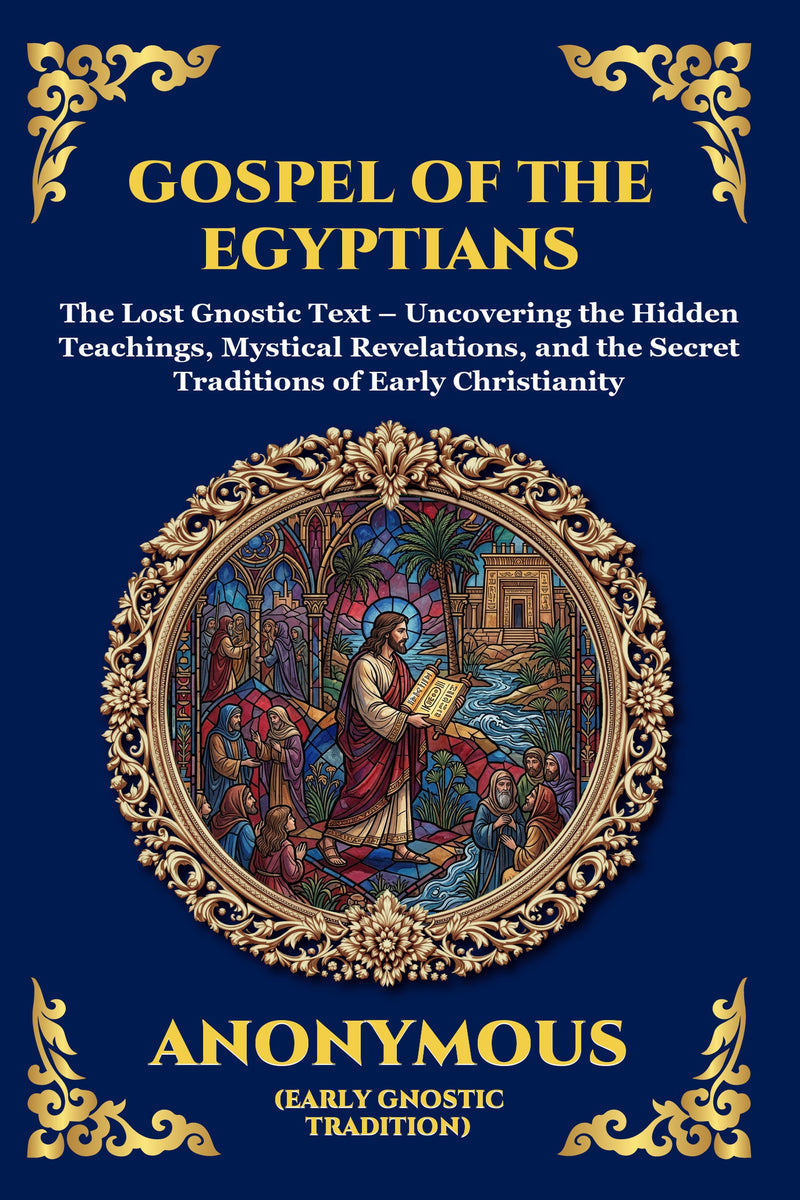
Gospel of the Egyptians
The Gospel of the Egyptians, often called the Holy Book of the Great Invisible Spirit, reveals a mystical alternative to early Christian teachings. Excluded from the canon, it explores cosmic origins and the divine spark within humanity, offering secret knowledge as the true path to salvation.
or free app
10,000+ hrs library
30-day guarantee
The complete Gospel of the Egyptians from the 3rd-century Nag Hammadi discovery is available in readable modern English translation online with full audiobook narration included for members.
The Gospel of the Egyptians stands as the only ancient Gnostic text to present a complete cosmological system centered on the Great Invisible Spirit. This extraordinary work reveals how early Christian mystics envisioned divine reality through radical theological innovation.
The Gospel of the Egyptians is one of the most fascinating works of ancient Gnostic literature. Often called the Holy Book of the Great Invisible Spirit, this text offered a deeply mystical alternative to developing orthodox doctrines, emphasizing secret knowledge (gnosis) as the true path to salvation.
It delves into profound themes of cosmic origins, the illusion of the physical universe, and the journey of the divine spark trapped within humanity back to the eternal realm of light.
What You’ll Discover in This Modern Translation
- Unveiling the Divine Realm — The Gnostic cosmology of the Great Invisible Spirit and the heavenly realms of light.
- The Path of Gnosis — The secret teachings that guided early seekers toward spiritual awakening.
- Overcoming Duality — The teachings on transcending the physical body to return to spiritual perfection.
Step into a world of hidden revelations. Begin your journey today.
| Formats | eBook (EPUB + PDF) · Audiobook · Paperback · Hardcover · Large Print |
| Language | English |
| Trim size (print) | 6 × 9 in |
| Binding | Paperback — perfect-bound · Hardcover — casewrap |
| Large Print edition | Same text in a larger, easy-read type — a larger font, not a larger trim |
| Print pricing | Every physical book at our true cost — at-cost, no profit (members) |
| Library | 873 restored titles, always growing |
| Composed | 3rd century AD |
| Original language | Coptic, likely from Greek originals |
| Source tradition | Nag Hammadi Codex III and IV |
| Translation basis | Public-domain scholarly translation, rendered in clear modern English |
| Length | 6,638 words · ~27 min reading |
| Reading level | Grade 12 · rich, literary prose (this modern-English edition) |
| Edition | Modern English translation · 2026 |
Member reviews for this edition are collected as readers finish it — be the first. Across the library: 12,000+ books shipped, every plan covered by a 365-day print guarantee.
About this edition
The complete, unabridged text in clear modern English — faithful to the original, never simplified. Every paragraph is checked against the source, so nothing is cut, summarised, or paraphrased away. It reads cleanly for today while keeping the original meaning intact.
This text survives in Coptic translation within the Nag Hammadi library, discovered in Egypt in 1945. Our edition derives from the standard scholarly translation of these ancient codices, rendered in clear modern English for contemporary readers.
- Complete & unabridgedVerified paragraph by paragraph against the source — never a scan, never abridged.
- Modern English, faithfulReadable today, with the author’s meaning kept intact. Readable — not simplified.
- Every format, one membershipRead in your browser or the free app, or listen to the full audiobook.
Included free with your membership
Cancel anytime, one click · 30-day money-back guarantee
Edition last updated June 2026
What’s inside
Gospel of the Egyptians — complete and unabridged: all 8 sections included with membership, plus the full audiobook.
Begin reading Gospel of the Egyptians
In clear modern English — the complete text is included with membership.
A World Before Orthodoxy
To truly appreciate what we are dealing with when we engage with a text like the one at the center of this book, we need to travel back in our imaginations to a world that is almost unrecognizable from the perspective of modern religious life. The first three centuries of the Common Era were a time of extraordinary religious ferment in the Mediterranean world. The old civic religions of Greece and Rome were losing their hold on the imagination of educated people. Mystery cults from Egypt and Persia were spreading westward, offering initiates direct experiences of the divine rather than mere participation in public ritual. Jewish communities were grappling with the catastrophic destruction of the Temple in Jerusalem and the profound theological questions that catastrophe raised. And in the midst of all this, a new movement was emerging from the eastern margins of the Roman Empire — a movement centered on the life, death, and reported resurrection of a Jewish teacher named Jesus of Nazareth.
What is crucial to understand — and what mainstream religious education has often obscured — is that this new movement was not, in its early centuries, a single unified thing. It was a constellation of communities, each with its own understanding of who Jesus was, what his significance meant, and how his followers should live and worship. Some of these communities emphasized the apocalyptic dimension of his teaching, expecting an imminent end to the present age. Others focused on his role as a wisdom teacher, a sage who had revealed the path to right living. Still others developed elaborate theological systems in which Jesus played a cosmic role as the revealer of hidden divine knowledge — the knowledge that could liberate human souls from the prison of the material world.
It is this last stream that we know as Gnosticism, and it is important to say immediately that this label covers an enormous diversity of thought and practice. The term 'Gnostic' comes from the Greek word 'gnosis,' which means knowledge — but not the kind of knowledge you acquire by studying books or memorizing facts. Gnosis is experiential knowledge, the knowledge that comes from direct encounter with the divine. It is the knowledge of who you truly are, where you truly come from, and how you can return to your true home. This kind of knowledge, the Gnostics believed, was the key to salvation — not faith, not moral virtue in the conventional sense, not participation in institutional religion, but a direct, transformative awakening to the deepest truth of your own nature.
The mythological systems that different Gnostic groups developed to explain the need for this awakening are among the most elaborate and fascinating in the history of human religious thought. They typically begin not with a single, all-powerful creator God who makes a good world, but with a vast, incomprehensible divine realm — often called the Pleroma, or 'fullness' — populated by a series of divine emanations or beings called Aeons. These Aeons represent different aspects or qualities of the ultimate divine reality, and they exist in a state of perfect harmony and light. The material world — the world we inhabit — is not the creation of this ultimate divine reality. It is, rather, the creation of a lesser, flawed, or even ignorant divine being, often called the Demiurge, who fashioned the material cosmos without fully understanding the higher divine realm from which he himself had emerged.
This is a radical idea, and it is worth sitting with for a moment. In the mainstream Jewish and Christian traditions, the God who created the world is the highest God, the ultimate reality, the source of all goodness and truth. In the Gnostic vision, the creator of the material world is a subordinate being, sometimes portrayed as arrogant, sometimes as simply ignorant, but in either case not the true God. The true God — the ultimate divine source — is utterly transcendent, beyond all categories, beyond all names, beyond all human comprehension. Human beings, in the Gnostic understanding, contain within themselves a spark of this true divine light, a fragment of the higher Pleroma that has become trapped in the material world through a series of cosmic events. The purpose of gnosis is to awaken to the reality of this divine spark, to recognize one's true origin and nature, and thereby to begin the journey of return to the divine fullness from which one came.
The text that is the focus of this book is one of the most exalted expressions of this vision. It is not a narrative gospel in the sense that Matthew, Mark, Luke, and John are narrative gospels. It does not tell the story of Jesus's earthly ministry. Instead, it is a visionary and liturgical text, a kind of cosmic hymn that traces the origins and structure of the divine realm, the emergence of the material world, and the path of redemption made available through a figure identified with Seth — the third son of Adam and Eve in the Hebrew Bible, who in Gnostic tradition becomes a supremely important figure, a divine revealer who descends into the material world across multiple generations to awaken the sleeping divine sparks within humanity.
The Sethian Gnostics, as scholars call the group associated with this text, developed one of the most sophisticated and internally coherent theological systems in the ancient world. Their texts — of which this is perhaps the most important — are filled with elaborate lists of divine names, descriptions of heavenly realms and their inhabitants, accounts of cosmic dramas played out across vast expanses of time and space, and prayers and hymns of extraordinary beauty and power. Reading them requires patience and a willingness to enter into a mode of thought that is very different from the linear, discursive reasoning we are accustomed to. But the rewards for that patience are immense. These texts open windows onto a vision of reality that is both ancient and strangely contemporary, a vision that resonates with everything from modern physics to depth psychology to the mystical traditions of East and West.
The world in which these texts were composed was also a world of intense persecution and danger. The Gnostic communities did not exist in peaceful academic isolation. They were embedded in a broader religious landscape that was becoming increasingly hostile to their ideas. As the mainstream church consolidated its power and authority during the second and third centuries, it increasingly defined itself against what it called heresy — and Gnostic Christianity was consistently at the top of the list of heresies to be combated. Figures like Irenaeus of Lyon, Tertullian, and Epiphanius of Salamis wrote extensive refutations of Gnostic teachings, and their works — ironically — are one of our major sources of information about those teachings, since the Gnostic texts themselves were largely destroyed. The discovery of the Nag Hammadi Library in 1945 was so significant precisely because it gave us access to the Gnostic texts themselves, in their own words, rather than through the filter of their opponents.
Understanding this context of suppression and survival is essential for appreciating the full significance of what we are reading. These texts were hidden, presumably by monks from a nearby monastery who understood that the campaign to destroy 'heretical' literature was closing in on them. They sealed their precious books in a jar and buried them in the desert, where they lay undisturbed for sixteen centuries until a peasant's mattock struck the jar and changed the history of religious scholarship forever. There is something deeply moving about that act of preservation, that determination to protect these words even at great personal risk. It speaks to how profoundly important these texts were to the people who treasured them, and it invites us to approach them with a corresponding seriousness and respect.
Reading the Hidden Gospel Today
We live in a moment that is, in some ways, uniquely suited to receiving what this ancient text has to offer. The twentieth and twenty-first centuries have witnessed a remarkable convergence of developments that make the Gnostic vision more accessible and more relevant than it has been at any point since the ancient world. The explosion of academic scholarship on early Christianity and late antique religion has given us tools for understanding these texts that previous generations lacked. The rise of depth psychology — particularly the work of Carl Gustav Jung, who was deeply engaged with Gnostic thought and saw in it a profound anticipation of his own discoveries about the unconscious — has given us a psychological framework for making sense of the mythological imagery. And the broader cultural turn toward spirituality that is not bound by institutional religion has created an audience genuinely hungry for exactly the kind of direct, experiential, transformative encounter with the sacred that Gnostic texts describe and prescribe.
Jung's engagement with Gnostic thought is worth dwelling on for a moment, because it illustrates something important about why these ancient texts continue to matter. Jung recognized in the Gnostic myths a sophisticated symbolic language for describing the inner life of the psyche — the experience of feeling alienated from one's own deepest nature, the sense of being trapped in a world that does not reflect one's true self, the longing for a reunion with something vast and luminous that one can barely remember but cannot forget. He saw the Gnostic Demiurge as a symbol for the ego's tendency to mistake itself for the whole of the self, and the divine spark within matter as a symbol for the Self in his technical sense — the deeper, transpersonal center of the psyche that transcends the ego and connects the individual to the universal. Whether or not one accepts the Jungian framework, his engagement with these texts opened a door that has never fully closed, and it points to the enduring psychological resonance of Gnostic mythology.
But it would be a mistake to reduce these texts to psychological allegory, just as it would be a mistake to read them as mere historical curiosities. The people who wrote them believed they were describing something real — a genuine cosmic situation, an actual divine realm, a true account of the human condition and the path of liberation. They were not writing metaphors, though their language is necessarily metaphorical. They were doing their best to describe realities that exceeded the capacity of ordinary language to capture. This is what all mystical literature does, and it is why mystical literature from very different traditions so often sounds surprisingly similar — not because the traditions are all saying the same thing, but because they are all grappling with the same fundamental challenge of pointing toward what cannot be fully said.
The specific text at the heart of this book presents particular challenges and particular rewards for the modern reader. Its language is dense and at times deliberately obscure. Its lists of divine names and attributes can seem overwhelming at first encounter. Its cosmological system is elaborate and requires careful attention to follow. But beneath and within all of this complexity, there is a vision of extraordinary clarity and power: the vision of a universe suffused with divine light, of human beings who carry within themselves a fragment of that light, and of a path — through knowledge, through awakening, through the recognition of one's true nature — that leads back to the source. It is a vision that has inspired mystics, philosophers, and spiritual seekers across the centuries, and it continues to inspire them today.
The structure of this book is designed to take you into that vision as fully and as richly as possible. We begin with the historical and archaeological story of how the text was discovered and how it came to the attention of scholars. We then move into a careful examination of the intellectual and spiritual world that produced it — the world of Sethian Gnosticism, with its distinctive mythology, its ritual practices, and its understanding of the divine. From there, we undertake a close reading of the text itself, moving through its major sections and unpacking their meaning with the help of the best available scholarship. And finally, we consider the legacy of this tradition — how it was suppressed, how it survived in hidden and transformed forms, and what it might have to offer the contemporary spiritual seeker.
Throughout this journey, the guiding principle is engagement rather than mere description. This is not a book that simply reports on what scholars have said about an ancient text. It is a book that invites you into a living encounter with a tradition that has profound things to say about the deepest questions of human existence. The ancient authors who composed this text were not writing for posterity. They were writing for people like themselves — people who felt the weight of the material world pressing down on them, who sensed that there was something more, something luminous and vast and real, that ordinary life obscured. They were writing, in other words, for people not entirely unlike us.
There is also an ethical dimension to this project that deserves to be named explicitly. The suppression of Gnostic Christianity was not a neutral historical event. It was an act of power — the imposition of one vision of truth over others through a combination of theological argument, institutional authority, and ultimately physical coercion. The books were burned. The communities were dispersed. The teachers were condemned. And the version of Christianity that emerged from this process of suppression was shaped, at least in part, by what it had excluded. To recover these lost voices is not merely an academic exercise. It is an act of historical justice, a recognition that the full story of early Christianity — and of the human spiritual quest more broadly — is richer, stranger, and more various than the official version has allowed us to see.
Cancel anytime, one click · 30-day money-back guarantee
Founding annual rate available now — your price locks for life when you join.
Not ready? Get this free chapter by email — read it anytime.
✓ Sent — check your inbox for Gospel of the Egyptians.
Questions about Gospel of the Egyptians
Why wasn't the Gospel of the Egyptians included in the biblical canon?
The Gospel of the Egyptians was excluded from the biblical canon because it represented Gnostic theology that differed significantly from orthodox Christian doctrine. Early church leaders rejected texts emphasizing secret knowledge and complex cosmological systems over apostolic tradition and simpler salvation messages.
What does the Gospel of the Egyptians actually contain?
The Gospel of the Egyptians presents a complex Gnostic cosmology describing the origins of divine beings, the creation of the material world, and humanity's path to salvation through secret knowledge. It focuses on mystical revelations rather than historical narratives about Jesus's life.
Who wrote the Gospel of the Egyptians?
The Gospel of the Egyptians is anonymous, composed by unknown Gnostic Christians in the 3rd century AD. Despite its title suggesting Egyptian origin, scholars believe it was written by Greek-speaking Gnostic communities, possibly in Egypt or elsewhere in the eastern Mediterranean.
Is Gospel of the Egyptians free to read?
The opening of the text is free to read below. Members read and listen to the complete work — and the entire Lost & Forbidden Library — free.
What is Gospel of the Egyptians?
Have you ever wondered why certain hidden teachings of early Christianity were suppressed and nearly lost to history? The Gospel of the Egyptians is one of the most fascinating works of ancient Gnostic literature.
How long is Gospel of the Egyptians?
8 chapters (~4,072 words) in this restored edition.
Shipping & returns
Billing & membership
More from the library


Explore The Lost & Forbidden Library
- 1 Enoch · Attributed to Enoch
- 1–4 Maccabees · Various Jewish authors
- 2 Baruch · Attributed to Baruch
- 2 Enoch · Attributed to Enoch
- 2 Esdras · Attributed to the prophet Ezra
- 3 Baruch · Attributed to Baruch ben Neriah
- 4 Baruch · Attributed to Baruch ben Neriah
- A Valentinian Exposition · Attributed to a follower of Val...
- Acta Archelai · Attributed to Hegemonius
- Acts of Andrew · Anonymous (Early Christian Apoc...
- Acts of Andrew and Matthias in the City of the Cannibals · Attributed to early Christian a...
- Acts of Barnabas · Attributed to John Mark
- Acts of Bartholomew
- Acts of John · Anonymous (Early Christian Apoc...
- Acts of Matthias · Anonymous early Christian writers
- Acts of Paul · Attributed to an unknown early ...
- Acts of Paul and Thecla · Attributed to Onesiphorus
- Acts of Peter
- Acts of Peter and Andrew · Attributed to various early Chr...
- Acts of Peter and Paul · Attributed to Leucius Charinus
- Acts of Peter and Simon · Attributed to Leucius Charinus
- Acts of Peter and the Twelve Apostles · Attributed to early Christian a...
- Acts of Philip · Anonymous (Early Christian Apoc...
- Acts of Pilate (Gospel of Nicodemus) · Attributed to various early Chr...
- Acts of Saturninus
- Acts of Thaddaeus · Attributed to Thaddaeus the Apo...
- Acts of Thomas
- Acts of Titus · Anonymous early Christian writer
- Acts of Xanthippe, Polyxena, and Rebecca
- Allogenes · Anonymous (Early Gnostic Mystic)
Gospel of the Egyptians
Gospel of the Egyptians
The Lost Gnostic Apocrypha – Uncovering the Secret Wisdom, Divine Mysteries, and Hidden History of Early Christianity
Library of Alexandria Press
Gospel of the Egyptians
© Copyright 2026 Library of Alexandria Press. All rights reserved.
Published by Library of Alexandria Press
Printed in the United States of America
It is not legal to copy, share, or send any part of this document in either digital or printed form without written permission from the publisher, except short quotes in a book review.
Table of Contents
Introduction
A World Before the World We Know
Why This Text Still Matters
Gospel of the Egyptians
OOOOOOOOOOOOOOOOOOOOOO
IEN IEN EA EA EA
You are what you are, You are who you are!
O AEON, AEON, O God of Silence!
Introduction
Somewhere beneath the sands of Upper Egypt, in the winter of 1945, a young man named Muhammad Ali al-Samman reached into a sealed earthenware jar and pulled out a collection of leather-bound codices that would forever alter our understanding of early Christianity. The discovery at Nag Hammadi was not merely an archaeological event — it was a rupture in history, a crack in the wall that institutional religion had spent nearly two millennia constructing around the origins of Christian thought. Among the texts that emerged from that jar was a work so strange, so luminous, and so unlike anything the modern world associated with Christianity that scholars struggled for years simply to describe it. That text, known today as the Gospel of the Egyptians, did not tell the story of Jesus walking through Galilee. It did not recount the Sermon on the Mount or the raising of Lazarus. Instead, it opened onto a cosmos of breathtaking complexity — a universe populated by invisible powers, emanating aeons, and a supreme divine principle so far beyond human comprehension that even naming it required a kind of sacred stuttering, a cascade of negations and near-silent syllables.
To read this text for the first time is to feel the ground shift beneath your feet. The Christianity most of us grew up knowing — or knowing about — is a faith built on relatively familiar architecture: a personal God, a historical savior, a community of believers, a moral code, and the promise of eternal life. That architecture is real, and it has sustained billions of human beings across two thousand years. But it is not the only architecture that was ever proposed. In the first and second centuries of the Common Era, the landscape of early Christian thought was vastly more diverse, more experimental, and more philosophically daring than the version that eventually became orthodox. Dozens of communities, teachers, and visionaries were working out what it meant to encounter the figure of Jesus, what the cosmos truly was, and what human beings were doing inside it. Some of their answers were so radical that the emerging institutional church spent generations hunting down their books and burning them. The text at the center of this book survived that burning — barely, and by accident — and what it contains is nothing less than an alternative map of reality.
This book is an invitation to explore that map. It is written for readers who are curious about the hidden dimensions of religious history, who suspect that the official story of Christianity's origins is incomplete, and who are willing to sit with ideas that are genuinely strange before those ideas reveal their underlying coherence. You do not need a background in theology or ancient languages to follow the journey ahead. What you need is an open mind and a willingness to entertain the possibility that some of the most profound spiritual insights in human history were nearly erased from the record — and that recovering them changes not only how we understand the past, but how we understand ourselves.
The word 'Gnostic' will appear throughout these pages, and it is worth pausing at the outset to say something honest about it. The term is both indispensable and problematic. It comes from the Greek word gnosis, meaning knowledge — but not the kind of knowledge you acquire by reading a textbook or memorizing facts. Gnosis refers to a direct, experiential, transformative knowing: the kind of knowledge that changes who you are at the deepest level, the kind that the mystics of every tradition have pointed toward when ordinary language fails them. In the ancient world, Gnostic referred to a loose constellation of communities and teachers who believed that the material world was not the creation of the highest God, that human beings contained within them a divine spark imprisoned in matter, and that salvation consisted not in following rules or performing rituals but in waking up to one's own true nature. This was a revolutionary idea, and it was dangerous — dangerous enough that the heresiologists of the early church, men like Irenaeus of Lyon and Tertullian of Carthage, devoted enormous energy to refuting it, cataloguing it, and ensuring that its texts would not survive.
They almost succeeded. For more than a thousand years, our knowledge of Gnostic Christianity came almost entirely from its enemies. We knew what Irenaeus said the Gnostics believed. We knew what Tertullian found so offensive about their theology. But we did not have the Gnostic texts themselves, and so we could not read them on their own terms, hear their own voices, or evaluate their claims with any fairness. The Nag Hammadi discovery changed all of that. Suddenly, scholars had access to more than fifty texts representing a wide range of Gnostic traditions, written in Coptic but translated from earlier Greek originals, preserved by monks or seekers who had hidden them — perhaps from the very authorities who were destroying such things — sometime around the late fourth century. Among these texts, the one that concerns us most deeply in this book stands as one of the most extraordinary specimens of ancient religious literature ever recovered.
It calls itself, in its own closing lines, 'the holy book of the great invisible Spirit' — a title that tells you immediately that you are dealing with a theology in which the highest divine principle is not a personal God who speaks from burning bushes or dictates commandments on stone tablets, but something so utterly transcendent that visibility itself is a limitation it exceeds. The name by which scholars have come to know it — the Gospel of the Egyptians — comes from those same closing lines, and it connects the text to a broader tradition of Egyptian religious wisdom that stretches back through the centuries to the banks of the Nile. Egypt, in the ancient imagination, was the land of hidden knowledge, of mystery cults, of the weighing of souls and the journey through the underworld. That a text of such esoteric depth should claim Egyptian lineage is not an accident. It is a deliberate positioning within a long lineage of sacred wisdom.
Two copies of this text were found at Nag Hammadi, in two different codices, which tells us something important: it was valued enough to be copied more than once, preserved in more than one place, considered significant enough to warrant the labor of scribal reproduction in a world where writing was expensive, slow, and precious. The differences between the two copies are themselves fascinating — small variations that hint at a living tradition, a text that was being used, discussed, meditated upon, and perhaps even performed in some kind of ritual context. This was not a dead letter. It was a living document in a living community, and reading it today means entering into a conversation that has been interrupted for sixteen centuries.
Gospel of the Egyptians
Three powers came forth from him: the Father, the Mother, and the Son — from the living silence, what came forth from the incorruptible Father. These came forth from the silence of the unknown Father.
And from that place, Domedon Doxomedon came forth, the aeon of the aeons and the light of each of their powers. And so the Son came forth fourth, the Mother fifth, the Father sixth. He was unheralded — he who is unmarked among all the powers, the glories, and the incorruptions.
From that place the three powers came forth, the three ogdoads that the Father brings forth in silence with his providence, from his bosom — that is, the Father, the Mother, and the Son.
The first ogdoad, because of which the thrice-male child came forth: thought, and word, and incorruption, and eternal life, the will, the mind, and the foreknowledge — the androgynous Father.
The second ogdoad-power: the Mother, the virginal Barbelon, Epititiochai, Memeneaimen, who presides over the heaven, Karb — the uninterpretable power, the ineffable Mother. She originated from herself; she came forth; she came into agreement with the Father of the silent silence.
The third ogdoad-power: the Son of the silent silence, and the crown of the silent silence, and the glory of the Father, and the virtue of the Mother. He brings forth from the bosom the seven powers of the great light of the seven voices. And the word is their completion.
These are the three powers, the three ogdoads that the Father, through his providence, brought forth from his bosom. He brought them forth at that place.
Domedon Doxomedon came forth, the aeon of the aeons, and the throne which is in him, and the powers which surround him, the glories and the incorruptions. The Father of the great light who came forth from the silence — he is the great Doxomedon-aeon, in which the thrice-male child rests. And the throne of his glory was established within it, that throne upon which his unrevealable name is inscribed. On the tablet is the word: the Father of the light of everything, he who came forth from the silence, who rests in the silence, he whose name is an invisible symbol. A hidden, invisible mystery came forth, voiced as the sacred letters repeated in their fullness — the great luminous vowels sounding out in the silence of the eternal realm.
End of the free sample
Keep reading, free
Members read and listen to the complete book — and the entire library. Cancel anytime, one click · 30-day money-back guarantee.