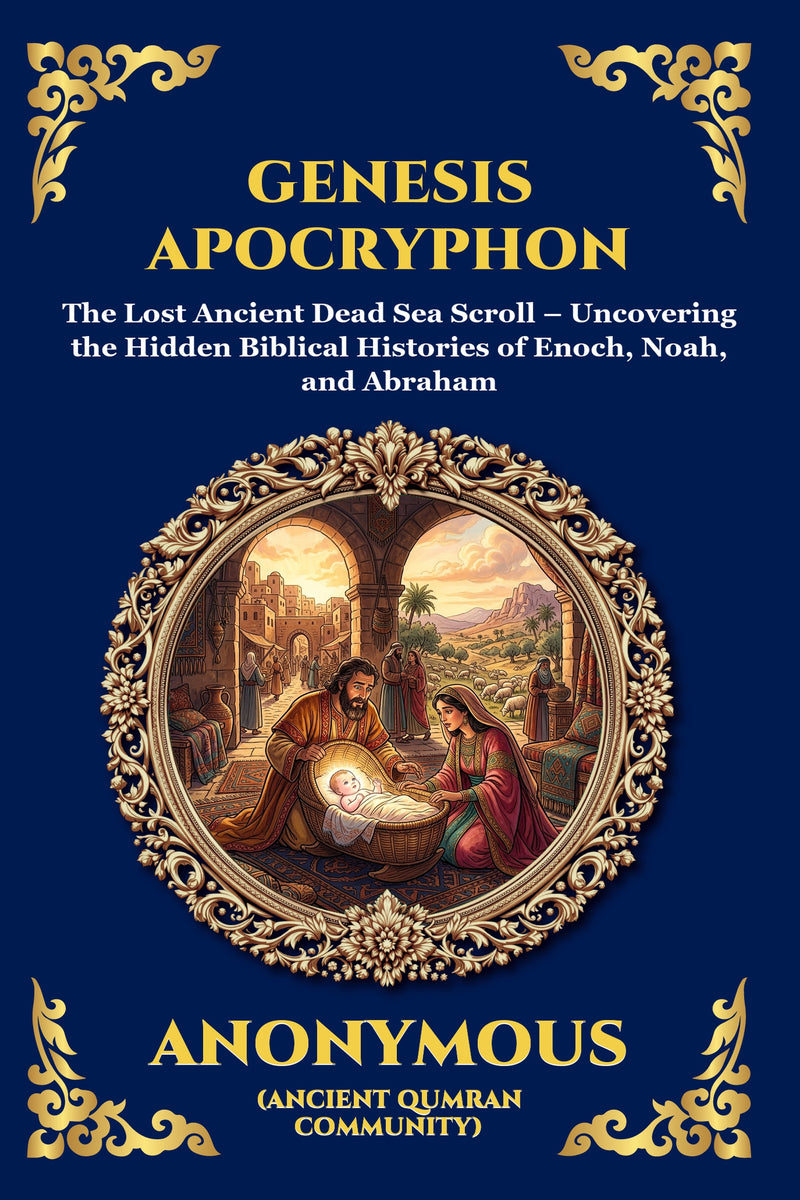
Genesis Apocryphon
The Genesis Apocryphon reveals long-hidden details about the ancient patriarchs, offering vivid accounts and supernatural encounters within the Genesis narrative. Preserved in Aramaic among the Dead Sea Scrolls, this text was excluded from the traditional biblical canon, yet it enriches the earliest chapters of human history.
or free app
10,000+ hrs library
30-day guarantee
The Genesis Apocryphon presents the complete modern-English translation of this Aramaic Dead Sea Scroll text, available for online reading with full audiobook narration included.
The Genesis Apocryphon stands as one of the most enigmatic and fragmentary texts ever recovered from the caves of Qumran.
The Genesis Apocryphon provides a compelling modern translation of one of the most significant and mysterious texts discovered among the Dead Sea Scrolls. Written in Aramaic and preserved by the ancient Qumran community, this fascinating scroll breathes new life into the earliest chapters of human history. Far from a simple retelling, this document acts as an ancient expansion, filling in the gaps of the traditional Genesis narrative with rich dialogue, emotional depth, and supernatural encounters.
The stories of the patriarchs are brought to life with startling clarity. Read firsthand accounts of Lamech's terror and awe at the miraculous birth of his son Noah, who appeared so radiant and divine that Lamech feared he was fathered by the Watchers—the fallen angels of ancient lore. Follow Abraham's perilous journey into Egypt, featuring vivid descriptions of Sarah's legendary beauty and the dramatic plagues that befell the Pharaoh.
What You Will Discover in This Modern Translation
- The Mystery of Noah’s Birth: Uncover the dramatic events surrounding Noah's arrival and Lamech's desperate quest for truth from his grandfather, Enoch.
- The Visions of Enoch: Delve into the ancient wisdom and divine revelations granted to Enoch, the man who walked with God.
- Abraham in Egypt: Experience the detailed, gripping account of Abraham and Sarah’s descent into Egypt, expanding on their trials and ultimate deliverance.
- A Window into the Qumran Community: Gain a deeper understanding of the spiritual and historical beliefs of the ancient Jewish sect that preserved these scrolls.
- Lost Biblical Lore: Explore the rich traditions, extended dialogues, and ancient perspectives that shaped early Jewish and Christian thought.
Whether you are a student of ancient history, a theologian seeking deeper context, or a curious reader drawn to the mysteries of the Dead Sea Scrolls, the Genesis Apocryphon offers an unparalleled journey into the past.
Step into the desert caves of antiquity and discover the hidden narratives of the Genesis Apocryphon. Begin your historical journey today.
| Formats | eBook (EPUB + PDF) · Audiobook · Paperback · Hardcover · Large Print |
| Language | English |
| Trim size (print) | 6 × 9 in |
| Binding | Paperback — perfect-bound · Hardcover — casewrap |
| Large Print edition | Same text in a larger, easy-read type — a larger font, not a larger trim |
| Print pricing | Every physical book at our true cost — at-cost, no profit (members) |
| Library | 873 restored titles, always growing |
| Composed | 1st century BC to 1st century AD |
| Original language | Aramaic |
| Source tradition | Dead Sea Scrolls, Cave 1 (1QapGen) |
| Translation basis | Public-domain scholarly translation, rendered in clear modern English |
| Length | 7,868 words · ~31 min reading |
| Reading level | Grade 10 · a confident, adult read (this modern-English edition) |
| Edition | Modern English translation · 2026 |
Member reviews for this edition are collected as readers finish it — be the first. Across the library: 12,000+ books shipped, every plan covered by a 365-day print guarantee.
About this edition
The complete, unabridged text in clear modern English — faithful to the original, never simplified. Every paragraph is checked against the source, so nothing is cut, summarised, or paraphrased away. It reads cleanly for today while keeping the original meaning intact.
This edition derives from the Aramaic manuscript fragments discovered at Qumran (Cave 1) in 1947, using the standard scholarly translation established by Dead Sea Scrolls researchers, rendered here in clear modern English.
- Complete & unabridgedVerified paragraph by paragraph against the source — never a scan, never abridged.
- Modern English, faithfulReadable today, with the author’s meaning kept intact. Readable — not simplified.
- Every format, one membershipRead in your browser or the free app, or listen to the full audiobook.
Included free with your membership
Cancel anytime, one click · 30-day money-back guarantee
Edition last updated June 2026
What’s inside
Genesis Apocryphon — complete and unabridged: all 5 sections included with membership, plus the full audiobook.
Begin reading Genesis Apocryphon
In clear modern English — the complete text is included with membership.
Voices from the Desert Silence
To truly appreciate what this ancient scroll represents, it helps to understand the world in which it was created — a world very different from our own in its external circumstances, but startlingly similar in its deepest human concerns. The community most scholars associate with the Dead Sea Scrolls, commonly identified with the Essenes described by ancient writers like Josephus and Philo, lived at Qumran during a period of intense religious and political crisis. The Hasmonean dynasty that had won Jewish independence from the Seleucid Greeks was collapsing into civil war. The Romans were tightening their grip on the region. The Jerusalem Temple, the beating heart of Jewish religious life, was controlled by priestly factions that the Qumran community considered corrupt and illegitimate. In this atmosphere of crisis and dislocation, the community turned inward, to the study of scripture, to the practice of ritual purity, and to the cultivation of an intense, almost apocalyptic sense of living at the hinge-point of history.
For people living under these pressures, the stories of Genesis were not merely ancient history. They were living templates, maps of the human condition that could be read and reread for guidance, comfort, and meaning. The story of Noah — a righteous man surrounded by a corrupt and violent world, preserved by divine grace while everything around him was destroyed — resonated with extraordinary power for a community that saw itself as a faithful remnant in a fallen age. The story of Abraham — a man called out of his homeland, traveling through foreign and sometimes hostile territories, sustained by his covenant with God — spoke directly to the experience of a group that had withdrawn from mainstream Jewish society to live in the desert wilderness.
But the authors of this scroll were not content merely to repeat these stories as they found them in the canonical text. They were readers of extraordinary sophistication, and they noticed what the text left out as much as what it included. Take, for example, the story of Noah's birth as it appears in a related text, the Book of Enoch, and as it is echoed in the opening columns of this scroll. The biblical account of Noah's birth is among the most laconic in all of scripture: 'And Lamech lived a hundred and eighty-two years, and begat a son: and he called his name Noah.' That is essentially all we are told. But the author of this scroll — drawing on traditions that were clearly circulating in Jewish communities of the Second Temple period — imagined that Noah's birth was accompanied by extraordinary, even supernatural signs: a child of dazzling, almost otherworldly beauty, whose very appearance seemed to belong to a different order of being. And Lamech, confronted with this uncanny infant, is seized by a terrible suspicion. What if this child is not his? What if his wife Bitenosh has been visited by one of the Watchers — the divine beings described in Genesis 6 as having taken human wives — and this radiant, strange child is the product of that union?
The scene that follows in the scroll is one of the most psychologically acute passages in all of ancient literature. Lamech confronts his wife. Bitenosh responds — not with meek submission, not with evasion, but with passion, with indignation, with a torrent of words in which she swears by every sacred thing she knows that this child is Lamech's, conceived in the ordinary way of human love. The emotional texture of this exchange — the husband's fear and suspicion, the wife's wounded dignity and fierce maternal love — feels startlingly modern. These are not mythological figures moving through a symbolic landscape. They are human beings in a recognizable domestic crisis, and the author renders their conflict with a sympathy and precision that would do credit to any novelist of any era.
This humanizing impulse runs throughout the entire document. When Noah speaks, in the sections of the scroll that deal with the Flood and its aftermath, he does not speak in the measured, dignified tones of a patriarch delivering theological pronouncements. He speaks as a man who has survived an unimaginable catastrophe, who has watched the world end and been given the terrible privilege of watching it begin again. His voice carries the weight of that experience — the gratitude, the grief, the disorientation of emerging from the ark into a world scrubbed clean of everything familiar. The scroll's Noah is not a symbol or an archetype. He is a survivor, and the text honors the full complexity of what survival means.
The Abraham sections of the scroll are perhaps even more remarkable. Here the first-person voice achieves a sustained intimacy and specificity that is unlike anything else in ancient Jewish literature. Abraham — here called Abram, as he is in the early chapters of Genesis — describes his dreams and visions in vivid, sensory detail. He recounts his travels through the ancient world with the eye of someone who is genuinely curious about the lands he passes through, who notices the landscape, the people, the customs. And when the narrative reaches the famous episode in which Abram and Sarai descend into Egypt — an episode that raises deeply uncomfortable questions about Abram's behavior toward his wife, which the biblical text handles with characteristic reticence — the scroll does something extraordinary. It expands the story in ways that both deepen the moral complexity and, in a remarkable passage, give us what may be the most detailed physical description of a woman in all of ancient Jewish literature.
When Pharaoh's courtiers see Sarai and report her beauty to their master, the scroll does not simply tell us she was beautiful. It gives us a blazing, specific, almost breathless account of her appearance — her face, her hair, her eyes, her hands, the way she moves, the quality of her presence. This passage has fascinated scholars ever since the scroll was first published, not only for its literary qualities but for what it reveals about ancient ideals of beauty, about the way the authors of this text understood the relationship between physical appearance and spiritual worth, and about the complex gender dynamics at work in the retelling of a story that has always made modern readers uneasy. The scroll does not resolve these complexities — it deepens them, and in doing so it treats its readers as adults capable of sitting with moral ambiguity.
Throughout all of this, what strikes the reader most forcefully is not the theological content of the scroll — though that content is rich and fascinating — but its sheer literary quality. Whoever wrote this text was a gifted storyteller. The prose moves with confidence and grace. The dialogue feels natural and alive. The descriptive passages achieve a kind of luminous precision. The emotional life of the characters is rendered with genuine psychological depth. This is not a dry theological treatise or a mechanical retelling of familiar material. It is a work of imaginative literature, created by someone who loved stories, who loved the characters in these ancient stories, and who wanted to give them the fullness of life that the spare biblical text could only gesture toward.
Why This Scroll Still Matters
The question of why a text written two thousand years ago in a cave above the Dead Sea should matter to a reader today is one worth taking seriously. We live in an age saturated with information, with competing narratives, with an almost overwhelming abundance of stories available to us at the touch of a screen. What can an ancient, fragmentary, partially damaged scroll — written in a language nobody speaks anymore, by authors whose names we do not know, for a community that ceased to exist nearly two millennia ago — possibly offer us that we cannot find elsewhere?
The answer, it turns out, is quite a lot. And the reasons are both historical and deeply personal.
Historically, this scroll is invaluable because it gives us a window into a world of biblical interpretation that was thriving and creative long before the traditions we now think of as normative Christianity and Judaism had fully crystallized. The Second Temple period — roughly the five centuries between the rebuilding of the Jerusalem Temple after the Babylonian exile and its destruction by the Romans in 70 CE — was one of the most extraordinarily fertile periods in the history of religious thought. During these centuries, Jewish thinkers and writers were grappling with the same texts that would become the foundation of both Christianity and Judaism, but they were doing so in an atmosphere of remarkable interpretive freedom. The boundaries of the canon were not yet fixed. The rules about what could and could not be said about scripture were not yet established. The relationship between the written text and the oral traditions that surrounded it was fluid and dynamic.
In this atmosphere, texts like this scroll flourished. They represent not a fringe or heterodox tradition but a mainstream form of Jewish piety and scholarship — a way of engaging with sacred texts that was practiced across a wide spectrum of Jewish communities during this period. When we read the expanded birth narrative of Noah, we are not reading the eccentric fantasy of some isolated sectarian. We are reading a tradition that was clearly widespread and well-established, one that left traces in multiple ancient texts including the Book of Enoch, the Book of Jubilees, and later rabbinic literature. Understanding this tradition helps us understand the intellectual and spiritual world in which both early Christianity and rabbinic Judaism were born — a world far more diverse, far more creative, and far more theologically adventurous than later orthodoxies of either tradition would suggest.
But the historical importance of the scroll, significant as it is, is ultimately secondary to its human importance. What makes this text matter to a reader today is not what it tells us about ancient Jewish sectarianism or the development of the biblical canon. It is what it tells us about the enduring human need to make stories live — to take the inherited narratives of our tradition and breathe new life into them, to ask the questions the official text leaves unanswered, to imagine our way into the interior lives of the figures who have shaped our understanding of who we are and where we come from.
Every generation does this. Every generation takes the stories it has inherited and retells them in ways that speak to its own experience, its own fears, its own hopes. The authors of this scroll were doing exactly what storytellers, theologians, novelists, filmmakers, and poets have always done: they were taking a sacred inheritance and making it new. The fact that they did so with such extraordinary skill, with such genuine literary gifts, and with such evident love for the characters and stories they were working with, makes their achievement all the more remarkable and all the more worthy of our attention.
There is also something specifically important about the way this scroll handles the figures of Enoch, Noah, and Abraham — the three great patriarchs whose stories form its core. These are not minor characters in the tradition. They are foundational figures, men whose stories have shaped the moral and spiritual imagination of billions of people across three great world religions. And yet, in the canonical biblical text, they remain in many ways opaque — figures of enormous symbolic weight but limited psychological depth. The scroll changes this. It gives them voices. It gives them inner lives. It makes them human in the fullest sense of the word, which paradoxically makes their greatness more impressive, not less. A Noah who struggles with grief and disorientation after the Flood is a more compelling figure than a Noah who moves through his story with serene, untroubled righteousness. An Abraham who dreams vivid, frightening dreams and wakes uncertain of their meaning is a more relatable guide to the life of faith than an Abraham who receives divine instructions with calm, unquestioning confidence.
The scroll's Enoch, though present mainly through reference and allusion in the surviving portions of the text, casts a long shadow over the entire document. Enoch was the great mysterious figure of the antediluvian world — the man who, according to Genesis, 'walked with God and was not, for God took him.' This cryptic statement, just nine words in the original Hebrew, generated an enormous body of speculative literature in the Second Temple period, of which the various books of Enoch are the most extensive surviving examples. The traditions about Enoch — his ascent to heaven, his visions of cosmic secrets, his role as a scribe of divine wisdom — form an essential background to the scroll's treatment of Noah and Abraham. Understanding Enoch's place in this tradition helps us understand why the scroll's authors were so interested in the question of what makes a person truly righteous, truly worthy of divine favor, in a world that seems to have gone catastrophically wrong.
This question — what does it mean to be righteous in a corrupt world? — is not an antiquarian concern. It is one of the most urgent questions of our own time. We live in an era of institutional failure, of environmental crisis, of political polarization, of widespread disillusionment with the structures and authorities that previous generations trusted. The figures at the center of this scroll — Enoch, who saw the corruption of the world and was taken out of it; Noah, who survived the destruction of everything familiar and had to build a new world from scratch; Abraham, who left behind everything he knew to follow a call he could not fully understand — these are figures whose stories speak with particular power to anyone who has ever felt that the world as currently constituted is not the world as it ought to be, and who has wondered what faithfulness looks like under those circumstances.
Cancel anytime, one click · 30-day money-back guarantee
Founding annual rate available now — your price locks for life when you join.
Not ready? Get this free chapter by email — read it anytime.
✓ Sent — check your inbox for Genesis Apocryphon.
Questions about Genesis Apocryphon
Why isn't the Genesis Apocryphon in the Bible?
The Genesis Apocryphon was composed after the Hebrew Bible's formation and was preserved by the Qumran community. It represents Jewish interpretive tradition rather than canonical scripture, expanding on Genesis narratives with additional details and perspectives.
What stories does the Genesis Apocryphon contain?
The Genesis Apocryphon retells portions of Genesis, focusing on Noah, Abraham, and Sarah. It includes expanded narratives about Noah's birth, Abraham's journey to Egypt, and Sarah's beauty, providing vivid details absent from the biblical account.
Who wrote the Genesis Apocryphon?
The Genesis Apocryphon's author remains anonymous. Scholars believe it was composed by Jewish writers between the 1st century BC and 1st century AD, likely within the broader Second Temple period interpretive tradition.
Is Genesis Apocryphon free to read?
The opening of the text is free to read below. Members read and listen to the complete work — and the entire Lost & Forbidden Library — free.
What is Genesis Apocryphon?
Have you ever wondered why certain astonishing details about the ancient patriarchs were left out of the traditional biblical canon?
How long is Genesis Apocryphon?
5 chapters (~5,190 words) in this restored edition.
Shipping & returns
Billing & membership
More from the library


Explore The Lost & Forbidden Library
- 1 Enoch · Attributed to Enoch
- 1–4 Maccabees · Various Jewish authors
- 2 Baruch · Attributed to Baruch
- 2 Enoch · Attributed to Enoch
- 2 Esdras · Attributed to the prophet Ezra
- 3 Baruch · Attributed to Baruch ben Neriah
- 4 Baruch · Attributed to Baruch ben Neriah
- A Valentinian Exposition · Attributed to a follower of Val...
- Acta Archelai · Attributed to Hegemonius
- Acts of Andrew · Anonymous (Early Christian Apoc...
- Acts of Andrew and Matthias in the City of the Cannibals · Attributed to early Christian a...
- Acts of Barnabas · Attributed to John Mark
- Acts of Bartholomew
- Acts of John · Anonymous (Early Christian Apoc...
- Acts of Matthias · Anonymous early Christian writers
- Acts of Paul · Attributed to an unknown early ...
- Acts of Paul and Thecla · Attributed to Onesiphorus
- Acts of Peter
- Acts of Peter and Andrew · Attributed to various early Chr...
- Acts of Peter and Paul · Attributed to Leucius Charinus
- Acts of Peter and Simon · Attributed to Leucius Charinus
- Acts of Peter and the Twelve Apostles · Attributed to early Christian a...
- Acts of Philip · Anonymous (Early Christian Apoc...
- Acts of Pilate (Gospel of Nicodemus) · Attributed to various early Chr...
- Acts of Saturninus
- Acts of Thaddaeus · Attributed to Thaddaeus the Apo...
- Acts of Thomas
- Acts of Titus · Anonymous early Christian writer
- Acts of Xanthippe, Polyxena, and Rebecca
- Allogenes · Anonymous (Early Gnostic Mystic)
Genesis Apocryphon
Genesis Apocryphon
The Lost Ancient Dead Sea Scroll – Uncovering the Hidden Biblical Histories of Enoch, Noah, and Abraham
Library of Alexandria Press
Genesis Apocryphon
© Copyright 2026 Library of Alexandria Press. All rights reserved.
Published by Library of Alexandria Press
Printed in the United States of America
It is not legal to copy, share, or send any part of this document in either digital or printed form without written permission from the publisher, except short quotes in a book review.
Table of Contents
Introduction
Voices from the Desert Silence
Why This Scroll Still Matters
Lamech and Noah's Birth Narrative
Noah's Life, Flood, and Abram's Journey
Introduction
Somewhere in the dry, windswept hills above the northwestern shore of the Dead Sea, in the final decades before the common era, a group of scribes carefully rolled a long sheet of leather, tucked it inside a clay jar, sealed the lid, and placed it in a cave. They may have been fleeing the advancing Roman legions. They may have been preserving what they considered sacred beyond all measure. They may have believed they were hiding these texts only temporarily, that someone from their own community would return within weeks or months to retrieve them. Whatever their intention, those jars remained undisturbed for nearly two thousand years, until a young Bedouin shepherd named Muhammad edh-Dhib, tossing a stone into a cave opening in the winter of 1946 or 1947, heard the distinctive crack of pottery shattering in the dark. What he and his companions pulled out of that cave would change the landscape of biblical scholarship forever.
The discovery of the Dead Sea Scrolls is one of the most dramatic archaeological finds in human history. Over the course of the following decade, scholars, Bedouin treasure hunters, and archaeologists combed through eleven caves in the Qumran region and recovered fragments and full manuscripts numbering in the hundreds — texts that had been composed, copied, and treasured by a Jewish sect living in the desert wilderness during a period of extraordinary religious ferment. Some of these documents were familiar: early copies of books from the Hebrew Bible, older by a thousand years than any previously known manuscripts. Others were entirely unknown — sectarian rulebooks, hymns, apocalyptic visions, and commentaries on scripture that gave scholars an unprecedented window into the spiritual and intellectual world of Second Temple Judaism. Among all these remarkable finds, however, one scroll stood apart for the sheer richness of its storytelling, the intimacy of its prose, and the audacity of its imaginative reach. That scroll was the text you now hold in your hands.
Known to scholars as the Genesis Apocryphon, this ancient document is one of the seven original scrolls discovered in Cave 1 at Qumran — the very first cave opened, the one that launched the entire enterprise of Dead Sea Scroll scholarship. And yet, paradoxically, it was the last of those seven scrolls to be unrolled and read. The reason was heartbreaking in its simplicity: the scroll was so badly deteriorated, so fragile and brittle after two millennia of storage, that scholars feared it would crumble entirely if they attempted to open it. For years it sat in a laboratory, tantalizingly sealed, while the other six scrolls were studied, translated, and published. It was not until 1956, nearly a decade after its discovery, that Nahman Avigad and Yigael Yadin finally succeeded in unrolling it — and what they found inside astonished them.
The text was written in Aramaic, the everyday spoken language of Jewish Palestine during the Second Temple period, rather than the more formal Hebrew of most other Qumran manuscripts. This choice of language was not accidental. Aramaic was the tongue of the marketplace, the home, the street — the language in which ordinary people told stories to their children, in which merchants settled accounts, in which lovers whispered. By writing in Aramaic, the author or authors of this document were making a deliberate choice: they wanted their expanded, retold, deeply humanized version of the early chapters of Genesis to feel immediate, vivid, and alive. They wanted the reader — or the listener, since these texts were often read aloud in community settings — to feel as though they were hearing these ancient stories for the very first time, not as distant theological abstractions but as living human experiences.
What the scroll contains, in the portions that have survived the ravages of time, is a series of elaborate narrative expansions of stories from the Book of Genesis. The biblical text, spare and often cryptic in its original form, is here fleshed out with extraordinary detail. Characters who appear in the Bible as names attached to genealogies suddenly acquire voices, personalities, fears, and desires. Events that the biblical narrative passes over in a single sentence are here expanded into full dramatic scenes. And perhaps most remarkably, the perspective of the narrative shifts in ways that the original biblical text never does — so that we hear, in the first person, the voices of figures like Lamech, Noah, and Abraham speaking directly to us across the millennia, telling us what they saw, what they felt, what they feared, and what they believed.
This technique — taking a canonical sacred text and elaborating upon it, filling in its gaps, answering its unasked questions, giving voice to its silent characters — had a name in the ancient world. Scholars today call it 'rewritten Bible,' and it was one of the most vital and creative literary traditions of Second Temple Judaism. The impulse behind it was not irreverence but its opposite: a deep, almost obsessive reverence for the sacred text combined with an equally deep awareness that the text, in its canonical brevity, left enormous amounts unsaid. Who exactly was the mother of Noah? What did Lamech think and feel when he heard rumors that his wife had conceived her child not by him but by one of the mysterious divine beings known as the Watchers? What did Noah experience during the Flood — not just the external events, but the interior landscape of a man who has watched the entire world he knew disappear beneath dark water? What did Abraham see and think and feel as he traveled through the ancient lands of the Fertile Crescent, encountering the great civilizations of Egypt and Mesopotamia? The Genesis Apocryphon answers all of these questions, and in doing so it opens a doorway into an ancient imaginative world of breathtaking richness.
The surviving text of the scroll, even in its damaged and fragmentary state, covers material corresponding roughly to Genesis chapters 5 through 15, though with enormous expansions and additions. The document begins with a first-person account from Lamech, the father of Noah, who is deeply troubled by rumors surrounding the birth of his extraordinary son. It then moves into extended material about Noah — his birth, his righteousness, the Flood, and the aftermath — before transitioning to a remarkable first-person narrative in the voice of Abraham himself, tracing his journeys through Canaan, his descent into Egypt, and the dramatic confrontation with Pharaoh over his wife Sarah. The Abrahamic section is the longest and best-preserved portion of the scroll, and it contains some of the most beautiful and moving prose in all of ancient Jewish literature.
Lamech and Noah's Birth Narrative
Then I considered whether the pregnancy was due to the Watchers and Holy Ones, or to the Nephilim, and I grew deeply troubled about this child.
Then I, Lamech, became afraid and went to Batenosh my wife. I swore to her by the Most High, by the Lord of Greatness, by the King of all heavenly beings, that she must tell me everything truthfully and without lies — whether this child was truly mine, conceived through our marital relations. I pressed her to speak to me truthfully and not deceive me. But I was perturbed even more than before.
When Batenosh my wife noticed that my face had changed expression, she gained control of her emotion and spoke with me. She said to me, "O my master and my lord, hear me. I swear to you by the Great Holy One, by the Ruler of Heaven, that this seed is yours, that this pregnancy is from you, that from you is the planting of this fruit — not from any stranger, not from any of the Watchers, not from any heavenly being. Why has your face changed like this? Why does it look so troubled, and why is your spirit so dejected? Tell me, and I will tell you everything truthfully."
Then I, Lamech, hurried to Methuselah my father and told him all of this. I asked him to go to his own father Enoch and learn everything with certainty from him, since Enoch was beloved and favored, and his lot had been apportioned among the Holy Ones, and they revealed everything to him.
When Methuselah heard this, he gave his approval and set out, for he had previously gone to Parvayyim. There he found Enoch, and he said to him, "O my father and master, I have come to you, and I ask you not to be angry with me for coming here to you. I come with reverence for you." And Enoch spoke to him of what had happened during the days of Jared his father, when the Watchers descended to the daughters of men and brought corruption upon the whole earth. He told him of the great judicial sentence he had beheld, and of the end that would come upon them, and that he had written it all down. Then Enoch said, "Go to Lamech your son and tell him: this child is not from the heavenly beings, but truly from Lamech your son. Do not be afraid. Tell Lamech your son to believe this, for it is the truth." And Enoch declared to him the mystery, saying, "Praised be the Lord of all." When Methuselah heard all of this, he went to Lamech his son and spoke with him privately. And when I, Lamech, heard everything, it was declared to me that the child had indeed issued from me.
End of the free sample
Keep reading, free
Members read and listen to the complete book — and the entire library. Cancel anytime, one click · 30-day money-back guarantee.