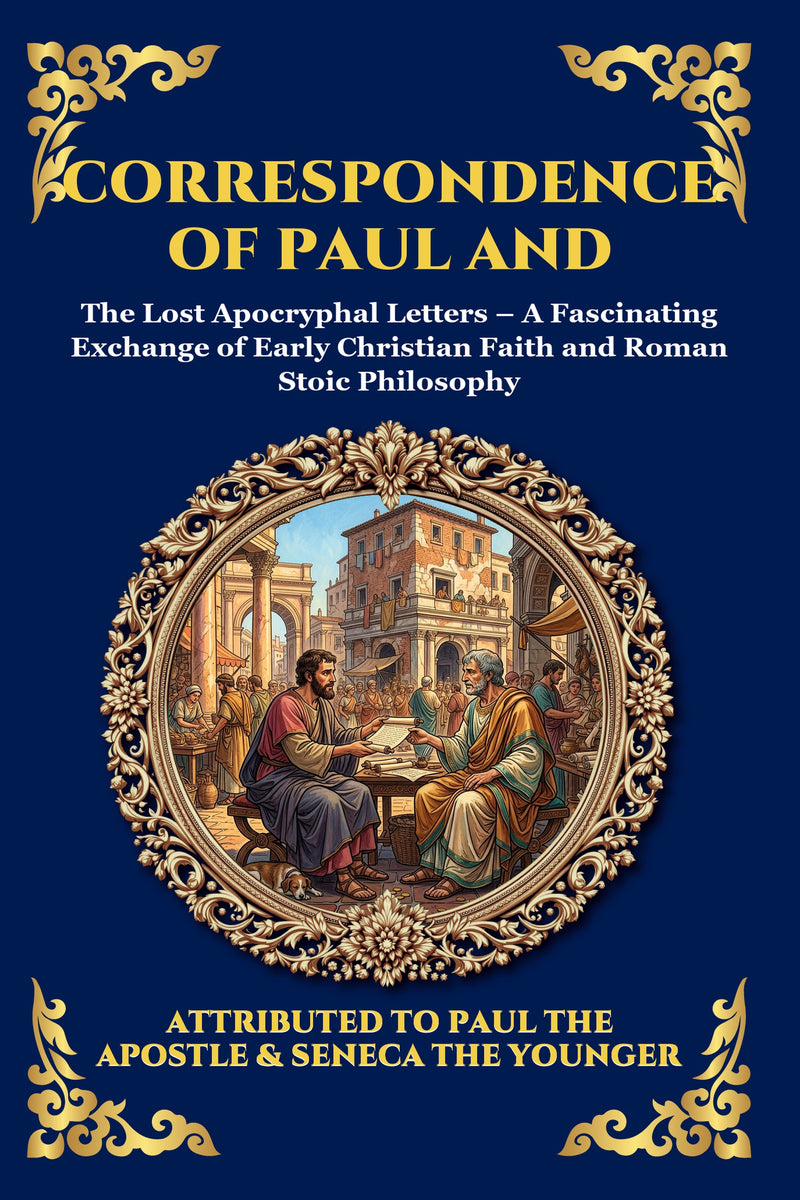
Correspondence of Paul and Seneca
Early Christians linked their faith to Roman intellect through letters between Paul the Apostle and Seneca, a Stoic philosopher and advisor to Nero. Though likely a forgery, this correspondence reveals the allure of merging Christian doctrine with Stoic philosophy and Roman power.
or free app
10,000+ hrs library
30-day guarantee
Complete modern-English translation of the Correspondence of Paul and Seneca—listed in Jerome's De Viris Illustribus as genuine 4th-century correspondence—readable online with audiobook narration included for members.
In the flickering candlelight of medieval scriptoriums, monks carefully copied letters claiming to reveal secret exchanges between Christianity's greatest missionary and Rome's most celebrated philosopher. The Correspondence of Paul and Seneca stands as one of the most intriguing literary mysteries of the ancient world.
The Correspondence of Paul and Seneca stands as one of the most intriguing literary mysteries of the ancient world. For centuries, theologians and historians were captivated by the possibility that Paul the Apostle, the fiery architect of early Christianity, maintained a secret, respectful correspondence with Lucius Annaeus Seneca, the preeminent Stoic philosopher and powerful advisor to the infamous Emperor Nero. While modern scholarship widely regards these fourteen letters as a late antique forgery, their historical and cultural significance remains absolutely monumental.
This apocryphal text reveals the deep, underlying desire of the early Christian church to find common ground with classical Roman philosophy. The letters depict a fascinating mutual admiration society between the two towering figures. Seneca praises Paul's profound moral teachings and the divine inspiration behind his words, even expressing a desire to share Paul's writings with the Emperor himself. In turn, Paul acknowledges Seneca's immense wisdom and elevated status within the Roman court. It is a brilliant, early attempt at religious apologetics, perfectly designed to demonstrate that the new Christian faith was not a threat to the empire, but rather entirely compatible with the highest intellectual traditions of the Roman world.
This comprehensive modern translation brings the fascinating exchange back to life, capturing the formal, polite, and deeply philosophical tone of the letters. It provides an essential window into how early Christians viewed their relationship with secular authorities and intellectual elites during a time of immense cultural upheaval and impending persecution.
What You’ll Discover in This Modern Translation
- The Meeting of Two Worlds: Witness the imagined, respectful dialogue between the spiritual fervor of early Christianity and the rational discipline of Roman Stoicism.
- Early Christian Apologetics: Explore how ancient writers attempted to legitimize their growing faith by connecting it to the most respected and powerful intellectual figures of the empire.
- Insights into Roman Imperial Life: Gain a unique perspective on the perilous political and social landscape of Nero's court through the eyes of his most famous, yet doomed, advisor.
- A Window into Apocryphal Literature: Understand the historical context, the brilliant motivations, and the enduring legacy of pseudepigraphal writings that actively shaped the intellectual history of the early church.
Whether you are exploring this work for its immense historical value, its philosophical themes, or its fascinating view of early church history, the Correspondence of Paul and Seneca offers an unforgettable intellectual journey. Step into the minds of antiquity's greatest thinkers and discover the letters that captivated the ancient world. Begin your journey today.
| Formats | eBook (EPUB + PDF) · Audiobook · Paperback · Hardcover · Large Print |
| Language | English |
| Trim size (print) | 6 × 9 in |
| Binding | Paperback — perfect-bound · Hardcover — casewrap |
| Large Print edition | Same text in a larger, easy-read type — a larger font, not a larger trim |
| Print pricing | Every physical book at our true cost — at-cost, no profit (members) |
| Library | 873 restored titles, always growing |
| Composed | 4th century AD |
| Original language | Latin |
| Source tradition | Medieval Latin manuscript tradition |
| Translation basis | Public-domain scholarly translation, rendered in clear modern English |
| Length | 1,989 words · ~8 min reading |
| Reading level | Grade 9 · clear and comfortable (this modern-English edition) |
| Edition | Modern English translation · 2026 |
Member reviews for this edition are collected as readers finish it — be the first. Across the library: 12,000+ books shipped, every plan covered by a 365-day print guarantee.
About this edition
The complete, unabridged text in clear modern English — faithful to the original, never simplified. Every paragraph is checked against the source, so nothing is cut, summarised, or paraphrased away. It reads cleanly for today while keeping the original meaning intact.
The correspondence survives in medieval Latin manuscripts from the 8th century onward. This edition derives from the standard public-domain scholarly translation and renders it in clear modern English.
- Complete & unabridgedVerified paragraph by paragraph against the source — never a scan, never abridged.
- Modern English, faithfulReadable today, with the author’s meaning kept intact. Readable — not simplified.
- Every format, one membershipRead in your browser or the free app, or listen to the full audiobook.
Included free with your membership
Cancel anytime, one click · 30-day money-back guarantee
Edition last updated June 2026
What’s inside
Correspondence of Paul and Seneca — complete and unabridged: all 15 sections included with membership, plus the full audiobook.
Begin reading Correspondence of Paul and Seneca
In clear modern English — the complete text is included with membership.
Chapter 1
Annaeus Seneca to Paul, Greeting.
I imagine, Paul, that you have heard about the conversation I had yesterday with my friend Lucilius, touching on hypocrisy and various other subjects — for some of your disciples were with us at the time.
We had withdrawn into the Sallustian gardens, and they happened to be passing through as well. They were about to take a different path, but we persuaded them to join us.
I want you to know that we greatly desire your company.
We were deeply moved by your collection of letters, which you have written to various cities and provincial capitals, and which contain remarkable guidance for the conduct of life.
The sentiments expressed in them are such that I take you to have been not so much their author as the instrument through which they were conveyed — though at times, perhaps, both at once.
For the sublimity of those teachings, and their greatness, is such that I think a single human lifetime is barely enough to be instructed and formed by them. I wish you well, my brother. Farewell.
Chapter 2
Paul to Seneca, Greeting.
I received your letter yesterday with great pleasure, and would have written back immediately had the young man I intended to send to you been at home. You know well when, by whom, at what times, and to whom I must entrust everything I send. Do not charge me with negligence, then, if I wait until I have the right person to carry my reply.
I count myself very fortunate to have the approval of so worthy a man, and to know that my letters give you delight. You would not deserve your reputation as a critic and philosopher, nor your role as tutor to so great a prince and master of every branch of learning, if you were not entirely sincere. I wish you enduring prosperity.
Chapter 3
Annaeus Seneca to Paul, Greeting.
I have finished several volumes and divided them into their proper sections.
I intend to read them to Caesar, and if a favorable opportunity arises, I would like you to be present at the reading.
If that cannot be arranged, I will set a day and let you know, so that we may read through the work together.
My wish had been, if it could safely be done, to have your opinion of it before presenting it to Caesar, so that you might see for yourself how much I value your judgment. Farewell, dearest Paul.
Chapter 4
Paul to Seneca, Greeting.
Whenever I read your letters, I feel as though you are right here with me, and I can hardly think of you as anything other than a constant presence in my life.
So as soon as you are able to come, we will see each other face to face. I wish you every happiness.
Chapter 5
Annaeus Seneca to Paul, Greeting.
We are deeply troubled by your long absence from us.
What is it that keeps you away? What business stands in your path?
If you fear Caesar's anger because you have changed your former religion and brought others to do the same, you have this defense: that your action arose not from inconstancy, but from considered judgment. Farewell.
Chapter 6
Paul to Seneca and Lucilius, Greeting.
Regarding the matters you wrote to me about, it is not proper for me to commit anything to writing with pen and ink — one of which leaves visible marks, and the other plainly reveals what is written.
I say this especially because I know that there are people near you, as there are near me, who will understand my meaning.
Deference must be shown to all people, and all the more so toward those who are more likely to seize on occasions for quarreling.
If we conduct ourselves with a humble and yielding spirit, we shall prevail effectively in every respect — provided they are people capable of seeing clearly and acknowledging that they themselves have been in the wrong. Farewell.
Chapter 7
Annaeus Seneca to Paul, Greeting.
I confess that I have taken great pleasure in reading your letters to the Galatians, the Corinthians, and the people of Achaia.
The Holy Spirit has, through you, expressed in them sentiments that are lofty, sublime, worthy of all reverence, and far beyond anything you could have devised on your own.
I would wish, therefore, that when you write things so extraordinary, the language might not fall short of their grandeur, but match it with a fitting elegance.
I must also tell you, my brother — for I will not be dishonest with you or false to my own conscience — that the emperor has been greatly struck by the ideas in your epistles. When the opening of them was read aloud to him, he declared himself astonished that such thoughts could come from a man who had received no formal education.
I replied that the gods sometimes choose humble instruments to speak through, and I gave him the example of a simple countryman named Vatienus, who, while he was in the region of Reate, had two men appear to him — Castor and Pollux — and received a revelation from the gods through them. Farewell.
Chapter 8
Paul to Seneca, Greeting.
Although I know the emperor is both an admirer and a supporter of ours, I must ask you not to expose yourself to harm on our account.
I think you ventured upon a very dangerous course when you declared to the emperor something so contrary to his religion and manner of worship, given that he is a devotee of the pagan gods.
I do not know exactly what you had in mind when you spoke to him of this, but I suspect you did it out of too great a regard for me.
I ask that in the future you refrain from doing so, for you must take care that in showing your affection for me you do not give offense to your master.
His anger, after all, can do us no real harm so long as he remains a pagan, and equally, his goodwill is of no particular benefit to us.
As for the empress, if she acts in a manner worthy of her station she will not take offense; but if she acts merely as a woman, she will feel affronted. Farewell.
Chapter 9
Annaeus Seneca to Paul, Greeting.
I know that my letter, in which I told you I had read your epistles to the Emperor, does not affect you as much as the nature of the things themselves does.
These things so powerfully turn men's minds away from their former habits and ways of living that I have always been struck by it, and have been fully convinced of this by many arguments in the past.
Let us therefore make a fresh start, and if anything on my part has previously been handled unwisely, I ask your forgiveness.
I have sent you a book on the richness of language. Farewell, dearest Paul.
Chapter 10
Paul to Seneca, Greeting.
Every time I write to you and place my name before yours, I do something that troubles me and runs contrary to our faith. As I have often said, I ought to become all things to all people, and to show proper respect for your rank — the rank that Roman law honors all senators with — by placing my name last in the letter. I should not have to feel discomfort and embarrassment when finally doing what I always wished to do. Farewell, most respected master. Written on the fifth of the Calends of July, in the fourth consulship of Nero and Messala.
Chapter 11
Annaeus Seneca to Paul, Greeting.
All happiness to you, my dearest Paul.
If a man as great and admirable as you are becomes not merely an acquaintance but a close and intimate friend to me, how fortunate Seneca will be!
You, who are so distinguished and so far above all others, even the greatest among them, should not think it beneath you to be named first in the salutation of a letter.
Otherwise I might suspect that you mean not so much to test me as to mock me — for you know very well that you are a Roman citizen.
I could wish to be in the position and standing that you occupy, and that you were in mine. Farewell, dearest Paul. Written on the tenth day before the Kalends of April, in the consulship of Aprianus and Capito.
Chapter 12
Annaeus Seneca to Paul, Greeting.
All happiness to you, my dearest Paul. Can you doubt how deeply concerned and grieved I am that your innocence should bring you to suffering?
That all the people should count you a criminal, and imagine that every misfortune befalling the city is your doing?
But let us bear these charges with patience, appealing to that court which is the only one our hard fortune allows us to address, until at last our misfortunes give way to an unalterable happiness.
Earlier ages produced Alexander the son of Philip, and Dionysius; our own age has produced Caius Caesar, men whose personal whims served as their only law.
As for the repeated burnings of the city of Rome, the true cause is plain enough; and if a man of my modest station were permitted to speak freely, and one could declare these dark things without danger, the whole truth of the matter would be clear to everyone.
The Christians and Jews are of course the ones commonly punished for the crime of burning the city; but that impious wretch who delights in murder and butchery, and covers his villainy with lies, is being reserved for his own appointed time.
And as the life of every excellent person is now sacrificed in place of that one man, so that one man shall in turn be sacrificed for many, and he shall be given over to be consumed by fire in place of them all.
A hundred and thirty-two houses and four entire city blocks were burned down in six days; the seventh day brought the burning to an end. I wish you all happiness.
Written on the fifth day before the Kalends of April, in the consulship of Frigius and Bassus.
Chapter 13
Annaeus Seneca to Paul, Greeting.
All happiness to you, my dearest Paul.
You have written many volumes in an allegorical and mystical style, and therefore such great matters as have been entrusted to you require not rhetorical flourishes of speech, but only a fitting elegance.
I recall that you often say many writers do injury to their subjects by straining after such a style, and lose the force of what they are trying to convey.
In this one thing, then, I ask you to heed me: attend to sound Latin, and choose your words with care, so that you may the better discharge the noble trust that has been placed in you.
Farewell. Written on the fifth day before the Nones of July, in the consulship of Leo and Savinus.
Chapter 14
Paul to Seneca, Greeting.
Your earnest reflection has been rewarded with insights that God grants to very few.
I am therefore confident that I am sowing the strongest seed in fertile ground — not anything material, which is subject to decay, but the enduring word of God, which will grow and bear fruit into eternity.
What you have come to understand through your wisdom will remain with you, imperishable, forever.
Know that you must turn away from the superstitions of both Jews and Gentiles.
The truths you have in some measure grasped, share wisely with the emperor, his household, and your trusted friends.
And though your words may seem unwelcome to them, and beyond their comprehension — since most of them will pay little heed to what you say — yet the word of God, once it has entered them, will in time make them new people, reaching out toward God.
Farewell, Seneca, most dear to us. Written on the Calends of August, in the consulship of Leo and Savinus.
Cancel anytime, one click · 30-day money-back guarantee
Founding annual rate available now — your price locks for life when you join.
Not ready? Get this free chapter by email — read it anytime.
✓ Sent — check your inbox for Correspondence of Paul and Seneca.
Questions about Correspondence of Paul and Seneca
Is the Correspondence of Paul and Seneca authentic?
Modern scholars unanimously consider the Correspondence of Paul and Seneca a later forgery, likely composed in the 4th century AD. The Latin style and anachronistic content clearly indicate it was not written by either historical figure.
Why was this correspondence created?
The Correspondence of Paul and Seneca was likely created to legitimize Christianity among Roman intellectuals by connecting Christian doctrine with respected Stoic philosophy. It reflects early Christian efforts to engage with classical philosophical traditions.
What does the Correspondence of Paul and Seneca contain?
The correspondence consists of fourteen brief letters exchanged between Paul and Seneca, discussing philosophical and theological matters. The letters show mutual respect and explore connections between Christian teachings and Stoic philosophy.
Is Correspondence of Paul and Seneca free to read?
The opening of the text is free to read below. Members read and listen to the complete work — and the entire Lost & Forbidden Library — free.
What is Correspondence of Paul and Seneca?
Have you ever wondered why early Christians were so eager to connect their faith with the greatest minds of the Roman Empire, and what they might have said to one another?
How long is Correspondence of Paul and Seneca?
15 chapters (~2,002 words) in this restored edition.
Shipping & returns
Billing & membership
More from the library


Explore The Lost & Forbidden Library
- 1 Enoch · Attributed to Enoch
- 1–4 Maccabees · Various Jewish authors
- 2 Baruch · Attributed to Baruch
- 2 Enoch · Attributed to Enoch
- 2 Esdras · Attributed to the prophet Ezra
- 3 Baruch · Attributed to Baruch ben Neriah
- 4 Baruch · Attributed to Baruch ben Neriah
- A Valentinian Exposition · Attributed to a follower of Val...
- Acta Archelai · Attributed to Hegemonius
- Acts of Andrew · Anonymous (Early Christian Apoc...
- Acts of Andrew and Matthias in the City of the Cannibals · Attributed to early Christian a...
- Acts of Barnabas · Attributed to John Mark
- Acts of Bartholomew
- Acts of John · Anonymous (Early Christian Apoc...
- Acts of Matthias · Anonymous early Christian writers
- Acts of Paul · Attributed to an unknown early ...
- Acts of Paul and Thecla · Attributed to Onesiphorus
- Acts of Peter
- Acts of Peter and Andrew · Attributed to various early Chr...
- Acts of Peter and Paul · Attributed to Leucius Charinus
- Acts of Peter and Simon · Attributed to Leucius Charinus
- Acts of Peter and the Twelve Apostles · Attributed to early Christian a...
- Acts of Philip · Anonymous (Early Christian Apoc...
- Acts of Pilate (Gospel of Nicodemus) · Attributed to various early Chr...
- Acts of Saturninus
- Acts of Thaddaeus · Attributed to Thaddaeus the Apo...
- Acts of Thomas
- Acts of Titus · Anonymous early Christian writer
- Acts of Xanthippe, Polyxena, and Rebecca
- Allogenes · Anonymous (Early Gnostic Mystic)
Correspondence of Paul and Seneca
The Correspondence of Paul and Seneca
Fourteen Apocryphal Letters Between the Apostle Paul and the Philosopher Seneca — On the Power of Paul's Epistles, the Court of Nero, the Burning of Rome, and the Persecution of the Christians
Library of Alexandria Press
The Correspondence of Paul and Seneca
© Copyright 2026 Library of Alexandria Press. All rights reserved.
Published by Library of Alexandria Press
Printed in the United States of America
It is not legal to copy, share, or send any part of this document in either digital or printed form without written permission from the publisher, except short quotes in a book review.
Table of Contents
Introduction
Chapter 1
Chapter 2
Chapter 3
Chapter 4
Chapter 5
Chapter 6
Chapter 7
Chapter 8
Chapter 9
Chapter 10
Chapter 11
Chapter 12
Chapter 13
Chapter 14
Introduction
Imagine two men, separated by culture, language, and the vast social hierarchies of the Roman Empire, finding in each other a mirror of their deepest convictions. One is a Jewish tentmaker from Tarsus, a former Pharisee who had undergone a shattering transformation on a road to Damascus and now traveled the Mediterranean world preaching a gospel that turned conventional wisdom upside down. The other is one of the most celebrated intellectuals of the ancient world — a Spanish-born philosopher, playwright, and statesman who served as tutor and advisor to the Emperor Nero, and whose essays on virtue, friendship, and the examined life remain among the most widely read texts from antiquity. That these two figures — the Apostle Paul and Lucius Annaeus Seneca — might have exchanged letters is a proposition that has fascinated, divided, and captivated scholars, theologians, and general readers for nearly two thousand years.
The collection of letters you are about to read is one of the most extraordinary and contested documents to have survived from late antiquity. Fourteen letters in total — eight attributed to Seneca and six to Paul — they circulate under the Latin title Epistulae Senecae ad Paulum et Pauli ad Senecam, and they have been read, copied, debated, dismissed, defended, and reinterpreted across centuries of intellectual history. They were known to Saint Jerome, who cited them in his catalogue of illustrious men written around 392 CE. Augustine was aware of their existence. Medieval monks copied them alongside the genuine letters of both men. Renaissance humanists puzzled over their authenticity. And modern scholars have subjected them to every form of textual, historical, and linguistic scrutiny available, reaching conclusions that range from outright forgery to cautious agnosticism to something approaching wonder.
Whether or not these letters are what they purport to be — genuine correspondence between the apostle and the philosopher — they are, without question, a remarkable human document. They represent an early and deeply earnest attempt to bridge two of the most powerful intellectual and spiritual traditions of the ancient world: the Stoic philosophy of Rome, with its emphasis on reason, self-mastery, and the brotherhood of all rational beings under a universal logos, and the emerging Christian faith, with its proclamation of a crucified and risen savior, its insistence on grace over achievement, and its radical vision of a community defined not by birth or status but by shared belief and love. The conversation these letters stage — whether historically real or imaginatively reconstructed — is one of the most consequential conversations that could have taken place in the first century of the Common Era.
To read these letters without some preparation is to risk missing much of what makes them extraordinary. The world in which they were supposedly written was one of tremendous upheaval and possibility. Rome under Nero was a city of breathtaking wealth and appalling cruelty, of philosophical salons and public executions, of cosmopolitan intellectual exchange and brutal political repression. Seneca himself occupied an almost impossibly contradictory position within this world: a man who wrote movingly about the vanity of wealth while accumulating one of the largest private fortunes in the empire, a philosopher who counseled clemency to an emperor who would eventually order his death, a Stoic sage who was also a courtier, a moralist who was also a survivor. Paul, meanwhile, was writing his letters from prisons, from ships, from the houses of converts scattered across the Greek-speaking world, building a movement that the Roman authorities regarded with suspicion and occasional violent hostility. That these two men might have recognized something of themselves in each other — might have found, across the gulf of their different worlds, a shared hunger for truth and a shared impatience with the merely conventional — is not, when you think carefully about it, so implausible at all.
The letters themselves are brief, sometimes frustratingly so. They do not contain the soaring theological arguments of Paul's letter to the Romans or the intimate philosophical meditations of Seneca's letters to his friend Lucilius. They are, in their surviving form, the letters of busy men — men who are aware of being watched, who choose their words with some care, who circle around the deepest questions without always landing on them directly. And yet, in their very restraint, in the gaps and silences they contain, they invite the reader into an act of imaginative reconstruction that is itself a kind of philosophical and spiritual exercise. To read these letters well is to ask yourself what it would mean for a Roman Stoic and a Christian apostle to find common ground — and to discover, perhaps to your surprise, that the ground between them is both more fertile and more contested than you had imagined.
This introduction is designed to give you everything you need to enter that conversation fully equipped. It will offer you a portrait of both men as they stood at the moment these letters were supposedly exchanged, a map of the intellectual terrain they shared and the chasms that divided them, and a guide to the long and fascinating history of how these letters have been read and what they have meant to different communities across the centuries. By the time you turn to the letters themselves, you will, I hope, be ready not merely to read them but to inhabit them — to feel the weight of what was at stake in every careful phrase, every diplomatic circumlocution, every moment of unexpected candor.
Two Worlds on the Edge of Collision
To understand what makes this exchange so electrically charged, you need to understand who Seneca and Paul actually were — not as the marble busts and stained-glass windows of later tradition have rendered them, but as living, breathing, contradictory human beings navigating one of the most turbulent periods in Western history.
Lucius Annaeus Seneca was born in Córdoba, in the Roman province of Hispania Baetica, sometime around 4 BCE, into a wealthy and intellectually distinguished family. His father, Seneca the Elder, was a celebrated rhetorician whose writings on oratory survive in part today. The younger Seneca was brought to Rome as a child and educated in the finest philosophical traditions the city had to offer, studying under Stoic, Pythagorean, and Epicurean teachers and developing the eclectic but fundamentally Stoic outlook that would characterize his mature work. He was a prodigiously gifted writer — his tragedies, his philosophical dialogues, his natural history, and above all his letters to Lucilius constitute one of the richest bodies of Latin prose from the classical period — and he was also, from an early age, a man who understood how to navigate power.
His career at court was marked by the kind of dramatic reversals that seem almost novelistic in retrospect. He was exiled to Corsica under the Emperor Claudius on a charge of adultery with the emperor's niece — a charge almost certainly politically motivated — and spent eight years in that remote island writing philosophical essays that meditate, with varying degrees of convincing serenity, on the Stoic ideal of equanimity in the face of misfortune. He was recalled to Rome to serve as tutor to the young Nero, and for the first years of Nero's reign he exercised, along with the praetorian prefect Burrus, something like a moderating influence on imperial policy. These years — sometimes called the quinquennium Neronis, the five good years of Nero — were a period of relatively enlightened governance, and Seneca's fingerprints are visible on many of its more humane features. But as Nero's character darkened and his reign grew more erratic and violent, Seneca's position became increasingly untenable. He attempted to retire from court life, to withdraw into philosophical contemplation, but Nero would not entirely release him. And in 65 CE, implicated — almost certainly unjustly — in the Pisonian conspiracy to assassinate the emperor, he was ordered to take his own life. His death, described in vivid and moving detail by the historian Tacitus, was staged as a deliberate echo of Socrates: the philosopher dying by his own hand, attended by friends, discoursing on the immortality of the soul.
What strikes any careful reader of Seneca's genuine writings is how persistently, almost obsessively, he returns to certain themes: the shortness of life and the importance of using time well, the distinction between true goods (virtue, wisdom, friendship) and false goods (wealth, fame, power), the brotherhood of all human beings under the universal reason that Stoics called the logos or pneuma, and the possibility — even the necessity — of moral progress. He is not a systematic philosopher in the manner of Aristotle or even of the earlier Stoics like Chrysippus. He is, rather, a moral essayist of genius, a man who uses philosophy as a tool for self-examination and self-transformation, and who writes with an urgency and intimacy that can make a reader feel, across two millennia, that he is being addressed personally.
Paul of Tarsus was born, probably within a decade of Seneca, into a Jewish family in the city of Tarsus in Cilicia — a city that was, like Seneca's Córdoba, a provincial capital with strong Greek cultural traditions and deep connections to the wider Roman world. He was, by his own account, a Pharisee of the Pharisees, educated in Jerusalem under the great rabbi Gamaliel, zealous for the traditions of his ancestors to the point of actively persecuting the nascent Jesus movement. His conversion — the sudden, overwhelming experience on the road to Damascus that he describes in his letter to the Galatians — was the hinge on which his entire life turned. After it, he spent years in Arabia and Syria before beginning the missionary journeys that would take him across the Greek-speaking Mediterranean world, establishing communities of believers in city after city, writing the letters that would eventually become part of the Christian New Testament, and ultimately arriving in Rome itself.
Paul's intellectual formation was complex and has been debated by scholars for generations. He was clearly deeply rooted in the Hebrew scriptures and in the traditions of Jewish biblical interpretation. But he was also, inevitably, a man of his Hellenistic world, familiar with the rhetorical conventions and philosophical vocabulary of educated Greek speakers. Scholars have long noted points of contact between Paul's thought and Stoic philosophy — his use of the concept of conscience, his discussion of natural law in Romans, his famous hymn to love in First Corinthians, his insistence that in Christ there is neither Jew nor Greek, slave nor free, male nor female. Whether these parallels reflect direct knowledge of Stoic texts, indirect influence through the broader culture of educated Hellenism, or simply the convergence of two traditions grappling with similar human questions, they are real and they are significant.
The world that both men inhabited in the late 50s and early 60s CE — the period when the letters are supposed to have been exchanged — was one in which the boundaries between different philosophical and religious traditions were considerably more permeable than later orthodoxies would suggest. Educated Romans read Jewish texts in Greek translation. Jewish thinkers like Philo of Alexandria wrote philosophical works that drew deeply on Platonic and Stoic sources. Stoic philosophers like Epictetus would later use language and concepts that scholars have found strikingly reminiscent of the Sermon on the Mount. The intellectual world of the first century was one of extraordinary cross-pollination, and it is against this background that the supposed meeting of minds between Seneca and Paul must be understood.
There is, moreover, a specific historical context that gives the correspondence particular plausibility — or at least particular poignancy. Paul was in Rome, under house arrest, appealing his case to the emperor, probably between 60 and 62 CE. Seneca was still at court, still exercising some influence, still trying to navigate the increasingly dangerous waters of Nero's reign. The city in which both men found themselves was a city of perhaps a million inhabitants, a city in which different communities — Roman, Greek, Jewish, Egyptian, Syrian — lived in close if not always comfortable proximity. It was a city in which a letter of introduction from a mutual acquaintance could open almost any door, and in which the circles of the educated and the powerful were small enough that two such remarkable figures might plausibly have come to each other's attention. Seneca's brother Gallio, it is worth noting, is mentioned in the Acts of the Apostles as the Roman proconsul before whom Paul appeared in Corinth — a detail that has struck many readers as providing at least a thin thread of historical connection between the two men's worlds.
A Document for the Ages
The question of whether these letters are genuine has occupied scholars since at least the Renaissance, and it is a question to which there is, at present, no universally accepted answer. The consensus among modern classical scholars and New Testament specialists leans heavily toward inauthenticity — toward the view that the letters are a later composition, probably dating from the third or fourth century CE, written by a Christian author (or authors) who wished to demonstrate the compatibility of Stoic philosophy and Christian faith, or to claim the prestige of Seneca's name for the Christian intellectual tradition, or simply to imagine what such a correspondence might have looked like. The arguments for this view are substantial. The Latin of the letters is generally regarded as inferior to Seneca's genuine prose style. The letters contain historical and chronological inconsistencies. They do not engage with the deepest theological questions of either tradition with anything like the sophistication one would expect from their supposed authors. And there is no reference to the correspondence in any source that predates Jerome's mention of it in the late fourth century.
And yet the case for inauthenticity, compelling as it is, does not exhaust the interest of the letters or settle all the questions they raise. Even if they are a later composition — even if they were written by some anonymous Christian intellectual of the third or fourth century who was trying to imagine or reconstruct or perhaps invent a dialogue between the apostle and the philosopher — they remain a document of extraordinary historical and cultural significance. They tell us something important about how early Christians understood their relationship to the classical philosophical tradition. They tell us something about the strategies that Christian intellectuals used to make their faith legible and respectable to educated Roman audiences. They tell us something about the deep human desire to find, across the boundaries of different traditions and different worlds, a common language for the most important questions.
There is also a minority scholarly view — not without its defenders — that the letters, or some core of them, may preserve genuine material, even if they have been edited, expanded, or transmitted imperfectly. The argument is not that every word is authentic, but that the tradition of a connection between Seneca and Paul may rest on some historical foundation — a meeting, a conversation, a lost letter or two — that was later elaborated into the collection we now possess. This view cannot be proven, but it cannot be entirely dismissed either, and it has the virtue of taking seriously both the persistence of the tradition and the genuine points of contact between the two men's worlds.
What is perhaps most striking about the long history of these letters' reception is how consistently they have served as a site for working out the relationship between faith and reason, between the wisdom of Athens and Rome and the revelation of Jerusalem. Jerome included Seneca among his catalogue of Christian writers — a remarkable move that reflects the early church's complex and ambivalent relationship to classical culture. Medieval thinkers who copied and read the letters were working through their own version of the same question: what was the relationship between the philosophical inheritance of antiquity and the theological commitments of Christianity? Could a pagan philosopher, however wise and virtuous, be saved? Could Christian faith be expressed in the language and categories of classical philosophy without being distorted or diluted? These are not merely historical questions. They are questions that have never entirely lost their urgency.
The Renaissance humanists who returned to these letters with fresh eyes brought their own set of concerns. For figures like Erasmus, who was skeptical of the letters' authenticity but fascinated by their implications, the correspondence represented an ideal of learned, irenic dialogue across confessional and cultural boundaries — an ideal that was becoming increasingly difficult to sustain in the fractured world of the Reformation. For later readers in the Enlightenment period, the letters offered a different kind of appeal: here, apparently, was evidence that the best of ancient wisdom and the best of Christian ethics converged, that reason and revelation were not enemies but allies, that the universal human capacity for moral reflection could find its way to truths that transcended any particular religious tradition.
Reading these letters today, in the early twenty-first century, we bring yet another set of questions and concerns. We live in a world in which the relationship between different religious and philosophical traditions is a matter of urgent practical importance, in which the boundaries between secular and sacred ways of knowing are constantly being negotiated and contested, in which the ancient questions about how to live well, how to face suffering and death, how to build communities of genuine solidarity across lines of difference, have lost none of their force. The conversation that these letters stage — however imperfectly, however incompletely — is a conversation we are still having.
There is something else that deserves to be said before you begin reading, something that no amount of scholarly apparatus can fully substitute for: these letters are moving. Not always in the ways that great literature is moving — they do not have the rhetorical power of Paul's genuine epistles or the meditative depth of Seneca's letters to Lucilius. But they are moving in the way that any sincere attempt at human connection across difference is moving. You can feel, in them, the effort of two minds trying to understand each other, trying to find a shared vocabulary for experiences and convictions that resist easy translation. You can feel the care with which each writer chooses his words, the delicacy with which he approaches the most sensitive subjects, the moments of genuine warmth and mutual admiration that break through the diplomatic surface of the prose. Whether these feelings were felt by the historical Seneca and Paul, or by some later writer who imagined their meeting with sympathy and intelligence, they are real feelings, and they deserve a real response.
The letters are arranged in this edition in their traditional order, with the Latin text facing an English translation that aims for clarity and readability rather than strict literalism. Each letter is accompanied by a brief commentary that places it in its historical and intellectual context, identifies the allusions and references that a modern reader might miss, and raises the interpretive questions that seem most important without pretending to settle them. The goal throughout has been to give you the richest possible encounter with these texts — to let you hear, as clearly as possible, the voices they contain, and to let you draw your own conclusions about what those voices are saying and why they still matter.
You are about to enter one of the most fascinating conversations in the history of Western thought. It is a conversation about virtue and grace, about reason and revelation, about the possibility of friendship across the deepest cultural and religious divides. It is a conversation that was begun, in one form or another, in the first century of the Common Era, and that has never entirely stopped. The letters that follow are your invitation to join it — to sit down, as it were, at the table where a Roman philosopher and a Christian apostle are trying, with all the intelligence and goodwill at their disposal, to understand each other and themselves. Whatever you conclude about their authenticity, I think you will find, as readers have found for nearly two millennia, that the conversation they conduct is one worth having, and one that has the power to change the way you think about faith, philosophy, and the human search for wisdom.
The Correspondence of Paul and Seneca
Chapter 1
Annaeus Seneca to Paul, Greeting.
I imagine, Paul, that you have heard about the conversation I had yesterday with my friend Lucilius, touching on hypocrisy and various other subjects — for some of your disciples were with us at the time.
We had withdrawn into the Sallustian gardens, and they happened to be passing through as well. They were about to take a different path, but we persuaded them to join us.
I want you to know that we greatly desire your company.
We were deeply moved by your collection of letters, which you have written to various cities and provincial capitals, and which contain remarkable guidance for the conduct of life.
The sentiments expressed in them are such that I take you to have been not so much their author as the instrument through which they were conveyed — though at times, perhaps, both at once.
For the sublimity of those teachings, and their greatness, is such that I think a single human lifetime is barely enough to be instructed and formed by them. I wish you well, my brother. Farewell.
Chapter 2
Paul to Seneca, Greeting.
I received your letter yesterday with great pleasure, and would have written back immediately had the young man I intended to send to you been at home. You know well when, by whom, at what times, and to whom I must entrust everything I send. Do not charge me with negligence, then, if I wait until I have the right person to carry my reply.
I count myself very fortunate to have the approval of so worthy a man, and to know that my letters give you delight. You would not deserve your reputation as a critic and philosopher, nor your role as tutor to so great a prince and master of every branch of learning, if you were not entirely sincere. I wish you enduring prosperity.
End of the free sample
Keep reading, free
Members read and listen to the complete book — and the entire library. Cancel anytime, one click · 30-day money-back guarantee.