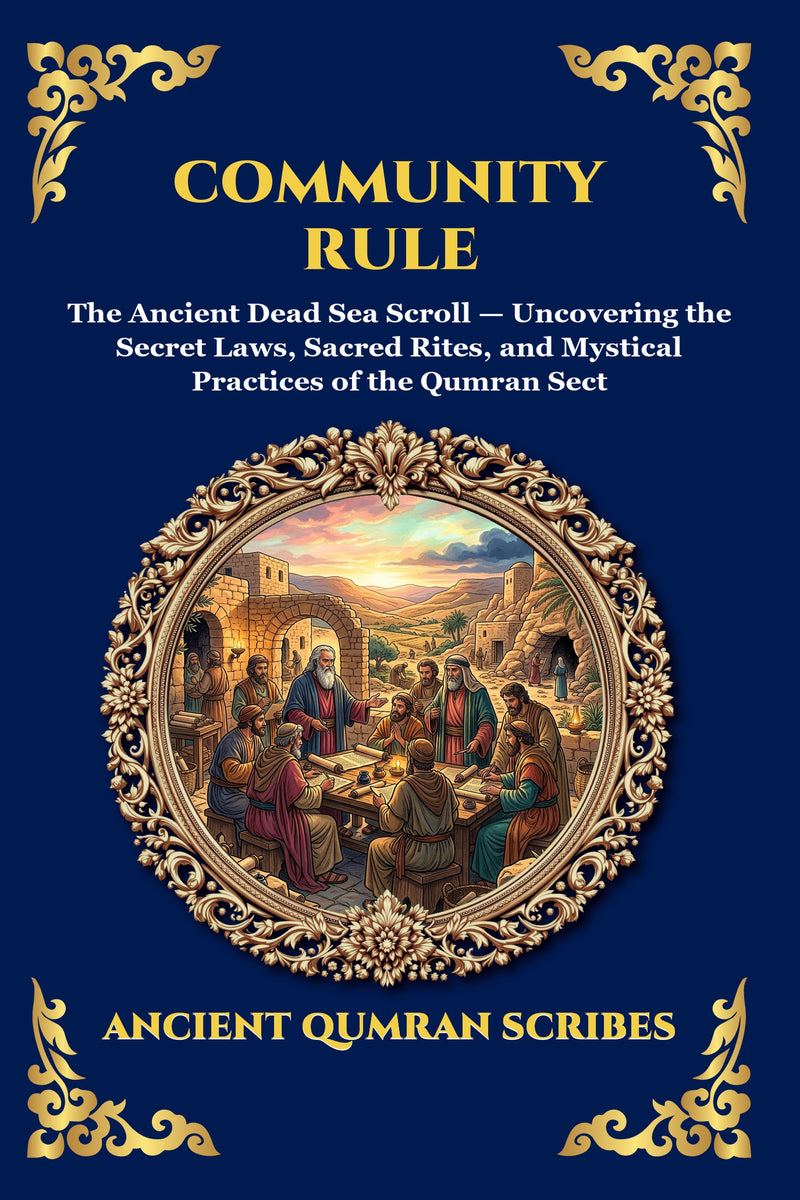
Community Rule
The Community Rule lays bare the strict regulations and daily rituals of the Qumran sect, thought to be the Essenes, who retreated to the desert to escape a world they deemed corrupt. Found among the Dead Sea Scrolls, this manual reveals the unyielding discipline of a secluded, devoted community.
or free app
10,000+ hrs library
30-day guarantee
The Community Rule from the Dead Sea Scrolls discovered at Qumran offers complete modern English translation online with audiobook narration included for members.
The Community Rule, discovered among the Dead Sea Scrolls in 1947, stands as one of archaeology's most significant finds for understanding ancient Jewish sectarian life.
In The Community Rule, you are granted unprecedented access to the inner workings of the Qumran sect—widely believed to be the ancient Essenes. Found hidden in jars within the caves overlooking the Dead Sea, this manuscript (also known as the Manual of Discipline) is not a theoretical theological treatise; it is the absolute, practical legal code of a radically devoted community. To these scribes, the world and the mainstream priesthood in Jerusalem had become hopelessly corrupted by darkness, prompting them to retreat to the wilderness to live a life of perfect, unyielding purity.
Far from a simple list of rules, this text provides a vivid, day-to-day blueprint of an ancient utopian society. Have you ever wanted to know how ancient initiates proved themselves worthy over a multi-year probation period, or how infractions as simple as interrupting a speaker or spitting in the communal assembly were punished? The Community Rule details it all. It also contains breathtaking theological reflections on the battle between the "Spirit of Truth" and the "Spirit of Deceit" that rages within every human heart.
What You’ll Discover in This Foundational Text
- The Laws of Initiation and Discipline: Explore the intense, multi-year process required to join the sect, and the strict penal code enforcing order, silence, and absolute obedience.
- The Cosmic Dualism of Human Nature: Understand the sect's profound, predestinarian theology detailing the ongoing war between the spirits of light and darkness residing within mankind.
- Sacred Rites and Communal Living: Learn about the sect's practices concerning ritual purity, sacred meals, communal property, and their unique, solar-based calendar.
- The Role of the "Master" and the Priesthood: Discover the hierarchical structure of the community, led by the sons of Zadok and the mysterious "Master" who guided their spiritual education.
- A Window into Second Temple Judaism: Gain a crucial historical perspective on the diverse, often radical religious movements that existed during the time of Jesus and the early church.
Whether you are a biblical scholar, a historian of the ancient Near East, or a reader fascinated by secret societies and ancient mysticism, The Community Rule offers a gripping, unfiltered look into a forgotten way of life.
Step into the austere beauty of the desert and uncover the hidden laws of the Qumran community. Begin your journey today.
| Formats | eBook (EPUB + PDF) · Audiobook · Paperback · Hardcover · Large Print |
| Language | English |
| Trim size (print) | 6 × 9 in |
| Binding | Paperback — perfect-bound · Hardcover — casewrap |
| Large Print edition | Same text in a larger, easy-read type — a larger font, not a larger trim |
| Print pricing | Every physical book at our true cost — at-cost, no profit (members) |
| Library | 873 restored titles, always growing |
| Composed | 2nd-1st century BC |
| Original language | Hebrew |
| Source tradition | Dead Sea Scrolls manuscript tradition from Qumran |
| Translation basis | Public-domain scholarly translation, rendered in clear modern English |
| Length | 3,178 words · ~13 min reading |
| Reading level | Grade 12 · rich, literary prose (this modern-English edition) |
| Edition | Modern English translation · 2026 |
Member reviews for this edition are collected as readers finish it — be the first. Across the library: 12,000+ books shipped, every plan covered by a 365-day print guarantee.
About this edition
The complete, unabridged text in clear modern English — faithful to the original, never simplified. Every paragraph is checked against the source, so nothing is cut, summarised, or paraphrased away. It reads cleanly for today while keeping the original meaning intact.
Preserved in Hebrew manuscripts discovered among the Dead Sea Scrolls at Qumran between 1947-1956. This edition derives from the standard public-domain scholarly translation and renders it in clear modern English.
- Complete & unabridgedVerified paragraph by paragraph against the source — never a scan, never abridged.
- Modern English, faithfulReadable today, with the author’s meaning kept intact. Readable — not simplified.
- Every format, one membershipRead in your browser or the free app, or listen to the full audiobook.
Included free with your membership
Cancel anytime, one click · 30-day money-back guarantee
Edition last updated June 2026
What’s inside
Community Rule — complete and unabridged: all 5 sections included with membership, plus the full audiobook.
Begin reading Community Rule
In clear modern English — the complete text is included with membership.
The World That Shaped the Scroll
Scholars have debated for decades the precise identity of the Qumran community. The most widely accepted hypothesis identifies them with or closely related to the Essenes, a Jewish sect described by ancient writers including Josephus, Philo of Alexandria, and the Roman author Pliny the Elder. All three describe a group of Jewish men who lived communally, held property in common, practiced elaborate ritual purification, observed strict Sabbath laws, and maintained an intense commitment to piety and brotherhood. Pliny even places an Essene settlement on the western shore of the Dead Sea, which corresponds remarkably well to the location of Qumran. The fit is not perfect — there are details in the scrolls that complicate a simple identification — but the broad outlines align closely enough that the Essene hypothesis remains the dominant scholarly position.
What matters more than the precise label, however, is understanding the texture of life that the scrolls reveal. The community was hierarchically organized, with priests — specifically the sons of Zadok, a particular priestly lineage — holding the highest authority. Below them were Levites, and below them the general membership, referred to simply as Israel. Every member had a precisely defined rank within this structure, and rank determined everything: where one sat at communal meals, in what order one spoke in assembly, even the sequence in which one offered blessings. This was not mere social convention. It was theology made visible. The ordered community was an image of divine order, a human reflection of the heavenly hierarchy that the community believed governed the cosmos.
Admission to the community was not a casual affair. The process described in the document is lengthy, demanding, and carefully staged. A prospective member first presented himself to an overseer, who examined his understanding and his conduct. If accepted at this initial stage, he underwent a period of instruction and probation before being examined by the full assembly. Even then he was not immediately admitted to the communal meals or the communal property — these were the most sacred aspects of community life, and access to them was granted only gradually, after further periods of testing and review. The whole process could take years. This was not a community that welcomed casual commitment.
The emphasis on examination and testing reflects a deep theological conviction about human nature. The document articulates a view of humanity as fundamentally divided — not just society at large, but each individual human being. Every person contains within them both the spirit of truth and the spirit of deceit, the angel of light and the angel of darkness. The struggle between these forces is not merely external, a battle between good people and bad people, but internal, a conflict that rages within every soul. The purpose of the community's discipline — its rules, its rituals, its hierarchy, its punishments — is precisely to support and strengthen the spirit of truth within each member, to create an environment in which the better part of human nature can flourish and the worse part can be checked and corrected.
This dualistic theology — the Two Spirits doctrine, as scholars call it — is one of the most philosophically sophisticated and historically influential ideas in the entire scroll. It draws on older currents in Jewish thought but develops them in new and striking directions, and its echoes can be heard in later religious traditions including early Christianity and certain strands of Islamic mysticism. The idea that the cosmos is a battleground between light and darkness, that human beings are participants in this cosmic struggle, that the outcome is certain but the battle is real and must be fought — this is a vision of extraordinary power, and the document presents it with a clarity and force that still resonates across the centuries.
The communal meals described in the text deserve particular attention, both for what they tell us about daily life at Qumran and for their broader historical significance. Meals in the community were not merely occasions for eating. They were sacred assemblies, presided over by a priest who blessed the food and drink before anyone ate. The order of seating reflected the community's hierarchy. Admission to the meal was a privilege that could be suspended as punishment for infractions. Some scholars have noted striking parallels between these communal meals and the early Christian Eucharist, and while the relationship between the two practices remains a matter of scholarly debate, the parallels are real and thought-provoking. At minimum, they remind us that the Qumran community was part of a broader world of Jewish religious experimentation from which early Christianity would also emerge.
The document's treatment of discipline and punishment is one of the aspects that modern readers may find most challenging and most fascinating. The community maintained a detailed code of conduct, and violations were met with specific penalties. Some infractions resulted in a reduction in food rations. Others led to temporary exclusion from the communal meals or from participation in the assembly. The most serious violations could result in permanent expulsion — a punishment that, in a community as tightly knit and as geographically isolated as this one, must have been devastating. A person expelled from the Yahad was cut off not just from a social group but from what they believed was the only truly holy community on earth, the only place where genuine atonement was possible.
Yet the document is not merely a catalog of rules and punishments. Woven through its legislative sections are passages of genuine theological depth and spiritual beauty. The Two Spirits passage is a remarkable piece of religious philosophy. The hymn that concludes the document — a long, soaring meditation on human frailty and divine grace — is one of the most moving pieces of religious poetry to survive from the ancient world. In it, the speaker acknowledges the absolute gulf between human sinfulness and divine holiness, and then, from the depths of that acknowledgment, rises to an expression of trust and gratitude that is genuinely affecting. This is not the voice of a legalist obsessed with rules for their own sake. This is the voice of someone who has looked honestly at the human condition and found, in the midst of its darkness, a reason for profound and sustaining hope.
Understanding the historical relationship between this community and the broader currents of Second Temple Judaism also requires some appreciation of the calendar dispute that was one of the community's defining grievances. The Jerusalem establishment followed a lunar calendar, which determined the dates of festivals and the cycles of priestly service. The Qumran community, by contrast, followed a solar calendar of 364 days, which they believed was the true and original calendar ordained by God and revealed in texts like the book of Jubilees and the astronomical sections of 1 Enoch. This was not a minor technical disagreement. If you were observing Passover on the wrong day, you were not observing Passover at all. If the Temple sacrifices were offered according to a false calendar, they were not merely ineffective but actively offensive to God. The calendar dispute was, for the community, a matter of cosmic significance, and it helps explain the depth of their conviction that separation from the Jerusalem establishment was not merely permissible but necessary.
Reading Across the Centuries
When you actually sit down to read the text that follows, you will encounter a document that is at once alien and strangely familiar. Its world is not our world. Its assumptions about hierarchy, purity, and cosmic warfare are not the assumptions of modern liberal democratic society. Its confidence in its own absolute rightness — the conviction that this community alone possesses the true interpretation of God's law — can feel uncomfortable to contemporary readers trained to value pluralism and humility. But if you are willing to meet the text on its own terms, to enter imaginatively into the world it describes and the convictions it expresses, you will find something remarkable: a community of human beings who were utterly serious about the questions that matter most.
The manuscript itself has a complex textual history that is worth briefly noting. The primary copy of the Community Rule was found in Cave 1 at Qumran and dates to approximately 100 to 75 BCE, though the text it preserves is almost certainly older, perhaps composed in the late third or early second century BCE. Additional fragments of the same or related texts were found in Cave 4, and these fragments reveal that the document existed in multiple versions, suggesting that it was a living text, revised and adapted over time as the community's circumstances and understanding evolved. This is itself a significant finding: it tells us that we are not dealing with a rigid, frozen code but with a tradition that breathed and changed, that was engaged with and wrestled over by successive generations of community members.
The language of the document is Hebrew — a form of late Biblical Hebrew with some features that anticipate the later rabbinic Hebrew of the Mishnah — and it bears the marks of a community deeply steeped in the scriptural tradition. Allusions to and quotations from the Hebrew Bible are woven throughout the text, often without explicit attribution, in the manner of a community for whom scripture was so thoroughly internalized that it had become the natural idiom of thought and expression. Reading the document with an awareness of these scriptural resonances enriches the experience enormously, revealing layers of meaning that a surface reading might miss.
The translation presented in this volume aims to balance fidelity to the original with readability for the modern English speaker. Ancient Hebrew is a terse, dense language, and the Community Rule in particular tends toward a kind of compressed, formulaic style that reflects its nature as a legal and liturgical document. Where the original is deliberately solemn and formal, the translation preserves that quality. Where it achieves moments of lyrical beauty — and it does achieve them — the translation attempts to honor that beauty without embellishment. The goal throughout has been to give the reader as direct and unmediated an encounter with the ancient text as possible.
It is also worth saying something about what this document is not. It is not a narrative. It does not tell a story in the conventional sense. It does not have characters in the way that a novel has characters, or a plot in the way that a history has a plot. What it has instead is something more like a sustained argument — an argument made through legislation, through theology, through ritual prescription, and through poetry — about what it means to live a fully human life in covenant relationship with the divine. The argument unfolds gradually, and its full force accumulates over the course of the whole document. Readers who approach it expecting the pace and drama of narrative may need to adjust their expectations. But readers who are willing to slow down, to read carefully and reflectively, will find that the document builds to something genuinely powerful.
The significance of this text for the study of early Christianity cannot be overstated, and scholars have spent decades mapping the connections. The community's practice of communal property holding parallels descriptions of the early Jerusalem church in the Acts of the Apostles. The community's meal practices anticipate the Eucharist. The Two Spirits theology resonates with Pauline discussions of flesh and spirit. The community's self-understanding as a new covenant people echoes throughout the New Testament. The figure of the Teacher of Righteousness — the community's founding leader, mentioned in other Qumran texts — has been compared to Jesus by some scholars, though the comparison is more suggestive than precise. None of this means that Christianity derived directly from Qumran, or that Jesus was an Essene, claims that go well beyond what the evidence supports. What it does mean is that both movements drew from the same deep wells of Jewish religious aspiration, and that understanding Qumran illuminates the world in which Christianity was born.
The document is also of immense importance for the study of Judaism itself — not just ancient Judaism but the long tradition that flows from it. The rabbis who shaped normative Judaism after the destruction of the Temple in 70 CE were grappling with many of the same questions that the Qumran community had confronted: How do you maintain Jewish identity and practice without the Temple? How do you create structures of authority and interpretation that can sustain a community across time? How do you balance the demands of law with the needs of human fallibility? The answers that rabbinic Judaism developed were very different from those of the Qumran community, but the questions were strikingly similar, and reading the Community Rule alongside early rabbinic literature reveals the richness and diversity of Jewish religious creativity in the Second Temple period.
Perhaps most importantly, this document speaks to something that transcends any particular religious tradition. At its heart, it is a record of human beings trying to build a genuinely good community — trying to figure out how to live together in a way that honors their deepest values, supports their highest aspirations, and holds their worst impulses in check. They did not entirely succeed. No human community ever does. But the seriousness and the sincerity of the attempt is evident on every page, and there is something deeply moving about encountering it across the distance of two thousand years.
Cancel anytime, one click · 30-day money-back guarantee
Founding annual rate available now — your price locks for life when you join.
Not ready? Get this free chapter by email — read it anytime.
✓ Sent — check your inbox for Community Rule.
Questions about Community Rule
What is the Community Rule and who wrote it?
The Community Rule is a sectarian Jewish text outlining regulations for the Qumran community, likely the Essenes. Written by unknown community leaders, it details admission procedures, daily practices, and disciplinary measures for this desert sect.
Why wasn't the Community Rule included in the Bible?
The Community Rule was a sectarian document specific to the Qumran community's internal governance, not intended as scripture. It was composed after most biblical books and reflects the particular practices of one Jewish sect.
What does the Community Rule contain?
The Community Rule contains detailed regulations for community life including initiation procedures, property sharing, meal rituals, punishment codes, and theological teachings about light versus darkness that governed the Qumran sect's daily existence.
Is Community Rule free to read?
The opening of the text is free to read below. Members read and listen to the complete work — and the entire Lost & Forbidden Library — free.
What is Community Rule?
Have you ever wondered what daily life was like for the secretive desert mystics who authored the Dead Sea Scrolls, and what extraordinary laws governed their isolation?
How long is Community Rule?
5 chapters (~663 words) in this restored edition.
Shipping & returns
Billing & membership
More from the library


Explore The Lost & Forbidden Library
- 1 Enoch · Attributed to Enoch
- 1–4 Maccabees · Various Jewish authors
- 2 Baruch · Attributed to Baruch
- 2 Enoch · Attributed to Enoch
- 2 Esdras · Attributed to the prophet Ezra
- 3 Baruch · Attributed to Baruch ben Neriah
- 4 Baruch · Attributed to Baruch ben Neriah
- A Valentinian Exposition · Attributed to a follower of Val...
- Acta Archelai · Attributed to Hegemonius
- Acts of Andrew · Anonymous (Early Christian Apoc...
- Acts of Andrew and Matthias in the City of the Cannibals · Attributed to early Christian a...
- Acts of Barnabas · Attributed to John Mark
- Acts of Bartholomew
- Acts of John · Anonymous (Early Christian Apoc...
- Acts of Matthias · Anonymous early Christian writers
- Acts of Paul · Attributed to an unknown early ...
- Acts of Paul and Thecla · Attributed to Onesiphorus
- Acts of Peter
- Acts of Peter and Andrew · Attributed to various early Chr...
- Acts of Peter and Paul · Attributed to Leucius Charinus
- Acts of Peter and Simon · Attributed to Leucius Charinus
- Acts of Peter and the Twelve Apostles · Attributed to early Christian a...
- Acts of Philip · Anonymous (Early Christian Apoc...
- Acts of Pilate (Gospel of Nicodemus) · Attributed to various early Chr...
- Acts of Saturninus
- Acts of Thaddaeus · Attributed to Thaddaeus the Apo...
- Acts of Thomas
- Acts of Titus · Anonymous early Christian writer
- Acts of Xanthippe, Polyxena, and Rebecca
- Allogenes · Anonymous (Early Gnostic Mystic)
Community Rule
Community Rule
The Ancient Dead Sea Scroll — Uncovering the Secret Laws, Sacred Rites, and Mystical Practices of the Qumran Sect
Library of Alexandria Press
Community Rule
© Copyright 2026 Library of Alexandria Press. All rights reserved.
Published by Library of Alexandria Press
Printed in the United States of America
It is not legal to copy, share, or send any part of this document in either digital or printed form without written permission from the publisher, except short quotes in a book review.
Table of Contents
Introduction
The World That Shaped the Scroll
Reading Across the Centuries
Humility Before the Arrogant and Unjust
Confession of Unworthiness and Divine Grace
Introduction
In the winter of 1946 to 1947, a young Bedouin shepherd named Muhammad edh-Dhib was searching for a lost goat along the rocky northwestern shore of the Dead Sea when he stumbled upon something that would permanently alter our understanding of ancient religion, Jewish history, and the origins of Western spirituality. Tossing a stone into a narrow cave opening in the limestone cliffs of Qumran, he heard not the expected scatter of rock on rock, but the sharp, hollow crack of breaking pottery. Inside that cave, wrapped in linen and sealed in clay jars as though waiting patiently across two millennia, were scrolls — ancient manuscripts of extraordinary age and remarkable preservation. What began as a shepherd's idle curiosity became one of the most consequential archaeological discoveries in recorded history.
Over the years that followed, eleven caves in the Qumran region yielded hundreds of manuscripts and thousands of fragments, representing nearly every book of the Hebrew Bible alongside a wealth of previously unknown texts. Among these treasures — some burned by time, some crumbling at the edges, some miraculously intact — was a document unlike any other. Scholars came to call it the Serekh ha-Yahad, a Hebrew phrase meaning roughly 'the Rule of the Community.' In English it is most commonly known as the Community Rule, and it stands today as one of the most important religious texts ever recovered from antiquity.
To hold this text in mind — to read it, even in translation, even across the vast gulf of centuries — is to be granted something extraordinary: direct access to the inner world of a community that chose to withdraw from the noise and compromise of mainstream society and dedicate itself entirely to what its members believed was the purest, most demanding form of covenant life possible. This was not a casual religious association. It was a total way of life, governed by precise rules, structured by sacred ritual, animated by an urgent and sometimes terrifying theology, and held together by bonds of discipline, mutual accountability, and shared mystical vision.
The document you are about to read is their rulebook, their charter, their founding manifesto, and their spiritual handbook all at once. It tells us how new members were admitted and tested. It describes the elaborate hierarchy that organized daily life. It sets out punishments for infractions ranging from the trivial to the gravely serious. It articulates a theology of cosmic dualism — a universe divided between the forces of light and the forces of darkness — that would echo through centuries of subsequent religious thought. And threaded through all of this practical legislation is a vein of genuine spiritual beauty: hymns, prayers, and meditations that reveal a community not merely obsessed with rules but genuinely hungry for God.
Before you enter that world, it is worth pausing to understand the context from which this text emerged — the physical landscape, the historical pressures, the religious ferment — because without that context, the document risks seeming like an artifact of mere antiquarian interest. In truth, it is anything but. The community that produced this scroll was grappling with questions that remain urgently alive: How do human beings live together in genuine community? What does it mean to submit to a higher authority? How do we balance individual conscience with collective obligation? What is the relationship between ritual purity and moral integrity? How do we sustain hope in a world that seems dominated by darkness and injustice? These are not questions that belong to the ancient past. They are the questions of every serious human life, and the Qumran community's answers — however strange some of them may initially appear — deserve our most careful and respectful attention.
The physical setting of Qumran is itself a kind of theological statement. The site sits on a marl terrace above the Dead Sea, the lowest point on the surface of the earth, in one of the most arid and inhospitable landscapes imaginable. The Judean Desert stretches away to the west, a wilderness of bleached limestone and sudden ravines. The Dead Sea lies to the east, its hypersaline waters shimmering in colors that shift from turquoise to deep indigo depending on the light. It is a place of extreme temperatures, scarce water, and almost total isolation from the rhythms of ordinary civilization. And yet it was here, deliberately, that the community chose to plant itself.
This was not mere accident or poverty. The wilderness had deep theological resonance for Jewish communities of the Second Temple period. It was in the wilderness that Moses had received the Torah. It was in the wilderness that Israel had been forged as a people. The great prophets had spoken of a new exodus, a new covenant, a purified people who would emerge from the desert to reclaim their destiny. For the men of Qumran — and the evidence suggests the community was predominantly or exclusively male — the desert was not an obstacle but a destination. They had come here to prepare. For what, exactly, they believed with fierce conviction: the imminent end of the present corrupt age and the dawn of a new era in which God's justice would finally and completely prevail.
The historical moment that produced this community was one of intense pressure and profound disillusionment. The Second Temple period in Judea was marked by successive waves of foreign domination — Babylonian, Persian, Hellenistic, and finally Roman — each bringing its own cultural pressures and political humiliations. But perhaps more painful to devout Jews than foreign rule was what many perceived as the internal corruption of their own religious institutions. The Jerusalem Temple, which should have been the beating heart of Jewish spiritual life, had become in the eyes of many a place of compromise, political manipulation, and priestly corruption. The high priesthood itself was bought and sold by Hellenistic and later Roman overlords. The sacred calendar — a matter of profound theological importance, since it determined when festivals were observed and sacrifices offered — was a subject of bitter dispute.
It was against this backdrop of perceived betrayal and defilement that a group of intensely committed Jews made a radical decision. They would separate. They would withdraw from a Temple they considered polluted and a religious establishment they considered apostate. They would go to the desert, form a pure community, and live in complete accordance with what they understood to be God's true law. They called themselves the Yahad — the Community, or perhaps better translated as the Union or the Together — and they understood their own collective life as a kind of substitute Temple, a living sanctuary of human holiness that could make the atonement and offer the worship that the corrupt Jerusalem establishment had forfeited the right to provide.
This is a breathtaking theological claim, and it is one that the document before you makes with quiet but absolute confidence. The community itself, properly ordered and properly purified, is holy ground. The assembly of the members, gathered in truth and righteousness, constitutes a sacred space. Human lives, lived in radical obedience and mutual accountability, can do the work that stone and sacrifice were meant to do. It would be difficult to overstate how revolutionary this idea was in its original context — or how influential it would prove in the centuries that followed.
Humility Before the Arrogant and Unjust
And discernment to the erring spirit, teaching understanding to those who murmur, that they may answer meekly before the arrogant and humbly before men of injustice who point the finger and speak wickedness and who are consumed with greed for wealth. As for me, my justification is with God. In His hand are the perfection of my way and the uprightness of my heart. He will wipe out my transgression through His righteousness. For my light has sprung from the source of His knowledge; my eyes have beheld His marvellous deeds, and the light of my heart, the mystery of what is to come.
Confession of Unworthiness and Divine Grace
He who is everlasting is the support of my right hand; the way of my steps is over solid rock that nothing shall shake, for the rock of my steps is the truth of God and His strength is the support of my right hand. From the source of His righteousness comes my justification, and from His marvellous mysteries comes the light in my heart. My eyes have gazed on that which is eternal, on wisdom concealed from men, on knowledge and wise design hidden from the sons of men; on a fountain of righteousness and a storehouse of power, on a spring of glory hidden from the assembly of flesh. God has given them to His chosen ones as an everlasting possession, and has caused them to inherit the lot of the Holy Ones. He has joined their assembly to the Sons of Heaven to be a Council of the Community, a foundation of the Building of Holiness, an eternal Plantation throughout all ages to come.
As for me, I belong to wicked mankind, to the company of ungodly flesh. My iniquities, rebellions, and sins, together with the perversity of my heart, belong to the company of worms and to those who walk in darkness. For mankind has no way of its own, and no man is able to establish his own steps, since justification is with God and perfection of way is out of His hand. All things come to pass by His knowledge; He establishes all things by His design, and without Him nothing is done. As for me, if I stumble, the mercies of God shall be my eternal salvation. If I stagger because of the sin of flesh, my justification shall be by the righteousness of God, which endures forever. When my distress is unleashed, He will deliver my soul from the Pit and will direct my steps to the way.
He will draw me near by His grace, and by His mercy will He bring my justification. He will judge me in the righteousness of His truth, and in the greatness of His goodness He will pardon all my sins. Through His righteousness He will cleanse me of the uncleanness of man and of the sins of the children of men, that I may confess to God His righteousness, and His majesty to the Most High. Blessed are you, my God, who open the heart of your servant to knowledge! Establish all his deeds in righteousness, and as it pleases you to do for the elect of mankind, grant that the son of your handmaid may stand before you forever.
For without you no way is perfect, and without your will nothing is done. It is you who have taught all knowledge, and all things come to pass by your will. There is none beside you to dispute your counsel, or to understand all your holy design, or to contemplate the depth of your mysteries and the power of your might. Who can endure your glory, and what is the son of man in the midst of your wonderful deeds? What shall one born of woman be accounted before you? Kneaded from the dust, his dwelling is the food of worms. He is but a shape, mere moulded clay, and inclines toward dust. What shall hand-moulded clay reply? What counsel shall it understand?
End of the free sample
Keep reading, free
Members read and listen to the complete book — and the entire library. Cancel anytime, one click · 30-day money-back guarantee.