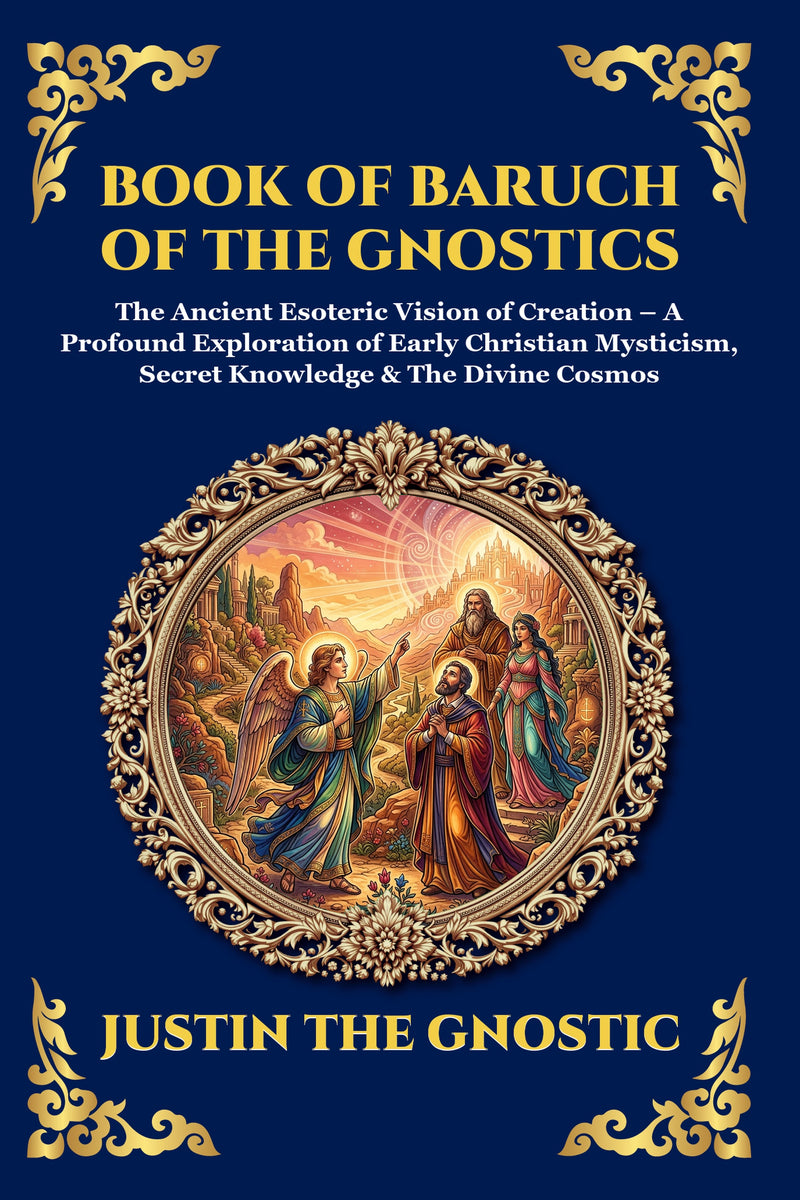
Book of Baruch of the Gnostics
Attributed to Justin the Gnostic, the Book of Baruch reveals a mythological cosmos where creation unfolds through divine and angelic forces. Excluded from the biblical canon, this text explores spiritual liberation and the hidden origins of the universe in a dramatic cosmic narrative.
or free app
10,000+ hrs library
30-day guarantee
You get a complete modern-English translation of the Book of Baruch of the Gnostics, readable online with audiobook included through Library of Alexandria Press membership.
The early Church Father Hippolytus preserved extensive quotations from the Book of Baruch of the Gnostics in his third-century work "Refutation of All Heresies," providing our primary knowledge of this lost text.
The Book of Baruch of the Gnostics provides a compelling modern translation of one of the most powerful and unusual works of ancient esoteric history. This ancient text, attributed to the visionary teacher Justin the Gnostic, recounts a complex and breathtaking mythological cosmos where the creation of the world was not a simple act, but a dramatic cosmic interplay between divine principles, angelic beings, and the material earth.
Far more than a simple historical chronicle, the Book of Baruch of the Gnostics delves into profound themes of spiritual liberation, the hidden origins of the human soul, and the sacrifices made in the pursuit of ultimate divine knowledge. It paints a vivid picture of a universe where humanity is caught in a celestial tug-of-war, possessing a dormant divine spark that must be awakened through secret wisdom to return to the highest, uncorrupted realm of the Good.
What You Will Discover in This Modern Translation
- The Secret History of Creation: Follow the awe-inspiring and highly esoteric narrative of how the heavens, the earth, and humanity were formed through the interactions of the primary cosmic powers.
- The Path to Spiritual Awakening: Explore stories of unshakable devotion to the pursuit of gnosis, detailing how the ancient mystics sought to awaken the divine spark trapped within the material body.
- Lessons on Cosmic Dualism and Liberation: Learn timeless principles about the nature of good and evil, the illusion of the material world, and the steps required to achieve true spiritual freedom.
- A Window into Gnostic Mysticism: Gain a deeper understanding of the historical, philosophical, and spiritual significance of the Gnostic movements that fiercely challenged orthodox early Christian identity.
Whether you are exploring this work for its immense historical value, its striking philosophical framework, or its deep spiritual insight, the Book of Baruch of the Gnostics offers inspiration and mind-expanding guidance for all.
Step into a story of unparalleled mystical depth and discover the timeless lessons of the Book of Baruch of the Gnostics. Begin your journey today.
| Formats | eBook (EPUB + PDF) · Audiobook · Paperback · Hardcover · Large Print |
| Language | English |
| Trim size (print) | 6 × 9 in |
| Binding | Paperback — perfect-bound · Hardcover — casewrap |
| Large Print edition | Same text in a larger, easy-read type — a larger font, not a larger trim |
| Print pricing | Every physical book at our true cost — at-cost, no profit (members) |
| Library | 873 restored titles, always growing |
| Length | 2,229 words · ~9 min reading |
| Reading level | Grade 12 · rich, literary prose (this modern-English edition) |
| Edition | Modern English translation · 2026 |
Member reviews for this edition are collected as readers finish it — be the first. Across the library: 12,000+ books shipped, every plan covered by a 365-day print guarantee.
About this edition
The complete, unabridged text in clear modern English — faithful to the original, never simplified. Every paragraph is checked against the source, so nothing is cut, summarised, or paraphrased away. It reads cleanly for today while keeping the original meaning intact.
- Complete & unabridgedVerified paragraph by paragraph against the source — never a scan, never abridged.
- Modern English, faithfulReadable today, with the author’s meaning kept intact. Readable — not simplified.
- Every format, one membershipRead in your browser or the free app, or listen to the full audiobook.
Included free with your membership
Cancel anytime, one click · 30-day money-back guarantee
Edition last updated June 2026
What’s inside
Book of Baruch of the Gnostics — complete and unabridged: all 6 sections included with membership, plus the full audiobook.
Begin reading Book of Baruch of the Gnostics
In clear modern English — the complete text is included with membership.
Chapter 1
There are three unbegotten principles of the universe — two male and one female. Of the two male principles, one is called Good; it alone bears that name and possesses the power of foreknowledge concerning the universe. The other is the father of all begotten things, lacking foreknowledge and invisible. The female principle likewise lacks foreknowledge; she is passionate, double-minded, and double-bodied — answering in every respect to the girl in Herodotus's legend: a virgin as far as the groin, and snake-like in the parts below. This girl is called Edem, and also Israel.
These three principles are the roots and fountains from which all existing things have been produced; there was nothing else besides them.
The Father — the one who lacks foreknowledge — on beholding the half-woman Edem, was seized with desire for her. This Father is called Elohim. Edem in turn longed no less for Elohim, and their mutual passion brought them together into one nuptial bed of love. From this union the Father generates out of Edem twelve angels for himself.
The names of the angels begotten by the Father are: Michael, Amen, Baruch, Gabriel, and Esaddaeus. The names of the maternal angels whom Edem brought forth are likewise as follows: Babel, Achamoth, Naas, Bel, Belias, Satan, Sael, Adonaeus, Leviathan, Pharao, Carcamenos, and Lathen.
Of these twenty-four angels, the paternal ones are associated with the Father and do all things according to his will; the maternal ones are associated with Edem the Mother.
The whole company of these angels together is Paradise — concerning which Moses speaks: "God planted a garden in Eden towards the east," that is, towards the face of Edem, so that Edem might look upon the garden — that is, upon the angels — continually. Allegorically, the angels are called the trees of this garden. The tree of life is the third of the paternal angels, Baruch; and the tree of the knowledge of good and evil is the third of the maternal angels, Naas. For this, says Justinus, is how one ought to interpret the words of Moses — noting that Moses said these things in a veiled manner, because not all attain the truth.
Paradise having been formed from the conjugal joy of Elohim and Edem, the angels of Elohim took from the most beautiful part of the earth — not from the monstrous lower portion of Edem, but from the parts above the groin, which are human in shape and gentle in aspect — and made man out of the earth. From the monstrous parts, by contrast, came wild beasts and the rest of the animal creation.
Chapter 2
Man was made, therefore, as a symbol of the unity and love between Elohim and Edem. They each endowed him with their own powers: Edem gave him the soul, and Elohim the spirit. And so Adam was produced as a kind of living seal and memorial of their love, an everlasting emblem of the marriage of Edem and Elohim.
In the same way Eve was also produced, as Moses described — an image, an emblem, and a seal, to be preserved forever, of Edem. A soul was placed in Eve as an image from Edem, and a spirit from Elohim.
They were given the commandment: "Be fruitful, and multiply, and replenish the earth" — that is, Edem; for so he wishes it had been written. For the entire power belonging to herself, Edem conferred upon Elohim as a kind of nuptial dowry. From this, women have imitated that primordial marriage down to this day, bringing a dowry to their husbands — fulfilling a certain divine and paternal law that came into existence on the part of Edem toward Elohim.
When all things had been created as Moses describes — heaven and earth and everything in them — the twelve angels of the Mother were divided into four groups, and each fourth part is called a river: Phison, Gehon, Tigris, and Euphrates, as Moses states. These twelve angels, mutually connected, move through the four parts and govern the world, holding from Edem a kind of viceregal authority over it. But they do not remain always in the same places; they move in a kind of circular procession, changing place after place, and at set times and intervals withdrawing to the regions subject to themselves.
When Phison holds sway over certain regions, famine, distress, and affliction prevail in that part of the earth, for the battalion of these angels is harsh and withholding. In the same way, to each of the four parts there belong, according to the power and nature of each, evil seasons and hosts of diseases. And continually, according to the dominion of each fourth part, this stream of evil — like the current of rivers — courses around the world without interruption, according to the will of Edem. From some cause of this kind arose the necessity of evil.
When Elohim had prepared and created the world in mutual pleasure, he wished to ascend to the highest parts of heaven and to see that nothing in the creation suffered from any deficiency. And he took his own angels with him, for his nature was to mount upward, leaving Edem below — for inasmuch as she was earth, she was not inclined to follow her spouse upward.
Chapter 3
Elohim, then, rising to the highest part of heaven, beheld a light superior to anything he himself had created, and cried out: "Open the gates for me, that I may enter and acknowledge the Lord, for I had considered myself to be Lord." A voice answered him from the light: "This is the gate of the Lord; through it the righteous enter in." And immediately the gate was opened, and the Father, without his angels, entered in and advanced toward the Good One, and beheld what eye has not seen, and ear has not heard, and what has never entered into the heart of man to conceive. Then the Good One said to him: "Sit at my right hand." And the Father said to the Good One: "Permit me, Lord, to overturn the world which I have made, for my spirit is bound in men, and I wish to take it back from them."
The Good One replied to him: "You can do no evil while you are with me, for both you and Edem made the world as a result of conjugal joy. Let Edem hold possession of the world as long as she wishes; but you remain with me."
Then Edem, knowing that she had been deserted by Elohim, was seized with grief, and gathered her own angels around her. She adorned herself in a comely fashion, hoping that Elohim, overcome by desire, might somehow descend from heaven to her. When, however, Elohim — held fast by the Good One — no longer descended to Edem, she commanded Babel, who is Venus, to cause adulteries and the dissolution of marriages among men. She did this so that, just as she had been divorced from Elohim, the spirit of Elohim that dwells in men might likewise be wrung with sorrow and punished through such separations, suffering precisely what the deserted Edem was enduring.
And Edem gave great power to her third angel, Naas, so that by every kind of punishment he might chastise the spirit of Elohim that is in men — in order that Elohim, through that spirit, might be punished for having deserted his spouse in violation of the agreements made between them.
Elohim the Father, seeing these things, sent forth Baruch, the third of his own angels, to come to the aid of the spirit that is in all men. Baruch came and stood in the midst of the angels of Edem — that is, in the midst of paradise, for paradise is the angels, in the midst of whom he stood — and gave the man this commandment: "Of every tree that is in paradise you may freely eat, but you may not eat of the tree of the knowledge of good and evil," which is Naas.
The meaning is that man should obey the remaining eleven angels of Edem, for the eleven possess passions but are not guilty of transgression. Naas, however, has committed sin, for he went in to Eve, deceiving her, and violated her — and such an act is a breach of the law. He likewise went in to Adam and had unnatural intercourse with him, and this too is an act of turpitude. From these acts adultery and sodomy entered the world.
Chapter 4
From that point on, vice and virtue were both prevalent among men, arising from a single source — that of the Father. For the Father, having ascended to the Good One, points out from time to time the way to those who desire to ascend likewise. Yet in departing from Edem, he caused an originating principle of evil for the spirit of the Father that is in men.
Baruch was therefore sent to Moses, and through him spoke to the children of Israel, so that they might be converted to the Good One. But the third angel, Naas, through the soul that came from Edem upon Moses — as upon all men — obscured the precepts of Baruch and caused his own peculiar injunctions to be heeded instead. For this reason the soul is arrayed against the spirit, and the spirit against the soul. For the soul is Edem, but the spirit is Elohim, and each of these exists in all human beings, both female and male.
Again, after these events, Baruch was sent to the Prophets, so that through the Prophets the spirit dwelling in men might hear words of warning and might turn away from Edem and her wicked contrivance, just as the Father had withdrawn from Edem. But in like manner, through the Prophets, Naas — by the same device, working through the soul that dwells in man alongside the spirit of the Father — enticed the prophets away, and all of them were drawn after him and did not follow the words of Baruch that Elohim had enjoined.
At last Elohim chose Hercules, an uncircumcised prophet, and sent him to overcome the twelve angels of Edem and to release the Father from those twelve wicked angels of the creation. These are the twelve labors of Hercules, undertaken in order from first to last: the Lion, the Hydra, the Boar, and the rest in succession. For these, they say, are the names given to them among the Gentiles, derived with altered designations from the power of the maternal angels.
But when Hercules seemed to have vanquished his adversaries, Omphale — who is Babel, or Venus — clung to him and enticed him away, and stripped him of his power, namely the commands of Baruch that Elohim had given him. And in place of that power she wrapped him in her own peculiar robe — that is, in the power of Edem, who is the power below — and in this way the prophecy of Hercules remained unfulfilled, and his works came to nothing.
Finally, however, in the days of King Herod, Baruch was sent once more by Elohim; and coming to Nazareth, he found Jesus, son of Joseph and Mary, a child of twelve years, feeding sheep.
Chapter 5
He announces to Jesus everything from the beginning — all that Edem and Elohim had done, and all that was likely to take place thereafter — and spoke these words: "All the prophets before you have been led astray. Make every effort, therefore, Jesus, Son of man, not to be seduced. Instead, preach this word to humanity, bring them tidings of the Father and of the Good One, then ascend to the Good One and sit there with Elohim, Father of us all."
Jesus was obedient to the angel, saying, "I will do all things, Lord," and went forth to preach.
Naas therefore wished to seduce this one as well. Jesus, however, would not listen to his overtures, for he remained faithful to Baruch. Naas, inflamed with anger because he could not seduce him, caused him to be crucified.
Jesus, however, left the body of Edem on the accursed tree and ascended to the Good One, saying to Edem as he departed, "Woman, you keep your son" — that is, the natural and earthly man. And commending his spirit into the hands of the Father, he ascended to the Good One.
Now the Good One is Priapus, and it is he who first brought everything that exists into being. He is called Priapus because he fashioned all things beforehand according to his own design. For this reason, his statue is placed in every temple and revered by every creature, and images of him stand along the highways, bearing ripened fruits above his head — that is, the produce of creation, of which he is the cause, having first formed creation according to his own design when it did not yet exist.
When you hear men say that the swan went in to Leda and fathered a child by her, know that the swan is Elohim and Leda is Edem. When people say that an eagle went in to Ganymede, know that the eagle is Naas and Ganymede is Adam. When they say that gold fell as a shower upon Danaë and fathered a child by her, understand that the gold is Elohim and Danaë is Edem. In this same manner they work through all such legendary accounts, using them as material for instruction.
Cancel anytime, one click · 30-day money-back guarantee
Founding annual rate available now — your price locks for life when you join.
Not ready? Get this free chapter by email — read it anytime.
✓ Sent — check your inbox for Book of Baruch of the Gnostics.
Questions about Book of Baruch of the Gnostics
What is the Book of Baruch of the Gnostics?
The Book of Baruch of the Gnostics is an ancient text attributed to Justin the Gnostic that presents a complex mythological account of creation involving divine principles and angelic forces, offering a Gnostic perspective on cosmic origins.
Why isn't this book in the Bible?
The Book of Baruch of the Gnostics was excluded from the biblical canon as early Christian communities developed their scriptural collections, as it represented Gnostic theological perspectives that differed from mainstream Christian doctrine.
Is Book of Baruch of the Gnostics free to read?
The opening of the text is free to read below. Members read and listen to the complete work — and the entire Lost & Forbidden Library — free.
What is Book of Baruch of the Gnostics?
Have you ever wondered why the earliest centuries of faith were filled with intense rivalries over the true nature of creation and the hidden secrets of the universe?
How long is Book of Baruch of the Gnostics?
6 chapters (~2,261 words) in this restored edition.
Which formats are available?
eBook and audiobook (included with membership), plus paperback, hardcover and large-print editions printed at cost.
Shipping & returns
Billing & membership
More from the library


Explore The Lost & Forbidden Library
- 1 Enoch · Attributed to Enoch
- 1–4 Maccabees · Various Jewish authors
- 2 Baruch · Attributed to Baruch
- 2 Enoch · Attributed to Enoch
- 2 Esdras · Attributed to the prophet Ezra
- 3 Baruch · Attributed to Baruch ben Neriah
- 4 Baruch · Attributed to Baruch ben Neriah
- A Valentinian Exposition · Attributed to a follower of Val...
- Acta Archelai · Attributed to Hegemonius
- Acts of Andrew · Anonymous (Early Christian Apoc...
- Acts of Andrew and Matthias in the City of the Cannibals · Attributed to early Christian a...
- Acts of Barnabas · Attributed to John Mark
- Acts of Bartholomew
- Acts of John · Anonymous (Early Christian Apoc...
- Acts of Matthias · Anonymous early Christian writers
- Acts of Paul · Attributed to an unknown early ...
- Acts of Paul and Thecla · Attributed to Onesiphorus
- Acts of Peter
- Acts of Peter and Andrew · Attributed to various early Chr...
- Acts of Peter and Paul · Attributed to Leucius Charinus
- Acts of Peter and Simon · Attributed to Leucius Charinus
- Acts of Peter and the Twelve Apostles · Attributed to early Christian a...
- Acts of Philip · Anonymous (Early Christian Apoc...
- Acts of Pilate (Gospel of Nicodemus) · Attributed to various early Chr...
- Acts of Saturninus
- Acts of Thaddaeus · Attributed to Thaddaeus the Apo...
- Acts of Thomas
- Acts of Titus · Anonymous early Christian writer
- Acts of Xanthippe, Polyxena, and Rebecca
- Allogenes · Anonymous (Early Gnostic Mystic)
Book of Baruch of the Gnostics
The Book of Baruch of the Gnostics
A Modern Reconstruction of the Gnostic Myth of Justin — The Three Unbegotten Principles of the Good, Elohim, and Edem; the Twenty-Four Angels of Paradise; the Making of Humankind; and the Mission of the Angel Baruch Against the Serpent Naas — Reconstructed from the Account Preserved in the Refutation of All Heresies of Hippolytus
Library of Alexandria Press
The Book of Baruch of the Gnostics
© Copyright 2026 Library of Alexandria Press. All rights reserved.
Published by Library of Alexandria Press
Printed in the United States of America
It is not legal to copy, share, or send any part of this document in either digital or printed form without written permission from the publisher, except short quotes in a book review.
Table of Contents
Introduction
Chapter 1
Chapter 2
Chapter 3
Chapter 4
Chapter 5
Introduction
There are texts that survive the centuries by accident, preserved in desert caves or monastery cellars, copied by devoted hands onto fragile papyrus and vellum, waiting in silence for a world that might finally be ready to receive them. And then there are texts that survive despite every effort to destroy them — condemned by councils, burned by bishops, excised from the canon of acceptable thought by the slow, deliberate machinery of religious orthodoxy. The work you now hold belongs to the second category. It is a document that was never meant for you, at least not according to those who once held the power to decide what humanity was permitted to know about its own origins, its own cosmos, and its own relationship to the divine.
What we are dealing with here is one of the most extraordinary and least understood artifacts of early religious thought in the Western world — a Gnostic text attributed to Baruch, a name that itself carries tremendous symbolic and historical weight. To encounter this text for the first time is to step through a doorway into a world that is simultaneously ancient and startlingly modern, a world in which the questions that haunt us most deeply — Who made us? Why does suffering exist? What is the nature of the divine? Is the universe friendly or hostile to human flourishing? — are addressed with a philosophical sophistication and a mythological richness that can genuinely take your breath away.
The tradition in which this text was produced is known broadly as Gnosticism, a term that has been both celebrated and misunderstood in roughly equal measure. The word itself derives from the Greek gnosis, meaning knowledge — but not just any knowledge. This is not the knowledge of facts and figures, not the accumulation of data that we might associate with modern scientific inquiry. Gnosis refers to a direct, experiential, transformative knowledge of divine reality. It is the kind of knowing that changes the knower, the kind of illumination that, once received, cannot be unfelt. The Gnostics were, at their core, seekers of this interior light, and the mythological systems they constructed — elaborate, strange, and breathtakingly ambitious — were maps drawn by those who believed they had glimpsed something real behind the veil of ordinary existence.
The specific system preserved in this text belongs to a teacher named Justin, and it represents one of the most distinctive and philosophically daring cosmological visions to emerge from the rich ferment of early Christian mysticism. Justin's vision — mediated through the figure of Baruch, one of the three primal principles at the heart of his cosmology — posits a universe that is neither simply good nor simply evil, but profoundly, tragically complex. It is a universe in which competing divine forces struggle for influence over human souls, in which the material world is the product not of a supreme and loving creator but of a flawed, passionate, and ultimately limited being whose ambitions exceeded her wisdom. And at the center of it all stands the human being, caught between higher and lower powers, capable of transcendence but also deeply vulnerable to entrapment.
To read this text without some preparation is to risk being overwhelmed by its strangeness. The cast of characters is large and their relationships intricate. There are three primal principles: the Good, the unbegotten Father who transcends all things; Elohim, the creator-god who fashioned the world; and Eden, a being who is simultaneously earth and woman, the material substrate of creation. From the union of Elohim and Eden come twenty-four angelic beings — twelve belonging to the father and twelve to the mother — whose names and functions structure the entire drama of cosmic and human history. And threading through all of this is Baruch, the angel of the Good, the divine messenger who appears again and again throughout human history to remind imprisoned souls of their true origin and their possible liberation.
But here is the thing about this cosmological drama: once you understand its basic structure, it becomes not just comprehensible but genuinely illuminating. The mythological language, which can initially seem like an obstacle, reveals itself as a sophisticated vehicle for exploring questions that philosophy and theology have never fully resolved. Why do human beings seem to contain within themselves both the capacity for extraordinary goodness and the tendency toward devastating cruelty? Why does the material world, which can be so beautiful, also seem so indifferent to human suffering? Why do religious traditions so often become instruments of oppression rather than liberation? These are not ancient questions that have been answered and set aside. They are the questions that define our moment, and this text addresses them with a directness and an honesty that can feel almost shocking.
The historical context in which this text emerged is itself a story of remarkable intellectual and spiritual creativity. The first and second centuries of the Common Era were a period of extraordinary religious ferment throughout the Mediterranean world. The old certainties of classical paganism were dissolving. Judaism was undergoing a profound transformation in the aftermath of the destruction of the Temple in Jerusalem. And the new movement that would eventually become Christianity was still a loose, diverse, and contentious collection of communities, each with its own understanding of who Jesus was, what his life and death meant, and how his teachings should be interpreted and practiced.
In this environment, the movement we now call Gnosticism flourished. It was not a single, unified religion but a constellation of related movements, each with its own teachers, texts, and practices, united by certain shared convictions: that the material world was not the creation of the highest divine principle; that human beings contained within themselves a spark of divine light that had become trapped in matter; and that salvation consisted not in moral improvement or ritual observance but in the acquisition of saving knowledge — gnosis — about one's true divine origin and nature. These convictions were expressed in an astonishing variety of mythological systems, philosophical arguments, ritual practices, and literary forms.
The text associated with Justin represents one of the most distinctive voices within this broader tradition. Unlike some Gnostic systems, which are deeply hostile to the material world and to the body, Justin's vision is more nuanced. Eden — the material principle — is not simply evil. She is passionate, creative, and in her own way, genuinely divine. Her tragedy is not that she is wicked but that she is abandoned, that Elohim, having created the world and ascended to the realm of the Good, leaves her behind. The suffering that results from this abandonment is not simply a cosmic accident but a profound meditation on the nature of loss, betrayal, and the consequences of broken relationship. There is something almost heartbreaking about Eden's situation, and this emotional complexity is one of the things that makes the text so remarkable.
The World This Text Was Born Into
To truly appreciate what you are about to read, it helps enormously to understand the world that produced it — not just the broad historical context of early Christianity and late antique religious diversity, but the specific intellectual and spiritual atmosphere in which thinkers like Justin were working. This was a world saturated with competing visions of divine reality, a world in which the boundaries between philosophy, religion, and mysticism were far more fluid than they are today, a world in which the question of what human beings fundamentally are — matter, spirit, or some tragic mixture of both — was not an abstract academic puzzle but a matter of urgent, existential concern.
The philosophical tradition that most deeply shaped Gnostic thought was Platonism, and specifically the form of Platonism that had developed in the centuries following Plato's death. For the Platonists, the material world was a reflection — imperfect, shadowy, and transient — of a higher realm of eternal, unchanging Forms or Ideas. The human soul, in this view, was a divine entity that had somehow become entangled in matter, and the goal of philosophy was to purify the soul and enable it to ascend back to its true home in the intelligible realm. The Gnostics took this basic framework and radicalized it, asking questions that orthodox Platonism preferred not to answer: If the material world is so inferior to the divine realm, why does it exist at all? What kind of being would create such a world? And why would a truly good and omnipotent God permit the existence of evil and suffering?
These questions were not merely theoretical. They arose from genuine human experience — from the experience of living in a world that seemed, far too often, to be organized against human flourishing. The Roman Empire, for all its impressive achievements, was built on slavery, conquest, and brutal violence. Disease, famine, and early death were the common lot of most people. The philosophical schools offered consolation and guidance, but their teachings were accessible mainly to the educated elite. The mystery religions offered initiation and the promise of blessed afterlife, but their rituals could seem hollow to those who had not received the transformative experience they promised. Into this landscape of spiritual hunger and intellectual ferment, the Gnostic teachers brought something genuinely new: a comprehensive explanation of why the world was the way it was, and a path — through knowledge rather than ritual, through illumination rather than mere belief — out of the trap of material existence.
Justin, the teacher whose system is preserved in this text, is known to us primarily through the writings of Hippolytus of Rome, a Christian theologian of the late second and early third centuries who devoted considerable energy to refuting what he considered dangerous heresies. It is one of the great ironies of religious history that we owe the preservation of so many Gnostic teachings to their opponents. Hippolytus, in his Refutation of All Heresies, quotes extensively from Justin's work — a text called Baruch — precisely in order to demonstrate how wrong and dangerous it was. In doing so, he preserved for us a document of extraordinary richness and depth that might otherwise have been lost entirely.
What Hippolytus found so threatening about Justin's system is itself revealing. It was not simply that Justin's cosmology differed from orthodox Christian teaching — many teachers held heterodox views, and the boundaries of acceptable belief were still being negotiated in this period. What was particularly disturbing to Hippolytus was the way Justin's system challenged the authority of the God of the Hebrew scriptures, the God who had revealed himself to Moses and the prophets. In Justin's vision, this God — Elohim — is not the supreme divine principle but a secondary being, a creator-god who is himself subject to higher powers and who, crucially, is capable of moral failure. The implications of this were radical: if the God of the Bible is not the highest God, then the Bible's authority is limited; if the creator is flawed, then the creation is not simply good; and if salvation comes through gnosis rather than through obedience to divine law, then the entire structure of religious authority — priestly, prophetic, and apostolic — is called into question.
This challenge to religious authority was not incidental to the Gnostic project; it was central to it. The Gnostics were, in a profound sense, anti-authoritarian thinkers. They were suspicious of institutions, skeptical of claims to exclusive divine revelation, and deeply committed to the idea that each individual soul had the capacity — and the responsibility — to seek its own direct experience of divine reality. This made them dangerous to any religious establishment, and it is one of the reasons why the suppression of Gnostic texts was so thorough and so sustained. The discovery of the Nag Hammadi library in Egypt in 1945 — a collection of Gnostic texts buried in the fourth century, presumably to save them from destruction — gave us access to a wealth of primary sources that had been lost for over a millennium and a half. It was as if a whole library of suppressed voices had suddenly been restored to us, speaking across the centuries with an urgency that had not diminished.
The text you are about to read belongs to this tradition of suppressed, recovered, and now finally accessible wisdom. It is a text that was considered so dangerous that its very existence had to be argued against, refuted, and ultimately silenced. And yet here it is — not silenced at all, but speaking, as it has always spoken, to those who are willing to listen. The questions it raises about the nature of divine reality, the origin of suffering, the possibility of liberation, and the relationship between knowledge and salvation are as alive today as they were in the second century. Perhaps more so, in a world that has grown deeply suspicious of institutional religion but remains hungry for genuine spiritual experience and meaning.
Understanding the historical and intellectual context of this text is not merely an academic exercise. It is essential preparation for the reading experience itself. When you encounter the strange and beautiful mythology of the three primal principles — the Good, Elohim, and Eden — you will be better equipped to understand what is at stake if you know something about the philosophical tradition from which it emerged and the religious controversies it was designed to address. When you encounter the figure of Baruch, the divine messenger who appears to the prophets and ultimately to Jesus himself, you will appreciate more fully the radical reimagining of biblical history that Justin is proposing. And when you encounter the text's account of the human condition — trapped between higher and lower impulses, capable of transcendence but also deeply vulnerable to the seductions of the material world — you will recognize in it something that speaks directly to your own experience of being human.
Reading Ancient Wisdom With Modern Eyes
There is a particular kind of intellectual courage required to engage seriously with a text like this one. It is not the courage required to believe something difficult or to accept a challenging moral demand. It is the courage to suspend, temporarily, the habits of mind that our own cultural moment has instilled in us — the habit of expecting linear narrative, the habit of demanding empirical verification, the habit of treating mythological language as mere decoration rather than as a sophisticated vehicle for philosophical and spiritual insight. Reading ancient esoteric texts well requires a kind of double consciousness: you must be willing to enter the world the text creates on its own terms, while also maintaining enough critical distance to reflect on what that world is telling you about the human condition.
The mythology of this text is, by any measure, extraordinary. It is populated by beings whose names and functions draw on a vast range of sources — Hebrew scripture, Greek philosophy, Babylonian mythology, and traditions that we can no longer fully trace. The twelve angels of Elohim bear names that will be familiar from the Hebrew Bible: Michael, Amen, Baruch, Gabriel, Esaddaeus, and others. The twelve angels of Eden bear names that evoke the vices and passions of the material world: Babel, Achamoth, Naas, Bel, Belias, Satan, Sael, Adonaios, Kavathan, Pharaoth, Carcamenos, Lathen. The drama that unfolds between these beings is not simply a colorful story; it is a systematic attempt to explain the structure of reality and the dynamics of human experience.
One of the most striking features of this cosmological system is its insistence on the genuine complexity and even the tragic dignity of the material world. In some Gnostic systems, matter is simply evil — the prison of the soul, the domain of darkness, something to be escaped and transcended as quickly as possible. Justin's vision is more nuanced and, in many ways, more psychologically sophisticated. Eden is not evil; she is abandoned. Her twelve angels — the passions and drives that animate human beings — are not simply obstacles to spiritual progress; they are expressions of a genuine divine creativity that has been cut off from its source. The suffering they cause is real, but so is the creative energy they embody. This complexity makes the text's vision of salvation more interesting and more demanding than a simple escape from matter: what is required is not the rejection of the material world but the transformation of one's relationship to it, the reorientation of one's deepest drives toward their true source in the divine.
The figure of Jesus in this text will surprise readers who come to it with expectations shaped by orthodox Christianity. Here, Jesus is not the second person of a divine Trinity, not the atoning sacrifice for human sin, not the founder of a church or the giver of a new law. He is, instead, a human being who received the message of Baruch — the angel of the Good — more completely than any previous messenger, and who, through his willingness to receive and embody this knowledge, became a vehicle for the liberation of the divine spark trapped in human souls. This is a Jesus who is recognizably human, who struggles with the temptations represented by Naas — the serpent-angel of Eden — and who triumphs not through miraculous power but through wisdom and fidelity to the higher truth he has received. It is a portrait that is, in its own way, deeply moving, and it raises profound questions about the relationship between historical religious figures and the spiritual principles they are understood to embody.
The text's treatment of the Hebrew prophets is equally striking. Figures like Moses, Elijah, and Isaiah appear here not as recipients of divine revelation in the orthodox sense but as messengers of Baruch who were ultimately corrupted — or at least diverted — by the influence of Naas, the angel who represents the seductive power of the material world. This is a radical reinterpretation of biblical history, one that inverts many of the assumptions that orthodox Judaism and Christianity brought to the reading of scripture. The prophets are not infallible channels of divine truth; they are human beings struggling, like all human beings, between the pull of the higher and the lower, between the call of Baruch and the seductions of Naas. Some succeed in transmitting the higher message; others are led astray. The result is a scripture that is not simply authoritative but deeply ambiguous — a record of the ongoing struggle between divine and material forces playing out in human history.
For the modern reader, this approach to scripture may actually feel more honest than the alternatives. We live in a world that has largely lost its ability to read ancient texts with the kind of naive literalism that once sustained religious orthodoxy, but has not yet found a satisfying way to engage with those texts at a deeper level. The Gnostic approach — treating mythological and scriptural texts as maps of inner experience rather than as historical records or doctrinal pronouncements — offers one possible path forward. It is an approach that takes the texts seriously without demanding literal belief, that honors the spiritual insights embedded in ancient stories without requiring us to pretend that we live in the same intellectual universe as the people who first told them.
There is also something deeply relevant about this text's understanding of the relationship between knowledge and liberation. We live in an age that is, in some ways, drowning in information while starving for wisdom. We have access to more facts, more data, more raw information than any previous generation in human history, and yet many people feel profoundly lost, disconnected from any sense of meaning or purpose. The Gnostic tradition's insistence that what we most need is not more information but a different kind of knowing — a direct, transformative encounter with the truth of our own nature and our relationship to the divine — speaks to this condition with remarkable precision. Gnosis, as the Gnostics understood it, is not something that can be transmitted through a lecture or a book; it is something that must be lived, experienced, and integrated. But texts like this one can point the way, can create the conditions in which genuine insight becomes possible.
As you prepare to enter the world of this text, it may be helpful to approach it with a particular kind of openness — not the openness of credulity, which accepts everything without discrimination, but the openness of genuine inquiry, which is willing to be surprised, challenged, and even unsettled. The mythology you will encounter is strange by any standard, and there will be moments when the sheer density of names and relationships threatens to overwhelm. But if you stay with it, if you allow yourself to move through the strangeness toward the deeper patterns underneath, you will find something genuinely remarkable: a vision of the cosmos and of human nature that is, in its own way, as sophisticated and as moving as anything produced by the great philosophical and religious traditions of the ancient world.
The editors and translators who have worked to make this text accessible to modern readers have done so with the conviction that it deserves to be read not merely as a historical curiosity but as a living document — one that speaks to perennial human questions with a freshness and a depth that centuries of suppression have not diminished. The notes and commentary that accompany the text are designed to illuminate without overwhelming, to provide the context necessary for genuine understanding without reducing the text to a mere object of academic study. The goal, throughout, has been to honor the text's own ambitions: to transmit not just information but something closer to wisdom, not just knowledge about the divine but a sense of what it might mean to encounter the divine directly.
What you are about to read is, among other things, a love story — the story of a cosmos created in passion and fractured by abandonment, of divine messengers who appear again and again in human history to remind us of something we have forgotten, of a human soul that contains within itself the capacity for both transcendence and entrapment. It is a story about the nature of knowledge and the cost of ignorance, about the relationship between the spiritual and the material, about what it means to be human in a cosmos that is neither simply friendly nor simply hostile but profoundly, irreducibly complex. It is a story that was told in secret, preserved against the odds, and now offered to you — not as doctrine to be believed but as wisdom to be encountered, tested against your own experience, and, if it proves true for you, integrated into the fabric of your understanding. Turn the page. The ancient voices are waiting.
The Book of Baruch of the Gnostics
Chapter 1
There are three unbegotten principles of the universe — two male and one female. Of the two male principles, one is called Good; it alone bears that name and possesses the power of foreknowledge concerning the universe. The other is the father of all begotten things, lacking foreknowledge and invisible. The female principle likewise lacks foreknowledge; she is passionate, double-minded, and double-bodied — answering in every respect to the girl in Herodotus's legend: a virgin as far as the groin, and snake-like in the parts below. This girl is called Edem, and also Israel.
These three principles are the roots and fountains from which all existing things have been produced; there was nothing else besides them.
The Father — the one who lacks foreknowledge — on beholding the half-woman Edem, was seized with desire for her. This Father is called Elohim. Edem in turn longed no less for Elohim, and their mutual passion brought them together into one nuptial bed of love. From this union the Father generates out of Edem twelve angels for himself.
The names of the angels begotten by the Father are: Michael, Amen, Baruch, Gabriel, and Esaddaeus. The names of the maternal angels whom Edem brought forth are likewise as follows: Babel, Achamoth, Naas, Bel, Belias, Satan, Sael, Adonaeus, Leviathan, Pharao, Carcamenos, and Lathen.
Of these twenty-four angels, the paternal ones are associated with the Father and do all things according to his will; the maternal ones are associated with Edem the Mother.
The whole company of these angels together is Paradise — concerning which Moses speaks: "God planted a garden in Eden towards the east," that is, towards the face of Edem, so that Edem might look upon the garden — that is, upon the angels — continually. Allegorically, the angels are called the trees of this garden. The tree of life is the third of the paternal angels, Baruch; and the tree of the knowledge of good and evil is the third of the maternal angels, Naas. For this, says Justinus, is how one ought to interpret the words of Moses — noting that Moses said these things in a veiled manner, because not all attain the truth.
Paradise having been formed from the conjugal joy of Elohim and Edem, the angels of Elohim took from the most beautiful part of the earth — not from the monstrous lower portion of Edem, but from the parts above the groin, which are human in shape and gentle in aspect — and made man out of the earth. From the monstrous parts, by contrast, came wild beasts and the rest of the animal creation.
End of the free sample
Keep reading, free
Members read and listen to the complete book — and the entire library. Cancel anytime, one click · 30-day money-back guarantee.