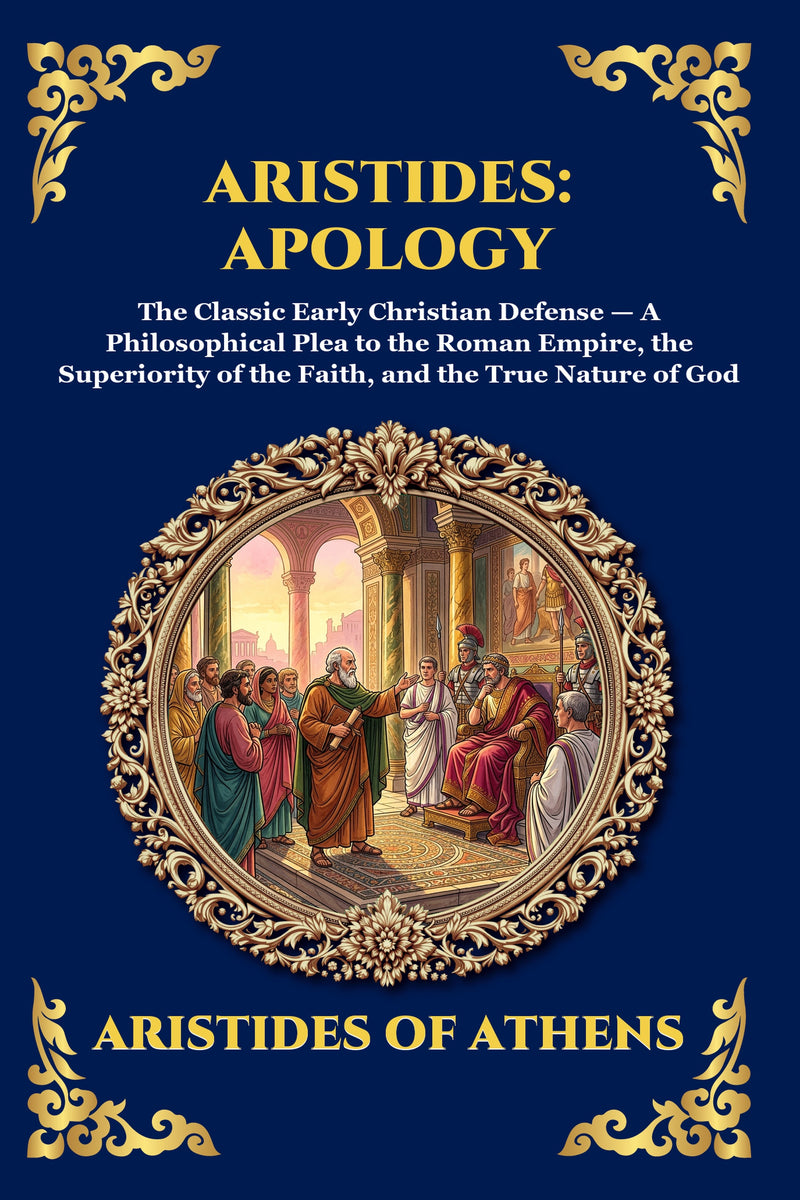
Aristides: Apology
Aristides presented his defense of Christianity to the Roman Emperor, articulating a powerful argument for monotheism over the empire's myriad idols. Once lost to history, this early Christian text showcases how believers out-reasoned the great philosophers of their time.
or free app
10,000+ hrs library
30-day guarantee
The Library of Alexandria edition presents Aristides' Apology as a complete modern-English translation, readable online with audiobook narration included, making this foundational Christian defense accessible to contemporary readers.
In "Aristides: Apology," an Athenian philosopher presents his systematic defense of Christian believers before Emperor Hadrian, methodically dismantling pagan criticisms with philosophical precision.
The Apology of Aristides provides a compelling modern translation of the earliest complete defense of the Christian faith. Written by Aristides, an Athenian philosopher who embraced the teachings of the apostles, this historic document was presented as an official plea for tolerance and understanding to the Roman Emperor. During a time when believers faced intense scrutiny and social exile, Aristides utilized his philosophical training to construct a brilliant, reasoned argument for the superiority of Christian monotheism and morality.
Far more than a simple historical record, The Apology of Aristides delves into profound themes of cosmic origins, the nature of the uncreated God, and the transformative power of a community built on love and charity. This text offers a rare, firsthand look at how the early church viewed itself in relation to the pagan and Jewish cultures surrounding it, providing a unique roadmap for living with integrity in a pluralistic world.
What You’ll Discover in This Modern Translation:
The Categorization of Human Belief Explore Aristides’ famous division of humanity into four groups, as he systematically analyzes the theological shortcomings of the Barbarians, Greeks, and Jews to highlight the clarity of the Christian path.
A Philosophical Vision of the Divine Understand how an ancient philosopher used logic to describe God as the unbegotten, unmeasurable, and eternal Creator who stands above the frailties of human-made myths.
The Blueprint for the Early Church Experience a vivid and moving description of the daily lives of the first believers—their radical charity, their care for the poor and the stranger, and their unwavering commitment to purity and truth.
A Historic Plea for Justice Gain a deeper understanding of the political and cultural climate of the Roman Empire and the intellectual bravery required to present a formal defense to the Emperor.
Timeless Lessons on Moral Integrity Discover how the ethical standards of the second-century church served as its most powerful argument for the truth of its message.
Whether you are exploring this work for its immense historical value, its theological brilliance, or its inspiring vision of a life well-lived, The Apology of Aristides offers wisdom and insight that remain strikingly relevant for today’s seekers and thinkers.
Step into a foundational moment of Western history and discover the enduring power of a reasoned faith. Get your copy today and embark on a journey into the heart of the early church.
| Formats | eBook (EPUB + PDF) · Audiobook · Paperback · Hardcover · Large Print |
| Language | English |
| Trim size (print) | 6 × 9 in |
| Binding | Paperback — perfect-bound · Hardcover — casewrap |
| Large Print edition | Same text in a larger, easy-read type — a larger font, not a larger trim |
| Print pricing | Every physical book at our true cost — at-cost, no profit (members) |
| Library | 873 restored titles, always growing |
| Composed | 2nd century AD |
| Original language | Greek |
| Source tradition | Syriac manuscript tradition with Greek papyrus fragments |
| Translation basis | Public-domain scholarly translation, rendered in clear modern English |
| Length | 10,348 words · ~41 min reading |
| Edition | Modern English translation · 2026 |
Member reviews for this edition are collected as readers finish it — be the first. Across the library: 12,000+ books shipped, every plan covered by a 365-day print guarantee.
About this edition
The complete, unabridged text in clear modern English — faithful to the original, never simplified. Every paragraph is checked against the source, so nothing is cut, summarised, or paraphrased away. It reads cleanly for today while keeping the original meaning intact.
This text survives primarily through a complete Syriac manuscript discovered in the 19th century, along with Greek papyrus fragments and an Armenian version. This edition derives from the standard public-domain scholarly translation and renders it in clear modern English.
- Complete & unabridgedVerified paragraph by paragraph against the source — never a scan, never abridged.
- Modern English, faithfulReadable today, with the author’s meaning kept intact. Readable — not simplified.
- Every format, one membershipRead in your browser or the free app, or listen to the full audiobook.
Included free with your membership
Cancel anytime, one click · 30-day money-back guarantee
Edition last updated June 2026
What’s inside
Aristides: Apology — complete and unabridged, included in full with membership, plus the full audiobook.
Begin reading Aristides: Apology
In clear modern English — the complete text is included with membership.
Chapter 1
I, O King, by the grace of God came into this world; and when I had considered the heaven and the earth and the seas, and had surveyed the sun and the rest of creation, I marvelled at the beauty of the world. And I perceived that the world and all that is therein are moved by the power of another; and I understood that he who moves them is God, who is hidden in them, and veiled by them. And it is manifest that that which causes motion is more powerful than that which is moved. But to search out the nature of this mover of all things, and to argue my way to a full grasp of the constancy of his governance — this is a vain effort for me, for no man can fully comprehend it. I say, however, concerning this mover of the world, that he is God of all, who made all things for the sake of mankind. And it seems to me reasonable that one should fear God and should not oppress man.
I say, then, that God is not born, not made, an ever-abiding nature without beginning and without end, immortal, perfect, and incomprehensible. When I say that he is perfect, I mean that there is no defect in him, and he is in need of nothing, but all things are in need of him. When I say that he is without beginning, I mean that everything which has a beginning also has an end, and that which has an end may be brought to an end. He has no name, for everything that bears a name is kindred to created things. He has no form, nor any union of members, for whatever possesses these is kindred to things fashioned. He is neither male nor female. The heavens do not limit him; rather, the heavens and all things, visible and invisible, receive their bounds from him. He has no adversary, for nothing exists that is stronger than he. He possesses neither wrath nor indignation, for nothing is able to stand against him. Ignorance and forgetfulness are not in his nature, for he is altogether wisdom and understanding, and in him all that exists stands fast. He requires no sacrifice or libation, nor any visible thing whatever; he requires nothing from anyone, but all living creatures stand in need of him.
Since we have now addressed you concerning God, as far as our discourse can reach, let us turn to the race of men, that we may know which of them share in the truth we have spoken of, and which of them go astray from it.
This is clear to you, O King: there are four classes of men in this world — Barbarians and Greeks, Jews and Christians. The Barbarians trace the origin of their religion from Kronos and Rhea and their other gods; the Greeks trace theirs from Helenos, who is said to have sprung from Zeus. From Helenos were born Aiolos and Xuthos; and there were others descended from Inachos and Phoroneus, and lastly from the Egyptian Danaos and from Kadmos and from Dionysos.
The Jews trace the origin of their race from Abraham, who begot Isaac, of whom was born Jacob. Jacob begot twelve sons who migrated from Syria to Egypt, and there they were called the nation of the Hebrews, by him who gave them their laws; and at length they were named Jews.
The Christians trace the beginning of their religion from Jesus the Messiah, who is named the Son of God Most High. It is said that God came down from heaven and from a Hebrew virgin assumed and clothed himself with flesh, and the Son of God lived in a daughter of man. This is taught in what is called the Gospel, which a short time ago was preached among them; and if you will read it yourself, you may perceive the power that belongs to it. This Jesus was born of the race of the Hebrews, and he had twelve disciples, so that the purpose of his incarnation might in time be accomplished. He was pierced by the Jews, and he died and was buried; and they say that after three days he rose and ascended to heaven. Thereupon these twelve disciples went out throughout the known parts of the world, proclaiming his greatness with all modesty and uprightness. And so those who today believe that preaching are called Christians, and they have become famous throughout the world.
Chapter 2
So then there are, as I said above, four classes of men: Barbarians and Greeks, Jews and Christians.
The wind is obedient to God, and fire to the angels; the waters likewise to the demons, and the earth to the sons of men.
Let us begin with the Barbarians, then, and go on to the rest of the nations one after another, so that we may see which of them hold the truth concerning God and which of them hold error.
The Barbarians, not having come to know God, went astray among the elements and began to worship created things instead of their Creator. To this end they made images and shut them up in shrines, and there they worship them, guarding them all the while with great care, lest their gods be stolen by robbers. The Barbarians did not observe that the one who acts as guard is greater than the one who is guarded, and that every maker is greater than what he has made. If their gods are too feeble to see to their own safety, how will they take thought for the safety of men? Great, then, is the error into which the Barbarians wandered in worshipping lifeless images that can do nothing to help them. I am moved to wonder, O King, at their philosophers as well, how even they went astray and gave the name of gods to images made in honor of the elements, and how their sages did not perceive that the elements themselves are dissoluble and perishable. For if a small part of an element is dissolved or destroyed, the whole of it may be dissolved and destroyed. If the elements themselves are dissolved and destroyed and compelled to be subject to something more enduring than they, and if they are not by their nature gods, why then do men call the images made in their honor gods? Great is the error which the philosophers among them have brought upon their followers.
Let us turn now, O King, to the elements themselves, so that we may make clear that they are not gods but created things, liable to ruin and change, sharing the same nature as man. God, by contrast, is imperishable and unchanging, and invisible, while yet he sees and overrules and transforms all things.
Those who believe that the earth is a god have deceived themselves, since it is furrowed and planted and trenched, and it receives the filthy refuse of men and beasts and cattle. At times it becomes unfruitful; if it is burnt to ashes it becomes devoid of life, for nothing germinates from an earthen jar. Moreover, if water collects upon it, it is dissolved along with its products. It is trodden underfoot by men and beasts, and receives the bloodstains of the slain; it is dug open and filled with the dead, and becomes a tomb for corpses. But it is impossible that a nature which is holy and worthy and blessed and immortal should admit of any one of these things. It is clear to us, therefore, that the earth is not a god but a creation of God.
Chapter 3
In the same way, those who believed the waters to be gods were also mistaken. For the waters were created for the use of man and are subject to him in many ways. They undergo change and admit impurity; they are destroyed and lose their nature when boiled down into various substances. They take on colors not their own; they are congealed by frost, and they are mingled and permeated with the filth of men and beasts and with the blood of the slain. Channeled and directed by skilled workmen through the restraint of aqueducts, they flow and are diverted against their natural course, led into gardens and other places so that they may be collected and released as a source of fertility for man, and so that they may wash away every impurity and fulfill whatever service man requires of them. It is therefore impossible that the waters should be a god; they are rather a work of God and a part of the world.
In like manner, those who believed fire to be a god were also greatly mistaken. For fire too was created for the service of men and is subject to them in many ways — in the preparation of food, in the casting of metals, and for other purposes of which your Majesty is well aware. And it is quenched and extinguished in many ways.
Those who believed the motion of the winds to be a god were likewise mistaken. For it is well known to us that the winds are under the dominion of another power: at times their motion increases, and at times it fails and ceases at the command of him who controls them. They were created by God for the sake of men, to supply the needs of trees and fruits and seeds, to drive across the sea the ships that carry necessities and goods from places where they are found to places where they are not, and to govern the quarters of the world. The wind itself at times increases and again abates, bringing help in one place and causing disaster in another at the bidding of him who rules it. Men too are able by known means to confine and restrain it so that it may fulfill the service they require of it. Of itself it has no authority whatsoever. It is therefore impossible that the winds should be called gods; they are rather a thing made by God.
So also those who believed the sun to be a god were mistaken. For we see that it is moved by the compulsion of another, that it revolves and makes its journey, passing from sign to sign, rising and setting every day, giving warmth for the growth of plants and trees and bringing forth into the air everything that grows upon the earth. It shares a course in common with the rest of the stars, and though it is one in its nature it serves many purposes in supplying the needs of men — not according to its own will, but according to the will of him who rules it. It is therefore impossible that the sun should be a god; it is the work of God. And the same is true of the moon and the stars.
Those who believed that certain men of the past were gods were also greatly mistaken. For as you yourself acknowledge, O King, man is constituted of the four elements together with a soul and a spirit, and without any one of these parts he cannot exist. He has a beginning and an end; he is born and he dies. But God, as I have said, has none of these things in his nature, being uncreated and imperishable. It is therefore impossible that we should hold man to be of the nature of God — man, to whom trouble comes when he looks for joy, and weeping when he looks for laughter; who is wrathful and covetous and envious, and burdened with many other defects besides. He is destroyed in many ways, by the elements and by animals alike.
Chapter 4
And so, O King, we are bound to recognize the error of the Barbarians: because they did not find traces of the true God, they fell away from the truth and went after the desires of their own imagination, serving perishable elements and lifeless images, and through their error never grasping what the true God is.
Let us turn now to the Greeks as well, so that we may understand what opinion they hold concerning the true God. The Greeks, being more sophisticated than the Barbarians, have gone further astray than the Barbarians; for they have introduced many fictitious gods, designating some as male and some as female. Among their gods there are found adulterers, murderers, the deluded, the envious, the wrathful, the passionate, parricides, thieves, and robbers. Some of them, they say, were crippled and lame, some were sorcerers, some actually went mad, some played on lyres, some were given to roaming the hills, some even died, some were struck dead by lightning, some were made servants to men, some escaped by flight, some were kidnapped by men, and some were lamented and mourned by men. Some, they say, descended to the underworld, some were grievously wounded, some transformed themselves into the likeness of animals to seduce mortal women, and some defiled themselves by lying with males. Some, they say, were wedded to their own mothers, sisters, and daughters. They say that their gods committed adultery with the daughters of men, and that from these unions a certain race was born that was likewise mortal. They say that some of the goddesses disputed over beauty and submitted themselves to the judgment of men. Thus, O King, have the Greeks put forward foulness, absurdity, and folly concerning their gods and concerning themselves, in calling beings of such a nature gods, when they are no gods at all. From these tales mankind has received encouragement to commit adultery and fornication, to steal, and to practice everything that is offensive, hateful, and abhorrent. For if those who are called gods practiced all the things written above, how much more readily will men practice them — men who believe that the gods themselves did so first. And because of the foulness of this error, mankind has been afflicted with devastating wars, great famines, bitter captivity, and utter desolation. All these things came upon them for this reason alone; and while they endured such sufferings, they did not perceive in their minds that it was on account of their error that these things were happening to them.
Cancel anytime, one click · 30-day money-back guarantee
Founding annual rate available now — your price locks for life when you join.
Not ready? Get this free chapter by email — read it anytime.
✓ Sent — check your inbox for Aristides: Apology.
Questions about Aristides: Apology
Who was Aristides and why did he write this apology?
Aristides was a Christian philosopher from Athens who wrote this defense of Christianity around 125-140 AD, likely addressed to Emperor Hadrian or Antoninus Pius, arguing for Christian monotheism against pagan polytheism and philosophical systems.
What arguments does Aristides make in his Apology?
Aristides' Apology systematically critiques Greek mythology, barbarian idol worship, and Jewish practices while presenting Christianity as the true philosophy, emphasizing monotheism, moral purity, and the divine nature of Christ as superior to all alternatives.
Why isn't Aristides' Apology in the Bible?
The Apology was written as a philosophical defense to Roman authorities, not as scripture for Christian communities. Early church councils included only apostolic writings and texts used in worship, excluding apologetic treatises like this one.
Shipping & returns
Billing & membership
More from the library


Explore The Lost & Forbidden Library
- 1 Enoch · Attributed to Enoch
- 1–4 Maccabees · Various Jewish authors
- 2 Baruch · Attributed to Baruch
- 2 Enoch · Attributed to Enoch
- 2 Esdras · Attributed to the prophet Ezra
- 3 Baruch · Attributed to Baruch ben Neriah
- 4 Baruch · Attributed to Baruch ben Neriah
- A Valentinian Exposition · Attributed to a follower of Val...
- Acta Archelai · Attributed to Hegemonius
- Acts of Andrew · Anonymous (Early Christian Apoc...
- Acts of Andrew and Matthias in the City of the Cannibals · Attributed to early Christian a...
- Acts of Barnabas · Attributed to John Mark
- Acts of Bartholomew
- Acts of John · Anonymous (Early Christian Apoc...
- Acts of Matthias · Anonymous early Christian writers
- Acts of Paul · Attributed to an unknown early ...
- Acts of Paul and Thecla · Attributed to Onesiphorus
- Acts of Peter
- Acts of Peter and Andrew · Attributed to various early Chr...
- Acts of Peter and Paul · Attributed to Leucius Charinus
- Acts of Peter and Simon · Attributed to Leucius Charinus
- Acts of Peter and the Twelve Apostles · Attributed to early Christian a...
- Acts of Philip · Anonymous (Early Christian Apoc...
- Acts of Pilate (Gospel of Nicodemus) · Attributed to various early Chr...
- Acts of Saturninus
- Acts of Thaddaeus · Attributed to Thaddaeus the Apo...
- Acts of Thomas
- Acts of Titus · Anonymous early Christian writer
- Acts of Xanthippe, Polyxena, and Rebecca
- Allogenes · Anonymous (Early Gnostic Mystic)
Aristides: Apology
Aristides: Apology
Attributed to Aristides of Athens
Contents
- Introduction
- The Apology of Aristides
Chapter 1
I, O King, by the grace of God came into this world; and when I had considered the heaven and the earth and the seas, and had surveyed the sun and the rest of creation, I marvelled at the beauty of the world. And I perceived that the world and all that is therein are moved by the power of another; and I understood that he who moves them is God, who is hidden in them, and veiled by them. And it is manifest that that which causes motion is more powerful than that which is moved. But to search out the nature of this mover of all things, and to argue my way to a full grasp of the constancy of his governance — this is a vain effort for me, for no man can fully comprehend it. I say, however, concerning this mover of the world, that he is God of all, who made all things for the sake of mankind. And it seems to me reasonable that one should fear God and should not oppress man.
I say, then, that God is not born, not made, an ever-abiding nature without beginning and without end, immortal, perfect, and incomprehensible. When I say that he is perfect, I mean that there is no defect in him, and he is in need of nothing, but all things are in need of him. When I say that he is without beginning, I mean that everything which has a beginning also has an end, and that which has an end may be brought to an end. He has no name, for everything that bears a name is kindred to created things. He has no form, nor any union of members, for whatever possesses these is kindred to things fashioned. He is neither male nor female. The heavens do not limit him; rather, the heavens and all things, visible and invisible, receive their bounds from him. He has no adversary, for nothing exists that is stronger than he. He possesses neither wrath nor indignation, for nothing is able to stand against him. Ignorance and forgetfulness are not in his nature, for he is altogether wisdom and understanding, and in him all that exists stands fast. He requires no sacrifice or libation, nor any visible thing whatever; he requires nothing from anyone, but all living creatures stand in need of him.
Since we have now addressed you concerning God, as far as our discourse can reach, let us turn to the race of men, that we may know which of them share in the truth we have spoken of, and which of them go astray from it.
This is clear to you, O King: there are four classes of men in this world — Barbarians and Greeks, Jews and Christians. The Barbarians trace the origin of their religion from Kronos and Rhea and their other gods; the Greeks trace theirs from Helenos, who is said to have sprung from Zeus. From Helenos were born Aiolos and Xuthos; and there were others descended from Inachos and Phoroneus, and lastly from the Egyptian Danaos and from Kadmos and from Dionysos.
The Jews trace the origin of their race from Abraham, who begot Isaac, of whom was born Jacob. Jacob begot twelve sons who migrated from Syria to Egypt, and there they were called the nation of the Hebrews, by him who gave them their laws; and at length they were named Jews.
The Christians trace the beginning of their religion from Jesus the Messiah, who is named the Son of God Most High. It is said that God came down from heaven and from a Hebrew virgin assumed and clothed himself with flesh, and the Son of God lived in a daughter of man. This is taught in what is called the Gospel, which a short time ago was preached among them; and if you will read it yourself, you may perceive the power that belongs to it. This Jesus was born of the race of the Hebrews, and he had twelve disciples, so that the purpose of his incarnation might in time be accomplished. He was pierced by the Jews, and he died and was buried; and they say that after three days he rose and ascended to heaven. Thereupon these twelve disciples went out throughout the known parts of the world, proclaiming his greatness with all modesty and uprightness. And so those who today believe that preaching are called Christians, and they have become famous throughout the world.
Chapter 2
So then there are, as I said above, four classes of men: Barbarians and Greeks, Jews and Christians.
The wind is obedient to God, and fire to the angels; the waters likewise to the demons, and the earth to the sons of men.
Let us begin with the Barbarians, then, and go on to the rest of the nations one after another, so that we may see which of them hold the truth concerning God and which of them hold error.
The Barbarians, not having come to know God, went astray among the elements and began to worship created things instead of their Creator. To this end they made images and shut them up in shrines, and there they worship them, guarding them all the while with great care, lest their gods be stolen by robbers. The Barbarians did not observe that the one who acts as guard is greater than the one who is guarded, and that every maker is greater than what he has made. If their gods are too feeble to see to their own safety, how will they take thought for the safety of men? Great, then, is the error into which the Barbarians wandered in worshipping lifeless images that can do nothing to help them. I am moved to wonder, O King, at their philosophers as well, how even they went astray and gave the name of gods to images made in honor of the elements, and how their sages did not perceive that the elements themselves are dissoluble and perishable. For if a small part of an element is dissolved or destroyed, the whole of it may be dissolved and destroyed. If the elements themselves are dissolved and destroyed and compelled to be subject to something more enduring than they, and if they are not by their nature gods, why then do men call the images made in their honor gods? Great is the error which the philosophers among them have brought upon their followers.
Let us turn now, O King, to the elements themselves, so that we may make clear that they are not gods but created things, liable to ruin and change, sharing the same nature as man. God, by contrast, is imperishable and unchanging, and invisible, while yet he sees and overrules and transforms all things.
Those who believe that the earth is a god have deceived themselves, since it is furrowed and planted and trenched, and it receives the filthy refuse of men and beasts and cattle. At times it becomes unfruitful; if it is burnt to ashes it becomes devoid of life, for nothing germinates from an earthen jar. Moreover, if water collects upon it, it is dissolved along with its products. It is trodden underfoot by men and beasts, and receives the bloodstains of the slain; it is dug open and filled with the dead, and becomes a tomb for corpses. But it is impossible that a nature which is holy and worthy and blessed and immortal should admit of any one of these things. It is clear to us, therefore, that the earth is not a god but a creation of God.
Chapter 3
In the same way, those who believed the waters to be gods were also mistaken. For the waters were created for the use of man and are subject to him in many ways. They undergo change and admit impurity; they are destroyed and lose their nature when boiled down into various substances. They take on colors not their own; they are congealed by frost, and they are mingled and permeated with the filth of men and beasts and with the blood of the slain. Channeled and directed by skilled workmen through the restraint of aqueducts, they flow and are diverted against their natural course, led into gardens and other places so that they may be collected and released as a source of fertility for man, and so that they may wash away every impurity and fulfill whatever service man requires of them. It is therefore impossible that the waters should be a god; they are rather a work of God and a part of the world.
In like manner, those who believed fire to be a god were also greatly mistaken. For fire too was created for the service of men and is subject to them in many ways — in the preparation of food, in the casting of metals, and for other purposes of which your Majesty is well aware. And it is quenched and extinguished in many ways.
Those who believed the motion of the winds to be a god were likewise mistaken. For it is well known to us that the winds are under the dominion of another power: at times their motion increases, and at times it fails and ceases at the command of him who controls them. They were created by God for the sake of men, to supply the needs of trees and fruits and seeds, to drive across the sea the ships that carry necessities and goods from places where they are found to places where they are not, and to govern the quarters of the world. The wind itself at times increases and again abates, bringing help in one place and causing disaster in another at the bidding of him who rules it. Men too are able by known means to confine and restrain it so that it may fulfill the service they require of it. Of itself it has no authority whatsoever. It is therefore impossible that the winds should be called gods; they are rather a thing made by God.
So also those who believed the sun to be a god were mistaken. For we see that it is moved by the compulsion of another, that it revolves and makes its journey, passing from sign to sign, rising and setting every day, giving warmth for the growth of plants and trees and bringing forth into the air everything that grows upon the earth. It shares a course in common with the rest of the stars, and though it is one in its nature it serves many purposes in supplying the needs of men — not according to its own will, but according to the will of him who rules it. It is therefore impossible that the sun should be a god; it is the work of God. And the same is true of the moon and the stars.
Those who believed that certain men of the past were gods were also greatly mistaken. For as you yourself acknowledge, O King, man is constituted of the four elements together with a soul and a spirit, and without any one of these parts he cannot exist. He has a beginning and an end; he is born and he dies. But God, as I have said, has none of these things in his nature, being uncreated and imperishable. It is therefore impossible that we should hold man to be of the nature of God — man, to whom trouble comes when he looks for joy, and weeping when he looks for laughter; who is wrathful and covetous and envious, and burdened with many other defects besides. He is destroyed in many ways, by the elements and by animals alike.
Chapter 4
And so, O King, we are bound to recognize the error of the Barbarians: because they did not find traces of the true God, they fell away from the truth and went after the desires of their own imagination, serving perishable elements and lifeless images, and through their error never grasping what the true God is.
Let us turn now to the Greeks as well, so that we may understand what opinion they hold concerning the true God. The Greeks, being more sophisticated than the Barbarians, have gone further astray than the Barbarians; for they have introduced many fictitious gods, designating some as male and some as female. Among their gods there are found adulterers, murderers, the deluded, the envious, the wrathful, the passionate, parricides, thieves, and robbers. Some of them, they say, were crippled and lame, some were sorcerers, some actually went mad, some played on lyres, some were given to roaming the hills, some even died, some were struck dead by lightning, some were made servants to men, some escaped by flight, some were kidnapped by men, and some were lamented and mourned by men. Some, they say, descended to the underworld, some were grievously wounded, some transformed themselves into the likeness of animals to seduce mortal women, and some defiled themselves by lying with males. Some, they say, were wedded to their own mothers, sisters, and daughters. They say that their gods committed adultery with the daughters of men, and that from these unions a certain race was born that was likewise mortal. They say that some of the goddesses disputed over beauty and submitted themselves to the judgment of men. Thus, O King, have the Greeks put forward foulness, absurdity, and folly concerning their gods and concerning themselves, in calling beings of such a nature gods, when they are no gods at all. From these tales mankind has received encouragement to commit adultery and fornication, to steal, and to practice everything that is offensive, hateful, and abhorrent. For if those who are called gods practiced all the things written above, how much more readily will men practice them — men who believe that the gods themselves did so first. And because of the foulness of this error, mankind has been afflicted with devastating wars, great famines, bitter captivity, and utter desolation. All these things came upon them for this reason alone; and while they endured such sufferings, they did not perceive in their minds that it was on account of their error that these things were happening to them.
I, O King, by the grace of God came into this world; and when I had considered the heaven and the earth and the seas, and had surveyed the sun and the rest of creation, I marvelled at the beauty of the world. And I perceived that the world and all that is therein are moved by the power of another; and I understood that he who moves them is God, who is hidden in them, and veiled by them. And it is manifest that that which causes motion is more powerful than that which is moved. But to search out the nature of this mover of all things, and to argue my way to a full grasp of the constancy of his governance — this is a vain effort for me, for no man can fully comprehend it. I say, however, concerning this mover of the world, that he is God of all, who made all things for the sake of mankind. And it seems to me reasonable that one should fear God and should not oppress man.
I say, then, that God is not born, not made, an ever-abiding nature without beginning and without end, immortal, perfect, and incomprehensible. When I say that he is perfect, I mean that there is no defect in him, and he is in need of nothing, but all things are in need of him. When I say that he is without beginning, I mean that everything which has a beginning also has an end, and that which has an end may be brought to an end. He has no name, for everything that bears a name is kindred to created things. He has no form, nor any union of members, for whatever possesses these is kindred to things fashioned. He is neither male nor female. The heavens do not limit him; rather, the heavens and all things, visible and invisible, receive their bounds from him. He has no adversary, for nothing exists that is stronger than he. He possesses neither wrath nor indignation, for nothing is able to stand against him. Ignorance and forgetfulness are not in his nature, for he is altogether wisdom and understanding, and in him all that exists stands fast. He requires no sacrifice or libation, nor any visible thing whatever; he requires nothing from anyone, but all living creatures stand in need of him.
End of the free sample
Keep reading, free
Members read and listen to the complete book — and the entire library. Cancel anytime, one click · 30-day money-back guarantee.