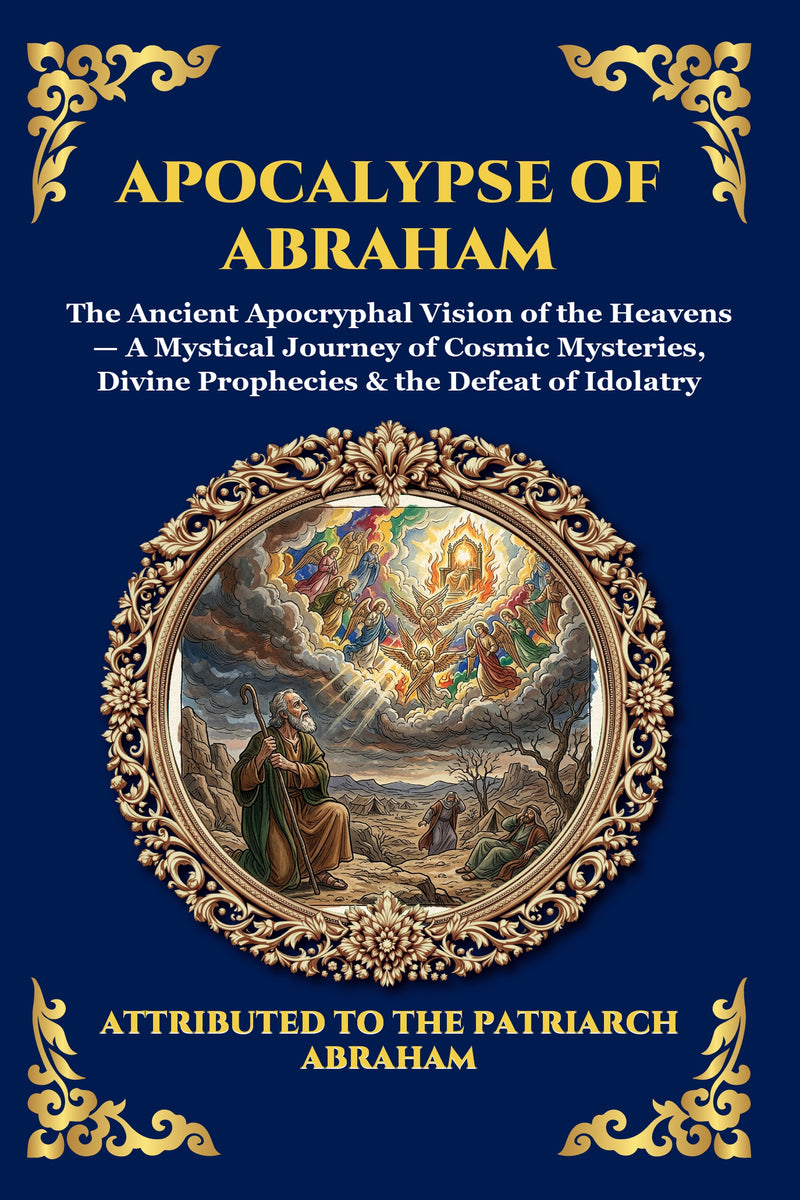
Apocalypse of Abraham
Abraham smashed his father's idols and turned to the one true Creator, driven by visions of the cosmos and its mysteries. Excluded from the biblical canon, the Apocalypse of Abraham reveals a journey from earthly awakening to celestial revelation.
or free app
10,000+ hrs library
30-day guarantee
The Apocalypse of Abraham is a complete modern-English translation of this ancient Jewish apocalyptic text, readable online with audiobook included through Library of Alexandria Press membership.
The Apocalypse of Abraham stands as one of ancient literature's most extraordinary visionary journeys, combining mystical revelation with breathtaking cosmic imagery.
The Apocalypse of Abraham presents a compelling modern translation of one of the most vividly imaginative and spiritually profound texts of the ancient apocryphal tradition. Attributed to the biblical patriarch himself, this fascinating work is divided into two breathtaking parts: an intimate, earthly narrative of spiritual awakening, and a sweeping, cosmic flight into the mysteries of heaven.
The story begins in the workshop of Terah, Abraham's father, who crafts idols out of wood, stone, and metal. In a series of powerful, often humorous observations, Abraham realizes that these lifeless statues cannot save themselves from fire, rot, or falling over, let alone save humanity. Rejecting the idolatry of his youth, Abraham is called by the one true Creator to leave his past behind. In response to his faith, God sends the angelic guide Jaoel to carry Abraham on the wings of a celestial bird up through the firmaments.
Far more than a story of personal faith, this text plunges the reader into the heart of ancient Jewish apocalyptic thought. Once in the heavens, Abraham is shown the grand tapestry of human history. He witnesses the fall of Adam and Eve orchestrated by the sinister figure of Azazel, the complex spiritual architecture of the cosmos, and the ultimate prophetic timeline leading to the end of days and divine judgment. Blending profound theological contemplation with dramatic visionary imagery, The Apocalypse of Abraham challenges readers to reflect on the nature of idolatry, the origins of evil, and the unshakable justice of God.
What You’ll Discover in This Modern Translation
- The Defeat of Idolatry: Follow Abraham’s powerful and logical realization that the man-made gods of his father are powerless, and his courageous choice to seek the ultimate Creator of the universe.
- The Heavenly Ascent: Journey alongside Abraham and the great angel Jaoel as they pierce the veil of the physical world and ascend through the terrifying and glorious layers of the heavens.
- The Fall of Humanity and Azazel: Explore ancient theological traditions regarding the origins of evil, featuring the dark spiritual figure of Azazel and his role in the corruption of mankind.
- Prophecies of the End Times: Uncover the visions granted to Abraham concerning the future tribulations of his descendants, the final judgment of the wicked, and the restoration of the righteous.
- A Window into Ancient Mysticism: Gain a deeper understanding of the visionary traditions and angelic lore that profoundly shaped early religious theology and apocalyptic literature.
Whether you are exploring this work for its immense historical value, its complex theological arguments concerning free will and evil, or its dramatic narrative of spiritual rebellion and ascension, The Apocalypse of Abraham offers inspiration and insight that endures across millennia.
Step into a narrative of unparalleled prophetic vision and discover the timeless lessons of this ancient apocalyptic journey. Begin your reading today.
| Formats | eBook (EPUB + PDF) · Audiobook · Paperback · Hardcover · Large Print |
| Language | English |
| Trim size (print) | 6 × 9 in |
| Binding | Paperback — perfect-bound · Hardcover — casewrap |
| Large Print edition | Same text in a larger, easy-read type — a larger font, not a larger trim |
| Print pricing | Every physical book at our true cost — at-cost, no profit (members) |
| Library | 873 restored titles, always growing |
| Composed | 1st-2nd century AD |
| Original language | Greek (original lost), surviving in Old Church Slavonic |
| Source tradition | Old Church Slavonic manuscript tradition |
| Translation basis | Public-domain scholarly translation, rendered in clear modern English |
| Length | 13,358 words · ~53 min reading |
| Reading level | Grade 8 · clear and comfortable (this modern-English edition) |
| Edition | Modern English translation · 2026 |
Member reviews for this edition are collected as readers finish it — be the first. Across the library: 12,000+ books shipped, every plan covered by a 365-day print guarantee.
About this edition
The complete, unabridged text in clear modern English — faithful to the original, never simplified. Every paragraph is checked against the source, so nothing is cut, summarised, or paraphrased away. It reads cleanly for today while keeping the original meaning intact.
This text survives primarily in Old Church Slavonic manuscripts, translated from a lost Greek original. This edition renders the standard scholarly translation into clear, accessible modern English for contemporary readers.
- Complete & unabridgedVerified paragraph by paragraph against the source — never a scan, never abridged.
- Modern English, faithfulReadable today, with the author’s meaning kept intact. Readable — not simplified.
- Every format, one membershipRead in your browser or the free app, or listen to the full audiobook.
Included free with your membership
Cancel anytime, one click · 30-day money-back guarantee
Edition last updated June 2026
What’s inside
Apocalypse of Abraham — complete and unabridged: all 33 sections included with membership, plus the full audiobook.
Begin reading Apocalypse of Abraham
In clear modern English — the complete text is included with membership.
Chapter 1
On the day I was guarding the gods of my father Terah and the gods of my brother Nahor, while I was testing which god is in truth the strongest,
I, Abraham — at the time when my lot came, when I was completing the services of my father Terah's sacrifice to his gods of wood, of stone, of gold, of silver, of copper, and of iron — having entered their temple for the service, I found a god named Marumath, carved from stone, fallen at the feet of the iron god.
And it came to pass that when I saw it, my heart was troubled, and I thought to myself that I, Abraham, could not put it back in its place alone, because it was heavy, being a large stone. So I went and told my father, and he came in with me. And when we both lifted it to put it back in its place, its head fell off, even while I was holding it by the head. And when my father saw that the head of his god Marumath had fallen, he said to me, "Abraham!"
And I said, "Here I am!" And he said to me, "Bring me the axes and chisels from the house." And I brought them to him from the house. And he carved another Marumath from a different stone, this one without a head, and he smashed the head that had fallen from Marumath together with the rest of the original Marumath.
Chapter 2
He made five other gods and gave them to me, ordering me to sell them out on the town road. I saddled my father's ass, loaded the gods onto it, and set out along the highway to sell them. As I went, I came upon merchants from Phandana of Syria traveling with camels on their way to Egypt to buy kokonil from the Nile. I spoke with them, and they answered me, and we walked along together in conversation. Then one of their camels cried out. The ass took fright, bolted, and threw off the gods. Three of them were smashed to pieces, and two remained intact.
When the Syrians saw that I had gods, they said to me, "Why did you not tell us you were carrying gods? We would have bought them before the ass heard the camel's cry, and you would have suffered no loss. Give us at least the gods that remain, and we will pay you a fair price." I turned this over in my heart. In the end they paid me for both the smashed gods and the ones that remained, for I had been worrying about how I would bring any payment back to my father at all. The three that were broken I threw into the waters of the river Gur, which flowed nearby, and they sank into the depths of the river Gur and were seen no more.
Chapter 3
As I walked along the road, my heart was troubled and my mind unsettled. I said to myself, "What is this strange business my father is engaged in? Is he not, in fact, a god to his own gods? For they come into being through his carving, his planning, and his skill. They ought to honor my father, since they are his handiwork. What then is the point of my father's labor over these things he has made?
Consider: Marumath fell and could not stand upright in his sanctuary, and I myself could not lift him until my father came and we raised him together. Even then we struggled, and his head broke off. So my father set it on another stone belonging to a different god — one he had made without a head. And the other five gods that were smashed by the donkey could not save themselves or punish the animal that smashed them, and their broken pieces could not even be retrieved from the river. So I said to myself, "If this is how things are, how can my father's god Marumath — whose head belongs to a different stone and whose body is carved from yet another — save a man, or hear a man's prayer, or give him any gift at all?"
Chapter 4
And thinking this over, I came to my father's house. I watered the donkey and gave him hay, then took out the silver and placed it in my father Terah's hand.
When he saw it he was glad, and said, "You are blessed, Abraham, by the god of my gods, since you have brought me the price of the idols and my labor was not wasted." I answered him, "Listen, father Terah! Whatever blessing the gods receive comes from you, because you are a god to them — you made them. Their blessing is their own ruin, and their power is empty. They could not even help themselves; how then can they help you or bless me? I did you a good turn in this business, for it was my own good sense that brought you the silver for the broken ones." When he heard my words he was furious with me, because I had spoken harshly against his gods.
Chapter 5
But having pondered my father's anger, I went out. Afterward, when I had gone out, he called me, saying, "Abraham!" And I said, "Here I am!" And he said, "Come, gather wood chips — I was carving gods from fir before you arrived — and use them to prepare my midday meal."
When I was gathering the wood chips, I found among them a small god that fit in my left hand. On its forehead was written: god Barisat. When I laid the chips on the fire to prepare my father's food, I went out to check on the meal, and I stood Barisat near the kindling fire, saying to him with mock sternness, "Barisat, watch that the fire does not go out before I come back! If it goes out, blow on it so it flares up." Then I went out and attended to my errand.
When I returned, I found Barisat fallen on his back, his feet wrapped in fire and burning fiercely. When I saw this, I laughed and said to myself, "Barisat, truly you know how to light a fire and cook food!" And as I said this, still laughing, I watched him burn slowly away in the fire until he became ashes.
I carried the food to my father to eat. I gave him wine and milk, and he drank and was pleased, and he blessed Marumath his god. And I said to him, "Father Terah, do not bless Marumath your god — do not praise him! Praise Barisat instead, your god, for out of love for you he threw himself into the fire to cook your food."
He said to me, "Then where is he now?" And I said, "He burned in the fierceness of the fire and turned to dust." And he said, "Great is the power of Barisat! I will make another today, and tomorrow he will prepare my food."
Chapter 6
When I, Abraham, heard words like these from my father, I laughed inwardly, and I groaned in the bitterness and anger of my soul. I said to myself, "How then can a mere figment shaped by his own hands be an aid to my father? Or can he really have subordinated his body to his soul, his soul to a spirit, and his spirit to stupidity and ignorance?" And I said, "It is right that I endure this evil patiently, so that I may turn my mind toward purity and lay my thoughts plainly before him." So I answered and said, "Father Terah, whichever of these gods you praise, you are mistaken in your thinking.
Look — the gods of my brother Nahor, standing in the holy sanctuary, are more worthy of reverence than yours. For Zouchaios, my brother Nahor's god, is more venerable than your god Marumath, because he is made of gold and is valued by men.
And if he grows old with time, he can be melted down and recast, whereas Marumath, if he is changed or broken, cannot be renewed, because he is stone. And what of Ioav, the god who stands alongside Zouchaios? He too is more venerable than your god Barisat, for he is carved from wood and overlaid with silver, and he likewise has worth, being valued by men according to outward appearance. But Barisat, your god — before he was carved, he was rooted in the earth, great and wondrous, with branches and blossoms, and he was a thing of beauty and praise. Then you took an axe to him, and by your own craft he was made into a god. And now look at him: he has already dried out, his sap is gone. He fell from his height to the ground, he came down from greatness to nothing, and the beauty of his face has wasted away. He was consumed by fire and became ashes and is no more. And yet you say, 'Let me make another, and tomorrow he will prepare my food.' But in perishing he left nothing of himself behind — not even the strength to save himself from destruction."
Chapter 7
This I say: fire is more worthy of reverence than the others, for even the unconquerable are conquered by it, and it mocks whatever perishes easily in its burning. Yet fire itself is not worthy of reverence, for it is subdued by water.
Rather, water is more worthy of reverence than fire, because water overcomes fire and nourishes the earth so that it bears fruit. But I will not call water a god either, for water sinks beneath the earth and is subject to it. Nor will I call the earth a goddess, for it is dried by the sun and is made subject to man for his labor.
Among the gods, I say, the sun is most worthy of reverence, for with its rays it illuminates the whole universe and all the surrounding air.
Yet neither will I place among the gods the one whose course is obscured by the moon and the clouds.
Nor again will I call the moon or the stars gods, because they too at times dim their light in the night.
Listen, Terah my father: I will seek before you the God who created all the gods we have supposed to exist.
For who is it, which one is it, who made the heavens crimson and the sun golden, who gave light to the moon and the stars along with it, who dried the earth in the midst of the many waters, who set you yourself among all created things, and who has sought me out in the confusion of my thoughts?
If it is God, he will reveal himself to us by himself!
Chapter 8
And it came to pass that while I was turning these things over in my mind concerning my father Terah, there in the courtyard of my house, the voice of the Mighty One came down from the heavens in a stream of fire, calling out, "Abraham, Abraham!"
And I said, "Here I am." And he said, "You are searching for the God of gods, the Creator, with the understanding of your heart. I am he. Go out from Terah your father, and leave his house, so that you too may not be destroyed in the sins of your father's household." And it came to pass that as I went out — I had not yet crossed the threshold of the courtyard — the sound of a great thunder came and consumed him and his house and everything in it, down to the ground, forty cubits deep.
Chapter 9
Then a voice came and spoke to me twice: "Abraham, Abraham!" And I said, "Here I am." And he said, "Behold, it is I. Fear not, for I am Before-the-World and Mighty, the God who created all things before the light of the age. I am your shield and I am your helper.
Go, get me a three-year-old heifer, a three-year-old she-goat, a three-year-old ram, a turtledove, and a pigeon, and make me a pure sacrifice. In this sacrifice I will establish the ages. I will reveal to you hidden things, and you will see great things which you have never seen, because you desired to seek me, and I have called you my beloved. But for forty days abstain from every kind of food cooked by fire, from drinking wine, and from anointing yourself with oil. Then you shall prepare for me the sacrifice I have commanded you, in the place I will show you on a high mountain. There I will show you the things that were made by the ages and by my word, affirmed, created, and renewed. And I will declare to you what will come upon those who have done evil and those who have done righteous things in the race of mankind."
Chapter 10
And it came to pass that when I heard the voice speaking these words to me, I looked this way and that. But there was no breath of any man. My spirit was seized with wonder, and my soul fled from me. I became like a stone and fell face down upon the earth, for I no longer had the strength to stand. And while I still lay face down on the ground, I heard the voice speaking: "Go, Iaoel of the same name, through the meditation of my ineffable name — consecrate this man for me and strengthen him against his trembling."
Cancel anytime, one click · 30-day money-back guarantee
Founding annual rate available now — your price locks for life when you join.
Not ready? Get this free chapter by email — read it anytime.
✓ Sent — check your inbox for Apocalypse of Abraham.
Questions about Apocalypse of Abraham
Why isn't the Apocalypse of Abraham in the Bible?
The Apocalypse of Abraham was composed after the Hebrew Bible canon was established and was not accepted into the Christian biblical canon. It was preserved in Slavonic Christian communities as an important religious text.
Did Abraham actually write this text?
Scholars agree the Apocalypse of Abraham was written centuries after the biblical Abraham lived, likely in the 1st-2nd century AD. Ancient authors commonly attributed works to revered figures like Abraham to convey authority.
What does the Apocalypse of Abraham contain?
The Apocalypse of Abraham narrates Abraham's rejection of idolatry and his mystical journey through the heavens, where he receives visions of creation, history, and the end times guided by the angel Yahoel.
Is Apocalypse of Abraham free to read?
The opening of the text is free to read below. Members read and listen to the complete work — and the entire Lost & Forbidden Library — free.
What is Apocalypse of Abraham?
Have you ever wondered why the patriarch Abraham abandoned the gods of his ancestors to seek the one true Creator, and what terrifying cosmic visions he was shown in return?
How long is Apocalypse of Abraham?
33 chapters (~13,405 words) in this restored edition.
Shipping & returns
Billing & membership
More from the library


Explore The Lost & Forbidden Library
- 1 Enoch · Attributed to Enoch
- 1–4 Maccabees · Various Jewish authors
- 2 Baruch · Attributed to Baruch
- 2 Enoch · Attributed to Enoch
- 2 Esdras · Attributed to the prophet Ezra
- 3 Baruch · Attributed to Baruch ben Neriah
- 4 Baruch · Attributed to Baruch ben Neriah
- A Valentinian Exposition · Attributed to a follower of Val...
- Acta Archelai · Attributed to Hegemonius
- Acts of Andrew · Anonymous (Early Christian Apoc...
- Acts of Andrew and Matthias in the City of the Cannibals · Attributed to early Christian a...
- Acts of Barnabas · Attributed to John Mark
- Acts of Bartholomew
- Acts of John · Anonymous (Early Christian Apoc...
- Acts of Matthias · Anonymous early Christian writers
- Acts of Paul · Attributed to an unknown early ...
- Acts of Paul and Thecla · Attributed to Onesiphorus
- Acts of Peter
- Acts of Peter and Andrew · Attributed to various early Chr...
- Acts of Peter and Paul · Attributed to Leucius Charinus
- Acts of Peter and Simon · Attributed to Leucius Charinus
- Acts of Peter and the Twelve Apostles · Attributed to early Christian a...
- Acts of Philip · Anonymous (Early Christian Apoc...
- Acts of Pilate (Gospel of Nicodemus) · Attributed to various early Chr...
- Acts of Saturninus
- Acts of Thaddaeus · Attributed to Thaddaeus the Apo...
- Acts of Thomas
- Acts of Titus · Anonymous early Christian writer
- Acts of Xanthippe, Polyxena, and Rebecca
- Allogenes · Anonymous (Early Gnostic Mystic)
Apocalypse of Abraham
The Apocalypse of Abraham
The Patriarch's Vision — Abraham's Rejection of His Father's Idols, the Sacrifice and the Fallen Angel Azazel, the Ascent to Heaven and the Vision of the Throne-Chariot, the Fall of Adam, and the Course of History to the Final Judgement
Library of Alexandria Press
The Apocalypse of Abraham
© Copyright 2026 Library of Alexandria Press. All rights reserved.
Published by Library of Alexandria Press
Printed in the United States of America
It is not legal to copy, share, or send any part of this document in either digital or printed form without written permission from the publisher, except short quotes in a book review.
Table of Contents
Introduction
Chapter 1
Chapter 2
Chapter 3
Chapter 4
Chapter 5
Chapter 6
Chapter 7
Chapter 8
Chapter 9
Chapter 10
Chapter 11
Chapter 12
Chapter 13
Chapter 14
Chapter 15
Chapter 16
Chapter 17
Chapter 18
Chapter 19
Chapter 20
Chapter 21
Chapter 22
Chapter 23
Chapter 24
Chapter 25
Chapter 26
Chapter 27
Chapter 28
Chapter 29
Chapter 30
Chapter 31
Chapter 32
Introduction
There are books that inform, and there are books that transform. The ancient text you are about to encounter belongs firmly to the second category. It is a work that has survived the wreckage of empires, the burning of libraries, the suppression of heterodox traditions, and the long, slow erosion of centuries — and it has survived because it carries within it something that cannot easily be extinguished: a vision of the universe so vast, so strange, and so morally urgent that readers across millennia have found themselves unable to set it aside once they have begun. You are holding one of the most remarkable pieces of religious literature ever produced in the ancient world, a text that stands at the crossroads of Jewish mysticism, apocalyptic prophecy, philosophical inquiry, and narrative drama, weaving all of these threads into a single extraordinary tapestry.
To read this work is to enter a world that feels simultaneously ancient and immediate. The concerns it raises — the nature of evil, the meaning of human freedom, the relationship between the divine and the created order, the question of why suffering exists in a world supposedly governed by a just and omnipotent God — are not the concerns of a distant, irrelevant past. They are the questions that keep people awake at night in every century, in every culture, in every corner of the human experience. The genius of this text is that it addresses these questions not through dry philosophical argument or systematic theology, but through story, through vision, through the breathtaking immediacy of one man's journey beyond the boundaries of the known world into the terrifying and magnificent heart of reality itself.
The protagonist of this journey is Abraham, one of the most recognizable figures in the entire history of world religion. He is the patriarch, the father of nations, the man to whom God made the foundational covenant that would shape the destiny of entire civilizations. But the Abraham we encounter in this text is not yet the towering figure of later tradition. He is, at the outset, a young man living in his father's house, surrounded by idols, troubled by questions, and possessed of a restless, probing intelligence that refuses to accept easy answers. The opening sections of the work are among the most vivid and darkly comic passages in all of ancient literature — a portrait of a household devoted to the manufacture and worship of stone and wooden gods, rendered with a satirical sharpness that would not be out of place in a modern novel.
What makes these opening chapters so remarkable is the way they establish Abraham's character before the supernatural drama begins. We see him thinking, questioning, testing the logic of idol worship against his own observations of the physical world. He watches a wooden idol burn in a fire and asks the obvious question that no one around him seems willing to ask: how can something that cannot save itself from flames be expected to save human beings from anything at all? This is not naive skepticism — it is the beginning of a genuine philosophical and theological awakening, and the text renders it with extraordinary psychological realism. Abraham is not simply told the truth by a divine messenger; he reasons his way toward it, step by careful step, through a process of intellectual and moral courage that the text clearly intends us to admire and emulate.
The transition from this grounded, almost novelistic opening to the cosmic visions that follow is one of the most dramatic pivots in ancient literature. When the divine call comes to Abraham, it does not arrive as a gentle invitation. It arrives as a summons, urgent and overwhelming, pulling him out of the familiar world and into something so far beyond ordinary human experience that the text must strain the limits of language itself to describe it. The journey that follows takes Abraham through layers of reality that most human beings never glimpse — through fire and cloud, through the architecture of the heavens, through the very foundations of the created order — and at every stage, he is confronted with revelations that challenge, expand, and ultimately remake his understanding of everything he thought he knew.
It is important to understand something about the literary and religious tradition within which this text was produced, because that understanding will enormously enrich your experience of reading it. The work belongs to the genre known as apocalyptic literature, a category of ancient writing that flourished primarily between the third century BCE and the second century CE, producing such extraordinary works as the Book of Enoch, the Book of Daniel, Fourth Ezra, the Apocalypse of Baruch, and, most famously, the Book of Revelation. The word 'apocalypse' comes from the Greek for 'unveiling' or 'revelation,' and that etymology is crucial: these are not primarily texts about destruction and catastrophe, though they often contain both. They are texts about the lifting of a veil, about the disclosure of hidden truths that lie beneath the surface of ordinary reality.
Apocalyptic literature emerged in periods of intense social, political, and theological crisis, when the conventional frameworks for understanding the world had broken down or proven inadequate. It was a literature born of suffering and confusion, produced by communities that looked at the world around them and could not reconcile what they saw with what they believed. If God was just and powerful, why did the wicked prosper and the righteous suffer? If the covenant between God and the chosen people was real and binding, why did history seem to mock it at every turn? Apocalyptic writers responded to these questions not by abandoning faith, but by expanding the frame of reference — by insisting that the visible, historical world was only a small part of a much larger cosmic drama, and that the full meaning of events could only be understood by those who had been granted a vision of the whole.
This particular text is believed to have been composed sometime in the late first or early second century CE, in the aftermath of one of the most catastrophic events in Jewish history: the destruction of the Second Temple in Jerusalem by the Romans in 70 CE. This was not merely a military defeat or a political disaster — it was a theological earthquake. The Temple was the center of Jewish religious life, the dwelling place of God's presence on earth, the axis around which the entire sacrificial system and much of Jewish law revolved. Its destruction raised questions so profound and so painful that they threatened to shatter the entire framework of Jewish faith. How could God have allowed this? What did it mean for the covenant? Was there still hope, and if so, of what kind?
The text engages with these questions with remarkable depth and sophistication, using the figure of Abraham — the very origin point of the covenant — as a lens through which to examine them. By setting the narrative at the very beginning of sacred history, the author creates a perspective from which the entire sweep of that history, including its most terrible moments, can be seen and, perhaps, understood. This is one of the text's most powerful and moving qualities: its refusal to look away from darkness, its insistence on confronting the hardest questions directly, even when the answers it offers are not simple or comforting.
The text has come down to us primarily through Slavonic manuscripts, which means it was preserved in the Slavic Christian tradition rather than in Jewish or Greek sources. This is itself a fascinating piece of literary history, raising questions about transmission, translation, and the ways in which texts migrate across cultural and religious boundaries. Scholars generally believe that the work was originally composed in Hebrew or Aramaic, translated into Greek, and then translated again into Old Church Slavonic, with each stage of transmission introducing its own layers of interpretation and, inevitably, some degree of alteration. What we have, therefore, is a text that has been shaped by multiple hands across multiple centuries and cultures — and yet the core of it, the essential vision and the driving questions, shines through with remarkable clarity and force.
Reading this work today, in a modern translation that aims to make its language accessible without sacrificing its power, you are participating in a chain of transmission that stretches back nearly two thousand years. You are joining a long procession of readers — Jewish mystics, Christian monks, Slavic scribes, Renaissance scholars, modern academics — who have found in this text something that spoke to them across the vast distances of time and culture. That is not a small thing. It is, in fact, one of the most profound experiences that literature can offer: the sense of genuine contact with a mind and a spirit from another world, another time, another set of circumstances, and yet recognizably, unmistakably human.
The World That Shaped This Vision
To fully appreciate the depth and complexity of what you are about to read, it helps to have some sense of the intellectual and spiritual landscape from which it emerged. The world of late antiquity — roughly the period from the first century BCE to the third century CE — was one of the most extraordinarily fertile periods in the history of human thought. It was a world in ferment, a world in which ancient traditions were colliding with new ideas, in which empires were reshaping the boundaries of culture and religion, in which old certainties were dissolving and new ones were struggling to be born.
Judaism in this period was not the monolithic tradition that later historical memory sometimes makes it appear. It was a richly diverse religious culture, encompassing a wide spectrum of beliefs, practices, and interpretive traditions. There were the Pharisees, with their emphasis on oral law and the democratization of religious practice. There were the Sadducees, with their focus on the Temple cult and their skepticism about resurrection and angelic beings. There were the Essenes, whose ascetic communities at Qumran produced the Dead Sea Scrolls and whose theology was deeply shaped by apocalyptic and dualistic ideas. There were the Zealots, who believed that armed resistance to Roman rule was a religious obligation. And there were the apocalyptists — writers and thinkers who stood somewhat apart from all of these groups, or who drew from several of them simultaneously, and who were convinced that the key to understanding the present lay in a revealed vision of the cosmic whole.
The apocalyptic tradition drew heavily on an older strand of Jewish religious experience known as merkavah mysticism — the mysticism of the divine chariot. This tradition took its name from the opening chapter of the Book of Ezekiel, in which the prophet describes a vision of God's throne-chariot, the merkavah, surrounded by terrifying angelic beings and blazing with unearthly fire. The merkavah mystics developed elaborate techniques for ascending through the heavenly realms, passing through gates guarded by angelic sentinels, and ultimately achieving a vision of the divine glory. Their literature is among the most psychologically intense and visually extraordinary in all of religious writing, and its influence on the text you are about to read is profound and pervasive.
At the same time, this work was being produced in a world deeply shaped by Hellenistic philosophy — by Platonism, Stoicism, and the various mystery religions that competed for the allegiance of thoughtful people across the Mediterranean world. Ideas about the nature of the soul, the structure of the cosmos, the relationship between the visible and invisible worlds, the problem of evil, and the possibility of human transformation had been circulating and cross-pollinating across cultural boundaries for centuries. A Jewish apocalyptic writer working in the late first or early second century CE would have been aware of these ideas, even if he rejected or reinterpreted them in light of his own tradition. The result is a text that is deeply, irreducibly Jewish in its concerns and its framework, but that also resonates with the broader intellectual and spiritual currents of its age in ways that give it a universal dimension.
The problem of evil, in particular, receives in this text a treatment that is both deeply traditional and strikingly original. The figure of Azazel — the demonic being who plays a significant role in the narrative — is drawn from ancient Jewish tradition, appearing in the Book of Leviticus as the name associated with the scapegoat ritual and in the Book of Enoch as a fallen angel who corrupts humanity. But the way this text uses Azazel goes beyond mere tradition. He becomes a figure through whom some of the deepest questions about the nature of evil and human freedom are explored — questions about whether evil is an independent force in the universe or a corruption of something good, about the relationship between divine sovereignty and human moral agency, about why a good God would create a world in which such a being could exist and operate.
These are not questions with easy answers, and the text does not pretend that they are. One of its most admirable qualities is its intellectual honesty, its willingness to sit with difficulty and ambiguity rather than rushing toward false resolution. Abraham, in his heavenly journey, is allowed to see things that raise as many questions as they answer, and the text's treatment of his responses — his fear, his confusion, his moments of partial understanding — is psychologically nuanced in ways that feel remarkably modern. He is not a passive recipient of divine revelation but an active participant in a dialogue, a seeker who pushes back, who asks follow-up questions, who struggles to integrate what he is shown into a coherent understanding of reality.
The historical context of the text's composition adds another layer of meaning to everything in it. Writing in the shadow of the Temple's destruction, the author was grappling with a trauma that had no precedent in living memory. The rabbis who would eventually shape normative Judaism responded to this trauma in one way — by shifting the center of religious life from Temple sacrifice to Torah study and prayer, by developing the synagogue as a portable sacred space that could exist anywhere, by insisting on the continuing validity of the covenant even in the absence of its central institution. The apocalyptic writers responded differently — by insisting that the destruction was not the end of the story, that it was part of a larger divine plan that would ultimately be vindicated, that the suffering of the present age was the prelude to a transformation of cosmic proportions.
Neither response was wrong, and in many ways they were complementary rather than contradictory. But the apocalyptic response had a particular emotional and spiritual power in moments of acute crisis, because it offered not just consolation but meaning — not just the promise that things would get better, but a framework for understanding why they had gotten so bad in the first place. This is what the vision at the heart of this text ultimately offers: not a simple answer to the problem of evil, but a perspective from which the problem can be held and contemplated without destroying the one who contemplates it. That is a gift of no small importance, and it is one that the text continues to offer to readers who are willing to receive it.
How to Read What Follows
Every great ancient text makes certain demands on its readers, and it is worth being honest about what those demands are before you begin. This is not a work that yields all of its riches on a first, casual reading. It is a text that rewards patience, attention, and a willingness to dwell in uncertainty — to let images and ideas sit in the mind without immediately demanding that they resolve into neat, comfortable meanings. The visions it contains are not puzzles to be solved but experiences to be undergone, and the most productive way to approach them is with the same openness and receptivity that the text itself models in its protagonist.
At the same time, it would be a mistake to approach this work as though it were entirely alien or impenetrable. For all its strangeness, it is also a profoundly human document, animated by recognizable emotions and driven by questions that any thoughtful person can understand and share. The fear that Abraham feels as he ascends through the heavens is not an abstract theological category — it is the visceral, embodied fear of a human being confronting something infinitely larger than himself. The wonder he experiences is not a literary convention — it is the authentic response of a consciousness being expanded beyond its previous limits. The grief and confusion he feels when he is shown the darker dimensions of human history and divine justice are not rhetorical gestures — they are the genuine moral and emotional struggles of a person trying to hold faith and reality together in the face of overwhelming evidence of their tension.
Reading with this kind of emotional attunement — allowing yourself to feel what Abraham feels, to be troubled by what troubles him, to be astonished by what astonishes him — will enrich your experience of the text enormously. Ancient religious literature is sometimes approached with a kind of reverent distance, as though it were a museum artifact to be admired behind glass rather than a living thing to be encountered directly. That approach, however understandable, tends to flatten and diminish texts that were written to be experienced with the full force of one's humanity. This particular work was written for people in crisis, people grappling with loss and confusion and the apparent silence of God, and it deserves to be read with the full weight of those circumstances in mind.
It is also worth paying close attention to the structure of the narrative, because the architecture of the text is itself meaningful. The movement from the earthly, domestic world of the opening sections to the cosmic visions of the later sections is not merely a change of setting — it is a journey of transformation, a movement from the partial and fragmentary understanding of ordinary human experience to the larger, more terrible, more magnificent understanding that comes from seeing the whole. This movement mirrors the journey that the text implicitly invites its readers to undertake — a journey out of the comfortable, familiar world of unexamined assumptions into the more demanding and more rewarding territory of genuine vision.
The figure of Azazel, when he appears, deserves particular attention. He is one of the most complex and fascinating characters in ancient religious literature — not a simple embodiment of evil, but a figure whose very existence raises profound questions about the nature of the created order and the limits of divine sovereignty. The way the text handles his relationship with Abraham, and the way Abraham is instructed to respond to him, is one of the most theologically rich passages in the entire work. Do not rush past it. Let it sit. Let it trouble you, if it does. The trouble is productive.
Similarly, the cosmological visions — the descriptions of the heavenly realms, the divine throne, the angelic beings, the structure of the created universe — should not be read merely as ancient science or mythology. They are attempts to render in language something that language was not designed to render: the experience of ultimate reality, the encounter with the ground of being, the confrontation with a presence so vast and so other that the human mind can only approach it through image and symbol and the deliberate stretching of metaphor to its breaking point. Read these passages slowly. Read them aloud, if you can. Let the language work on you the way music works on you — not by conveying information, but by inducing a state, creating an atmosphere, opening a door in the mind that ordinary prose keeps firmly shut.
The prophetic sections of the text — the visions of history and the future that Abraham is shown — require a different kind of attention. Here the text is engaging with the specific historical and theological concerns of its time, and some of the references may require a degree of contextual knowledge to fully appreciate. But even without detailed historical knowledge, these passages communicate something essential: the sense that history is not random, not chaotic, not simply the meaningless collision of human ambitions and accidents, but a narrative with a shape, a direction, a purpose that is not always visible from within it. Whether or not one shares the theological convictions that underlie this vision, the emotional and moral force of the conviction itself is something that any reader can feel and respond to.
One final word about what you will find in the pages that follow. This is a text that takes human dignity with absolute seriousness. In a world that was, by any modern standard, brutally hierarchical — a world of emperors and slaves, of conquerors and conquered, of rigid social and religious boundaries — this work insists on the profound significance of individual human beings, on the reality of human moral agency, on the importance of the choices that each person makes in the brief span of their earthly existence. Abraham's journey is not undertaken on behalf of a class or a nation or a religious institution — it is the journey of a single human soul, trying to understand the world it finds itself in and to live in it with integrity and faithfulness. That is a story that belongs to everyone. It belonged to the communities that first read this text in the ruins of their destroyed world, and it belongs to you, reading it now, in whatever circumstances have brought you to this moment.
The veil is about to be lifted. The journey is about to begin. Bring everything you have — your intelligence, your imagination, your moral seriousness, your capacity for wonder — and let this ancient, extraordinary vision do what it was always meant to do: take you somewhere you have never been before, and bring you back changed.
The Apocalypse of Abraham
Chapter 1
On the day I was guarding the gods of my father Terah and the gods of my brother Nahor, while I was testing which god is in truth the strongest,
I, Abraham — at the time when my lot came, when I was completing the services of my father Terah's sacrifice to his gods of wood, of stone, of gold, of silver, of copper, and of iron — having entered their temple for the service, I found a god named Marumath, carved from stone, fallen at the feet of the iron god.
And it came to pass that when I saw it, my heart was troubled, and I thought to myself that I, Abraham, could not put it back in its place alone, because it was heavy, being a large stone. So I went and told my father, and he came in with me. And when we both lifted it to put it back in its place, its head fell off, even while I was holding it by the head. And when my father saw that the head of his god Marumath had fallen, he said to me, "Abraham!"
And I said, "Here I am!" And he said to me, "Bring me the axes and chisels from the house." And I brought them to him from the house. And he carved another Marumath from a different stone, this one without a head, and he smashed the head that had fallen from Marumath together with the rest of the original Marumath.
End of the free sample
Keep reading, free
Members read and listen to the complete book — and the entire library. Cancel anytime, one click · 30-day money-back guarantee.