1 h 14 minAudiobook8 minSummaryRead it, hear it, the 15-minute summary, and print and large print at costPaperback · 6 × 9 in · printing soonHardcover · 6 × 9 in · printing soon
About this book
What if peace begins with admitting how little you can control?
In The Enchiridion, Epictetus offers a firm starting point: separate what is up to you from what is not. This short handbook of Stoic advice turns that distinction toward anger, loss, ambition, illness and other people's opinions. The question is where your effort belongs.
Epictetus asks you to examine desire, question your judgments and face things as they are. A dinner becomes a test of patience: take what reaches you rather than grab for more. His guidance is blunt, not soothing. Again and again, he calls you away from discussing principles and toward putting them into practice.
What you’ll discover
- Where your power lies Learn to distinguish your own choices from the things that remain beyond your control.
- Desire with a direction Examine what you reach for, and ask whether your wants aim at the right target.
- A closer look at judgment Explore Epictetus's claim that our judgments, rather than events themselves, are what disturb us.
- Calm among other people Consider how to live with others without letting their opinions govern your peace.
- Practice instead of display Meet a demanding call to live your principles rather than show them off in conversation.
Is it for you?
This book suits anyone who wants a short, firm guide for stress, envy or loss, and anyone curious about Stoicism at its source. If you want gentle comfort or a long argument with many proofs, you may find it blunt.
What’s inside
The key ideas, in the 15-minute summary
- Sort what is up to you
- Aim your wants at the right target
- See each event for what it is
- Opinions disturb us, not events
- Live among others without losing yourself
- Practice more than talk, and last long
Formats and delivery
- eBook
- On your phone, tablet, computer or Kindle, with the type as large as you like.
- Large-print eBook
- The same book in bigger, clearer type, from the first page.
- Audiobook
- 1 h 14 min, complete, read by Lucas Linden.
- 15-minute summary
- The key ideas in about 8 minutes, to read or to hear.
- Paperback
- 6 × 9 in. Printing soon: leave your email under Paperback or Hardcover above.
- Hardcover
- 6 × 9 in. Printing soon: leave your email under Paperback or Hardcover above.
- Large print paperback
- 8.5 × 11 in. Printing soon: leave your email under Paperback or Hardcover above.
- Large print hardcover
- 8.5 × 11 in. Printing soon: leave your email under Paperback or Hardcover above.
eBooks and audiobooks open right away. Download EPUB or PDF, or send the book to your Kindle. Every printed copy is made when you order it and shipped worldwide; shipping is shown at checkout.
How it works · 60-day guarantee
- Start free. Nothing to pay today; the eBook of this book is yours to keep.
- Read, listen and print. 200,000+ classics as eBook, large-print eBook, audiobook and 15-minute summary, and any book printed at cost as a paperback, hardcover or large print, for the whole household.
- We remind you first. We email you 7 days before your first payment. Then your first year is 50% off: USD 0.14 a day, then USD 0.27 a day, never raised. Or USD 0.66 a day on the monthly plan. Cancel online in two clicks.
60-day money-back guarantee. If the library is not for you, ask within 60 days of your first payment and we refund it in full.
25 languages, side by side
Read and hear The Enchiridion in 25 languages and switch at any time. Or read two side by side, paragraph by paragraph: the way to learn a language with a book you love.
Read it side by side
Philosophy & IdeasFree to read
The Enchiridion
 by Epictetus· 125
Stoic advice on what can and cannot be controlled.
Excellent
- The whole book free
- Read or listen
- 25 languages, side by side
- Print and large print at cost
Opens right away, on any device
Read the whole book freeNo sign-upNothing to pay


Language: English
From the 15-minute summary · Key idea 1 of 6
Sort what is up to you
The book opens with its main claim. Some things are up to us, and some are not. Epictetus names what is ours: our judgments, our impulses, our desires and our aversions. In short, whatever comes from our own will. Everything else is not ours, and that includes our body, our property, our reputation and our office.
This split is the key to the whole manual. Epictetus says that the things in our power are free by nature. Nobody can block them or force them. The things outside our power are weak, and they belong to others. If you treat them as your own, you will be thwarted and disturbed, and you will blame gods and people.
Renews every year · Cancel anytime
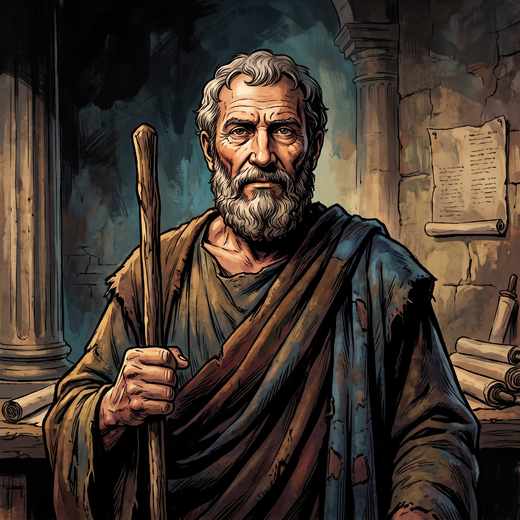
The author
Epictetus
50–125 · Ancient Greek Stoic philosopher
Epictetus was a Greek Stoic philosopher who lived in the first and second centuries AD. Born in Hierapolis, in present-day Turkey, he was enslaved in Rome and later freed. He taught in Nicopolis, Greece. His pupil Arrian recorded his teachings in the Discourses and Enchiridion during the second century.
Free gifts
USD 580 in free gifts when you start
Every book in every format and in 25 languages, for the whole household. Nothing to pay today.
- 200,000+ classic eBooksIn 25 languages, side by side
USD 170FREE - Every audiobookIn 25 languages, any device
USD 120FREE - 15-minute summariesRead or listen, in 25 languages
USD 60FREE - Print at cost, no markupPaperback, hardcover, large print
USD 60FREE - The whole householdUp to 5 readers
USD 170FREE - A part in rebuilding the libraryNew languages and books for all
FREE


More like this
 Free


 Free
 Free

 Free


Our mission
The library burned once. We are building it back.
Every great book, in every language and every format, for every family. Every plan helps pay for new languages, new audiobooks and books for readers who have never had them. Join the movement.
Read our story- Every language25 languages today, side by side, and more every year
- No wastePrinted on demand: no warehouses, no unsold stock, no pulped copies
- For everyonePaperback, hardcover and large print at the cost of printing
Questions about The Enchiridion
Is the whole book really free?
Yes. The Enchiridion is one of 200 complete books that are free to read and hear, with no sign-up and nothing to pay. Start free and you also get 200,000+ more classics, the 15-minute summaries, and any book printed at cost as a paperback, hardcover or large print.
Can I buy the printed book?
Soon. The paperback, hardcover and large print editions are being prepared. Choose Paperback or Hardcover above, leave your email, and we tell you the day you can order it, printed at cost.
Can my family read too?
Yes. The whole household reads and listens: up to 5 readers, each with their own shelf and their own place in every book.
What if it is not for me?
Cancel online in two clicks at any time and nothing more is charged. If you have paid and the library is not for you, ask within 60 days of your first payment and we refund it in full.
What is the Enchiridion about?
It is a short handbook of Stoic advice. Its main lesson is to separate what is in your power, such as your judgments and choices, from what is not, such as other people, fame and fortune, and to focus only on the first.
Did Epictetus write the Enchiridion himself?
No. Epictetus taught by speaking, and his student Arrian wrote down his lessons. Arrian compiled the Enchiridion as a brief digest of those teachings, so the ideas are Epictetus and the arrangement is Arrian.
What does Enchiridion mean?
It is a Greek word meaning something held in the hand, so a handbook or manual. The title fits the book's purpose, which is to give a short set of rules a person can keep close and use daily.
Popular in philosophy & ideas
See all
 Free
 Free
 Free

 Free


 Free