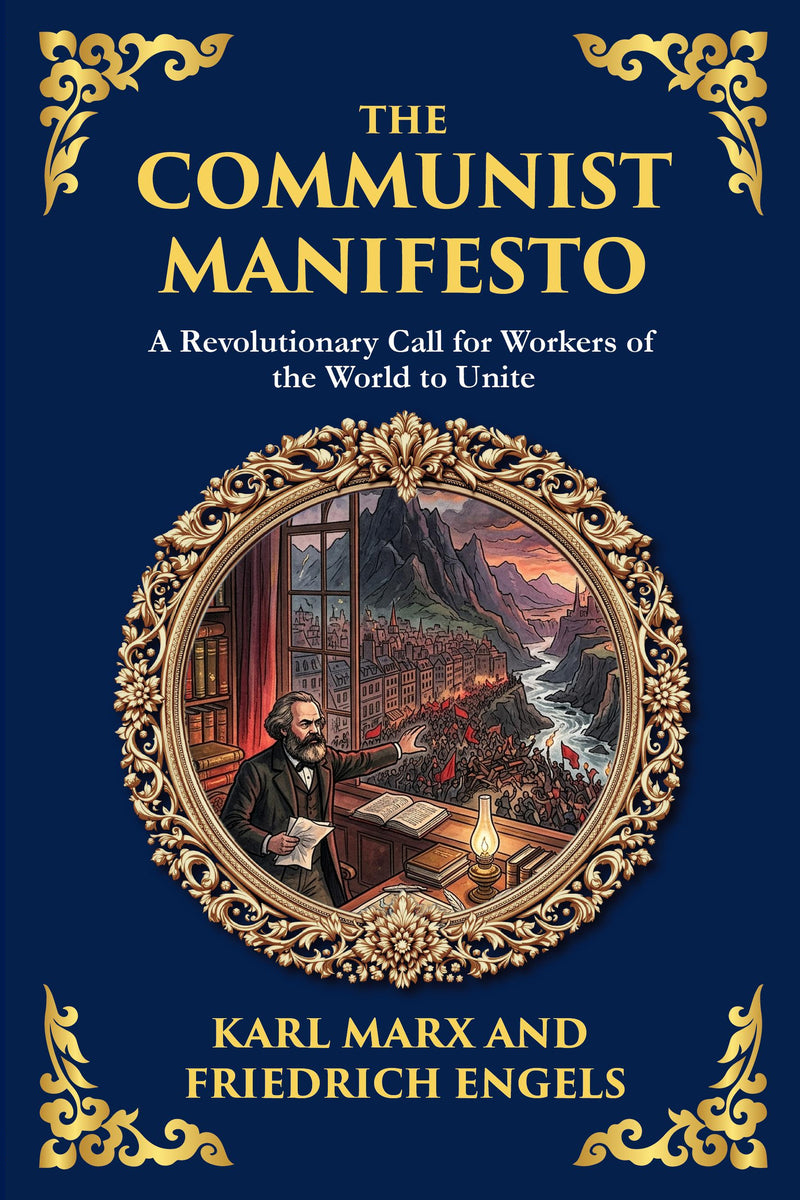
The Communist Manifesto
Karl Marx & Friedrich Engels Few books have shaken the world like The Communist Manifesto. Written in 1848, this fiery document by Karl Marx and Friedrich Engels is both a rallying cry and a blueprint for revolution.
or free app
10,000+ hrs library
30-day guarantee
The complete The Communist Manifesto appears in modern English through Library of Alexandria Press, available online with audiobook narration included for members.
Have you ever wondered why capitalism has faced such fierce resistance throughout modern history? The Communist Manifesto by Karl Marx and Friedrich Engels is a groundbreaking declaration that ignited political revolutions and ideological debates across the globe. First published in 1848, this concise yet powerful work offers a searing indictment of capitalist exploitation and a passionate vision for a world governed by the collective will of the people.
This modern edition revives the spirit of rebellion and critical analysis that defined Marx and Engels’ message—delivered in language that speaks clearly to the injustices still faced today.
What you’ll discover in this modern edition
- A Powerful Critique of Capitalism Examine how industrial society creates class division, alienation, and systemic inequality that enriches the few at the cost of the many.
| Formats | eBook (EPUB + PDF) · Audiobook · Paperback · Hardcover · Large Print |
| Language | English |
| Trim size (print) | 6 × 9 in |
| Binding | Paperback — perfect-bound · Hardcover — casewrap |
| Large Print edition | Same text in a larger, easy-read type — a larger font, not a larger trim |
| Print pricing | Every physical book at our true cost — at-cost, no profit (members) |
| Library | 873 restored titles, always growing |
| Length | 13,901 words · ~56 min reading |
| Reading level | Grade 13 · a demanding, literary read (this modern-English edition) |
| Edition | Modern English translation · 2026 |
Member reviews for this edition are collected as readers finish it — be the first. Across the library: 12,000+ books shipped, every plan covered by a 365-day print guarantee.
About this edition
A faithful, unabridged modern-English edition by The Library of Alexandria — carefully rendered for today's reader and verified paragraph-by-paragraph against the public-domain source. Available as eBook, audiobook, paperback, hardcover, and large print.
- Complete & unabridgedVerified paragraph by paragraph against the source — never a scan, never abridged.
- Modern English, faithfulReadable today, with the author’s meaning kept intact. Readable — not simplified.
- Every format, one membershipRead in your browser or the free app, or listen to the full audiobook.
Included free with your membership
Cancel anytime, one click · 30-day money-back guarantee
Edition last updated July 2026
What’s inside
The Communist Manifesto — complete and unabridged: all 5 sections included with membership, plus the full audiobook.
Begin reading The Communist Manifesto
In clear modern English — the complete text is included with membership.
Introduction
There are books that describe the world, and there are books that set out to change it. The Communist Manifesto belongs unmistakably to the second category. Few documents written in the modern era have traveled so far, provoked so much, and outlived their own century with such stubborn vitality. Composed in the closing weeks of 1847 and the opening days of 1848 by two young men in their late twenties and early thirties, this slim pamphlet was meant to be a practical statement of principles for a small and obscure political association. It became, instead, one of the most consequential texts in human history—read in factories and prisons, banned and burned, quoted by revolutionaries and condemned by statesmen, translated into virtually every written language on earth. To open it today is to encounter not a relic but a live wire, a piece of writing that still hums with the urgency of its first composition.
This modern adaptation has been prepared with a single purpose in mind: to let the contemporary reader meet the work on its own terms, without the barriers that nineteenth-century prose, dated references, and unfamiliar political vocabulary can throw up between a text and the person trying to understand it. The aim has not been to dilute or soften, but to clarify—to render the argument in language that moves with the same force in our century as it did in its own. What follows in these pages is an idea presented as its authors intended it: bold, sweeping, confrontational, and unafraid. The introduction you are reading now is meant to prepare the ground, to help you appreciate where this text came from, why it was written, what makes its style so distinctive, and how you might read it most rewardingly. It is not a summary, and it does not give away the path the argument takes. That experience belongs to you.
To understand why this text reads the way it does—with its drumbeat sentences, its sweeping historical pronouncements, its sense of something enormous about to break loose—you have to understand the world that produced it. The middle of the nineteenth century was a period of staggering transformation. The Industrial Revolution, which had begun in Britain decades earlier, was reshaping the entire fabric of European life with a speed that few could fully grasp. Within a single generation, populations that had lived for centuries in rural villages, governed by the rhythms of agriculture and the customs of the land, were being drawn into rapidly swelling cities. New machines, new factories, and new forms of production were creating wealth on an unprecedented scale—and, alongside that wealth, forms of poverty and human misery that shocked even contemporary observers.
The new industrial cities were places of extraordinary contradiction. They housed the engines of modern prosperity and, at the same time, slums where workers lived crowded into squalid tenements, children labored long hours in dangerous conditions, and life expectancy plummeted. The men, women, and children who powered the factories—the people the authors would call the working class—had been uprooted from older ways of life and thrown into a system they neither designed nor controlled. They worked for wages that often barely kept them alive, subject to the fluctuations of markets they could not influence and the decisions of owners they would never meet. This was the raw material from which the authors built their analysis: a society being torn apart and remade by economic forces of breathtaking power.
It was a turbulent and combustible moment politically as well. Across the European continent, the old order established after the defeat of Napoleon was straining under pressures it could not contain. Monarchies and aristocracies clung to power while a rising commercial and industrial middle class demanded political influence to match its economic weight, and beneath both groups the laboring masses simmered with grievances. Censorship was widespread, political organizing was often illegal, and reformers and radicals of every stripe operated in a shadow world of secret societies, exile, and clandestine publication. The very year the work appeared, 1848, would erupt into a wave of revolutions that swept across France, the German states, the Austrian Empire, and the Italian peninsula. Thrones trembled; barricades rose in the streets; for a brief, electric moment it seemed the entire continent might be reborn. The authors did not predict these uprisings with prophetic precision, but they wrote in the charged atmosphere that produced them, and the text carries the unmistakable voltage of a world on the edge of upheaval.
The immediate occasion for the work was a commission. A small organization of radical workers and intellectuals, which had recently reorganized itself under the name the Communist League, asked the two authors to draft a clear statement of its aims and principles. This was meant to be a working document, a declaration that could explain to the world what this group stood for and why. The authors took the assignment and transformed it into something far larger than a party program. They produced a comprehensive vision of human history, an analysis of the economic system reshaping their world, a critique of rival ideas, and a call to action—all compressed into a remarkably brief space. The pamphlet first appeared in German, printed in London in February 1848, just as the revolutionary wave was beginning to crest. Its timing was a coincidence, but a fitting one. The document and the moment seemed made for each other.
The two minds behind the work brought complementary gifts to the task. The principal author was a philosopher and economist of formidable intellectual ambition, trained in the rigorous traditions of German philosophy and possessed of a relentless drive to understand the deep structures underlying surface events. His collaborator was the son of a wealthy industrialist who had managed his family’s business interests in the heart of the English industrial world and had seen with his own eyes the conditions of factory labor, about which he wrote a searing early study. One supplied much of the philosophical architecture and the sheer analytical power; the other supplied direct knowledge of industry, a gift for vivid prose, and a lifelong partnership of editing, debating, and refining. Their friendship and collaboration would last for the rest of their lives, and the work they produced together bears the mark of two extraordinary intellects working in concert. The voice that emerges from the text is singular and unified, but it was forged through dialogue.
What they produced was not a dry policy paper. It was, in its way, a work of literature. The prose is propulsive, rhythmic, and charged with rhetorical energy. It builds momentum through repetition and contrast, sweeps across centuries of history in a few sentences, and reaches for grand metaphors and images that lodge in the memory. Whatever one makes of its conclusions, it is impossible to deny the craft. This is writing meant to be read aloud, to move a crowd, to fire the imagination. The authors understood that ideas, to change the world, must first capture the heart, and they wrote accordingly.
A modern reader approaching this text for the first time deserves some honest guidance, because the way you read it shapes what you take from it. The first thing worth knowing is that this is a work of argument, not a neutral description. The authors are not pretending to stand above the conflicts they describe; they are taking a side, openly and unapologetically. They want to persuade you. They want to stir you. To read the text well, you do not have to agree with it—you simply have to engage with it as the deliberate, partisan, world-changing argument it was designed to be. Many of the most rewarding readers of this work over the past century and a half have been people who disagreed with it profoundly, yet found themselves grappling with its insights long after they had set the book down.
The second thing to understand is the structure of the argument, which unfolds in a logical sequence even when it moves at breakneck speed. The work begins with a sweeping interpretation of human history, reframing the whole story of human society through a particular lens—one that emphasizes economic relationships and the struggles between different groups defined by their place in the system of production. From this historical foundation, the authors turn to an analysis of the world they actually inhabited, examining the dramatic rise of the new economic order and the social class that had come to dominate it. Here the work offers some of its most striking passages, including a genuinely astonishing appreciation of the dynamism and creative destruction unleashed by modern industry and commerce. Whatever else one says about these authors, they were not blind to the achievements of the system they sought to overturn; they describe its transformative power in almost awestruck terms before turning to what they saw as its contradictions and its costs.
From this analysis of the present, the argument moves to the working class—the group the authors believed would become the agent of historical change—and then to the principles and aims of the political movement they hoped to build. Along the way, the text pauses to distinguish its own position from various rival schools of reformist and radical thought that were circulating at the time. These sections, where the authors take aim at competing ideas, can feel the most rooted in their specific historical moment, since some of the groups and thinkers they criticize have faded into obscurity. The modern adaptation has worked to make these passages as accessible as possible, but it helps to read them with the understanding that the authors were staking out their territory in a crowded and contentious field of competing visions. They were not the only people in their time proposing radical change; part of what they are doing is explaining why their approach differs from the others on offer.
A third piece of guidance concerns the famous opening and closing of the work, which have become so well known that they have taken on a life of their own apart from the text. The book begins with an unforgettable image of a force haunting an entire continent, and it ends with a ringing call that has echoed through generations. These bookends are justly celebrated, but they are best appreciated in the context of everything that comes between them. The opening is not merely a dramatic flourish; it sets up the central claim that the ideas in this book represent something the powers of the old world feared and sought to suppress. The closing call is not an isolated slogan but the culmination of the entire argument, the practical conclusion the authors believed followed inevitably from everything they had laid out. Reading the whole, you will understand why these phrases became so iconic—and you will appreciate them far more than someone who has only ever encountered them as detached quotations.
It is also worth approaching the text with a sense of historical perspective. Some of the specific predictions and expectations the authors voiced did not unfold as they anticipated. History rarely obeys the scripts written for it, and the world of the twenty-first century differs in countless ways from anything these writers could have foreseen. Part of the fascination of reading the work today lies precisely in this tension between what its authors expected and what actually came to pass. Where were they remarkably prescient? They wrote, for instance, about the way modern industry would dissolve traditional boundaries and bind the entire globe into a single interconnected economic web—a description that anticipates much of what we now call globalization with uncanny accuracy. Where did events diverge from their expectations? Reading critically, holding their claims up against the long record of the century and a half that followed, is one of the great pleasures and challenges this text offers. It rewards the engaged reader who comes equipped with their own knowledge and judgment.
Cancel anytime, one click · 30-day money-back guarantee
Founding annual rate available now — your price locks for life when you join.
Not ready? Get this free chapter by email — read it anytime.
✓ Sent — check your inbox for The Communist Manifesto.
Questions about The Communist Manifesto
What is The Communist Manifesto about?
Karl Marx & Friedrich Engels Few books have shaken the world like The Communist Manifesto. Written in 1848, this fiery document by Karl Marx and Friedrich Engels is both a rallying cry and a blueprint for revolution. Unleashing a bold critique of capitalism and class inequality, it calls upon the proletariat—the working class—to rise up, dismantle oppressive systems, and create a society based on justice, equity, and collective power.
Is The Communist Manifesto free to read?
The opening chapter is free to read on this page. Members read and listen to the complete work — and the entire library — free, and can order any physical book at our true print cost.
How long is The Communist Manifesto?
5 chapters (~13,901 words) — about 56 min of reading in this modern-English edition.
Is this an abridged version of The Communist Manifesto?
No. This is the complete, unabridged The Communist Manifesto, carefully rendered into clear modern English and verified paragraph-by-paragraph against the public-domain source — nothing is cut or summarised.
What formats does The Communist Manifesto come in?
The Communist Manifesto is available as eBook, paperback, hardcover and large print. eBook and audiobook are included with membership; printed editions ship at our true print cost.
Shipping & returns
Billing & membership
More from the library


Explore History
- The Advancement of Learning · Francis Bacon
- Democracy in America — Volume 2 · Alexis de Tocqueville
- Second Treatise of Government · John Locke
- The Prince · Niccolò Machiavelli
- Society in America, Volume 1 (of 2) · Harriet Martineau
- The Everlasting Man · G. K. Chesterton
- The Book of Tea · Kakuzo Okakura
- The Japanese Spirit · Yoshisaburo Okakura
- Give Me Liberty or Give Me Death · Patrick Henry
- Ion · Plato
- John F. Kennedy’s Inaugural Address · John F. Kennedy
- The Declaration of Independence of the United States of America · Thomas Jefferson
- On Heroes, Hero-Worship, and the Heroic in History · Thomas Carlyle
- The Souls of Black Folk · W. E. B. Du Bois
- Letters on the Equality of the Sexes, and the Condition of Woman · Sarah Grimké
- The Romance of Biography (Vol. 1 of 2) · Mrs. Jameson
- The Erotic Motive in Literature · Albert Mordell
The Communist Manifesto
The Communist Manifesto
A Revolutionary Call for Workers of the World to Unite
Anonymous
Contents
- Introduction
- Chapter 1
- Chapter 2
- Chapter 3
- Chapter 4
Introduction
There are books that describe the world, and there are books that set out to change it. The Communist Manifesto belongs unmistakably to the second category. Few documents written in the modern era have traveled so far, provoked so much, and outlived their own century with such stubborn vitality. Composed in the closing weeks of 1847 and the opening days of 1848 by two young men in their late twenties and early thirties, this slim pamphlet was meant to be a practical statement of principles for a small and obscure political association. It became, instead, one of the most consequential texts in human history—read in factories and prisons, banned and burned, quoted by revolutionaries and condemned by statesmen, translated into virtually every written language on earth. To open it today is to encounter not a relic but a live wire, a piece of writing that still hums with the urgency of its first composition.
This modern adaptation has been prepared with a single purpose in mind: to let the contemporary reader meet the work on its own terms, without the barriers that nineteenth-century prose, dated references, and unfamiliar political vocabulary can throw up between a text and the person trying to understand it. The aim has not been to dilute or soften, but to clarify—to render the argument in language that moves with the same force in our century as it did in its own. What follows in these pages is an idea presented as its authors intended it: bold, sweeping, confrontational, and unafraid. The introduction you are reading now is meant to prepare the ground, to help you appreciate where this text came from, why it was written, what makes its style so distinctive, and how you might read it most rewardingly. It is not a summary, and it does not give away the path the argument takes. That experience belongs to you.
To understand why this text reads the way it does—with its drumbeat sentences, its sweeping historical pronouncements, its sense of something enormous about to break loose—you have to understand the world that produced it. The middle of the nineteenth century was a period of staggering transformation. The Industrial Revolution, which had begun in Britain decades earlier, was reshaping the entire fabric of European life with a speed that few could fully grasp. Within a single generation, populations that had lived for centuries in rural villages, governed by the rhythms of agriculture and the customs of the land, were being drawn into rapidly swelling cities. New machines, new factories, and new forms of production were creating wealth on an unprecedented scale—and, alongside that wealth, forms of poverty and human misery that shocked even contemporary observers.
The new industrial cities were places of extraordinary contradiction. They housed the engines of modern prosperity and, at the same time, slums where workers lived crowded into squalid tenements, children labored long hours in dangerous conditions, and life expectancy plummeted. The men, women, and children who powered the factories—the people the authors would call the working class—had been uprooted from older ways of life and thrown into a system they neither designed nor controlled. They worked for wages that often barely kept them alive, subject to the fluctuations of markets they could not influence and the decisions of owners they would never meet. This was the raw material from which the authors built their analysis: a society being torn apart and remade by economic forces of breathtaking power.
It was a turbulent and combustible moment politically as well. Across the European continent, the old order established after the defeat of Napoleon was straining under pressures it could not contain. Monarchies and aristocracies clung to power while a rising commercial and industrial middle class demanded political influence to match its economic weight, and beneath both groups the laboring masses simmered with grievances. Censorship was widespread, political organizing was often illegal, and reformers and radicals of every stripe operated in a shadow world of secret societies, exile, and clandestine publication. The very year the work appeared, 1848, would erupt into a wave of revolutions that swept across France, the German states, the Austrian Empire, and the Italian peninsula. Thrones trembled; barricades rose in the streets; for a brief, electric moment it seemed the entire continent might be reborn. The authors did not predict these uprisings with prophetic precision, but they wrote in the charged atmosphere that produced them, and the text carries the unmistakable voltage of a world on the edge of upheaval.
The immediate occasion for the work was a commission. A small organization of radical workers and intellectuals, which had recently reorganized itself under the name the Communist League, asked the two authors to draft a clear statement of its aims and principles. This was meant to be a working document, a declaration that could explain to the world what this group stood for and why. The authors took the assignment and transformed it into something far larger than a party program. They produced a comprehensive vision of human history, an analysis of the economic system reshaping their world, a critique of rival ideas, and a call to action—all compressed into a remarkably brief space. The pamphlet first appeared in German, printed in London in February 1848, just as the revolutionary wave was beginning to crest. Its timing was a coincidence, but a fitting one. The document and the moment seemed made for each other.
The two minds behind the work brought complementary gifts to the task. The principal author was a philosopher and economist of formidable intellectual ambition, trained in the rigorous traditions of German philosophy and possessed of a relentless drive to understand the deep structures underlying surface events. His collaborator was the son of a wealthy industrialist who had managed his family’s business interests in the heart of the English industrial world and had seen with his own eyes the conditions of factory labor, about which he wrote a searing early study. One supplied much of the philosophical architecture and the sheer analytical power; the other supplied direct knowledge of industry, a gift for vivid prose, and a lifelong partnership of editing, debating, and refining. Their friendship and collaboration would last for the rest of their lives, and the work they produced together bears the mark of two extraordinary intellects working in concert. The voice that emerges from the text is singular and unified, but it was forged through dialogue.
What they produced was not a dry policy paper. It was, in its way, a work of literature. The prose is propulsive, rhythmic, and charged with rhetorical energy. It builds momentum through repetition and contrast, sweeps across centuries of history in a few sentences, and reaches for grand metaphors and images that lodge in the memory. Whatever one makes of its conclusions, it is impossible to deny the craft. This is writing meant to be read aloud, to move a crowd, to fire the imagination. The authors understood that ideas, to change the world, must first capture the heart, and they wrote accordingly.
A modern reader approaching this text for the first time deserves some honest guidance, because the way you read it shapes what you take from it. The first thing worth knowing is that this is a work of argument, not a neutral description. The authors are not pretending to stand above the conflicts they describe; they are taking a side, openly and unapologetically. They want to persuade you. They want to stir you. To read the text well, you do not have to agree with it—you simply have to engage with it as the deliberate, partisan, world-changing argument it was designed to be. Many of the most rewarding readers of this work over the past century and a half have been people who disagreed with it profoundly, yet found themselves grappling with its insights long after they had set the book down.
The second thing to understand is the structure of the argument, which unfolds in a logical sequence even when it moves at breakneck speed. The work begins with a sweeping interpretation of human history, reframing the whole story of human society through a particular lens—one that emphasizes economic relationships and the struggles between different groups defined by their place in the system of production. From this historical foundation, the authors turn to an analysis of the world they actually inhabited, examining the dramatic rise of the new economic order and the social class that had come to dominate it. Here the work offers some of its most striking passages, including a genuinely astonishing appreciation of the dynamism and creative destruction unleashed by modern industry and commerce. Whatever else one says about these authors, they were not blind to the achievements of the system they sought to overturn; they describe its transformative power in almost awestruck terms before turning to what they saw as its contradictions and its costs.
From this analysis of the present, the argument moves to the working class—the group the authors believed would become the agent of historical change—and then to the principles and aims of the political movement they hoped to build. Along the way, the text pauses to distinguish its own position from various rival schools of reformist and radical thought that were circulating at the time. These sections, where the authors take aim at competing ideas, can feel the most rooted in their specific historical moment, since some of the groups and thinkers they criticize have faded into obscurity. The modern adaptation has worked to make these passages as accessible as possible, but it helps to read them with the understanding that the authors were staking out their territory in a crowded and contentious field of competing visions. They were not the only people in their time proposing radical change; part of what they are doing is explaining why their approach differs from the others on offer.
A third piece of guidance concerns the famous opening and closing of the work, which have become so well known that they have taken on a life of their own apart from the text. The book begins with an unforgettable image of a force haunting an entire continent, and it ends with a ringing call that has echoed through generations. These bookends are justly celebrated, but they are best appreciated in the context of everything that comes between them. The opening is not merely a dramatic flourish; it sets up the central claim that the ideas in this book represent something the powers of the old world feared and sought to suppress. The closing call is not an isolated slogan but the culmination of the entire argument, the practical conclusion the authors believed followed inevitably from everything they had laid out. Reading the whole, you will understand why these phrases became so iconic—and you will appreciate them far more than someone who has only ever encountered them as detached quotations.
It is also worth approaching the text with a sense of historical perspective. Some of the specific predictions and expectations the authors voiced did not unfold as they anticipated. History rarely obeys the scripts written for it, and the world of the twenty-first century differs in countless ways from anything these writers could have foreseen. Part of the fascination of reading the work today lies precisely in this tension between what its authors expected and what actually came to pass. Where were they remarkably prescient? They wrote, for instance, about the way modern industry would dissolve traditional boundaries and bind the entire globe into a single interconnected economic web—a description that anticipates much of what we now call globalization with uncanny accuracy. Where did events diverge from their expectations? Reading critically, holding their claims up against the long record of the century and a half that followed, is one of the great pleasures and challenges this text offers. It rewards the engaged reader who comes equipped with their own knowledge and judgment.
The history of every society up to this point has been a history of class struggle.
Free people and slaves, nobles and commoners, lords and peasants, masters and journeymen—in short, oppressors and the oppressed—have always been in conflict. They have fought a constant battle, sometimes in secret and sometimes in the open. Each time, this struggle ended either by completely transforming society or by destroying the classes involved.
In earlier periods of history, we see that society was almost always organized into a complex system of different ranks and social levels. In ancient Rome, there were patricians, knights, plebeians, and slaves. In the Middle Ages, there were feudal lords, vassals, guild-masters, journeymen, apprentices, and serfs. Within almost all of these groups, there were further sub-levels of rank.
Modern bourgeois society, which grew out of the ruins of feudal society, has not eliminated class conflict. Instead, it has simply replaced old classes, old forms of oppression, and old types of struggle with new ones. However, our current era—the age of the bourgeoisie—has one unique characteristic: it has simplified these class conflicts. Society as a whole is increasingly splitting into two large, opposing camps and two main classes that face each other directly: the Bourgeoisie and the Proletariat.
A spectre is haunting Europe—the spectre of Communism. All the Powers of the old world have entered a holy alliance to drive it out.
The chartered citizens of the first towns grew out of the peasant serfs of the Middle Ages. From these townspeople, the first members of the bourgeoisie emerged.
End of the free sample
Keep reading, free
Members read and listen to the complete book — and the entire library. Cancel anytime, one click · 30-day money-back guarantee.