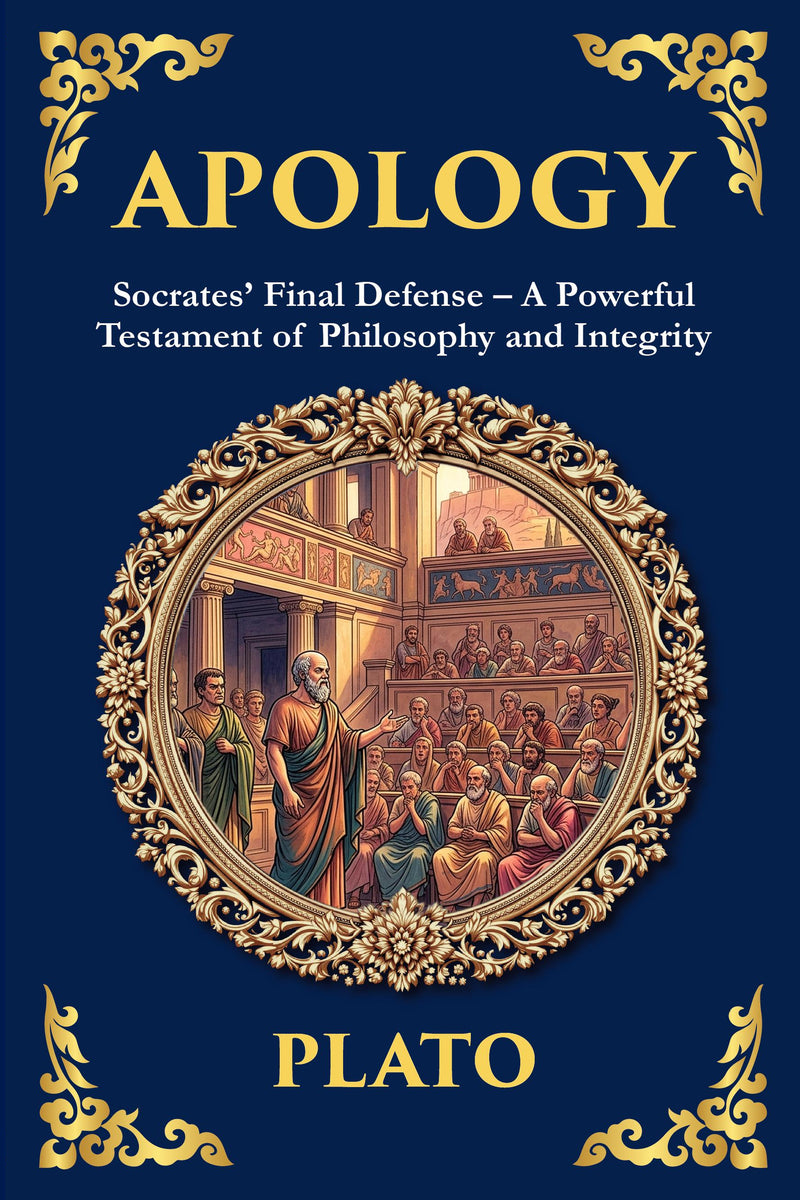
Apology
Socrates (Plato, Apology) Apology is not an expression of regret—it is the immortal defense of Socrates, as told by his student Plato.
or free app
10,000+ hrs library
30-day guarantee
The complete Apology appears in modern English through Library of Alexandria Press, available online with audiobook narration included for members.
What is worth defending when your own life is at stake?
In Plato’s Apology, Socrates stands before an Athenian jury accused of dishonoring the city’s gods, introducing new divine things, and corrupting the young. He answers with questions rather than pleas for mercy. As he confronts his accusers, the trial becomes a test of whether a man can keep his principles when his life hangs in the balance.
Here, apology means a defense, not an expression of regret. Socrates explains how a question put to the oracle at Delphi leads him to question others. He challenges Meletus directly and asks what wisdom, duty, and courage demand. Short and almost entirely in one voice, Plato’s account brings you close to a man who refuses to bend his convictions to save himself.
What you'll discover
- Wisdom begins with questions – Follow Socrates as he examines what people know and what they only think they know.
- An accuser under scrutiny – Watch Socrates question Meletus directly, putting the charge against him to the test.
- The city’s persistent gadfly – Discover why Socrates pictures Athens as a sleepy horse that needs his sting.
- Principles under pressure – Consider why Socrates places duty above survival when his way of life puts him in danger.
- A voice without pleading – Encounter a defense that asks the jury to listen to reason rather than grant mercy.
Perfect for first-time readers of Plato, anyone curious about Western philosophy’s beginnings, and those weighing their convictions under pressure.
Open the first page now and meet Socrates as he begins his defense.
| Formats | eBook (EPUB + PDF) · Audiobook · Paperback · Hardcover · Large Print |
| Language | English |
| Trim size (print) | 6 × 9 in |
| Binding | Paperback — perfect-bound · Hardcover — casewrap |
| Large Print edition | Same text in a larger, easy-read type — a larger font, not a larger trim |
| Print pricing | Every physical book at our true cost — at-cost, no profit (members) |
| Library | 873 restored titles, always growing |
| Length | 13,410 words · ~54 min reading |
| Reading level | Grade 3 · an easy, flowing read (this modern-English edition) |
| Edition | Modern English translation · 2026 |
Member reviews for this edition are collected as readers finish it — be the first. Across the library: 12,000+ books shipped, every plan covered by a 365-day print guarantee.
About this edition
A faithful, unabridged modern-English edition by The Library of Alexandria — carefully rendered for today's reader and verified paragraph-by-paragraph against the public-domain source. Available as eBook, audiobook, paperback, hardcover, and large print.
- Complete & unabridgedVerified paragraph by paragraph against the source — never a scan, never abridged.
- Modern English, faithfulReadable today, with the author’s meaning kept intact. Readable — not simplified.
- Every format, one membershipRead in your browser or the free app, or listen to the full audiobook.
Included free with your membership
Cancel anytime, one click · 30-day money-back guarantee
Edition last updated July 2026
What’s inside
Apology — complete and unabridged, included in full with membership, plus the full audiobook.
Begin reading Apology
In clear modern English — the complete text is included with membership.
Introduction
There are few moments in the history of human thought as electric, as morally charged, and as enduringly relevant as the one captured in the pages that follow. Picture a single man, well into his seventh decade of life, standing before a jury of five hundred of his fellow citizens. The charges against him are grave, the mood of the city tense, and the stakes nothing less than his life. He has no lawyer, no team of advisors, no carefully rehearsed strategy designed to soothe the crowd or flatter the powerful. Instead, he has only his voice, his lifelong habit of asking uncomfortable questions, and his absolute refusal to pretend to be anyone other than who he truly is. What unfolds in that ancient courtroom is one of the most remarkable speeches ever recorded—a defense that becomes an indictment, a trial that becomes a lesson, and a single human life that becomes a permanent challenge to every generation that comes after.
This is the account of how the philosopher Socrates confronted his accusers, and through them, the entire society that had shaped him and that he, in turn, had spent a lifetime trying to improve. Set down by his most gifted student, it preserves not just the words but the spirit of a man who decided that the truth was worth more than his own survival. The work you are about to read is short—it can be finished in a single sitting—yet it carries a weight far out of proportion to its length. For nearly two and a half thousand years, readers have returned to it again and again, finding in its lines a mirror that reflects their own moments of compromise, courage, and conscience. It asks a question that never loses its urgency: when the world demands that you betray what you believe in order to save yourself, what will you do?
This modern translation has been prepared with a single goal in mind: to make that ancient voice speak as clearly and powerfully to you as it once spoke to the citizens gathered in that crowded hall. The language has been carefully rendered to remove the barriers of archaic phrasing and unfamiliar idiom that can make older translations feel distant and cold, while preserving every ounce of the original’s intellectual force and emotional intensity. You will not need a classical education to follow the argument or feel its impact. What you will need—and what the text richly rewards—is an open mind and a willingness to let an old man’s questions become your own.
The World That Put a Philosopher on Trial
To appreciate fully the drama that awaits you, it helps to understand something of the time and place in which it unfolds. The events take place in Athens, the city that, more than any other in the ancient world, gave us the foundations of democracy, philosophy, drama, and the very idea that human beings might govern themselves through reasoned debate rather than the will of kings. But the Athens of this trial was a city in crisis, bruised and uncertain after decades of turmoil. It had endured a long and devastating war, suffered crushing military defeats, watched its empire crumble, and lived through periods of brutal tyranny followed by uneasy returns to democratic rule. The confident, golden city that had built magnificent temples and produced soaring works of art was now anxious, suspicious, and quick to look for someone to blame.
Into this fraught atmosphere stepped a man who had spent his entire adult life doing something that many found deeply irritating. Rather than pursuing wealth, political power, or social status, he had devoted himself to wandering the public spaces of the city, engaging anyone who would speak with him in conversation. But these were not idle chats. He questioned politicians who claimed to know what was just, poets who claimed to understand the meaning of their own works, and craftsmen who believed their technical skill gave them wisdom about everything else. With patient, persistent questioning, he exposed the gaps between what people thought they knew and what they actually understood. He was, in a sense, the conscience of the city, refusing to let anyone rest comfortably in unexamined assumptions or borrowed opinions.
This made him both beloved and despised. To the young men who followed him through the streets, listening as he dismantled the pretensions of the supposedly wise, he was a thrilling figure—a teacher who taught not by lecturing but by helping his companions discover for themselves the limits of their own understanding. But to many of the prominent and powerful citizens whose ignorance he exposed, he was a humiliation and a threat. He made them look foolish in front of others. He undermined their authority. And in a time of fear and instability, his relentless questioning of conventional wisdom and traditional belief began to look dangerous—even subversive.
The formal charges brought against him were that he corrupted the young people of the city and that he did not believe in the gods the city believed in, introducing instead new divinities of his own. But anyone reading closely will sense that these official accusations were only the surface of a much deeper resentment. The real charge, never quite spoken aloud, was that he had spent his life refusing to play along—refusing to pretend, refusing to flatter, refusing to accept that wealth and reputation were the same as goodness and truth. He had made enemies not by breaking any law but by living according to a standard that exposed the hollowness of how many of his fellow citizens lived. And now, with the machinery of the law set in motion against him, those enemies had their chance.
What makes the situation so poignant is that this was a democracy putting one of its own to trial. The jury was not a panel of professional judges but a great body of ordinary citizens, chosen by lot, representing the people themselves. The very system that prided itself on free speech and open debate was about to confront a man who had taken those principles more seriously than almost anyone—and who would now use his final hours of freedom to ask whether the city truly believed in the values it claimed to cherish. The tension between the individual conscience and the will of the majority, between the freedom to question and the demand for conformity, runs through every line of what follows. It is a tension we still wrestle with today, in our own societies, in our own institutions, and often in our own hearts.
As you read, you will notice that the speech does not follow the pattern you might expect from someone fighting for his life. There is no groveling, no desperate appeal for mercy, no calculated attempt to manipulate the emotions of the jury. Instead, the accused man speaks with a kind of serene defiance, treating his trial as just another occasion for the same honest inquiry he has always pursued. He explains himself patiently, even good-humoredly, but he refuses to compromise his principles even when doing so might save him. This is what gives the work its extraordinary moral power. Here is a man who has so thoroughly aligned his life with his beliefs that the threat of death cannot shake him from his course. He would rather die as himself than live as someone he is not.
A Defense That Became a Philosophy of Life
What you hold in your hands is far more than a historical record of an ancient legal proceeding. It is, at its heart, a profound meditation on how a human being ought to live—and what makes a life worth living at all. The speech ranges across some of the deepest questions any person can ask. What is wisdom, and how do we recognize it? Is it better to suffer injustice than to commit it? Can a good person truly be harmed by a wicked one? What do we owe to our communities, and what do we owe to ourselves? And perhaps most hauntingly: is death something to be feared, or might it be something else entirely?
One of the most famous and influential ideas to emerge from these pages is the principle that the unexamined life is not worth living for a human being. This is not merely a clever phrase but the distilled essence of an entire way of being in the world. The man on trial argues that the highest human activity—the thing that makes us most fully ourselves—is the constant, courageous examination of our own beliefs, values, and assumptions. To drift through existence accepting whatever we are told, never questioning, never reflecting, never holding our own opinions up to the light of scrutiny, is to live a kind of half-life, no better than that of an animal. To examine, to question, to seek understanding even at great cost—this is what it means to be truly human and truly alive.
Closely tied to this is one of the most curious and disarming aspects of his philosophy: his insistence that he is wise precisely because he knows that he knows nothing. This is not false modesty or rhetorical trickery. It is a genuine and revolutionary insight into the nature of human understanding. Most people, he observes, are confident that they understand things they do not actually understand. They mistake opinion for knowledge, habit for wisdom, and confidence for truth. He alone, he claims, has grasped the most important fact about human knowledge—namely, how little of it we truly possess. This humility before the vastness of what we do not know is not a weakness but the very beginning of wisdom. It opens the door to genuine inquiry, while false certainty slams that door shut. There is something deeply liberating in this idea, and something deeply challenging too, for it asks us to question the very foundations of what we believe we know about ourselves and our world.
The work also offers an unforgettable portrait of moral courage. Faced with a choice between his principles and his survival, the accused man does not hesitate. He explains that he could easily save himself by abandoning his philosophical mission, by promising to keep quiet, by ceasing to ask his troublesome questions. But he flatly refuses. To do so, he argues, would be a betrayal not only of himself but of a deeper duty—a calling he describes in almost sacred terms, a mission to awaken his fellow citizens from their moral slumber. He compares himself to a gadfly, the small insect that stings a great, sluggish horse and rouses it to action. Athens, he suggests, is that horse: large, powerful, but prone to laziness and complacency. He is the gadfly sent to sting it into wakefulness. And though the horse may swat the gadfly away in irritation, the city will be the poorer for losing the very voice that keeps it honest.
This image, like so much in the text, resonates far beyond its original context. Every society, every institution, every community needs its gadflies—those uncomfortable individuals who refuse to let the rest of us settle into easy certainties and comfortable hypocrisies. And every society, in moments of fear or anger, is tempted to silence them. The drama of this trial is, in this sense, perpetually contemporary. It plays out wherever a person of conscience stands against the pressure of the crowd, wherever truth-telling carries a personal cost, wherever the demand to conform collides with the duty to question. As you read, you may find yourself thinking of figures from your own time, your own country, perhaps even your own life. The names and the settings change, but the fundamental confrontation endures.
It is worth saying something about the man who recorded this speech and gave it to the world. He was a young follower of the philosopher, present at the trial, who would go on to become one of the most influential thinkers in all of human history. The teacher himself left no writings; everything we know of his ideas comes to us through the works of his students, and this account is among the most powerful and personal of them all. We cannot know with certainty how closely the words preserved here match the words actually spoken on that day. The author was almost certainly shaping the material, drawing out its deeper meaning, perhaps adding his own philosophical insights to those of his beloved teacher. But this need not trouble us. Whether we read it as historical reportage or as a kind of philosophical portrait painted by a devoted disciple, the work succeeds magnificently in capturing the essence of an extraordinary human being and the ideas he lived and died for. It is, in the truest sense, a labor of love—an attempt by a grieving student to ensure that his teacher’s voice would never be silenced, that the city which condemned him would be answered across the centuries by the very words it tried to extinguish.
Cancel anytime, one click · 30-day money-back guarantee
Founding annual rate available now — your price locks for life when you join.
Not ready? Get this free chapter by email — read it anytime.
✓ Sent — check your inbox for Apology.
Questions about Apology
What is the Apology by Plato about?
It is Plato's version of the speech Socrates gave at his trial in 399 BC. Socrates answers charges of impiety and corrupting the young, and explains why he lives as a questioner of others.
Does apology here mean saying sorry?
No. The Greek word apologia means a defense or a reasoned reply to an accusation. Socrates never says he regrets his way of life. He explains and defends it before the jury.
Is the Apology a true story?
Socrates was a real man and was tried in Athens in 399 BC. Plato attended the trial, but scholars debate how closely his text follows the actual words. It is generally taken as a faithful portrait of Socrates.
Is the Apology hard to read?
It is one of the easiest places to begin with Plato. It is short, it is a single speech with a clear order, and it needs little background beyond the basic Athenian setting.
Shipping & returns
Billing & membership
More from the library


Explore Philosophy & Ideas
- The Art of War · Sun Tzu
- The Prince · Niccolò Machiavelli
- The Republic · Plato
- The Tao Teh King, or the Tao and its Characteristics · Laozi
- Thus Spake Zarathustra: A Book for All and None · Friedrich Nietzsche
- The Analects of Confucius (from the Chinese Classics) · Confucius
- Beyond Good and Evil · Friedrich Nietzsche
- The Enchiridion · Epictetus
- Walden, and On The Duty Of Civil Disobedience · Henry David Thoreau
- Utopia · Thomas More
- On Liberty · John Stuart Mill
- Common Sense · Thomas Paine
- Leviathan by Thomas Hobbes · Thomas Hobbes
- Discourse on the Method · René Descartes
- The I Ching
- The Communist Manifesto · Karl Marx; Friedrich Engels
- Essays — Second Series · Ralph Waldo Emerson
- The Imitation of Christ · Thomas à Kempis
- The Critique of Pure Reason · Immanuel Kant
- The Koran (Al-Qur'an) · Anonymous; George Sale (transla...
- Crimes and Punishments · James Anson Farrer
- St. Benedict's Rule for Monasteries · Saint Benedict
- Demonologia · J. S. Forsyth
- The King James Version of the Bible
- The Ladies' Book of Etiquette, and Manual of Politeness · Florence Hartley
- The Federalist Papers · Alexander Hamilton; John Jay; J...
- Meditations · Marcus Aurelius
- Deuterocanonical Books of the Bible
- The Yoga Sutras of Patanjali · Patañjali
- The Diamond Sutra (Chin-Kang-Ching) · Unknown
Apology
Apology
Socrates’ Final Defense – A Powerful Testament of Philosophy and Integrity
Plato
Contents
- Introduction
- Apology
Introduction
There are few moments in the history of human thought as electric, as morally charged, and as enduringly relevant as the one captured in the pages that follow. Picture a single man, well into his seventh decade of life, standing before a jury of five hundred of his fellow citizens. The charges against him are grave, the mood of the city tense, and the stakes nothing less than his life. He has no lawyer, no team of advisors, no carefully rehearsed strategy designed to soothe the crowd or flatter the powerful. Instead, he has only his voice, his lifelong habit of asking uncomfortable questions, and his absolute refusal to pretend to be anyone other than who he truly is. What unfolds in that ancient courtroom is one of the most remarkable speeches ever recorded—a defense that becomes an indictment, a trial that becomes a lesson, and a single human life that becomes a permanent challenge to every generation that comes after.
This is the account of how the philosopher Socrates confronted his accusers, and through them, the entire society that had shaped him and that he, in turn, had spent a lifetime trying to improve. Set down by his most gifted student, it preserves not just the words but the spirit of a man who decided that the truth was worth more than his own survival. The work you are about to read is short—it can be finished in a single sitting—yet it carries a weight far out of proportion to its length. For nearly two and a half thousand years, readers have returned to it again and again, finding in its lines a mirror that reflects their own moments of compromise, courage, and conscience. It asks a question that never loses its urgency: when the world demands that you betray what you believe in order to save yourself, what will you do?
This modern translation has been prepared with a single goal in mind: to make that ancient voice speak as clearly and powerfully to you as it once spoke to the citizens gathered in that crowded hall. The language has been carefully rendered to remove the barriers of archaic phrasing and unfamiliar idiom that can make older translations feel distant and cold, while preserving every ounce of the original’s intellectual force and emotional intensity. You will not need a classical education to follow the argument or feel its impact. What you will need—and what the text richly rewards—is an open mind and a willingness to let an old man’s questions become your own.
The World That Put a Philosopher on Trial
To appreciate fully the drama that awaits you, it helps to understand something of the time and place in which it unfolds. The events take place in Athens, the city that, more than any other in the ancient world, gave us the foundations of democracy, philosophy, drama, and the very idea that human beings might govern themselves through reasoned debate rather than the will of kings. But the Athens of this trial was a city in crisis, bruised and uncertain after decades of turmoil. It had endured a long and devastating war, suffered crushing military defeats, watched its empire crumble, and lived through periods of brutal tyranny followed by uneasy returns to democratic rule. The confident, golden city that had built magnificent temples and produced soaring works of art was now anxious, suspicious, and quick to look for someone to blame.
Into this fraught atmosphere stepped a man who had spent his entire adult life doing something that many found deeply irritating. Rather than pursuing wealth, political power, or social status, he had devoted himself to wandering the public spaces of the city, engaging anyone who would speak with him in conversation. But these were not idle chats. He questioned politicians who claimed to know what was just, poets who claimed to understand the meaning of their own works, and craftsmen who believed their technical skill gave them wisdom about everything else. With patient, persistent questioning, he exposed the gaps between what people thought they knew and what they actually understood. He was, in a sense, the conscience of the city, refusing to let anyone rest comfortably in unexamined assumptions or borrowed opinions.
This made him both beloved and despised. To the young men who followed him through the streets, listening as he dismantled the pretensions of the supposedly wise, he was a thrilling figure—a teacher who taught not by lecturing but by helping his companions discover for themselves the limits of their own understanding. But to many of the prominent and powerful citizens whose ignorance he exposed, he was a humiliation and a threat. He made them look foolish in front of others. He undermined their authority. And in a time of fear and instability, his relentless questioning of conventional wisdom and traditional belief began to look dangerous—even subversive.
The formal charges brought against him were that he corrupted the young people of the city and that he did not believe in the gods the city believed in, introducing instead new divinities of his own. But anyone reading closely will sense that these official accusations were only the surface of a much deeper resentment. The real charge, never quite spoken aloud, was that he had spent his life refusing to play along—refusing to pretend, refusing to flatter, refusing to accept that wealth and reputation were the same as goodness and truth. He had made enemies not by breaking any law but by living according to a standard that exposed the hollowness of how many of his fellow citizens lived. And now, with the machinery of the law set in motion against him, those enemies had their chance.
What makes the situation so poignant is that this was a democracy putting one of its own to trial. The jury was not a panel of professional judges but a great body of ordinary citizens, chosen by lot, representing the people themselves. The very system that prided itself on free speech and open debate was about to confront a man who had taken those principles more seriously than almost anyone—and who would now use his final hours of freedom to ask whether the city truly believed in the values it claimed to cherish. The tension between the individual conscience and the will of the majority, between the freedom to question and the demand for conformity, runs through every line of what follows. It is a tension we still wrestle with today, in our own societies, in our own institutions, and often in our own hearts.
As you read, you will notice that the speech does not follow the pattern you might expect from someone fighting for his life. There is no groveling, no desperate appeal for mercy, no calculated attempt to manipulate the emotions of the jury. Instead, the accused man speaks with a kind of serene defiance, treating his trial as just another occasion for the same honest inquiry he has always pursued. He explains himself patiently, even good-humoredly, but he refuses to compromise his principles even when doing so might save him. This is what gives the work its extraordinary moral power. Here is a man who has so thoroughly aligned his life with his beliefs that the threat of death cannot shake him from his course. He would rather die as himself than live as someone he is not.
A Defense That Became a Philosophy of Life
What you hold in your hands is far more than a historical record of an ancient legal proceeding. It is, at its heart, a profound meditation on how a human being ought to live—and what makes a life worth living at all. The speech ranges across some of the deepest questions any person can ask. What is wisdom, and how do we recognize it? Is it better to suffer injustice than to commit it? Can a good person truly be harmed by a wicked one? What do we owe to our communities, and what do we owe to ourselves? And perhaps most hauntingly: is death something to be feared, or might it be something else entirely?
One of the most famous and influential ideas to emerge from these pages is the principle that the unexamined life is not worth living for a human being. This is not merely a clever phrase but the distilled essence of an entire way of being in the world. The man on trial argues that the highest human activity—the thing that makes us most fully ourselves—is the constant, courageous examination of our own beliefs, values, and assumptions. To drift through existence accepting whatever we are told, never questioning, never reflecting, never holding our own opinions up to the light of scrutiny, is to live a kind of half-life, no better than that of an animal. To examine, to question, to seek understanding even at great cost—this is what it means to be truly human and truly alive.
Closely tied to this is one of the most curious and disarming aspects of his philosophy: his insistence that he is wise precisely because he knows that he knows nothing. This is not false modesty or rhetorical trickery. It is a genuine and revolutionary insight into the nature of human understanding. Most people, he observes, are confident that they understand things they do not actually understand. They mistake opinion for knowledge, habit for wisdom, and confidence for truth. He alone, he claims, has grasped the most important fact about human knowledge—namely, how little of it we truly possess. This humility before the vastness of what we do not know is not a weakness but the very beginning of wisdom. It opens the door to genuine inquiry, while false certainty slams that door shut. There is something deeply liberating in this idea, and something deeply challenging too, for it asks us to question the very foundations of what we believe we know about ourselves and our world.
The work also offers an unforgettable portrait of moral courage. Faced with a choice between his principles and his survival, the accused man does not hesitate. He explains that he could easily save himself by abandoning his philosophical mission, by promising to keep quiet, by ceasing to ask his troublesome questions. But he flatly refuses. To do so, he argues, would be a betrayal not only of himself but of a deeper duty—a calling he describes in almost sacred terms, a mission to awaken his fellow citizens from their moral slumber. He compares himself to a gadfly, the small insect that stings a great, sluggish horse and rouses it to action. Athens, he suggests, is that horse: large, powerful, but prone to laziness and complacency. He is the gadfly sent to sting it into wakefulness. And though the horse may swat the gadfly away in irritation, the city will be the poorer for losing the very voice that keeps it honest.
This image, like so much in the text, resonates far beyond its original context. Every society, every institution, every community needs its gadflies—those uncomfortable individuals who refuse to let the rest of us settle into easy certainties and comfortable hypocrisies. And every society, in moments of fear or anger, is tempted to silence them. The drama of this trial is, in this sense, perpetually contemporary. It plays out wherever a person of conscience stands against the pressure of the crowd, wherever truth-telling carries a personal cost, wherever the demand to conform collides with the duty to question. As you read, you may find yourself thinking of figures from your own time, your own country, perhaps even your own life. The names and the settings change, but the fundamental confrontation endures.
It is worth saying something about the man who recorded this speech and gave it to the world. He was a young follower of the philosopher, present at the trial, who would go on to become one of the most influential thinkers in all of human history. The teacher himself left no writings; everything we know of his ideas comes to us through the works of his students, and this account is among the most powerful and personal of them all. We cannot know with certainty how closely the words preserved here match the words actually spoken on that day. The author was almost certainly shaping the material, drawing out its deeper meaning, perhaps adding his own philosophical insights to those of his beloved teacher. But this need not trouble us. Whether we read it as historical reportage or as a kind of philosophical portrait painted by a devoted disciple, the work succeeds magnificently in capturing the essence of an extraordinary human being and the ideas he lived and died for. It is, in the truest sense, a labor of love—an attempt by a grieving student to ensure that his teacher’s voice would never be silenced, that the city which condemned him would be answered across the centuries by the very words it tried to extinguish.
I don’t know how my accusers have influenced you, Athenians, but I know they almost made me forget who I was because they spoke so convincingly—even though they hardly told a single truth. Out of the many lies they told, one completely shocked me: they warned you to be careful and not let yourselves be fooled by my powerful speaking skills. To say this, when it would be obvious the moment I started talking that I am not a great orator, seemed incredibly shameless to me—unless by “powerful speaking” they actually mean the power of truth. If that is what they meant, then I admit I am eloquent. But my eloquence is nothing like theirs. As I said, they have barely told the truth, but from me, you will hear the whole truth. However, I won’t deliver it like they did, in a rehearsed speech filled with fancy words and phrases. No, I swear, I will use the words and arguments that come to me in the moment, because I am confident that my cause is just. At my age, I should not be appearing before you, people of Athens, as some kind of young, polished public speaker—please do not expect that from me. I must ask you for a favor: if I defend myself the way I usually do, and you hear me using the same language I use in the marketplace, at the money-changers’ tables, or anywhere else, please don’t be surprised or interrupt me. I am over seventy years old, and since this is my first time in a court of law, I am a complete stranger to the formal language used here. Therefore, I ask you to treat me as if I were actually a foreigner, whom you would excuse for speaking in his own native tongue and style. Is that too much to ask? Please ignore whether my style is good or bad; focus only on whether my words are true. Let the speaker tell the truth, and let the judge decide fairly.
End of the free sample
Keep reading, free
Members read and listen to the complete book — and the entire library. Cancel anytime, one click · 30-day money-back guarantee.