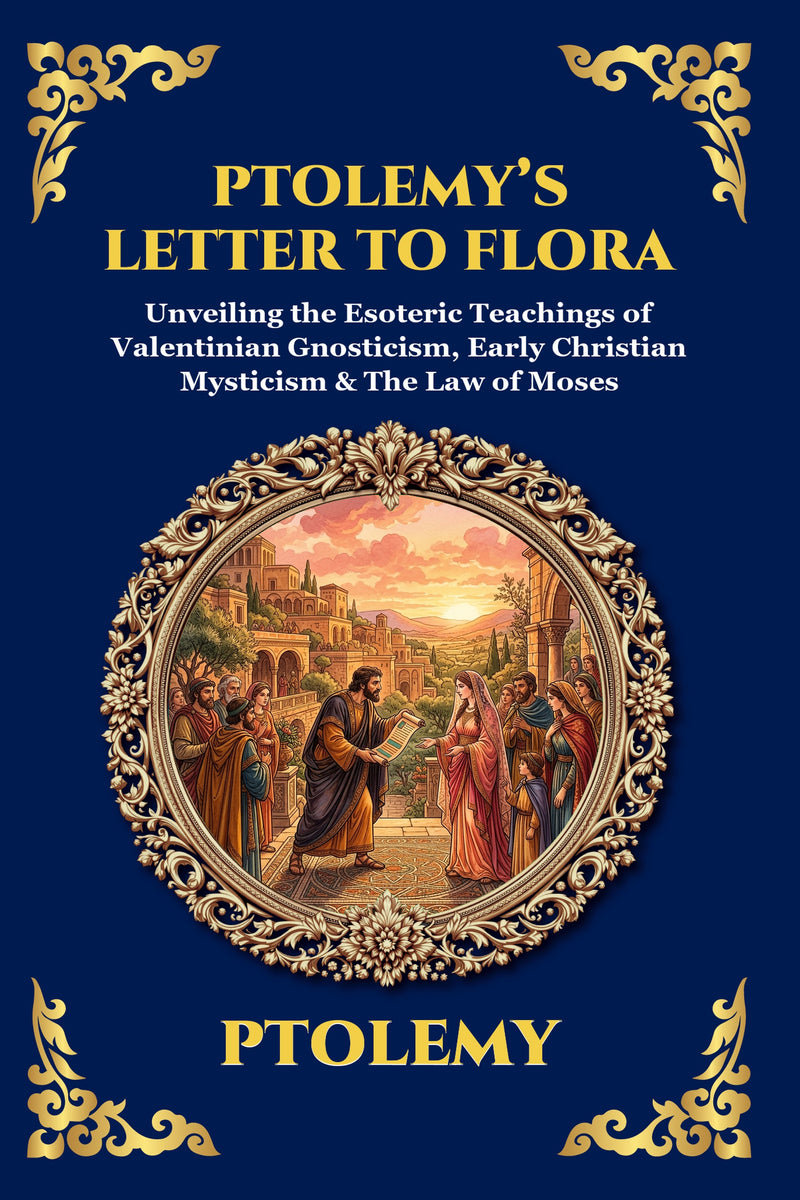
Ptolemy’s Letter to Flora — Large Print
Ptolemy’s Letter to Flora navigates the tangled laws of the Old Testament, offering a Gnostic perspective that distinguishes between divine justice and human interpretation. Excluded from the biblical canon, this influential text provides a unique lens on the teachings of Christ and the nature of the Creator.
or free app
10,000+ hrs library
30-day guarantee
Ptolemy's Letter to Flora offers a complete modern-English translation of this foundational Gnostic text, readable online with audiobook narration included, making accessible Ptolemy's influential explanation of Old Testament law through Valentinian Christian theology.
Large Print Edition. The complete, unabridged text set in a larger, easy-on-the-eyes typeface for comfortable reading.
Have you ever wondered why the laws of the Old Testament seem so complex and contradictory, and how early mystics reconciled them with the teachings of Christ?
Ptolemy’s Letter to Flora provides a compelling modern translation of one of the most accessible and important texts of Valentinian Gnosticism. This ancient letter, penned by the influential Gnostic teacher Ptolemy, was designed to guide a fellow Christian, Flora, through the perplexing nature of the Law of Moses. Far more than a simple theological treatise, this letter delves into profound themes of divine justice, the nature of the Creator, and the esoteric path to spiritual enlightenment.
Ptolemy masterfully breaks down the Mosaic Law, arguing that it does not come from a single, supreme God, but rather from a mixture of divine, demiurgic, and human sources. By exploring these distinctions, he unveils a deeply layered universe where the ultimate, perfect God remains hidden, while a lesser creator governs the material realm. Blending early Christian scripture with mystical philosophy, Ptolemy crafts a thought-provoking framework that challenges readers to reconsider their beliefs about scripture, the purpose of moral laws, and the redemptive power of hidden knowledge.
What You’ll Discover in This Modern Translation:
The Valentinian Gnostic Worldview: Gain a clear and structured introduction to one of the most influential and misunderstood mystical movements in early Christianity.
A Unique Analysis of the Law of Moses: Explore Ptolemy’s fascinating division of the biblical laws into those ordained by God, those by Moses, and those by the elders.
The Nature of the Demiurge: Understand the Gnostic concept of the lesser creator god, who is neither perfectly good nor entirely evil, but an instrument of justice.
A Modern, Accessible Translation: This adaptation ensures that Ptolemy’s deep philosophical and theological insights remain clear, engaging, and impactful for today’s readers.
More than just an ancient letter, Ptolemy’s Letter to Flora is a philosophical and spiritual bridge connecting early Christian orthodoxy with esoteric mysticism. Step into a world of hidden knowledge and discover the timeless lessons of this foundational Gnostic text. Begin your journey today.
| Formats | eBook (EPUB + PDF) · Audiobook · Paperback · Hardcover · Large Print |
| Language | English |
| Trim size (print) | 6 × 9 in |
| Binding | Paperback — perfect-bound · Hardcover — casewrap |
| Large Print edition | Same text in a larger, easy-read type — a larger font, not a larger trim |
| Print pricing | Every physical book at our true cost — at-cost, no profit (members) |
| Library | 873 restored titles, always growing |
| Composed | 2nd century AD |
| Original language | Greek |
| Source tradition | Preserved through patristic quotations, primarily Epiphanius' Panarion |
| Translation basis | Public-domain scholarly translation, rendered in clear modern English |
| Length | 2,399 words · ~10 min reading |
| Reading level | Grade 14 · rich, literary prose (this modern-English edition) |
| Edition | Modern English translation · 2026 |
Member reviews for this edition are collected as readers finish it — be the first. Across the library: 12,000+ books shipped, every plan covered by a 365-day print guarantee.
About this edition
The complete, unabridged text in clear modern English — faithful to the original, never simplified. Every paragraph is checked against the source, so nothing is cut, summarised, or paraphrased away. It reads cleanly for today while keeping the original meaning intact.
This text survives through quotations and references in early church fathers, particularly Epiphanius of Salamis in his Panarion. This edition renders the standard scholarly reconstruction in clear modern English.
- Complete & unabridgedVerified paragraph by paragraph against the source — never a scan, never abridged.
- Modern English, faithfulReadable today, with the author’s meaning kept intact. Readable — not simplified.
- Every format, one membershipRead in your browser or the free app, or listen to the full audiobook.
Included free with your membership
Cancel anytime, one click · 30-day money-back guarantee
Edition last updated June 2026
What’s inside
Ptolemy’s Letter to Flora — Large Print — complete and unabridged: all 6 sections included with membership, plus the full audiobook.
Begin reading Ptolemy’s Letter to Flora — Large Print
In clear modern English — the complete text is included with membership.
Chapter 1
The Law ordained through Moses, my dear sister Flora, has not been understood by many people, who have accurate knowledge neither of the one who ordained it nor of its commandments. I think this will become perfectly clear to you once you have learned the contradictory opinions held about it.
Some say it is legislation given by God the Father; others, taking the opposite view, insist stubbornly that it was ordained by the adversary — the Devil who causes destruction — just as they attribute the fashioning of the world to him, calling him the Father and maker of this universe. Both are completely wrong; they refute each other, and neither has reached the truth of the matter.
It is evident that the Law was not ordained by the perfect God the Father, for it is secondary — imperfect, in need of completion by another, and containing commandments alien to the nature and thought of such a God.
On the other hand, one cannot attribute the Law to the injustice of the opposing power, for the Law stands opposed to injustice. Those who do so fail to understand what the Savior said: a house or city divided against itself cannot stand. Furthermore, the apostle declares that creation is the work of him through whom everything was made, and apart from whom nothing was made. In saying this, the apostle sweeps away in advance the groundless wisdom of the false accusers and shows that creation is not the work of a destructive God but of one who is just and hates evil. Only unintelligent people hold that other view — people who do not recognize the providence of the creator, and who have blinded not only the eye of the soul but of the body as well.
From all this it is clear that both groups have entirely missed the truth. The first has done so because they do not know the God of justice; the second because they do not know the Father of all, who alone was revealed by the one who alone came to reveal him. It remains for us, who have been counted worthy of the knowledge of both, to give you an accurate account of the nature of the Law and of the legislator by whom it was ordained. We shall draw our proofs from the words of the Savior, which alone can lead us without error to the comprehension of reality.
First, you must understand that the entire Law contained in the Pentateuch of Moses was not ordained by a single legislator — that is, not by God alone. Some commandments are Moses' own, and some were given by other men. The words of the Savior teach us this threefold division. The first part must be attributed to God alone and to his legislation; the second to Moses — not in the sense that God legislated through him, but in the sense that Moses gave certain legislation under the influence of his own ideas; and the third to the elders of the people, who appear to have established certain commandments of their own at the beginning. You will now learn how the truth of this is proved by the words of the Savior.
Chapter 2
In a discussion with those who disputed with the Savior about the divorce that the Law permitted, he said: "Because of your hard-heartedness Moses permitted a man to divorce his wife; from the beginning it was not so; for God made this marriage, and what the Lord has joined together, man must not separate." In this way he shows that there is a Law of God, which prohibits a man from divorcing his wife, and another law, that of Moses, which permits the breaking of this bond because of hard-heartedness. Moses thus lays down legislation contrary to that of God, for joining is contrary to separating.
But if we examine Moses' intention in giving this legislation, it will be seen that he did not give it arbitrarily or on his own initiative, but out of necessity, because of the weakness of those for whom the legislation was given. Since they were unable to keep God's intention — according to which it was not lawful for them to reject their wives — and since some of them found it impossible to live with their wives and were therefore in danger of turning to greater injustice and thence to destruction, Moses wanted to remove the cause of that aversion, which was placing them in jeopardy of ruin. Therefore, given the critical circumstances, he chose a lesser evil in place of a greater, and ordained on his own authority a second law, the law of divorce, so that if they could not observe the first, they might at least keep this one and not turn to unjust and evil actions, which would have brought complete destruction upon them. This was his intention when he gave legislation contrary to that of God. It is therefore indisputable that the law of Moses is here different from the Law of God, even though we have demonstrated this from only one example.
The Savior also makes plain that there are certain traditions of the elders interwoven in the Law. "For God," he says, "said: Honor your father and your mother, that it may be well with you." But you, he says, addressing the elders, have declared as a gift to God that by which you have nullified the Law of God through the tradition of your elders. Isaiah also proclaimed this, saying: "This people honors me with their lips, but their hearts are far from me, teaching as doctrines the commandments of men."
It is therefore obvious that the whole Law is divided into three parts: we find in it the legislation of Moses, the legislation of the elders, and the legislation of God himself. This division of the entire Law, as we have set it out, has brought to light what is true in it.
The Law of God himself is in turn divided into three parts. First, there is the pure legislation unmixed with evil, which is properly called the Law — the part which the Savior came not to destroy but to fulfill, for what he fulfilled was not alien to him but stood in need of completion, since it did not yet possess perfection. Second, there is the legislation interwoven with inferiority and injustice, which the Savior abolished because it was alien to his nature. And third, there is the legislation which is allegorical and symbolic, an image of what is spiritual and transcendent, which the Savior transferred from the perceptible and visible realm to the spiritual and invisible.
The Law of God that is pure and unmixed with inferiority is the Decalogue — those ten commandments engraved on two tablets, forbidding what must not be done and enjoining what must be done. These contain legislation that is pure but imperfect, and required the completion that the Savior provided.
Chapter 3
There is also the law interwoven with injustice, laid down for vengeance and the requital of previous injuries, ordaining that an eye be taken for an eye, a tooth for a tooth, and that a murder be avenged by a murderer. The person who acts unjustly second is no less unjust than the first; he simply reverses the order of events while performing the same action. Admittedly, this commandment was just, and still is just, given the weakness of those for whom the legislation was made, so that they would not transgress the pure law. But it is alien to the nature and goodness of the Father of all. No doubt it was appropriate to the circumstances, or even necessary; for he who did not want one murder committed — saying, "You shall not kill" — and then commanded that a murder be repaid by another murder, gave a second law enjoining two murders after having forbidden one. This fact proves that he was unwittingly the victim of necessity.
This is why, when his Son came, he abolished this part of the law while acknowledging that it came from God. He counts this part of the law as belonging to the old order, not only in other passages but also where he said, "God said: He who curses father or mother shall surely die."
Finally, there is the allegorical part, ordained as an image of spiritual and transcendent realities — I mean the part dealing with offerings and circumcision and the Sabbath and fasting and Passover and unleavened bread and other such matters.
Since all these things are images and symbols, when the truth was made manifest they were translated into another meaning. In their outward appearance and their literal application they were abolished, but in their spiritual meaning they were restored; the names remained the same while the content was changed. Thus the Savior commanded us to make offerings not of irrational animals or of worldly incense, but of spiritual praise and glorification and thanksgiving, and of sharing and doing good to our neighbors. He wanted us to be circumcised, not in regard to our physical foreskin but in regard to our spiritual heart; to keep the Sabbath, for he wishes us to be idle with respect to evil works; to fast, not in physical fasting but in spiritual fasting, which consists in abstaining from everything evil.
Among us, outward fasting is also observed, since it can be beneficial to the soul when done reasonably — not for the sake of imitating others, or from habit, or because of a day specially appointed for the purpose. It is also observed so that those who are not yet able to keep the true fast may have a reminder of it through the outward fast. Similarly, Paul the apostle shows that the Passover and the unleavened bread are images when he says, "Christ our Passover has been sacrificed, so that you may be unleavened bread, containing no leaven, but may be a new lump."
Chapter 4
Thus the Law of God itself is clearly divided into three parts. The first was fulfilled by the Savior, for the commandments "You shall not kill," "You shall not commit adultery," and "You shall not swear falsely" are included in his prohibition of anger, desire, and swearing. The second part was entirely abolished, for "An eye for an eye and a tooth for a tooth," being interwoven with injustice, was destroyed by the Savior through its opposite. Opposites cancel each other out: "I say to you, do not resist the evil man, but if anyone strikes you, turn the other cheek to him."
Finally, there is the part that was translated and changed from the literal to the spiritual — the symbolic legislation that is an image of transcendent things. For the images and symbols that represent other things were good as long as the Truth had not yet come; but since the Truth has come, we must perform the actions of the Truth, not those of the image.
The disciples of the Savior and the Apostle Paul showed that this teaching is correct. Speaking of the part that deals with images, as we have already noted, Paul mentions "our Passover" and "the Unleavened Bread." Speaking of the law interwoven with injustice, he says that "the law of commandments contained in ordinances was abolished." And speaking of what is not mixed with anything inferior, he says that "the law is holy, and the commandment is holy and just and good." I believe I have shown you sufficiently, within the limits of a brief treatment, both the addition of human legislation to the Law and the threefold division of the Law of God itself.
It remains for us to say who this God is who ordained the Law; but I think this too has been shown in what we have already said, if you have followed it attentively.
For if the Law was not ordained by the perfect God himself, as we have already taught you, nor by the devil — a statement one cannot possibly make — then the legislator must be someone other than these two. In fact, he is the Demiurge and maker of this universe and everything in it; and because he is essentially different from these two and stands between them, he is rightly called the Intermediate.
Chapter 5
If the perfect God is good by nature — and he is, for our Savior declared that there is only one good God, his Father, whom he revealed — and if the one of opposite nature is evil and wicked, defined by injustice, then the one situated between the two is neither good nor evil nor unjust, but can rightly be called just, since justice is his proper domain.
This intermediate god is inferior to the perfect God and falls short of his justice, being generated rather than ungenerated — for there is only one ungenerated Father, from whom all things come, since all things depend on him, each in its own way. Yet this intermediate god is greater and more powerful than the adversary, by nature, since his substance partakes of both extremes. The substance of the adversary is corruption and darkness, for he is material and composite, while the substance of the ungenerated Father of all is incorruption and self-subsistent light, simple and uniform. The substance of the intermediate god is derived from both of these, while the Savior is the image of the greater one.
Cancel anytime, one click · 30-day money-back guarantee
Founding annual rate available now — your price locks for life when you join.
Not ready? Get this free chapter by email — read it anytime.
✓ Sent — check your inbox for Ptolemy’s Letter to Flora — Large Print.
Questions about Ptolemy’s Letter to Flora — Large Print
Who was Ptolemy and why did he write this letter?
Ptolemy was a prominent 2nd-century Valentinian Gnostic teacher who wrote this letter to instruct a Christian woman named Flora about interpreting Old Testament law through Gnostic theology, distinguishing between different sources and levels of divine authority within scripture.
What does Ptolemy's Letter to Flora teach about the Old Testament?
The letter argues that Old Testament law comes from three sources: God himself, Moses, and human elders. Ptolemy teaches that Christ's mission was to fulfill the divine portions while abolishing human additions and ceremonial elements.
Why isn't this letter in the Bible?
Ptolemy's Letter to Flora represents Valentinian Gnostic Christianity, which mainstream church authorities rejected as heretical. The letter was excluded from the biblical canon as early Christian communities established orthodox doctrine against Gnostic interpretations of scripture.
Is Ptolemy’s Letter to Flora free to read?
The opening of the text is free to read below. Members read and listen to the complete work — and the entire Lost & Forbidden Library — free.
What is Ptolemy’s Letter to Flora?
Have you ever wondered why the laws of the Old Testament seem so complex and contradictory, and how early mystics reconciled them with the teachings of Christ?
How long is Ptolemy’s Letter to Flora?
6 chapters (~2,418 words) in this restored edition.
Shipping & returns
Billing & membership
More from the library


Explore Gnostic & Nag Hammadi
- A Valentinian Exposition · Attributed to a follower of Val...
- Book of Baruch of the Gnostics · Attributed to Justin the Gnostic
- Coptic Gospel of the Twelve
- Manichaean Homilies · Attributed to the prophet Mani
- Ginza Rabba · Attributed to Mandaean priests
- Apocalypse of James · Attributed to James the Just
- Manichaean Psalm-Book · Attributed to the prophet Mani
- Paraphrase of Shem · Attributed to early Gnostic wri...
- Third Epistle to the Corinthians · Attributed to the Apostle Paul
- Antitheses of Marcion · Attributed to Marcion of Sinope
- Hymn of the Pearl · Attributed to the Apostle Thomas
- Secret Gospel of Mark · Attributed to Mark
- Wisdom of Solomon · Attributed to King Solomon
- Vision of Paul
- Gospel of Gamaliel
- Marcion: Antitheses · Attributed to Marcion of Sinope
- Basilides: Fragments · Attributed to Basilides
- Gospel of Thomas · Attributed to Thomas the Apostle
- Prayer of Thanksgiving · Attributed to Hermes Trismegistus
- Second Treatise of the Great Seth · Attributed to a Gnostic sage
- Marcion’s Gospel · Attributed to Marcion of Sinope
- Heracleon Fragments · Attributed to Heracleon
- Excerpts from Theodotus · Attributed to Theodotus
- Ptolemy’s Letter to Flora · Attributed to Ptolemy the Gnostic
- Epistle of the Apostles · Various early Christian authors
- Oxyrhynchus 840
- Life of Adam and Eve
- The Second Apocalypse of James · Anonymous early Christian mystic
- The First Apocalypse of James · Anonymous Gnostic writer
- The Interpretation of Knowledge · Attributed to an anonymous Gnos...
Ptolemy’s Letter to Flora — Large Print
Ptolemy's Letter to Flora
A Valentinian Master's Letter to a Noble Lady — On the True Origin and Threefold Division of the Law of Moses, and Why It Was Given Neither by the Perfect Father Nor by the Devil, but by an Intermediate Just God
Library of Alexandria Press
Ptolemy's Letter to Flora
© Copyright 2026 Library of Alexandria Press. All rights reserved.
Published by Library of Alexandria Press
Printed in the United States of America
It is not legal to copy, share, or send any part of this document in either digital or printed form without written permission from the publisher, except short quotes in a book review.
Table of Contents
Introduction
Chapter 1
Chapter 2
Chapter 3
Chapter 4
Chapter 5
Introduction
There are documents that survive from antiquity not because they were meant to survive, but because the ideas they contain proved too vital, too dangerous, or too luminous to be extinguished. The letter you are about to read belongs to that rare and precious category. Written sometime in the second century of the Common Era by a Christian teacher named Ptolemy — a leading figure within the Valentinian Gnostic school — it was addressed to a woman named Flora, a thoughtful seeker who had apparently raised serious and sincere questions about the nature of the Jewish Law, its divine origin, and its relationship to the teachings of Jesus Christ. What Ptolemy wrote in response was not merely a reply to a personal inquiry. It was, and remains, one of the most elegant, philosophically sophisticated, and spiritually penetrating documents to emerge from the entire early Christian world.
To read this letter today is to step into a world that feels simultaneously ancient and startlingly modern. The questions Ptolemy raises — Who made the law? Is the God of the Old Testament the same as the God of Jesus? How do we distinguish between the divine, the human, and the corrupt in sacred texts? — are not questions that have been settled by the passage of time. If anything, they have grown more urgent. In an era when millions of people wrestle with the relationship between religious tradition and spiritual truth, between institutional authority and personal revelation, between the letter of the law and the spirit that animates it, Ptolemy's careful, compassionate, and rigorously argued letter speaks with the freshness of something written yesterday.
Yet for most of history, this document was effectively lost. Not destroyed, exactly — it was preserved within the pages of a refutation written by Epiphanius of Salamis in the fourth century, a heresiologist who quoted it extensively precisely because he wanted to expose and condemn it. There is a profound irony in the fact that we owe the survival of one of early Christianity's most beautiful theological texts to a man who despised everything it represented. But this is how history works. The victors write the records, and sometimes, embedded within their condemnations, the voices of the defeated speak more clearly and more truthfully than the victors themselves.
Ptolemy was a disciple of Valentinus, who was himself one of the most remarkable religious thinkers of the ancient world. Valentinus was born in Egypt around 100 CE, received a sophisticated Hellenistic education in Alexandria, and eventually made his way to Rome, where he taught and gathered followers for decades. By all accounts — even hostile ones — he was a man of extraordinary intellectual gifts and genuine spiritual depth. Some ancient sources suggest he came very close to being elected bishop of Rome. Instead, he founded what became the most widespread and theologically elaborate of all the Gnostic movements, a school of thought that spread across the Roman Empire and produced an astonishing body of literature, much of which was only recovered in the twentieth century with the discovery of the Nag Hammadi library in Egypt in 1945.
Within the Valentinian school, Ptolemy represented what scholars sometimes call the Western or Italian branch, distinguished by its relatively moderate and philosophically refined approach. Where some Gnostic teachers delighted in elaborate mythological systems and esoteric cosmologies that could seem bewildering to outsiders, Ptolemy wrote with clarity, precision, and a genuine pastoral concern for his reader. His letter to Flora is not a dense theological treatise or an initiation into secret mysteries. It is, at its surface level, an accessible and carefully reasoned argument addressed to an intelligent person who deserves a straight answer. And yet beneath that accessibility lies a depth of theological vision that rewards careful reading and rereading.
The central question Ptolemy addresses — the nature and origin of the Mosaic Law — was one of the defining controversies of early Christianity. The earliest followers of Jesus were, of course, Jews, and they understood his teachings within the framework of Jewish scripture and tradition. But as the movement spread into the Gentile world, and as the catastrophic events of 70 CE and 135 CE — the destruction of the Temple and the crushing of the Bar Kokhba revolt — reshaped the relationship between Jews and Christians, the question of the Law became increasingly fraught. What was a Christian to make of the Torah? Was it binding? Was it holy? Was it the word of God, or was it something more complicated?
Different early Christians gave very different answers. Some, like Marcion of Sinope, took the radical position that the God of the Old Testament was an entirely different and inferior deity from the Father revealed by Jesus, and that the Law was simply the instrument of that inferior God, to be rejected entirely. Others, like the proto-orthodox mainstream that would eventually become Catholic Christianity, insisted on the unity of the two Testaments and the continuity of the one God, while arguing that the Law had been superseded or fulfilled by Christ. Ptolemy's answer, characteristically, is more nuanced and more philosophically interesting than either of these positions. It is an answer that takes the complexity of the question seriously, that refuses to flatten the evidence in order to reach a tidy conclusion, and that ultimately points toward a vision of spiritual reality that is both intellectually satisfying and spiritually transformative.
A World of Hidden Depths
To appreciate what Ptolemy is doing in this letter, it helps to understand something of the world in which Valentinian Gnosticism emerged and flourished. The second century CE was a period of extraordinary religious creativity and ferment. The Roman Empire had unified the Mediterranean world politically, and one consequence of that unification was an unprecedented mixing of religious traditions, philosophical schools, and spiritual practices. Egyptian mystery religions, Persian Zoroastrianism, Jewish apocalypticism, Platonic philosophy, Stoic ethics, and the nascent Christian movement all circulated through the same cultural space, influencing and transforming one another in ways that were complex, unpredictable, and immensely generative.
Within this context, Gnosticism — a term that covers a diverse range of related movements rather than a single unified system — represented one of the most ambitious attempts to synthesize the available spiritual resources into a comprehensive vision of reality. The word 'Gnostic' derives from the Greek word gnosis, meaning knowledge — but not knowledge in the ordinary sense of factual information or even philosophical understanding. Gnosis, in the Gnostic sense, was direct experiential knowledge of one's own divine nature, a recognition of the spark of the divine that lay hidden within the human soul, buried beneath layers of ignorance, matter, and cosmic confusion. To attain gnosis was not merely to believe something new; it was to undergo a transformation of consciousness, to awaken to who and what one truly was.
The Valentinian version of this vision was particularly sophisticated. Valentinus and his followers developed an elaborate theology that attempted to account for the existence of evil, suffering, and ignorance within a universe created by a good God. Their answer, in broad strokes, was that the material world as we experience it is not the direct creation of the highest divine principle — the ultimate God, whom they called the Father or the Forefather — but rather the product of a kind of cosmic accident or fall, a process by which divine fullness (the Pleroma) became fragmented and diminished, eventually giving rise to a lesser divine being, the Demiurge, who fashioned the material world in ignorance of the higher realities above him. This Demiurge — identified by many Valentinians with the God of the Old Testament, or at least with one aspect of that figure — was not evil, but he was limited. He was just, but not loving. He was powerful, but not wise in the deepest sense.
This theology allowed the Valentinians to do something quite remarkable: to take the Hebrew scriptures seriously as a genuine revelation, while also explaining why they seemed to contain elements that were morally troubling, spiritually limited, or simply inconsistent with the higher revelation brought by Christ. The Law of Moses, in this reading, was not a fraud or a deception. It was a genuine, if partial, expression of divine will — the will of the Demiurge, who was himself a real, if subordinate, divine power. Understanding this allowed the Valentinian interpreter to read the scriptures with both respect and critical discernment, honoring what was genuinely divine in them while recognizing their limitations.
It is within this theological framework that Ptolemy's letter makes its most distinctive contribution. Rather than simply asserting the Valentinian position, he walks Flora through a careful analysis of the Law itself, showing from the internal evidence of the text that it cannot be the work of a single author or a single divine principle. He distinguishes between the laws that come from God, the laws that come from Moses himself, and the laws that come from the elders of the people. He further distinguishes, within the divine portion of the Law, between what is purely spiritual, what is mixed with imperfection, and what is merely symbolic or typological — pointing toward higher realities that Christ came to fulfill and transcend. This is not a crude dismissal of the Old Testament. It is a subtle and careful hermeneutic, a way of reading that honors the complexity of the text while opening it up to deeper levels of meaning.
What makes this approach so fascinating — and so relevant to modern readers — is that it anticipates, in important ways, the methods of modern biblical criticism. The recognition that the biblical text is a composite document, reflecting multiple authorial voices, historical contexts, and theological perspectives, is now a commonplace of academic scholarship. Ptolemy arrived at a version of this insight not through historical-critical methods but through theological reasoning and spiritual intuition. He noticed the same tensions and contradictions in the text that modern scholars notice, and he developed a sophisticated interpretive framework for making sense of them. The framework is different from what modern scholarship would offer, but the underlying intellectual move — taking the complexity of the text seriously rather than papering over it — is strikingly similar.
Beyond its hermeneutical significance, the letter also offers a rare window into the lived experience of early Christian communities that did not survive the eventual triumph of proto-orthodox Christianity. Flora herself is a figure of considerable interest. She is clearly an educated woman, capable of engaging with sophisticated theological arguments. She is apparently a sincere seeker, not a hostile critic. And she is being addressed by Ptolemy with a respect and intellectual seriousness that is itself remarkable in an ancient context. The letter assumes that she can follow complex arguments, weigh evidence, and reach her own conclusions. There is no condescension here, no suggestion that theological truth is the exclusive property of an ordained male clergy. This is, in its quiet way, a radical document.
The Valentinian communities, as far as we can reconstruct them, were characterized by a relatively egalitarian ethos, at least compared to the emerging Catholic mainstream. Women participated actively in worship, teaching, and prophecy. Leadership was rotated rather than fixed in permanent offices. The community gathered for shared meals and spiritual practices that emphasized the direct experience of the divine rather than submission to institutional authority. All of this was, of course, precisely what the proto-orthodox found most threatening about the Gnostic movements — not just their theology, but their social organization, their refusal to accept the hierarchical structures that were becoming increasingly central to mainstream Christian identity.
Reading Ptolemy Today
The history of how this letter came to be available to modern readers is itself a story worth telling, because it illuminates both the fragility of ancient knowledge and the unexpected ways in which truth manages to persist. When the proto-orthodox party gradually consolidated its authority over the Christian world in the third and fourth centuries, the Gnostic texts were condemned, their communities were disbanded, and their books were ordered destroyed. For over a millennium, knowledge of Gnostic teachings survived almost entirely through the writings of their opponents — the heresiologists like Irenaeus of Lyon, Tertullian of Carthage, and Epiphanius of Salamis, who quoted Gnostic texts extensively in order to refute them. This is how Ptolemy's letter survived: embedded within Epiphanius's Panarion, a massive fourth-century encyclopedia of heresies, where it was preserved as an example of Valentinian error.
Then, in December of 1945, an Egyptian farmer named Muhammad Ali al-Samman was digging near the cliff face of Jabal al-Tarif, close to the town of Nag Hammadi in Upper Egypt, when he unearthed a sealed clay jar containing thirteen leather-bound codices. These codices, dating to the fourth century CE, contained fifty-two texts — Coptic translations of Greek originals — that represented a treasure trove of Gnostic literature, including the Gospel of Thomas, the Gospel of Philip, the Gospel of Truth (possibly written by Valentinus himself), and dozens of other texts that had been entirely unknown to the modern world. The discovery transformed the scholarly study of early Christianity, making it possible to read Gnostic texts in their own words rather than exclusively through the distorting lens of their opponents.
The Nag Hammadi discovery did not include Ptolemy's letter — that text was already known through Epiphanius — but it transformed the context in which the letter could be read and understood. Suddenly, scholars had access to a rich library of Valentinian and related texts that allowed them to situate Ptolemy's arguments within a much broader theological and literary tradition. The letter, which had previously seemed like an isolated curiosity, now appeared as part of a coherent and sophisticated intellectual movement with its own internal logic, its own spiritual practices, and its own vision of what it meant to be human in a cosmos that was simultaneously fallen and redeemable.
For the general reader approaching this text today, the most important thing to understand is that you do not need to be a scholar of ancient history or a specialist in Gnostic theology to find this letter meaningful and rewarding. Ptolemy was writing for Flora, who was not a specialist either. He was writing for a thoughtful person who had serious questions and deserved serious answers. His prose, even in translation, retains a quality of clarity and intellectual honesty that is immediately accessible. He states his arguments plainly, acknowledges where things are uncertain, and invites his reader into a process of reasoning rather than demanding submission to authority.
At the same time, the letter rewards those who are willing to bring patience and attentiveness to their reading. The arguments build on one another carefully, and the full significance of what Ptolemy is saying only becomes apparent when the letter is read as a whole. He is not simply making a series of independent points about the Law. He is constructing a vision of reality — a vision in which the divine is not a simple, monolithic authority that issues commands from on high, but a complex, layered, and ultimately loving reality that communicates itself to human beings through multiple channels and at multiple levels of depth. The Law is one such channel, partial and imperfect but genuinely revelatory. Christ is another, deeper and more complete. And the highest knowledge — the gnosis to which Ptolemy's teaching ultimately points — is the direct recognition of the divine Father who transcends all law, all mediation, and all limitation.
This vision has implications that reach far beyond the specific question of the Mosaic Law. It suggests a way of approaching all religious traditions — not with the binary choice between total acceptance and total rejection, but with the discerning intelligence that can recognize different levels of truth, different degrees of spiritual depth, different modes of divine communication. In a world where religious fundamentalism and religious nihilism often seem like the only available options, Ptolemy's middle path — rigorous, humble, and spiritually ambitious — offers something genuinely valuable.
There is also something to be said about the figure of Flora herself, and what her presence in this text means for the reader. We know almost nothing about her beyond what can be inferred from the letter. But the very fact that Ptolemy is writing to her — that a leading Gnostic teacher is taking the time to address her questions with such care and thoroughness — tells us something important about the world from which this text emerged. It tells us that in at least some corners of early Christianity, the spiritual questions of an individual woman were considered worthy of the most serious theological engagement. It tells us that knowledge was not the exclusive property of the ordained or the institutionally powerful. And it tells us that the relationship between teacher and student, between the one who knows and the one who seeks, was understood as a relationship of mutual respect and genuine intellectual partnership.
Ptolemy tells Flora explicitly that he is not giving her the whole picture — that what he is sharing with her is an introduction, a beginning, and that there is more to be revealed when she is ready. This is not evasiveness or condescension. It is an acknowledgment that spiritual understanding is a journey, not a destination, and that the deepest truths cannot simply be handed over in a letter but must be lived into over time. There is something deeply honest about this acknowledgment, and something that resonates powerfully with the experience of anyone who has seriously pursued a spiritual path. The greatest teachers are always pointing beyond themselves, beyond their own teachings, toward something that cannot quite be captured in words.
As you prepare to read this remarkable document, it is worth pausing to consider what you are holding in your hands. This is a letter that was written nearly two thousand years ago, by a man whose name we know but whose face we cannot see, to a woman whose name we know but whose life we cannot trace. It was preserved by an enemy, rediscovered by scholars, and has now made its way to you — a reader in a world that Ptolemy could not have imagined, grappling with questions that he would immediately recognize. The specific historical circumstances that produced it are long gone. The community that cherished it was destroyed. The theological debates it engaged in were, in a sense, settled by force rather than by argument. And yet the letter survives, and it speaks, and it asks us to think carefully about things that matter deeply: the nature of the divine, the meaning of law, the relationship between justice and love, and the possibility of a knowledge that goes beyond all of these to something that can only be called, in the ancient language of those who sought it, the light of the Father.
What follows is an invitation to that seeking. Read slowly. Read carefully. And be prepared to find, in a voice from the ancient world, something that speaks directly to the questions you carry within yourself today.
Ptolemy's Letter to Flora
Chapter 1
The Law ordained through Moses, my dear sister Flora, has not been understood by many people, who have accurate knowledge neither of the one who ordained it nor of its commandments. I think this will become perfectly clear to you once you have learned the contradictory opinions held about it.
Some say it is legislation given by God the Father; others, taking the opposite view, insist stubbornly that it was ordained by the adversary — the Devil who causes destruction — just as they attribute the fashioning of the world to him, calling him the Father and maker of this universe. Both are completely wrong; they refute each other, and neither has reached the truth of the matter.
It is evident that the Law was not ordained by the perfect God the Father, for it is secondary — imperfect, in need of completion by another, and containing commandments alien to the nature and thought of such a God.
On the other hand, one cannot attribute the Law to the injustice of the opposing power, for the Law stands opposed to injustice. Those who do so fail to understand what the Savior said: a house or city divided against itself cannot stand. Furthermore, the apostle declares that creation is the work of him through whom everything was made, and apart from whom nothing was made. In saying this, the apostle sweeps away in advance the groundless wisdom of the false accusers and shows that creation is not the work of a destructive God but of one who is just and hates evil. Only unintelligent people hold that other view — people who do not recognize the providence of the creator, and who have blinded not only the eye of the soul but of the body as well.
From all this it is clear that both groups have entirely missed the truth. The first has done so because they do not know the God of justice; the second because they do not know the Father of all, who alone was revealed by the one who alone came to reveal him. It remains for us, who have been counted worthy of the knowledge of both, to give you an accurate account of the nature of the Law and of the legislator by whom it was ordained. We shall draw our proofs from the words of the Savior, which alone can lead us without error to the comprehension of reality.
First, you must understand that the entire Law contained in the Pentateuch of Moses was not ordained by a single legislator — that is, not by God alone. Some commandments are Moses' own, and some were given by other men. The words of the Savior teach us this threefold division. The first part must be attributed to God alone and to his legislation; the second to Moses — not in the sense that God legislated through him, but in the sense that Moses gave certain legislation under the influence of his own ideas; and the third to the elders of the people, who appear to have established certain commandments of their own at the beginning. You will now learn how the truth of this is proved by the words of the Savior.
End of the free sample
Keep reading, free
Members read and listen to the complete book — and the entire library. Cancel anytime, one click · 30-day money-back guarantee.