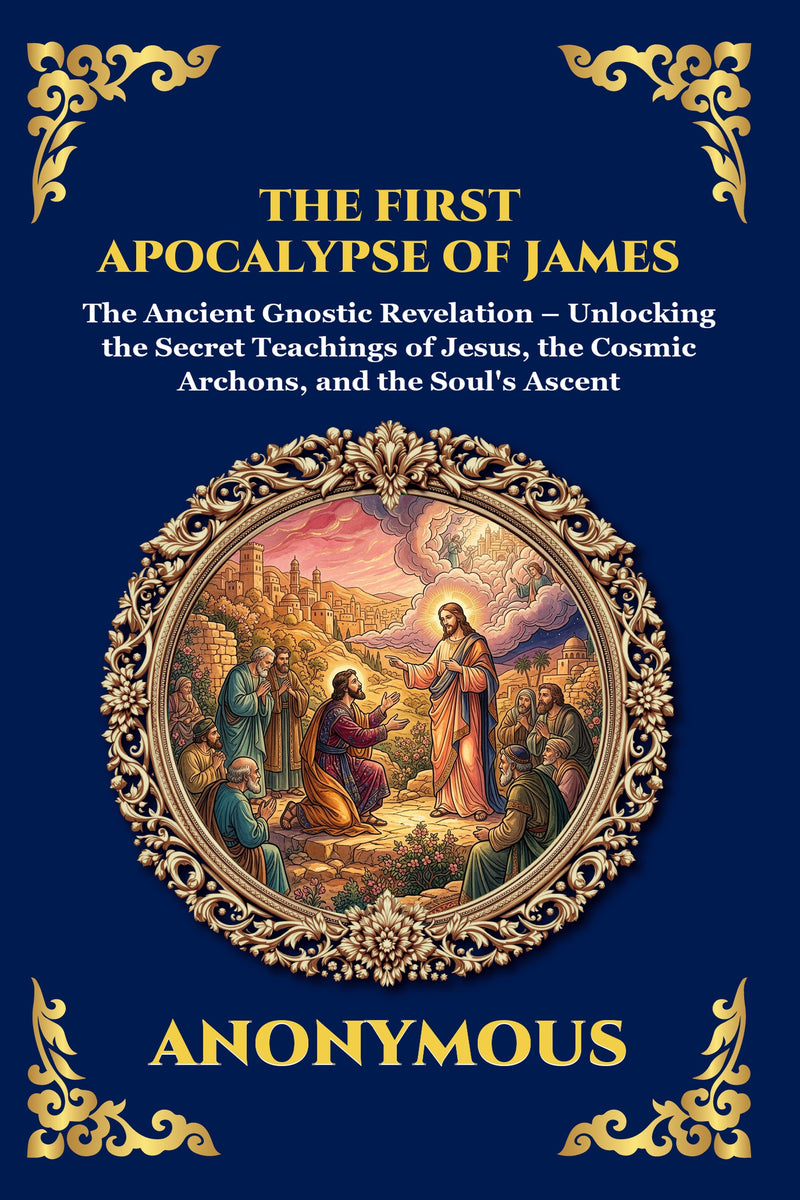
The First Apocalypse of James
In The First Apocalypse of James, Jesus shares secret teachings with his brother about the soul's journey past cosmic gatekeepers. Excluded from canonical texts, this work explores spiritual liberation and the Archons' role in the soul's ascent to the divine.
or free app
10,000+ hrs library
30-day guarantee
The First Apocalypse of James offers a complete modern-English translation of this Gnostic text from the Nag Hammadi Library, readable online with audiobook narration included.
What if the soul must answer hostile powers before it can find its way home?
The First Apocalypse of James is an anonymous early Christian revelation built around secret dialogues between Jesus and James the Just. Its two main scenes take place before Jesus’s suffering and after his resurrection. According to the text, Jesus comes from a Father beyond all names and prepares James to face suffering without surrendering to fear.
The teaching reaches beyond James’s coming death. In this Gnostic vision, the soul must pass hostile powers that question it on its journey toward the divine. Jesus gives James answers that work like passwords. Preserved in Coptic and found near Nag Hammadi, this text opens a window onto ancient Christian ideas outside the New Testament.
Inside this book
- A teacher beyond names – Explore the text’s portrait of Jesus as a heavenly teacher sent by the Unnameable Father.
- James in the face of fear – Meet James as he receives warnings of suffering and teaching meant to steady him.
- The soul under questioning – Follow a vision of the soul confronted by hostile powers demanding answers after death.
- Words that open a passage – Read the answers Jesus gives James to pass the powers guarding the soul’s ascent.
- A different Christian vision – Discover how this Gnostic text connects hidden knowledge, spiritual freedom, and the journey beyond death.
Perfect for readers of early Christian history, the Nag Hammadi library, and ancient ideas about death and the soul, especially those curious about James.
Open the first page and enter the secret dialogue between Jesus and James.
| Formats | eBook (EPUB + PDF) · Audiobook · Paperback · Hardcover · Large Print |
| Language | English |
| Trim size (print) | 6 × 9 in |
| Binding | Paperback — perfect-bound · Hardcover — casewrap |
| Large Print edition | Same text in a larger, easy-read type — a larger font, not a larger trim |
| Print pricing | Every physical book at our true cost — at-cost, no profit (members) |
| Library | 873 restored titles, always growing |
| Composed | 2nd-3rd century AD |
| Original language | Coptic |
| Source tradition | Nag Hammadi Codex V |
| Translation basis | Public-domain scholarly translation, rendered in clear modern English |
| Length | 4,790 words · ~19 min reading |
| Reading level | Grade 5 · easy, accessible reading (this modern-English edition) |
| Edition | Modern English translation · 2026 |
Member reviews for this edition are collected as readers finish it — be the first. Across the library: 12,000+ books shipped, every plan covered by a 365-day print guarantee.
About this edition
The complete, unabridged text in clear modern English — faithful to the original, never simplified. Every paragraph is checked against the source, so nothing is cut, summarised, or paraphrased away. It reads cleanly for today while keeping the original meaning intact.
This text survives in Nag Hammadi Codex V, discovered in Egypt in 1945. Our edition derives from the standard public-domain scholarly translation and renders it in clear modern English.
- Complete & unabridgedVerified paragraph by paragraph against the source — never a scan, never abridged.
- Modern English, faithfulReadable today, with the author’s meaning kept intact. Readable — not simplified.
- Every format, one membershipRead in your browser or the free app, or listen to the full audiobook.
Included free with your membership
Cancel anytime, one click · 30-day money-back guarantee
Edition last updated June 2026
What’s inside
The First Apocalypse of James — complete and unabridged, included in full with membership, plus the full audiobook.
Begin reading The First Apocalypse of James
In clear modern English — the complete text is included with membership.
The First Apocalypse of James
Introduction
The First Apocalypse of James
Introduction
There is a conversation that has been waiting nearly two thousand years to be heard. It takes place between two men who love each other like brothers — one of whom is about to die, and one of whom already knows it. The teacher speaks. The student listens. And in the space between their words, an entire cosmology unfolds: a map of the universe, a guide for the soul, and a set of secret passwords that may determine what happens to human consciousness after the body ceases to breathe. This is not mythology in the dismissive sense. This is theology in its most urgent and intimate register — a private transmission, given at the edge of catastrophe, preserved against all odds, and now placed in your hands.
The text you are about to read is one of the most extraordinary documents to survive from the ancient world. It belongs to a body of literature known broadly as Gnostic scripture — writings produced by early Christian communities who understood the faith of Jesus in ways that were eventually declared heretical, suppressed, and, wherever possible, destroyed. For centuries, these texts existed only as fragments quoted by their opponents, men like Irenaeus of Lyon and Tertullian of Carthage, who cited them primarily to refute them. We knew they had existed. We did not know what they actually said. Then, in the winter of 1945, everything changed.
A Egyptian farmer named Mohammed Ali al-Samman was digging near the cliffs of Jabal al-Tarif, not far from the town of Nag Hammadi in Upper Egypt, when his mattock struck something hard beneath the soil. What he uncovered was a sealed ceramic jar containing thirteen leather-bound codices — ancient books — filled with texts written in Coptic, the late form of the Egyptian language that had absorbed Greek vocabulary and script. The discovery was chaotic in its aftermath: pages were burned for kindling, codices were smuggled across borders, scholars argued over access, and governments intervened. But slowly, painstakingly, the texts were gathered, translated, and published. By the 1970s, the world had access to a library that had been buried for over sixteen hundred years, most likely hidden by monks from the nearby monastery of Saint Pachomius when the orthodox church began its systematic campaign to eliminate unauthorized scriptures.
Among the fifty-two texts recovered from what became known as the Nag Hammadi Library was the document at the center of this book. It presents itself as a record of secret teachings delivered by Jesus to his brother James — not the canonical James of the New Testament epistles, exactly, but a figure of far greater cosmic significance: a man standing at the threshold between the human and the divine, chosen to receive knowledge that was too dangerous, too subversive, and too liberating to be shared with the crowds. The text is intimate in tone, apocalyptic in scope, and philosophically dense in a way that rewards careful, patient reading. It is also, in places, genuinely moving — a portrait of two people who know that time is running out and who choose to spend what remains of it speaking truth to each other.
To encounter this scripture for the first time is to feel simultaneously that you are reading something very old and something startlingly contemporary. The questions it raises — Who made this world? Is the creator of the universe actually good? What traps await the soul after death? How does one achieve genuine liberation? — are not questions that belong to any single century. They are the permanent questions of human existence, and they were being asked with extraordinary sophistication by communities of believers who lived within a generation or two of Jesus himself. The answers this text proposes are not the answers that became orthodox Christianity. They are stranger, darker, more philosophically rigorous, and, for many modern readers, more honest about the terrifying complexity of being alive in a world that does not always seem to have been designed with human flourishing in mind.
Before we can fully appreciate what the text says, we need to understand the world in which it was written — a world of competing revelations, of secret brotherhoods, of cosmic speculation conducted under the shadow of Roman imperial power. We need to understand what Gnosticism actually was, not as a heresy defined by its enemies, but as a living spiritual movement with its own internal logic, its own beauty, and its own profound engagement with the deepest questions of human existence. And we need to understand who James was — or rather, who he was understood to be in the communities that produced and treasured this text — because the figure of James in Gnostic tradition is almost unrecognizable compared to his relatively minor role in mainstream Christianity.
The World That Produced This Text
To read any ancient document well, you must first try to inhabit the world that produced it. This is especially true of Gnostic scripture, because the Gnostic worldview is so different from the assumptions most modern readers bring to religious texts — whether those assumptions are traditionally Christian, secular, or anything in between. The word 'Gnostic' comes from the Greek gnosis, meaning knowledge — but not knowledge in the ordinary sense of accumulated information or scientific data. Gnosis is experiential, transformative knowledge: the kind that changes not just what you think but what you are. It is the knowledge of your own divine origin, your true nature, and the path back to the realm from which you came. It is, in the most literal sense, saving knowledge — the thing that saves you, not from sin in the moral sense, but from ignorance, which the Gnostics considered the fundamental condition of human suffering.
The Gnostic movement — if we can even call it a single movement, given its extraordinary diversity — flourished roughly between the first and fourth centuries of the Common Era. It drew on an astonishing range of sources: Jewish mysticism and apocalyptic literature, Platonic philosophy, Egyptian religion, Zoroastrian dualism, and, of course, the emerging traditions surrounding Jesus of Nazareth. Different Gnostic schools combined these elements in different proportions and arrived at different conclusions, but certain themes recur with enough consistency that we can speak of a broadly Gnostic sensibility. Chief among these is the conviction that the material world is not the creation of the highest God — the ultimate, unknowable divine source — but rather the botched or even malicious production of a lesser being, a demiurge, who either mistakenly believes himself to be the supreme deity or actively seeks to keep human souls imprisoned in matter, unaware of their true origin.
This is a radical idea, and it is important not to domesticate it or reduce it to something more comfortable. The Gnostic critique of the creator god — often identified with the God of the Hebrew Bible — was not a casual theological quibble. It was a fundamental challenge to the entire framework of ancient religion, which generally assumed that the world's creator was also the world's rightful ruler and that human beings owed him worship, obedience, and gratitude. The Gnostics looked at the world — at its suffering, its injustice, its apparent indifference to human pain — and drew a different conclusion. A truly good and truly powerful god would not have made this. Therefore, either the creator is not good, or the creator is not the highest power, or both. From this starting point, elaborate cosmological systems were constructed to explain how the divine fullness — the Pleroma, as it was called — had generated lower levels of being, how something had gone wrong in that process of generation, and how sparks of divine light had become trapped in material bodies, longing for a home they could no longer remember.
The figure of the Archons — the cosmic rulers who appear so prominently in the text you are about to read — emerges directly from this framework. The Archons are the administrators of the lower cosmos, the beings who maintain the prison of matter and who intercept souls attempting to ascend through the celestial spheres after death. They are not simply demons in the folk-religious sense. They are, in the Gnostic imagination, something more philosophically disturbing: the personification of the forces that keep consciousness confined, the embodiment of ignorance masquerading as authority. In some Gnostic systems, the Archons correspond to the planetary powers of ancient astrology — the seven celestial bodies whose influence was believed to shape human destiny. To ascend past them requires knowledge: specifically, the knowledge of their names, their natures, and the correct responses to their challenges. This is why the secret teachings transmitted in this text are not merely interesting theological speculation. They are, from the perspective of the communities that produced and used them, a matter of life and death — or more precisely, a matter of what happens after death.
The social world of early Gnosticism was also more complex and more interesting than the stereotype of a fringe cult might suggest. Gnostic communities existed within the broader landscape of early Christianity and often saw themselves as the inner circle of the faith — the ones who had received the deeper teaching that Jesus had reserved for those capable of understanding it. The canonical gospels themselves contain hints of this esoteric dimension: Jesus repeatedly speaks in parables that he explains only to his disciples, and the Gospel of Mark in particular contains a mysterious reference to a 'secret of the kingdom of God' disclosed only to the inner group. Gnostic Christians took this esotericism seriously and extended it into a full-blown theology of hidden revelation. They were not, in their own self-understanding, departing from Christianity. They were practicing its deepest form.
It is also worth noting that many Gnostic communities were remarkably egalitarian by the standards of the ancient world. Women held leadership roles in some groups. The divine was understood to have both masculine and feminine dimensions — the Gnostic concept of the divine Sophia, the feminine wisdom figure whose fall and redemption forms the backbone of many Gnostic mythologies, gave theological weight to the idea that the female principle was not subordinate but essential. This is one reason why the orthodox church fathers attacked Gnosticism so vigorously: it was not merely theologically threatening but socially disruptive, challenging the hierarchies of gender and authority that the emerging institutional church was working to consolidate.
The specific school of thought from which our text emerges is associated with a tradition that placed extraordinary emphasis on James — known in some traditions as James the Just, the brother of Jesus — as the primary recipient of secret revelation. This is itself a significant theological move. In mainstream Christianity, the apostle Peter became the foundation of ecclesiastical authority, the rock on which the church was built. In the Gnostic traditions that treasured texts like the one you are about to read, James occupies a different but equally exalted position: not the administrator of an institution, but the guardian of a transmission — the living vessel through which the deepest teachings of Jesus were preserved and passed on to those capable of receiving them. The rivalry between these two figures — Peter as the symbol of institutional authority, James as the symbol of esoteric wisdom — runs beneath the surface of early Christian history like a fault line, occasionally breaking through in texts like this one with startling clarity.
Understanding the historical James requires separating him from the relatively thin portrait offered by the canonical New Testament and reconstructing him from a wider range of sources. The Jewish historian Josephus records his execution by stoning around 62 CE, ordered by the high priest Ananus — an event that Josephus suggests contributed to the social unrest that eventually led to the Jewish revolt against Rome. Early Christian sources describe James as a figure of almost superhuman piety, a man so devoted to prayer that his knees were said to have become as calloused as a camel's from constant kneeling, a man so respected even by non-Christian Jews that he was called 'the Just' or 'the Righteous.' He was, by all accounts, a figure of immense moral authority and spiritual intensity. It is not difficult to see why communities seeking a guarantor for secret teachings would choose him — not the impulsive, sometimes bumbling Peter of the canonical gospels, but the grave, contemplative, righteously suffering James.
How to Read What Follows
There is a particular kind of reading that ancient esoteric texts demand, and it is worth describing it before you begin, because approaching this material with the wrong set of expectations can lead to frustration or, worse, to a superficial engagement that misses everything that makes it remarkable. This is not a text designed to be read quickly. It is not a narrative in the conventional sense, with plot and character development and dramatic arc — though it does contain moments of genuine drama. It is more like a musical score: a set of instructions for an inner experience, a guide for a journey that takes place not in geographical space but in the space of consciousness itself.
The dialogue form that structures the text is not accidental. Throughout ancient philosophy and religious literature, the dialogue was understood as a uniquely powerful vehicle for truth — not because it made truth easier to grasp, but because it dramatized the process of coming to grasp it. Plato's dialogues work this way: Socrates does not simply deliver conclusions but draws his interlocutors through a process of questioning and discovery that mirrors the reader's own experience. The dialogues between Jesus and James in this text operate similarly. James's questions are not merely requests for information. They are expressions of genuine confusion, genuine fear, and genuine longing — the same confusion, fear, and longing that the reader is expected to bring to the text. When Jesus answers, he is not speaking only to James. He is speaking to you.
This means that the most productive way to read what follows is not as a detached observer studying an ancient curiosity, but as a participant in the conversation — someone willing to sit with the questions as questions, to feel the weight of the cosmological claims being made, and to notice what happens in your own understanding as the teaching unfolds. The Gnostics believed that gnosis could not be transmitted through argument alone. It required a kind of resonance — a moment of recognition in which the soul acknowledges something it already knew but had forgotten. Whether or not you share that belief, the reading experience this text is designed to produce is one of deepening recognition, not mere information transfer.
Cancel anytime, one click · 30-day money-back guarantee
Founding annual rate available now — your price locks for life when you join.
Not ready? Get this free chapter by email — read it anytime.
✓ Sent — check your inbox for The First Apocalypse of James.
Questions about The First Apocalypse of James
What is the First Apocalypse of James about?
It is a dialogue in which the risen Jesus teaches his brother James in secret. It deals with the Unnameable Father, the coming suffering and death of James, and how the soul should answer hostile powers after death.
Is the First Apocalypse of James in the Bible?
No. The early churches did not accept it into the New Testament. It was read in some Gnostic circles, and it was lost until a jar of books was found at Nag Hammadi in Egypt in 1945.
When was the First Apocalypse of James written?
Scholars generally place the lost Greek original in the second or early third century. The Coptic copy from Nag Hammadi dates to about the fourth century. The exact date and place of writing are still debated.
What is the difference between the First Apocalypse of James and the Apocryphon of James?
They are separate texts. The Apocryphon of James, from Codex One, is a letter that reports teaching of Jesus to James and Peter. The First Apocalypse of James is a dialogue in Codex Five.
Shipping & returns
Billing & membership
More from the library


Explore The Lost & Forbidden Library
- 1 Enoch · Attributed to Enoch
- 1–4 Maccabees · Various Jewish authors
- 2 Baruch · Attributed to Baruch
- 2 Enoch · Attributed to Enoch
- 4 Baruch · Attributed to Baruch ben Neriah
- A Valentinian Exposition · Attributed to a follower of Val...
- Acts of Saturninus
- Acts of Titus · Anonymous early Christian writer
- Allogenes the Stranger · Anonymous (Early Gnostic Mystic)
- Antitheses of Marcion · Marcion
- Apocalypse of Bartholomew · Attributed to the Apostle Barth...
- Apocalypse of Daniel
- Apocalypse of Paul · Attributed to the Apostle Paul
- Apocalypse of Paul (Visio Pauli, Latin) · Attributed to the Apostle Paul
- Apocalypse of Pseudo- Ephraem · Attributed to Ephraem the Syrian
- Apocalypse of Sedrach
- Apocalypse of Shenoute · Attributed to Shenoute the Arch...
- Apocalypse of Stephen
- Apostolic Fathers · Various early Christian authors
- Apostolic Tradition · Attributed to Hippolytus of Rome
- Ars Notoria · Attributed to King Solomon
- Asclepius · Attributed to Hermes Trismegistus
- Authoritative Teaching
- Book of Giants · Attributed to Mani
- Book of the Mysteries of Heaven and Earth · Attributed to early Jewish mystics
- Cave of Treasures · Attributed to Ephrem the Syrian
- Clementine Recognitions · Attributed to Clement of Rome
- Community Rule · Attributed to the Qumran community
- Coptic Gospel of the Twelve
- Diatessaron · Attributed to Tatian
The First Apocalypse of James
The First Apocalypse of James
The Ancient Gnostic Revelation – Unlocking the Secret Teachings of Jesus, the Cosmic Archons, and the Soul's Ascent
Library of Alexandria Press
The First Apocalypse of James
© Copyright 2026 Library of Alexandria Press. All rights reserved.
Published by Library of Alexandria Press
Printed in the United States of America
It is not legal to copy, share, or send any part of this document in either digital or printed form without written permission from the publisher, except short quotes in a book review.
Table of Contents
The First Apocalypse of James
The First Apocalypse of James
Introduction
The First Apocalypse of James
Introduction
There is a conversation that has been waiting nearly two thousand years to be heard. It takes place between two men who love each other like brothers — one of whom is about to die, and one of whom already knows it. The teacher speaks. The student listens. And in the space between their words, an entire cosmology unfolds: a map of the universe, a guide for the soul, and a set of secret passwords that may determine what happens to human consciousness after the body ceases to breathe. This is not mythology in the dismissive sense. This is theology in its most urgent and intimate register — a private transmission, given at the edge of catastrophe, preserved against all odds, and now placed in your hands.
The text you are about to read is one of the most extraordinary documents to survive from the ancient world. It belongs to a body of literature known broadly as Gnostic scripture — writings produced by early Christian communities who understood the faith of Jesus in ways that were eventually declared heretical, suppressed, and, wherever possible, destroyed. For centuries, these texts existed only as fragments quoted by their opponents, men like Irenaeus of Lyon and Tertullian of Carthage, who cited them primarily to refute them. We knew they had existed. We did not know what they actually said. Then, in the winter of 1945, everything changed.
A Egyptian farmer named Mohammed Ali al-Samman was digging near the cliffs of Jabal al-Tarif, not far from the town of Nag Hammadi in Upper Egypt, when his mattock struck something hard beneath the soil. What he uncovered was a sealed ceramic jar containing thirteen leather-bound codices — ancient books — filled with texts written in Coptic, the late form of the Egyptian language that had absorbed Greek vocabulary and script. The discovery was chaotic in its aftermath: pages were burned for kindling, codices were smuggled across borders, scholars argued over access, and governments intervened. But slowly, painstakingly, the texts were gathered, translated, and published. By the 1970s, the world had access to a library that had been buried for over sixteen hundred years, most likely hidden by monks from the nearby monastery of Saint Pachomius when the orthodox church began its systematic campaign to eliminate unauthorized scriptures.
Among the fifty-two texts recovered from what became known as the Nag Hammadi Library was the document at the center of this book. It presents itself as a record of secret teachings delivered by Jesus to his brother James — not the canonical James of the New Testament epistles, exactly, but a figure of far greater cosmic significance: a man standing at the threshold between the human and the divine, chosen to receive knowledge that was too dangerous, too subversive, and too liberating to be shared with the crowds. The text is intimate in tone, apocalyptic in scope, and philosophically dense in a way that rewards careful, patient reading. It is also, in places, genuinely moving — a portrait of two people who know that time is running out and who choose to spend what remains of it speaking truth to each other.
To encounter this scripture for the first time is to feel simultaneously that you are reading something very old and something startlingly contemporary. The questions it raises — Who made this world? Is the creator of the universe actually good? What traps await the soul after death? How does one achieve genuine liberation? — are not questions that belong to any single century. They are the permanent questions of human existence, and they were being asked with extraordinary sophistication by communities of believers who lived within a generation or two of Jesus himself. The answers this text proposes are not the answers that became orthodox Christianity. They are stranger, darker, more philosophically rigorous, and, for many modern readers, more honest about the terrifying complexity of being alive in a world that does not always seem to have been designed with human flourishing in mind.
Before we can fully appreciate what the text says, we need to understand the world in which it was written — a world of competing revelations, of secret brotherhoods, of cosmic speculation conducted under the shadow of Roman imperial power. We need to understand what Gnosticism actually was, not as a heresy defined by its enemies, but as a living spiritual movement with its own internal logic, its own beauty, and its own profound engagement with the deepest questions of human existence. And we need to understand who James was — or rather, who he was understood to be in the communities that produced and treasured this text — because the figure of James in Gnostic tradition is almost unrecognizable compared to his relatively minor role in mainstream Christianity.
The World That Produced This Text
To read any ancient document well, you must first try to inhabit the world that produced it. This is especially true of Gnostic scripture, because the Gnostic worldview is so different from the assumptions most modern readers bring to religious texts — whether those assumptions are traditionally Christian, secular, or anything in between. The word 'Gnostic' comes from the Greek gnosis, meaning knowledge — but not knowledge in the ordinary sense of accumulated information or scientific data. Gnosis is experiential, transformative knowledge: the kind that changes not just what you think but what you are. It is the knowledge of your own divine origin, your true nature, and the path back to the realm from which you came. It is, in the most literal sense, saving knowledge — the thing that saves you, not from sin in the moral sense, but from ignorance, which the Gnostics considered the fundamental condition of human suffering.
The Gnostic movement — if we can even call it a single movement, given its extraordinary diversity — flourished roughly between the first and fourth centuries of the Common Era. It drew on an astonishing range of sources: Jewish mysticism and apocalyptic literature, Platonic philosophy, Egyptian religion, Zoroastrian dualism, and, of course, the emerging traditions surrounding Jesus of Nazareth. Different Gnostic schools combined these elements in different proportions and arrived at different conclusions, but certain themes recur with enough consistency that we can speak of a broadly Gnostic sensibility. Chief among these is the conviction that the material world is not the creation of the highest God — the ultimate, unknowable divine source — but rather the botched or even malicious production of a lesser being, a demiurge, who either mistakenly believes himself to be the supreme deity or actively seeks to keep human souls imprisoned in matter, unaware of their true origin.
This is a radical idea, and it is important not to domesticate it or reduce it to something more comfortable. The Gnostic critique of the creator god — often identified with the God of the Hebrew Bible — was not a casual theological quibble. It was a fundamental challenge to the entire framework of ancient religion, which generally assumed that the world's creator was also the world's rightful ruler and that human beings owed him worship, obedience, and gratitude. The Gnostics looked at the world — at its suffering, its injustice, its apparent indifference to human pain — and drew a different conclusion. A truly good and truly powerful god would not have made this. Therefore, either the creator is not good, or the creator is not the highest power, or both. From this starting point, elaborate cosmological systems were constructed to explain how the divine fullness — the Pleroma, as it was called — had generated lower levels of being, how something had gone wrong in that process of generation, and how sparks of divine light had become trapped in material bodies, longing for a home they could no longer remember.
The figure of the Archons — the cosmic rulers who appear so prominently in the text you are about to read — emerges directly from this framework. The Archons are the administrators of the lower cosmos, the beings who maintain the prison of matter and who intercept souls attempting to ascend through the celestial spheres after death. They are not simply demons in the folk-religious sense. They are, in the Gnostic imagination, something more philosophically disturbing: the personification of the forces that keep consciousness confined, the embodiment of ignorance masquerading as authority. In some Gnostic systems, the Archons correspond to the planetary powers of ancient astrology — the seven celestial bodies whose influence was believed to shape human destiny. To ascend past them requires knowledge: specifically, the knowledge of their names, their natures, and the correct responses to their challenges. This is why the secret teachings transmitted in this text are not merely interesting theological speculation. They are, from the perspective of the communities that produced and used them, a matter of life and death — or more precisely, a matter of what happens after death.
The social world of early Gnosticism was also more complex and more interesting than the stereotype of a fringe cult might suggest. Gnostic communities existed within the broader landscape of early Christianity and often saw themselves as the inner circle of the faith — the ones who had received the deeper teaching that Jesus had reserved for those capable of understanding it. The canonical gospels themselves contain hints of this esoteric dimension: Jesus repeatedly speaks in parables that he explains only to his disciples, and the Gospel of Mark in particular contains a mysterious reference to a 'secret of the kingdom of God' disclosed only to the inner group. Gnostic Christians took this esotericism seriously and extended it into a full-blown theology of hidden revelation. They were not, in their own self-understanding, departing from Christianity. They were practicing its deepest form.
It is also worth noting that many Gnostic communities were remarkably egalitarian by the standards of the ancient world. Women held leadership roles in some groups. The divine was understood to have both masculine and feminine dimensions — the Gnostic concept of the divine Sophia, the feminine wisdom figure whose fall and redemption forms the backbone of many Gnostic mythologies, gave theological weight to the idea that the female principle was not subordinate but essential. This is one reason why the orthodox church fathers attacked Gnosticism so vigorously: it was not merely theologically threatening but socially disruptive, challenging the hierarchies of gender and authority that the emerging institutional church was working to consolidate.
The specific school of thought from which our text emerges is associated with a tradition that placed extraordinary emphasis on James — known in some traditions as James the Just, the brother of Jesus — as the primary recipient of secret revelation. This is itself a significant theological move. In mainstream Christianity, the apostle Peter became the foundation of ecclesiastical authority, the rock on which the church was built. In the Gnostic traditions that treasured texts like the one you are about to read, James occupies a different but equally exalted position: not the administrator of an institution, but the guardian of a transmission — the living vessel through which the deepest teachings of Jesus were preserved and passed on to those capable of receiving them. The rivalry between these two figures — Peter as the symbol of institutional authority, James as the symbol of esoteric wisdom — runs beneath the surface of early Christian history like a fault line, occasionally breaking through in texts like this one with startling clarity.
Understanding the historical James requires separating him from the relatively thin portrait offered by the canonical New Testament and reconstructing him from a wider range of sources. The Jewish historian Josephus records his execution by stoning around 62 CE, ordered by the high priest Ananus — an event that Josephus suggests contributed to the social unrest that eventually led to the Jewish revolt against Rome. Early Christian sources describe James as a figure of almost superhuman piety, a man so devoted to prayer that his knees were said to have become as calloused as a camel's from constant kneeling, a man so respected even by non-Christian Jews that he was called 'the Just' or 'the Righteous.' He was, by all accounts, a figure of immense moral authority and spiritual intensity. It is not difficult to see why communities seeking a guarantor for secret teachings would choose him — not the impulsive, sometimes bumbling Peter of the canonical gospels, but the grave, contemplative, righteously suffering James.
How to Read What Follows
There is a particular kind of reading that ancient esoteric texts demand, and it is worth describing it before you begin, because approaching this material with the wrong set of expectations can lead to frustration or, worse, to a superficial engagement that misses everything that makes it remarkable. This is not a text designed to be read quickly. It is not a narrative in the conventional sense, with plot and character development and dramatic arc — though it does contain moments of genuine drama. It is more like a musical score: a set of instructions for an inner experience, a guide for a journey that takes place not in geographical space but in the space of consciousness itself.
The dialogue form that structures the text is not accidental. Throughout ancient philosophy and religious literature, the dialogue was understood as a uniquely powerful vehicle for truth — not because it made truth easier to grasp, but because it dramatized the process of coming to grasp it. Plato's dialogues work this way: Socrates does not simply deliver conclusions but draws his interlocutors through a process of questioning and discovery that mirrors the reader's own experience. The dialogues between Jesus and James in this text operate similarly. James's questions are not merely requests for information. They are expressions of genuine confusion, genuine fear, and genuine longing — the same confusion, fear, and longing that the reader is expected to bring to the text. When Jesus answers, he is not speaking only to James. He is speaking to you.
This means that the most productive way to read what follows is not as a detached observer studying an ancient curiosity, but as a participant in the conversation — someone willing to sit with the questions as questions, to feel the weight of the cosmological claims being made, and to notice what happens in your own understanding as the teaching unfolds. The Gnostics believed that gnosis could not be transmitted through argument alone. It required a kind of resonance — a moment of recognition in which the soul acknowledges something it already knew but had forgotten. Whether or not you share that belief, the reading experience this text is designed to produce is one of deepening recognition, not mere information transfer.
It is also worth being honest about the difficulty of the material. Gnostic cosmology is intricate, and the specific system elaborated in this text draws on layers of Jewish mystical tradition, Platonic metaphysics, and early Christian theology that are not always immediately transparent to modern readers. The Archons have names. The heavenly realms have structures. The soul's ascent follows a specific itinerary. These details are not decorative — they are the substance of the teaching, the specific knowledge that the text exists to transmit. But they can be bewildering on first encounter, and it is important not to let bewilderment harden into dismissal. The strangeness of the cosmological framework is part of its point: it is designed to defamiliarize the world, to make you see the universe you inhabit as something other than the comfortable, comprehensible home that ordinary consciousness takes it to be.
One of the most striking features of the text, and one that modern readers often find unexpectedly moving, is its emotional register. For all its philosophical complexity, this is also a profoundly human document. The relationship between Jesus and James is depicted with genuine tenderness. There is grief in it — the grief of anticipated loss, of a teacher who knows his student will have to face dangers alone, of a student who knows his teacher is walking toward death and cannot stop it. There is also something that can only be called love: the kind of love that expresses itself not through sentiment but through the willingness to tell the whole truth, however difficult, however frightening, however far it departs from what the beloved might wish to hear. In this sense, the text participates in a very old and very human tradition: the tradition of the deathbed teaching, the final transmission, the last conversation that must contain everything essential because there will not be another chance.
The question of how to situate this text in relation to mainstream Christianity is one that readers will inevitably face, and it deserves a candid answer. This document does not fit comfortably within orthodox Christian theology. Its understanding of God, of creation, of salvation, and of Jesus himself differs substantially from what became the dominant tradition. Some readers will find this troubling. Others will find it liberating. What is important is not to resolve the tension prematurely — not to domesticate the text by forcing it into a familiar framework, but also not to dismiss it as mere heresy and therefore unworthy of serious engagement. The communities that produced and preserved this text were serious people grappling seriously with serious questions. They deserve the same respect we extend to any tradition of genuine spiritual inquiry.
It is also worth remembering that the line between orthodoxy and heresy in the early centuries of Christianity was not as clear as later church history sometimes implies. The canonical New Testament itself was not finalized until the late fourth century. Before that, a wide range of texts circulated among Christian communities, and the boundaries of acceptable belief were genuinely contested. The Gnostic scriptures were not fringe documents produced by isolated eccentrics. They were the scriptures of real communities, used in real worship, treasured by real people who found in them a path to what they experienced as genuine spiritual transformation. To read them now is to recover a dimension of early Christianity that was deliberately suppressed — and to ask, with fresh eyes, what was lost in that suppression.
What you are about to encounter is, among other things, a meditation on power — on who has it, who claims it, who deserves it, and what it means for the soul to move through a cosmos structured by its competing demands. The Archons who challenge the ascending soul are not simply monsters. They are, in a sense, the personification of every force that has ever told a human being that they are not enough, that they do not belong, that they must justify their existence to some external authority before they are permitted to proceed. The secret knowledge that this text transmits — the names, the responses, the understanding of one's own divine nature — is, at its deepest level, a form of resistance: the refusal to accept the terms set by powers that have no ultimate claim on the soul.
This is why the text has spoken to readers across centuries and cultures, and why it continues to speak now. The specific cosmological framework may be ancient, but the underlying experience it addresses — the experience of feeling trapped, of sensing that the world as it is presented to us is not the whole story, of longing for a deeper truth that official channels seem unable or unwilling to provide — is perennial. The Gnostics gave that experience a name, a map, and a path. Whether you read what follows as literal theology, as spiritual metaphor, as philosophical poetry, or simply as one of the most remarkable documents to survive from the ancient world, you are in the presence of something that was considered important enough to hide in a jar and bury in the Egyptian desert, preserved against the possibility that a future age might be ready to receive it.
That age, it seems, is now. The jar has been opened. The pages have been unfolded. The conversation between the teacher and his beloved student is ready to begin. All that remains is for you to take your place in it — to become, as every reader of this text has always been invited to become, the one to whom the teaching is addressed, the one standing at the threshold, the one who is about to learn what the soul needs to know for the journey ahead. Read carefully. Read slowly. And be prepared for the possibility that what you find here will change not just what you think, but what you understand yourself to be.
The First Apocalypse of James
The Lord spoke with me: "See now the completion of my redemption. I have given you a sign of these things, James, my brother. For not without reason have I called you my brother, although you are not my brother in a material sense. And I am not ignorant concerning you; so that when I give you a sign, know it and hear it."
"Nothing existed except Him-who-is. He is unnameable and ineffable. I myself am also unnameable, from Him-who-is, just as I have been given a number of names — two from Him-who-is. And I am before you. Since you have asked concerning femaleness: femaleness existed, but femaleness was not first. It prepared for itself powers and gods. But it did not exist when I came forth, since I am an image of Him-who-is. I have brought forth the image of him so that the sons of Him-who-is might know what things are theirs and what things are alien. Behold, I shall reveal to you everything of this mystery. For they will seize me the day after tomorrow. But my redemption will be near."
James said, "Rabbi, you have said, 'they will seize me.' But I — what can I do?" He said to me, "Fear not, James. You too will they seize. But leave Jerusalem. For it is she who always gives the cup of bitterness to the sons of light. She is a dwelling place of a great number of archons. But your redemption will be preserved from them. So that you may understand who they are and what kind they are, listen. They are nothing but archons. These twelve archons rule over their own hebdomad."
James said, "Rabbi, are there then twelve hebdomads and not seven, as there are in the scriptures?" The Lord said, "James, he who spoke concerning this scripture had a limited understanding. I, however, shall reveal to you what has come forth from him who has no number. I shall give you a sign concerning their number. And as for what has come forth from him who has no measure, I shall give you a sign concerning their measure."
James said, "Rabbi, behold — I have received their number. There are seventy-two measures!" The Lord said, "These are the seventy-two heavens, which are their subordinates. These are the powers of all their might; they were established by them; and these are they who were distributed everywhere, existing under the authority of the twelve archons. The inferior power among them brought forth for itself angels and unnumbered hosts. Yet on account of Him-who-is, they are unnumbered. If you want to give them a number now, you will not be able to do so until you cast away from yourself this blind thought, this bond of flesh which encircles you. Then you will reach Him-who-is. And you will no longer be James; rather, you will be the One-who-is. And all those who are unnumbered will at last have been named."
James said, "Rabbi, in what way shall I reach Him-who-is, since all these powers and these hosts are armed against me?" He said to me, "These powers are not armed against you specifically, but against another. It is against me that they are armed. They are armed with other powers, and they are armed against me in judgment. In this place I shall suffer, yet I shall not rebuke them. There shall be within me a silence and a hidden mystery. But I am troubled before their anger."
James said, "Rabbi, if they arm themselves against you, then is there no blame?"
You have come with knowledge,
that you might rebuke their forgetfulness.
You have come with recollection,
that you might rebuke their ignorance.
But I was concerned because of you.
For you descended into a great ignorance,
but you have not been defiled by anything in it.
For you descended into a great mindlessness,
and your recollection remained.
You walked in mud,
and your garments were not soiled,
and you have not been buried in their filth,
and you have not been caught.
And I was not like them, but I clothed myself with everything of theirs. There is in me forgetfulness, yet I remember things that are not theirs. There is within me their knowledge, yet not their sufferings. But I have become afraid before them, since they rule. For what will they do? What will I be able to say? What word will I be able to speak that I may escape them?"
The Lord said, "James, I praise your understanding and your fear. If you continue to be distressed, do not be concerned for anything else except your redemption. For behold, I shall complete this destiny upon this earth as I have said from the heavens. And I shall reveal to you your redemption."
James said, "Rabbi, how, after these things, will you appear to us again? After they seize you and you complete this destiny, you will go up to Him-who-is." The Lord said, "James, after these things I shall reveal to you everything — not for your sake alone, but for the sake of the unbelief of men, so that faith may exist in them. For a multitude will attain to faith and they will increase. And after this I shall appear as a reproof to the archons. And I shall reveal to them that he cannot be seized. If they seize him, then he will overpower each of them. But now I shall go. Remember the things I have spoken and let them rise up before you." James said, "Lord, I shall hasten as you have said." The Lord said farewell to him and fulfilled what was fitting.
When James heard of his suffering he was much distressed, and they awaited the sign of his coming. And he came after several days. And James was walking upon the mountain which is called Gaugelan, with his disciples, who listened to him because they had been distressed, and he was a comforter, saying, "This is the second time." Then the crowd dispersed, but James remained in prayer, as was his custom.
And the Lord appeared to him. Then he stopped praying and embraced him. He kissed him, saying, "Rabbi, I have found you! I have heard of your sufferings, which you endured. And I have been much distressed. My compassion you know. Therefore, on reflection, I was wishing that I would not see this people. They must be judged for these things that they have done. For these things that they have done are contrary to what is fitting."
The Lord said, "James, do not be concerned for me or for this people. I am he who was within me. Never have I suffered in any way, nor have I been distressed. And this people has done me no harm. But this existed as a type of the archons, and it deserved to be destroyed through them. But the archons have been angry with the Just One, who is his servant. Therefore your name is 'James the Just.' You see how you will become sober when you see me. And you stopped this prayer. Now since you are a just man of God, you have embraced me and kissed me. Truly I say to you that you have stirred up great anger and wrath against yourself. But this was necessary so that these others might come to be."
But James was timid and wept. He was very distressed. And they both sat down upon a rock. The Lord said to him, "James, thus you will undergo these sufferings. But do not be sad. For the flesh is weak. It will receive what has been ordained for it. But as for you, do not be timid or afraid." The Lord ceased.
Now when James heard these things, he wiped away the tears in his eyes and composed himself. The Lord said to him, "James, behold, I shall reveal to you your redemption. When you are seized, and you undergo these sufferings, a multitude will arm themselves against you that they may seize you. And in particular three of them will seize you — they who sit as toll collectors. Not only do they demand toll, but they also take away souls by theft. When you come into their power, one of them who is their guard will say to you, 'Who are you, or where are you from?' You are to say to him, 'I am a son, and I am from the Father.' He will say to you, 'What sort of son are you, and to what father do you belong?' You are to say to him, 'I am from the Pre-existent Father, and a son in the Pre-existent One.' When he says to you, 'Are these things alien to you?', you are to say to him in reply, so that you may pass through."
"'Of alien things?' You are to say to him, 'They are not entirely alien, but they are from Achamoth, who is the female. And these she produced as she brought down the race from the Pre-existent One. So then they are not alien, but they are ours. They are indeed ours because she who is mistress of them is from the Pre-existent One. At the same time they are alien because the Pre-existent One did not have intercourse with her when she produced them.' When he also says to you, 'Where will you go?', you are to say to him, 'To the place from which I have come, there shall I return.' And if you say these things, you will escape their attacks."
"But when you come to these three detainers who take away souls by theft, you will be in a place far greater than the one you came from, and you will be rooted in what is yours. You too will be sober. But I shall call upon the imperishable knowledge, which is Sophia, who is in the Father and who is the mother of Achamoth. Achamoth had no father nor male consort, but she is female from a female. She produced you without a male, since she was alone and in ignorance as to what lives through her mother, because she thought that she alone existed. But I shall cry out to her mother. And then they will fall into confusion and will blame their root and the race of their mother. But you will go up to what is yours, and you will ascend to the Pre-existent One."
"They are a type of the twelve disciples and the twelve pairs, and of Achamoth, which is translated 'Sophia.' And I myself am the imperishable Sophia through whom you will be redeemed, and all the sons of Him-who-is — these things they have known and have hidden within them. You are to hide these things within you, and you are to keep silence. But you are to reveal them to Addai. When you depart, immediately war will be made with this land. Weep, then, for him who dwells in Jerusalem. But let Addai take these things to heart. In the tenth year let Addai sit and write them down. And when he writes them down, he is to give them to one who is called Levi. Then Levi is to bring word from what I said earlier to a woman in Jerusalem, and through her he begets two sons. They are to inherit these things and the understanding of him who exalts. And they are to receive through him from his intellect. Now the younger of them is greater. And may these things remain hidden in him until he comes to the age of seventeen years, and then they will begin to work through him. They will pursue him exceedingly, since they are from among his companions. He will be proclaimed through them, and they will proclaim this word. Then he will become a seed of the living."
James said, "I am satisfied, and these things are the nourishment of my soul. Yet another thing I ask of you: who are the seven women who have been your disciples? And behold, all women bless you. I also am amazed how powerless vessels have become strong by a perception which is in them." The Lord said, "You have asked well. These women possess a spirit of life, a spirit of thought, a spirit of counsel and of wisdom, a spirit of understanding, a spirit of knowledge, and a spirit of the fear of God. Now when we had passed through the breath of this archon who is named Adonaios, he did not recognize me, and when I came forth from him he remembered that I am a son of his. He was gracious to me at that time as his son. And then, before I appeared here, he cast them among this people. And from the place of heaven came the prophets."
James said, "Rabbi, I am full of wonder at all these things, and especially at this." The Lord said, "James, I praise you. Walk upon the earth and speak these words while you are still here. For cast away from you the cup which is bitterness. For some from among this people have set themselves against you. For you have begun to understand their roots from beginning to end. Cast away from yourself all lawlessness. And beware lest they envy you. When you speak these words of this perception, encourage these four: Salome and Mariam and Martha and Arsinoe. Since he takes some to himself through burnt offerings, I do not act in this way; but rather I bring first-fruits upward, so that the power of God might appear. The perishable has gone up to the imperishable, and the female element has attained to the male element."
James said, "Rabbi, into these three, then, has their suffering been cast. For they have been reviled and they have been persecuted. Behold what comes from anyone. For you have received knowledge, and in that you will find the way. But I shall go forth and reveal that they believed in you, so that they may be content with their blessing and salvation, and this revelation may come to pass."
And he went at that time immediately and rebuked the twelve and cast out from them the contentment that stood in the way of knowledge.
And the majority of them, when they saw, received the messenger. The others said, "Remove him from this earth, for he is not worthy of life." These, then, were afraid. They arose, saying, "We have no part in this blood, for a just man will perish through injustice." And James departed, so that they might seek him.
End of the free sample
Keep reading, free
Members read and listen to the complete book — and the entire library. Cancel anytime, one click · 30-day money-back guarantee.