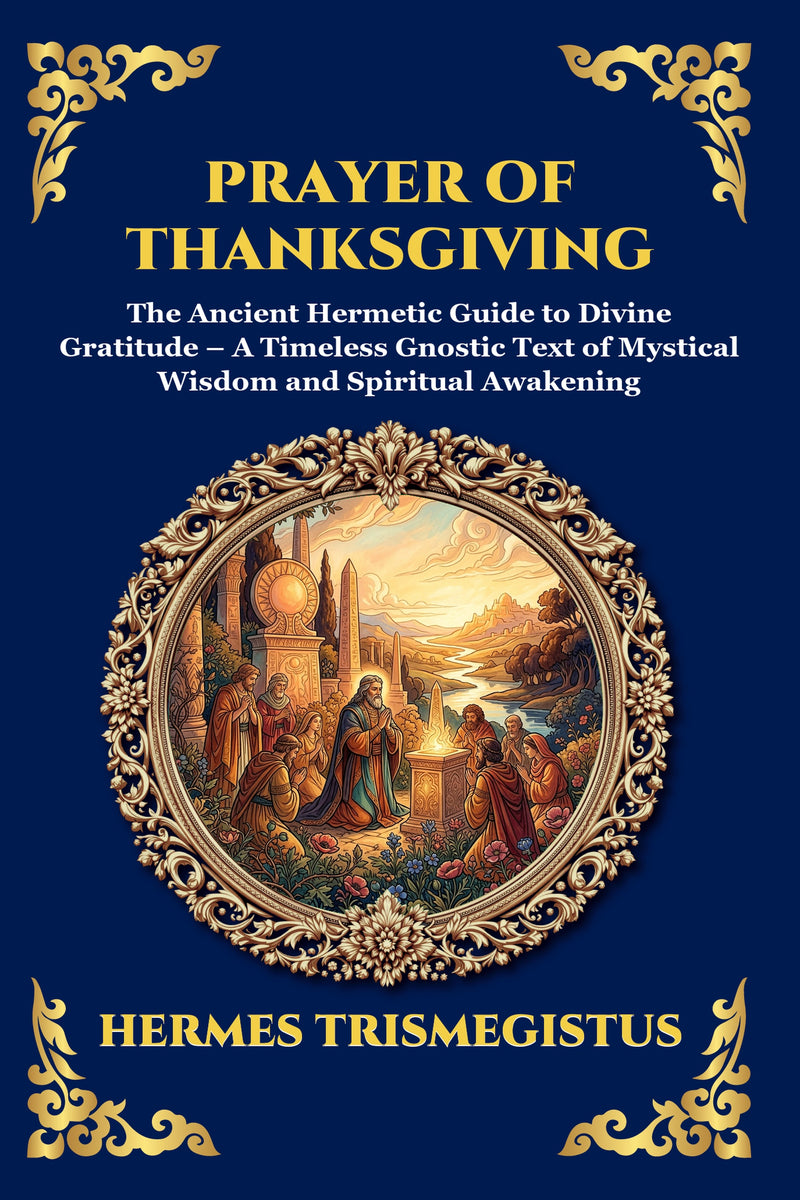
Prayer of Thanksgiving — Large Print
Attributed to Hermes Trismegistus, the Prayer of Thanksgiving offers a Hermetic path to enlightenment through pure gratitude. This Gnostic text, rediscovered in the Nag Hammadi library, was excluded from canon but remains a profound guide to transcending the mundane and accessing divine joy.
or free app
10,000+ hrs library
30-day guarantee
The complete Prayer of Thanksgiving from the 2nd-3rd century Nag Hammadi codices is available in modern English translation online with audiobook narration included for Library of Alexandria Press members.
Large Print Edition. The complete, unabridged text set in a larger, easy-on-the-eyes typeface for comfortable reading.
Have you ever wondered why true fulfillment remains elusive despite our modern comforts, and how the ancient mystics accessed a state of constant, divine joy?
In The Prayer of Thanksgiving, you are invited to rediscover one of the most significant spiritual documents of antiquity. Attributed to the legendary Hermes Trismegistus, this Hermetic masterpiece offers a window into the Gnostic soul, revealing a path to enlightenment through the practice of pure, unadulterated gratitude. This is not merely a historical artifact; it is a living guide to shifting your consciousness from the mundane to the miraculous.
This edition provides a modern, accessible exploration of the prayer found within the Nag Hammadi library and the Asclepius. It delves into the philosophical foundations of Hermeticism—the belief that "All is Mind" and that by recognizing our connection to the Creator, we can achieve a state of "Gnosis" or direct divine knowledge. Through this prayer, the seeker learns to thank the Divine not for material favors, but for the gift of consciousness itself.
What You’ll Discover in This Modern Translation:
- The Essence of Hermetic Wisdom — Gain a clear understanding of the core principles of Hermes Trismegistus and how they apply to the human experience.
- The Path of Gnosis — Explore how the ancients used sacred speech and prayer to trigger spiritual awakening and a deeper connection to the Universe.
- A Masterclass in Divine Gratitude — Learn how to move beyond "asking" and into "thanking," a shift that many believe is the key to manifesting a higher reality.
- Historical and Mystical Context — Understand the origins of this text within the broader Gnostic and Hermetic traditions that shaped Western esotericism.
- The Power of the Word — Discover how the specific structure and resonance of this ancient prayer were designed to elevate the spirit and calm the mind.
Whether you are a student of ancient history, a practitioner of the esoteric arts, or a modern seeker looking for a deeper spiritual practice, The Prayer of Thanksgiving provides a timeless blueprint for a soul-centered life. It is a call to awaken, to remember your divine origin, and to live in a state of perpetual wonder.
Are you ready to unlock the secrets of the ancient mystics?
Get your copy today and begin your journey into the heart of Hermetic wisdom.
| Formats | eBook (EPUB + PDF) · Audiobook · Paperback · Hardcover · Large Print |
| Language | English |
| Trim size (print) | 6 × 9 in |
| Binding | Paperback — perfect-bound · Hardcover — casewrap |
| Large Print edition | Same text in a larger, easy-read type — a larger font, not a larger trim |
| Print pricing | Every physical book at our true cost — at-cost, no profit (members) |
| Library | 873 restored titles, always growing |
| Composed | 2nd-3rd century AD |
| Original language | Greek |
| Source tradition | Nag Hammadi Codex VI |
| Translation basis | Public-domain scholarly translation, rendered in clear modern English |
| Length | 3,144 words · ~13 min reading |
| Reading level | Grade 14 · rich, literary prose (this modern-English edition) |
| Edition | Modern English translation · 2026 |
Member reviews for this edition are collected as readers finish it — be the first. Across the library: 12,000+ books shipped, every plan covered by a 365-day print guarantee.
About this edition
The complete, unabridged text in clear modern English — faithful to the original, never simplified. Every paragraph is checked against the source, so nothing is cut, summarised, or paraphrased away. It reads cleanly for today while keeping the original meaning intact.
This text survives in Nag Hammadi Codex VI and was also known from earlier Greek papyrus fragments. This edition derives from the standard scholarly translation and renders the Hermetic prayer in clear modern English.
- Complete & unabridgedVerified paragraph by paragraph against the source — never a scan, never abridged.
- Modern English, faithfulReadable today, with the author’s meaning kept intact. Readable — not simplified.
- Every format, one membershipRead in your browser or the free app, or listen to the full audiobook.
Included free with your membership
Cancel anytime, one click · 30-day money-back guarantee
Edition last updated June 2026
What’s inside
Prayer of Thanksgiving — Large Print — complete and unabridged: all 4 sections included with membership, plus the full audiobook.
Begin reading Prayer of Thanksgiving — Large Print
In clear modern English — the complete text is included with membership.
The World That Shaped This Prayer
To read this text well, it helps enormously to understand something of the intellectual and spiritual atmosphere in which it was composed. The first few centuries of the Common Era were a time of intense religious ferment throughout the Mediterranean world. The old civic religions of Greece and Rome were losing their hold on the educated classes, who found their elaborate mythologies increasingly difficult to take literally and their transactional relationship with the gods increasingly unsatisfying as a spiritual framework. At the same time, new religious movements were proliferating with extraordinary energy — Christianity in its many early forms, various strands of Judaism, the mystery religions of Isis and Mithras and Dionysus, Neoplatonism, Manichaeism, and the overlapping, interconnected movements we now group together under the labels of Gnosticism and Hermeticism.
What united many of these movements, despite their enormous differences, was a shared hunger for something that the old civic religions had not provided: a direct, personal, transformative relationship with the divine. People were no longer content to sacrifice at public altars to gods who guaranteed the health of the state and the fertility of the crops. They wanted to know the divine personally. They wanted to be changed by that knowing. They wanted a religion that addressed not just their social obligations but their inner lives — their fears, their longing for meaning, their sense of being somehow exiled from a home they could barely remember but could not stop seeking.
The Hermetic tradition offered one of the most sophisticated responses to this hunger. Drawing on Platonic philosophy, Egyptian religious wisdom, Jewish theological concepts, and its own distinctive insights, it developed a comprehensive account of the human situation and a detailed map of the path from spiritual ignorance to divine knowledge. Central to this account was the idea that the human being is a paradoxical creature — partly material, partly divine, caught between the world of matter and the world of spirit, capable of sinking into complete identification with the physical and temporal, but also capable of ascending to union with the eternal and the infinite.
This understanding of the human condition as fundamentally dual — as a being of two worlds — runs through virtually every text in the Hermetic corpus, and it is present in the prayer we are examining here, though in a characteristically indirect way. The prayer does not dwell on the problem of human limitation or the weight of material existence. It has moved beyond that problem, or rather it has resolved it, at least momentarily, through the experience of divine contact that it is giving thanks for. But the depth of the gratitude expressed in the prayer is only fully comprehensible when you understand what it is being contrasted with — the ordinary state of human consciousness, which the Hermetica consistently describes as a kind of sleep, a forgetting, a being lost in the labyrinth of sensory experience without any sense of the larger reality that contains and transcends it.
The concept of light, which appears throughout Hermetic literature and plays a central role in this prayer, carries enormous weight in this context. Light was not merely a metaphor for the Hermetic thinkers. It was understood to be the primary substance of the divine — the first emanation from the ultimate source, the medium through which divine reality makes itself known to created beings, and the very substance of the human soul in its highest and most essential nature. When the Hermetic texts speak of the divine light, they are speaking of something that the practitioner is meant to experience directly, not just to understand conceptually. The goal of Hermetic practice was to become, in some sense, transparent to this light — to allow it to shine through the individual consciousness rather than being blocked by the accumulated layers of ego, illusion, and material attachment.
This emphasis on light connects the Hermetic tradition to a much broader stream of mystical thought that runs through many of the world's great spiritual traditions. From the Jewish concept of the divine radiance known as the Shekinah to the Buddhist notion of the clear light of awareness to the Christian mystical tradition's talk of divine illumination, the metaphor of light as the medium of divine presence and divine knowledge appears with remarkable consistency across cultures and centuries. This consistency is not coincidental. It points to something in the nature of transformative spiritual experience itself — something that, when encountered directly, naturally reaches for the language of light to describe itself.
The Gnostic dimension of the prayer adds another layer of richness and complexity. The Gnostic traditions that flourished in the first few centuries CE were extraordinarily diverse, encompassing everything from highly elaborate mythological systems to simple, direct expressions of mystical experience. What they shared was the conviction that the material world, as ordinarily experienced, is not the whole of reality — that behind or within or above the world of appearances there is a deeper reality, a truer world, a divine pleroma or fullness from which the human soul has in some sense become separated and toward which it is always, whether consciously or unconsciously, oriented. The drama of Gnostic spirituality is the drama of this separation and return — the soul's gradual awakening to its own divine nature, its recognition of the false reality in which it has been imprisoned, and its eventual liberation and homecoming.
In this context, the act of giving thanks takes on a depth that goes far beyond conventional piety. When the speaker of this prayer gives thanks, they are not merely acknowledging a favor received. They are performing an act of recognition — recognizing the divine for what it truly is, recognizing themselves for what they truly are, and recognizing the relationship between the two as the fundamental reality underlying all appearances. This recognition is itself a form of liberation. To truly know what you are grateful for, in the Hermetic and Gnostic sense, is to know the divine. And to know the divine, as these traditions insist, is to know yourself at the deepest possible level.
The historical journey of this text is itself a remarkable story. After the period of its composition and circulation in the early centuries CE, the Hermetic tradition went underground — not entirely, but substantially. The rise of orthodox Christianity as the dominant religion of the Roman Empire created an environment in which texts like this one were viewed with deep suspicion, if not outright hostility. The Gnostic and Hermetic movements were condemned as heresies, their texts were ordered destroyed, and their practitioners faced increasing pressure to conform to orthodox belief and practice. That so much survived is a testament to the dedication of those who preserved these texts, often at considerable personal risk.
During the medieval period in Europe, the Hermetic tradition survived primarily through Arabic translations and through the Latin Hermetic texts that had been preserved in monastic libraries, often without the monks who copied them having any real understanding of what they were copying. Then, in 1463, a collection of Greek Hermetic texts arrived in Florence, brought from Macedonia by a monk working for Cosimo de' Medici. The result was the first printed edition of the Corpus Hermeticum, which became one of the most influential books of the Renaissance and sparked a renewed interest in Hermetic thought that has never entirely died away.
The Renaissance Hermeticists read these texts with the eyes of their own time, finding in them confirmation of a perennial philosophy that they believed underlay all the great religious and philosophical traditions. They were particularly struck by what they saw as the prophetic quality of the Hermetic texts — their apparent anticipation of Christian theological concepts, which they took as evidence that Hermes Trismegistus had been a historical figure of enormous antiquity, a contemporary of Moses who had received divine revelation independently. We now know that this interpretation was historically mistaken — the Hermetic texts were composed in the early centuries CE, not in remote antiquity — but the mistake is in some ways less important than the insight that motivated it: the recognition that these texts spoke to something universal in human spiritual experience, something that transcended the particular cultural context in which they were written.
How to Read What Follows
Having spent time with the historical and philosophical context, we can now turn to the question of how to approach the text itself — how to read it in a way that allows it to do what it was designed to do, which is not merely to inform but to transform. This is not a text that rewards the kind of reading we bring to a newspaper or a novel or even most works of academic scholarship. It asks something different of us. It asks us to slow down, to bring our full attention, to read not just with our minds but with what the ancient world called the heart — that deeper center of awareness and receptivity that is capable of being genuinely moved by what it encounters.
The tradition from which this prayer emerges was deeply aware of the difference between two kinds of reading. There is the reading that processes information, extracts meaning, and moves on — the kind of reading that leaves us with a set of ideas we can summarize and discuss. And there is the reading that opens us, that allows a text to work on us at levels below the conscious and analytical, that creates the conditions for genuine insight and genuine change. The first kind of reading has its place, and the contextual information provided in this introduction is meant to support it. But the second kind of reading is what this text ultimately calls for, and it is worth thinking about how to cultivate it.
One approach that many readers have found helpful is to read the prayer multiple times, in different states of mind and at different times of day, allowing each reading to reveal different facets of the text. The first reading might be primarily informational — getting the shape of the thing, understanding what is being said on the most immediate level. Subsequent readings can go deeper, attending more carefully to the specific words chosen, the images invoked, the emotional arc of the prayer as it moves from opening address through thanksgiving to its extraordinary conclusion. Some readers find it helpful to read the prayer aloud, allowing the physical act of speaking the words to engage a different kind of attention than silent reading. The Hermetic tradition was always an oral as well as a written tradition, and there is something about voicing these words that connects us, however faintly, to the communities of practitioners who first used them.
It is also worth approaching the text with a certain openness to its strangeness. We live in a world very different from the one that produced this prayer, and some of what it says will initially seem alien or difficult. The cosmological framework it assumes, the understanding of the human soul and its relationship to the divine, the specific vocabulary of Hermetic spirituality — all of these require some adjustment on the part of the modern reader. But strangeness is not a barrier to understanding. It can be an invitation. When we encounter something genuinely foreign to our ordinary way of thinking, we are given the opportunity to expand our conceptual vocabulary, to discover that the map of reality we carry around in our heads is smaller than the territory it purports to represent.
The Hermetic tradition was always pluralistic in its approach to spiritual truth. It did not claim exclusive possession of the divine. It recognized that the divine could be approached through many different names and forms, and it was characteristically generous in its acknowledgment of other traditions' wisdom. This generosity is reflected in the prayer itself, which does not invoke a tribal or sectarian deity but addresses itself to a divine reality that transcends all particular names and forms — a reality that is, as the Hermetic texts repeatedly insist, both utterly transcendent and intimately present, both beyond all human comprehension and closer to us than our own heartbeat.
This combination of transcendence and immanence is one of the most distinctive and most profound features of Hermetic theology, and it is worth pausing to appreciate it before diving into the text. Many religious traditions emphasize one side of this paradox at the expense of the other. Some traditions stress the absolute transcendence of the divine — its radical otherness, its incomprehensibility, the vast gulf that separates the creator from the created. Other traditions emphasize the divine immanence — the presence of the sacred in every aspect of the natural world, in every living being, in every moment of conscious experience. The Hermetic tradition insists on holding both sides of the paradox simultaneously, refusing to let either one collapse into the other. The divine is absolutely other — beyond all names, beyond all concepts, beyond all human capacity to grasp or contain. And the divine is absolutely present — the very ground of our being, the light within our consciousness, the love that holds all things in existence.
This paradox is not a logical problem to be solved. It is a living reality to be experienced. And the experience of it — the direct, felt sense of being simultaneously a finite, limited, mortal creature and an expression of something infinite, unlimited, and eternal — is precisely what the prayer is giving thanks for. When you read it with this understanding, the emotional intensity of the gratitude expressed becomes not just comprehensible but inevitable. If you have ever had even a glimpse of what this prayer is describing — even a moment of genuine recognition of the sacred dimension of your own existence — then you know exactly why someone would respond to it with an outpouring of thanks so total that it encompasses not just specific gifts but the very nature of reality itself.
Cancel anytime, one click · 30-day money-back guarantee
Founding annual rate available now — your price locks for life when you join.
Not ready? Get this free chapter by email — read it anytime.
✓ Sent — check your inbox for Prayer of Thanksgiving — Large Print.
Questions about Prayer of Thanksgiving — Large Print
Who wrote the Prayer of Thanksgiving?
The Prayer of Thanksgiving is attributed to Hermes Trismegistus, a legendary figure in Hermetic literature. Modern scholars understand this as pseudonymous authorship, with the actual author being an unknown Hermetic practitioner from the early centuries of the Common Era.
Why was the Prayer of Thanksgiving excluded from the biblical canon?
The Prayer of Thanksgiving was never considered for biblical inclusion as it belongs to the Hermetic tradition rather than Jewish or Christian scripture. It was preserved within Gnostic communities and later discovered among the Nag Hammadi texts in Egypt.
What does the Prayer of Thanksgiving contain?
The Prayer of Thanksgiving is a brief Hermetic text expressing gratitude to the divine and describing spiritual enlightenment. It includes both the prayer itself and instructions for ritual practice, reflecting typical Hermetic themes of gnosis and divine knowledge.
Is Prayer of Thanksgiving free to read?
The opening of the text is free to read below. Members read and listen to the complete work — and the entire Lost & Forbidden Library — free.
What is Prayer of Thanksgiving?
Have you ever wondered why true fulfillment remains elusive despite our modern comforts, and how the ancient mystics accessed a state of constant, divine joy?
How long is Prayer of Thanksgiving?
4 chapters (~225 words) in this restored edition.
Shipping & returns
Billing & membership
More from the library


Explore Gnostic & Nag Hammadi
- A Valentinian Exposition · Attributed to a follower of Val...
- Book of Baruch of the Gnostics · Attributed to Justin the Gnostic
- Secret Gospel of Mark · Attributed to Mark
- Wisdom of Solomon · Attributed to King Solomon
- Vision of Paul
- Gospel of Thomas · Attributed to Thomas the Apostle
- Prayer of Thanksgiving · Attributed to Hermes Trismegistus
- Life of Adam and Eve
- Authoritative Teaching
- On the Origin of the World
- The Hypostasis of the Archons · Attributed to early Gnostic wri...
- The Thunder, Perfect Mind
- The Three Steles of Seth · Attributed to Seth
- Sophia of Jesus Christ · Attributed to early Gnostic Chr...
- Pistis Sophia · Attributed to Valentinian Gnostics
- Apocryphon of John (Secret Book of John) · Attributed to John the Apostle
- Book of Thomas the Contender · Attributed to the apostle Thomas
- Melchizedek · Anonymous (Early Gnostic Mystic)
- Zostrianos · Anonymous (Early Gnostic Mystic)
- Coptic Gospel of the Twelve
- Manichaean Homilies · Attributed to the prophet Mani
- Ginza Rabba · Attributed to Mandaean priests
- Apocalypse of James · Attributed to James the Just
- Manichaean Psalm-Book · Attributed to the prophet Mani
- Paraphrase of Shem · Attributed to early Gnostic wri...
- Third Epistle to the Corinthians · Attributed to the Apostle Paul
- Antitheses of Marcion · Attributed to Marcion of Sinope
- Hymn of the Pearl · Attributed to the Apostle Thomas
- Gospel of Gamaliel
- Marcion: Antitheses · Attributed to Marcion of Sinope
Prayer of Thanksgiving — Large Print
The Prayer of Thanksgiving
A Hermetic Prayer of the Gnostic Mystics — Thanksgiving to the Unutterable Name for the Gift of Mind and Knowledge, and for the Grace by Which the Soul Is Made Divine, Sealed with the Sacred Embrace and the Holy Meal
Library of Alexandria Press
The Prayer of Thanksgiving
© Copyright 2026 Library of Alexandria Press. All rights reserved.
Published by Library of Alexandria Press
Printed in the United States of America
It is not legal to copy, share, or send any part of this document in either digital or printed form without written permission from the publisher, except short quotes in a book review.
Table of Contents
Introduction
The World That Shaped This Prayer
How to Read What Follows
Chapter 1
Introduction
There are texts that instruct, texts that entertain, and texts that transform. The ancient document you are about to encounter belongs firmly to that rarest third category — a piece of writing so concentrated in its spiritual intention, so luminous in its expression of gratitude and divine recognition, that readers across nearly two millennia have found themselves changed by it in ways they struggle to articulate. It is a short text, as ancient sacred writings go, but its brevity is deceptive. Like a seed that contains within its compact form the full architectural blueprint of a towering tree, this prayer carries within its few hundred words an entire cosmology, a complete philosophy of the human relationship with the divine, and a practical method for achieving what the ancient world called gnosis — direct, personal, experiential knowledge of the sacred.
To understand why this text matters — why it has survived the collapse of empires, the burning of libraries, the systematic suppression of the traditions from which it emerged, and the long centuries during which it was known only to a handful of scholars — we need to step back and appreciate the remarkable world that produced it. The Hermetic tradition, from which this prayer springs, was one of the most sophisticated spiritual and philosophical movements of the ancient Mediterranean world. It emerged from the extraordinary cultural crucible of Hellenistic Egypt, particularly in the great city of Alexandria, where Greek philosophical rigor met Egyptian mystical depth, where Jewish monotheism encountered Platonic idealism, and where the intellectual currents of an entire civilization swirled together in productive, sometimes explosive, creative tension.
Alexandria in the early centuries of the Common Era was unlike any city the world had seen before or has seen since. Its famous library — the greatest repository of human knowledge in the ancient world — drew scholars from across the Mediterranean basin and beyond. Its streets were alive with philosophical debate, religious innovation, and the kind of cross-cultural fertilization that happens when brilliant, restless minds from different traditions are thrown together in close proximity. It was in this environment that the Hermetic corpus took shape: a body of texts attributed to the legendary figure of Hermes Trismegistus, the 'Thrice-Greatest Hermes,' who was understood to be a synthesis of the Greek god Hermes and the Egyptian god Thoth, both associated with wisdom, writing, and the transmission of divine knowledge to humanity.
The figure of Hermes Trismegistus was, in a sense, the perfect patron for a tradition that sought to transcend cultural boundaries. He was neither purely Greek nor purely Egyptian, neither a god in the conventional sense nor a merely human teacher, but something in between — a divine revealer, a messenger between worlds, a figure who could move freely across the boundaries that ordinarily separated the human from the divine. The texts attributed to him, which we call the Hermetica, cover an enormous range of topics: cosmology, astrology, alchemy, magic, philosophy, and above all the question of how a human soul might come to know its own divine nature and return to the source from which it came.
Within this rich tradition, the text at the heart of this volume occupies a special place. It is not primarily a philosophical treatise or a cosmological speculation. It is, as its name suggests, a prayer — an act of address, of reaching out from the human toward the divine with the specific intention of giving thanks. This might seem like a simple thing, but in the context of Hermetic thought, gratitude is not merely a social grace or a pious gesture. It is a metaphysical act, a form of recognition that has the power to realign the soul with its source, to dissolve the illusions that separate the individual consciousness from the universal consciousness, and to open a channel through which divine light can flow more freely into human life.
The prayer has come down to us through multiple channels, which is itself testimony to its importance and its resonance across different traditions. It appears in the Nag Hammadi library, that extraordinary collection of ancient texts discovered by Egyptian farmers in 1945 near the town of Nag Hammadi in Upper Egypt. Buried in a sealed jar sometime in the fourth century CE, these texts survived precisely because someone thought them worth preserving — worth hiding from those who would have destroyed them. The discovery of the Nag Hammadi library was one of the most significant archaeological finds of the twentieth century, giving scholars direct access to texts that had been known only through references and fragments for over a thousand years. That this prayer was among the texts chosen for preservation tells us something important about how highly it was valued by those who knew it.
But the prayer also appears in other contexts. A version of it is found in the Greek Magical Papyri, that vast and fascinating collection of magical texts from Greco-Roman Egypt that blends high philosophy with practical ritual in ways that can surprise modern readers accustomed to keeping these categories separate. It also appears, in slightly different form, in the Asclepius, one of the most important texts of the Latin Hermetic tradition. The fact that this prayer circulated across such different contexts — philosophical, magical, liturgical — suggests that it was understood to operate on multiple levels simultaneously, addressing both the intellectually sophisticated seeker and the practically minded practitioner.
What strikes every reader who comes to this text for the first time is its emotional directness. After centuries of encountering ancient religious texts that can feel distant, formulaic, or culturally alien, there is something almost startling about the immediacy of this prayer's emotional register. The gratitude it expresses does not feel performed or obligatory. It feels genuine, felt, alive. This is not the gratitude of someone who has been taught that they ought to be thankful. It is the gratitude of someone who has actually experienced something — who has been touched by something real, something overwhelming, something that has changed the way they see everything — and who cannot help but respond with an outpouring of acknowledgment and praise.
This quality of authentic spiritual experience is central to the Gnostic and Hermetic traditions from which the prayer emerges. Both traditions placed enormous emphasis on direct personal experience of the divine as the foundation of genuine spiritual knowledge. The Greek word gnosis, from which the Gnostic tradition takes its name, means simply 'knowledge,' but it refers specifically to a kind of knowledge that is experiential rather than merely intellectual — knowledge that transforms the knower, not just their beliefs. In the Hermetic tradition, this transformative knowledge was the ultimate goal of all spiritual practice, the culmination of a long process of purification, study, and contemplation that could, at its highest point, result in what the Hermetica calls the 'vision of God' — a direct, unmediated encounter with the divine source of all existence.
The prayer we are exploring here can be understood as the natural response to such an encounter. It is what a person says — what a person cannot help but say — when they have actually experienced the divine presence. It is the voice of someone who has been, however briefly, outside the cave of ordinary consciousness and has seen the light that casts all the shadows we mistake for reality. Coming back from such an experience, the only adequate response is gratitude: gratitude so deep and so total that it encompasses not just specific blessings but the very fact of existence itself, the very capacity for awareness, the very possibility of knowing and being known.
Chapter 1
We give thanks to You! Every soul and heart is lifted up to You, undisturbed name, honored with the name "God" and praised with the name "Father" — for to everyone and everything you give fatherly kindness and affection and love, and whatever teaching is sweet and plain, giving us mind, speech, and knowledge: mind, so that we may understand You; speech, so that we may expound You; knowledge, so that we may know You. We rejoice, having been illuminated by Your knowledge. We rejoice because You have shown us Yourself. We rejoice because while we were still in the body, You have made us divine through Your knowledge.
The thanksgiving of the one who attains to You is this one thing: that we know You. We have known You, O intellectual light. Life of life, we have known You. Womb of every creature, we have known You. Womb pregnant with the nature of the Father, we have known You. Eternal permanence of the begetting Father, thus have we worshiped Your goodness. There is one petition we ask: that we be preserved in knowledge. And there is one protection we desire: that we not stumble in this kind of life.
When they had said these things in prayer, they embraced one another and went to eat their holy food, which has no blood in it.
End of the free sample
Keep reading, free
Members read and listen to the complete book — and the entire library. Cancel anytime, one click · 30-day money-back guarantee.