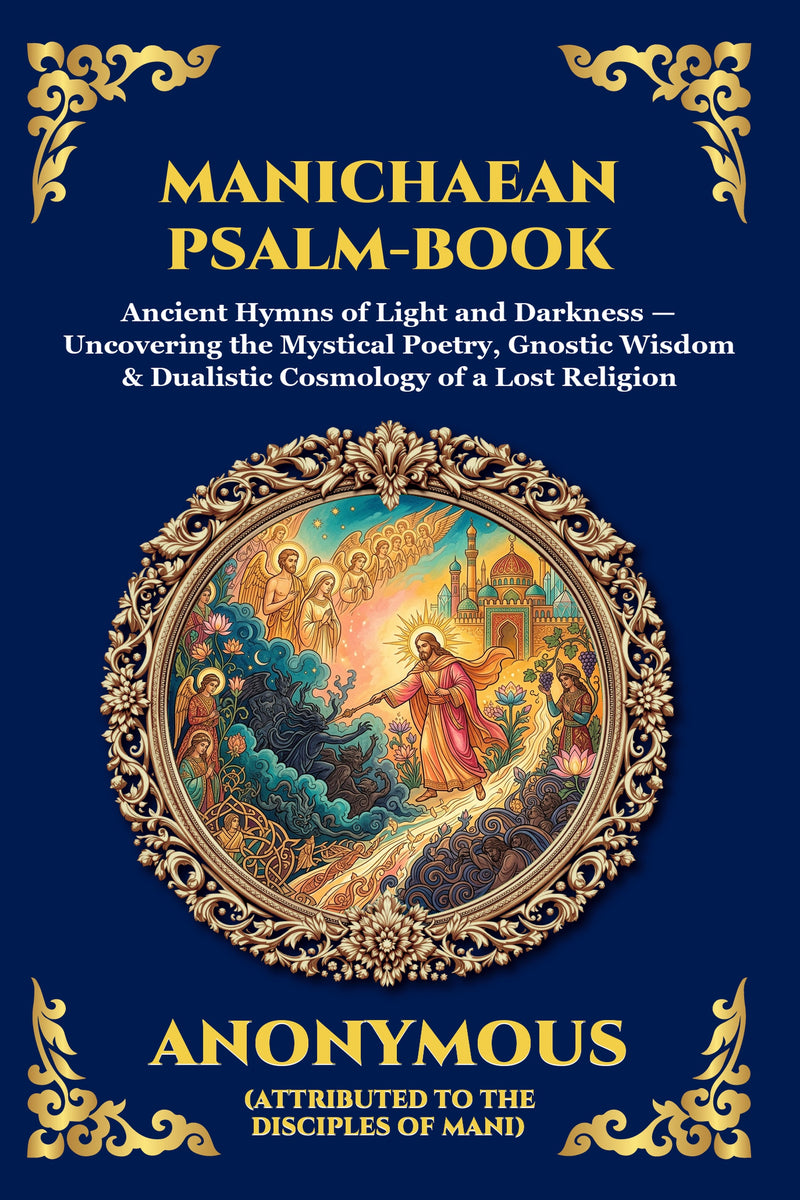
Manichaean Psalm-Book — Large Print
The Manichaean Psalm-Book reveals the fervent hymns and prayers of a faith that once rivaled early Christianity but was nearly obliterated by persecution. This rare text offers a firsthand glimpse into Manichaeism's radical dualism, where light and darkness eternally clash.
or free app
10,000+ hrs library
30-day guarantee
The complete Manichaean Psalm-Book from 3rd-4th century Egypt appears here in modern English translation with online access and audiobook narration for members.
Large Print Edition. The complete, unabridged text set in a larger, easy-on-the-eyes typeface for comfortable reading.
Have you ever wondered why one of the most widespread and powerful religions of the ancient world completely vanished from the pages of history?
The Manichaean Psalm-Book offers an incredibly rare, firsthand glimpse into the heart of Manichaeism, a global faith that once rivaled early Christianity before being systematically persecuted into extinction. Founded in the third century by the visionary prophet Mani, this religion taught a radical and uncompromising dualism: the universe is a battleground between two eternal, opposing kingdoms—the Kingdom of Light (representing spirit, truth, and goodness) and the Kingdom of Darkness (representing matter, ignorance, and evil). For centuries, the teachings of Mani were known to the modern world only through the bitter writings of the orthodox enemies who destroyed them.
That all changed with the miraculous discovery of authentic Manichaean texts in Egypt, among which was the awe-inspiring Manichaean Psalm-Book. This text does not offer dry theological treatises; instead, it is a vibrant, deeply emotional collection of the actual hymns, prayers, and psalms sung by the ancient faithful. These poetic verses were used in their daily worship, festivals, and mourning rituals, serving as a constant reminder of the soul's tragic fall into the physical body and its desperate, beautiful hope of returning to the divine source.
As you read these ancient hymns, you will witness the agonizing struggle of the spiritual seeker trying to navigate a world they believed was inherently flawed. The poetry vividly describes the "living soul" being devoured by darkness, the saving grace of divine messengers, and the ultimate, triumphant liberation of the light particles returning to the heavens. This modern exploration of the Manichaean Psalm-Book opens a portal to a rich, esoteric tradition that profoundly influenced the development of Western and Eastern mysticism.
What You’ll Discover in This Book:
The Lost Voices of Manichaeism Experience the authentic spiritual poetry and hymns of the Manichaean Psalm-Book, offering a direct connection to the believers of a forgotten global religion.
The Cosmic War of Light and Darkness Explore a dramatic, dualistic cosmology where the human soul is caught in an eternal struggle to free itself from the corruption of the material world.
Mystical Gnostic Wisdom Uncover esoteric teachings concerning the origins of the universe, the tragic imprisonment of the divine spark, and the path to ultimate salvation.
A Masterpiece of Ancient Literature Delve into the rich symbolism, emotional depth, and striking imagery used by ancient writers to articulate their deepest spiritual anxieties and hopes.
Whether you are a scholar of religious history, a student of Gnosticism, or a spiritual seeker fascinated by the esoteric traditions of the past, the Manichaean Psalm-Book is an essential and transformative read. Rediscover the sacred songs that once echoed across empires and learn the secrets of the Kingdom of Light.
| Formats | eBook (EPUB + PDF) · Audiobook · Paperback · Hardcover · Large Print |
| Language | English |
| Trim size (print) | 6 × 9 in |
| Binding | Paperback — perfect-bound · Hardcover — casewrap |
| Large Print edition | Same text in a larger, easy-read type — a larger font, not a larger trim |
| Print pricing | Every physical book at our true cost — at-cost, no profit (members) |
| Library | 873 restored titles, always growing |
| Composed | 3rd-4th century AD |
| Original language | Coptic, likely translated from Syriac or Middle Persian originals |
| Source tradition | Coptic manuscripts from Medinet Madi, Egypt |
| Translation basis | Public-domain scholarly translation, rendered in clear modern English |
| Length | 2,579 words · ~10 min reading |
| Reading level | Grade 14 · rich, literary prose (this modern-English edition) |
| Edition | Modern English translation · 2026 |
Member reviews for this edition are collected as readers finish it — be the first. Across the library: 12,000+ books shipped, every plan covered by a 365-day print guarantee.
About this edition
The complete, unabridged text in clear modern English — faithful to the original, never simplified. Every paragraph is checked against the source, so nothing is cut, summarised, or paraphrased away. It reads cleanly for today while keeping the original meaning intact.
This text survives in Coptic manuscripts discovered at Medinet Madi, Egypt in the 1920s. Our edition derives from the standard scholarly translations and renders the ancient Manichaean hymns in clear, accessible modern English.
- Complete & unabridgedVerified paragraph by paragraph against the source — never a scan, never abridged.
- Modern English, faithfulReadable today, with the author’s meaning kept intact. Readable — not simplified.
- Every format, one membershipRead in your browser or the free app, or listen to the full audiobook.
Included free with your membership
Cancel anytime, one click · 30-day money-back guarantee
Edition last updated June 2026
Begin reading Manichaean Psalm-Book — Large Print
In clear modern English — the complete text is included with membership.
The World That Made These Psalms
To read Manichaean psalms with any depth of understanding, one must have at least a working familiarity with the cosmological system they presuppose. This is not a simple system. It is, in fact, one of the most elaborate mythological architectures ever constructed by a human religious imagination, and it repays careful attention not only because it illuminates the specific imagery and theology of the psalms, but because it is genuinely fascinating in its own right — a monument to the human capacity for systematic mythological thinking.
At the foundation of everything lies a primordial dualism. Before the creation of the world, there existed two eternal, uncreated principles: the Realm of Light, presided over by the Father of Greatness, and the Realm of Darkness, presided over by the Prince of Darkness. These two realms existed in absolute separation — the Light in the north, radiant, peaceful, and overflowing with divine attributes; the Darkness in the south, chaotic, violent, and hungry. The catastrophe that set the cosmic drama in motion was the moment when the forces of Darkness, driven by their inherent aggression and their perception of the Light's beauty, launched an invasion across the boundary between the two realms.
The Father of Greatness, unwilling to sacrifice any part of his divine nature in combat with the forces of Darkness, called forth a series of emanations to respond to the attack. The first of these was the Primal Man — not the human being of later creation, but a cosmic entity sent to do battle with the demons of Darkness. The Primal Man was defeated. He was swallowed by the forces of Darkness, and the divine particles of Light that constituted his armor — the Five Light Elements — were consumed and absorbed into the material of Darkness. This was the primordial catastrophe, the original fall, the wound at the heart of the cosmos.
What followed was the long, elaborate process of cosmic rescue. The Father of Greatness called forth further emanations — the Living Spirit, the Mother of Life, and eventually the Third Messenger and the Jesus of Light — to construct the material universe as a mechanism for extracting the imprisoned particles of Light from the Darkness and returning them to their source. The sun and moon were understood as vessels of Light, slowly filling with rescued divine particles and ferrying them back to the Realm of Light. The stars were Light in transit. The entire visible cosmos was, in this vision, a vast salvage operation, a cosmic recycling plant for imprisoned divinity.
Human beings occupied a particularly poignant and pivotal position in this system. According to Manichaean teaching, the human body was created by the demonic Archons of Darkness specifically as a more sophisticated prison for the Light — a trap designed to keep divine particles bound in matter through the mechanisms of sexual reproduction, which perpetually created new bodies to imprison new particles of Light. The human soul, however, was understood as a fragment of divine Light, a spark of the original luminosity that had been swallowed in the primordial defeat of the Primal Man. Every human being was therefore simultaneously a prison and a prisoner — a body of Darkness containing a soul of Light.
This is the cosmological drama that the psalms enact, celebrate, mourn, and ultimately transcend. When a Manichaean singer raised his or her voice to sing of the 'light that is imprisoned in the world,' they were not speaking metaphorically. They were describing what they understood to be the literal condition of every living soul. When they sang of longing for the 'Land of Light,' they were expressing a homesickness that was, in their understanding, the deepest and most fundamental feeling available to human consciousness — the ache of a divine particle for its source.
The ethical implications of this cosmology were profound and demanding. If the body was a prison of Darkness and sexuality was the mechanism by which Darkness perpetuated its hold over Light, then the highest spiritual ideal was a life of radical asceticism. The Manichaean community was divided into two tiers: the Elect, who lived lives of strict celibacy, vegetarianism, and poverty, owning nothing and eating only foods — particularly melons, cucumbers, and other light-colored, moisture-rich plants — believed to contain high concentrations of imprisoned Light; and the Hearers or Auditors, the much larger lay community who supported the Elect with food and resources, lived more ordinary lives, and hoped through their service to be reborn eventually as members of the Elect.
This two-tiered structure had important implications for the psalms. Many of the hymns in this collection were composed specifically for liturgical use by the Elect, and they reflect the intense spiritual discipline and the heightened mystical awareness that the Elect's way of life was designed to cultivate. Others were clearly intended for the broader community of Hearers, and they speak in a more accessible register — still theologically sophisticated, but reaching toward emotional directness and devotional warmth rather than esoteric complexity. Reading across these different registers, one gets a remarkably complete picture of a living religious community, with all its internal diversity of spiritual experience and aspiration.
The geographical spread of Manichaeism is itself a remarkable story that bears directly on the nature of the textual tradition we are working with. From its origins in Babylonia, the religion spread westward into the Roman Empire within Mani's own lifetime — he was executed in 274 or 277 CE by the Sasanian Persian king Bahram I, under pressure from the Zoroastrian priestly establishment — and eastward along the Silk Road into Central Asia, where it eventually became the state religion of the Uyghur Khaganate in the eighth century, and into China, where small communities survived into the seventeenth century. This extraordinary geographical dispersal means that Manichaean texts survive in a remarkable variety of languages and scripts, each representing a different cultural adaptation of the core tradition.
The Coptic texts from Egypt, which form the primary basis of this volume, represent the western branch of the tradition and were likely composed or translated in the third and fourth centuries CE. They were discovered near the town of Medinet Madi in the Fayyum region of Egypt in 1929, and their publication by C.R.C. Allberry in 1938 remains a landmark in the study of ancient religion. The collection includes psalms attributed to various figures within the Manichaean tradition — psalms of the Bema festival (the annual commemoration of Mani's death and ascension), psalms attributed to the apostle Thomas, psalms of the wandering soul, and many others — and together they constitute one of the most substantial bodies of Manichaean liturgical poetry to have survived from antiquity.
What strikes the reader immediately upon encountering these texts is their literary sophistication. These are not simple folk hymns or naive devotional verses. They are carefully crafted poems, structured with deliberate artistry, employing a range of rhetorical devices — parallelism, anaphora, extended metaphor, dramatic dialogue — that reflect a deep familiarity with the literary traditions of late antiquity. At the same time, they are animated by a spiritual urgency that gives them an emotional directness and power that can cut through the considerable barriers of time and cultural distance. When a psalmist cries out, 'I am a god, born from gods, shining, glittering, luminous, radiant — but now I have fallen into this prison,' the theological framework may be unfamiliar, but the feeling — the sense of displacement, of exile, of longing for a home one can barely remember — speaks to something universal in human experience.
How to Read What Follows
There is a particular kind of reading that ancient religious texts require — and reward. It is neither the purely historical reading that treats the text as a document to be mined for factual information about the past, nor the purely devotional reading that approaches it as a living scripture demanding personal submission. It is something in between: a reading that takes the text seriously as an attempt to articulate genuine spiritual experience and genuine theological reflection, while also maintaining the critical awareness that allows us to understand it in its historical context and to notice its complexities, its tensions, and its silences.
The psalms in this collection reward that kind of reading enormously. They are, on one level, historical documents that tell us a great deal about the practice, belief, and self-understanding of a specific religious community in a specific time and place. They tell us how Manichaeans understood the soul's journey through the cosmos. They tell us how they conceptualized the figure of Mani — as a divine messenger, as a suffering savior, as a luminous apostle who descended into the darkness of the material world to rescue imprisoned Light. They tell us how they thought about death, about the afterlife, about the relationship between the individual soul and the cosmic drama of salvation.
But they are also, on another level, simply extraordinary poems. They contain images of startling beauty — the soul described as a pearl cast into the sea, as a lamp whose oil is running low, as a bird whose wings have been clipped by the weight of the body. They contain passages of genuine theological sublimity, moments where the language strains against its own limits in the attempt to describe the indescribable — the silence of the Realm of Light, the peace that awaits the soul when it has finally shed the last of its material bonds and returned to its divine source. And they contain passages of raw emotional intensity — cries of anguish, expressions of longing, declarations of faith that feel earned rather than merely asserted.
One of the most important things to understand about these psalms is that they were not meant to be read silently by individuals. They were meant to be sung, communally, in the context of elaborate liturgical ceremonies. The Bema festival, for instance — the most important annual celebration in the Manichaean calendar — involved the erection of a raised throne or dais (the bema itself) that remained empty throughout the ceremony, representing the presence of the absent Mani, who was understood to be spiritually present even though physically dead. The community would gather around this empty throne, and the psalms of the Bema would be sung as a kind of extended meditation on Mani's life, death, ascension, and ongoing spiritual presence. To read these psalms with that context in mind — to imagine the voices rising together in the lamplight, the empty throne at the center of the gathering, the shared understanding of a community that defined itself by its longing for the Light — is to encounter them in something much closer to their original power.
Music was not incidental to Manichaeism — it was theologically significant. Sound, like light, was understood as a manifestation of the divine, and the act of singing was understood as a form of spiritual work, a way of participating in the cosmic process of liberating Light from Darkness. When the Elect sang their psalms, they were not merely expressing devotion; they were, in the theology of their tradition, actively contributing to the great work of salvation. This gives the liturgical poetry of Manichaeism a weight and urgency that distinguishes it from purely aesthetic or entertainment-oriented verse. Every word was chosen with care. Every image was theologically loaded. Every performance of a psalm was an act of cosmic significance.
For the modern reader approaching these texts, there is also something profoundly moving about the circumstances of their survival. The communities that sang these hymns were persecuted almost everywhere they existed. In the Roman Empire, the emperor Diocletian issued an edict against them in 302 CE, ordering their leaders burned alive and their books destroyed. Later Christian emperors were no less hostile. In Persia, the Zoroastrian establishment viewed them as dangerous heretics. In the Islamic world, they faced periodic waves of violent suppression. In China, they were repeatedly banned and driven underground. The fact that any of their texts survived at all is something close to miraculous — a testament to the dedication of communities who copied and preserved their sacred books under conditions of extreme danger, who buried them in desert sands or carried them across mountain passes to keep them out of the hands of those who would destroy them.
The manuscripts that form the basis of this volume were hidden in the Egyptian desert sometime in the medieval period, probably by a community that feared — with good reason — that they would be destroyed if discovered. They lay in the sand for centuries, preserving in their Coptic letters the voices of people who had lived and sung and believed and suffered and hoped, and who had entrusted their most sacred expressions to the dry air of the desert in the hope that someday, someone would find them and understand. We are that someone. We are the readers they were writing for, even if they could not have imagined us.
This is not a book that requires any prior knowledge of Manichaeism, of Coptic, of late antique religion, or of the history of the ancient Near East. Everything you need to understand the psalms and their context will be provided as you read. But it is a book that asks something of its reader: a willingness to sit with unfamiliar ideas, to take seriously a worldview very different from any that dominates the modern world, and to approach with genuine openness the possibility that these ancient singers had something real to say — about the nature of the soul, about the experience of exile and longing, about the possibility of return — that remains worth hearing.
Cancel anytime, one click · 30-day money-back guarantee
Founding annual rate available now — your price locks for life when you join.
Not ready? Get this free chapter by email — read it anytime.
✓ Sent — check your inbox for Manichaean Psalm-Book — Large Print.
Questions about Manichaean Psalm-Book — Large Print
What is Manichaeism and why was this psalm-book created?
Manichaeism was a major world religion founded by the prophet Mani in 3rd-century Persia. The Manichaean Psalm-Book contains liturgical hymns expressing the faith's distinctive dualistic theology, where light and darkness represent opposing cosmic principles in eternal conflict.
Why don't we hear much about Manichaean texts today?
Manichaeism faced systematic persecution from both Christian and Islamic authorities, leading to the destruction of most Manichaean literature. The Manichaean Psalm-Book survived only because copies were preserved in the dry climate of Egypt until their modern discovery.
Is the Manichaean Psalm-Book connected to biblical psalms?
While the Manichaean Psalm-Book shares the hymnic format of biblical psalms, it expresses distinctly Manichaean theology rather than Jewish or Christian doctrine. It was never part of any biblical canon and represents an entirely separate religious tradition.
Shipping & returns
Billing & membership
More from the library


Explore Gnostic & Nag Hammadi
- A Valentinian Exposition · Attributed to a follower of Val...
- Book of Baruch of the Gnostics · Attributed to Justin the Gnostic
- Coptic Gospel of the Twelve
- Manichaean Homilies · Attributed to the prophet Mani
- Ginza Rabba · Attributed to Mandaean priests
- Apocalypse of James · Attributed to James the Just
- Manichaean Psalm-Book · Attributed to the prophet Mani
- Paraphrase of Shem · Attributed to early Gnostic wri...
- Third Epistle to the Corinthians · Attributed to the Apostle Paul
- Antitheses of Marcion · Attributed to Marcion of Sinope
- Hymn of the Pearl · Attributed to the Apostle Thomas
- Secret Gospel of Mark · Attributed to Mark
- Wisdom of Solomon · Attributed to King Solomon
- Vision of Paul
- Gospel of Gamaliel
- Marcion: Antitheses · Attributed to Marcion of Sinope
- Basilides: Fragments · Attributed to Basilides
- Gospel of Thomas · Attributed to Thomas the Apostle
- Prayer of Thanksgiving · Attributed to Hermes Trismegistus
- Second Treatise of the Great Seth · Attributed to a Gnostic sage
- Marcion’s Gospel · Attributed to Marcion of Sinope
- Heracleon Fragments · Attributed to Heracleon
- Excerpts from Theodotus · Attributed to Theodotus
- Ptolemy’s Letter to Flora · Attributed to Ptolemy the Gnostic
- Epistle of the Apostles · Various early Christian authors
- Oxyrhynchus 840
- Life of Adam and Eve
- The Second Apocalypse of James · Anonymous early Christian mystic
- The First Apocalypse of James · Anonymous Gnostic writer
- The Interpretation of Knowledge · Attributed to an anonymous Gnos...