Exegesis on the Soul — Large Print
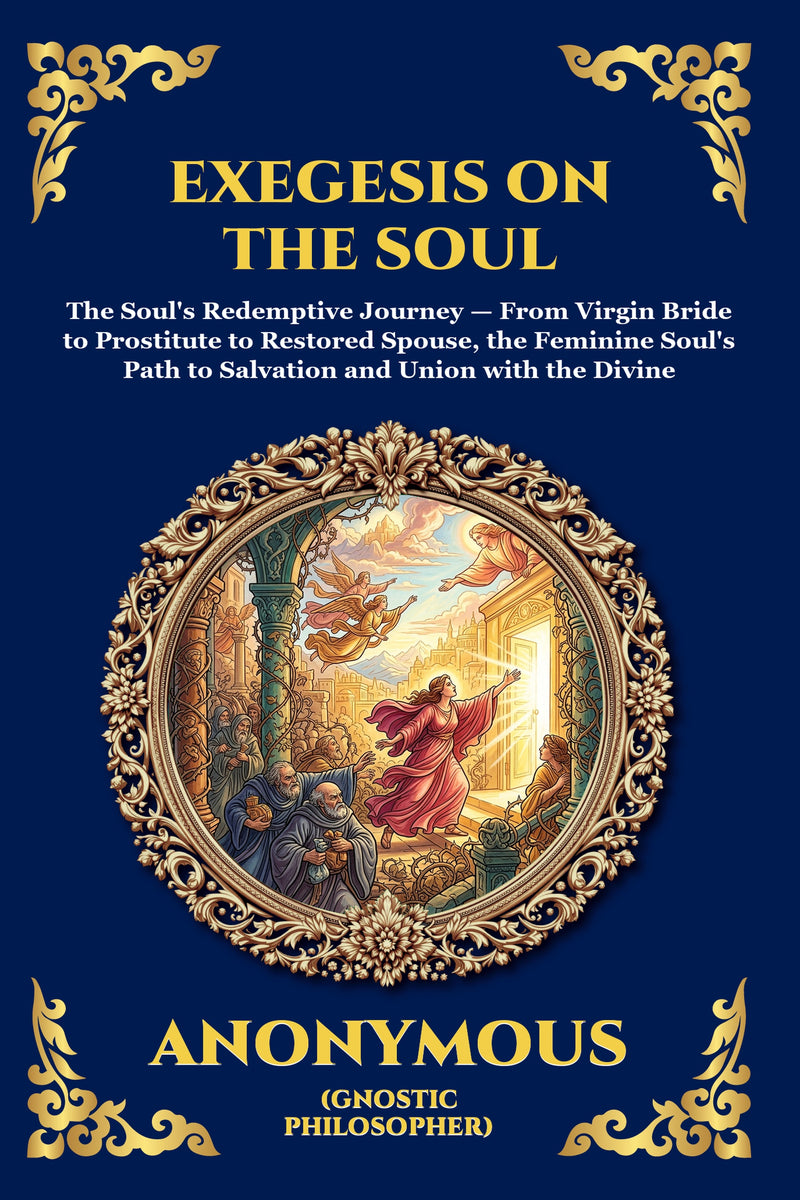
An anonymous ancient author from the Nag Hammadi library presents the soul as a living female protagonist, wandering far from her divine origins. Excluded from the biblical canon, this allegory captures the soul's struggle against the material world's corruption while holding onto an unextinguished divine spark.
or free app
10,000+ hrs library
30-day guarantee
Exegesis on the Soul, the 2nd-3rd century Gnostic text discovered among Egypt's 1945 Nag Hammadi codices, appears complete in modern English translation online with member audiobook narration.
Large Print Edition. The complete, unabridged text set in a larger, easy-on-the-eyes typeface for comfortable reading.
Have you ever wondered why the human spirit feels an undeniable longing for a lost spiritual home?
In the Exegesis on the Soul, one of the most evocative and poetic texts discovered in the Nag Hammadi library, an anonymous ancient author presents a stunning allegory of the human condition. This remarkable work captures the existential ache of humanity, depicting the soul not as an abstract concept, but as a living, breathing female protagonist who has wandered far from her divine origins.
Tricked and trapped within the physical realm, the soul is subjected to the corrupting influences of the material world. She loses her memory, her purity, and her spiritual sight. However, her inherent divine spark cannot be entirely extinguished. When the pain of the material world becomes too great, she turns inward, remembers her heavenly Father, and begins the arduous but beautiful process of repentance. Her sincere plea triggers a divine intervention, leading to her spiritual cleansing, rebirth, and ultimate reunion with the divine light.
Far more than an ancient relic, this text bridges psychology, mysticism, and early Christian philosophy, offering a profound commentary on trauma, recovery, and spiritual awakening. It challenges readers to examine their own attachments to the material world and to recognize the divine spark waiting to be reignited within them.
What You Will Discover in This Modern Translation:
The Allegory of the Fallen Soul: Follow the deeply moving narrative of the soul’s descent into the physical world and her struggles with material corruption.
The Power of Sincere Repentance: Explore the transformative moment when the soul realizes her plight and turns back toward the divine, highlighting themes of free will and spiritual awakening.
The Divine Rescue: Understand the esoteric concept of the "spiritual marriage" and the arrival of the heavenly Bridegroom who restores the soul to her original glory.
A Window into Gnostic Mysticism: Gain unparalleled insight into early esoteric Christian thought and the Nag Hammadi texts that shaped alternative spiritual movements.
Timeless Psychological Insights: Discover how this ancient myth mirrors modern understandings of trauma, dissociation, healing, and self-actualization.
Whether you are exploring this work for its historical significance, its rich mythological symbolism, or its deep spiritual wisdom, the Exegesis on the Soul offers profound guidance for the modern seeker.
Step into a story of unparalleled mystical depth and discover the timeless lessons of the Exegesis on the Soul. Begin your journey today.
| Formats | eBook (EPUB + PDF) · Audiobook · Paperback · Hardcover · Large Print |
| Language | English |
| Trim size (print) | 6 × 9 in |
| Binding | Paperback — perfect-bound · Hardcover — casewrap |
| Large Print edition | Same text in a larger, easy-read type — a larger font, not a larger trim |
| Print pricing | Every physical book at our true cost — at-cost, no profit (members) |
| Library | 873 restored titles, always growing |
| Composed | 2nd-3rd century AD |
| Original language | Coptic |
| Source tradition | Nag Hammadi Codex II |
| Translation basis | Public-domain scholarly translation, rendered in clear modern English |
| Length | 2,690 words · ~11 min reading |
| Reading level | Grade 8 · clear and comfortable (this modern-English edition) |
| Edition | Modern English translation · 2026 |
Member reviews for this edition are collected as readers finish it — be the first. Across the library: 12,000+ books shipped, every plan covered by a 365-day print guarantee.
About this edition
The complete, unabridged text in clear modern English — faithful to the original, never simplified. Every paragraph is checked against the source, so nothing is cut, summarised, or paraphrased away. It reads cleanly for today while keeping the original meaning intact.
This text survives in Nag Hammadi Codex II, discovered in Egypt in 1945. This edition derives from the standard public-domain scholarly translation and renders it in clear modern English.
- Complete & unabridgedVerified paragraph by paragraph against the source — never a scan, never abridged.
- Modern English, faithfulReadable today, with the author’s meaning kept intact. Readable — not simplified.
- Every format, one membershipRead in your browser or the free app, or listen to the full audiobook.
Included free with your membership
Cancel anytime, one click · 30-day money-back guarantee
Edition last updated June 2026
What’s inside
Exegesis on the Soul — Large Print — complete and unabridged: all 8 sections included with membership, plus the full audiobook.
Begin reading Exegesis on the Soul — Large Print
In clear modern English — the complete text is included with membership.
Chapter 1
Wise men of old gave the soul a feminine name. Indeed, she is female in her nature as well. She even has a womb.
As long as she was alone with the Father, she was a virgin, androgynous in form. But when she fell down into a body and came into this life, she fell into the hands of many robbers. The wanton creatures passed her from one to another and abused her. Some made use of her by force, while others did so by seducing her with gifts. In short, they defiled her and she lost her virginity.
In her body she prostituted herself and gave herself to one and all, considering each man she was about to embrace to be her husband. When she had given herself to wanton, unfaithful adulterers so that they might make use of her, she sighed deeply and repented. But even when she turns her face from those adulterers, she runs to others, and they compel her to live with them and render service to them upon their bed as if they were her masters. Out of shame she no longer dares to leave them, while they deceive her for a long time, pretending to be faithful, true husbands, as if they greatly respected her. And after all this they abandon her and go.
She then becomes a poor, desolate widow, without help. Not even a measure of food was left her from the time of her affliction. For from them she gained nothing except the defilements they gave her while they had sexual intercourse with her. And her children by the adulterers are dumb, blind, and sickly. They are feebleminded.
But when the Father who is above visits her and looks down upon her and sees her sighing — with her sufferings and disgrace — and repenting of the prostitution in which she engaged, and when she begins to call upon his name with all her heart so that he might help her, saying, "Save me, my Father, for behold I will render an account to you, for I abandoned my house and fled from my maiden's quarters. Restore me to yourself again" — when he sees her in such a state, he will count her worthy of his mercy, for many are the afflictions that have come upon her because she abandoned her house.
Now concerning the prostitution of the soul, the Holy Spirit prophesies in many places. For he said through the prophet Jeremiah,
Chapter 2
If a husband divorces his wife and she goes and takes another man, can she return to him after that? Has not that woman utterly defiled herself? "And you prostituted yourself to many shepherds and you returned to me!" said the Lord. "Take an honest look and see where you prostituted yourself. Were you not sitting in the streets defiling the land with your acts of prostitution and your vices? And you took many shepherds as a stumbling block for yourself. You became shameless with everyone. You did not call on me as kinsman or as father or as the author of your virginity."
Again it is written in the prophet Hosea:
Come, go to law with your mother, for she is not to be a wife to me nor I a husband to her. I shall remove her prostitution from my presence, and I shall remove her adultery from between her breasts. I shall make her naked as on the day she was born, and I shall make her desolate like a land without water, and I shall make her longingly childless. I shall show her children no pity, for they are children of prostitution, since their mother prostituted herself and put her children to shame. For she said, "I shall prostitute myself to my lovers. It was they who gave me my bread and my water and my garments and my clothes and my wine and my oil and everything I needed." Therefore, behold, I shall shut them up so that she shall not be able to run after her adulterers. And when she seeks them and does not find them, she will say, "I shall return to my former husband, for in those days I was better off than now."
Again he said in Ezekiel:
It came to pass after much depravity, said the Lord, you built yourself a brothel and you made yourself a beautiful place in the streets. And you built yourself brothels on every lane, and you wasted your beauty, and you spread your legs in every alley, and you multiplied your acts of prostitution. You prostituted yourself to the sons of Egypt, those who are your neighbors, men great of flesh.
But what does "the sons of Egypt, men great of flesh" mean, if not the domain of the flesh and the perceptible realm and the affairs of the earth, by which the soul has become defiled here, receiving bread from them, as well as wine, oil, clothing, and all the other external nonsense surrounding the body — the things she thinks she needs.
Chapter 3
But as to this prostitution, the apostles of the savior commanded: "Guard yourselves against it, purify yourselves from it," speaking not just of the prostitution of the body but especially that of the soul. For this reason the apostles write to the churches of God, that such prostitution might not occur among us.
Yet the greatest struggle has to do with the prostitution of the soul. From it arises the prostitution of the body as well. Therefore Paul, writing to the Corinthians, said, "I wrote you in the letter, 'Do not associate with prostitutes,' not at all the prostitutes of this world or the greedy or the thieves or the idolaters, since then you would have to go out from the world." Here he is speaking spiritually. "For our struggle is not against flesh and blood," as he said, "but against the world rulers of this darkness and the spirits of wickedness."
As long as the soul keeps running about everywhere, copulating with whomever she meets and defiling herself, she exists suffering her just deserts. But when she perceives the straits she is in and weeps before the father and repents, then the father will have mercy on her and he will make her womb turn from the external domain and will turn it again inward, so that the soul will regain her proper character. For it is not so with a woman. The womb of the body is inside the body like the other internal organs, but the womb of the soul is around the outside like the male genitalia, which is external.
So when the womb of the soul, by the will of the father, turns itself inward, it is baptized and is immediately cleansed of the external pollution which was pressed upon it, just as garments, when dirty, are put into the water and turned about until their dirt is removed and they become clean. And so the cleansing of the soul is to regain the newness of her former nature and to turn herself back again. That is her baptism.
Then she will begin to rage at herself like a woman in labor, who writhes and rages in the hour of delivery. But since she is female, by herself she is powerless to beget a child. From heaven the father sent her her man, who is her brother, the firstborn. Then the bridegroom came down to the bride. She gave up her former prostitution and cleansed herself of the pollutions of the adulterers, and she was renewed so as to be a bride. She cleansed herself in the bridal chamber; she filled it with perfume; she sat in it waiting for the true bridegroom. No longer does she run about the marketplace, copulating with whomever she desires, but she continued to wait for him — "When will he come?" — and to fear him, for she did not know what he looked like: she no longer remembered, from the time she fell from her father's house. But by the will of the father she dreamed of him like a woman in love with a man.
Then the bridegroom, according to the father's will, came down to her into the bridal chamber, which had been prepared. And he decorated the bridal chamber.
Chapter 4
For since that marriage is not like a carnal marriage, those who come together in it will be satisfied with that union. They do not leave one another burdened and annoyed by physical desire, turning their faces away as they do after bodily intercourse. This marriage is different. Once they unite with one another, they become a single life. This is why the prophet spoke of the first man and the first woman: "They will become a single flesh." For they were originally joined to one another when they were with the Father, before the woman led the man astray — he who is her brother. This marriage has brought them back together again, and the soul has been joined to her true love, her real master, as it is written: "For the master of the woman is her husband."
Then gradually she recognized him, and she rejoiced once more, weeping before him as she remembered the disgrace of her former widowhood. And she adorned herself still more, so that he might be pleased to stay with her.
And the prophet said in the Psalms: "Hear, my daughter, and see and incline your ear and forget your people and your father's house, for the king has desired your beauty, for he is your lord."
For he requires her to turn her face away from her people and the multitude of her adulterers, in whose midst she once lived, and to devote herself only to her king, her real lord, and to forget the house of the earthly father, with whom things went so badly for her, and instead to remember her Father who is in heaven. So too it was said to Abraham: "Come out from your country and your kinsfolk and from your father's house."
And so, when the soul had adorned herself again in her beauty, she enjoyed her beloved, and he also loved her. When she had intercourse with him, she received from him the seed that is the life-giving spirit, so that by him she bears good children and rears them. For this is the great and perfect marvel of birth. And so this marriage is made perfect by the will of the Father.
Now it is fitting that the soul regenerate herself and become again what she formerly was. The soul then moves of her own accord. She received the divine nature from the Father for her rejuvenation, so that she might be restored to the place where she originally had been. This is the resurrection from the dead. This is the ransom from captivity. This is the upward journey of ascent to heaven. This is the way of ascent to the Father. Therefore the prophet said:
Chapter 5
Praise the Lord, O my soul, and all that is within me, praise his holy name. My soul, praise God, who forgave all your sins, who healed all your sicknesses, who ransomed your life from death, who crowned you with mercy, who satisfies your longing with good things. Your youth will be renewed like an eagle's.
When she becomes young again, she will ascend, praising the Father and her brother, by whom she was rescued. It is by being born again that the soul will be saved. And this comes not through rote phrases, or professional skills, or book learning — it is the grace of God, the gift of God. For such is this heavenly thing. Therefore the Savior cries out: "No one can come to me unless my Father draws him and brings him to me; and I myself will raise him up on the last day."
It is therefore fitting to pray to the Father and to call on him with our whole soul — not outwardly with the lips, but with the spirit, which is inward, which came forth from the depth — sighing, repenting for the life we have lived, confessing our sins, perceiving the empty deception we were caught in and the empty zeal, weeping over how we were in darkness and in the wave, mourning for ourselves so that he might have pity on us, hating ourselves for what we are now.
Again, the Savior said: "Blessed are those who mourn, for it is they who will be pitied; blessed are those who are hungry, for it is they who will be filled."
Again he said: "If one does not hate his soul, he cannot follow me." For the beginning of salvation is repentance. Therefore, before Christ's appearance came John, preaching the baptism of repentance.
And repentance takes place in distress and grief. But the Father is good and loves humanity, and he hears the soul that calls upon him and sends it the light of salvation. Therefore he said through the spirit to the prophet: "Say to the children of my people, 'If your sins extend from earth to heaven, and if they become red like scarlet and blacker than sackcloth, and if you return to me with all your soul and say to me, My Father! — I will heed you as a holy people.'"
Cancel anytime, one click · 30-day money-back guarantee
Founding annual rate available now — your price locks for life when you join.
Not ready? Get this free chapter by email — read it anytime.
✓ Sent — check your inbox for Exegesis on the Soul — Large Print.
Questions about Exegesis on the Soul — Large Print
Why isn't the Exegesis on the Soul in the Bible?
The Exegesis on the Soul was composed in the 2nd-3rd century AD, after the core New Testament writings, and reflects Gnostic theological perspectives that differed from mainstream Christianity during the period of canonical formation.
What does the Exegesis on the Soul actually contain?
The Exegesis on the Soul presents an allegorical narrative depicting the human soul as a female figure who falls from divine origins into material corruption, then seeks redemption and return to her heavenly home.
Who wrote the Exegesis on the Soul?
The Exegesis on the Soul is anonymous, though scholars generally attribute it to Gnostic Christian circles, possibly Valentinian communities, based on its theological themes and literary style from the 2nd-3rd century AD.
Is Exegesis on the Soul free to read?
The opening of the text is free to read below. Members read and listen to the complete work — and the entire Lost & Forbidden Library — free.
What is Exegesis on the Soul?
Have you ever wondered why the human spirit feels an undeniable longing for a lost spiritual home?
How long is Exegesis on the Soul?
8 chapters (~2,698 words) in this restored edition.
Shipping & returns
Billing & membership
More from the library


Explore Gnostic & Nag Hammadi
- A Valentinian Exposition · Attributed to a follower of Val...
- Book of Baruch of the Gnostics · Attributed to Justin the Gnostic
- Coptic Gospel of the Twelve
- Manichaean Homilies · Attributed to the prophet Mani
- Ginza Rabba · Attributed to Mandaean priests
- Apocalypse of James · Attributed to James the Just
- Manichaean Psalm-Book · Attributed to the prophet Mani
- Paraphrase of Shem · Attributed to early Gnostic wri...
- Third Epistle to the Corinthians · Attributed to the Apostle Paul
- Antitheses of Marcion · Attributed to Marcion of Sinope
- Hymn of the Pearl · Attributed to the Apostle Thomas
- Secret Gospel of Mark · Attributed to Mark
- Wisdom of Solomon · Attributed to King Solomon
- Vision of Paul
- Gospel of Gamaliel
- Marcion: Antitheses · Attributed to Marcion of Sinope
- Basilides: Fragments · Attributed to Basilides
- Gospel of Thomas · Attributed to Thomas the Apostle
- Prayer of Thanksgiving · Attributed to Hermes Trismegistus
- Second Treatise of the Great Seth · Attributed to a Gnostic sage
- Marcion’s Gospel · Attributed to Marcion of Sinope
- Heracleon Fragments · Attributed to Heracleon
- Excerpts from Theodotus · Attributed to Theodotus
- Ptolemy’s Letter to Flora · Attributed to Ptolemy the Gnostic
- Epistle of the Apostles · Various early Christian authors
- Oxyrhynchus 840
- Life of Adam and Eve
- The Second Apocalypse of James · Anonymous early Christian mystic
- The First Apocalypse of James · Anonymous Gnostic writer
- The Interpretation of Knowledge · Attributed to an anonymous Gnos...
Exegesis on the Soul — Large Print
The Exegesis on the Soul
The Allegory of the Soul's Fall and Restoration — How the Feminine Soul Was Defiled, Repented, and Was Returned to Her Bridegroom by the Father
Library of Alexandria Press
The Exegesis on the Soul
© Copyright 2026 Library of Alexandria Press. All rights reserved.
Published by Library of Alexandria Press
Printed in the United States of America
It is not legal to copy, share, or send any part of this document in either digital or printed form without written permission from the publisher, except short quotes in a book review.
Table of Contents
Introduction
Chapter 1
Chapter 2
Chapter 3
Chapter 4
Chapter 5
Chapter 6
Chapter 7
Introduction
Somewhere between the second and fourth centuries of the Common Era, in the intellectual and spiritual ferment of the ancient Mediterranean world, an unknown author set down one of the most haunting and beautiful allegories ever composed. It is a story about a soul — not a particular soul belonging to a named individual, but the soul in its universal, archetypal sense. It is a story about falling, about forgetting, about the long and painful journey back to what was once whole. It is, in the deepest sense, a story about every human being who has ever drawn breath and wondered why existence so often feels like exile.
The text we now call the Exegesis on the Soul was discovered in December 1945 near the town of Nag Hammadi in Upper Egypt, when a local farmer named Muhammad Ali al-Samman unearthed a sealed earthenware jar containing thirteen leather-bound codices. What he found inside those ancient books would reshape our understanding of early Christianity, late antique religion, and the extraordinary diversity of spiritual thought that flourished in the first centuries after Christ. Among the texts preserved in those codices — texts that had been buried, perhaps deliberately hidden, perhaps lovingly protected from destruction — was this compact but extraordinarily rich allegorical narrative, nestled in the sixth codex alongside other remarkable writings.
For over a millennium and a half, this text had lain silent in the Egyptian desert. The community or communities that produced and preserved such writings had been suppressed, their libraries scattered or destroyed, their voices silenced by the consolidation of orthodox Christian authority. What survived at Nag Hammadi survived by accident, or by providence, depending on one's perspective. And when scholars finally began the painstaking work of translating and interpreting these Coptic manuscripts — themselves translations from earlier Greek originals — the world discovered that an entire universe of spiritual thought had been waiting patiently beneath the sand.
To read this text today is to enter that universe. It is to encounter a way of thinking about the human condition that is at once ancient and startlingly contemporary, mythological in its language and psychological in its insight. The allegory speaks to something that does not age, something that resonates across cultures and centuries precisely because it addresses the most fundamental questions any conscious being can ask: Who am I? How did I come to be here? What went wrong? And is there a way home?
Before you turn to the text itself, it is worth pausing to understand something of the world that produced it, the tradition from which it emerged, and the interpretive tools that will help you receive its full depth and beauty. This introduction is not meant to exhaust the meaning of what you are about to read — no introduction could, and none should. Great texts resist exhaustion. They give differently to different readers, and they give differently to the same reader at different moments in life. What this introduction aims to do is orient you, to give you enough context that the text can speak to you as directly and powerfully as it spoke to its original audience, and perhaps more so, because you come to it with the accumulated experience of a life already lived in the world the text describes.
The tradition from which this writing emerges is broadly known as Gnosticism — a term that is both useful and problematic, and one that requires some unpacking before we proceed. The word itself derives from the Greek gnosis, meaning knowledge, but not the kind of knowledge one acquires through study or empirical observation. Gnosis is experiential, transformative knowledge — the kind of knowing that changes the knower, that constitutes a kind of awakening rather than mere information transfer. To possess gnosis, in the sense these ancient writers intended, is to know who you truly are, where you came from, and where you are going. It is self-knowledge in the deepest possible sense, and it was understood to be salvific — that is, to bring about liberation or salvation not as a future reward but as an immediate transformation of consciousness.
Gnostic movements were extraordinarily diverse. They drew on Jewish scripture and interpretation, on Platonic philosophy, on Egyptian religion, on early Christian teachings, and on a wide range of mythological traditions circulating throughout the ancient Mediterranean. What they shared, broadly speaking, was a sense that the material world is not the ultimate reality, that the human soul is a divine spark that has somehow become trapped or lost in matter, and that the path to liberation runs through interior knowledge rather than external observance or ritual compliance. They were, in many respects, the mystics and contemplatives of their age — and like mystics in every tradition, they were often regarded with suspicion by institutional authorities who preferred a more manageable and uniform religious practice.
For centuries, our knowledge of Gnostic thought came almost entirely from the writings of their opponents — church fathers like Irenaeus of Lyon, Tertullian, and Epiphanius, who wrote detailed refutations of what they regarded as dangerous heresies. These polemical accounts were invaluable as historical sources, but they were inevitably distorted by their authors' agenda. Reading a description of Gnostic belief written by someone who considered it demonic error is a bit like trying to understand a poem from a hostile critic's summary. You get some of the facts, but you miss the spirit entirely. The Nag Hammadi discovery changed all of that. For the first time, scholars and readers could encounter Gnostic texts as their authors intended them — not as heresy to be refuted, but as revelation to be received.
A Soul Lost and Longing
The particular text before you is remarkable even within the remarkable collection in which it was found. Unlike many Gnostic writings, which are dense with elaborate mythological systems, cascading lists of divine emanations, and complex cosmological hierarchies, this text is relatively spare and focused. It tells a single story, and it tells it with genuine literary artistry. The soul — referred to throughout with feminine pronouns, in keeping with the grammatical gender of the Greek word psyche — begins in a state of original wholeness and divine belonging. She falls into the material world, where she suffers a series of degradations and violations that leave her broken, scattered, and desperate. And then, through a process of genuine repentance and divine compassion, she is restored, reunited with her true nature, and brought home.
This narrative arc — fall, suffering, repentance, restoration — will be familiar to readers acquainted with any number of religious and mythological traditions. It echoes the parable of the Prodigal Son from the Gospel of Luke, which the text itself quotes directly. It resonates with the Platonic myth of the soul's descent into matter and its longing to return to the realm of pure forms. It recalls the suffering servant of the Hebrew prophets, particularly the book of Hosea, with its devastating image of a wife who has prostituted herself and must be reclaimed by a faithful husband. The author of this text was clearly a person of wide reading and deep reflection, someone who could weave together strands from multiple traditions into a coherent and moving whole.
What makes the allegory so powerful is its unflinching honesty about the nature of the soul's predicament. This is not a text that softens the experience of spiritual lostness into something comfortable or easily resolved. The soul's suffering in the material world is described in terms that are raw and sometimes shocking — she is taken advantage of, violated, abandoned by those she trusted, left to fend for herself in a hostile environment. She mistakes her captors for liberators and her chains for ornaments. She forgets, gradually and then completely, what she once was and where she once belonged. The language is allegorical, but the experience it describes is one that anyone who has ever felt profoundly alienated from their own deepest nature will recognize immediately.
This is one of the text's most striking qualities: its psychological acuity. Long before the development of modern depth psychology, before Freud's theories of repression and Jung's explorations of the unconscious, the author of this ancient allegory was mapping the interior landscape of human experience with remarkable precision. The soul's amnesia — her forgetting of her divine origin — functions in the text in ways that are directly analogous to what psychologists would later call dissociation or repression. The false relationships she forms in her fallen state, the way she mistakes counterfeit love for the real thing, the exhaustion and despair that eventually drive her to turn inward — all of these are described with a subtlety and compassion that speaks to lived experience, not merely theological speculation.
Carl Jung himself was deeply interested in Gnostic texts and saw in them an anticipation of many of his own insights about the structure of the psyche. He recognized in the Gnostic myth of the fallen soul a symbolic representation of psychological processes that he had observed clinically — the fragmentation of the self, the alienation from one's deeper nature, the long and painful work of what he called individuation, the process by which a person becomes truly and wholly themselves. Whether or not one accepts the Jungian framework, it offers one productive lens through which to read this ancient text, and it helps explain why the allegory continues to resonate so powerfully with modern readers who may have no particular interest in ancient religion.
But it would be a mistake to reduce this text to psychology, just as it would be a mistake to reduce it to theology or mythology. It operates on all of these levels simultaneously, and its richness derives precisely from that multiplicity. On the theological level, it makes profound claims about the nature of the divine — a God who does not abandon the soul in her fallen state but responds to her cry with compassion and active intervention. On the mythological level, it participates in a vast network of ancient stories about divine beings who descend into the world of matter and must find their way back to the light. On the psychological level, it maps the inner journey of self-recovery with extraordinary precision. And on the literary level, it achieves something genuinely beautiful — a narrative that is spare without being thin, symbolic without being opaque, and emotionally resonant without being sentimental.
The text's use of scripture is particularly worth noting, because it illuminates both the author's method and their intention. Throughout the allegory, the narrative is interrupted by quotations from a wide range of texts — the Hebrew prophets, the Psalms, the Pauline epistles, the Gospels of Matthew and Luke, and the Odyssey of Homer. These quotations are not ornamental. They function as a kind of interpretive key, suggesting that the story being told is not a new story but the oldest story, one that has been told and retold across traditions precisely because it corresponds to something universally true about the human condition. The author is saying, in effect: look, here is the same story in Hosea, and here it is in the Psalms, and here it is in Paul, and here it is in Homer. This is not one culture's myth but the myth — the story beneath all stories.
This intertextual richness is one of the reasons the text rewards slow, attentive reading. Each quotation opens a window onto a larger world of meaning, inviting the reader to follow threads of association across traditions and centuries. At the same time, the text never loses its narrative momentum. The quotations are woven into the allegory so skillfully that they feel less like interruptions than like harmonics — overtones that enrich the primary melody without obscuring it.
Reading Across the Centuries
One of the questions any modern reader inevitably brings to an ancient text is the question of relevance. Why should someone living in the twenty-first century care about a religious allegory composed nearly two thousand years ago by an anonymous author working within a tradition that was suppressed before it could fully develop? It is a fair question, and it deserves a serious answer.
The most honest answer is also the simplest: because the condition the text describes has not changed. Human beings in the ancient Mediterranean world experienced alienation, longing, the sense of being exiled from something essential, the desperate search for connection and meaning in a world that seemed indifferent or hostile to those needs. Human beings today experience exactly the same things. The technological and social context has changed almost beyond recognition, but the interior landscape remains remarkably constant. We still fall. We still forget. We still mistake false intimacies for genuine ones. We still exhaust ourselves in the pursuit of things that cannot satisfy us. And we still, at our best moments, turn inward and cry out for something we cannot quite name but recognize immediately when it responds.
There is also a more specifically intellectual reason to engage with this text seriously. We live in a moment when the religious and philosophical traditions of the West are undergoing significant reassessment. The official narratives — both the orthodox religious ones and the secular rationalist ones — are showing their limitations, and there is widespread hunger for alternative ways of understanding human experience. The Gnostic texts discovered at Nag Hammadi represent exactly such an alternative: a sophisticated, psychologically astute, philosophically serious tradition that was suppressed before it could contribute fully to the development of Western thought. Reading these texts is not merely an act of historical curiosity. It is an act of recovery — the recovery of possibilities that were foreclosed too early, of questions that were silenced before they could be fully explored.
This particular text is an ideal entry point into that recovery. Its relative brevity and narrative clarity make it accessible to readers who might be intimidated by more elaborate Gnostic cosmological systems. Its emotional directness makes it immediately engaging. And its thematic focus — the soul's journey from lostness to restoration — gives it a universality that transcends the specific cultural and religious context of its composition. You do not need to be a scholar of ancient religion to be moved by this story. You need only be a human being who has experienced the feeling of being lost.
That said, some preparation does enhance the reading experience, and this introduction has tried to provide the most essential elements of that preparation. Understanding that the text is an allegory — that the soul is both a theological concept and a psychological reality, that her story is both cosmic myth and interior drama — allows you to hold multiple levels of meaning simultaneously as you read. Understanding the Gnostic context helps you appreciate why the material world is portrayed as it is, and why the soul's restoration requires not mere moral improvement but a fundamental transformation of consciousness. And understanding the text's intertextual method prepares you to notice and appreciate the scriptural and literary quotations that punctuate the narrative.
It is also worth saying something about the translation you are reading. Translating ancient texts is always an act of interpretation as well as transcription, and this is particularly true of texts that survive only in Coptic translations of lost Greek originals. Every translator makes choices — about vocabulary, syntax, tone, and register — that shape the reader's experience in significant ways. The translation presented here has aimed above all for clarity and readability, for the sense that you are reading a living text rather than a museum piece. Where the Coptic is ambiguous, choices have been made in favor of the reading that best preserves the text's emotional and spiritual force. Where technical terms have been retained, they have been explained in context. The goal throughout has been to give you the most direct possible access to what the original author was trying to communicate.
There is something almost miraculous about the fact that this text exists at all. Think of what it survived: the suppression of the community that produced it, the physical deterioration of nearly two millennia, the accident of discovery by a farmer who might easily have burned the codices for fuel, the decades of difficult scholarly work required to translate and interpret them. Each of these was a threshold the text had to cross to reach you, and it crossed all of them. There is a faint but unmistakable irony in the fact that a text about the soul's miraculous preservation and restoration is itself a document that was miraculously preserved and restored. The story and its survival are, in some sense, the same story.
As you prepare to read, it may help to approach the text not as a historical document to be analyzed but as a mirror to be looked into. The soul whose story is told here is not a stranger. She is, in the deepest sense, you — or at least, she is a part of you that you may recognize. Her falling is a falling you know. Her forgetting is a forgetting you have experienced. Her longing is a longing you carry. And her restoration — tentative, hard-won, achingly beautiful — is a restoration you may have glimpsed in your own life, in those moments when something clicks back into place, when you feel, however briefly, that you are exactly where you are supposed to be and exactly who you are supposed to be.
The ancient author who wrote this text understood something that the best spiritual writers in every tradition have understood: that the most universal truths are best conveyed through particular stories. Abstract propositions about the nature of the soul and the possibility of divine redemption can be stated, argued, and refuted. But a story — a story told with honesty and compassion and literary skill — can bypass the defenses of the analytical mind and speak directly to the part of us that already knows these things to be true. This is what great allegory does, and this is what this text does, with a power that has not diminished in nearly two thousand years.
So read slowly. Let the images settle. When a passage strikes you, pause with it rather than rushing past it. Notice what the text stirs in you — not just intellectually, but emotionally, physically, in whatever way ancient things sometimes stir us when they touch something we thought was buried. The author of this extraordinary document is reaching across an almost incomprehensible distance of time and culture to tell you something you need to hear. The least we can do is listen.
What follows is one of the most remarkable short texts in the history of human spiritual literature. It is brief enough to read in a single sitting, and deep enough to spend a lifetime returning to. It has waited a long time to be read. It is ready for you now.
The Exegesis on the Soul
Chapter 1
Wise men of old gave the soul a feminine name. Indeed, she is female in her nature as well. She even has a womb.
As long as she was alone with the Father, she was a virgin, androgynous in form. But when she fell down into a body and came into this life, she fell into the hands of many robbers. The wanton creatures passed her from one to another and abused her. Some made use of her by force, while others did so by seducing her with gifts. In short, they defiled her and she lost her virginity.
In her body she prostituted herself and gave herself to one and all, considering each man she was about to embrace to be her husband. When she had given herself to wanton, unfaithful adulterers so that they might make use of her, she sighed deeply and repented. But even when she turns her face from those adulterers, she runs to others, and they compel her to live with them and render service to them upon their bed as if they were her masters. Out of shame she no longer dares to leave them, while they deceive her for a long time, pretending to be faithful, true husbands, as if they greatly respected her. And after all this they abandon her and go.
She then becomes a poor, desolate widow, without help. Not even a measure of food was left her from the time of her affliction. For from them she gained nothing except the defilements they gave her while they had sexual intercourse with her. And her children by the adulterers are dumb, blind, and sickly. They are feebleminded.
But when the Father who is above visits her and looks down upon her and sees her sighing — with her sufferings and disgrace — and repenting of the prostitution in which she engaged, and when she begins to call upon his name with all her heart so that he might help her, saying, "Save me, my Father, for behold I will render an account to you, for I abandoned my house and fled from my maiden's quarters. Restore me to yourself again" — when he sees her in such a state, he will count her worthy of his mercy, for many are the afflictions that have come upon her because she abandoned her house.
Now concerning the prostitution of the soul, the Holy Spirit prophesies in many places. For he said through the prophet Jeremiah,
End of the free sample
Keep reading, free
Members read and listen to the complete book — and the entire library. Cancel anytime, one click · 30-day money-back guarantee.