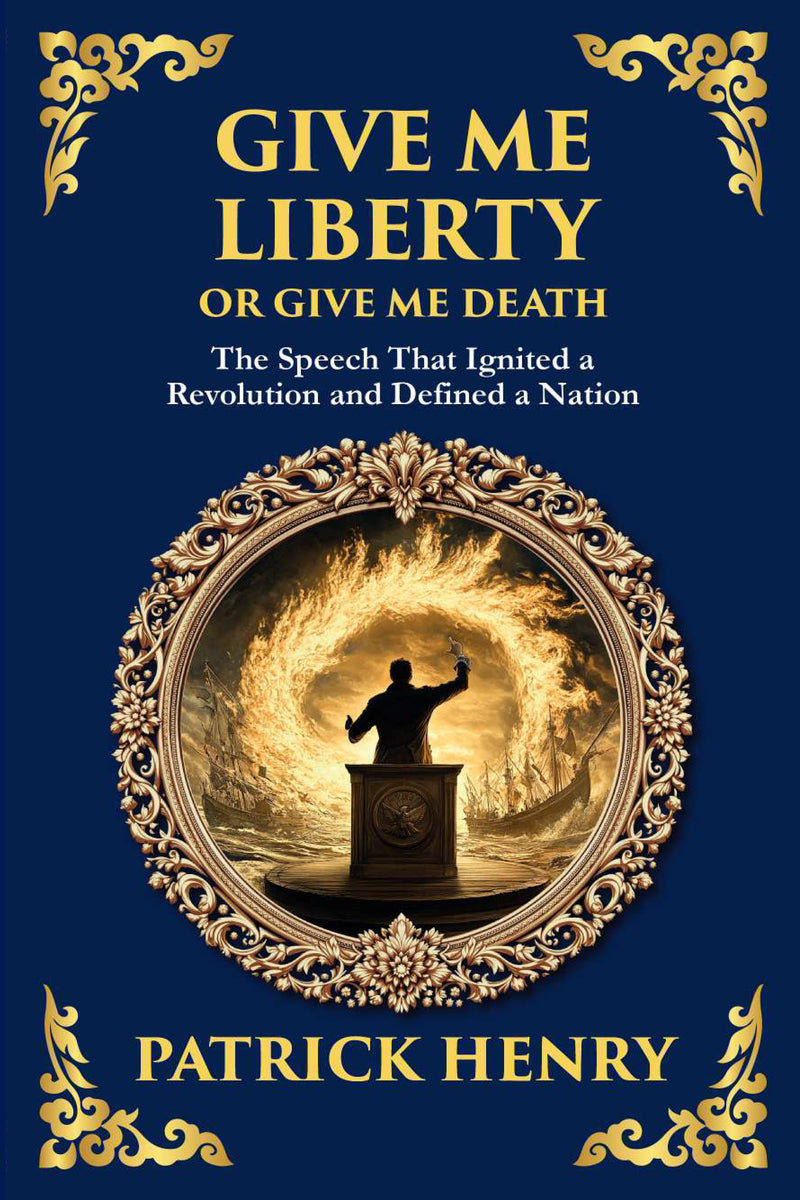
Give Me Liberty or Give Me Death — Large Print
With these immortal words, Patrick Henry lit a fire that would burn through the hearts of a people yearning for freedom.
or free app
10,000+ hrs library
30-day guarantee
The complete Give Me Liberty or Give Me Death appears in modern English through Library of Alexandria Press, available online with audiobook narration included for members.
Have you ever wondered why one speech could spark a revolution and shape the soul of a nation? Give Me Liberty or Give Me Death is not just a moment in American history—it is a defining roar of the human spirit against tyranny. On the eve of the American Revolutionary War, Patrick Henry delivered a fiery oration at the Virginia Convention that would galvanize a movement and signal the birth of a new nation.
This powerful volume offers readers the full text of Henry’s speech, presented with insightful historical framing that explains its urgency, its political stakes, and its rhetorical brilliance. The speech stands as a masterclass in persuasive oratory, appealing not only to reason and justice but to the raw emotional need for liberty. It is a timeless reminder that freedom must be demanded, defended, and—if necessary—won with sacrifice.
What you’ll discover in this modern edition
- The Full Text of Henry’s Speech Experience the unfiltered passion and power of one of history’s most compelling calls to action.
- Historical Context and Commentary Understand the political tensions in 1775 Virginia, and why this moment changed everything.
- The Anatomy of Revolutionary Rhetoric Explore the tools of persuasion that made Henry’s words unforgettable—from repetition to biblical cadence.
- Reflections on Liberty and Resistance Discover how the themes of this speech echo in modern struggles for freedom and civil rights.
- The Legacy of Patrick Henry’s Courage See how one man’s voice helped ignite a revolution and define the moral backbone of a republic.
| Formats | eBook (EPUB + PDF) · Audiobook · Paperback · Hardcover · Large Print |
| Language | English |
| Trim size (print) | 6 × 9 in |
| Binding | Paperback — perfect-bound · Hardcover — casewrap |
| Large Print edition | Same text in a larger, easy-read type — a larger font, not a larger trim |
| Print pricing | Every physical book at our true cost — at-cost, no profit (members) |
| Library | 873 restored titles, always growing |
| Length | 4,679 words · ~19 min reading |
| Reading level | Grade 12 · a confident, adult read (this modern-English edition) |
| Edition | Modern English translation · 2026 |
Member reviews for this edition are collected as readers finish it — be the first. Across the library: 12,000+ books shipped, every plan covered by a 365-day print guarantee.
About this edition
A faithful, unabridged modern-English edition by The Library of Alexandria — carefully rendered for today's reader and verified paragraph-by-paragraph against the public-domain source. Available as eBook, audiobook, paperback, hardcover, and large print.
- Complete & unabridgedVerified paragraph by paragraph against the source — never a scan, never abridged.
- Modern English, faithfulReadable today, with the author’s meaning kept intact. Readable — not simplified.
- Every format, one membershipRead in your browser or the free app, or listen to the full audiobook.
Included free with your membership
Cancel anytime, one click · 30-day money-back guarantee
Edition last updated July 2026
What’s inside
Give Me Liberty or Give Me Death — Large Print — complete and unabridged, included in full with membership, plus the full audiobook.
Begin reading Give Me Liberty or Give Me Death — Large Print
In clear modern English — the complete text is included with membership.
Introduction
There are moments in history when a single voice rises above the noise of debate, hesitation, and fear, and gives shape to the unspoken thoughts of an entire people. These moments are rare. They cannot be manufactured or rehearsed into existence. They arrive when circumstance, conviction, and courage converge in a single human being who chooses, against every instinct of caution, to say aloud what others only dare to think. On a tense spring afternoon in 1775, inside the candlelit walls of a church in Richmond, Virginia, such a moment occurred. A lawyer and statesman named Patrick Henry stood before a divided assembly of his peers and delivered words so charged with urgency that they would outlive him by centuries, echoing down through the generations until they became inseparable from the very idea of American freedom.
What you hold in your hands is a faithful modern adaptation of that speech and the spirit that animated it—rendered into language accessible to the contemporary reader without sacrificing the fire, rhythm, and moral weight of the original. This is not merely a historical document to be studied at arm’s length, like an artifact behind museum glass. It is a living piece of rhetoric, a demonstration of how language itself can become an instrument of transformation. To read it is to be transported into a chamber thick with anxiety and indecision, where the future of a continent hung in the balance, and to feel the pressure of a decision that could not be postponed any longer. The purpose of this introduction is to prepare you for that experience: to set the stage, to explain why these words mattered so profoundly, and to help you appreciate the artistry and the audacity that made them immortal.
To understand the power of what was spoken that day, you must first understand the precariousness of the world in which it was spoken. The American colonies in the early months of 1775 were caught in a state of unbearable tension—a kind of collective breath held too long. For more than a decade, relations between Great Britain and her colonies across the Atlantic had been deteriorating, fraying under the weight of taxes imposed without consent, restrictions placed without consultation, and a growing sense among many colonists that they were being treated not as full citizens of an empire but as subjects to be managed and milked. The grievances had accumulated steadily, each one adding to a reservoir of resentment that swelled larger with every passing season.
Yet for all this discontent, the colonies remained deeply divided about how to respond. The notion of open rebellion against the most powerful empire on earth was, to most reasonable people, a form of madness. Britain commanded the seas. Its armies were professional, disciplined, and battle-hardened. Its wealth seemed inexhaustible. To rise against such a force was to invite annihilation—and many colonists, even those who shared the sense of injustice, clung to the hope that reconciliation was still possible. They believed that if they petitioned respectfully enough, negotiated patiently enough, and demonstrated their loyalty sincerely enough, the Crown would eventually relent. They wanted peace. They wanted to remain Englishmen. They wanted, above all, to avoid the catastrophe of war.
This was the mood that prevailed when delegates gathered in Richmond for the Second Virginia Convention. The choice of location itself was telling. Ordinarily such gatherings would have taken place in the colonial capital of Williamsburg, but the political climate had grown too dangerous, the watchful eye of royal authority too close. Richmond, set further inland, offered a measure of safety for men whose deliberations were beginning to verge on the seditious. They met in a modest wooden church, the largest building in the small town capable of holding them, and there they confronted the question that would define their generation: What was to be done?
The cautious majority favored continued patience. They proposed sending yet another address to the King, hoping once more that loyal appeals might bridge the widening gulf. They argued that the colonies were unprepared for conflict, that arming themselves would provoke rather than prevent disaster, and that prudence demanded restraint. These were not cowardly men, nor foolish ones. Their position was, by every conventional measure, the sensible one. They understood the stakes of war better than the hotheads who clamored for resistance, and they were not eager to gamble the lives of their families and the future of their communities on a confrontation they were likely to lose.
It was into this atmosphere of hesitation and dread that Patrick Henry rose to speak. He was not the most senior man in the room, nor the wealthiest, nor the most powerful in the formal sense. But he possessed something that none of his colleagues could match: an almost supernatural gift for oratory, a voice that could move the human heart in ways that argument alone never could. He had built his reputation on this gift, having already made himself famous years earlier with his fierce opposition to British taxation. Now, standing before the assembled leaders of Virginia, he prepared to make the case that the time for petitions had passed, that the time for preparation—and, if necessary, for war—had arrived.
What he understood, and what makes his speech so remarkable, is that he was not merely trying to win a debate. He was trying to change the way his listeners felt about reality itself. The facts were known to everyone in the room; the grievances had been recited a hundred times. What was lacking was not information but resolve—the willingness to look clearly at a frightening truth and act upon it. Henry’s task was to dissolve the comfortable illusions to which his colleagues clung, to strip away the false hope of reconciliation, and to confront them with a choice they had been desperately avoiding. He had to make them feel, in their bones, that the crisis was upon them, that delay was itself a form of surrender, and that the moment of decision could not be deferred to some more convenient future.
This is the deeper drama you should carry with you as you read. The speech is not a triumphant cry from a people already committed to revolution. It is an intervention—a deliberate, calculated, passionate effort to shake a wavering assembly out of its paralysis. Every word was chosen to overcome resistance, to anticipate objections, to dismantle excuses, and to leave the listener with no honorable option but action. Understanding this transforms the experience of reading. You are not witnessing a foregone conclusion celebrated after the fact; you are present at the precise instant when the scales tipped, when hesitation began to give way to conviction, when a nation’s future was being argued into existence one sentence at a time.
What elevates this speech above the countless political addresses lost to history is the extraordinary craftsmanship with which it was constructed. Patrick Henry was not simply a man of strong feeling; he was a master of the art of persuasion, and the speech rewards careful attention to the techniques he employed. As you read this modern adaptation, you will notice that the argument unfolds with a kind of relentless logic, building from a posture of humility to a crescendo of defiance, carrying the listener along an emotional journey from which there is no turning back.
Consider how he begins. Rather than launching immediately into accusation or demand, he opens with a gesture of respect toward those who disagree with him. He acknowledges the patriotism and ability of the men who counsel patience, conceding that they are wise and worthy individuals. This is not mere politeness. It is a strategic disarming of his opponents, a way of establishing that he is reasonable and fair-minded, not a reckless agitator seeking conflict for its own sake. By honoring the sincerity of those who differ from him, he earns the right to be heard, and he makes it harder for his listeners to dismiss him as an extremist. Only after he has built this foundation of mutual respect does he begin to advance his more radical conclusions.
From there, the speech moves through a series of carefully reasoned stages. Henry insists on the necessity of facing the truth, however unpleasant, declaring that it is natural for human beings to indulge in hopeful illusions and to shut their eyes against painful realities. He frames the choice before them in the gravest possible terms, as a matter of survival and liberty, of slavery and freedom. He then proceeds to systematically demolish the case for continued patience. He reviews the long history of colonial petitions and the contemptuous responses they have received, demonstrating through this recitation that every peaceful avenue has been tried and exhausted. He points to the military preparations being made by the British, asking pointedly what purpose these armies and fleets could serve except the subjugation of the colonies. Each argument closes a door, eliminating an escape route, narrowing the range of possible responses until only one remains.
This is the architecture of persuasion at its finest. Henry does not simply assert that war is necessary; he leads his listeners step by step to that conclusion, allowing them to feel that they have arrived at it themselves through the force of reason. And then, having prepared the ground so thoroughly, he unleashes the full power of his rhetoric in the speech’s famous closing passages, where logic gives way to passion and the language soars into something approaching prophecy. The final words, which give this book its title, are not an argument at all. They are a declaration of personal commitment so absolute, so fearless, that they make the abstract question of liberty suddenly and overwhelmingly real. By staking his own life on the principle, Henry transforms a political position into a moral imperative.
The rhetorical devices he employs throughout are worth noticing as you read. He uses rhetorical questions to force his listeners to supply the damning answers themselves. He uses repetition to drive his points home with the force of a hammer striking the same nail again and again. He uses vivid imagery—chains, slavery, storms, the clash of arms—to make the dangers and the stakes tangible and immediate. He invokes God and Providence to lend his cause a sense of righteousness and inevitability. And he employs a rising rhythm, a quickening pace, that mirrors the urgency of his message and carries the listener forward with mounting intensity toward the explosive conclusion. These are not accidents of style. They are the deliberate tools of a man who understood that to change minds, one must first move hearts, and that the surest path to action is through emotion harnessed and directed by reason.
One of the great pleasures of this modern adaptation is that it allows you to appreciate these techniques without the barrier of archaic language obscuring them. The original speech, magnificent as it is, was delivered in the formal, ornate style of the eighteenth century, and for many contemporary readers that style can feel distant, even forbidding. This adaptation preserves the structure, the logic, and the emotional power of the original while rendering it in language that speaks directly to the modern ear. The aim is not to replace the original but to open a door to it—to let you experience the speech as Henry’s listeners experienced it, as something immediate, urgent, and alive, rather than as a museum piece to be admired from a respectful distance. When you reach the closing lines, you should feel something of what those men in the Richmond church felt: a quickening of the pulse, a stirring of resolve, a sense that you have been challenged to decide where you truly stand.
It is also worth reflecting on the courage it took to speak these words at all. We must remember that what Henry was advocating was, in the eyes of the British Crown, treason—a crime punishable by death. To stand before an assembly and call for armed resistance against the lawful government was to place a noose around one’s own neck. There was no guarantee of success, no assurance that the colonies would prevail, no certainty that history would vindicate the cause. Henry spoke not from a position of safety but from one of genuine peril, and the personal risk he assumed lends his words a weight that mere rhetoric could never achieve. When he declared his willingness to die rather than live in subjection, he was not indulging in hollow theatrics. He was expressing a conviction for which he was genuinely prepared to pay the ultimate price, and his listeners knew it. This authenticity is part of what made the speech so persuasive, and it is part of what makes it endure.
Cancel anytime, one click · 30-day money-back guarantee
Founding annual rate available now — your price locks for life when you join.
Not ready? Get this free chapter by email — read it anytime.
✓ Sent — check your inbox for Give Me Liberty or Give Me Death — Large Print.
Questions about Give Me Liberty or Give Me Death — Large Print
What is Give Me Liberty or Give Me Death about?
With these immortal words, Patrick Henry lit a fire that would burn through the hearts of a people yearning for freedom. Delivered on March 23, 1775, in the face of looming British oppression, Henry’s speech became a thunderclap in American history—fusing eloquence, urgency, and unshakable resolve into one of the most iconic declarations of liberty ever spoken. Give Me Liberty or Give Me Death captures not only a pivotal moment in the birth of the United States but also the spirit of defiance that defines the strug
Who wrote Give Me Liberty or Give Me Death?
Give Me Liberty or Give Me Death was written by Patrick Henry. This edition presents the complete work in clear modern English, faithfully rendered from the public-domain original by Library of Alexandria Press.
Is Give Me Liberty or Give Me Death free to read?
The opening chapter is free to read on this page. Members read and listen to the complete work — and the entire library — free, and can order any physical book at our true print cost.
How long is Give Me Liberty or Give Me Death?
2 chapters (~4,679 words) — about 19 min of reading in this modern-English edition.
Is this an abridged version of Give Me Liberty or Give Me Death?
No. This is the complete, unabridged Give Me Liberty or Give Me Death, carefully rendered into clear modern English and verified paragraph-by-paragraph against the public-domain source — nothing is cut or summarised.
What formats does Give Me Liberty or Give Me Death come in?
Give Me Liberty or Give Me Death is available as eBook, paperback and large print. eBook and audiobook are included with membership; printed editions ship at our true print cost.
Shipping & returns
Billing & membership
More from the library


Explore History
- Democracy in America — Volume 2 · Alexis de Tocqueville
- The Prince · Niccolò Machiavelli
- A Short History of the World · H. G. Wells
- A Short History of the World — Large Print · H. G. Wells
- Anabasis — Large Print · Xenophon
- Anabasis · Xenophon
- On Heroes, Hero-Worship, and the Heroic in History — Large Print · Thomas Carlyle
- A History of the Philippines · David P. Barrows
- A History of the Philippines — Large Print · David P. Barrows
- Omens and Superstitions of Southern India — Large Print · Edgar Thurston
- Omens and Superstitions of Southern India · Edgar Thurston
- The Communist Manifesto — Large Print · Karl Marx; Friedrich Engels
- The Everlasting Man — Large Print · G. K. Chesterton
- The Japanese Spirit — Large Print · Yoshisaburo Okakura
- Eighty Years and More; Reminiscences 1815–1897 · Elizabeth Cady Stanton
- Eighty Years and More; Reminiscences 1815–1897 — Large Print · Elizabeth Cady Stanton
- Japanese Girls and Women · Alice Mabel Bacon
- Japanese Girls and Women — Large Print · Alice Mabel Bacon
- An Account of Egypt · Herodotus
- An Account of Egypt — Large Print · Herodotus
- The Prince — Large Print · Niccolò Machiavelli
- The Anglo-Saxon Chronicle — Large Print · Anonymous; J. Ingram (translato...
- The Anglo-Saxon Chronicle · Anonymous; J. Ingram (translato...
- The Jew, The Gypsy and El Islam — Large Print · Richard Francis Burton
- Common Sense · Thomas Paine
- Memoirs of the Courts of Louis XV and XVI — Complete · Madame du Hausset; Princesse de...
- Lucretia Borgia — Large Print · Ferdinand Gregorovius
- Lucretia Borgia · Ferdinand Gregorovius
- The Eleusinian Mysteries and Rites — Large Print · Dudley Wright
- A Vindication of the Rights of Men · Mary Wollstonecraft
Give Me Liberty or Give Me Death — Large Print
Give Me Liberty or Give Me Death — Large Print
The Speech That Sparked a Revolution and Shaped a Nation
Patrick Henry
Contents
- Introduction
- Give Me Liberty or Give Me Death
Introduction
There are moments in history when a single voice rises above the noise of debate, hesitation, and fear, and gives shape to the unspoken thoughts of an entire people. These moments are rare. They cannot be manufactured or rehearsed into existence. They arrive when circumstance, conviction, and courage converge in a single human being who chooses, against every instinct of caution, to say aloud what others only dare to think. On a tense spring afternoon in 1775, inside the candlelit walls of a church in Richmond, Virginia, such a moment occurred. A lawyer and statesman named Patrick Henry stood before a divided assembly of his peers and delivered words so charged with urgency that they would outlive him by centuries, echoing down through the generations until they became inseparable from the very idea of American freedom.
What you hold in your hands is a faithful modern adaptation of that speech and the spirit that animated it—rendered into language accessible to the contemporary reader without sacrificing the fire, rhythm, and moral weight of the original. This is not merely a historical document to be studied at arm’s length, like an artifact behind museum glass. It is a living piece of rhetoric, a demonstration of how language itself can become an instrument of transformation. To read it is to be transported into a chamber thick with anxiety and indecision, where the future of a continent hung in the balance, and to feel the pressure of a decision that could not be postponed any longer. The purpose of this introduction is to prepare you for that experience: to set the stage, to explain why these words mattered so profoundly, and to help you appreciate the artistry and the audacity that made them immortal.
To understand the power of what was spoken that day, you must first understand the precariousness of the world in which it was spoken. The American colonies in the early months of 1775 were caught in a state of unbearable tension—a kind of collective breath held too long. For more than a decade, relations between Great Britain and her colonies across the Atlantic had been deteriorating, fraying under the weight of taxes imposed without consent, restrictions placed without consultation, and a growing sense among many colonists that they were being treated not as full citizens of an empire but as subjects to be managed and milked. The grievances had accumulated steadily, each one adding to a reservoir of resentment that swelled larger with every passing season.
Yet for all this discontent, the colonies remained deeply divided about how to respond. The notion of open rebellion against the most powerful empire on earth was, to most reasonable people, a form of madness. Britain commanded the seas. Its armies were professional, disciplined, and battle-hardened. Its wealth seemed inexhaustible. To rise against such a force was to invite annihilation—and many colonists, even those who shared the sense of injustice, clung to the hope that reconciliation was still possible. They believed that if they petitioned respectfully enough, negotiated patiently enough, and demonstrated their loyalty sincerely enough, the Crown would eventually relent. They wanted peace. They wanted to remain Englishmen. They wanted, above all, to avoid the catastrophe of war.
This was the mood that prevailed when delegates gathered in Richmond for the Second Virginia Convention. The choice of location itself was telling. Ordinarily such gatherings would have taken place in the colonial capital of Williamsburg, but the political climate had grown too dangerous, the watchful eye of royal authority too close. Richmond, set further inland, offered a measure of safety for men whose deliberations were beginning to verge on the seditious. They met in a modest wooden church, the largest building in the small town capable of holding them, and there they confronted the question that would define their generation: What was to be done?
The cautious majority favored continued patience. They proposed sending yet another address to the King, hoping once more that loyal appeals might bridge the widening gulf. They argued that the colonies were unprepared for conflict, that arming themselves would provoke rather than prevent disaster, and that prudence demanded restraint. These were not cowardly men, nor foolish ones. Their position was, by every conventional measure, the sensible one. They understood the stakes of war better than the hotheads who clamored for resistance, and they were not eager to gamble the lives of their families and the future of their communities on a confrontation they were likely to lose.
It was into this atmosphere of hesitation and dread that Patrick Henry rose to speak. He was not the most senior man in the room, nor the wealthiest, nor the most powerful in the formal sense. But he possessed something that none of his colleagues could match: an almost supernatural gift for oratory, a voice that could move the human heart in ways that argument alone never could. He had built his reputation on this gift, having already made himself famous years earlier with his fierce opposition to British taxation. Now, standing before the assembled leaders of Virginia, he prepared to make the case that the time for petitions had passed, that the time for preparation—and, if necessary, for war—had arrived.
What he understood, and what makes his speech so remarkable, is that he was not merely trying to win a debate. He was trying to change the way his listeners felt about reality itself. The facts were known to everyone in the room; the grievances had been recited a hundred times. What was lacking was not information but resolve—the willingness to look clearly at a frightening truth and act upon it. Henry’s task was to dissolve the comfortable illusions to which his colleagues clung, to strip away the false hope of reconciliation, and to confront them with a choice they had been desperately avoiding. He had to make them feel, in their bones, that the crisis was upon them, that delay was itself a form of surrender, and that the moment of decision could not be deferred to some more convenient future.
This is the deeper drama you should carry with you as you read. The speech is not a triumphant cry from a people already committed to revolution. It is an intervention—a deliberate, calculated, passionate effort to shake a wavering assembly out of its paralysis. Every word was chosen to overcome resistance, to anticipate objections, to dismantle excuses, and to leave the listener with no honorable option but action. Understanding this transforms the experience of reading. You are not witnessing a foregone conclusion celebrated after the fact; you are present at the precise instant when the scales tipped, when hesitation began to give way to conviction, when a nation’s future was being argued into existence one sentence at a time.
What elevates this speech above the countless political addresses lost to history is the extraordinary craftsmanship with which it was constructed. Patrick Henry was not simply a man of strong feeling; he was a master of the art of persuasion, and the speech rewards careful attention to the techniques he employed. As you read this modern adaptation, you will notice that the argument unfolds with a kind of relentless logic, building from a posture of humility to a crescendo of defiance, carrying the listener along an emotional journey from which there is no turning back.
Consider how he begins. Rather than launching immediately into accusation or demand, he opens with a gesture of respect toward those who disagree with him. He acknowledges the patriotism and ability of the men who counsel patience, conceding that they are wise and worthy individuals. This is not mere politeness. It is a strategic disarming of his opponents, a way of establishing that he is reasonable and fair-minded, not a reckless agitator seeking conflict for its own sake. By honoring the sincerity of those who differ from him, he earns the right to be heard, and he makes it harder for his listeners to dismiss him as an extremist. Only after he has built this foundation of mutual respect does he begin to advance his more radical conclusions.
From there, the speech moves through a series of carefully reasoned stages. Henry insists on the necessity of facing the truth, however unpleasant, declaring that it is natural for human beings to indulge in hopeful illusions and to shut their eyes against painful realities. He frames the choice before them in the gravest possible terms, as a matter of survival and liberty, of slavery and freedom. He then proceeds to systematically demolish the case for continued patience. He reviews the long history of colonial petitions and the contemptuous responses they have received, demonstrating through this recitation that every peaceful avenue has been tried and exhausted. He points to the military preparations being made by the British, asking pointedly what purpose these armies and fleets could serve except the subjugation of the colonies. Each argument closes a door, eliminating an escape route, narrowing the range of possible responses until only one remains.
This is the architecture of persuasion at its finest. Henry does not simply assert that war is necessary; he leads his listeners step by step to that conclusion, allowing them to feel that they have arrived at it themselves through the force of reason. And then, having prepared the ground so thoroughly, he unleashes the full power of his rhetoric in the speech’s famous closing passages, where logic gives way to passion and the language soars into something approaching prophecy. The final words, which give this book its title, are not an argument at all. They are a declaration of personal commitment so absolute, so fearless, that they make the abstract question of liberty suddenly and overwhelmingly real. By staking his own life on the principle, Henry transforms a political position into a moral imperative.
The rhetorical devices he employs throughout are worth noticing as you read. He uses rhetorical questions to force his listeners to supply the damning answers themselves. He uses repetition to drive his points home with the force of a hammer striking the same nail again and again. He uses vivid imagery—chains, slavery, storms, the clash of arms—to make the dangers and the stakes tangible and immediate. He invokes God and Providence to lend his cause a sense of righteousness and inevitability. And he employs a rising rhythm, a quickening pace, that mirrors the urgency of his message and carries the listener forward with mounting intensity toward the explosive conclusion. These are not accidents of style. They are the deliberate tools of a man who understood that to change minds, one must first move hearts, and that the surest path to action is through emotion harnessed and directed by reason.
One of the great pleasures of this modern adaptation is that it allows you to appreciate these techniques without the barrier of archaic language obscuring them. The original speech, magnificent as it is, was delivered in the formal, ornate style of the eighteenth century, and for many contemporary readers that style can feel distant, even forbidding. This adaptation preserves the structure, the logic, and the emotional power of the original while rendering it in language that speaks directly to the modern ear. The aim is not to replace the original but to open a door to it—to let you experience the speech as Henry’s listeners experienced it, as something immediate, urgent, and alive, rather than as a museum piece to be admired from a respectful distance. When you reach the closing lines, you should feel something of what those men in the Richmond church felt: a quickening of the pulse, a stirring of resolve, a sense that you have been challenged to decide where you truly stand.
It is also worth reflecting on the courage it took to speak these words at all. We must remember that what Henry was advocating was, in the eyes of the British Crown, treason—a crime punishable by death. To stand before an assembly and call for armed resistance against the lawful government was to place a noose around one’s own neck. There was no guarantee of success, no assurance that the colonies would prevail, no certainty that history would vindicate the cause. Henry spoke not from a position of safety but from one of genuine peril, and the personal risk he assumed lends his words a weight that mere rhetoric could never achieve. When he declared his willingness to die rather than live in subjection, he was not indulging in hollow theatrics. He was expressing a conviction for which he was genuinely prepared to pay the ultimate price, and his listeners knew it. This authenticity is part of what made the speech so persuasive, and it is part of what makes it endure.
I have as much respect for the patriotism and skills of the honorable gentlemen who just spoke to this House as anyone. However, different people often view the same issue from different perspectives. Therefore, I hope it isn’t seen as disrespectful if I speak my mind honestly and openly, even though my opinions are the complete opposite of theirs. Now is not the time for formalities. The issue this House is facing is of critical importance to our country. For me, this is nothing less than a choice between freedom and slavery; the openness of our debate should match the scale of the problem. This is the only way we can find the truth and meet the great responsibility we owe to God and our nation. If I were to hold back my thoughts now just to avoid offending others, I would consider myself a traitor to my country and disloyal to the Majesty of Heaven, whom I honor above all earthly kings.
Mr. President, it is human nature to cling to the false hope that things will get better. We tend to ignore painful truths and listen to misleading promises until it is too late. Is this how wise men should act while fighting a difficult and great struggle for liberty? Are we willing to be like those who have eyes but cannot see, and ears but cannot hear, the things that are vital to their own survival? As for me, no matter how much mental anguish it causes, I want to know the full truth; I want to know the worst-case scenario and prepare for it.
I have only one light to guide my way, and that is the light of experience. I don’t know of any way to predict the future except by looking at the past. And judging by the past, I want to know what the British government has done over the last ten years to justify the hopes that some gentlemen have used to comfort themselves and this House. Is it that sneaky smile with which our petition was recently received? Do not trust it, sir; it will only trip you up. Do not allow yourselves to be betrayed by a kiss. Ask yourselves how this friendly reception of our petition fits with the military preparations that now fill our waters and darken our land. Are fleets and armies necessary for a work of love and reconciliation? Have we acted so unwillingly toward peace that force must be used to win back our affection? Let us not lie to ourselves, sir. These are the tools of war and conquest; they are the final arguments that kings use. I ask you, gentlemen, what is the meaning of this military buildup if its purpose is not to force us to submit? Can anyone suggest any other possible motive for it? Does Great Britain have any other enemy in this part of the world that would require all these ships and soldiers? No, sir, she does not. They are meant for us: they cannot be meant for anyone else. They have been sent here to lock us into the chains that the British government has been forging for so long. And what do we have to fight them with? Should we try to argue? Sir, we have been trying that for the last ten years. Do we have anything new to say on the matter? Nothing. We have looked at this issue from every possible angle, but it has all been useless. Should we turn to begging and humble pleas? What words are left that we haven’t already used? I beg you, sir, let us not deceive ourselves. Sir, we have done everything possible to stop the storm that is now arriving. We have petitioned; we have protested; we have begged; we have humbled ourselves before the throne and pleaded for it to stop the tyrannical actions of the government and Parliament. Our petitions have been ignored; our protests have only led to more violence and insults; our pleas have been disregarded; and we have been kicked away from the throne with contempt! After all this, it is useless to cling to the foolish hope of peace and reconciliation. There is no longer any room for hope. If we want to be free—if we intend to protect those priceless rights we have fought for so long—if we do not intend to cowardly abandon the noble struggle we have been part of, and which we promised never to leave until we achieved our glorious goal—we must fight! I repeat, sir, we must fight! An appeal to arms and to the God of hosts is all that is left to us!
End of the free sample
Keep reading, free
Members read and listen to the complete book — and the entire library. Cancel anytime, one click · 30-day money-back guarantee.