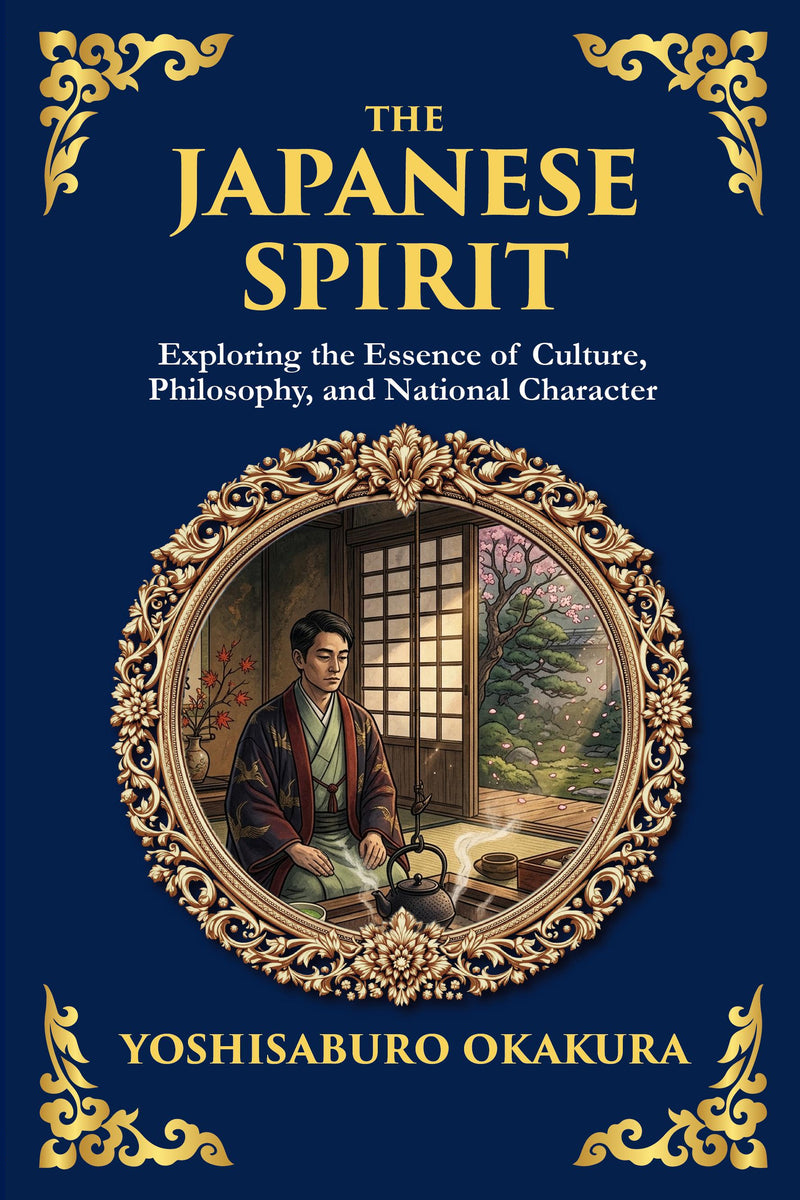
The Japanese Spirit — Large Print
The Japanese Spirit is a profound exploration of the heart and soul of Japan—its values, philosophy, and the deep cultural forces that shaped its national character.
or free app
10,000+ hrs library
30-day guarantee
The complete The Japanese Spirit appears in modern English through Library of Alexandria Press, available online with audiobook narration included for members.
Have you ever wondered why the spirit of Japan continues to captivate the world—even in silence? The Japanese Spirit is not merely a cultural study—it is a meditation on the soul of a nation. Written in the early 20th century by Yoshisaburo Okakura, this timeless work captures the moral framework, aesthetic depth, and national consciousness of Japan at a turning point in its history.
Through elegant prose and philosophical reflection, Okakura introduces readers to the ideals of bushido (the way of the warrior), the balance between tradition and modernity, and the unique moral fiber that informs Japanese thought and identity. His exploration touches on everything from education and religion to loyalty and self-sacrifice, revealing a worldview that values inner strength over outward display, and harmony over conquest.
What you’ll discover in this modern edition
- The Essence of Bushido – Understand the moral code that shaped generations of warriors, leaders, and citizens
- The Role of Aesthetics and Simplicity – Explore how beauty and restraint are embedded in every facet of Japanese life
- East Meets West – Learn how Japan preserved its spiritual heritage while responding to the pressures of Westernization
- A Philosophy of Dignity and Discipline – Discover the quiet virtues that form the core of the Japanese national character
| Formats | eBook (EPUB + PDF) · Audiobook · Paperback · Hardcover · Large Print |
| Language | English |
| Trim size (print) | 6 × 9 in |
| Binding | Paperback — perfect-bound · Hardcover — casewrap |
| Large Print edition | Same text in a larger, easy-read type — a larger font, not a larger trim |
| Print pricing | Every physical book at our true cost — at-cost, no profit (members) |
| Library | 873 restored titles, always growing |
| Length | 17,269 words · ~1 hr 9 min reading |
| Reading level | Grade 3 · an easy, flowing read (this modern-English edition) |
| Edition | Modern English translation · 2026 |
Member reviews for this edition are collected as readers finish it — be the first. Across the library: 12,000+ books shipped, every plan covered by a 365-day print guarantee.
About this edition
A faithful, unabridged modern-English edition by The Library of Alexandria — carefully rendered for today's reader and verified paragraph-by-paragraph against the public-domain source. Available as eBook, audiobook, paperback, hardcover, and large print.
- Complete & unabridgedVerified paragraph by paragraph against the source — never a scan, never abridged.
- Modern English, faithfulReadable today, with the author’s meaning kept intact. Readable — not simplified.
- Every format, one membershipRead in your browser or the free app, or listen to the full audiobook.
Included free with your membership
Cancel anytime, one click · 30-day money-back guarantee
Edition last updated July 2026
What’s inside
The Japanese Spirit — Large Print — complete and unabridged, included in full with membership, plus the full audiobook.
Begin reading The Japanese Spirit — Large Print
In clear modern English — the complete text is included with membership.
Introduction
There are books that explain a culture, and there are books that breathe it. The pages that follow belong firmly to the second kind. Written by Yoshisaburo Okakura at a moment when Japan was wrestling with its own reflection in the mirror of modernity, this slender but luminous meditation does not merely describe the Japanese mind to outsiders; it invites the reader to stand for a while inside it, to feel the rhythm of a sensibility shaped by mountains and seasons, by silence and suggestion, by centuries of disciplined attention to the small and the fleeting. To read it today is to encounter not a museum exhibit but a living conversation, one that began more than a century ago and that still has a great deal to say to us about how human beings find meaning, beauty, and identity in a rapidly shifting world.
The book you are about to read concerns itself with what its author called the spirit of a people — a phrase that can sound grand to the point of vagueness until one realizes how precisely Okakura meant it. He was not interested in flag-waving nationalism or in the kind of cultural boasting that flattens a civilization into a few exotic clichés. He was interested in something far more delicate and far more difficult: the underlying temperament, the characteristic way of seeing and feeling, that gives a culture its coherence even as its surface forms change. What is it, he asks, that makes a poem feel Japanese, or a garden, or a gesture of courtesy, or a moment of restraint in the face of grief? What threads run beneath the visible patterns of art, religion, social custom, and philosophy, binding them into a single recognizable whole? These are the questions that animate every chapter, and they are questions that reward the patient, curious reader many times over.
A Voice from the Threshold Between Worlds
To understand why this book carries the weight it does, it helps to picture the man who wrote it and the age he wrote it in. Yoshisaburo Okakura lived during one of the most extraordinary transformations any nation has ever undergone. The Japan of his youth had only recently emerged from more than two centuries of near-total isolation, a long quiet during which the country had cultivated its arts and customs in relative seclusion from the outside world. Then, almost overnight by the measure of history, the gates opened. Foreign ships, foreign ideas, foreign machines, and foreign ambitions poured in. Within a single generation, Japan rebuilt its government, its army, its schools, its industries, and much of its way of life along lines borrowed and adapted from Europe and America. It was a feat of national will that astonished the world. But it came at a cost that thoughtful Japanese felt keenly — the danger that in racing to modernize, the nation might forget who it had been, might trade its inheritance for a borrowed coat that never quite fit.
Okakura belonged to the generation that lived inside this tension. He was thoroughly conversant with the languages, the literatures, and the intellectual traditions of the West; indeed, he wrote with a fluency and a cosmopolitan ease that allowed him to speak directly to readers raised on entirely different assumptions. Yet he never lost his rootedness in the older Japan, the Japan of the tea ceremony and the haiku, of Buddhist contemplation and Shinto reverence, of an aesthetic that prized suggestion over statement and emptiness over ornament. He stood, in other words, on a threshold — one foot in each world — and from that vantage he could do something rare. He could translate not merely words but sensibilities, carrying across the gap between cultures the things that are hardest to carry: the feelings, the values, the half-conscious habits of perception that a people rarely bother to articulate because they are simply the water in which they swim.
This is what gives the book its peculiar authority and its peculiar charm. Okakura is not lecturing from on high, nor is he pleading a defensive case. He writes as a guide who genuinely loves what he is showing you and who trusts you enough to show it honestly, including its complexities and its contradictions. He understands that his readers will arrive with their own frameworks, their own measures of what counts as reasonable or beautiful or true, and he meets them where they are. When he reaches for a comparison, it is often to Western art or philosophy or history, not to score points but to build a bridge — to say, in effect, here is something in your tradition that resembles what I am describing, and now let me show you where the resemblance ends and something genuinely different begins. That generosity of approach makes the book unusually welcoming. You do not need any prior knowledge of Japan to begin. You need only an open mind and a willingness to be surprised.
It is worth dwelling for a moment on the historical poignancy of the project. Okakura was attempting to capture, in clear and durable prose, a spirit that he sensed was already under pressure — already beginning to blur at the edges as the modern world advanced. There is, throughout the book, a quiet awareness of preservation, of setting down on the page something precious that might otherwise be lost or misunderstood. This gives the work an emotional undertone that careful readers will feel beneath its measured sentences. It is at once a celebration and a kind of safeguarding, a love letter and an archive. And because the questions he raised about how a nation keeps its soul while remaking its body have only grown more urgent in the century since, the book speaks to our own moment with surprising directness. We, too, live amid dizzying change. We, too, wonder what is essential and what is merely habitual, what we must protect and what we can let go. Okakura’s meditation on these matters, conducted through the specific lens of his own culture, turns out to be a meditation we can all profitably share.
Let me say plainly what kind of experience awaits you, so that you can settle into it with the right expectations. This is not a textbook, and it does not proceed by accumulating facts and dates. It is closer to an extended essay, or a series of linked reflections, in which a thoughtful and cultivated mind turns a single great subject over and over, examining it from many angles, allowing themes to recur and deepen. Okakura returns repeatedly to certain core ideas — the love of nature, the cult of beauty, the discipline of restraint, the interplay of religion and daily life, the moral codes that shaped conduct, the aesthetic principles that governed taste — and each return adds a new layer of understanding. The structure rewards a reader who is willing to let the book accumulate its effect rather than demanding a single linear argument that resolves on the final page.
One of the deepest pleasures of the text is the way it illuminates the connection between things that, to an outside observer, might seem entirely separate. Okakura helps you see how the same underlying sensibility expresses itself across radically different domains — how the principles at work in a brush painting are kin to the principles at work in a meal, a poem, a religious rite, or a code of manners. This is the heart of what he means by a national spirit: not a list of customs but a unifying disposition, a way of being in the world that leaves its fingerprint on everything it touches. Once you begin to perceive this unity, the apparently strange and unfamiliar elements of the culture start to make a kind of intuitive sense. You realize that the famous Japanese love of simplicity, for instance, is not a mere style preference but the visible expression of a whole philosophy of life — a philosophy about impermanence, about the value of what is left unsaid, about the dignity of small and ordinary things. The book gives you the key that turns a dozen separate locks at once.
There is also a great deal of beauty in the writing itself, and it would be a shame not to mention it. Okakura had a gift for the resonant phrase and the well-chosen image, and even when he is conveying complex ideas he never loses the thread of grace. He is fond of paradox — of the truth that hides inside an apparent contradiction — and he uses it the way the tradition he describes uses empty space in a painting: to suggest more than can be directly stated. Reading him, you begin to feel the very quality of mind he is trying to describe, because his prose enacts it. He shows by doing. The form and the content reinforce one another, so that the book becomes not merely an explanation of an aesthetic sensibility but a small example of it.
This particular edition has been prepared with the contemporary reader firmly in mind. The original was written for an audience separated from us by more than a century, and language inevitably drifts over such a span. Idioms grow stiff, references that were once obvious become obscure, and sentence rhythms that felt natural to readers of an earlier era can feel laborious to us. The aim of this modern adaptation has been to clear away those obstacles while preserving everything that matters — the architecture of the argument, the warmth of the voice, the precision of the insights, and above all the spirit of the original. Where a phrase might once have puzzled or stalled a present-day reader, it has been gently clarified. Where the older conventions of prose slowed the flow, the path has been smoothed. But none of this has been done at the expense of authenticity. The thoughts are Okakura’s thoughts; the perspective is his perspective; the discoveries that await you are the ones he intended you to make. The goal has simply been to ensure that nothing stands between you and the substance of what he has to say — that the wisdom comes through as freshly and as forcefully as it did when it was new.
A word, too, about how best to approach the reading. Resist the temptation to rush. This is a book to be savored in unhurried sittings, ideally with time afterward to let its observations settle. Many of its insights are quiet ones; they do not announce themselves with fanfare but reveal their depth only when you pause to consider them. You may find that a single sentence opens up an entire way of looking at the world, and that it repays several minutes of reflection far more than the next several pages would have. Read, in short, the way the culture it describes would have you read — attentively, patiently, alert to the suggestion behind the statement and the meaning behind the form. Approached this way, the book becomes something more than information. It becomes a kind of training in perception, a gentle reshaping of how you notice and value the world around you.
You should also know that this is a book of its time, and part of the richness of reading it lies precisely in that fact. Okakura was writing within the assumptions and the rhetorical conventions of his era, addressing the particular anxieties and aspirations of his moment in history. Some of his generalizations are sweeping; some of his framings reflect concerns that have shifted in the century since. The modern reader will, I think, find this not a flaw but an added dimension of interest. To read Okakura well is to engage in a kind of double vision — to take in what he is saying about his subject, and at the same time to be aware of the particular vantage from which he was saying it. This is not a reason for condescension toward the past; it is an invitation to a richer conversation across time. Okakura himself was a master of cross-cultural and cross-temporal dialogue, and he would, I suspect, have welcomed readers who brought their own perspective into productive contact with his. The most rewarding way to read any thinker of an earlier age is neither to accept everything uncritically nor to dismiss what does not match our current views, but to listen carefully, to weigh, and to let the encounter enlarge our own thinking.
Cancel anytime, one click · 30-day money-back guarantee
Founding annual rate available now — your price locks for life when you join.
Not ready? Get this free chapter by email — read it anytime.
✓ Sent — check your inbox for The Japanese Spirit — Large Print.
Questions about The Japanese Spirit — Large Print
What is The Japanese Spirit about?
The Japanese Spirit is a profound exploration of the heart and soul of Japan—its values, philosophy, and the deep cultural forces that shaped its national character. Written at a pivotal time in Japan’s modern history, this work offers rare insight into the essence of bushido, loyalty, honor, and the uniquely spiritual worldview of the Japanese people. Yoshisaburo Okakura, a leading thinker and cultural ambassador of his time, shares the intricacies of Japanese education, morality, and the synthesis of Eastern and
Who wrote The Japanese Spirit?
The Japanese Spirit was written by Yoshisaburo Okakura. This edition presents the complete work in clear modern English, faithfully rendered from the public-domain original by Library of Alexandria Press.
Is The Japanese Spirit free to read?
The opening chapter is free to read on this page. Members read and listen to the complete work — and the entire library — free, and can order any physical book at our true print cost.
How long is The Japanese Spirit?
2 chapters (~17,269 words) — about 1 hr 9 min of reading in this modern-English edition.
Is this an abridged version of The Japanese Spirit?
No. This is the complete, unabridged The Japanese Spirit, carefully rendered into clear modern English and verified paragraph-by-paragraph against the public-domain source — nothing is cut or summarised.
What formats does The Japanese Spirit come in?
The Japanese Spirit is available as eBook, paperback, hardcover and large print. eBook and audiobook are included with membership; printed editions ship at our true print cost.
Shipping & returns
Billing & membership
More from the library


Explore History
- The Advancement of Learning · Francis Bacon
- Democracy in America — Volume 2 · Alexis de Tocqueville
- Second Treatise of Government · John Locke
- The Prince · Niccolò Machiavelli
- Society in America, Volume 1 (of 2) · Harriet Martineau
- The Everlasting Man · G. K. Chesterton
- The Book of Tea · Kakuzo Okakura
- The Japanese Spirit · Yoshisaburo Okakura
- Give Me Liberty or Give Me Death · Patrick Henry
- Ion · Plato
- John F. Kennedy’s Inaugural Address · John F. Kennedy
- The Declaration of Independence of the United States of America · Thomas Jefferson
- On Heroes, Hero-Worship, and the Heroic in History · Thomas Carlyle
- The Communist Manifesto
- The Souls of Black Folk · W. E. B. Du Bois
- Letters on the Equality of the Sexes, and the Condition of Woman · Sarah Grimké
- The Romance of Biography (Vol. 1 of 2) · Mrs. Jameson
- The Erotic Motive in Literature · Albert Mordell
The Japanese Spirit — Large Print
The Japanese Spirit — Large Print
Exploring the Core of Culture, Philosophy, and National Identity
Yoshisaburo Okakura
Contents
- Introduction
- Preface by the Author
Introduction
There are books that explain a culture, and there are books that breathe it. The pages that follow belong firmly to the second kind. Written by Yoshisaburo Okakura at a moment when Japan was wrestling with its own reflection in the mirror of modernity, this slender but luminous meditation does not merely describe the Japanese mind to outsiders; it invites the reader to stand for a while inside it, to feel the rhythm of a sensibility shaped by mountains and seasons, by silence and suggestion, by centuries of disciplined attention to the small and the fleeting. To read it today is to encounter not a museum exhibit but a living conversation, one that began more than a century ago and that still has a great deal to say to us about how human beings find meaning, beauty, and identity in a rapidly shifting world.
The book you are about to read concerns itself with what its author called the spirit of a people — a phrase that can sound grand to the point of vagueness until one realizes how precisely Okakura meant it. He was not interested in flag-waving nationalism or in the kind of cultural boasting that flattens a civilization into a few exotic clichés. He was interested in something far more delicate and far more difficult: the underlying temperament, the characteristic way of seeing and feeling, that gives a culture its coherence even as its surface forms change. What is it, he asks, that makes a poem feel Japanese, or a garden, or a gesture of courtesy, or a moment of restraint in the face of grief? What threads run beneath the visible patterns of art, religion, social custom, and philosophy, binding them into a single recognizable whole? These are the questions that animate every chapter, and they are questions that reward the patient, curious reader many times over.
A Voice from the Threshold Between Worlds
To understand why this book carries the weight it does, it helps to picture the man who wrote it and the age he wrote it in. Yoshisaburo Okakura lived during one of the most extraordinary transformations any nation has ever undergone. The Japan of his youth had only recently emerged from more than two centuries of near-total isolation, a long quiet during which the country had cultivated its arts and customs in relative seclusion from the outside world. Then, almost overnight by the measure of history, the gates opened. Foreign ships, foreign ideas, foreign machines, and foreign ambitions poured in. Within a single generation, Japan rebuilt its government, its army, its schools, its industries, and much of its way of life along lines borrowed and adapted from Europe and America. It was a feat of national will that astonished the world. But it came at a cost that thoughtful Japanese felt keenly — the danger that in racing to modernize, the nation might forget who it had been, might trade its inheritance for a borrowed coat that never quite fit.
Okakura belonged to the generation that lived inside this tension. He was thoroughly conversant with the languages, the literatures, and the intellectual traditions of the West; indeed, he wrote with a fluency and a cosmopolitan ease that allowed him to speak directly to readers raised on entirely different assumptions. Yet he never lost his rootedness in the older Japan, the Japan of the tea ceremony and the haiku, of Buddhist contemplation and Shinto reverence, of an aesthetic that prized suggestion over statement and emptiness over ornament. He stood, in other words, on a threshold — one foot in each world — and from that vantage he could do something rare. He could translate not merely words but sensibilities, carrying across the gap between cultures the things that are hardest to carry: the feelings, the values, the half-conscious habits of perception that a people rarely bother to articulate because they are simply the water in which they swim.
This is what gives the book its peculiar authority and its peculiar charm. Okakura is not lecturing from on high, nor is he pleading a defensive case. He writes as a guide who genuinely loves what he is showing you and who trusts you enough to show it honestly, including its complexities and its contradictions. He understands that his readers will arrive with their own frameworks, their own measures of what counts as reasonable or beautiful or true, and he meets them where they are. When he reaches for a comparison, it is often to Western art or philosophy or history, not to score points but to build a bridge — to say, in effect, here is something in your tradition that resembles what I am describing, and now let me show you where the resemblance ends and something genuinely different begins. That generosity of approach makes the book unusually welcoming. You do not need any prior knowledge of Japan to begin. You need only an open mind and a willingness to be surprised.
It is worth dwelling for a moment on the historical poignancy of the project. Okakura was attempting to capture, in clear and durable prose, a spirit that he sensed was already under pressure — already beginning to blur at the edges as the modern world advanced. There is, throughout the book, a quiet awareness of preservation, of setting down on the page something precious that might otherwise be lost or misunderstood. This gives the work an emotional undertone that careful readers will feel beneath its measured sentences. It is at once a celebration and a kind of safeguarding, a love letter and an archive. And because the questions he raised about how a nation keeps its soul while remaking its body have only grown more urgent in the century since, the book speaks to our own moment with surprising directness. We, too, live amid dizzying change. We, too, wonder what is essential and what is merely habitual, what we must protect and what we can let go. Okakura’s meditation on these matters, conducted through the specific lens of his own culture, turns out to be a meditation we can all profitably share.
Let me say plainly what kind of experience awaits you, so that you can settle into it with the right expectations. This is not a textbook, and it does not proceed by accumulating facts and dates. It is closer to an extended essay, or a series of linked reflections, in which a thoughtful and cultivated mind turns a single great subject over and over, examining it from many angles, allowing themes to recur and deepen. Okakura returns repeatedly to certain core ideas — the love of nature, the cult of beauty, the discipline of restraint, the interplay of religion and daily life, the moral codes that shaped conduct, the aesthetic principles that governed taste — and each return adds a new layer of understanding. The structure rewards a reader who is willing to let the book accumulate its effect rather than demanding a single linear argument that resolves on the final page.
One of the deepest pleasures of the text is the way it illuminates the connection between things that, to an outside observer, might seem entirely separate. Okakura helps you see how the same underlying sensibility expresses itself across radically different domains — how the principles at work in a brush painting are kin to the principles at work in a meal, a poem, a religious rite, or a code of manners. This is the heart of what he means by a national spirit: not a list of customs but a unifying disposition, a way of being in the world that leaves its fingerprint on everything it touches. Once you begin to perceive this unity, the apparently strange and unfamiliar elements of the culture start to make a kind of intuitive sense. You realize that the famous Japanese love of simplicity, for instance, is not a mere style preference but the visible expression of a whole philosophy of life — a philosophy about impermanence, about the value of what is left unsaid, about the dignity of small and ordinary things. The book gives you the key that turns a dozen separate locks at once.
There is also a great deal of beauty in the writing itself, and it would be a shame not to mention it. Okakura had a gift for the resonant phrase and the well-chosen image, and even when he is conveying complex ideas he never loses the thread of grace. He is fond of paradox — of the truth that hides inside an apparent contradiction — and he uses it the way the tradition he describes uses empty space in a painting: to suggest more than can be directly stated. Reading him, you begin to feel the very quality of mind he is trying to describe, because his prose enacts it. He shows by doing. The form and the content reinforce one another, so that the book becomes not merely an explanation of an aesthetic sensibility but a small example of it.
This particular edition has been prepared with the contemporary reader firmly in mind. The original was written for an audience separated from us by more than a century, and language inevitably drifts over such a span. Idioms grow stiff, references that were once obvious become obscure, and sentence rhythms that felt natural to readers of an earlier era can feel laborious to us. The aim of this modern adaptation has been to clear away those obstacles while preserving everything that matters — the architecture of the argument, the warmth of the voice, the precision of the insights, and above all the spirit of the original. Where a phrase might once have puzzled or stalled a present-day reader, it has been gently clarified. Where the older conventions of prose slowed the flow, the path has been smoothed. But none of this has been done at the expense of authenticity. The thoughts are Okakura’s thoughts; the perspective is his perspective; the discoveries that await you are the ones he intended you to make. The goal has simply been to ensure that nothing stands between you and the substance of what he has to say — that the wisdom comes through as freshly and as forcefully as it did when it was new.
A word, too, about how best to approach the reading. Resist the temptation to rush. This is a book to be savored in unhurried sittings, ideally with time afterward to let its observations settle. Many of its insights are quiet ones; they do not announce themselves with fanfare but reveal their depth only when you pause to consider them. You may find that a single sentence opens up an entire way of looking at the world, and that it repays several minutes of reflection far more than the next several pages would have. Read, in short, the way the culture it describes would have you read — attentively, patiently, alert to the suggestion behind the statement and the meaning behind the form. Approached this way, the book becomes something more than information. It becomes a kind of training in perception, a gentle reshaping of how you notice and value the world around you.
You should also know that this is a book of its time, and part of the richness of reading it lies precisely in that fact. Okakura was writing within the assumptions and the rhetorical conventions of his era, addressing the particular anxieties and aspirations of his moment in history. Some of his generalizations are sweeping; some of his framings reflect concerns that have shifted in the century since. The modern reader will, I think, find this not a flaw but an added dimension of interest. To read Okakura well is to engage in a kind of double vision — to take in what he is saying about his subject, and at the same time to be aware of the particular vantage from which he was saying it. This is not a reason for condescension toward the past; it is an invitation to a richer conversation across time. Okakura himself was a master of cross-cultural and cross-temporal dialogue, and he would, I suspect, have welcomed readers who brought their own perspective into productive contact with his. The most rewarding way to read any thinker of an earlier age is neither to accept everything uncritically nor to dismiss what does not match our current views, but to listen carefully, to weigh, and to let the encounter enlarge our own thinking.
These pages exist thanks to Mr. Martin White, whose strong interest in comparative sociology led to the creation of special courses on the subject at the University of London.
I am grateful to Mr. P.J. Hartog, the University’s Academic Registrar, and to Dr. and Mrs. E.R. Edwards, who gave me the courage to take on this project despite my lack of experience. Most of all, I want to express my deepest gratitude to Professor Walter Rippmann. Without his kindness and support, I would not have been able to share my work with an English audience. However, I take full responsibility for any oddities in thought or language that may appear, though I hope they at least make this booklet worth reading.
With these opening remarks, I humbly offer this essay for my readers’ consideration.
3. The words that describe the subject come at the end of the sentence.
It is worth noting that, despite the strong structural similarities between these related languages, they share relatively few common words. This is true even for numbers and pronouns, which have been so vital to the study of Indo-European languages. We will have to wait a long time before a deeper understanding of linguistic connections reveals the definitive links needed to trace the Japanese origins on the mainland.
Now, let’s look at how the civilizations of mainland Asia influenced the mental growth of the Japanese people within their own island home.
Before we dive into the specific doctrines from China and India that took root in our country, it is helpful to explain how the Japanese typically react to a new culture, especially one that is, in many ways, far more advanced than their own. It is difficult to define this exactly, but if we trace the main threads of our history, we can see that the Japanese generally aren’t naturally inclined toward deep, abstract philosophy. We aren’t the kind of people who typically produce thinkers like Kant or Schopenhauer. Because we are naturally more warlike than anything else, we have always possessed the straightforwardness of a soldier and the easy satisfaction of people who prefer action over theory—traits that the practical nature of Confucian ethics helped strengthen. We accepted the complex ideas from China and India exactly as they were taught, and usually, we didn’t bother to overanalyze them. Instead, thanks to our unique ability to quickly grasp the core meaning of things, we simplified them and turned them into practical rules for living. There are many examples of small suggestions from the mainland that we adapted into useful maxims for our own needs. Ideas that remained theoretical in their original homes became practical realities in our islands, directly affecting our daily lives. Even today, we are always looking for new hints and suggestions that we can transform into active forces for practical use. Currently, we are focusing all our mental energy on Europe and America, searching for the kind of new ideas for future growth that we used to find in China and India. Even something as simple as drinking a cup of tea becomes something more in our hands: it becomes a lesson in calm endurance and the ability to smile in the face of life’s problems. Perhaps one day you will learn a new philosophy from us based on how to use cars and telephones to improve one’s life and behavior!
End of the free sample
Keep reading, free
Members read and listen to the complete book — and the entire library. Cancel anytime, one click · 30-day money-back guarantee.