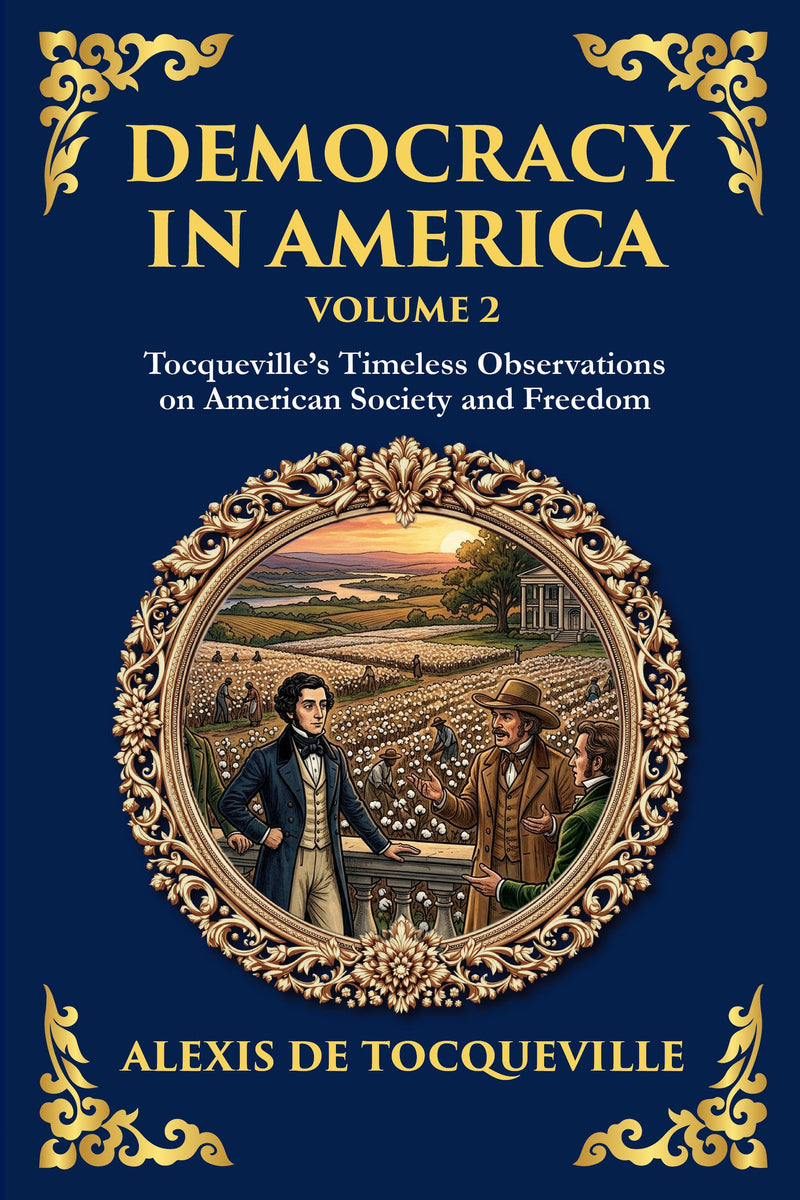
Democracy in America — Volume 2 — Large Print
In Democracy in America — Volume 2, Alexis de Tocqueville continues his penetrating analysis of the young American republic, offering timeless reflections on its evolving political culture, values, and the delicate balance between liberty and equality.
or free app
10,000+ hrs library
30-day guarantee
The complete Democracy in America — Volume 2 appears in modern English through Library of Alexandria Press, available online with audiobook narration included for members.
Have you ever wondered why freedom flourishes in some societies—and quietly fades in others? In the landmark continuation of his political masterpiece, Democracy in America — Volume 2, Alexis de Tocqueville shifts his focus from the external mechanisms of government to the internal workings of the democratic soul. In doing so, he crafts one of the most enduring meditations on the tension between individual liberty and collective equality.
Through careful observation, Tocqueville charts how democracy affects everyday life, social structures, intellectual trends, and the spiritual well-being of citizens. With uncanny foresight, he warns of “soft despotism,” where democratic societies may surrender their freedoms not by force, but by comfort and conformity.
What you’ll discover in this modern edition
- A Deep Dive into Democratic Culture Explore how democracy influences daily habits, relationships, and community life in profound and often unexpected ways.
- Insights into Liberty vs.
| Formats | eBook (EPUB + PDF) · Audiobook · Paperback · Hardcover · Large Print |
| Language | English |
| Trim size (print) | 6 × 9 in |
| Binding | Paperback — perfect-bound · Hardcover — casewrap |
| Large Print edition | Same text in a larger, easy-read type — a larger font, not a larger trim |
| Print pricing | Every physical book at our true cost — at-cost, no profit (members) |
| Library | 873 restored titles, always growing |
| Length | 106,239 words · ~7 hr 5 min reading |
| Reading level | Grade 14 · a demanding, literary read (this modern-English edition) |
| Edition | Modern English translation · 2026 |
Member reviews for this edition are collected as readers finish it — be the first. Across the library: 12,000+ books shipped, every plan covered by a 365-day print guarantee.
About this edition
A faithful, unabridged modern-English edition by The Library of Alexandria — carefully rendered for today's reader and verified paragraph-by-paragraph against the public-domain source. Available as eBook, audiobook, paperback, hardcover, and large print.
- Complete & unabridgedVerified paragraph by paragraph against the source — never a scan, never abridged.
- Modern English, faithfulReadable today, with the author’s meaning kept intact. Readable — not simplified.
- Every format, one membershipRead in your browser or the free app, or listen to the full audiobook.
Included free with your membership
Cancel anytime, one click · 30-day money-back guarantee
Edition last updated July 2026
What’s inside
Democracy in America — Volume 2 — Large Print — complete and unabridged: all 45 sections included with membership, plus the full audiobook.
Begin reading Democracy in America — Volume 2 — Large Print
In clear modern English — the complete text is included with membership.
Introduction
When Alexis de Tocqueville returned to France after his nine-month journey through the United States, he carried with him not merely a notebook full of observations but the seed of a question that would occupy him for the rest of his intellectual life. The first volume of his great work, published in 1835, had examined the political institutions of the young American republic—its laws, its constitution, its mechanisms of self-government. It made him famous almost overnight. But Tocqueville knew that he had only completed half of his task. The political machinery of democracy, however ingeniously constructed, could not by itself explain the strange new world he had witnessed. Something deeper was at work in America, something that touched not only how people governed themselves but how they thought, felt, married, worshipped, conducted business, and imagined their own futures. This second volume, which appeared in 1840, is the fruit of that deeper inquiry. It is a book less about America’s government than about the American soul—and, by extension, about the soul of every society moving toward the great leveling that Tocqueville believed was the destiny of the modern world.
To read this volume today is to encounter a mind of extraordinary subtlety wrestling with a phenomenon that had no precedent and no name. Tocqueville did not invent the word “democracy,” but he used it in a way that was uniquely his own. For him, democracy meant far more than a form of voting or a system of representation. It meant the gradual, irresistible, and providential equalization of conditions—the slow dissolution of the rigid hierarchies that had structured human life for centuries. In the aristocratic world from which he came, a man was born into his place. His occupation, his beliefs, his relationships, and his sense of self were largely determined before he drew his first breath. In the democratic world that was being born in America and spreading inexorably across the West, those fixed positions were melting away. Each individual stood, in principle, on the same level as every other, free to rise or fall by his own efforts, unmoored from the inherited certainties of the past. This transformation, Tocqueville understood, was not merely political. It reached into the most intimate recesses of human experience, reshaping the way people think, the way they feel, and the way they live together. The second volume is his attempt to trace those reshapings, to follow the influence of equality as it spreads from the public square into the mind, the heart, and the home.
What makes this undertaking so remarkable—and so enduringly valuable—is that Tocqueville approached it not as a partisan but as a kind of seer. He was an aristocrat by birth and temperament, a man who felt a genuine attachment to the world that was passing away. Yet he had concluded, with a clarity that few of his contemporaries possessed, that the democratic revolution was both inevitable and, in some profound sense, just. To resist it was futile; to lament it was childish. The only worthy task for a thoughtful person was to understand it, to discern its dangers as well as its promises, and to learn how a free and dignified life might be lived within it. This double vision—the capacity to see democracy from the outside, with the critical eye of one shaped by another world, and yet to embrace it as the unavoidable future of mankind—gives the book a peculiar power. Tocqueville is neither a flatterer of democracy nor its enemy. He is its most honest friend, the kind who tells you the truth precisely because he wishes you well.
The structure of this volume reflects the breadth of Tocqueville’s ambition. He moves through the influence of equality on the intellect, on sentiment, on manners and customs, and finally on the relationship between citizens and the state. Each of these movements opens onto questions that remain startlingly alive for readers nearly two centuries later. Consider his treatment of how people in a democratic age form and hold their ideas. In an aristocratic society, Tocqueville observed, individuals look upward for authority. They accept the beliefs handed down by tradition, by their superiors, by the institutions that have always commanded respect. But when conditions are equal, no one is naturally disposed to accept another person’s word as superior to his own. Each individual is thrown back upon his own reason, encouraged to think for himself, suspicious of inherited dogma. This is, in one sense, a triumph of intellectual independence. Yet Tocqueville saw the paradox lurking within it. The very same equality that frees a person from deference to particular authorities makes him peculiarly vulnerable to a new and more anonymous master: public opinion. When all men are equal, the opinion of the mass acquires an almost irresistible weight. Who am I, the democratic citizen reasons, to set my single judgment against the combined judgment of millions of my equals? And so a society that prizes independent thought may, without noticing it, surrender to a tyranny of the majority over the mind itself—a soft, invisible pressure that discourages dissent not by force but by the sheer crushing presence of consensus.
This insight alone would justify the book’s reputation, but it is only one of many. Tocqueville’s analysis of the democratic relationship to general ideas, to language, to philosophy, and to the sciences is consistently illuminating. He noticed that democratic peoples are drawn to broad, sweeping generalizations because such ideas allow them to grasp many things at once without the labor of examining each individually—a tendency that has both intellectual advantages and intellectual perils. He observed that they tend to prefer the practical applications of science over its pure theoretical foundations, because a restless, commercial society values what produces immediate results. He explored why democratic literature tends toward a particular kind of restless energy, why democratic poetry turns away from legends and ancestors toward the destiny of mankind as a whole and the inner life of the individual, why the very vocabulary of a democratic people shifts and expands and grows abstract. Throughout these chapters, Tocqueville is doing something that had never quite been attempted before: he is constructing a sociology of the imagination, demonstrating that the deepest features of a culture’s intellectual life are shaped by its underlying social condition.
When he turns from the intellect to the sentiments, the book becomes, if anything, even more penetrating. Here Tocqueville introduces one of his most famous and most haunting contributions to political thought: his analysis of individualism. The word was relatively new in his time, and he used it with precision. Individualism, as he defined it, is not the same as selfishness, which is an ardent and exaggerated love of self that has existed in all ages. Individualism is something more modern and more insidious—a calm, considered tendency that disposes each citizen to withdraw from the mass of his fellows, to draw apart with his family and friends into a small private circle, and to leave the larger society to take care of itself. In an aristocratic world, every individual was bound by visible chains to those above and below him; he could scarcely imagine himself apart from the long chain of generations and obligations into which he was born. Equality severs those chains. It makes each person feel that he owes nothing to anyone and expects nothing from anyone. It throws him back forever upon himself and threatens to confine him entirely within the solitude of his own heart.
Tocqueville saw in this tendency one of the gravest dangers of the democratic age. A society of isolated individuals, each absorbed in his private concerns, indifferent to the fate of his neighbors and the destiny of the whole, is a society ripe for despotism—not the loud, bloody tyranny of the past, but a new kind of mild, methodical, all-encompassing administrative power that takes charge of every citizen’s welfare and, in doing so, gradually relieves him of the trouble of thinking and acting for himself. The passages in which Tocqueville imagines this new form of servitude are among the most prophetic in the entire history of political writing. He describes an immense, tutelary power that watches over the fate of its citizens with the solicitude of a parent, that seeks to keep them in perpetual childhood, that provides for their needs and manages their affairs and softens and guides every aspect of their lives until their own will atrophies from disuse. It does not break men’s wills, he wrote, so much as it softens them, bends them, and directs them. Such a power does not destroy; it prevents existence. It does not tyrannize; it compresses, enervates, extinguishes, and stupefies a people. Reading these lines today, one feels the chill of recognition. Tocqueville was describing a possibility, not a certainty—and the remainder of the book is largely devoted to identifying the forces within democracy that might prevent that possibility from becoming reality.
Chief among those countervailing forces is the practice of free association. Tocqueville was endlessly fascinated by the American genius for forming associations of every conceivable kind—civic, commercial, religious, charitable, recreational. Where a European aristocrat might accomplish some public purpose through his personal wealth and authority, and where the French were inclined to demand that the government do everything, Americans simply banded together. When a road needed building, a school needed founding, a moral cause needed advancing, or a hospital needed staffing, the citizens did not wait for a great man or a central bureaucracy; they associated. Tocqueville understood that this habit of voluntary cooperation was not a quaint feature of American life but the very antidote to the isolating tendencies of equality. In learning to act together for common purposes, citizens learn to look beyond their private circles. They discover that their own interest is bound up with the interest of others. They acquire the arts of self-government in miniature, and in doing so they preserve their capacity for freedom on the largest scale. The art of association, he wrote, is the mother of all other arts in a democratic country. This is among the book’s most consequential lessons, and it is one that has shaped how generations of thinkers have understood the meaning of civil society.
The Doctrine of Self-Interest and the Restless Spirit
Closely connected to his analysis of association is Tocqueville’s exploration of how democratic peoples understand virtue and self-interest. He noticed that Americans rarely spoke of sacrificing themselves for others out of pure, disinterested nobility. Instead, they were fond of explaining that virtue is useful, that helping one’s neighbor ultimately serves one’s own welfare, that a well-understood self-interest leads naturally to good citizenship. To an aristocratic sensibility, this might seem a degraded, calculating, even ignoble way of speaking about goodness. But Tocqueville, with characteristic acuteness, saw that the doctrine of self-interest rightly understood was perhaps the most appropriate ethical foundation for a democratic age. It did not produce great acts of heroic devotion, but it formed a steady multitude of citizens who were orderly, temperate, self-controlled, and habitually attentive to the common good. It did not aim at making men virtuous, but it made them habitually disposed toward the behaviors that virtue requires. In a world where the old aristocratic ideals of glory and honor were losing their hold, this modest, accessible, democratic ethic might be the surest safeguard of social cohesion. Here again, Tocqueville refuses easy judgment. He sees both what is lost and what is gained, and he insists that we reckon honestly with both.
Cancel anytime, one click · 30-day money-back guarantee
Founding annual rate available now — your price locks for life when you join.
Not ready? Get this free chapter by email — read it anytime.
✓ Sent — check your inbox for Democracy in America — Volume 2 — Large Print.
Questions about Democracy in America — Volume 2 — Large Print
What is Democracy in America — Volume 2 about?
In Democracy in America — Volume 2, Alexis de Tocqueville continues his penetrating analysis of the young American republic, offering timeless reflections on its evolving political culture, values, and the delicate balance between liberty and equality. With striking foresight, Tocqueville delves into the dangers of despotism, the power of civic associations, and the spiritual consequences of democratic life. This second volume moves beyond political structures to explore the moral and psychological foundations of d
Who wrote Democracy in America — Volume 2?
Democracy in America — Volume 2 was written by Alexis de Tocqueville. This edition presents the complete work in clear modern English, faithfully rendered from the public-domain original by Library of Alexandria Press.
Is Democracy in America — Volume 2 free to read?
The opening chapter is free to read on this page. Members read and listen to the complete work — and the entire library — free, and can order any physical book at our true print cost.
How long is Democracy in America — Volume 2?
45 chapters (~106,239 words) — about 7 hr 5 min of reading in this modern-English edition.
Is this an abridged version of Democracy in America — Volume 2?
No. This is the complete, unabridged Democracy in America — Volume 2, carefully rendered into clear modern English and verified paragraph-by-paragraph against the public-domain source — nothing is cut or summarised.
What formats does Democracy in America — Volume 2 come in?
Democracy in America — Volume 2 is available as eBook, paperback, hardcover and large print. eBook and audiobook are included with membership; printed editions ship at our true print cost.
Shipping & returns
Billing & membership
More from the library


Explore History
- Democracy in America — Volume 2 · Alexis de Tocqueville
- The Prince · Niccolò Machiavelli
- A Short History of the World · H. G. Wells
- A Short History of the World — Large Print · H. G. Wells
- Anabasis — Large Print · Xenophon
- Anabasis · Xenophon
- On Heroes, Hero-Worship, and the Heroic in History — Large Print · Thomas Carlyle
- A History of the Philippines · David P. Barrows
- A History of the Philippines — Large Print · David P. Barrows
- Omens and Superstitions of Southern India — Large Print · Edgar Thurston
- Omens and Superstitions of Southern India · Edgar Thurston
- The Communist Manifesto — Large Print · Karl Marx; Friedrich Engels
- The Everlasting Man — Large Print · G. K. Chesterton
- The Japanese Spirit — Large Print · Yoshisaburo Okakura
- Eighty Years and More; Reminiscences 1815–1897 · Elizabeth Cady Stanton
- Eighty Years and More; Reminiscences 1815–1897 — Large Print · Elizabeth Cady Stanton
- Japanese Girls and Women · Alice Mabel Bacon
- Japanese Girls and Women — Large Print · Alice Mabel Bacon
- An Account of Egypt · Herodotus
- An Account of Egypt — Large Print · Herodotus
- The Prince — Large Print · Niccolò Machiavelli
- The Anglo-Saxon Chronicle — Large Print · Anonymous; J. Ingram (translato...
- The Anglo-Saxon Chronicle · Anonymous; J. Ingram (translato...
- The Jew, The Gypsy and El Islam — Large Print · Richard Francis Burton
- Common Sense · Thomas Paine
- Memoirs of the Courts of Louis XV and XVI — Complete · Madame du Hausset; Princesse de...
- Lucretia Borgia — Large Print · Ferdinand Gregorovius
- Lucretia Borgia · Ferdinand Gregorovius
- The Eleusinian Mysteries and Rites — Large Print · Dudley Wright
- A Vindication of the Rights of Men · Mary Wollstonecraft
Democracy in America — Volume 2 — Large Print
Democracy in America — Volume 2 — Large Print
Tocqueville’s Timeless Observations on American Society and Freedom
Alexis de Tocqueville
Contents
- Introduction
- Book 2
- Chapter 1
- Chapter 2
- Chapter 3
- Chapter 4
- Chapter 5
- Chapter 6
- Chapter 7
- Chapter 8
- Chapter 9
- Chapter 10
- Chapter 11
- Chapter 12
- Chapter 13
- Chapter 14
- Chapter 15
- Chapter 16
- Chapter 17
- Chapter 18
- Chapter 19
- Chapter 20
- Chapter 21
- Chapter 22
- Chapter 23
- Chapter 24
- Chapter 25
- Chapter 26
- Chapter 27
- Chapter 28
- Chapter 29
- Chapter 30
- Chapter 31
- Chapter 32
- Chapter 33
- Chapter 34
- Chapter 35
- Chapter 36
- Chapter 37
- Chapter 38
- … and 5 more chapters
Introduction
When Alexis de Tocqueville returned to France after his nine-month journey through the United States, he carried with him not merely a notebook full of observations but the seed of a question that would occupy him for the rest of his intellectual life. The first volume of his great work, published in 1835, had examined the political institutions of the young American republic—its laws, its constitution, its mechanisms of self-government. It made him famous almost overnight. But Tocqueville knew that he had only completed half of his task. The political machinery of democracy, however ingeniously constructed, could not by itself explain the strange new world he had witnessed. Something deeper was at work in America, something that touched not only how people governed themselves but how they thought, felt, married, worshipped, conducted business, and imagined their own futures. This second volume, which appeared in 1840, is the fruit of that deeper inquiry. It is a book less about America’s government than about the American soul—and, by extension, about the soul of every society moving toward the great leveling that Tocqueville believed was the destiny of the modern world.
To read this volume today is to encounter a mind of extraordinary subtlety wrestling with a phenomenon that had no precedent and no name. Tocqueville did not invent the word “democracy,” but he used it in a way that was uniquely his own. For him, democracy meant far more than a form of voting or a system of representation. It meant the gradual, irresistible, and providential equalization of conditions—the slow dissolution of the rigid hierarchies that had structured human life for centuries. In the aristocratic world from which he came, a man was born into his place. His occupation, his beliefs, his relationships, and his sense of self were largely determined before he drew his first breath. In the democratic world that was being born in America and spreading inexorably across the West, those fixed positions were melting away. Each individual stood, in principle, on the same level as every other, free to rise or fall by his own efforts, unmoored from the inherited certainties of the past. This transformation, Tocqueville understood, was not merely political. It reached into the most intimate recesses of human experience, reshaping the way people think, the way they feel, and the way they live together. The second volume is his attempt to trace those reshapings, to follow the influence of equality as it spreads from the public square into the mind, the heart, and the home.
What makes this undertaking so remarkable—and so enduringly valuable—is that Tocqueville approached it not as a partisan but as a kind of seer. He was an aristocrat by birth and temperament, a man who felt a genuine attachment to the world that was passing away. Yet he had concluded, with a clarity that few of his contemporaries possessed, that the democratic revolution was both inevitable and, in some profound sense, just. To resist it was futile; to lament it was childish. The only worthy task for a thoughtful person was to understand it, to discern its dangers as well as its promises, and to learn how a free and dignified life might be lived within it. This double vision—the capacity to see democracy from the outside, with the critical eye of one shaped by another world, and yet to embrace it as the unavoidable future of mankind—gives the book a peculiar power. Tocqueville is neither a flatterer of democracy nor its enemy. He is its most honest friend, the kind who tells you the truth precisely because he wishes you well.
The structure of this volume reflects the breadth of Tocqueville’s ambition. He moves through the influence of equality on the intellect, on sentiment, on manners and customs, and finally on the relationship between citizens and the state. Each of these movements opens onto questions that remain startlingly alive for readers nearly two centuries later. Consider his treatment of how people in a democratic age form and hold their ideas. In an aristocratic society, Tocqueville observed, individuals look upward for authority. They accept the beliefs handed down by tradition, by their superiors, by the institutions that have always commanded respect. But when conditions are equal, no one is naturally disposed to accept another person’s word as superior to his own. Each individual is thrown back upon his own reason, encouraged to think for himself, suspicious of inherited dogma. This is, in one sense, a triumph of intellectual independence. Yet Tocqueville saw the paradox lurking within it. The very same equality that frees a person from deference to particular authorities makes him peculiarly vulnerable to a new and more anonymous master: public opinion. When all men are equal, the opinion of the mass acquires an almost irresistible weight. Who am I, the democratic citizen reasons, to set my single judgment against the combined judgment of millions of my equals? And so a society that prizes independent thought may, without noticing it, surrender to a tyranny of the majority over the mind itself—a soft, invisible pressure that discourages dissent not by force but by the sheer crushing presence of consensus.
This insight alone would justify the book’s reputation, but it is only one of many. Tocqueville’s analysis of the democratic relationship to general ideas, to language, to philosophy, and to the sciences is consistently illuminating. He noticed that democratic peoples are drawn to broad, sweeping generalizations because such ideas allow them to grasp many things at once without the labor of examining each individually—a tendency that has both intellectual advantages and intellectual perils. He observed that they tend to prefer the practical applications of science over its pure theoretical foundations, because a restless, commercial society values what produces immediate results. He explored why democratic literature tends toward a particular kind of restless energy, why democratic poetry turns away from legends and ancestors toward the destiny of mankind as a whole and the inner life of the individual, why the very vocabulary of a democratic people shifts and expands and grows abstract. Throughout these chapters, Tocqueville is doing something that had never quite been attempted before: he is constructing a sociology of the imagination, demonstrating that the deepest features of a culture’s intellectual life are shaped by its underlying social condition.
When he turns from the intellect to the sentiments, the book becomes, if anything, even more penetrating. Here Tocqueville introduces one of his most famous and most haunting contributions to political thought: his analysis of individualism. The word was relatively new in his time, and he used it with precision. Individualism, as he defined it, is not the same as selfishness, which is an ardent and exaggerated love of self that has existed in all ages. Individualism is something more modern and more insidious—a calm, considered tendency that disposes each citizen to withdraw from the mass of his fellows, to draw apart with his family and friends into a small private circle, and to leave the larger society to take care of itself. In an aristocratic world, every individual was bound by visible chains to those above and below him; he could scarcely imagine himself apart from the long chain of generations and obligations into which he was born. Equality severs those chains. It makes each person feel that he owes nothing to anyone and expects nothing from anyone. It throws him back forever upon himself and threatens to confine him entirely within the solitude of his own heart.
Tocqueville saw in this tendency one of the gravest dangers of the democratic age. A society of isolated individuals, each absorbed in his private concerns, indifferent to the fate of his neighbors and the destiny of the whole, is a society ripe for despotism—not the loud, bloody tyranny of the past, but a new kind of mild, methodical, all-encompassing administrative power that takes charge of every citizen’s welfare and, in doing so, gradually relieves him of the trouble of thinking and acting for himself. The passages in which Tocqueville imagines this new form of servitude are among the most prophetic in the entire history of political writing. He describes an immense, tutelary power that watches over the fate of its citizens with the solicitude of a parent, that seeks to keep them in perpetual childhood, that provides for their needs and manages their affairs and softens and guides every aspect of their lives until their own will atrophies from disuse. It does not break men’s wills, he wrote, so much as it softens them, bends them, and directs them. Such a power does not destroy; it prevents existence. It does not tyrannize; it compresses, enervates, extinguishes, and stupefies a people. Reading these lines today, one feels the chill of recognition. Tocqueville was describing a possibility, not a certainty—and the remainder of the book is largely devoted to identifying the forces within democracy that might prevent that possibility from becoming reality.
Chief among those countervailing forces is the practice of free association. Tocqueville was endlessly fascinated by the American genius for forming associations of every conceivable kind—civic, commercial, religious, charitable, recreational. Where a European aristocrat might accomplish some public purpose through his personal wealth and authority, and where the French were inclined to demand that the government do everything, Americans simply banded together. When a road needed building, a school needed founding, a moral cause needed advancing, or a hospital needed staffing, the citizens did not wait for a great man or a central bureaucracy; they associated. Tocqueville understood that this habit of voluntary cooperation was not a quaint feature of American life but the very antidote to the isolating tendencies of equality. In learning to act together for common purposes, citizens learn to look beyond their private circles. They discover that their own interest is bound up with the interest of others. They acquire the arts of self-government in miniature, and in doing so they preserve their capacity for freedom on the largest scale. The art of association, he wrote, is the mother of all other arts in a democratic country. This is among the book’s most consequential lessons, and it is one that has shaped how generations of thinkers have understood the meaning of civil society.
The Doctrine of Self-Interest and the Restless Spirit
Closely connected to his analysis of association is Tocqueville’s exploration of how democratic peoples understand virtue and self-interest. He noticed that Americans rarely spoke of sacrificing themselves for others out of pure, disinterested nobility. Instead, they were fond of explaining that virtue is useful, that helping one’s neighbor ultimately serves one’s own welfare, that a well-understood self-interest leads naturally to good citizenship. To an aristocratic sensibility, this might seem a degraded, calculating, even ignoble way of speaking about goodness. But Tocqueville, with characteristic acuteness, saw that the doctrine of self-interest rightly understood was perhaps the most appropriate ethical foundation for a democratic age. It did not produce great acts of heroic devotion, but it formed a steady multitude of citizens who were orderly, temperate, self-controlled, and habitually attentive to the common good. It did not aim at making men virtuous, but it made them habitually disposed toward the behaviors that virtue requires. In a world where the old aristocratic ideals of glory and honor were losing their hold, this modest, accessible, democratic ethic might be the surest safeguard of social cohesion. Here again, Tocqueville refuses easy judgment. He sees both what is lost and what is gained, and he insists that we reckon honestly with both.
The Influence of Democracy on the Development of Opinion in the United States
De Tocqueville’s Preface to the Second Part
Americans live in a democratic society, which has naturally shaped their laws and their political identity. Furthermore, this social structure has created many feelings and perspectives that were nonexistent in the older aristocratic societies of Europe. It has erased or altered all previous social connections and replaced them with entirely new ones. The nature of civil society has been changed just as much as the political world. I addressed the first topic in my book on the Democracy in America, published five years ago; the purpose of this current book is to examine the latter. However, these two parts complement each other and together make up a single work.
I need to warn the reader immediately about a mistake that would be very unfair to me. When the reader sees that I credit the principle of equality with so many different results, they might assume that I believe it is the only cause of everything happening today. That would be a very narrow interpretation of my views. There are many opinions, feelings, and tendencies today that come from circumstances completely unrelated to, or even opposite to, the principle of equality. For instance, if I use the United States as an example, I could easily show that the geography of the country, the origins of its people, the religion of its founders, their education, and their old habits have all had—and still have—a huge influence on the people’s thoughts and feelings, regardless of democracy. Similar and distinct causes could be found in Europe to explain much of what is happening there.
End of the free sample
Keep reading, free
Members read and listen to the complete book — and the entire library. Cancel anytime, one click · 30-day money-back guarantee.