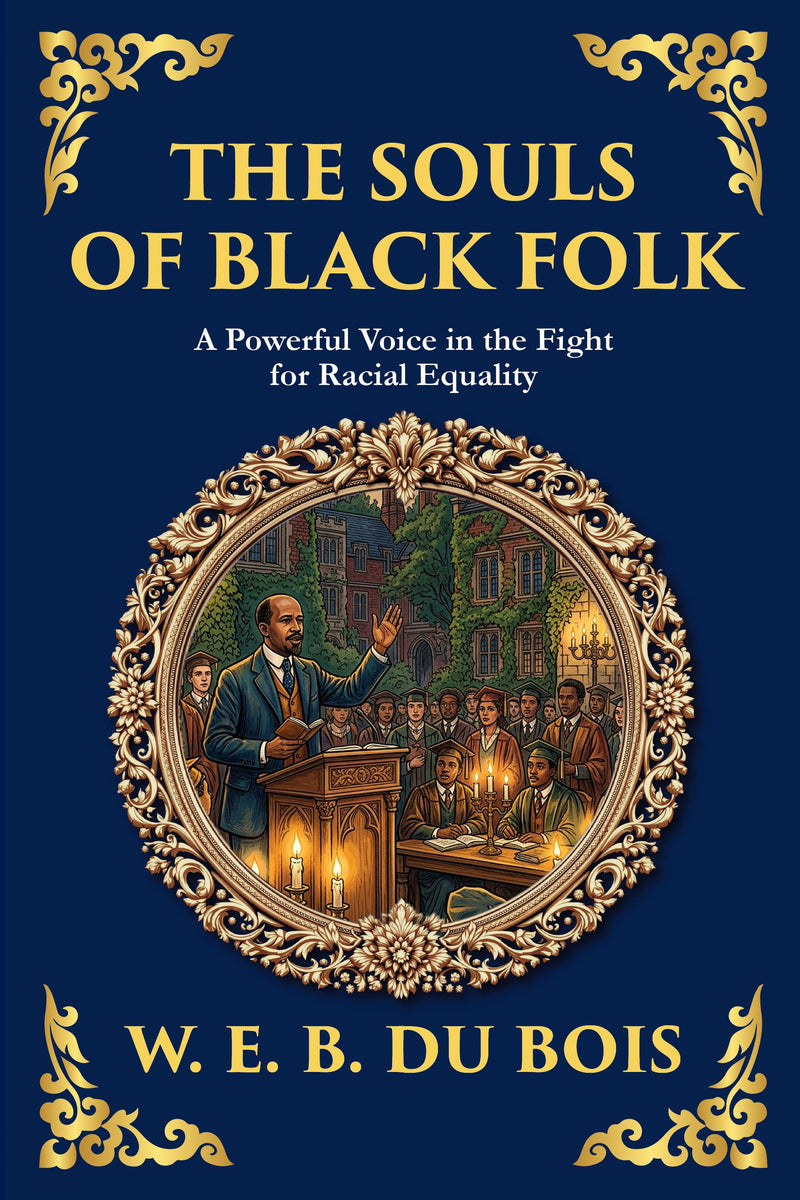
The Souls of Black Folk — Large Print
A landmark in American literature and civil rights thought, The Souls of Black Folk by W. E. B. Du Bois is both an impassioned cry for justice and a deep reflection on the African American experience.
or free app
10,000+ hrs library
30-day guarantee
The complete The Souls of Black Folk appears in modern English through Library of Alexandria Press, available online with audiobook narration included for members.
Have you ever wondered why this book remains essential reading in the fight for justice and equality? The Souls of Black Folk is not just a historical document—it is a lyrical, powerful meditation on race, identity, and freedom in America. In this modernized edition of W. E. B. Du Bois’ seminal 1903 masterpiece, readers are invited into the soul of a nation still reckoning with its past.
Du Bois introduces the concept of “double consciousness”—the internal conflict experienced by African Americans torn between their heritage and their national identity. Combining sociological insight with personal narrative, music, and philosophy, Du Bois lays bare the harsh realities of post-slavery America while pointing to paths of resistance, education, and hope. This edition ensures that Du Bois’ powerful voice remains accessible and relevant for new generations seeking to understand and transform the structures of racial injustice.
What you’ll discover in this modern edition
- in This Modern Edition of The Souls of Black Folk:
- A Profound Examination of Identity – Understand Du Bois’ revolutionary theory of “double consciousness” and its impact on Black identity.
| Formats | eBook (EPUB + PDF) · Audiobook · Paperback · Hardcover · Large Print |
| Language | English |
| Trim size (print) | 6 × 9 in |
| Binding | Paperback — perfect-bound · Hardcover — casewrap |
| Large Print edition | Same text in a larger, easy-read type — a larger font, not a larger trim |
| Print pricing | Every physical book at our true cost — at-cost, no profit (members) |
| Library | 873 restored titles, always growing |
| Length | 71,232 words · ~4 hr 45 min reading |
| Reading level | Grade 8 · an easy, flowing read (this modern-English edition) |
| Edition | Modern English translation · 2026 |
Member reviews for this edition are collected as readers finish it — be the first. Across the library: 12,000+ books shipped, every plan covered by a 365-day print guarantee.
About this edition
A faithful, unabridged modern-English edition by The Library of Alexandria — carefully rendered for today's reader and verified paragraph-by-paragraph against the public-domain source. Available as eBook, audiobook, paperback, hardcover, and large print.
- Complete & unabridgedVerified paragraph by paragraph against the source — never a scan, never abridged.
- Modern English, faithfulReadable today, with the author’s meaning kept intact. Readable — not simplified.
- Every format, one membershipRead in your browser or the free app, or listen to the full audiobook.
Included free with your membership
Cancel anytime, one click · 30-day money-back guarantee
Edition last updated July 2026
What’s inside
The Souls of Black Folk — Large Print — complete and unabridged: all 17 sections included with membership, plus the full audiobook.
Begin reading The Souls of Black Folk — Large Print
In clear modern English — the complete text is included with membership.
Introduction
When The Souls of Black Folk first appeared in 1903, it arrived not merely as a book but as a turning point in the way a nation understood itself. Within its pages lived a voice unlike any that American readers had encountered before: scholarly yet lyrical, fiercely analytical yet aching with feeling, rooted in the hard facts of history and economics yet soaring into the realm of music, memory, and the human spirit. W. E. B. Du Bois, then a young professor still in his thirties, set out to do something audacious. He wanted to make the inner life of Black Americans visible to a world that had spent centuries refusing to look. He wanted to answer, in the fullest sense, a question that had haunted him since childhood—a question that haunts the book from its first chapter to its last: How does it feel to be a problem?
That question, deceptively simple, opens a door into one of the most profound meditations on identity, freedom, and belonging ever written on American soil. This edition has been carefully prepared as a modern translation, adapted for the contemporary reader, so that the power of Du Bois’s thought might reach across the distance of more than a century without losing its essential character. The work you are about to read remains true to the spirit, the argument, and the emotional weight of the original, while smoothing the path for readers who might otherwise stumble over the dense rhetorical conventions and the heavy formality of turn-of-the-century prose. The goal has never been to simplify Du Bois’s ideas—they are anything but simple—but to ensure that nothing stands between you and the experience he intended you to have.
To approach this book is to enter into conversation with one of the great minds of the modern age. Du Bois was a historian, a sociologist, a journalist, a novelist, a civil rights organizer, and a poet, and remarkably, all of these identities are present at once in the work before you. He moves without warning from rigorous data about the cotton economy of the Deep South to a tender portrait of a child who died too soon, from a withering critique of political compromise to the soaring cadences of spirituals sung in the dark. The book is, in a sense, a demonstration of the very wholeness it argues for—a refusal to be reduced to a single category, a single voice, a single way of being seen. Reading it, you come to understand that Du Bois was not simply writing about a people; he was insisting on their full humanity, in all its complexity, contradiction, and dignity.
A Book Born of Its Moment, Speaking to All Time
To understand the urgency that pulses beneath every page, it helps to picture the world into which this book was born. The American Civil War had ended in 1865, and with it the institution of slavery that had bound millions of human beings in bondage for generations. The years that followed brought a brief, extraordinary flowering of hope known as Reconstruction, during which formerly enslaved people voted, held office, built schools, established churches, and began to imagine a future as full citizens of the nation that had so long denied them. But that hope was systematically crushed. By the time Du Bois sat down to write, the gains of Reconstruction had been rolled back through violence, intimidation, fraudulent laws, and the silent complicity of a country eager to move on. A new and brutal system of segregation had taken hold, enforced by terror and sanctioned by the highest courts. The promises of emancipation had curdled into a fresh kind of confinement.
It was into this atmosphere of betrayal and retrenchment that Du Bois released his great statement. He was writing against a tide of opinion that held Black Americans to be inherently inferior, fit only for menial labor and political silence. He was writing, too, against the most influential Black leader of his era, whose program of accommodation and patient self-improvement Du Bois believed had conceded too much, too quickly, to the forces of oppression. One of the most famous chapters in this book is a direct and respectful but unflinching critique of that philosophy, and it marked a profound shift in the direction of the struggle for equality. Where some counseled patience and the quiet accumulation of skills, Du Bois argued that civil and political rights could not be deferred, that the vote and access to higher education and the full protection of the law were not luxuries to be earned but birthrights to be claimed. This argument helped lay the intellectual foundation for the civil rights movements that would follow over the next century, and its echoes can still be heard in the debates of our own time.
Yet to read this book merely as a historical artifact would be to miss its astonishing vitality. Du Bois was speaking to his own moment, yes, but the questions he raised have refused to fade. The tension between patience and urgency, between working within a system and demanding its transformation, between assimilation and the preservation of cultural identity—these are not questions that belong only to 1903. They belong to every generation that has wrestled with the gap between a nation’s stated ideals and its lived realities. When Du Bois writes about the daily indignities of being seen as a problem rather than a person, when he describes the exhausting labor of maintaining one’s sense of self in a world determined to define you from the outside, he speaks to an experience that countless readers across many circumstances will recognize as their own. This is the secret of the book’s endurance. It is rooted so deeply in a specific time and place that it becomes universal.
Among the concepts Du Bois introduced in these pages, none has proven more enduring or more widely discussed than the idea he called “double consciousness.” This is the peculiar sensation, as he describes it, of always seeing oneself through the eyes of others—of measuring one’s own soul by the standards of a world that looks back with contempt or pity. To be both an American and a Black person, in his formulation, was to feel a kind of two-ness, a sense of being split between two selves that the surrounding society refused to allow to merge into one whole and unhindered human being. This single insight has rippled outward across more than a century of thought, influencing fields as varied as psychology, literature, philosophy, and the study of identity itself. It gave language to an experience that had long gone unnamed, and in naming it, Du Bois gave countless people a way to understand the strange and painful arithmetic of their own inner lives. As you read, you will find this idea returning again and again, threading through the personal essays and the historical analysis alike, binding the whole book together into a single sustained meditation on what it means to be divided against oneself by forces beyond one’s control.
But for all its analytical brilliance, the book never loses its heart. Du Bois had a gift for the small, telling detail that opens up an entire world—the schoolhouse with its dirt floor, the worn faces of sharecroppers trapped in cycles of debt, the bright eyes of a student hungry for learning, the particular quality of light over a Southern field at evening. He traveled through the rural counties of Georgia and other parts of the Deep South, and what he saw there he rendered with the precision of a scientist and the compassion of a poet. He wanted his readers, many of whom had never set foot in the world he described, to feel the texture of these lives—the labor, the longing, the small joys snatched from the jaws of hardship, the immense weight of a history that pressed down on every shoulder. He refused to let the people he wrote about become abstractions or statistics. He insisted that they be seen as full human beings, with inner lives as rich and complex as any reader’s own.
One of the things that makes this book so remarkable, and so rewarding to read, is its unusual structure. It is not a single continuous argument but a collection of fourteen chapters and an afterword, each one a distinct essay with its own subject, its own mood, and its own form. Some are works of historical and sociological analysis, tracing the rise and fall of the agency established to aid formerly enslaved people after the war, or examining the economic conditions that kept Black workers trapped in poverty. Others are intensely personal, including one of the most moving chapters ever written about the loss of a child. Still others turn toward culture and the spirit, exploring the role of religion in the lives of Black communities and the extraordinary music—the sorrow songs, as Du Bois called them—that arose from the experience of slavery and endured as a testament to the resilience of the human soul.
What unifies these varied pieces is a single sensibility, a single questing intelligence, and a single overriding purpose: to lift the veil that separated Black Americans from the understanding of the wider world, and to allow readers to glimpse the souls behind it. Du Bois uses that image of the veil throughout the book, and it becomes one of his most powerful metaphors. The veil is the barrier of prejudice and ignorance that hangs between Black people and the rest of society, distorting how they are seen and how they are able to see themselves. To live behind the veil is to be set apart, to be misunderstood, to be denied the simple recognition of one’s full humanity. Du Bois’s project, in part, is to draw that veil aside, not by erasing the differences it conceals but by inviting the reader to look honestly and unflinchingly at what lies beyond it.
A distinctive feature of the original work, which has been preserved in this edition, is the way Du Bois opens each chapter. Before the prose begins, he places two epigraphs: a few lines of poetry drawn from the great traditions of Western literature, and a bar or two of musical notation from one of the spirituals, the sorrow songs born out of slavery. This pairing is no mere decoration. It is a deliberate and profound statement. By placing the poetry of European civilization side by side with the music of enslaved Africans and their descendants, Du Bois was making an argument without words—asserting that these two traditions belonged together, that the culture of Black America was not a thing apart from the great achievements of humanity but a vital and equal contribution to them. In the book’s final chapter, he turns his full attention to these sorrow songs, and in doing so he offers one of the earliest and most eloquent appreciations of what would come to be recognized as one of America’s greatest artistic gifts to the world. The music, he argues, carries the deepest truths of a people’s experience—their suffering, their faith, their unconquerable hope—and to listen to it rightly is to hear the very voice of the human spirit straining toward freedom.
Reading the book in this edition, you will find that its rhythms reward patience and attention. Du Bois was a master of cadence, and even in modernized form his sentences carry a music of their own. He builds his effects gradually, returning to certain images and phrases until they accumulate a deep resonance. The veil, the color line, the question of how it feels to be a problem, the two-ness of double consciousness—these motifs recur and develop, so that by the time you reach the final pages you feel the full weight of what has been built. This is not a book to be rushed. It is a book to be lived with, considered, and returned to. Each chapter can stand alone, and you may find yourself wanting to pause after each one to sit with what you have read. At the same time, the chapters speak to one another across the gaps between them, and the experience of reading them in sequence is the experience of watching a single magnificent vision unfold.
It is worth noting, too, the famous prophecy that Du Bois announces near the very beginning of the book. He declares that the problem of the twentieth century is the problem of the color line—the dividing line of race that ran not only through American society but through the relations of peoples across the entire globe. This was an extraordinary statement to make in 1903, and the century that followed proved its accuracy with terrible force. The struggles over race and freedom that defined so much of the twentieth century, from the movements for civil rights in the United States to the dismantling of colonial empires around the world, all unfolded along the line that Du Bois identified. To read his words now, with the knowledge of all that came after, is to recognize the work of a genuine visionary—someone who saw, with painful clarity, the central drama of the age that was just beginning.
Cancel anytime, one click · 30-day money-back guarantee
Founding annual rate available now — your price locks for life when you join.
Not ready? Get this free chapter by email — read it anytime.
✓ Sent — check your inbox for The Souls of Black Folk — Large Print.
Questions about The Souls of Black Folk — Large Print
What is The Souls of Black Folk about?
A landmark in American literature and civil rights thought, The Souls of Black Folk by W. E. B. Du Bois is both an impassioned cry for justice and a deep reflection on the African American experience. Through personal essays, historical analysis, and literary storytelling, Du Bois reveals the struggles of Black Americans after emancipation, the persistence of systemic racism, and the unshakable resilience of the human spirit. This timeless work remains one of the most vital calls for racial equality, education, and
Who wrote The Souls of Black Folk?
The Souls of Black Folk was written by W. E. B. Du Bois. This edition presents the complete work in clear modern English, faithfully rendered from the public-domain original by Library of Alexandria Press.
Is The Souls of Black Folk free to read?
The opening chapter is free to read on this page. Members read and listen to the complete work — and the entire library — free, and can order any physical book at our true print cost.
How long is The Souls of Black Folk?
17 chapters (~71,232 words) — about 4 hr 45 min of reading in this modern-English edition.
Is this an abridged version of The Souls of Black Folk?
No. This is the complete, unabridged The Souls of Black Folk, carefully rendered into clear modern English and verified paragraph-by-paragraph against the public-domain source — nothing is cut or summarised.
What formats does The Souls of Black Folk come in?
The Souls of Black Folk is available as eBook, paperback, hardcover and large print. eBook and audiobook are included with membership; printed editions ship at our true print cost.
Shipping & returns
Billing & membership
More from the library


Explore History
- The Advancement of Learning · Francis Bacon
- Democracy in America — Volume 2 · Alexis de Tocqueville
- Second Treatise of Government · John Locke
- The Prince · Niccolò Machiavelli
- Society in America, Volume 1 (of 2) · Harriet Martineau
- The Everlasting Man · G. K. Chesterton
- The Book of Tea · Kakuzo Okakura
- The Japanese Spirit · Yoshisaburo Okakura
- Give Me Liberty or Give Me Death · Patrick Henry
- Ion · Plato
- John F. Kennedy’s Inaugural Address · John F. Kennedy
- The Declaration of Independence of the United States of America · Thomas Jefferson
- On Heroes, Hero-Worship, and the Heroic in History · Thomas Carlyle
- The Communist Manifesto
- The Souls of Black Folk · W. E. B. Du Bois
- Letters on the Equality of the Sexes, and the Condition of Woman · Sarah Grimké
- The Romance of Biography (Vol. 1 of 2) · Mrs. Jameson
- The Erotic Motive in Literature · Albert Mordell
The Souls of Black Folk — Large Print
The Souls of Black Folk — Large Print
A Powerful Voice in the Fight for Racial Equality
W. E. B. Du Bois
Contents
- Introduction
- Preface by the Author
- Chapter 1
- Chapter 2
- Chapter 3
- Chapter 4
- Chapter 5
- Chapter 6
- Chapter 7
- Chapter 8
- Chapter 9
- Chapter 10
- Chapter 11
- Chapter 12
- Chapter 13
- Chapter 14
- Chapter 15
Introduction
When The Souls of Black Folk first appeared in 1903, it arrived not merely as a book but as a turning point in the way a nation understood itself. Within its pages lived a voice unlike any that American readers had encountered before: scholarly yet lyrical, fiercely analytical yet aching with feeling, rooted in the hard facts of history and economics yet soaring into the realm of music, memory, and the human spirit. W. E. B. Du Bois, then a young professor still in his thirties, set out to do something audacious. He wanted to make the inner life of Black Americans visible to a world that had spent centuries refusing to look. He wanted to answer, in the fullest sense, a question that had haunted him since childhood—a question that haunts the book from its first chapter to its last: How does it feel to be a problem?
That question, deceptively simple, opens a door into one of the most profound meditations on identity, freedom, and belonging ever written on American soil. This edition has been carefully prepared as a modern translation, adapted for the contemporary reader, so that the power of Du Bois’s thought might reach across the distance of more than a century without losing its essential character. The work you are about to read remains true to the spirit, the argument, and the emotional weight of the original, while smoothing the path for readers who might otherwise stumble over the dense rhetorical conventions and the heavy formality of turn-of-the-century prose. The goal has never been to simplify Du Bois’s ideas—they are anything but simple—but to ensure that nothing stands between you and the experience he intended you to have.
To approach this book is to enter into conversation with one of the great minds of the modern age. Du Bois was a historian, a sociologist, a journalist, a novelist, a civil rights organizer, and a poet, and remarkably, all of these identities are present at once in the work before you. He moves without warning from rigorous data about the cotton economy of the Deep South to a tender portrait of a child who died too soon, from a withering critique of political compromise to the soaring cadences of spirituals sung in the dark. The book is, in a sense, a demonstration of the very wholeness it argues for—a refusal to be reduced to a single category, a single voice, a single way of being seen. Reading it, you come to understand that Du Bois was not simply writing about a people; he was insisting on their full humanity, in all its complexity, contradiction, and dignity.
A Book Born of Its Moment, Speaking to All Time
To understand the urgency that pulses beneath every page, it helps to picture the world into which this book was born. The American Civil War had ended in 1865, and with it the institution of slavery that had bound millions of human beings in bondage for generations. The years that followed brought a brief, extraordinary flowering of hope known as Reconstruction, during which formerly enslaved people voted, held office, built schools, established churches, and began to imagine a future as full citizens of the nation that had so long denied them. But that hope was systematically crushed. By the time Du Bois sat down to write, the gains of Reconstruction had been rolled back through violence, intimidation, fraudulent laws, and the silent complicity of a country eager to move on. A new and brutal system of segregation had taken hold, enforced by terror and sanctioned by the highest courts. The promises of emancipation had curdled into a fresh kind of confinement.
It was into this atmosphere of betrayal and retrenchment that Du Bois released his great statement. He was writing against a tide of opinion that held Black Americans to be inherently inferior, fit only for menial labor and political silence. He was writing, too, against the most influential Black leader of his era, whose program of accommodation and patient self-improvement Du Bois believed had conceded too much, too quickly, to the forces of oppression. One of the most famous chapters in this book is a direct and respectful but unflinching critique of that philosophy, and it marked a profound shift in the direction of the struggle for equality. Where some counseled patience and the quiet accumulation of skills, Du Bois argued that civil and political rights could not be deferred, that the vote and access to higher education and the full protection of the law were not luxuries to be earned but birthrights to be claimed. This argument helped lay the intellectual foundation for the civil rights movements that would follow over the next century, and its echoes can still be heard in the debates of our own time.
Yet to read this book merely as a historical artifact would be to miss its astonishing vitality. Du Bois was speaking to his own moment, yes, but the questions he raised have refused to fade. The tension between patience and urgency, between working within a system and demanding its transformation, between assimilation and the preservation of cultural identity—these are not questions that belong only to 1903. They belong to every generation that has wrestled with the gap between a nation’s stated ideals and its lived realities. When Du Bois writes about the daily indignities of being seen as a problem rather than a person, when he describes the exhausting labor of maintaining one’s sense of self in a world determined to define you from the outside, he speaks to an experience that countless readers across many circumstances will recognize as their own. This is the secret of the book’s endurance. It is rooted so deeply in a specific time and place that it becomes universal.
Among the concepts Du Bois introduced in these pages, none has proven more enduring or more widely discussed than the idea he called “double consciousness.” This is the peculiar sensation, as he describes it, of always seeing oneself through the eyes of others—of measuring one’s own soul by the standards of a world that looks back with contempt or pity. To be both an American and a Black person, in his formulation, was to feel a kind of two-ness, a sense of being split between two selves that the surrounding society refused to allow to merge into one whole and unhindered human being. This single insight has rippled outward across more than a century of thought, influencing fields as varied as psychology, literature, philosophy, and the study of identity itself. It gave language to an experience that had long gone unnamed, and in naming it, Du Bois gave countless people a way to understand the strange and painful arithmetic of their own inner lives. As you read, you will find this idea returning again and again, threading through the personal essays and the historical analysis alike, binding the whole book together into a single sustained meditation on what it means to be divided against oneself by forces beyond one’s control.
But for all its analytical brilliance, the book never loses its heart. Du Bois had a gift for the small, telling detail that opens up an entire world—the schoolhouse with its dirt floor, the worn faces of sharecroppers trapped in cycles of debt, the bright eyes of a student hungry for learning, the particular quality of light over a Southern field at evening. He traveled through the rural counties of Georgia and other parts of the Deep South, and what he saw there he rendered with the precision of a scientist and the compassion of a poet. He wanted his readers, many of whom had never set foot in the world he described, to feel the texture of these lives—the labor, the longing, the small joys snatched from the jaws of hardship, the immense weight of a history that pressed down on every shoulder. He refused to let the people he wrote about become abstractions or statistics. He insisted that they be seen as full human beings, with inner lives as rich and complex as any reader’s own.
One of the things that makes this book so remarkable, and so rewarding to read, is its unusual structure. It is not a single continuous argument but a collection of fourteen chapters and an afterword, each one a distinct essay with its own subject, its own mood, and its own form. Some are works of historical and sociological analysis, tracing the rise and fall of the agency established to aid formerly enslaved people after the war, or examining the economic conditions that kept Black workers trapped in poverty. Others are intensely personal, including one of the most moving chapters ever written about the loss of a child. Still others turn toward culture and the spirit, exploring the role of religion in the lives of Black communities and the extraordinary music—the sorrow songs, as Du Bois called them—that arose from the experience of slavery and endured as a testament to the resilience of the human soul.
What unifies these varied pieces is a single sensibility, a single questing intelligence, and a single overriding purpose: to lift the veil that separated Black Americans from the understanding of the wider world, and to allow readers to glimpse the souls behind it. Du Bois uses that image of the veil throughout the book, and it becomes one of his most powerful metaphors. The veil is the barrier of prejudice and ignorance that hangs between Black people and the rest of society, distorting how they are seen and how they are able to see themselves. To live behind the veil is to be set apart, to be misunderstood, to be denied the simple recognition of one’s full humanity. Du Bois’s project, in part, is to draw that veil aside, not by erasing the differences it conceals but by inviting the reader to look honestly and unflinchingly at what lies beyond it.
A distinctive feature of the original work, which has been preserved in this edition, is the way Du Bois opens each chapter. Before the prose begins, he places two epigraphs: a few lines of poetry drawn from the great traditions of Western literature, and a bar or two of musical notation from one of the spirituals, the sorrow songs born out of slavery. This pairing is no mere decoration. It is a deliberate and profound statement. By placing the poetry of European civilization side by side with the music of enslaved Africans and their descendants, Du Bois was making an argument without words—asserting that these two traditions belonged together, that the culture of Black America was not a thing apart from the great achievements of humanity but a vital and equal contribution to them. In the book’s final chapter, he turns his full attention to these sorrow songs, and in doing so he offers one of the earliest and most eloquent appreciations of what would come to be recognized as one of America’s greatest artistic gifts to the world. The music, he argues, carries the deepest truths of a people’s experience—their suffering, their faith, their unconquerable hope—and to listen to it rightly is to hear the very voice of the human spirit straining toward freedom.
Reading the book in this edition, you will find that its rhythms reward patience and attention. Du Bois was a master of cadence, and even in modernized form his sentences carry a music of their own. He builds his effects gradually, returning to certain images and phrases until they accumulate a deep resonance. The veil, the color line, the question of how it feels to be a problem, the two-ness of double consciousness—these motifs recur and develop, so that by the time you reach the final pages you feel the full weight of what has been built. This is not a book to be rushed. It is a book to be lived with, considered, and returned to. Each chapter can stand alone, and you may find yourself wanting to pause after each one to sit with what you have read. At the same time, the chapters speak to one another across the gaps between them, and the experience of reading them in sequence is the experience of watching a single magnificent vision unfold.
It is worth noting, too, the famous prophecy that Du Bois announces near the very beginning of the book. He declares that the problem of the twentieth century is the problem of the color line—the dividing line of race that ran not only through American society but through the relations of peoples across the entire globe. This was an extraordinary statement to make in 1903, and the century that followed proved its accuracy with terrible force. The struggles over race and freedom that defined so much of the twentieth century, from the movements for civil rights in the United States to the dismantling of colonial empires around the world, all unfolded along the line that Du Bois identified. To read his words now, with the knowledge of all that came after, is to recognize the work of a genuine visionary—someone who saw, with painful clarity, the central drama of the age that was just beginning.
O water, voice of my heart, crying in the sand, all night long crying with a mournful sound, as I lie and listen, unable to understand the voice of my heart within me or the voice of the sea. O water, crying for rest, is it me, is it me? All night long the water cries out to me.
Restless water, there will never be peace until the last moon fades and the last tide fails, and the fires of the end begin to burn in the west; and the heart will grow weary and wonder and cry like the sea, crying in vain throughout all of life, just as the water cries to me all night long.
Between me and the other world, there is always an unspoken question. Some people don’t ask it because they want to be polite; others don’t know how to phrase it correctly. Still, everyone circles around it. They approach me with hesitation, looking at me with curiosity or pity. Then, instead of asking directly, “How does it feel to be a problem?” they say things like, “I know a wonderful Black man in my town,” or “I fought at Mechanicsville,” or “Don’t these Southern atrocities make your blood boil?” To these comments, I smile, or act interested, or calm my anger, depending on what the situation requires. To the real question—“How does it feel to be a problem?”—I rarely say a word.
And yet, being a problem is a strange experience—even for someone who has never been anything else, except perhaps as a baby or while in Europe. It is during the carefree days of early childhood that this realization first hits a person, almost all at once. I remember clearly when that shadow first fell over me. I was very young, living up in the hills of New England, where the dark Housatonic River flows between Hoosac and Taghkanic toward the sea. In a tiny wooden schoolhouse, some idea got into the students’ heads to buy fancy visiting cards—ten cents a pack—and trade them. The trading was fun, until one girl, a tall new student, refused my card. She rejected it flatly, with a single glance. Then it suddenly became clear to me that I was different from the others; or perhaps I was similar in heart, life, and longing, but I was shut out from their world by a massive veil. After that, I had no desire to tear down that veil or sneak through it. I looked down on everything beyond it and lived above it in a world of blue skies and great, drifting shadows. That sky felt bluest when I could beat my classmates on a test, or win a footrace, or even fight them. Unfortunately, as the years passed, that proud contempt began to fade; because the words I craved and all the brilliant opportunities were theirs, not mine. But I told myself they shouldn’t keep those prizes; I would take some or all of them. I could never decide exactly how I would do it: by studying law, by healing the sick, or by telling the amazing stories that filled my head—somehow. For other Black boys, the struggle wasn’t so bright and hopeful: their youth shrank into tasteless flattery, or into a silent hatred of the pale world around them and a mocking distrust of everything white; or it was wasted in a bitter cry: “Why did God make me an outcast and a stranger in my own home?” The shadows of a prison closed in around us all: the walls were tight and stubborn for everyone, but they were relentlessly narrow, tall, and impossible to climb for the sons of night, who had to plod on in resignation, or beat their palms uselessly against the stone, or steadily, and almost hopelessly, watch the strip of blue sky above.
End of the free sample
Keep reading, free
Members read and listen to the complete book — and the entire library. Cancel anytime, one click · 30-day money-back guarantee.