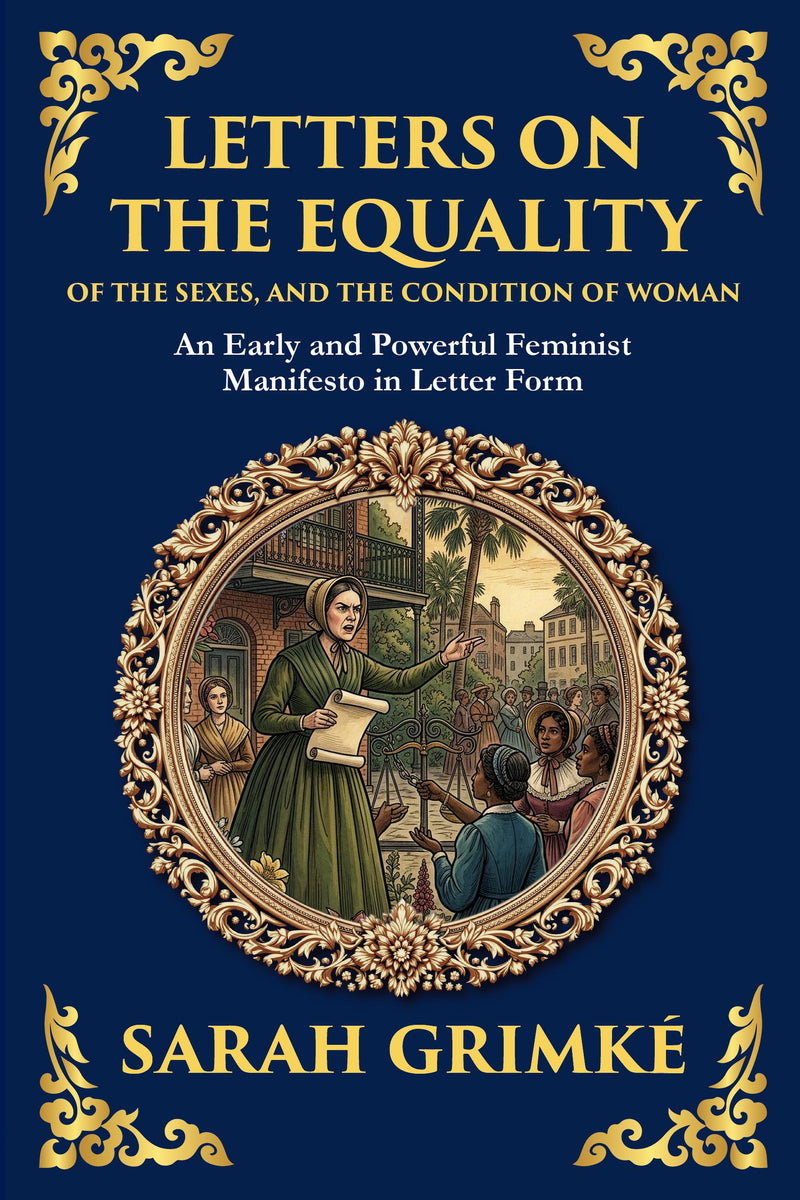
Letters on the Equality of the Sexes, and the Condition of Woman
First published in 1837, Letters on the Equality of the Sexes, and the Condition of Woman remains one of the most radical and enduring texts in the fight for gender equality.
or free app
10,000+ hrs library
30-day guarantee
The complete Letters on the Equality of the Sexes, and the Condition of Woman appears in modern English through Library of Alexandria Press, available online with audiobook narration included for members.
Have you ever wondered why women’s voices were silenced for centuries—and how one woman dared to break that silence? Sarah Grimké’s Letters on the Equality of the Sexes, and the Condition of Woman is one of the earliest and most influential feminist works in American history. Composed as a series of letters addressed to a fellow advocate, this bold and unapologetic manifesto challenges 19th-century gender roles, church doctrine, legal inequality, and the cultural norms that perpetuated female subjugation.
This compelling modern edition restores Grimké’s voice for a new generation, offering an essential roadmap for understanding the roots of feminist thought and the timeless relevance of the struggle for equality. Inside this groundbreaking work, you’ll discover: A Courageous Voice for Equality – Grimké speaks out on issues still debated today: education, marriage, political representation, and bodily autonomy. One of the First Feminist Manifestos – A seminal text that influenced the women’s rights movement in both the U.S. and abroad. A Bridge Between Abolition and Feminism – Written by a woman who was both an anti- slavery activist and an advocate for gender equality. An Unflinching Challenge to Patriarchal Power – Addressed to male readers, her letters dismantle the theological and legal arguments used to justify female inferiority. Timeless Wisdom for Modern Readers – Grimké’s impassioned defense of women's rights resonates just as powerfully in the 21st century. For readers of history, feminism, social justice, and anyone who values the written word as a tool of resistance, Letters on the Equality of the Sexes is not just a historical document—it is a call to action.
What you’ll discover in this modern edition
- A powerful call for equality in education, law, and religion
- A fearless critique of 19th-century gender roles
- A bridge between abolition and the women’s rights movement
| Formats | eBook (EPUB + PDF) · Audiobook · Paperback · Hardcover · Large Print |
| Language | English |
| Trim size (print) | 6 × 9 in |
| Binding | Paperback — perfect-bound · Hardcover — casewrap |
| Large Print edition | Same text in a larger, easy-read type — a larger font, not a larger trim |
| Print pricing | Every physical book at our true cost — at-cost, no profit (members) |
| Library | 873 restored titles, always growing |
| Length | 34,674 words · ~2 hr 19 min reading |
| Reading level | Grade 12 · a confident, adult read (this modern-English edition) |
| Edition | Modern English translation · 2026 |
Member reviews for this edition are collected as readers finish it — be the first. Across the library: 12,000+ books shipped, every plan covered by a 365-day print guarantee.
About this edition
A faithful, unabridged modern-English edition by The Library of Alexandria — carefully rendered for today's reader and verified paragraph-by-paragraph against the public-domain source. Available as eBook, audiobook, paperback, hardcover, and large print.
- Complete & unabridgedVerified paragraph by paragraph against the source — never a scan, never abridged.
- Modern English, faithfulReadable today, with the author’s meaning kept intact. Readable — not simplified.
- Every format, one membershipRead in your browser or the free app, or listen to the full audiobook.
Included free with your membership
Cancel anytime, one click · 30-day money-back guarantee
Edition last updated July 2026
What’s inside
Letters on the Equality of the Sexes, and the Condition of Woman — complete and unabridged: all 16 sections included with membership, plus the full audiobook.
Begin reading Letters on the Equality of the Sexes, and the Condition of Woman
In clear modern English — the complete text is included with membership.
Introduction
In the summer of 1837, a slight, plainly dressed woman from a prominent South Carolina slaveholding family sat down to defend a position so radical that it scandalized even her allies: that women, as moral and intellectual beings, stood on perfect equality with men before God and ought to claim that equality in every sphere of life. The series of essays she produced—cast in the intimate, urgent form of letters addressed to a friend—would become one of the earliest sustained arguments for women’s rights ever written by an American. Letters on the Equality of the Sexes, and the Condition of Woman is the work of Sarah Grimké, and to read it today is to witness a mind in the act of breaking free from the very world that formed it.
The collection you are about to read carries the weight of its moment, but it does not feel like a museum piece. It crackles with the energy of someone who has spent a lifetime being told to be silent and has finally decided to speak. What makes these letters so remarkable is not only the boldness of their claims but the deeply personal cost behind them. Sarah Grimké did not arrive at her convictions through abstract speculation. She lived her way into them, painfully and at great expense, and the reader can feel that hard-won quality on every page. This is a document written by a woman who had everything to lose by writing it, and who wrote it anyway.
This modern adaptation has been prepared with a single purpose: to make Grimké’s extraordinary thought accessible to readers living nearly two centuries after her pen first touched paper. The language of the 1830s, rich and resonant as it is, can present obstacles—dense scriptural references, archaic constructions, and rhetorical conventions that once felt natural but now require patience to navigate. The aim here has been to preserve the fire and clarity of the original argument while smoothing the path for the contemporary reader, so that what reaches you is not a relic to be admired from a distance but a living voice you can actually hear. The hope is that you will come away not merely informed about an important historical figure, but genuinely moved by her, perhaps even changed by her.
To understand why these letters matter, it helps to understand the woman who wrote them—not in exhaustive biographical detail, but in the broad outlines that shaped her thinking. Sarah Moore Grimké was born in 1792 in Charleston, South Carolina, into a family of wealth, social standing, and slaveholding power. Her father was a judge and a planter; the household ran on the labor of enslaved people, and the comforts Sarah enjoyed as a child were purchased by their suffering. This was the world she was born to inherit and uphold.
She did not. From an early age, Sarah felt a deep and disquieting tension between the values her society professed and the realities it practiced. As a girl, she was hungry for education—genuinely, fiercely hungry—and she watched with growing frustration as her brothers were given access to learning, law, and the wider world while she was steered toward the narrow accomplishments deemed appropriate for a young lady of her class. She taught herself what she could. She slipped into her father’s study and read what she was not supposed to read. And famously, in an act of quiet rebellion, she secretly taught an enslaved girl to read, an offense for which she could have faced serious consequences. These early experiences planted seeds that would take decades to flower.
The defining decision of Sarah’s life was her rejection of the entire system that had nurtured her. Repelled by slavery and by the spiritual emptiness she found in the genteel Episcopalian world of Charleston, she eventually left the South altogether, relocating to Philadelphia and embracing the Quaker faith. The Quakers, with their relative openness to women speaking in religious meetings and their strong antislavery tradition, seemed to offer her a path forward. In time, her younger sister Angelina joined her in the North, and the two became inseparable partners in a cause that would define them both: the abolition of slavery.
It was as abolitionists that the Grimké sisters first stepped onto the public stage—and it was the controversy surrounding that public role that gave birth to the very letters in this book. As Southern women who had witnessed slavery firsthand, Sarah and Angelina possessed a moral authority that the antislavery movement desperately wanted to deploy. They began to speak publicly against slavery, drawing larger and larger audiences. But here they collided with one of the deepest taboos of their era: women were not supposed to address public gatherings, especially gatherings that included men. The sight of a woman standing before a “promiscuous assembly”—the period’s term for a mixed-sex audience—struck many as a violation of the natural order, an affront to decency, very nearly an act of indecency itself.
The backlash was swift and came from a quarter that must have stung deeply. In 1837, a group of Congregationalist ministers in Massachusetts issued a pastoral letter rebuking the Grimké sisters, warning of the dangers posed by women who stepped outside their God-ordained sphere. The clergy invoked Scripture, womanly modesty, and the supposed fragility of the female character to argue that women like Sarah and Angelina were endangering both themselves and society. The implication was clear: a woman who spoke in public unsexed herself, forfeited her protection, and threatened the foundations of Christian civilization.
For many women, such an attack would have been the end of the matter—a humiliation to be absorbed in silence. For Sarah Grimké, it was a provocation that demanded a response, and the response she produced went far beyond the immediate quarrel. Rather than simply defending the right of women to speak against slavery, she chose to interrogate the entire framework that confined women in the first place. If the ministers were wrong about a woman’s right to address an audience, perhaps they were wrong about a great deal more. Perhaps the whole edifice of female subordination, propped up by selective readings of Scripture and centuries of unexamined custom, deserved to be examined and dismantled. And so she set out to do exactly that.
The letters were addressed to Mary Parker, the president of the Boston Female Anti-Slavery Society, and they were published serially before being gathered into a single volume. The epistolary form was not incidental. By writing as one friend to another, Grimké achieved a tone of directness and intimacy that a formal treatise could never match. She is not lecturing from a podium; she is reasoning with you, the reader, drawing you into her confidence, inviting you to follow the chain of her thinking and to feel the force of her conclusions. This is part of what makes the work endure. You are not reading a document so much as you are being spoken to, urgently and personally, by a woman who believes that your understanding matters.
It is worth pausing to appreciate just how early all of this is. The famous Seneca Falls Convention, often treated as the symbolic birth of the American women’s rights movement, would not take place until 1848—more than a decade after Grimké composed these letters. The arguments and language that would later be associated with that movement were, in significant part, anticipated and articulated here first. When the women who gathered at Seneca Falls drafted their declaration, they were building on intellectual ground that Sarah Grimké and a handful of others had already cleared. To read these letters, then, is to encounter the women’s rights movement not at its celebrated public unveiling but in its formative, courageous infancy, when the very idea of women claiming equality was so novel that it required defending almost from first principles.
There is a further dimension to Grimké’s significance that the modern reader should hold in mind, because it speaks directly to her originality. Many of her contemporaries in the antislavery movement saw the cause of the enslaved and the cause of women as separate concerns, and some feared that mixing the two would damage both. Grimké refused this separation. For her, the logic of human equality was indivisible. If it was wrong to treat enslaved people as property, denying them their full humanity, then it was likewise wrong to treat women as the property and dependents of men, denying them their full personhood. She perceived, with a clarity that was rare in her day, that systems of domination tend to justify themselves with the same kinds of arguments—appeals to nature, to Scripture, to the supposed good of those being dominated—and that these arguments, once exposed in one arena, lose their power in others. Her experience as a witness to slavery sharpened her perception of injustice everywhere, including injustices that her society had taught her to regard as normal and even benevolent.
What does Grimké actually argue in these pages? While it would spoil the experience to walk through her reasoning in detail—the pleasure of the book lies in following her line of thought as it unfolds—it is worth sketching the contours of her project so that you can read with a clear sense of what she is attempting.
At the heart of her case lies a single, electrifying conviction: that men and women are created equal, that this equality is rooted in their shared nature as moral and rational beings, and that whatever is right for a man to do is equally right for a woman to do. She insists on what she calls the principle that “whatsoever it is morally right for a man to do, it is morally right for a woman to do.” This may sound unremarkable to us, but in 1837 it was incendiary. It cut directly against the prevailing doctrine of “separate spheres,” which held that men and women occupied fundamentally different domains—men the public world of work, politics, and commerce; women the private world of home, family, and moral influence—and that this division was ordained by God and nature alike. Grimké did not merely chip away at the edges of this doctrine. She challenged its foundations.
Much of her argument is conducted on theological ground, and here a word of guidance may help the modern reader. Grimké was a deeply religious woman writing for a deeply religious audience, and she knew that the most powerful weapons used against women’s equality were drawn from Scripture. So she met her opponents on their own terrain. She reexamines the biblical texts that had long been cited to justify female subordination—the story of creation, the account of the Fall, the teachings of Paul on the conduct of women—and she argues, with considerable boldness and ingenuity, that these texts have been misread, mistranslated, and misapplied by men who had every interest in interpreting them to their own advantage. She contends that the original intent of Scripture, properly understood, affirms the equality of the sexes rather than the dominion of one over the other.
For some contemporary readers, this heavy reliance on biblical interpretation may at first seem distant from their own concerns. But it would be a mistake to skim past it. Grimké’s theological arguments are not pious window-dressing; they are the strategic core of her project. She understood that to liberate women, she had to wrest the authority of Scripture out of the hands of those who used it as a chain. In doing so, she demonstrated a kind of intellectual courage that has its own thrilling quality, regardless of the reader’s personal beliefs. To watch a woman in 1837 calmly and confidently reinterpret sacred texts that had been used to silence her—to claim the right to read and reason for herself in matters where men had always claimed final authority—is to witness an act of profound liberation. The medium of her argument is itself part of her message: she is asserting, by the very act of arguing, that women possess the intellectual and spiritual standing to engage these questions as equals.
Cancel anytime, one click · 30-day money-back guarantee
Founding annual rate available now — your price locks for life when you join.
Not ready? Get this free chapter by email — read it anytime.
✓ Sent — check your inbox for Letters on the Equality of the Sexes, and the Condition of Woman.
Questions about Letters on the Equality of the Sexes, and the Condition of Woman
What is Letters on the Equality of the Sexes, and the Condition of Woman about?
First published in 1837, Letters on the Equality of the Sexes, and the Condition of Woman remains one of the most radical and enduring texts in the fight for gender equality. Written by pioneering abolitionist and feminist Sarah Grimké, these powerful letters confront the systemic oppression of women in religion, law, and society with unwavering clarity and moral conviction. In an era when women were expected to remain silent, Grimké raised her voice—and in doing so, laid the groundwork for generations of activists
Who wrote Letters on the Equality of the Sexes, and the Condition of Woman?
Letters on the Equality of the Sexes, and the Condition of Woman was written by Sarah Grimké. This edition presents the complete work in clear modern English, faithfully rendered from the public-domain original by Library of Alexandria Press.
Is Letters on the Equality of the Sexes, and the Condition of Woman free to read?
The opening chapter is free to read on this page. Members read and listen to the complete work — and the entire library — free, and can order any physical book at our true print cost.
How long is Letters on the Equality of the Sexes, and the Condition of Woman?
16 chapters (~34,674 words) — about 2 hr 19 min of reading in this modern-English edition.
Is this an abridged version of Letters on the Equality of the Sexes, and the Condition of Woman?
No. This is the complete, unabridged Letters on the Equality of the Sexes, and the Condition of Woman, carefully rendered into clear modern English and verified paragraph-by-paragraph against the public-domain source — nothing is cut or summarised.
What formats does Letters on the Equality of the Sexes, and the Condition of Woman come in?
Letters on the Equality of the Sexes, and the Condition of Woman is available as eBook, paperback, hardcover and large print. eBook and audiobook are included with membership; printed editions ship at our true print cost.
Shipping & returns
Billing & membership
More from the library


Explore History
- The Advancement of Learning · Francis Bacon
- Democracy in America — Volume 2 · Alexis de Tocqueville
- Second Treatise of Government · John Locke
- The Prince · Niccolò Machiavelli
- Society in America, Volume 1 (of 2) · Harriet Martineau
- The Everlasting Man · G. K. Chesterton
- The Book of Tea · Kakuzo Okakura
- The Japanese Spirit · Yoshisaburo Okakura
- Give Me Liberty or Give Me Death · Patrick Henry
- Ion · Plato
- John F. Kennedy’s Inaugural Address · John F. Kennedy
- The Declaration of Independence of the United States of America · Thomas Jefferson
- On Heroes, Hero-Worship, and the Heroic in History · Thomas Carlyle
- The Communist Manifesto
- The Souls of Black Folk · W. E. B. Du Bois
- The Romance of Biography (Vol. 1 of 2) · Mrs. Jameson
- The Erotic Motive in Literature · Albert Mordell
Letters on the Equality of the Sexes, and the Condition of Woman
Letters on the Equality of the Sexes, and the Condition of Woman
An Early and Powerful Feminist Manifesto in Letter Form
Sarah Grimké
Contents
- Introduction
- Letter 1
- Letter 2
- Letter 3
- Letter 4
- Letter 5
- Letter 6
- Letter 7
- Letter 8
- Letter 9
- Letter 10
- Letter 11
- Letter 12
- Letter 13
- Letter 14
- Letter 15
Introduction
In the summer of 1837, a slight, plainly dressed woman from a prominent South Carolina slaveholding family sat down to defend a position so radical that it scandalized even her allies: that women, as moral and intellectual beings, stood on perfect equality with men before God and ought to claim that equality in every sphere of life. The series of essays she produced—cast in the intimate, urgent form of letters addressed to a friend—would become one of the earliest sustained arguments for women’s rights ever written by an American. Letters on the Equality of the Sexes, and the Condition of Woman is the work of Sarah Grimké, and to read it today is to witness a mind in the act of breaking free from the very world that formed it.
The collection you are about to read carries the weight of its moment, but it does not feel like a museum piece. It crackles with the energy of someone who has spent a lifetime being told to be silent and has finally decided to speak. What makes these letters so remarkable is not only the boldness of their claims but the deeply personal cost behind them. Sarah Grimké did not arrive at her convictions through abstract speculation. She lived her way into them, painfully and at great expense, and the reader can feel that hard-won quality on every page. This is a document written by a woman who had everything to lose by writing it, and who wrote it anyway.
This modern adaptation has been prepared with a single purpose: to make Grimké’s extraordinary thought accessible to readers living nearly two centuries after her pen first touched paper. The language of the 1830s, rich and resonant as it is, can present obstacles—dense scriptural references, archaic constructions, and rhetorical conventions that once felt natural but now require patience to navigate. The aim here has been to preserve the fire and clarity of the original argument while smoothing the path for the contemporary reader, so that what reaches you is not a relic to be admired from a distance but a living voice you can actually hear. The hope is that you will come away not merely informed about an important historical figure, but genuinely moved by her, perhaps even changed by her.
To understand why these letters matter, it helps to understand the woman who wrote them—not in exhaustive biographical detail, but in the broad outlines that shaped her thinking. Sarah Moore Grimké was born in 1792 in Charleston, South Carolina, into a family of wealth, social standing, and slaveholding power. Her father was a judge and a planter; the household ran on the labor of enslaved people, and the comforts Sarah enjoyed as a child were purchased by their suffering. This was the world she was born to inherit and uphold.
She did not. From an early age, Sarah felt a deep and disquieting tension between the values her society professed and the realities it practiced. As a girl, she was hungry for education—genuinely, fiercely hungry—and she watched with growing frustration as her brothers were given access to learning, law, and the wider world while she was steered toward the narrow accomplishments deemed appropriate for a young lady of her class. She taught herself what she could. She slipped into her father’s study and read what she was not supposed to read. And famously, in an act of quiet rebellion, she secretly taught an enslaved girl to read, an offense for which she could have faced serious consequences. These early experiences planted seeds that would take decades to flower.
The defining decision of Sarah’s life was her rejection of the entire system that had nurtured her. Repelled by slavery and by the spiritual emptiness she found in the genteel Episcopalian world of Charleston, she eventually left the South altogether, relocating to Philadelphia and embracing the Quaker faith. The Quakers, with their relative openness to women speaking in religious meetings and their strong antislavery tradition, seemed to offer her a path forward. In time, her younger sister Angelina joined her in the North, and the two became inseparable partners in a cause that would define them both: the abolition of slavery.
It was as abolitionists that the Grimké sisters first stepped onto the public stage—and it was the controversy surrounding that public role that gave birth to the very letters in this book. As Southern women who had witnessed slavery firsthand, Sarah and Angelina possessed a moral authority that the antislavery movement desperately wanted to deploy. They began to speak publicly against slavery, drawing larger and larger audiences. But here they collided with one of the deepest taboos of their era: women were not supposed to address public gatherings, especially gatherings that included men. The sight of a woman standing before a “promiscuous assembly”—the period’s term for a mixed-sex audience—struck many as a violation of the natural order, an affront to decency, very nearly an act of indecency itself.
The backlash was swift and came from a quarter that must have stung deeply. In 1837, a group of Congregationalist ministers in Massachusetts issued a pastoral letter rebuking the Grimké sisters, warning of the dangers posed by women who stepped outside their God-ordained sphere. The clergy invoked Scripture, womanly modesty, and the supposed fragility of the female character to argue that women like Sarah and Angelina were endangering both themselves and society. The implication was clear: a woman who spoke in public unsexed herself, forfeited her protection, and threatened the foundations of Christian civilization.
For many women, such an attack would have been the end of the matter—a humiliation to be absorbed in silence. For Sarah Grimké, it was a provocation that demanded a response, and the response she produced went far beyond the immediate quarrel. Rather than simply defending the right of women to speak against slavery, she chose to interrogate the entire framework that confined women in the first place. If the ministers were wrong about a woman’s right to address an audience, perhaps they were wrong about a great deal more. Perhaps the whole edifice of female subordination, propped up by selective readings of Scripture and centuries of unexamined custom, deserved to be examined and dismantled. And so she set out to do exactly that.
The letters were addressed to Mary Parker, the president of the Boston Female Anti-Slavery Society, and they were published serially before being gathered into a single volume. The epistolary form was not incidental. By writing as one friend to another, Grimké achieved a tone of directness and intimacy that a formal treatise could never match. She is not lecturing from a podium; she is reasoning with you, the reader, drawing you into her confidence, inviting you to follow the chain of her thinking and to feel the force of her conclusions. This is part of what makes the work endure. You are not reading a document so much as you are being spoken to, urgently and personally, by a woman who believes that your understanding matters.
It is worth pausing to appreciate just how early all of this is. The famous Seneca Falls Convention, often treated as the symbolic birth of the American women’s rights movement, would not take place until 1848—more than a decade after Grimké composed these letters. The arguments and language that would later be associated with that movement were, in significant part, anticipated and articulated here first. When the women who gathered at Seneca Falls drafted their declaration, they were building on intellectual ground that Sarah Grimké and a handful of others had already cleared. To read these letters, then, is to encounter the women’s rights movement not at its celebrated public unveiling but in its formative, courageous infancy, when the very idea of women claiming equality was so novel that it required defending almost from first principles.
There is a further dimension to Grimké’s significance that the modern reader should hold in mind, because it speaks directly to her originality. Many of her contemporaries in the antislavery movement saw the cause of the enslaved and the cause of women as separate concerns, and some feared that mixing the two would damage both. Grimké refused this separation. For her, the logic of human equality was indivisible. If it was wrong to treat enslaved people as property, denying them their full humanity, then it was likewise wrong to treat women as the property and dependents of men, denying them their full personhood. She perceived, with a clarity that was rare in her day, that systems of domination tend to justify themselves with the same kinds of arguments—appeals to nature, to Scripture, to the supposed good of those being dominated—and that these arguments, once exposed in one arena, lose their power in others. Her experience as a witness to slavery sharpened her perception of injustice everywhere, including injustices that her society had taught her to regard as normal and even benevolent.
What does Grimké actually argue in these pages? While it would spoil the experience to walk through her reasoning in detail—the pleasure of the book lies in following her line of thought as it unfolds—it is worth sketching the contours of her project so that you can read with a clear sense of what she is attempting.
At the heart of her case lies a single, electrifying conviction: that men and women are created equal, that this equality is rooted in their shared nature as moral and rational beings, and that whatever is right for a man to do is equally right for a woman to do. She insists on what she calls the principle that “whatsoever it is morally right for a man to do, it is morally right for a woman to do.” This may sound unremarkable to us, but in 1837 it was incendiary. It cut directly against the prevailing doctrine of “separate spheres,” which held that men and women occupied fundamentally different domains—men the public world of work, politics, and commerce; women the private world of home, family, and moral influence—and that this division was ordained by God and nature alike. Grimké did not merely chip away at the edges of this doctrine. She challenged its foundations.
Much of her argument is conducted on theological ground, and here a word of guidance may help the modern reader. Grimké was a deeply religious woman writing for a deeply religious audience, and she knew that the most powerful weapons used against women’s equality were drawn from Scripture. So she met her opponents on their own terrain. She reexamines the biblical texts that had long been cited to justify female subordination—the story of creation, the account of the Fall, the teachings of Paul on the conduct of women—and she argues, with considerable boldness and ingenuity, that these texts have been misread, mistranslated, and misapplied by men who had every interest in interpreting them to their own advantage. She contends that the original intent of Scripture, properly understood, affirms the equality of the sexes rather than the dominion of one over the other.
For some contemporary readers, this heavy reliance on biblical interpretation may at first seem distant from their own concerns. But it would be a mistake to skim past it. Grimké’s theological arguments are not pious window-dressing; they are the strategic core of her project. She understood that to liberate women, she had to wrest the authority of Scripture out of the hands of those who used it as a chain. In doing so, she demonstrated a kind of intellectual courage that has its own thrilling quality, regardless of the reader’s personal beliefs. To watch a woman in 1837 calmly and confidently reinterpret sacred texts that had been used to silence her—to claim the right to read and reason for herself in matters where men had always claimed final authority—is to witness an act of profound liberation. The medium of her argument is itself part of her message: she is asserting, by the very act of arguing, that women possess the intellectual and spiritual standing to engage these questions as equals.
My Dear Friend,—In trying to fulfill your request to share my views on the role of women, I feel like I am venturing into unexplored territory. I know I will be presenting arguments that challenge corrupt public opinion and the distorted interpretations of Holy Scripture that have become so common. However, I am searching for the truth, and no obstacle will stop me. I believe the world will be greatly improved by every new discovery we make regarding God’s plan for the creation of women. It is impossible for us to fulfill the purpose of our existence if we do not understand that purpose. We cannot carry out our duties if we do not comprehend them, nor can we embrace our privileges if we do not know what they are.
As I examine this important topic, I will rely solely on the Bible to define the role of women. I believe that almost everything written on this subject has resulted from a misunderstanding of the simple truths revealed in the Scriptures, caused by poor translations of many passages. I have completely let go of the superstitious reverence people have for the English version of the Bible. The translators of the King James version were certainly not inspired. Therefore, I use the original texts as my standard, believing those to be inspired. I also claim the right to decide for myself what the inspired writers meant. I believe it is the solemn duty of every person to study the Scriptures for themselves with the help of the Holy Spirit, rather than being controlled by the opinions of any one man or group of men.
First, we must look at women at the time of their creation. “And God said, Let us make man in our own image, after our likeness; and let them have dominion over the fish of the sea, and over the fowl of the air, and over the cattle, and over all the earth, and over every creeping thing that creepeth upon the earth. So God created man in his own image, in the image of God created he him, male and female created he them.” In this magnificent description of the creation of humanity (where “man” is a general term including both men and women), there is not a single hint that any difference exists between them. Both were made in the image of God. Both were given authority over every other creature, but not over each other. Created as perfect equals, they were expected to carry out the leadership entrusted to them by their Creator in harmony and love.
End of the free sample
Keep reading, free
Members read and listen to the complete book — and the entire library. Cancel anytime, one click · 30-day money-back guarantee.