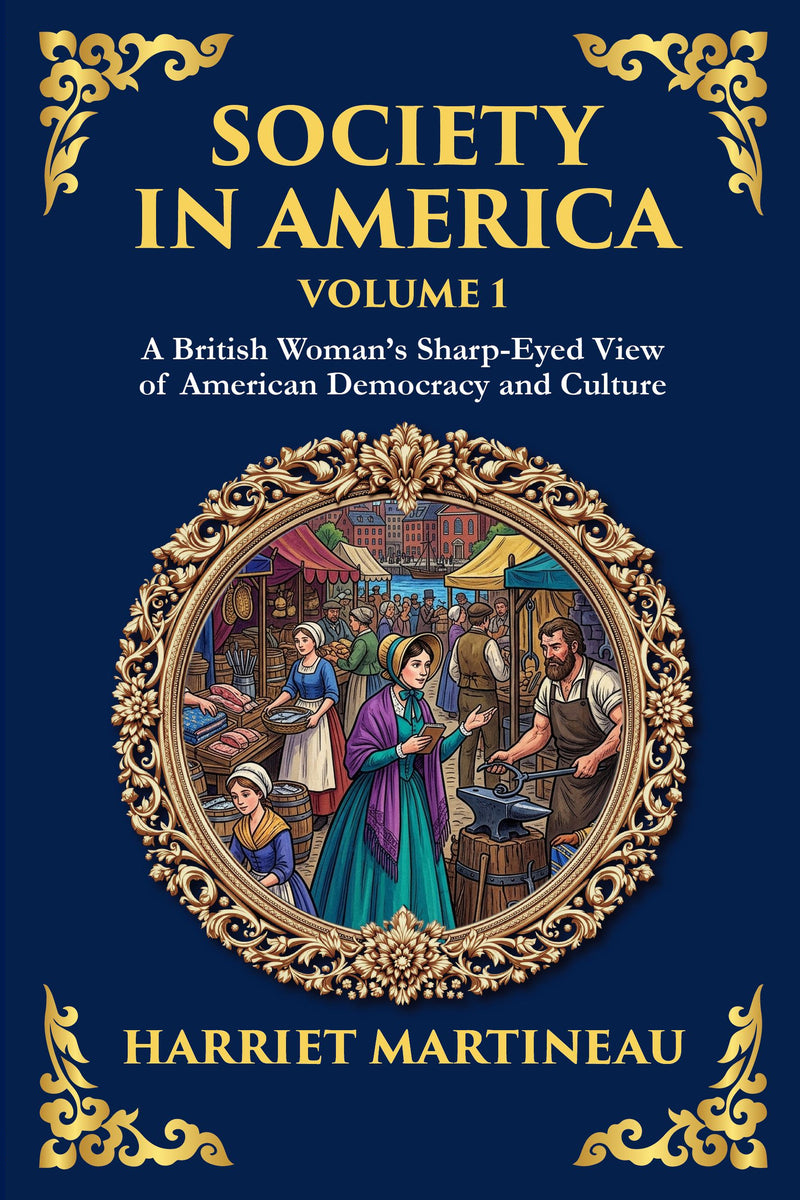
Society in America, Volume 1 (of 2)
In an age of revolution and reform, one woman dared to cross the Atlantic and tell the truth as she saw it. Society in America, Volume 1 is Harriet Martineau’s brilliant and unflinching analysis of early 19th-century American democracy, race relations, religion, gender equality, and social customs.
or free app
10,000+ hrs library
30-day guarantee
The complete Society in America, Volume 1 appears in modern English through Library of Alexandria Press, available online with audiobook narration included for members.
Have you ever wondered why America’s founding ideals so often clash with its realities? Society in America, Volume 1 is Harriet Martineau’s searing exploration of the American experiment—written by a British woman unafraid to ask difficult questions. First published in 1837, this landmark work combines personal observation with sharp political critique to examine how democracy was practiced—and contradicted—in the everyday life of the United States.
Martineau’s journey through America takes her from salons and churches to courtrooms and slave plantations. Her subject matter is sweeping: civil liberties, the status of women, the treatment of Native Americans, education, religion, prisons, and—most damningly—the institution of slavery. She dissects not only what Americans say they believe, but how they actually live.
This first volume focuses on the foundational political structure of the United States and its impact on social life, moral philosophy, and human rights. With fresh relevance in today’s era of political polarization and cultural reckoning, Society in America remains a cornerstone of critical democratic thought.
What you’ll discover in this modern edition
- A Firsthand Feminist Perspective on Early American Life – One of the first women to publish serious sociopolitical analysis of the U.S.
- A Blistering Critique of American Hypocrisy – Martineau examines the gulf between democratic ideals and social injustice.
- The Birth of Modern Sociology and Political Theory – A foundational text in sociological observation and cross-cultural critique.
- Themes That Echo into the Present – Her insights on race, gender, and inequality feel startlingly contemporary.
- A Beautifully Modernized Edition – This version maintains Martineau’s piercing voice while making the 19th-century text accessible to modern readers.
| Formats | eBook (EPUB + PDF) · Audiobook · Paperback · Hardcover · Large Print |
| Language | English |
| Trim size (print) | 6 × 9 in |
| Binding | Paperback — perfect-bound · Hardcover — casewrap |
| Large Print edition | Same text in a larger, easy-read type — a larger font, not a larger trim |
| Print pricing | Every physical book at our true cost — at-cost, no profit (members) |
| Library | 873 restored titles, always growing |
| Length | 119,578 words · ~7 hr 58 min reading |
| Reading level | Grade 12 · a confident, adult read (this modern-English edition) |
| Edition | Modern English translation · 2026 |
Member reviews for this edition are collected as readers finish it — be the first. Across the library: 12,000+ books shipped, every plan covered by a 365-day print guarantee.
About this edition
A faithful, unabridged modern-English edition by The Library of Alexandria — carefully rendered for today's reader and verified paragraph-by-paragraph against the public-domain source. Available as eBook, audiobook, paperback, hardcover, and large print.
- Complete & unabridgedVerified paragraph by paragraph against the source — never a scan, never abridged.
- Modern English, faithfulReadable today, with the author’s meaning kept intact. Readable — not simplified.
- Every format, one membershipRead in your browser or the free app, or listen to the full audiobook.
Included free with your membership
Cancel anytime, one click · 30-day money-back guarantee
Edition last updated July 2026
What’s inside
Society in America, Volume 1 (of 2) — complete and unabridged: all 60 sections included with membership, plus the full audiobook.
Begin reading Society in America, Volume 1 (of 2)
In clear modern English — the complete text is included with membership.
Introduction
Harriet Martineau arrived in New York harbor on the nineteenth of September, 1834, carrying with her a notebook, an ear trumpet, and a set of intellectual convictions that were, by her own careful admission, almost entirely untested by experience. She was thirty-two years old, already famous in Britain as the author of the Illustrations of Political Economy — a series of didactic tales that had made her, improbably, one of the most widely read writers in the English-speaking world — and she was about to spend two years traversing a republic that most of her countrymen understood only through rumor, prejudice, and the hasty impressions of travelers who had seen very little and concluded a great deal. What she produced from that journey, published in 1837, was something genuinely unprecedented: a work of social analysis so rigorous, so self-aware about its own limitations, and so morally serious in its ambitions that it stands, nearly two centuries later, as one of the most important books ever written about the United States in the period before the Civil War. This edition places the first of its two volumes in your hands, and the editors of Library of Alexandria Press believe that if you give it the attention it deserves, you will find it not merely a historical document but a living argument — one that speaks, with uncomfortable directness, to questions that have never stopped mattering.
It is worth pausing, before you read a single page of the text itself, on the extraordinary passage with which Martineau opens her introduction. She quotes at length from the Edinburgh Review — a passage describing the typical travel writer as a kind of confident fool, a person who arrives in a foreign country, sees almost nothing, understands less, and then produces a portrait of a nation that resembles nothing so much as the image he carried with him when he disembarked. The traveler, the passage argues, is like someone staring at the veined marble of a wall: the lines are random, the patterns are accidental, and yet a lively imagination will always find in them whatever shape it was already looking for. The hundred-times-repeated error becomes, in time, the accepted truth. Dunce the thousandth writes of it like dunce the first.
Martineau quotes this passage not to exempt herself from its criticism but to place herself squarely within its field of fire. She had, she tells us, felt the force of this argument so strongly — even before she encountered the Edinburgh Review’s formulation of it — that she had repeatedly resolved not to write about America at all. Every time she found herself confronted with six irreconcilable but equally respectable opinions on a single point of political doctrine, every time she glimpsed how much she did not and could not know, she was tempted to put down her pen and say nothing. The image she uses for her own situation is one of the most honest and self-deflating in the literature of travel writing: she compares herself to someone surveying a continent from a balloon, by starlight, with no fixed point of reference and no reliable instrument of measurement. She is not, she insists, offering herself as an authority. She is offering herself as a witness — a careful, conscientious, deeply fallible witness — and she is asking her readers to judge her testimony accordingly.
This is not false modesty. It is, rather, the foundation of a methodological commitment that makes this book unlike almost anything else written about America in the nineteenth century. Martineau understood, with a clarity that many of her contemporaries lacked, that the problem of writing about a foreign society is not primarily a problem of gathering facts. It is a problem of interpretation — of knowing what framework you are using to make sense of what you see, and of being honest about where that framework comes from and what it might be causing you to miss. Her solution to this problem is elegant and, in retrospect, philosophically sophisticated: rather than comparing American society to English society, or to some idealized European standard, she proposes to compare it to its own stated principles. She will test American institutions, morals, and manners not against what she thinks a good society ought to look like, but against what Americans themselves have declared a good society ought to look like. The standard she applies is not hers. It belongs to the Declaration of Independence, to the Constitution, to the founding documents and the founding arguments of the republic itself. If there are discrepancies between the ideal and the reality — and there are, and they are sometimes devastating — the judgment is not Martineau’s. It is America’s own.
This methodological choice has consequences that ripple through every chapter of the book, and understanding it before you begin will transform your reading experience. When Martineau writes about slavery, she is not writing as a British abolitionist imposing her values on a foreign culture. She is writing as an analyst who has noticed that a society founded on the proposition that all men are created equal has constructed an elaborate legal and social architecture to deny that proposition to a significant portion of its population. When she writes about the condition of women, she is not writing as a proto-feminist lecturing Americans about their failures. She is writing as someone who has observed that a republic premised on the consent of the governed has systematically excluded half its population from any meaningful form of political consent. The critique, in each case, is internal. It is the critique that the republic’s own best principles make available, and Martineau is simply the person willing to make it clearly and in print.
The itinerary that Martineau lays out in her introduction is, by any measure, staggering. In two years she traveled from New York to Niagara, through Pennsylvania and over the Alleghenies, down through the Carolinas to Charleston, across Georgia and Alabama, down the Alabama River to Mobile, through New Orleans and up the Mississippi and Ohio, into Kentucky and Tennessee, back through New England, and finally far into the western territories — to Detroit, to Chicago, out onto the Illinois prairies, around the southern shore of Lake Michigan, and back through Ohio and Pennsylvania to New York. She visited prisons, hospitals, factories, plantations, universities, legislative chambers, and private homes. She attended sessions of Congress and of the Supreme Court. She was received by President Andrew Jackson and dined with members of his cabinet. She spent two days in conversation with James Madison at Montpelier — Madison was then eighty-three years old and within two years of his death — and she records those conversations with a reverence and a precision that make them among the most valuable firsthand accounts of the last Founder that we possess. She knew Chief Justice John Marshall. She visited the university that Thomas Jefferson had designed and built at Charlottesville, and she notes, with a mixture of astonishment and reproach, that she appears to have been the first British traveler ever to do so.
All of this matters because it establishes something that the reader needs to hold onto throughout: Martineau was not a tourist. She was not passing through. She was not, as the Edinburgh Review’s dunce was, deciphering a nation from a four-wheeled vehicle. She was embedded, for two full years, in the daily life of a society at every level of its operation, from the drawing rooms of Washington to the cotton factories of New Jersey to the slave plantations of the Deep South. She was, moreover, severely deaf — a fact she mentions almost in passing but which has significant implications for how she gathered her information. Unable to rely on casual overheard conversation, she was forced to seek out deliberate, sustained, face-to-face exchanges with people who were willing to speak directly to her. This limitation, paradoxically, may have made her a better observer than most of her contemporaries. She could not skim the surface of a society. She had to go deep, or go without.
She also went, as she is careful to tell us, without a predetermined conclusion. She had read everything available in English about the United States before she sailed, and she had come away from that reading convinced that she understood nothing about the country at all. She carried with her a strong disposition to admire democratic institutions — she does not pretend otherwise — but an equally strong uncertainty about whether the Americans she was about to meet actually lived up to, or fell below, the ideals those institutions were supposed to embody. This combination of sympathy and skepticism, of genuine admiration for the experiment and genuine willingness to examine its failures, is what gives the book its peculiar and enduring power. Martineau is not a hostile witness. She is not a credulous one. She is something rarer and more valuable: a fair one.
A word about what you are holding and how best to approach it. This is the first of two volumes, and it is worth being clear about what that means for your experience as a reader. Martineau organized her material thematically rather than chronologically, which means that this volume does not simply cover the first year of her travels and leave the second year for the sequel. Instead, she has divided her subject into large conceptual categories — the political institutions of the republic, the economy, the conditions of various classes and groups within American society — and she works through each category with a thoroughness and a willingness to follow an argument wherever it leads that can, at moments, feel demanding. This is not a book that rewards skimming. It rewards the kind of reading you give to a serious essay or a work of philosophy: attentive, patient, willing to pause and think before moving on.
At the same time, it would be a mistake to approach it as a dry academic treatise, because it is not one. Martineau is a vivid writer, and her prose — even in this contemporary-English edition, which has modernized spelling, punctuation, and occasional archaisms without altering her meaning or her voice — retains the energy and the occasional sharpness of a mind that is genuinely engaged with its subject. She can be funny. She can be indignant. She can be moved. When she describes her two days with James Madison, the warmth in her prose is unmistakable, and it is all the more affecting for being so carefully controlled. When she describes what she saw in the slave states, the control becomes something else — a kind of disciplined horror, a refusal to look away that is more powerful, in its restraint, than any amount of rhetorical denunciation would have been.
The contemporary-English edition you are reading has been prepared with a single overriding principle: to make Martineau’s argument as accessible as possible to a modern reader without softening or simplifying it. The nineteenth century had conventions of punctuation and sentence construction that can, for a twenty-first-century reader, create unnecessary friction — long periodic sentences held together by semicolons, parenthetical qualifications nested inside other parenthetical qualifications, the occasional use of words whose meanings have shifted or narrowed over time. Where these conventions created genuine obstacles to comprehension, the editors have intervened lightly, breaking sentences, substituting clearer equivalents for obsolete terms, and occasionally restructuring a paragraph whose logic was obscured by period conventions rather than by any genuine complexity in Martineau’s thought. Where the complexity is genuine — and it often is — the editors have left it alone. Martineau is not always easy, and she should not be made to seem so. She is asking you to think, and the best service this edition can render is to ensure that the thinking you are asked to do is hers, not the inadvertent puzzle-solving required to decode Victorian prose mechanics.
Cancel anytime, one click · 30-day money-back guarantee
Founding annual rate available now — your price locks for life when you join.
Not ready? Get this free chapter by email — read it anytime.
✓ Sent — check your inbox for Society in America, Volume 1 (of 2).
Questions about Society in America, Volume 1 (of 2)
What is Society in America, Volume 1 about?
In an age of revolution and reform, one woman dared to cross the Atlantic and tell the truth as she saw it. Society in America, Volume 1 is Harriet Martineau’s brilliant and unflinching analysis of early 19th-century American democracy, race relations, religion, gender equality, and social customs. With the keen observational power of a sociologist and the literary elegance of a Victorian essayist, Martineau holds a mirror to a young nation wrestling with its ideals.
Who wrote Society in America, Volume 1?
Society in America, Volume 1 was written by Harriet Martineau. This edition presents the complete work in clear modern English, faithfully rendered from the public-domain original by Library of Alexandria Press.
Is Society in America, Volume 1 free to read?
The opening chapter is free to read on this page. Members read and listen to the complete work — and the entire library — free, and can order any physical book at our true print cost.
How long is Society in America, Volume 1?
60 chapters (~119,578 words) — about 7 hr 58 min of reading in this modern-English edition.
Is this an abridged version of Society in America, Volume 1?
No. This is the complete, unabridged Society in America, Volume 1, carefully rendered into clear modern English and verified paragraph-by-paragraph against the public-domain source — nothing is cut or summarised.
What formats does Society in America, Volume 1 come in?
Society in America, Volume 1 is available as eBook, paperback, hardcover and large print. eBook and audiobook are included with membership; printed editions ship at our true print cost.
Shipping & returns
Billing & membership
More from the library


Explore History
- The Advancement of Learning · Francis Bacon
- Democracy in America — Volume 2 · Alexis de Tocqueville
- Second Treatise of Government · John Locke
- The Prince · Niccolò Machiavelli
- The Everlasting Man · G. K. Chesterton
- The Book of Tea · Kakuzo Okakura
- The Japanese Spirit · Yoshisaburo Okakura
- Give Me Liberty or Give Me Death · Patrick Henry
- Ion · Plato
- John F. Kennedy’s Inaugural Address · John F. Kennedy
- The Declaration of Independence of the United States of America · Thomas Jefferson
- On Heroes, Hero-Worship, and the Heroic in History · Thomas Carlyle
- The Communist Manifesto
- The Souls of Black Folk · W. E. B. Du Bois
- Letters on the Equality of the Sexes, and the Condition of Woman · Sarah Grimké
- The Romance of Biography (Vol. 1 of 2) · Mrs. Jameson
- The Erotic Motive in Literature · Albert Mordell
Society in America, Volume 1 (of 2)
Society in America, Volume 1 (of 2)
A Modern Translation
Harriet Martineau
Contents
- Introduction
- Chapter 1
- Chapter 2
- Chapter 3
- Chapter 4
- Chapter 5
- Chapter 6
- Chapter 7
- Chapter 8
- Chapter 9
- Chapter 10
- Chapter 11
- Chapter 12
- Chapter 13
- Chapter 14
- Chapter 15
- Chapter 16
- Chapter 17
- Chapter 18
- Chapter 19
- Chapter 20
- Chapter 21
- Chapter 22
- Chapter 23
- Chapter 24
- Chapter 25
- Chapter 26
- Chapter 27
- Chapter 28
- Chapter 29
- Chapter 30
- Chapter 31
- Chapter 32
- Chapter 33
- Chapter 34
- Chapter 35
- Chapter 36
- Chapter 37
- Chapter 38
- Chapter 39
- … and 20 more chapters
Introduction
Harriet Martineau arrived in New York harbor on the nineteenth of September, 1834, carrying with her a notebook, an ear trumpet, and a set of intellectual convictions that were, by her own careful admission, almost entirely untested by experience. She was thirty-two years old, already famous in Britain as the author of the Illustrations of Political Economy — a series of didactic tales that had made her, improbably, one of the most widely read writers in the English-speaking world — and she was about to spend two years traversing a republic that most of her countrymen understood only through rumor, prejudice, and the hasty impressions of travelers who had seen very little and concluded a great deal. What she produced from that journey, published in 1837, was something genuinely unprecedented: a work of social analysis so rigorous, so self-aware about its own limitations, and so morally serious in its ambitions that it stands, nearly two centuries later, as one of the most important books ever written about the United States in the period before the Civil War. This edition places the first of its two volumes in your hands, and the editors of Library of Alexandria Press believe that if you give it the attention it deserves, you will find it not merely a historical document but a living argument — one that speaks, with uncomfortable directness, to questions that have never stopped mattering.
It is worth pausing, before you read a single page of the text itself, on the extraordinary passage with which Martineau opens her introduction. She quotes at length from the Edinburgh Review — a passage describing the typical travel writer as a kind of confident fool, a person who arrives in a foreign country, sees almost nothing, understands less, and then produces a portrait of a nation that resembles nothing so much as the image he carried with him when he disembarked. The traveler, the passage argues, is like someone staring at the veined marble of a wall: the lines are random, the patterns are accidental, and yet a lively imagination will always find in them whatever shape it was already looking for. The hundred-times-repeated error becomes, in time, the accepted truth. Dunce the thousandth writes of it like dunce the first.
Martineau quotes this passage not to exempt herself from its criticism but to place herself squarely within its field of fire. She had, she tells us, felt the force of this argument so strongly — even before she encountered the Edinburgh Review’s formulation of it — that she had repeatedly resolved not to write about America at all. Every time she found herself confronted with six irreconcilable but equally respectable opinions on a single point of political doctrine, every time she glimpsed how much she did not and could not know, she was tempted to put down her pen and say nothing. The image she uses for her own situation is one of the most honest and self-deflating in the literature of travel writing: she compares herself to someone surveying a continent from a balloon, by starlight, with no fixed point of reference and no reliable instrument of measurement. She is not, she insists, offering herself as an authority. She is offering herself as a witness — a careful, conscientious, deeply fallible witness — and she is asking her readers to judge her testimony accordingly.
This is not false modesty. It is, rather, the foundation of a methodological commitment that makes this book unlike almost anything else written about America in the nineteenth century. Martineau understood, with a clarity that many of her contemporaries lacked, that the problem of writing about a foreign society is not primarily a problem of gathering facts. It is a problem of interpretation — of knowing what framework you are using to make sense of what you see, and of being honest about where that framework comes from and what it might be causing you to miss. Her solution to this problem is elegant and, in retrospect, philosophically sophisticated: rather than comparing American society to English society, or to some idealized European standard, she proposes to compare it to its own stated principles. She will test American institutions, morals, and manners not against what she thinks a good society ought to look like, but against what Americans themselves have declared a good society ought to look like. The standard she applies is not hers. It belongs to the Declaration of Independence, to the Constitution, to the founding documents and the founding arguments of the republic itself. If there are discrepancies between the ideal and the reality — and there are, and they are sometimes devastating — the judgment is not Martineau’s. It is America’s own.
This methodological choice has consequences that ripple through every chapter of the book, and understanding it before you begin will transform your reading experience. When Martineau writes about slavery, she is not writing as a British abolitionist imposing her values on a foreign culture. She is writing as an analyst who has noticed that a society founded on the proposition that all men are created equal has constructed an elaborate legal and social architecture to deny that proposition to a significant portion of its population. When she writes about the condition of women, she is not writing as a proto-feminist lecturing Americans about their failures. She is writing as someone who has observed that a republic premised on the consent of the governed has systematically excluded half its population from any meaningful form of political consent. The critique, in each case, is internal. It is the critique that the republic’s own best principles make available, and Martineau is simply the person willing to make it clearly and in print.
The itinerary that Martineau lays out in her introduction is, by any measure, staggering. In two years she traveled from New York to Niagara, through Pennsylvania and over the Alleghenies, down through the Carolinas to Charleston, across Georgia and Alabama, down the Alabama River to Mobile, through New Orleans and up the Mississippi and Ohio, into Kentucky and Tennessee, back through New England, and finally far into the western territories — to Detroit, to Chicago, out onto the Illinois prairies, around the southern shore of Lake Michigan, and back through Ohio and Pennsylvania to New York. She visited prisons, hospitals, factories, plantations, universities, legislative chambers, and private homes. She attended sessions of Congress and of the Supreme Court. She was received by President Andrew Jackson and dined with members of his cabinet. She spent two days in conversation with James Madison at Montpelier — Madison was then eighty-three years old and within two years of his death — and she records those conversations with a reverence and a precision that make them among the most valuable firsthand accounts of the last Founder that we possess. She knew Chief Justice John Marshall. She visited the university that Thomas Jefferson had designed and built at Charlottesville, and she notes, with a mixture of astonishment and reproach, that she appears to have been the first British traveler ever to do so.
All of this matters because it establishes something that the reader needs to hold onto throughout: Martineau was not a tourist. She was not passing through. She was not, as the Edinburgh Review’s dunce was, deciphering a nation from a four-wheeled vehicle. She was embedded, for two full years, in the daily life of a society at every level of its operation, from the drawing rooms of Washington to the cotton factories of New Jersey to the slave plantations of the Deep South. She was, moreover, severely deaf — a fact she mentions almost in passing but which has significant implications for how she gathered her information. Unable to rely on casual overheard conversation, she was forced to seek out deliberate, sustained, face-to-face exchanges with people who were willing to speak directly to her. This limitation, paradoxically, may have made her a better observer than most of her contemporaries. She could not skim the surface of a society. She had to go deep, or go without.
She also went, as she is careful to tell us, without a predetermined conclusion. She had read everything available in English about the United States before she sailed, and she had come away from that reading convinced that she understood nothing about the country at all. She carried with her a strong disposition to admire democratic institutions — she does not pretend otherwise — but an equally strong uncertainty about whether the Americans she was about to meet actually lived up to, or fell below, the ideals those institutions were supposed to embody. This combination of sympathy and skepticism, of genuine admiration for the experiment and genuine willingness to examine its failures, is what gives the book its peculiar and enduring power. Martineau is not a hostile witness. She is not a credulous one. She is something rarer and more valuable: a fair one.
A word about what you are holding and how best to approach it. This is the first of two volumes, and it is worth being clear about what that means for your experience as a reader. Martineau organized her material thematically rather than chronologically, which means that this volume does not simply cover the first year of her travels and leave the second year for the sequel. Instead, she has divided her subject into large conceptual categories — the political institutions of the republic, the economy, the conditions of various classes and groups within American society — and she works through each category with a thoroughness and a willingness to follow an argument wherever it leads that can, at moments, feel demanding. This is not a book that rewards skimming. It rewards the kind of reading you give to a serious essay or a work of philosophy: attentive, patient, willing to pause and think before moving on.
At the same time, it would be a mistake to approach it as a dry academic treatise, because it is not one. Martineau is a vivid writer, and her prose — even in this contemporary-English edition, which has modernized spelling, punctuation, and occasional archaisms without altering her meaning or her voice — retains the energy and the occasional sharpness of a mind that is genuinely engaged with its subject. She can be funny. She can be indignant. She can be moved. When she describes her two days with James Madison, the warmth in her prose is unmistakable, and it is all the more affecting for being so carefully controlled. When she describes what she saw in the slave states, the control becomes something else — a kind of disciplined horror, a refusal to look away that is more powerful, in its restraint, than any amount of rhetorical denunciation would have been.
The contemporary-English edition you are reading has been prepared with a single overriding principle: to make Martineau’s argument as accessible as possible to a modern reader without softening or simplifying it. The nineteenth century had conventions of punctuation and sentence construction that can, for a twenty-first-century reader, create unnecessary friction — long periodic sentences held together by semicolons, parenthetical qualifications nested inside other parenthetical qualifications, the occasional use of words whose meanings have shifted or narrowed over time. Where these conventions created genuine obstacles to comprehension, the editors have intervened lightly, breaking sentences, substituting clearer equivalents for obsolete terms, and occasionally restructuring a paragraph whose logic was obscured by period conventions rather than by any genuine complexity in Martineau’s thought. Where the complexity is genuine — and it often is — the editors have left it alone. Martineau is not always easy, and she should not be made to seem so. She is asking you to think, and the best service this edition can render is to ensure that the thinking you are asked to do is hers, not the inadvertent puzzle-solving required to decode Victorian prose mechanics.
AGRICULTURE 291 SECTION I.--Land Disposal 318 II.--Rural Labor 338
“... Those unchanging relationships that Providence has decreed for everything to have with everything else. These relationships, which are truth itself, the foundation of virtue, and therefore the only measures of happiness, should also be the only standards we use to guide our reasoning. We should sincerely conform to these and not try to force nature, and the entire order of her system, to fit our artificial regulations just to satisfy our pride and folly. By following this method, we have discovered the few truths we know and enjoyed the small amount of liberty and rational happiness we possess.” Burke.
Mr. Madison mentioned to me that the United States had been “useful in proving things previously held impossible.” He provided several examples of such proofs. Others, which he did not mention, have since occurred to me; among them, the use of the à priori method in creating a constitution—the à priori method, as its critics call it, though its supporters more reasonably call it the inductive method. Until the U.S. government was formed, it was generally assumed—and is still assumed by the majority of the old world—that a sound theory of government can only be built from human experience with existing governments: the experience mankind has had with autocracies, oligarchies, and mixtures of these with small amounts of democracy. However, the essential condition for the inductive method to be accurate is that all elements of experience must be included. If, in this specific problem of finding the true theory of government, we only look at the experience of governments and ignore all other human experience except when people were ruling or being ruled, we will never reach a philosophical conclusion. The correct application of the inductive method here is to test a theory of government derived from the principles of human nature against the results of every government mankind has experienced. No narrower foundation will work for such an induction. This method of finding a good theory of government was considered impossible until the United States “proved” it.
End of the free sample
Keep reading, free
Members read and listen to the complete book — and the entire library. Cancel anytime, one click · 30-day money-back guarantee.