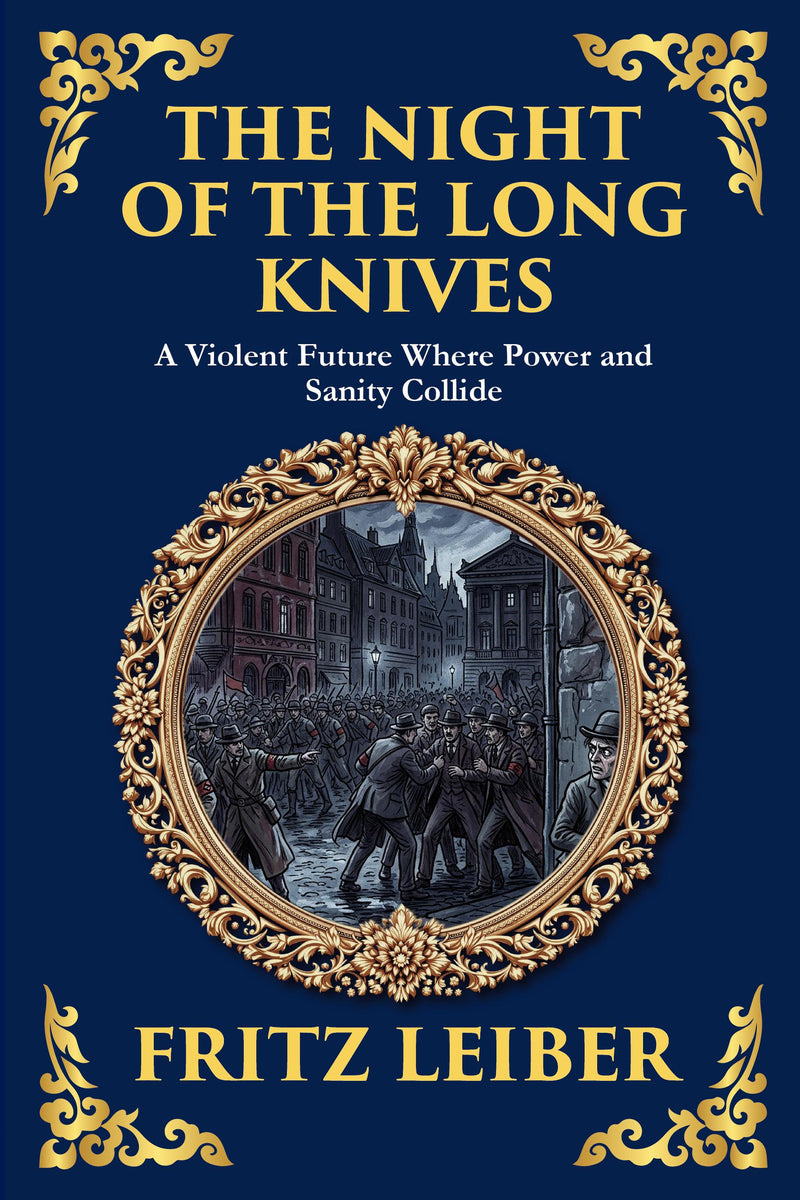
The Night of the Long Knives
In a desolate, radioactive America, civilization is a whisper and madness rules the streets. Killers are no longer criminals—they are the law.
or free app
10,000+ hrs library
30-day guarantee
The complete The Night of the Long Knives appears in modern English through Library of Alexandria Press, available online with audiobook narration included for members.
Have you ever wondered why a society built on violence eventually turns on itself? In The Night of the Long Knives, Hugo and Nebula Award–winning author Fritz Leiber creates a disturbing vision of a post-nuclear America where civilization has crumbled and killing is no longer a crime—it’s a job. The story follows Ray, a government-sanctioned murderer drifting across the wasteland in a deadly game of survival.
In this lawless zone, killers are ranked, and bodies are currency. But when Ray encounters a fellow assassin and a government psychiatrist conducting a strange experiment, the trio is pulled into a brutal spiral of paranoia, psychology, and rebellion. As alliances form and fracture in a radioactive desert, Ray faces the ultimate question: is there any meaning left in a world that rewards the most violent?
Leiber’s razor-sharp prose and haunting psychological insight elevate this dystopian tale into a parable of madness, control, and the fragility of human morality.
What you’ll discover in this modern edition
- A Brutal Post-Apocalyptic Landscape – Explore a decaying America where murder is institutionalized and morality is obsolete.
| Formats | eBook (EPUB + PDF) · Audiobook · Paperback · Hardcover · Large Print |
| Language | English |
| Trim size (print) | 6 × 9 in |
| Binding | Paperback — perfect-bound · Hardcover — casewrap |
| Large Print edition | Same text in a larger, easy-read type — a larger font, not a larger trim |
| Print pricing | Every physical book at our true cost — at-cost, no profit (members) |
| Library | 873 restored titles, always growing |
| Length | 35,166 words · ~2 hr 21 min reading |
| Reading level | Grade 6 · an easy, flowing read (this modern-English edition) |
| Edition | Modern English translation · 2026 |
Member reviews for this edition are collected as readers finish it — be the first. Across the library: 12,000+ books shipped, every plan covered by a 365-day print guarantee.
About this edition
A faithful, unabridged modern-English edition by The Library of Alexandria — carefully rendered for today's reader and verified paragraph-by-paragraph against the public-domain source. Available as eBook, audiobook, paperback, hardcover, and large print.
- Complete & unabridgedVerified paragraph by paragraph against the source — never a scan, never abridged.
- Modern English, faithfulReadable today, with the author’s meaning kept intact. Readable — not simplified.
- Every format, one membershipRead in your browser or the free app, or listen to the full audiobook.
Included free with your membership
Cancel anytime, one click · 30-day money-back guarantee
Edition last updated July 2026
What’s inside
The Night of the Long Knives — complete and unabridged: all 8 sections included with membership, plus the full audiobook.
Begin reading The Night of the Long Knives
In clear modern English — the complete text is included with membership.
Introduction
There are stories that imagine the end of the world, and then there are stories that imagine what comes crawling out of the ashes afterward. Fritz Leiber, one of the most restlessly inventive minds in twentieth-century speculative fiction, understood that the truly unsettling question is never simply how civilization falls. The deeper, more disturbing inquiry is what happens to the human soul when the structures that once held it in place dissolve—when law becomes memory, when distance becomes destiny, and when the only thing standing between a person and oblivion is the precarious balance of their own mind. The work you are about to read takes that question and drives it like a blade into the reader’s attention, refusing to let go until the final page.
This is a tale set against a scorched and broken horizon, a future stripped of comfort and certainty, where the trappings of the modern age have been burned away to expose the raw machinery of survival. It is a landscape that Leiber renders with a precision that feels almost cruel in its clarity, and yet there is something hypnotic in the desolation, a strange beauty that emerges from the very harshness of the terrain. The story moves through this wasteland with the propulsive urgency of a chase and the introspective depth of a confession, and it is this combination—action married to interiority, violence wedded to psychology—that gives the narrative its distinctive electric charge.
What makes this particular work so rewarding for the contemporary reader is the way it refuses the easy comforts of its genre. Many post-catastrophe stories settle into familiar grooves: the lone hero, the noble quest, the redemptive arc that reassures us that goodness will prevail. Leiber is far too honest and far too sophisticated a writer to offer such tidy consolations. Instead, he gives us characters who are damaged, compromised, and morally ambiguous, people whose motivations shift like sand and whose claims to heroism are perpetually in doubt. The reader is invited not to admire from a safe distance but to wrestle alongside these figures, to feel the weight of their choices and the ambiguity of their fates. This is fiction that respects your intelligence and your capacity to sit with discomfort, and it rewards that respect many times over.
To understand the texture of this story, it helps to understand the remarkable mind that produced it. Fritz Leiber occupies a peculiar and honored place in the history of imaginative literature. Born in 1910 into a family of Shakespearean actors, he grew up surrounded by the rhythms of dramatic language and the architecture of theatrical tension, and these influences would resonate throughout his career in ways both obvious and subtle. He had a feel for the stage—for the entrance and the exit, for the soliloquy and the confrontation—and his prose carries an almost performative awareness of how scenes build and break. When his characters speak, they do not merely convey information; they reveal themselves, contradict themselves, and play to invisible audiences that exist only in their own fevered imaginations.
Leiber was a writer who refused to be confined to any single category. He moved with extraordinary fluidity between horror, fantasy, and science fiction, and within each of these domains he produced work that has come to be regarded as foundational. He is often credited with coining the very term “sword and sorcery” to describe the heroic fantasy adventures he wrote about the rogues Fafhrd and the Gray Mouser, and those stories remain touchstones for anyone interested in how the fantasy genre evolved. But Leiber was equally at home in the shadowed corners of supernatural dread, where he updated the gothic tradition for the modern urban age, locating horror not in crumbling castles but in the anxieties and alienations of contemporary city life. His landmark novel of psychological terror demonstrated that the most frightening hauntings might be the ones we carry within ourselves.
It was in the realm of science fiction, however, that Leiber pursued some of his most ambitious and philosophically searching work. He was fascinated by the malleability of human consciousness, by the fragility of identity, and by the ways in which extreme circumstances could strip away the social veneer to reveal something more primal and unsettling beneath. He won the field’s highest honors repeatedly across several decades, a testament not merely to his productivity but to his persistent capacity for reinvention. While many of his contemporaries found a successful formula and repeated it, Leiber seemed almost constitutionally incapable of standing still. Each new work was an experiment, a probe into some unexplored region of human experience or some untested possibility of narrative form.
This restlessness is everywhere apparent in the story before you. It bears the marks of a writer who is not interested in delivering a comfortable product but in pursuing an idea wherever it leads, even into territory that is genuinely disturbing. There is a fearlessness in Leiber’s engagement with the darker dimensions of the human psyche, a willingness to look unflinchingly at cruelty, madness, and the seductive logic of power. And yet this darkness is never gratuitous. It serves a purpose. Leiber understood, perhaps better than almost any of his peers, that the function of speculative fiction is not to provide escape but to provide perspective—to defamiliarize the world so that we might see its underlying truths more clearly. By imagining a future in which the constraints of our present have been removed, he forces us to confront what those constraints actually conceal about who we are.
The title of this work signals its preoccupations with characteristic boldness. The phrase evokes a moment of betrayal and bloodletting, a purge in which trust is weaponized and violence becomes the instrument of consolidation. It is a phrase loaded with historical resonance, drawn from the vocabulary of political treachery, and Leiber deploys it with full awareness of its weight. But the night referenced here is not merely a literal episode of conflict within the story; it is also a metaphysical condition, a long darkness of the spirit through which the characters must travel. The “long knives” are not only the weapons that menace the body but the suspicions, paranoias, and self-deceptions that menace the mind. To read this story is to enter that long night and to navigate it, lantern in hand, never entirely certain whether the figures you encounter are allies, enemies, or projections of your own unease.
What distinguishes Leiber’s treatment of these themes from lesser practitioners is the genuine intelligence he brings to questions of sanity and its discontents. He does not treat madness as a convenient plot device or a cheap source of menace. Instead, he approaches it with something like compassion mingled with clinical curiosity, exploring the ways in which a mind under unbearable pressure might fracture, reconstruct itself, and develop strange new logics in order to survive. The story is deeply interested in the boundary between rationality and delusion, and in the uncomfortable possibility that this boundary is far more porous and negotiable than we like to believe. In a world where the old certainties have collapsed, what does it even mean to be sane? Is clinging to the values of a vanished civilization a form of fidelity or a form of madness? Is adaptation to barbarism a sign of health or of corruption? These are the questions that pulse beneath the surface of the narrative, giving its violent surface a profound undercurrent of philosophical seriousness.
The Architecture of Tension and the Pleasures of the Prose
One of the great satisfactions of reading Leiber is the sheer quality of his sentences. He was a prose stylist of unusual gifts, capable of shifting registers with seemingly effortless command. He can be lean and propulsive when the action demands it, his clauses snapping forward with the momentum of a body in flight, and then, in the next moment, he can slow into passages of haunting lyricism, capturing the desolate grandeur of a ruined world or the disorienting interior weather of a troubled mind. This range is not merely decorative. It is functional. The rhythm of the prose itself enacts the rhythm of the experience, drawing the reader into the heightened states of perception that the characters undergo.
The modern reader approaching this adapted edition will find the experience particularly accessible. This translation and adaptation for the contemporary reader has been crafted to preserve the essential power and intelligence of Leiber’s vision while ensuring that no unnecessary barriers stand between the audience and the story. Language evolves, idioms shift, and certain conventions of an earlier era can create friction for readers today. The careful work of adaptation smooths that friction without sanding away the distinctive character of the original, allowing the narrative’s force to come through with full clarity. The result is a reading experience that feels immediate and alive, as though the story were composed for our moment rather than recovered from another. Yet beneath this accessibility, the deeper architecture of Leiber’s craft remains fully intact—the careful pacing, the psychological acuity, the slow accumulation of dread, and the sudden detonations of incident.
That architecture deserves attention, because Leiber was a master builder of tension. He understood that suspense is not generated merely by withholding information, though he was skilled at that too. True suspense, in his hands, arises from the reader’s growing investment in characters whose situations are genuinely precarious and whose inner lives are genuinely uncertain. We do not simply wonder what will happen; we wonder what these people will become, and whether the choices they make will preserve or destroy whatever remains of their humanity. The stakes are never merely physical. Survival, in Leiber’s vision, is always shadowed by the question of what survival costs and whether the self that survives is worth the surviving.
Consider too the way the story handles its setting. The blasted future world is not simply a backdrop against which human dramas play out. It is itself a kind of character, an active presence that shapes and pressures everyone within it. Leiber had a gift for environmental storytelling long before the term became fashionable. Every detail of the ruined landscape carries meaning, suggesting the magnitude of what has been lost and the precariousness of what endures. The reader comes to feel the texture of this world—its dangers, its silences, its peculiar economies of scarcity and survival. And because the world is so vividly realized, the human encounters that take place within it acquire additional weight. When two people meet in such a place, the meeting is freighted with implication. Trust is a luxury that may prove fatal. Kindness is a gamble. Every interaction is a negotiation conducted in the shadow of potential betrayal, and Leiber wrings extraordinary tension from these dynamics.
There is also, threaded throughout the narrative, a current of dark irony that is characteristic of Leiber’s sensibility. He was acutely aware of the absurdities and self-deceptions that govern human behavior even, perhaps especially, in extremis. His characters are capable of grand pronouncements and noble postures even as they pursue base and self-serving ends, and Leiber observes these contradictions with a knowing eye that never tips fully into cynicism. There is something almost compassionate in the way he allows his characters their illusions while quietly revealing the gaps between their self-conceptions and their actions. This ironic awareness gives the story a sophistication that elevates it well above the level of pulp adventure, even as it delivers all the visceral satisfactions that adventure can provide.
Cancel anytime, one click · 30-day money-back guarantee
Founding annual rate available now — your price locks for life when you join.
Not ready? Get this free chapter by email — read it anytime.
✓ Sent — check your inbox for The Night of the Long Knives.
Questions about The Night of the Long Knives
What is The Night of the Long Knives about?
In a desolate, radioactive America, civilization is a whisper and madness rules the streets. Killers are no longer criminals—they are the law. In this ruthless world, where murder is not only legal but required, one man begins to question the blood-soaked order.
Who wrote The Night of the Long Knives?
The Night of the Long Knives was written by Fritz Leiber. This edition presents the complete work in clear modern English, faithfully rendered from the public-domain original by Library of Alexandria Press.
Is The Night of the Long Knives free to read?
The opening chapter is free to read on this page. Members read and listen to the complete work — and the entire library — free, and can order any physical book at our true print cost.
How long is The Night of the Long Knives?
8 chapters (~35,166 words) — about 2 hr 21 min of reading in this modern-English edition.
Is this an abridged version of The Night of the Long Knives?
No. This is the complete, unabridged The Night of the Long Knives, carefully rendered into clear modern English and verified paragraph-by-paragraph against the public-domain source — nothing is cut or summarised.
What formats does The Night of the Long Knives come in?
The Night of the Long Knives is available as eBook, paperback, hardcover and large print. eBook and audiobook are included with membership; printed editions ship at our true print cost.
Shipping & returns
Billing & membership
More from the library


Explore Science Fiction
- The Princess and the Goblin — Large Print · George MacDonald
- The Wonderful Wizard of Oz · L. Frank Baum
- The Island of Doctor Moreau · H. G. Wells
- The Invisible Man: A Grotesque Romance · H. G. Wells
- The War of the Worlds · H. G. Wells
- The Strange Case of Dr. Jekyll and Mr. Hyde · Robert Louis Stevenson
- The Marvelous Land of Oz — Large Print · L. Frank Baum
- The Island of Doctor Moreau — Large Print · H. G. Wells
- The Lost World — Large Print · Arthur Conan Doyle
- Limanora: The Island of Progress — Large Print · Godfrey Sweven
- The War of the Worlds — Large Print · H. G. Wells
- The Strange Case of Dr. Jekyll and Mr. Hyde — Large Print · Robert Louis Stevenson
- Red Nails — Large Print · Robert E. Howard
- R.U.R. (Rossum's Universal Robots) — Large Print · Karel Čapek
- Gulliver of Mars — Large Print · Edwin Lester Arnold
- Out of Time's Abyss — Large Print · Edgar Rice Burroughs
- Jewels of Gwahlur — Large Print · Robert E. Howard
- The Doomsman — Large Print · Van Tassel Sutphen
- Flatland: A Romance of Many Dimensions — Large Print · Edwin Abbott Abbott
- Armageddon—2419 A.D. — Large Print · Philip Francis Nowlan
- Mizora: A Prophecy — Large Print · Mary E. Bradley Lane
- A Voyage to Arcturus — Large Print · David Lindsay
- The Invisible Man: A Grotesque Romance — Large Print · H. G. Wells
- The Mummy! A Tale of the Twenty-Second Century — Large Print · Jane Loudon
- A Martian Odyssey — Large Print · Stanley G. Weinbaum
- We — Large Print · Yevgeny Zamyatin
- A Connecticut Yankee in King Arthur's Court — Large Print · Mark Twain
- The Revolt on Venus — Large Print · Carey Rockwell
- She — Large Print · H. Rider Haggard
- Dorothy and the Wizard in Oz — Large Print · L. Frank Baum
The Night of the Long Knives
The Night of the Long Knives
A Violent Future Where Power and Sanity Collide
Fritz Leiber
Contents
- Introduction
- Chapter 1
- Chapter 2
- Chapter 3
- Chapter 4
- Chapter 5
- Chapter 6
- Chapter 7
Introduction
There are stories that imagine the end of the world, and then there are stories that imagine what comes crawling out of the ashes afterward. Fritz Leiber, one of the most restlessly inventive minds in twentieth-century speculative fiction, understood that the truly unsettling question is never simply how civilization falls. The deeper, more disturbing inquiry is what happens to the human soul when the structures that once held it in place dissolve—when law becomes memory, when distance becomes destiny, and when the only thing standing between a person and oblivion is the precarious balance of their own mind. The work you are about to read takes that question and drives it like a blade into the reader’s attention, refusing to let go until the final page.
This is a tale set against a scorched and broken horizon, a future stripped of comfort and certainty, where the trappings of the modern age have been burned away to expose the raw machinery of survival. It is a landscape that Leiber renders with a precision that feels almost cruel in its clarity, and yet there is something hypnotic in the desolation, a strange beauty that emerges from the very harshness of the terrain. The story moves through this wasteland with the propulsive urgency of a chase and the introspective depth of a confession, and it is this combination—action married to interiority, violence wedded to psychology—that gives the narrative its distinctive electric charge.
What makes this particular work so rewarding for the contemporary reader is the way it refuses the easy comforts of its genre. Many post-catastrophe stories settle into familiar grooves: the lone hero, the noble quest, the redemptive arc that reassures us that goodness will prevail. Leiber is far too honest and far too sophisticated a writer to offer such tidy consolations. Instead, he gives us characters who are damaged, compromised, and morally ambiguous, people whose motivations shift like sand and whose claims to heroism are perpetually in doubt. The reader is invited not to admire from a safe distance but to wrestle alongside these figures, to feel the weight of their choices and the ambiguity of their fates. This is fiction that respects your intelligence and your capacity to sit with discomfort, and it rewards that respect many times over.
To understand the texture of this story, it helps to understand the remarkable mind that produced it. Fritz Leiber occupies a peculiar and honored place in the history of imaginative literature. Born in 1910 into a family of Shakespearean actors, he grew up surrounded by the rhythms of dramatic language and the architecture of theatrical tension, and these influences would resonate throughout his career in ways both obvious and subtle. He had a feel for the stage—for the entrance and the exit, for the soliloquy and the confrontation—and his prose carries an almost performative awareness of how scenes build and break. When his characters speak, they do not merely convey information; they reveal themselves, contradict themselves, and play to invisible audiences that exist only in their own fevered imaginations.
Leiber was a writer who refused to be confined to any single category. He moved with extraordinary fluidity between horror, fantasy, and science fiction, and within each of these domains he produced work that has come to be regarded as foundational. He is often credited with coining the very term “sword and sorcery” to describe the heroic fantasy adventures he wrote about the rogues Fafhrd and the Gray Mouser, and those stories remain touchstones for anyone interested in how the fantasy genre evolved. But Leiber was equally at home in the shadowed corners of supernatural dread, where he updated the gothic tradition for the modern urban age, locating horror not in crumbling castles but in the anxieties and alienations of contemporary city life. His landmark novel of psychological terror demonstrated that the most frightening hauntings might be the ones we carry within ourselves.
It was in the realm of science fiction, however, that Leiber pursued some of his most ambitious and philosophically searching work. He was fascinated by the malleability of human consciousness, by the fragility of identity, and by the ways in which extreme circumstances could strip away the social veneer to reveal something more primal and unsettling beneath. He won the field’s highest honors repeatedly across several decades, a testament not merely to his productivity but to his persistent capacity for reinvention. While many of his contemporaries found a successful formula and repeated it, Leiber seemed almost constitutionally incapable of standing still. Each new work was an experiment, a probe into some unexplored region of human experience or some untested possibility of narrative form.
This restlessness is everywhere apparent in the story before you. It bears the marks of a writer who is not interested in delivering a comfortable product but in pursuing an idea wherever it leads, even into territory that is genuinely disturbing. There is a fearlessness in Leiber’s engagement with the darker dimensions of the human psyche, a willingness to look unflinchingly at cruelty, madness, and the seductive logic of power. And yet this darkness is never gratuitous. It serves a purpose. Leiber understood, perhaps better than almost any of his peers, that the function of speculative fiction is not to provide escape but to provide perspective—to defamiliarize the world so that we might see its underlying truths more clearly. By imagining a future in which the constraints of our present have been removed, he forces us to confront what those constraints actually conceal about who we are.
The title of this work signals its preoccupations with characteristic boldness. The phrase evokes a moment of betrayal and bloodletting, a purge in which trust is weaponized and violence becomes the instrument of consolidation. It is a phrase loaded with historical resonance, drawn from the vocabulary of political treachery, and Leiber deploys it with full awareness of its weight. But the night referenced here is not merely a literal episode of conflict within the story; it is also a metaphysical condition, a long darkness of the spirit through which the characters must travel. The “long knives” are not only the weapons that menace the body but the suspicions, paranoias, and self-deceptions that menace the mind. To read this story is to enter that long night and to navigate it, lantern in hand, never entirely certain whether the figures you encounter are allies, enemies, or projections of your own unease.
What distinguishes Leiber’s treatment of these themes from lesser practitioners is the genuine intelligence he brings to questions of sanity and its discontents. He does not treat madness as a convenient plot device or a cheap source of menace. Instead, he approaches it with something like compassion mingled with clinical curiosity, exploring the ways in which a mind under unbearable pressure might fracture, reconstruct itself, and develop strange new logics in order to survive. The story is deeply interested in the boundary between rationality and delusion, and in the uncomfortable possibility that this boundary is far more porous and negotiable than we like to believe. In a world where the old certainties have collapsed, what does it even mean to be sane? Is clinging to the values of a vanished civilization a form of fidelity or a form of madness? Is adaptation to barbarism a sign of health or of corruption? These are the questions that pulse beneath the surface of the narrative, giving its violent surface a profound undercurrent of philosophical seriousness.
The Architecture of Tension and the Pleasures of the Prose
One of the great satisfactions of reading Leiber is the sheer quality of his sentences. He was a prose stylist of unusual gifts, capable of shifting registers with seemingly effortless command. He can be lean and propulsive when the action demands it, his clauses snapping forward with the momentum of a body in flight, and then, in the next moment, he can slow into passages of haunting lyricism, capturing the desolate grandeur of a ruined world or the disorienting interior weather of a troubled mind. This range is not merely decorative. It is functional. The rhythm of the prose itself enacts the rhythm of the experience, drawing the reader into the heightened states of perception that the characters undergo.
The modern reader approaching this adapted edition will find the experience particularly accessible. This translation and adaptation for the contemporary reader has been crafted to preserve the essential power and intelligence of Leiber’s vision while ensuring that no unnecessary barriers stand between the audience and the story. Language evolves, idioms shift, and certain conventions of an earlier era can create friction for readers today. The careful work of adaptation smooths that friction without sanding away the distinctive character of the original, allowing the narrative’s force to come through with full clarity. The result is a reading experience that feels immediate and alive, as though the story were composed for our moment rather than recovered from another. Yet beneath this accessibility, the deeper architecture of Leiber’s craft remains fully intact—the careful pacing, the psychological acuity, the slow accumulation of dread, and the sudden detonations of incident.
That architecture deserves attention, because Leiber was a master builder of tension. He understood that suspense is not generated merely by withholding information, though he was skilled at that too. True suspense, in his hands, arises from the reader’s growing investment in characters whose situations are genuinely precarious and whose inner lives are genuinely uncertain. We do not simply wonder what will happen; we wonder what these people will become, and whether the choices they make will preserve or destroy whatever remains of their humanity. The stakes are never merely physical. Survival, in Leiber’s vision, is always shadowed by the question of what survival costs and whether the self that survives is worth the surviving.
Consider too the way the story handles its setting. The blasted future world is not simply a backdrop against which human dramas play out. It is itself a kind of character, an active presence that shapes and pressures everyone within it. Leiber had a gift for environmental storytelling long before the term became fashionable. Every detail of the ruined landscape carries meaning, suggesting the magnitude of what has been lost and the precariousness of what endures. The reader comes to feel the texture of this world—its dangers, its silences, its peculiar economies of scarcity and survival. And because the world is so vividly realized, the human encounters that take place within it acquire additional weight. When two people meet in such a place, the meeting is freighted with implication. Trust is a luxury that may prove fatal. Kindness is a gamble. Every interaction is a negotiation conducted in the shadow of potential betrayal, and Leiber wrings extraordinary tension from these dynamics.
There is also, threaded throughout the narrative, a current of dark irony that is characteristic of Leiber’s sensibility. He was acutely aware of the absurdities and self-deceptions that govern human behavior even, perhaps especially, in extremis. His characters are capable of grand pronouncements and noble postures even as they pursue base and self-serving ends, and Leiber observes these contradictions with a knowing eye that never tips fully into cynicism. There is something almost compassionate in the way he allows his characters their illusions while quietly revealing the gaps between their self-conceptions and their actions. This ironic awareness gives the story a sophistication that elevates it well above the level of pulp adventure, even as it delivers all the visceral satisfactions that adventure can provide.
Anyone who sees you or even hears your footsteps must be ambushed, hunted, and killed, regardless of whether you need them for food. If you don’t, they will keep tracking you for as long as they have the strength.
I was exactly one hundred miles away from Nowhere when I noticed this girl out of the corner of my eye. I had been staying extra alert because I expected the other undead monster from the massacre at Nowhere to still be hunting me.
I was following a row of high-voltage power towers, all leaning at the same drunken angle due to an old explosion from the Last War. I figured the girl was heading in the same general direction, pushed toward my path by a cloud of dust that, even from far away, showed dangerous metallic glints and dark shapes that could have been dead people or livestock.
She looked lean, dark-haired, and alert. She was small like me, and like me, she wore a scarf loosely around the lower half of her face, similar to the old cowboys.
Neither of us waved, turned our heads, or gave any sign that we had spotted each other as we slowly drew closer. However, we were both intensely and carefully watchful—I knew I was, and she had better be too.
Above us, the sky was a low, dusty haze, as it always was. I can’t remember what a clear, high sky looks like. Three years ago, I think I saw Venus. Or maybe it was Sirius or Jupiter.
The hot, smoky light was shifting from the amber of noon to the bloody bronze of evening.
The line of towers I was following leaned slightly in one direction—they must have been only a few miles from the center of the blast. As I passed each one, I could see where the metal on the side facing the blast had been worn away. Most of it had been vaporized by the explosion, though there were lumps and blisters where the metal had simply melted and run. I assumed the wires the towers carried had also been vaporized, but with the haze, I couldn’t be sure, although I did see three dark shapes up there that might have been perching vultures.
End of the free sample
Keep reading, free
Members read and listen to the complete book — and the entire library. Cancel anytime, one click · 30-day money-back guarantee.